

|
시장보고서
상품코드
2118225
이탈리아의 기업 컨텐츠 관리 시장 : 시장 점유율 분석, 업계 동향 및 통계, 성장 예측(2026-2031년)Italy Enterprise Content Management - Market Share Analysis, Industry Trends & Statistics, Growth Forecasts (2026 - 2031) |
||||||
 Mordor Intelligence
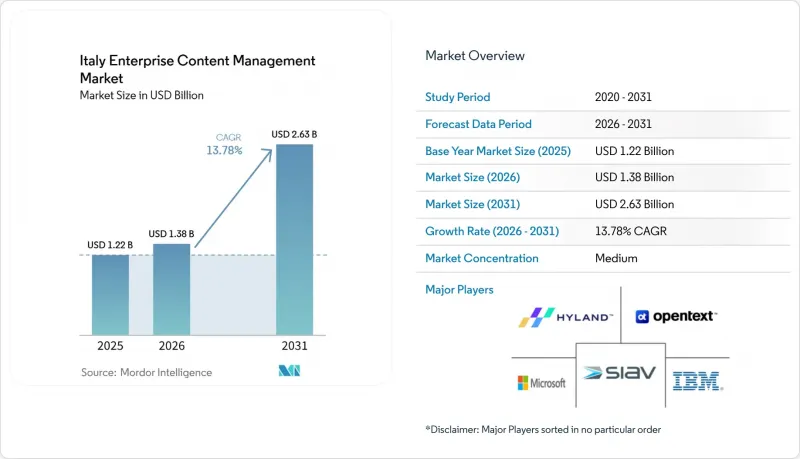
Mordor Intelligence에 의하면, 이탈리아의 기업 컨텐츠 관리 시장 규모는 2025년 12억 2,000만 달러로 평가되었고, 2026년에는 13억 8,000만 달러로 추정되고, 2031년까지 26억 3,000만 달러에 이를 것으로 예상되며, 2026-2031년 CAGR 13.78%로 성장할 전망입니다.
본 보고서는 솔루션 유형별(문서 관리, 기록 관리, 워크플로우 및 비즈니스 프로세스 관리 등), 도입 형태별(온프레미스 등), 기업 규모별(중소기업 및 대기업), 최종 사용자 산업별(은행, 금융서비스 및 보험(BFSI), 정부·공공 행정 등)로 분류되어 있습니다. 시장 전망은 금액(달러) 기준으로 제시되어 있습니다.
이탈리아의 기업 컨텐츠 관리 시장 동향 및 인사이트
규제 대상인 이탈리아 워크플로우의 종이 없는 업무 전환 가속화
이탈리아의 기업 컨텐츠 관리 시장은 공공 행정 및 규제 대상 워크플로우 전반에 걸친 디지털 문서에 관한 법적 구속력이 있는 규정으로부터 직접적인 추진력을 얻고 있습니다. 이탈리아의 ‘디지털 행정법(Codice dell’Amministrazione Digitale)’ 및 AgID의 지침에 따르면, 공공기관은 문서 관리 프로세스를 공식적으로 수립하고, 기록 관리 책임자를 지정하며, 디지털 기록의 규정 준수에 부합하는 보관 방식을 유지해야 할 의무가 있습니다. AgID의 2024-2026년 계획 프레임워크에서는 2025년까지 공공 행정 전반에 걸쳐 문서 관리 매뉴얼을 전면 도입하고 기록 관리 책임자를 지정하는 것을 목표로 하고 있으며, 이에 따라 조직들은 단편적인 도구가 아닌 체계적인 플랫폼에 투자하는 방향으로 전환했습니다. 2025년 하반기 AgID가 공식 설문조사 형식의 모니터링을 실시함에 따라 규정 준수 부담이 더욱 시급해졌으며, 공공 부문 전반의 준비 상황이 더욱 명확해졌습니다. 이는 중요한 점입니다. 왜냐하면 이탈리아의 기업 컨텐츠 관리(ECM) 시장의 구매 담당자들은 내부 효율화 목표를 충족할 뿐만 아니라, 기한 및 감독 요건도 준수해야 하기 때문입니다. 이러한 요인들이 결합되어, 더 광범위한 IT 예산 배분이 엄격하게 선별되는 상황에서도 조달 활동은 계속되고 있습니다.
AI를 활용한 검색 및 검색 기능에 대한 수요 증가
이탈리아의 기업 컨텐츠 관리 시장은 비정형 컨텐츠의 검색, 검색 결과 확보, 해석 속도를 높여야 한다는 수요에서도 탄력을 받고 있습니다. 이탈리아 기업들의 AI 도입률은 2024년 8%에서 2025년에는 16.4%에 달했으며, AI를 활용한 비즈니스 도구에 대한 준비가 빠르게 진행되고 있음을 보여줍니다. 문서가 대량으로 존재하는 환경에서 AI의 매력은 실용성에 있습니다. 직원들은 수년에 걸친 수작업 태그 지정 작업에 의존하지 않고도 계약서, 기록, 아카이브 파일에 신속하게 접근할 수 있어야 하기 때문입니다. 이에 따라 이탈리아의 기업 컨텐츠 관리 시장의 평가 기준도 변화하고 있습니다. 검색의 질과 거버넌스가 적용된 자동화가 스토리지 및 아카이브 기능과 마찬가지로 구매 결정에 영향을 미치게 되었기 때문입니다. 구매자들은 감사 가능성과 모니터링 기능이 동일한 환경에 통합되어 있기를 원하기 때문에 관리된 워크플로우 내에 AI를 통합한 벤더는 별도의 도구를 제공하는 벤더보다 유리한 입장에 있습니다. 그 결과, AI가 단순한 선택적 기능 강화에서 플랫폼 업데이트의 핵심적인 이유로 전환되고 있는 시장이 형성되고 있습니다.
공공 기관 및 중견 기업에서 레거시 아카이브 마이그레이션의 복잡성
이탈리아의 기업 컨텐츠 관리 시장은 대규모 종이 아카이브나 독자적인 형식의 디지털 기록을 최신 시스템으로 마이그레이션하는 데 따르는 어려움으로 인해 여전히 큰 걸림돌에 직면해 있습니다. 많은 공공기관과 중견 기업은 일관성 없는 메타데이터를 기반으로 생성된 분산형 기록을 보유하고 있으며, 이로 인해 분류 및 마이그레이션이 지연되고 있습니다. 이 작업은 단순히 스캔하는 데 그치지 않습니다. 조직은 검증 및 포맷 처리뿐만 아니라, 디지털화된 기록이 법적으로 신뢰할 수 있음을 증명해야 하기 때문입니다. AgID의 보존 프레임워크는 규정 준수를 따르는 디지털 보존이 임시방편적인 보존 관행이 아니라 공식적인 규칙을 따라야 하므로, 더욱 엄격한 기준을 적용하고 있습니다. 이로 인해 새로운 플랫폼이 완전한 운영 가치를 창출하기 시작하는 시기가 늦어지게 됩니다. 또한 구매자들은 대규모 도입을 결정하기 전에 마이그레이션 계획의 명확성을 요구하는 경우가 많기 때문에 이탈리아의 기업 컨텐츠 관리 시장에서의 의사결정 주기 또한 장기화되고 있습니다.
부문 분석
2025년, 문서 관리는 이탈리아의 기업 컨텐츠 관리 시장에서 28.27%라는 가장 큰 점유율을 차지했으며, 해당 연도 시장 점유율의 28.27%를 차지했습니다. 이러한 선두 위치는 BFSI(은행 및 금융 및 보험), 제조업, 행정 기관에서 수년에 걸쳐 진행된 디지털화 및 아카이빙 활동에 기인한 것으로, 이러한 분야에서는 방대한 문서량 덕분에 안정적인 도입 기반이 구축되어 있었습니다. 많은 구매자들이 보다 고도화된 자동화로 전환하기 전에 분류, 보존 기간, 검색에 대한 보다 강력한 관리를 여전히 필요로 하고 있기 때문에 이 부문은 여전히 중심적인 위치를 차지하고 있습니다. 또한, 감사 위험, 법적 보존 규정, 정보 거버넌스 요구로 인해 수요가 엄격한 라이프사이클 관리로 이어지고 있기 때문에 기록 관리도 중요한 위치를 계속 차지하고 있습니다. 웹 컨텐츠 관리 및 관련 리포지토리 도구는 단일 관리 환경에서 사내 및 사외 컨텐츠를 조정해야 하는 조직을 지속적으로 지원하고 있습니다.
워크플로우 및 BPM은 2031년까지 연평균 성장률(CAGR) 15.03%를 나타낼 것으로 예측되며, 이탈리아의 기업 컨텐츠 관리 시장에서 가장 역동적인 솔루션 분야로 자리매김하고 있습니다. 이러한 성장 속도는 수동적인 보존에서 승인, 규제 보고, 계약 라우팅, 서비스 워크플로우와 같은 능동적인 처리로 명확하게 전환되고 있음을 보여줍니다. 이탈리아의 기업 컨텐츠 관리 업계에서 이는 플랫폼의 가치가 평가되는 방식을 변화시키고 있습니다. 이는 구매자들이 아카이브의 보존 기간뿐만 아니라 문서를 둘러싼 업무상의 흐름을 점점 더 요구하고 있기 때문입니다. 케이스 관리는 여러 이해관계자가 관여하고 규칙에 기반한 조치가 수반되는 프로세스가 전개되는 법무, 보험, 공공 행정 분야에서 그 중요성이 커지고 있습니다. 또한, 디지털 자산 관리 역시 전체 상업 채널에 걸친 광범위한 컨텐츠 라이브러리를 관리하는 부문에서 수요가 확대되고 있습니다. 이러한 변화들을 종합적으로 볼 때, 이탈리아의 기업 컨텐츠 관리 시장이 리포지토리 중심 모델에서 워크플로우 중심 모델로 확장되고 있음을 보여줍니다.
2025년에는 클라우드 도입이 73.14%의 점유율을 차지하며 주류가 되었고, 같은 해 이탈리아 기업 컨텐츠 관리 시장 규모의 73.14%를 차지했습니다. 이러한 선두 위상은 이탈리아 기업들이 컨텐츠 인프라를 전용 온프레미스형 하드웨어에서 보다 유연한 서비스 환경으로 전환한 속도를 반영합니다. 디지털 운영에 강점을 가진 기업들은 현재 새로운 문서 워크플로우, 공동 액세스 및 지사 간 거버넌스 분야에서 클라우드 제공을 기본 선택지로 삼고 있습니다. 이는 특히 조직이 더 신속한 도입, 더 간단한 업데이트, 그리고 인프라 관리 부담 경감을 필요로 하는 상황에서 두드러지게 나타납니다. 또한 클라우드 모델은 구독 중심의 조달 및 기능 확장의 신속화라는 더 광범위한 추세와도 부합합니다.
하이브리드 배포는 2031년까지 연평균 성장률(CAGR) 15.68%를 나타낼 것으로 예측되며, 이탈리아의 기업 컨텐츠 관리 시장에서 가장 높은 성장률을 보이는 배포 모델이 될 것입니다. 그 이유는 실용적입니다. 많은 조직이 클라우드 환경에서 새로운 디지털 프로세스를 시작하는 한편, 대규모 온프레미스 아카이브를 즉시 폐지할 수는 없기 때문입니다. 이에 따라 활성 컨텐츠와 워크플로우 계층은 먼저 이전하고, 과거 기록이나 기밀성이 높은 기록은 관리된 저장소에 남겨두는 전환 모델이 등장하고 있습니다. 이탈리아의 기업 컨텐츠 관리 업계에서 이러한 혼합형 아키텍처는 법적 증거 능력에 대한 우려, 보존 의무 또는 내부 데이터 취급 규정을 가진 구매자에게 특히 중요합니다. 따라서 온프레미스 시스템은 완전히 사라지는 것이 아니라, 선택적인 역할을 계속 수행하고 있습니다. 이러한 공존을 관리할 수 있는 벤더는 단계적인 변화가 필요한 복잡한 프로젝트를 수주하는 데 있어 더 유리한 입장에 있습니다.
기타 혜택 :
- 엑셀 형식 시장 예측(ME) 시트
- 3개월간의 애널리스트 지원
자주 묻는 질문
목차
제1장 서론
제2장 조사 방법
제3장 개요
제4장 시장 구도
제5장 시장 규모 및 성장 예측
제6장 경쟁 구도
제7장 시장 기회 및 향후 전망
AJY 26.09.01According to Mordor Intelligence, the Italy enterprise content management market size is expected to increase from USD 1.22 billion in 2025 to USD 1.38 billion in 2026 and reach USD 2.63 billion by 2031, growing at a CAGR of 13.78% over 2026-2031.
This report is Segmented by Solution Type (Document Management, Records Management, Workflow and Business Process Management, and More), Deployment Mode (On-Premises, and More), Enterprise Size (Small and Medium Enterprises, and Large Enterprises), and End-User Industry (BFSI, Government and Public Administration, and More). The Market Forecasts are Provided in Terms of Value (USD).
Italy Enterprise Content Management Market Trends and Insights
Accelerated Paperless Compliance in Regulated Italian Workflows
The Italy enterprise content management market is receiving direct support from binding rules on digital documents across public administration and regulated workflows. Italy's Codice dell'Amministrazione Digitale and AgID guidance require public entities to formalize document management processes, assign records responsibility, and maintain compliant preservation methods for digital records. AgID's 2024-2026 planning framework set a target for full adoption of document management manuals and designated records officers across public administration by 2025, which pushed organizations toward structured platform investments rather than isolated tools. The compliance burden became more immediate when AgID carried out a formal questionnaire-based monitoring exercise in late 2025, making the state of readiness more visible across the public sector. This matters because buyers in the Italy enterprise content management market are not only reacting to internal efficiency goals, they are also responding to deadlines and oversight. That combination keeps procurement moving even when broader IT budgets remain selective.
Rising Demand For AI-Assisted Search and Retrieval
The Italy enterprise content management market is also gaining momentum from demand for faster search, retrieval, and interpretation of unstructured content. AI adoption among Italian enterprises reached 16.4% in 2025, up from 8% in 2024, which shows that readiness for AI-enabled business tools is building quickly. In document-heavy environments, the appeal of AI is practical because staff need quicker access to contracts, records, and archived files without depending on years of manual tagging. This is changing how the Italy enterprise content management market is evaluated, because search quality and governed automation now influence buying decisions as much as storage and archive features. Vendors that place AI inside controlled workflows are in a better position than those offering separate tools, since buyers want auditability and oversight built into the same environment. The result is a market where AI is moving from an optional enhancement to a core reason for platform renewal.
Legacy Archive Migration Complexity in Public and Mid-Market Enterprises
The Italy enterprise content management market still faces a major drag from the difficulty of moving large paper archives and proprietary digital records into modern systems. Many public bodies and mid-sized firms hold decentralized records that were created without consistent metadata, which makes classification and migration slow. The work is not limited to scanning, because organizations also need validation, format handling, and proof that digitized records remain legally reliable. AgID's preservation framework adds another layer of rigor, since compliant digital conservation must follow formal rules rather than ad hoc storage practices. This delays the point at which a new platform starts generating full operational value. It also extends decision cycles in the Italy enterprise content management market because buyers often need migration clarity before they commit to a larger rollout.
Other drivers and restraints analyzed in the detailed report include:
- Expansion of Cloud-Native Content Governance
- Modernization of Public Sector and Healthcare Records
- High Integration Cost With ERP, ERP-Adjacent, And Legacy Line-Of-Business Systems
For complete list of drivers and restraints, kindly check the Table Of Contents.
Segment Analysis
Document management held the largest share of the Italy enterprise content management market at 28.27% in 2025, and it accounted for 28.27% of the Italy enterprise content management market share in that year. Its lead came from long-running digitization and archiving activity across BFSI, manufacturing, and public administration, where large document volumes built a steady installed base. The segment remains central because many buyers still need stronger control over classification, retention, and retrieval before they extend into more advanced automation. Records management also remains important, since audit exposure, legal retention rules, and information governance needs keep demand tied to disciplined lifecycle control. Web content management and adjacent repository tools continue to support organizations that need to coordinate internal and external content from one governed environment.
Workflow and BPM is projected to grow at 15.03% CAGR through 2031, which makes it the most dynamic solution area in the Italy enterprise content management market. That pace shows a clear shift from passive storage toward active handling of approvals, regulatory reporting, contract routing, and service workflows. In the Italy enterprise content management industry, this changes the way platform value is judged because buyers increasingly want operational movement around documents, not only archive depth. Case management is gaining relevance in legal, insurance, and public administration settings where processes involve multiple participants and rule-based actions. Digital asset management is also finding room in sectors that manage broad content libraries across commercial channels. Together, these changes show that the Italy enterprise content management market is broadening from a repository-centered model into a workflow-centered one.
Cloud deployment dominated with a 73.14% share in 2025, and it represented 73.14% share of the Italy enterprise content management market size in that year. That lead reflects the speed at which Italian organizations moved content infrastructure away from dedicated on-premises hardware and into more flexible service environments. Enterprises with strong digital operations now treat cloud delivery as the default option for new document workflows, collaborative access, and cross-site governance. This is especially visible where organizations need faster deployment, simpler updates, and lower infrastructure management burdens. The cloud model also fits the wider move toward subscription-led procurement and faster functional expansion.
Hybrid deployment is forecast to grow at 15.68% CAGR through 2031, which makes it the highest-growth deployment model in the Italy enterprise content management market. The reason is practical, since many organizations cannot retire large on-premises archives immediately, even while they launch new digital processes in cloud environments. This creates a transition model where active content and workflow layers move first, while historical or highly sensitive records remain in controlled repositories. In the Italy enterprise content management industry, that blended architecture is particularly relevant for buyers with legal admissibility concerns, retention obligations, or internal data handling rules. On-premises systems, therefore, continue to play a selective role instead of disappearing outright. Vendors that can manage this coexistence are better placed to win complex accounts where change must happen in stages.
Complete Report Scope:
- By Solution Type
- Document Management
- Records Management
- Workflow and Business Process Management
- Case Management
- Digital Asset Management
- Web Content Management
- Other Solutions
- By Deployment Mode
- On-Premises
- Cloud
- Hybrid
- By Enterprise Size
- Small and Medium Enterprises
- Large Enterprises
- By End-User Industry
- BFSI
- Government and Public Administration
- Healthcare and Lifesciences
- IT and Telecommunications
- Industrial Manufacturing
- Retail and E-Commerce
- Media and Entertainment
- Education
- Energy and Utilities
- Other End-User Industries
List of Companies Covered in this Report:
- OpenText Corporation
- Hyland Software, Inc.
- Microsoft Corporation
- Siav S.p.A.
- IBM Corporation
- Able Tech S.r.l. (ARXivar)
- Oracle Corporation
- SAP SE
- Adobe Inc.
- M-Files Corporation
- DocuWare GmbH
- SER Group Holding GmbH
- ELO Digital Office GmbH
- Fabasoft AG
- d.velop AG
- Therefore Corporation
- Laserfiche, Inc.
- Alfresco Software, LLC
- Newgen Software Technologies Limited
- Box, Inc.
Additional Benefits:
- The market estimate (ME) sheet in Excel format
- 3 months of analyst support
TABLE OF CONTENTS
1 INTRODUCTION
- 1.1 Study Assumptions And Market Definition
- 1.2 Scope Of The Study
2 RESEARCH METHODOLOGY
3 EXECUTIVE SUMMARY
4 MARKET LANDSCAPE
- 4.1 Market Overview
- 4.2 Market Drivers
- 4.2.1 Accelerated Paperless Compliance in Regulated Italian Workflows
- 4.2.2 Rising Demand for AI-Assisted Search and Retrieval
- 4.2.3 Expansion of Cloud-Native Content Governance
- 4.2.4 Modernization of Public Sector and Healthcare Records
- 4.2.5 Sovereign Cloud and Data Residency Preference
- 4.2.6 Rising Need for Embedded Compliance Evidence Trails in Contract-Heavy Industries
- 4.3 Market Restraints
- 4.3.1 Legacy Archive Migration Complexity in Public and Mid-Market Enterprises
- 4.3.2 High Integration Cost With ERP, ERP-Adjacent, and Legacy Line-of-Business Systems
- 4.3.3 Security and Privacy Concerns Around Unstructured Content in Hybrid Environments
- 4.3.4 Shortage of ECM-Skilled Administrators and Content Governance Specialists
- 4.4 Industry Value Chain Analysis
- 4.5 Regulatory Landscape
- 4.6 Technological Outlook
- 4.7 Impact of Macroeconomic Factors on the Market
- 4.8 Porter's Five Forces Analysis
- 4.8.1 Bargaining Power of Suppliers
- 4.8.2 Bargaining Power of Buyers
- 4.8.3 Threat of New Entrants
- 4.8.4 Threat of Substitutes
- 4.8.5 Intensity of Competitive Rivalry
5 MARKET SIZE AND GROWTH FORECASTS (VALUE)
- 5.1 By Solution Type
- 5.1.1 Document Management
- 5.1.2 Records Management
- 5.1.3 Workflow and Business Process Management
- 5.1.4 Case Management
- 5.1.5 Digital Asset Management
- 5.1.6 Web Content Management
- 5.1.7 Other Solutions
- 5.2 By Deployment Mode
- 5.2.1 On-Premises
- 5.2.2 Cloud
- 5.2.3 Hybrid
- 5.3 By Enterprise Size
- 5.3.1 Small and Medium Enterprises
- 5.3.2 Large Enterprises
- 5.4 By End-User Industry
- 5.4.1 BFSI
- 5.4.2 Government and Public Administration
- 5.4.3 Healthcare and Lifesciences
- 5.4.4 IT and Telecommunications
- 5.4.5 Industrial Manufacturing
- 5.4.6 Retail and E-Commerce
- 5.4.7 Media and Entertainment
- 5.4.8 Education
- 5.4.9 Energy and Utilities
- 5.4.10 Other End-User Industries
6 COMPETITIVE LANDSCAPE
- 6.1 Market Concentration
- 6.2 Strategic Moves
- 6.3 Market Share Analysis
- 6.4 Company Profiles (includes Global Level Overview, Market Level Overview, Core Segments, Financials as available, Strategic Information, Market Rank/Share, Products and Services, Recent Developments)
- 6.4.1 OpenText Corporation
- 6.4.2 Hyland Software, Inc.
- 6.4.3 Microsoft Corporation
- 6.4.4 Siav S.p.A.
- 6.4.5 IBM Corporation
- 6.4.6 Able Tech S.r.l. (ARXivar)
- 6.4.7 Oracle Corporation
- 6.4.8 SAP SE
- 6.4.9 Adobe Inc.
- 6.4.10 M-Files Corporation
- 6.4.11 DocuWare GmbH
- 6.4.12 SER Group Holding GmbH
- 6.4.13 ELO Digital Office GmbH
- 6.4.14 Fabasoft AG
- 6.4.15 d.velop AG
- 6.4.16 Therefore Corporation
- 6.4.17 Laserfiche, Inc.
- 6.4.18 Alfresco Software, LLC
- 6.4.19 Newgen Software Technologies Limited
- 6.4.20 Box, Inc.
7 MARKET OPPORTUNITIES AND FUTURE OUTLOOK
- 7.1 White-Space And Unmet-Need Assessment


