|
시장보고서
상품코드
2118864
방사성 리간드 요법(RLT) 시장 : 시장 점유율 분석, 업계 동향 및 통계, 성장 예측(2026-2031년)Radioligand Therapy (RLT) - Market Share Analysis, Industry Trends & Statistics, Growth Forecasts (2026 - 2031) |
||||||
 Mordor Intelligence
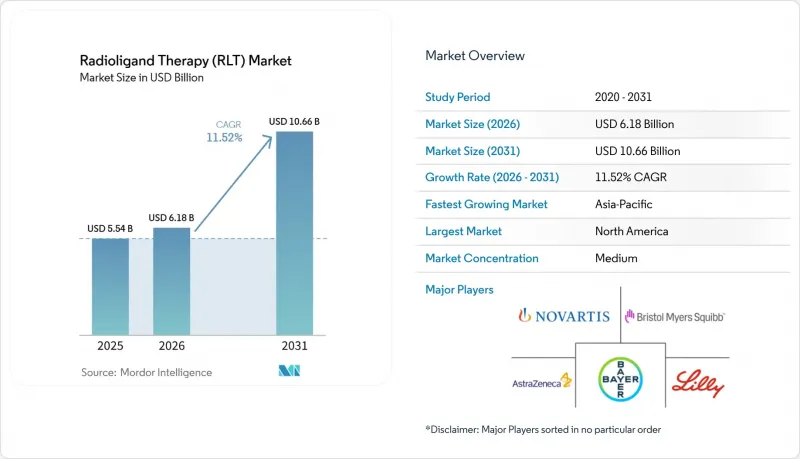
Mordor Intelligence에 의하면, 방사성 리간드 요법(RLT) 시장 규모는 2025년 55억 4,000만 달러로 평가되었고, 2026년에는 61억 8,000만 달러로 추정되고, 2031년까지 106억 6,000만 달러에 이를 것으로 예상되며, 2026-2031년 CAGR 11.52%로 성장할 전망입니다.
본 보고서는 제품별(Lu-177 비피보티드·테트라크세탄, Lu-177 도타테이트, Ra-223, 기타), 표적별(전립선 특이 막 항원 등), 적응증별(전립선암, 소세포 폐암 등), 최종 사용자별(3차 의료기관, 핵의학 센터, 병원, 진료소, 기타), 지역별(북미, 유럽, 기타)로 분류되어 있습니다. 시장 전망은 금액(달러) 단위로 표시됩니다.
세계의 방사성 리간드 요법(RLT) 시장 동향 및 인사이트
정밀 종양학 및 테라노스틱스의 도입
방사성 리간드 치료 시장은 동반 진단과 표적 치료의 연계에 의해 뒷받침되고 있습니다. 이는 치료의 두 측면이 동일한 생물학적 마커를 기반으로 계획되기 때문입니다. PSMA-PET 스캔은 적격 환자를 식별하고, 질병의 분포를 파악하며, 치료 시작 전에 치료 반응을 예측하는 데 도움이 됩니다. 이러한 연계 모델을 통해 치료법 선택 기간이 단축되고, 임상의가 부적합한 환자에 대한 치료를 피할 수 있게 되어 임상적 중도 탈락률을 낮출 수 있습니다. 갈륨-68 PSMA PET 조영제에 대한 FDA의 승인은 관련 치료 용도에 대한 보험 급여의 선례를 마련하여 실질적인 접근 장벽을 낮췄습니다. 그 결과, 방사선과가 단순한 진단 기능에 그치지 않고 치료 접근성 및 병원의 조달 결정에서 더 큰 역할을 담당하게 되었습니다. 신경내분비 종양을 대상으로 한 SSTR2 프로그램과 새롭게 등장하고 있는 FAP 영상 프로그램은 이러한 진단과 치료를 결합한 접근 방식이 PSMA의 범위를 넘어 확산되고 있음을 보여줍니다.
적응증 확대와 조기 치료 단계에서의 활용
규제 당국의 적응증 확대로 인해 승인된 치료법이 더 조기 치료 단계로 이동함에 따라, 방사성 리간드 요법 시장의 치료 대상 환자층이 확대되고 있습니다. 치료 라인이 한 단계 앞당겨질 때마다 적격 환자 그룹은 2-3배 증가할 가능성이 있으며, 이에 따라 적응증 확대 결정은 상업적으로 극히 중요한 의미를 지닙니다. FDA는 2025년 3월, ARPI 후·탁산계 약물 치료 전의 mCRPC에 대한 ‘Pluvicto’를 승인하여, 기존의 탁산계 약물 치료 후 설정에 비해 75% 규모로 더 큰 환자군을 개척했습니다. 노바티스는 PSMAddition 임상시험을 바탕으로, mHSPC에 대한 ‘Pluvicto’에 대해 2026년 3분기에 FDA의 결정이 내려질 것으로 전망하고 있습니다. 또한, 루타세라는 2025년 미국 및 일본에서 승인된 GEP-NET(위장관 신경내분비종양) 치료에 있어 더 초기 치료 단계에서의 사용이 가능해졌을 뿐만 아니라, 소아 적응증도 추가되었습니다. 이러한 반복 승인 절차를 통해, 이미 확립된 제품은 동일한 화학 조성, 제조거점 및 임상 네트워크를 더 많은 치료 상황에서 활용할 수 있게 됩니다.
치료용 방사성 동위원소 공급 제약
방사성 리간드 치료 시장에서는 수요 증가와 동위원소 생산량을 늘리는 데 필요한 시간 사이에 여전히 불일치가 발생하고 있습니다. 원자로를 이용한 루테튬-177의 생산은 제한된 수의 생산 시설에 의존하고 있기 때문에 한 곳에서 혼란이 발생하면 여러 시장에 걸친 공급망에 영향을 미칠 가능성이 있습니다. 로렌티스 에너지 파트너스는 2027년에 온타리오 파워 제너레이션(Ontario Power Generation)의 달링턴 원자력 발전소에서 루테튬-177의 상업적 생산을 시작할 예정입니다. 이 시설은 연간 300만 회분, 즉 50만 명의 환자에게 필요한 치료분을 공급할 수 있도록 설계되었습니다. 악티늄-225의 확보 가능성은 더욱 제한적이어서, 임상 결과가 양호함에도 불구하고 BMS-RayzeBio 및 아스트라제네카 퓨전(AstraZeneca Fusion)의 프로그램이 제약을 받을 가능성이 있습니다. 에덴 라디오아이소토프(Eden Radioisotope)는 미국 내 루테튬-177 제조 시설에 대해 2026년에 NRC(미국 원자력 규제 위원회)에 허가 신청을 제출했으나, 원자로 프로젝트에는 수년에 걸친 개발 및 시운전이 필요합니다.
부문별 분석
2025년, Pluvicto는 제품 부문의 45.31%를 차지했습니다. 적응증 확대와 미국 내 탁산계 약물 치료 전 전이성 거세 저항성 전립선암(mCRPC) 환자들 수요가 이러한 입지를 뒷받침했습니다. ‘Pluvicto’의 매출액은 2026년 상반기에 12억 9,300만 달러에 달했으며, 환율 변동의 영향을 제외하면 전년 동기 대비 57% 증가했습니다. 2025년 3월의 적응증 확대 및 미국 이외 지역에서의 사용 확대가 매출을 견인했습니다. ‘루타셀라’는 가장 빠르게 성장하는 제품으로, 2026-2031년 연평균 성장률(CAGR) 15.58%를 나타낼 것으로 전망됩니다.
루타세라는 미국 및 일본에서의 소아 적응증 승인 및 조기 치료 단계에서의 사용에 힘입어 2025년에 8억 1,600만 달러의 매출을 기록했습니다. 조피고는 알파선 방출 기전을 통해 골전이성 CRPC를 치료하는 약제로, 동반 진단이 필요하지 않습니다. 란테우스사는 2026년 3월, 루타세라의 방사능 등가물인 PNT2003에 대해 FDA로부터 잠정 승인을 획득했습니다. ITM-11의 FDA PDUFA 결정일은 2026년 8월 28일로 예정되어 있어 경쟁 압력을 높이고 있습니다. 악티늄-225 결합체, 납-212 제제 및 구리-64 테라노스틱스는 2028년 이후의 상업적 사이클을 형성할 것입니다.
2025년, PSMA 표적 치료제는 해당 부문의 58.44%를 차지했습니다. Pluvicto의 상업적 규모와 확립된 동반 영상 진단 인프라가 이러한 위상을 뒷받침했습니다. SSTR은 GEP-NET 치료의 중심적인 위치를 차지하고 있으며, 1주기당 비용 감소로 인해 치료 건수가 증가할 가능성이 있습니다. FAP는 상피성 악성 종양의 90% 이상에서 발현되며, 여러 종양 유형에서 잠재력을 지니고 있습니다. 초기 FAPI 치료제는 종양 내 체류 시간이 짧아 효능에 한계가 있었습니다.
현재 진행 중인 1상 및 2상 임상시험에서는 고리형 펩타이드와 알부민 결합제를 이용한 개선을 통해 용량 분포가 개선되었습니다. 일라이 릴리 산하의 포인트 바이오파마, 테릭스 파마슈티컬스, 그리고 AAA614를 개발 중인 노바티스는 FAP 분야에서 적극적으로 개발을 추진하고 있는 기업들입니다. GRPR은 PSMA 발현이 불충분한 조기 전립선암이나 유방암 치료에 효과적입니다. 노바티스의 AAA817(악티늄-225-PSMA-617 화합물)은 루테튬-177 치료 후의 전이성 거세 저항성 전립선암(mCRPC)을 표적으로 합니다. 루테튬-177과 악티늄-225를 순차적으로 사용함으로써, 치료 선택지의 확대와 환자 1인당 수익 증대가 기대됩니다.
지역별 분석
2025년 기준, 북미는 세계 시장의 80.61%를 차지했습니다. 조기 상용화, 확립된 핵의학 인프라, 그리고 보험 환급 체계가 이러한 위상을 뒷받침했습니다. 미국에는 FDA 승인을 받은 시판 제품과 성숙한 PSMA-PET 네트워크가 있습니다. 노바티스는 5개의 국내 RLT 시설을 포함해 5년 동안 230억 달러를 미국의 제조 거점에 투자하고 있습니다. 캐나다는 2027년에 상업 운전을 시작할 예정인 달링턴 시설을 통해 국내 루테튬-177 생산 능력을 구축하고 있습니다.
유럽은 방사성 리간드 요법 시장에서 미국에 이어 확고한 입지를 구축한 지역입니다. ‘Pluvicto’ 및 ‘Lutathera’에 대한 유럽의약품청(EMA)의 승인으로 독일, 프랑스, 영국, 이탈리아, 스페인에서의 사용이 뒷받침되고 있습니다. 큐리움(Curium)사는 2026년 6월, 사크레(Sacre) 시설에서 유럽용 루테튬-177 PSMA-I&T 생산 라인 구축을 위해 3,200만 유로(3,650만 달러)를 투자한다고 발표했습니다. EU 회원국 간의 보험 급여 제도 차이로 인해, 확립된 학술 프로그램 이외의 광범위한 이용은 여전히 제한되고 있습니다.
아시아태평양은 가장 빠르게 성장하는 지역으로, 2026-2031년 연평균 성장률(CAGR) 15.85%가 예상됩니다. 중국은 2025년 말에 ‘Pluvicto’를 승인하여, 중국 최초의 PSMA 표적 방사성 리간드 치료제로 허가했습니다. 노바티스는 6억 위안(8,460만 달러)을 투자해 저장성에 시설을 건설 중이며, 2026년 말까지 가동을 시작할 예정입니다. 일본에서는 2026년 7월 3상 임상시험 피험자 등록이 완료됨에 따라, 테릭스(Terix)사의 ‘Illuccix’에 대한 승인 신청이 심사 중입니다. 호주에서는 ‘Pluvicto’가 승인되었으며, GCC(걸프협력회의) 및 브라질 학술 기관의 투자를 통해 2028년부터 2031년에 걸쳐 중동 및 아프리카, 남미 지역에서의 접근성이 향상될 가능성이 있습니다.
기타 혜택 :
- 엑셀 형식 시장 예측(ME) 시트
- 3개월간의 애널리스트 지원
자주 묻는 질문
목차
제1장 서론
제2장 조사 방법
제3장 개요
제4장 시장 구도
제5장 시장 규모 및 성장 예측
제6장 경쟁 구도
제7장 시장 기회 및 향후 전망
AJY 26.09.01According to Mordor Intelligence, the radioligand therapy (RLT) market size is expected to increase from USD 5.54 billion in 2025 to USD 6.18 billion in 2026 and reach USD 10.66 billion by 2031, growing at a CAGR of 11.52% over 2026-2031.
This report is Segmented by Product (Lu-177 Vipivotide Tetraxetan, Lu-177 Dotatate, Ra-223, Others), Target (Prostate-Specific Membrane Antigen and More), Indication (Prostate Cancer, Small Cell Lung Cancer, and More), End User (Tertiary Care, Nuclear Medicine Centers, Hospitals, Clinics, Others), and Geography (North America, Europe, and More). The Market Forecasts are in Value (USD).
Global Radioligand Therapy (RLT) Market Trends and Insights
Precision Oncology and Theranostic Adoption
The radioligand therapy market is supported by the closer use of companion diagnostics and targeted treatment, because both parts of care are planned around the same biological marker. A PSMA PET scan can identify eligible patients, show the distribution of disease, and help predict therapeutic response before treatment begins. This paired model shortens treatment selection, helps clinicians avoid treatment in unsuitable patients, and can reduce clinical attrition. FDA approvals for gallium-68 PSMA PET agents created a reimbursement precedent for related therapeutic use and lowered a practical access barrier. Radiology departments therefore have a larger role in treatment access and hospital procurement decisions, rather than serving only a diagnostic function. SSTR2 programs for neuroendocrine tumors and emerging FAP imaging programs show that this paired diagnostic and therapy approach extends beyond PSMA.
Label Expansion and Earlier-Line Treatment Use
Regulatory label extensions are expanding the treated population in the radioligand therapy market by moving approved therapies into earlier care settings. Each shift to an earlier treatment line can increase the eligible patient group by 2 to 3 times, which gives label decisions outsized commercial importance. The FDA approved Pluvicto in March 2025 for post-ARPI, pre-taxane mCRPC, opening a patient group 75% larger than the earlier post-taxane setting. Novartis anticipates a Q3 2026 FDA decision for Pluvicto in mHSPC based on the PSMAddition trial. Lutathera also gained from earlier-line use in approved GEP-NET settings in the United States and Japan during 2025, together with a pediatric indication. These repeat approval pathways let established products use the same chemistry, manufacturing base, and clinical network across more treatment settings.
Therapeutic Radioisotope Supply Constraints
The radioligand therapy market faces a continuing mismatch between growing demand and the time needed to increase isotope output. Reactor-based lutetium-177 depends on a limited number of production facilities, so disruption at one site can affect supply chains across several markets. Laurentis Energy Partners plans to begin commercial lutetium-177 production at Ontario Power Generation's Darlington Nuclear Generating Station in 2027. The facility is designed to supply 3 million doses, or treatment for 500,000 patients, annually. Actinium-225 availability is even more limited, which may restrict BMS-RayzeBio and AstraZeneca-Fusion programs despite favorable clinical results. Eden Radioisotopes submitted a 2026 NRC permit application for a United States lutetium-177 facility, but reactor projects require multiyear development and commissioning.
Other drivers and restraints analyzed in the detailed report include:
- Rising Cancer Burden and Aging Population
- Increasing Radioisotope and RLT Manufacturing Capacity
- Specialized Workforce and Treatment-Center Capacity Shortages
For complete list of drivers and restraints, kindly check the Table Of Contents.
Segment Analysis
Pluvicto held 45.31% of the product segment in 2025. Its expanding indication set and demand in United States pre-taxane mCRPC supported this position. Pluvicto sales reached USD 1,293 million in H1 2026, 57% above the prior-year period in constant currency. The March 2025 label expansion and growing access outside the United States supported sales. Lutathera is the fastest-growing product, with a 15.58% CAGR forecast from 2026 to 2031.
Lutathera generated USD 816 million in 2025, supported by pediatric approval and earlier-line use in the United States and Japan. Xofigo treats bone-metastatic CRPC through an alpha-emitting mechanism and does not require a companion diagnostic. Lantheus received FDA tentative approval for PNT2003, a radioequivalent of Lutathera, in March 2026. ITM-11 had an FDA PDUFA date of August 28, 2026, adding competitive pressure. Actinium-225 conjugates, lead-212 agents, and copper-64 theranostics will shape the commercial cycle beyond 2028.
PSMA-targeted agents accounted for 58.44% of the target segment in 2025. Pluvicto's commercial scale and established companion imaging infrastructure supported this position. SSTR remains central to GEP-NET treatment and lower per-cycle costs could increase treatment volumes. FAP is expressed in more than 90% of epithelial malignancies and has potential across multiple tumor types. Earlier FAPI therapeutics showed limited efficacy because tumor retention was short.
Cyclic peptide and albumin-binder modifications are improving dosimetry in active Phase 1 and Phase 2 studies. Eli Lilly's Point Biopharma, Telix Pharmaceuticals, and Novartis with AAA614 are active FAP developers. GRPR can address early-stage prostate and breast cancer when PSMA expression is insufficient. Novartis's AAA817, an actinium-225-PSMA-617 compound, targets post-lutetium-177 mCRPC. Sequential use of lutetium-177 and actinium-225 could extend treatment options and revenue per patient.
Complete Report Scope:
- By Product
- Lutetium-177 Vipivotide Tetraxetan (Pluvicto)
- Lutetium-177 Dotatate (Lutathera)
- Radium-223 Dichloride (Xofigo)
- Other Product Types
- By Target
- Prostate-Specific Membrane Antigen
- Somatostatin Receptor
- Fibroblast Activation Protein
- Gastrin-Releasing Peptide Receptor
- Other Targets
- By Indication
- Prostate Cancer
- Gastroenteropancreatic Neuroendocrine Tumors
- Small Cell Lung Cancer
- Hepatocellular Carcinoma
- Breast Cancer
- Other Indications
- By End User
- Tertiary Care Academic and Comprehensive Cancer Centers
- Specialized Nuclear Medicine Centers
- Hospitals
- Specialized Clinics
- Other End Users
- By Geography
- North America
- United States
- Canada
- Mexico
- Europe
- Germany
- United Kingdom
- France
- Italy
- Spain
- Rest of Europe
- Asia-Pacific
- China
- Japan
- India
- Australia
- South Korea
- Rest of Asia-Pacific
- Middle East and Africa
- GCC
- South Africa
- Rest of Middle East and Africa
- South America
- Brazil
- Argentina
- Rest of South America
- North America
Geography Analysis
North America held 80.61% of the global market in 2025. Early commercial activity, established nuclear medicine infrastructure, and reimbursement pathways supported its position. The United States has FDA-approved commercial products and a mature PSMA PET network. Novartis is investing USD 23 billion in United States manufacturing over 5 years, including 5 domestic RLT facilities. Canada is developing domestic lutetium-177 capacity through the planned Darlington facility, which is expected to begin commercial operation in 2027.
Europe is the second established region for the radioligand therapy market. EMA approvals for Pluvicto and Lutathera support use across Germany, France, the United Kingdom, Italy, and Spain. Curium announced a EUR 32 million investment (USD 36.5 million), at its Saclay facility in June 2026 for a European lutetium-177 PSMA-I&T production line. Reimbursement differences across EU member states continue to limit wider use outside established academic programs.
Asia-Pacific is the fastest-growing region, with a 15.85% CAGR forecast for 2026 to 2031. China approved Pluvicto in late 2025, its first licensed PSMA-targeted radioligand treatment. Novartis is constructing a Zhejiang facility at CNY 600 million (USD 84.6 million), for commissioning by the end of 2026. Japan is reviewing Telix's Illuccix application after Phase 3 enrollment finished in July 2026. Australia has approved Pluvicto, while GCC and Brazilian academic investment could support access in the Middle East, Africa, and South America from 2028 to 2031.
- Actinium Pharmaceuticals, Inc.
- Ariceum Therapeutics GmbH
- AstraZeneca
- Bayer
- Bristol-Myers Squibb
- Clarity Pharmaceuticals Limited
- Convergent Therapeutics, Inc.
- Curium Pharma
- Eli Lilly and Company
- ITM Isotope Technologies Munich SE
- Lantheus Holdings, Inc.
- NorthStar Medical Radioisotopes, LLC
- Novartis
- Nusano, Inc.
- Orano Med
- Perspective Therapeutics, Inc.
- RadioMedix, Inc.
- Radiopharm Theranostics Limited
- SHINE Technologies, LLC
- Telix Pharmaceuticals Limited
Additional Benefits:
- The market estimate (ME) sheet in Excel format
- 3 months of analyst support
TABLE OF CONTENTS
1 Introduction
- 1.1 Study Assumptions and Market Definition
- 1.2 Scope of the Study
2 Research Methodology
3 Executive Summary
4 Market Landscape
- 4.1 Market Overview
- 4.2 Market Drivers
- 4.2.1 Precision Oncology and Theranostic Adoption
- 4.2.2 Label Expansion and Earlier-Line Treatment Use
- 4.2.3 Rising Cancer Burden and Aging Population
- 4.2.4 Increasing Radioisotope and RLT Manufacturing Capacity
- 4.2.5 Patient-Specific Dose Planning and Decentralized RLT Delivery
- 4.3 Market Restraints
- 4.3.1 Therapeutic Radioisotope Supply Constraints
- 4.3.2 Specialized Workforce and Treatment-Center Capacity Shortages
- 4.3.3 Complex Radiation Logistics and Short Product Half-Lives
- 4.4 Supply-Chain Analysis
- 4.5 Regulatory Landscape
- 4.6 Technological Outlook
- 4.7 Porter's Five Forces Analysis
- 4.7.1 Threat of New Entrants
- 4.7.2 Bargaining Power of Suppliers
- 4.7.3 Bargaining Power of Buyers
- 4.7.4 Threat of Substitutes
- 4.7.5 Competitive Rivalry
5 Market Size & Growth Forecasts (Value, USD)
- 5.1 By Product
- 5.1.1 Lutetium-177 Vipivotide Tetraxetan (Pluvicto)
- 5.1.2 Lutetium-177 Dotatate (Lutathera)
- 5.1.3 Radium-223 Dichloride (Xofigo)
- 5.1.4 Other Product Types
- 5.2 By Target
- 5.2.1 Prostate-Specific Membrane Antigen
- 5.2.2 Somatostatin Receptor
- 5.2.3 Fibroblast Activation Protein
- 5.2.4 Gastrin-Releasing Peptide Receptor
- 5.2.5 Other Targets
- 5.3 By Indication
- 5.3.1 Prostate Cancer
- 5.3.2 Gastroenteropancreatic Neuroendocrine Tumors
- 5.3.3 Small Cell Lung Cancer
- 5.3.4 Hepatocellular Carcinoma
- 5.3.5 Breast Cancer
- 5.3.6 Other Indications
- 5.4 By End User
- 5.4.1 Tertiary Care Academic and Comprehensive Cancer Centers
- 5.4.2 Specialized Nuclear Medicine Centers
- 5.4.3 Hospitals
- 5.4.4 Specialized Clinics
- 5.4.5 Other End Users
- 5.5 By Geography
- 5.5.1 North America
- 5.5.1.1 United States
- 5.5.1.2 Canada
- 5.5.1.3 Mexico
- 5.5.2 Europe
- 5.5.2.1 Germany
- 5.5.2.2 United Kingdom
- 5.5.2.3 France
- 5.5.2.4 Italy
- 5.5.2.5 Spain
- 5.5.2.6 Rest of Europe
- 5.5.3 Asia-Pacific
- 5.5.3.1 China
- 5.5.3.2 Japan
- 5.5.3.3 India
- 5.5.3.4 Australia
- 5.5.3.5 South Korea
- 5.5.3.6 Rest of Asia-Pacific
- 5.5.4 Middle East and Africa
- 5.5.4.1 GCC
- 5.5.4.2 South Africa
- 5.5.4.3 Rest of Middle East and Africa
- 5.5.5 South America
- 5.5.5.1 Brazil
- 5.5.5.2 Argentina
- 5.5.5.3 Rest of South America
- 5.5.1 North America
6 Competitive Landscape
- 6.1 Market Concentration
- 6.2 Market Share Analysis
- 6.3 Company Profiles (includes Global Level Overview, Market Level Overview, Core Segments, Financials as available, Strategic Information, Market Rank/Share, Products and Services, Recent Developments)
- 6.3.1 Actinium Pharmaceuticals, Inc.
- 6.3.2 Ariceum Therapeutics GmbH
- 6.3.3 AstraZeneca plc
- 6.3.4 Bayer AG
- 6.3.5 Bristol-Myers Squibb Company
- 6.3.6 Clarity Pharmaceuticals Limited
- 6.3.7 Convergent Therapeutics, Inc.
- 6.3.8 Curium Pharma
- 6.3.9 Eli Lilly and Company
- 6.3.10 ITM Isotope Technologies Munich SE
- 6.3.11 Lantheus Holdings, Inc.
- 6.3.12 NorthStar Medical Radioisotopes, LLC
- 6.3.13 Novartis AG
- 6.3.14 Nusano, Inc.
- 6.3.15 Orano Med
- 6.3.16 Perspective Therapeutics, Inc.
- 6.3.17 RadioMedix, Inc.
- 6.3.18 Radiopharm Theranostics Limited
- 6.3.19 SHINE Technologies, LLC
- 6.3.20 Telix Pharmaceuticals Limited
7 Market Opportunities and Future Outlook
- 7.1 White-Space and Unmet-Need Assessment