

|
시장보고서
상품코드
2118879
유료 검색 관리 소프트웨어 시장 : 시장 점유율 분석, 업계 동향 및 통계, 성장 예측(2026-2031년)Paid Search Management Software - Market Share Analysis, Industry Trends & Statistics, Growth Forecasts (2026 - 2031) |
||||||
 Mordor Intelligence
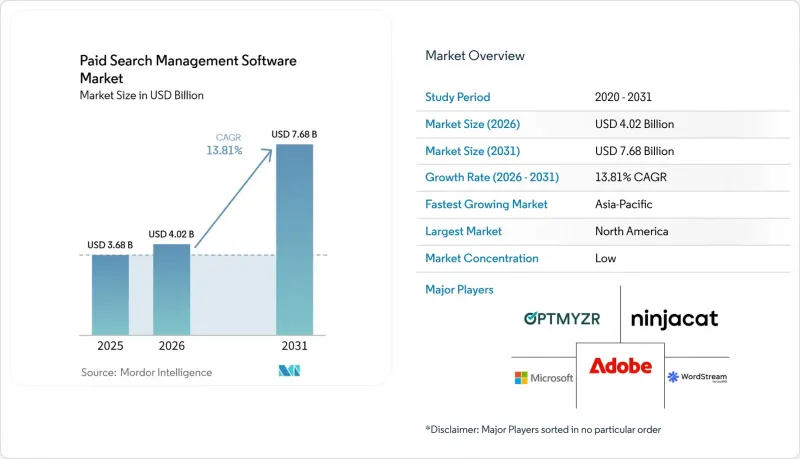
Mordor Intelligence에 의하면, 유료 검색 관리 소프트웨어 시장 규모는 2025년 36억 8,000만 달러로 평가되었고, 2026년 40억 2,000만 달러에서 2031년까지 76억 8,000만 달러로 확대될 것응로 예측되며, 2026-2031년 CAGR 13.81%를 기록할 전망입니다.
본 보고서는 구성 요소별(소프트웨어 및 서비스), 도입 형태별(클라우드 및 온프레미스), 조직 규모별(대기업 및 중소기업(SME)), 용도별(검색 광고 캠페인 관리 등), 최종 사용자 산업별(정보 기술 및 통신 등), 지역별로 분류되어 있습니다. 시장 예측은 금액(달러) 기준으로 제시되어 있습니다.
세계의 유료 검색 관리 소프트웨어 시장 동향 및 인사이트
입찰 및 예산 재분배 자동화에 대한 수요 증가
유료 검색 관리 소프트웨어 시장은 수동 입찰 규칙 대신 대규모 포트폴리오 전반에 걸친 포트폴리오 수준의 최적화가 도입되면서 성장하고 있습니다. 검색 수요, 전환 품질, 가용 예산의 미세한 변화에 대해 빈번한 의사 결정이 필요하기 때문에 수동 확인만으로는 계속해서 대응하기 어려워지고 있기 때문입니다. Google Ads API v25에서는 ‘AI Max’ 캠페인 설정이 도입되어, 연동된 플랫폼이 ‘AI Max for Search’를 대규모로 구성할 수 있게 되었습니다. 이를 통해 타사 자동화 도구는 네이티브 플랫폼의 자동화 기능을 단순히 대체하는 것이 아니라, 이를 이끄는 계층으로서의 역할을 수행하게 됩니다. 또한, 소프트웨어가 광고주가 계정, 팀 및 변화하는 캠페인 조건 전반에 걸쳐 일관되게 적용할 수 있는 제어 기능을 추가함으로써 유료 검색 관리 소프트웨어 시장은 혜택을 받게 될 것입니다. COLING 2025에서 발표된 학술 연구에 따르면, 동적 키워드 생성은 정적 키워드 세트보다 변화하는 성과 지표에 더 효과적으로 적응할 수 있는 것으로 밝혀졌습니다. 또한, Microsoft Advertising은 2026년 5월, 검색 및 쇼핑 광고를 위한 계정 간 포트폴리오 입찰을 도입하여 타사 도구에 대한 요구 수준을 높였습니다. 캠페인 설정의 자동화가 진행되고 있음에도 불구하고, 광고주는 계속해서 계정과 채널 전반에 걸쳐 일관된 예산 관리를 수행해야 합니다.
퍼스트파티 검색 성과 분석으로의 전환
퍼스트파티 데이터로의 전환에 따라 유료 검색 관리 소프트웨어 시장에서 측정 기능에 대한 수요가 증가하고 있습니다. 구글은 2025년 영국 경쟁·시장청(CMA)에 대해 크롬에서 제3자 쿠키에 대한 사용자의 선택권을 유지하겠다고 밝혔지만, 이로 인해 광범위한 크로스사이트 측정이 부활한 것은 아닙니다. Google Analytics는 동의를 얻은 퍼스트 파티 데이터를 이용할 수 있는 경우, 전환 모델링을 개선하기 위해 사용자가 제공한 데이터 수집을 지원합니다. 이러한 설정에는 신뢰할 수 있는 데이터 처리와 계정 전반에 걸친 일관된 캠페인 프로세스가 필요합니다. 더 깨끗한 자사 데이터를 입찰 및 보고서 작성에 연동하는 플랫폼은 광고주가 성과 지표의 품질을 향상시키는 데 도움이 될 뿐만 아니라, 대행사에게도 클라이언트 계정 전반에 걸친 동의 현황, 전환 입력, 보고서 정의를 확인하기 위한 일관된 프로세스를 제공합니다. 또한, 개인정보 보호 및 동의 관련 요건으로 인해 유럽 및 기타 규제 시장에서 규정 준수를 고려한 분석 기능이 중요해지고 있으며, 이에 따라 유료 검색 관리 소프트웨어 시장은 팀이 검색 성과를 검증하는 동시에 일관된 데이터 관리 관행을 유지할 수 있도록 지원하는 역할을 담당하고 있습니다.
플랫폼 정책 및 API 변경에 대한 의존성
유료 검색 관리 소프트웨어 시장은 광고 플랫폼의 정책 및 출시 일정에 의존하고 있습니다. Google은 2026년 1월에 Google Ads API에서 ‘콜 온리(Call-Only) 광고’ 지원을 종료할 예정이며, 기존 콜 온리 광고의 게재는 2027년 2월에 중단될 예정입니다. 또한, 구글은 2025년 6월부터 10월에 걸쳐 API 버전 20부터 22까지를 출시했습니다. 각 릴리스에 따라 소프트웨어 공급업체는 연동 기능과 캠페인 워크플로를 업데이트해야 하므로, 유료 검색 관리 소프트웨어 시장에 지속적인 비용이 발생할 뿐만 아니라, 엔지니어링 리소스가 제한적인 소규모 공급업체에는 더 큰 압박이 가해질 것입니다. 소규모 벤더는 신제품 개발에서 유지보수로 엔지니어링 리소스를 재배치해야 할 가능성이 있습니다. 광고 플랫폼의 변경이 연동되는 소프트웨어 제품보다 빠른 속도로 진행될 경우, 광고주는 워크플로우의 혼란에 직면할 우려가 있습니다. 이는 벤더가 플랫폼의 변경 요구 사항에 맞추어 연동 기능을 조정하는 동안, 캠페인 팀이 일상적인 변경을 일시 중단하고 설정을 확인하거나 데이터 흐름을 재검토해야 하기 때문입니다.
부문 분석
2025년, 소프트웨어는 유료 검색 관리 소프트웨어 시장 점유율의 68.19%를 차지했습니다. 구독형 라이선싱은 엔터프라이즈용 플랫폼 및 대행사용 대시보드에서 여전히 핵심적인 수익 모델로 자리 잡고 있습니다. 이러한 구조로 인해 지속적인 캠페인 관리가 필요한 광고주에게 이 소프트웨어는 기본적인 선택지가 되고 있습니다. 검색 프로그램은 일회성 도입이 아닌 빈번한 조정이 필요하기 때문에 유료 검색 관리 소프트웨어 업계는 계속해서 이 라이선싱 모델에 의존하고 있습니다.
서비스 부문은 2026-2031년 연평균 성장률(CAGR) 16.67%를 나타낼 것으로 예측됩니다. 이러한 성장은 광고주가 더 많은 플랫폼을 이용함에 따라 도입 지원, 관리형 서비스, API 통합에 대한 수요가 증가하고 있음을 반영합니다. 팀이 검색, 리테일 미디어, 측정 시스템을 연동해야 하는 경우, 인적 지원의 중요성이 커집니다. 마이크로소프트 애드버타이징은 2026년 5월, Google Ads 및 Meta Ads에서의 캠페인 이전을 간소화하기 위해 새로운 ‘가져오기 센터’를 도입했습니다. 이전이나 데이터 정규화 과정에서는 구독형 소프트웨어만으로는 완료할 수 없는 작업이 발생할 수 있습니다. 따라서 이 부문에서는 확장 가능한 라이선스 수익과, 더욱 복잡해진 캠페인 환경으로 인해 발생하는 서비스 수요가 결합되어 있습니다.
2025년에는 매출의 70.21%를 클라우드가 차지했으며, 2031년까지 연평균 성장률(CAGR) 16.05%로 확대될 것으로 예측됩니다. 이에 따라 클라우드는 주요 도입 형태인 동시에 가장 빠르게 성장하는 선택지로서의 입지를 확고히 하고 있습니다. 클라우드 시스템은 광고 플랫폼 전반에 걸친 실시간 입찰 신호 및 여러 API 호출을 처리할 수 있습니다. 또한 각 클라이언트의 거점에 로컬 인프라를 구축하지 않고도 계정 전반에 걸친 포트폴리오 운영을 가능하게 합니다. 캠페인 활동이 더욱 지속적해짐에 따라 이러한 기능은 유료 검색 관리 소프트웨어 시장의 요구에 부합하고 있습니다.
온프레미스 배포는 엄격한 데이터 상주 요건이나 규정 준수 요건을 가진 광고주에게 여전히 중요한 선택지입니다. 금융 서비스, 의료, 정부 관련 기관의 경우 내부 정책에 따라 클라우드 전환이 제한될 때 이러한 시스템을 유지할 가능성이 있습니다. 클라우드 우선 벤더들이 새로운 기능을 더 신속하게 출시함에 따라 두 모델 간의 차이는 더욱 뚜렷해질 것입니다. Optmyzr는 AI 도구를 통해 사용자가 실시간 계정 데이터에 통제된 방식으로 접근할 수 있는 클라우드 기반 MCP 연결에 대해 설명하고 있습니다. Smartly는 2026년 6월 ‘Synapse’ AI 오케스트레이션 레이어를 도입하여 클라우드 네이티브 광고 운영이라는 방향성을 더욱 강화했습니다.
지역별 분석
2025년, 북미는 유료 검색 관리 소프트웨어 시장 점유율의 36.44%를 차지했습니다. 이 지역은 성숙한 디지털 광고 기반과 광고 플랫폼, 광고 대행사, 기업 바이어가 집중되어 있다는 이점이 있습니다. 미국은 포트폴리오 입찰 및 상세한 보고서 작성을 지원하는 소프트웨어의 주요 수요 거점으로 자리 잡고 있습니다. 또한 북미의 구매 담당자들은 증분 효과 테스트, 다중 네트워크 관리, AI를 활용한 쿼리 프로세스를 조기에 도입하고 있습니다. 이 지역의 유료 검색 관리 소프트웨어 시장은 광고주가 기존 검색 플랫폼에 더해 리테일 미디어를 점점 더 중시함에 따라 진화하고 있으며, 그 결과 여러 네트워크에 걸친 캠페인 정보를 통합하고 대행사에 계정 수준의 성과 개요를 제공하는 도구의 실용적 가치가 확대되고 있습니다.
유럽은 두 번째로 큰 지역으로, 독일, 영국, 프랑스가 기업 및 대행사들 수요를 뒷받침하고 있습니다. 구글이 영국 경쟁·시장청(CMA)에 제출한 ‘프라이버시 샌드박스’ 2025년 진행 보고서는 이 지역의 측정 계획에 여전히 중요한 의미를 지닙니다. 이러한 규제 환경은 동의와 규정 준수를 염두에 두고 설계된 퍼스트 파티 분석 기능에 대한 수요를 뒷받침하고 있습니다. 남미는 매출 규모는 작지만, 중소기업의 클라우드 소프트웨어 도입 여지가 있어 벤더들은 현지화된 제품을 활용하여 브라질 및 아르헨티나 기업의 업무상 요구를 충족시킬 수 있습니다.
아시아태평양은 2031년까지 연평균 성장률(CAGR) 15.36%를 나타낼 것으로 예측되며, 이는 각 지역 중 가장 높은 성장률입니다. 인도, 중국, 한국, 호주, 뉴질랜드에서는 검색 관리 도구가 필요한 광고주 기반이 확대되고 있습니다. 인도에서는 현지 언어를 활용한 키워드 분석 및 지역별 입찰 지원에 대한 수요가 발생하고 있습니다. 중국에서는 바이두(Baidu), 알리바바, 텐센트가 서유럽 플랫폼과는 다른 기술 스택으로 운영되고 있기 때문에 독자적인 제품 접근 방식이 요구됩니다. 이러한 현지화 요건은 세계 벤더의 단순한 사업 확장을 제한하는 한편, 현지 상황에 적합한 제품을 위한 시장 진입 기회를 창출하고 있습니다.
기타 혜택 :
- 엑셀 형식 시장 예측(ME) 시트
- 3개월간의 애널리스트 지원
자주 묻는 질문
목차
제1장 서론
제2장 조사 방법
제3장 개요
제4장 시장 구도
제5장 시장 규모 및 성장 예측
제6장 경쟁 구도
제7장 시장 기회 및 향후 전망
AJY 26.09.01According to Mordor Intelligence, the paid search management software market size is projected to expand from USD 3.68 billion in 2025 and USD 4.02 billion in 2026 to USD 7.68 billion by 2031, registering a CAGR of 13.81% between 2026 and 2031.
This report is Segmented by Component (Software and Services), Deployment Mode (Cloud and On-Premises), Organization Size (Large Enterprises and Small and Medium Enterprises [SMEs]), Application (Search Advertising Campaign Management, and More), End-User Industry (Information Technology and Telecommunication, and More), and Geography. The Market Forecasts are Provided in Terms of Value (USD).
Global Paid Search Management Software Market Trends and Insights
Rising Need for Automated Bid and Budget Reallocation
The paid search management software market is driven by the replacement of manual bid rules with portfolio-level optimization across larger portfolios, where small changes in search demand, conversion quality, and available budget require frequent decisions that are difficult to sustain through manual checks alone. Google Ads API v25 introduced an AI Max campaign setting that lets connected platforms configure AI Max for Search at scale. This makes third-party automation a layer that can guide native platform automation rather than simply replace it, and the paid search management software market benefits when software adds controls that advertisers can apply consistently across accounts, teams, and changing campaign conditions. Academic work presented at COLING 2025 found that on-the-fly keyword generation can adapt to changing performance indicators more effectively than static keyword sets. Microsoft Advertising also introduced cross-account portfolio bidding for Search and Shopping in May 2026, raising the bar for independent tools. As campaign settings become more automated, advertisers still need consistent budget control across accounts and channels.
Shift Toward First-Party Search Performance Analytics
The move toward first-party data is increasing demand for measurement features in the paid search management software market. Google told the UK Competition and Markets Authority in 2025 that it would retain user choice on third-party cookies in Chrome, but this did not restore broad cross-site measurement. Google Analytics supports user-provided data collection to improve conversion modeling when consented first-party data is available. These configurations require reliable data handling and consistent campaign processes across accounts. Platforms that connect cleaner first-party data to bidding and reporting can help advertisers improve the quality of their performance signals, while also giving agencies a consistent process for checking consent status, conversion inputs, and reporting definitions across client accounts. Privacy and consent requirements also make compliance-aware analytics functions important in Europe and other regulated markets, which gives the paid search management software market a role in helping teams maintain consistent data practices while reviewing search performance.
Dependence on Platform Policy and API Changes
The paid search management software market depends on the policies and release schedules of advertising platforms. Google deprecated call-only ads from the Google Ads API in January 2026, and existing call-only ads are scheduled to stop serving in February 2027. Google also released API versions 20 through 22 between June and October 2025. Each release can require software vendors to update integrations and campaign workflows, creating ongoing costs for the paid search management software market and putting greater pressure on smaller providers with limited engineering capacity. Smaller vendors may need to reallocate engineering resources from new product development to maintenance. Advertisers can face workflow disruption when an advertising platform changes faster than a connected software product, since campaign teams may need to pause routine changes, verify settings, and review data flows while a vendor adjusts its integration to the revised platform requirements.
Other drivers and restraints analyzed in the detailed report include:
- Retail Media and Search Convergence
- Growth of Multi-Account Agency Workflows
- Budget Compression in Small Advertiser Accounts
For complete list of drivers and restraints, kindly check the Table Of Contents.
Segment Analysis
Software held 68.19% of the paid search management software market share in 2025. Subscription licensing remains the central revenue model for enterprise platforms and agency dashboards. The structure also makes software the default choice for advertisers who need ongoing campaign management. The paid search management software industry continues to rely on this licensing model because search programs require frequent adjustment rather than one-time implementation.
Services are projected to grow at a 16.67% CAGR from 2026 to 2031. This growth reflects demand for implementation support, managed services, and API integration as advertisers use more platforms. Human support becomes more important when teams must connect search, retail media, and measurement systems. Microsoft Advertising introduced a new Import Center in May 2026 to simplify campaign migration from Google Ads and Meta Ads. Migration and data normalization can create work that subscription software alone does not complete. The segment, therefore, combines scalable license revenue with a services need created by more complex campaign environments.
Cloud accounted for 70.21% of revenue in 2025 and is projected to advance at a 16.05% CAGR through 2031. This establishes cloud as both the leading deployment mode and the faster-growing option. Cloud systems can support real-time bid signals and multiple API calls across advertising platforms. They also enable cross-account portfolio work without requiring local infrastructure at each client location. These capabilities align with the needs of the paid search management software market as campaign activity becomes more continuous.
On-premises deployment remains relevant for advertisers with strict data residency and compliance requirements. Financial services, healthcare, and government-related organizations may retain these systems when internal policies limit cloud migration. The difference between the two models is likely to become clearer as cloud-first vendors release new functions more quickly. Optmyzr has described cloud-based MCP connections that give users controlled access to live account data through AI tools. Smartly introduced its Synapse AI orchestration layer in June 2026, reinforcing the direction of cloud-native advertising operations.
Complete Report Scope:
- By Component
- Software
- Services
- By Deployment Mode
- Cloud
- On-Premises
- By Organization Size
- Large Enterprises
- Small and Medium Enterprises (SMEs)
- By Application
- Search Advertising Campaign Management
- Bid Management and Budget Optimization
- Performance Tracking and Attribution Analytics
- Audience Targeting and Keyword Intelligence
- By End-User Industry
- Retail and E-Commerce
- Banking, Financial Services, and Insurance (BFSI)
- Healthcare and Life Sciences
- Information Technology and Telecommunication
- Media and Entertainment
- Travel and Hospitality
- Other End-User Industries
- By Geography
- North America
- United States
- Canada
- Mexico
- South America
- Brazil
- Argentina
- Rest of South America
- Europe
- Germany
- United Kingdom
- France
- Italy
- Spain
- Russia
- Rest of Europe
- Asia-Pacific
- China
- Japan
- India
- South Korea
- Australia and New Zealand
- Rest of Asia-Pacific
- Middle East
- Saudi Arabia
- United Arab Emirates
- Turkey
- Rest of Middle East
- Africa
- South Africa
- Nigeria
- Rest of Africa
- North America
Geography Analysis
North America held 36.44% of the paid search management software market share in 2025. The region benefits from a mature digital advertising base and a concentration of advertising platforms, agencies, and enterprise buyers. The United States provides a major demand center for software that supports portfolio bidding and detailed reporting. North American buyers have also adopted incrementality testing, multi-network management, and AI-assisted query processes early. The paid search management software market in the region is also evolving as advertisers place greater emphasis on retail media alongside established search platforms, thereby expanding the practical value of tools that reconcile campaign information across multiple networks and provide agencies with an account-level view of performance.
Europe is the second-largest regional area, with Germany, the United Kingdom, and France supporting enterprise and agency demand. Google's 2025 Privacy Sandbox progress report to the UK Competition and Markets Authority remains relevant to measurement planning in the region. This regulatory environment supports demand for first-party analytics functions that are designed with consent and compliance in mind. South America is smaller in revenue but offers room for cloud software adoption among SMEs, and vendors can use localized products to address the operational needs of businesses in Brazil and Argentina.
Asia-Pacific is projected to grow at a 15.36% CAGR through 2031, the fastest rate among the regions. India, China, South Korea, Australia, and New Zealand are expanding the base of advertisers that require search management tools. India creates demand for local-language keyword intelligence and regional bidding support. China requires a distinct product approach because Baidu, Alibaba, and Tencent operate on different technology stacks than Western platforms. This localization requirement can limit simple expansion by global vendors while creating an opening for adapted products.
- Microsoft Corporation
- Adobe Inc.
- NinjaCat, Inc.
- Adzooma Limited
- Marin Software Incorporated
- Semrush Holdings, Inc.
- SpyFu, LLC
- Adalysis, LLC
- WordStream, Inc.
- Acquisio Inc.
- Search Ads 360
- PPCentive, Inc.
- Opteo Limited
- Brainlabs Digital Limited
- Smartly.io Solutions Oy
- Performance Max Pro
- Bidnamic Limited
- Kenshoo Technologies, LLC
- Skai B.V.
- Optmyzr Corporation
Additional Benefits:
- The market estimate (ME) sheet in Excel format
- 3 months of analyst support
TABLE OF CONTENTS
1 INTRODUCTION
- 1.1 Study Assumptions and Market Definition
- 1.2 Scope of the Study
2 RESEARCH METHODOLOGY
3 EXECUTIVE SUMMARY
4 MARKET LANDSCAPE
- 4.1 Market Overview
- 4.2 Market Drivers
- 4.2.1 Rising Need For Automated Bid and Budget Reallocation
- 4.2.2 Shift Toward First-Party Search Performance Analytics
- 4.2.3 Retail Media and Search Convergence
- 4.2.4 Growth of Multi-Account Agency Workflows
- 4.2.5 Increased Adoption of AI Assisted Query Mining
- 4.2.6 Greater Demand for Incrementality and Incremental ROAS Measurement
- 4.3 Market Restraints
- 4.3.1 Dependence on Platform Policy and API Changes
- 4.3.2 Budget Compression in Small Advertiser Accounts
- 4.3.3 Attribution Noise across Cross-Device Search Journeys
- 4.3.4 Limited In-House Expertise for Advanced Automation Governance
- 4.4 Industry Value Chain Analysis
- 4.5 Regulatory Landscape
- 4.6 Technological Outlook
- 4.7 Impact of Macroeconomic Factors on the Market
- 4.8 Porter's Five Forces Analysis
- 4.8.1 Threat of New Entrants
- 4.8.2 Bargaining Power of Suppliers
- 4.8.3 Bargaining Power of Buyers
- 4.8.4 Threat of Substitutes
- 4.8.5 Intensity of Competitive Rivalry
5 MARKET SIZE AND GROWTH FORECASTS (VALUE)
- 5.1 By Component
- 5.1.1 Software
- 5.1.2 Services
- 5.2 By Deployment Mode
- 5.2.1 Cloud
- 5.2.2 On-Premises
- 5.3 By Organization Size
- 5.3.1 Large Enterprises
- 5.3.2 Small and Medium Enterprises (SMEs)
- 5.4 By Application
- 5.4.1 Search Advertising Campaign Management
- 5.4.2 Bid Management and Budget Optimization
- 5.4.3 Performance Tracking and Attribution Analytics
- 5.4.4 Audience Targeting and Keyword Intelligence
- 5.5 By End-User Industry
- 5.5.1 Retail and E-Commerce
- 5.5.2 Banking, Financial Services, and Insurance (BFSI)
- 5.5.3 Healthcare and Life Sciences
- 5.5.4 Information Technology and Telecommunication
- 5.5.5 Media and Entertainment
- 5.5.6 Travel and Hospitality
- 5.5.7 Other End-User Industries
- 5.6 By Geography
- 5.6.1 North America
- 5.6.1.1 United States
- 5.6.1.2 Canada
- 5.6.1.3 Mexico
- 5.6.2 South America
- 5.6.2.1 Brazil
- 5.6.2.2 Argentina
- 5.6.2.3 Rest of South America
- 5.6.3 Europe
- 5.6.3.1 Germany
- 5.6.3.2 United Kingdom
- 5.6.3.3 France
- 5.6.3.4 Italy
- 5.6.3.5 Spain
- 5.6.3.6 Russia
- 5.6.3.7 Rest of Europe
- 5.6.4 Asia-Pacific
- 5.6.4.1 China
- 5.6.4.2 Japan
- 5.6.4.3 India
- 5.6.4.4 South Korea
- 5.6.4.5 Australia and New Zealand
- 5.6.4.6 Rest of Asia-Pacific
- 5.6.5 Middle East
- 5.6.5.1 Saudi Arabia
- 5.6.5.2 United Arab Emirates
- 5.6.5.3 Turkey
- 5.6.5.4 Rest of Middle East
- 5.6.6 Africa
- 5.6.6.1 South Africa
- 5.6.6.2 Nigeria
- 5.6.6.3 Rest of Africa
- 5.6.1 North America
6 COMPETITIVE LANDSCAPE
- 6.1 Market Concentration
- 6.2 Strategic Moves
- 6.3 Market Share Analysis
- 6.4 Company Profiles (includes Global Level Overview, Market Level Overview, Core Segments, Financials as available, Strategic Information, Market Rank/Share, Products and Services, Recent Developments)
- 6.4.1 Microsoft Corporation
- 6.4.2 Adobe Inc.
- 6.4.3 NinjaCat, Inc.
- 6.4.4 Adzooma Limited
- 6.4.5 Marin Software Incorporated
- 6.4.6 Semrush Holdings, Inc.
- 6.4.7 SpyFu, LLC
- 6.4.8 Adalysis, LLC
- 6.4.9 WordStream, Inc.
- 6.4.10 Acquisio Inc.
- 6.4.11 Search Ads 360
- 6.4.12 PPCentive, Inc.
- 6.4.13 Opteo Limited
- 6.4.14 Brainlabs Digital Limited
- 6.4.15 Smartly.io Solutions Oy
- 6.4.16 Performance Max Pro
- 6.4.17 Bidnamic Limited
- 6.4.18 Kenshoo Technologies, LLC
- 6.4.19 Skai B.V.
- 6.4.20 Optmyzr Corporation
7 MARKET OPPORTUNITIES AND FUTURE OUTLOOK
- 7.1 White-Space And Unmet-Need Assessment


