
|
시장보고서
상품코드
2118925
병원 소모품 시장 : 시장 점유율 분석, 업계 동향 및 통계, 성장 예측(2026-2031년)Hospital Consumables - Market Share Analysis, Industry Trends & Statistics, Growth Forecasts (2026 - 2031) |
||||||
 Mordor Intelligence
병원 소모품 시장 규모는 2025년에 4,289억 달러로 평가되었고, 2026년에 4,428억 4,000만 달러로 추정되고, 2031년까지 5,196억 3,000만 달러에 이를 것으로 예측되며, 2026-2031년 CAGR 3.25%로 성장할 전망입니다.
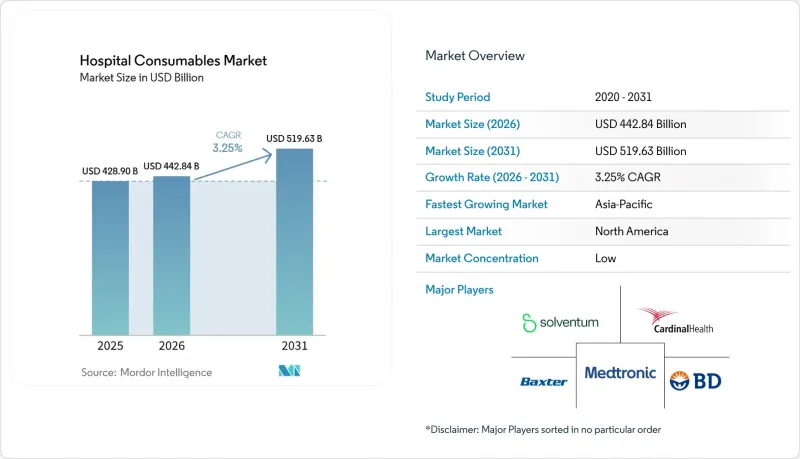
본 보고서는 제품 유형별(부직포 일회용 제품, 주사기, 수액 키트, 카테터, 기타), 적용 분야별(일반외과, 중환자 치료, 기타), 최종 사용자별(병원, 당일 수술센터, 기타), 유통 채널별(직접 계약, GPO, 기타), 지역별(북미, 유럽, 아시아태평양, 중동 및 아프리카, 남미)로 분류되어 있습니다. 시장 예측은 금액(달러) 기준으로 제시되어 있습니다.
세계의 병원 소모품 시장 동향 및 인사이트
외과 수술 및 최소 침습 수술 건수 증가
2026년, 수술 건수는 회복 추세를 유지한 반면, 최소 침습 수술 및 로봇 보조 수술은 여전히 성장률이 높은 수술 범주 중 하나였습니다. 각 수술에는 멸균 드레이프, 가운,캐뉼라, 세척 제품 및 일회용 기구가 필요하며, 이로 인해 병원 소모품의 임상 사용량이 증가했습니다. 미국의 외래 진료 시설에서는 2024년에 인공 슬관절 전치환술 건수가 27.6% 증가했고, 인공 고관절 전치환술 건수는 28.7% 증가했습니다. 잉글랜드에서는 2035년까지 연간 50만 건의 로봇 보조 수술을 목표로 하고 있으며, 이에 따라 유럽의 급성기 의료 현장에서 로봇 호환 일회용 제품에 대한 향후 수요가 촉진될 전망입니다. 공급업체들이 정형외과, 비뇨기과, 복강경 수술 및 기타 고성장 분야의 수술에 대응하는 제품 포트폴리오를 구축함에 따라 병원 소모품 시장은 혜택을 볼 것입니다.
의료 관련 감염 예방 요건 강화
의료 관련 감염은 여전히 병원과 공중보건 시스템에 있어 큰 우려 사항입니다. 세계보건기구(WHO) 보고서에 따르면, 고소득 국가에서는 입원 환자 100명당 7명이 입원 기간 동안 적어도 한 건의 의료 관련 감염에 걸리는 반면, 중저소득 국가에서는 100명당 15명이 감염되는 것으로 나타났습니다. 미국 질병통제예방센터(CDC)의 보고에 따르면, 2023년 미국 병원에서 발생한 의료 관련 감염은 51만 8,000건에 달했으며, 그중 61%는 특정 의료기기나 시술과 관련이 없는 것이었습니다. BD는 2026년 3월, Surgiphor(TM) 1000mL에 대해 FDA의 510(k) 승인을 획득하여, 상처 관리, 혈관 접근 및 외과 분야에서 감염 감소 기능이 조달 결정에 미치는 역할을 강화했습니다.
GPO 및 중앙 집중식 조달을 통한 가격 인하
그룹 구매 조직(GPO)은 미국 병원의 97%가 조달 주기에 포함하고 있습니다. 대규모 구매 조직은 그 규모를 활용하여 가격 인하를 협상하고, 병원 네트워크 전체에 걸쳐 우선 공급업체 계약을 확보하고 있습니다. 헬스케어 그룹 구매 산업 이니셔티브(HGPI)의 보고서에 따르면, 이 이니셔티브의 가맹 조직들은 관세 압력과 의료 제공업체의 비용 제약에 대응하면서 연간 1,000억 달러가 넘는 구매 활동을 관리하고 있습니다. 제조업체는 계약을 유지하기 위해 단가 인하를 수용해야 할 수도 있습니다. 특히 기본 주사기, 장갑, 거즈, 표준 수액 용품 등 차별화가 제한적인 제품의 경우 이러한 경향이 더욱 강해집니다. 이러한 압박은 소규모 공급업체를 상품(commodity) 분야에서 철수하게 만들거나, 자사 브랜드 프로그램을 지원하는 유통업체와의 제휴로 이끌 수도 있습니다.
부문 분석
2025년, 부직포 일회용 제품은 병원 소모품 시장 규모의 24.55%를 차지하며 가장 큰 제품 카테고리가 되었습니다. 이러한 선두 위상은 수술용 드레이프, 가운, 페이스 마스크, 멸균 랩, 캡, 상처 관리 제품, 그리고 다양한 의료 현장에서 사용되는 요실금 관리 제품 등 폭넓은 용도로 활용되고 있음을 반영합니다. 폴리프로필렌 스펀본드는 높은 비용 효율성과 대량 생산 적합성으로 인해 계속해서 널리 사용되었습니다. 유럽의 폐기물 규제 및 확장된 생산자 책임(EPR) 체계로 인해 생분해성 및 바이오 대체 제품에 대한 관심이 높아졌습니다.
일회용 주사기는 2026-2031년 연평균 성장률(CAGR) 7.15%를 나타낼 것으로 예측됩니다. 북미와 유럽의 산업 안전 및 날카로운 물체로 인한 부상 방지 요건에 힘입어, 병원 및 공중 보건 프로그램에서는 리트랙터블형, 자동 무력화형, 패시브 메커니즘형 등 안전 설계가 적용된 주사기의 사용이 점점 증가하고 있습니다. 2형 당뇨병 및 비만에 대한 GLP-1 수용체 작용제 사용 증가 또한 프리필드 제품 및 자가 주사용 제품에 대한 수요 증가로 이어졌습니다. 카테터, 정맥 내 키트, 정맥 내 수액, 가이드와이어, 캐뉼라 및 시술 트레이는 지속적인 구매 및 번들 계약을 통해 꾸준한 수익을 뒷받침했습니다.
2025년, 일반외과 및 수술실은 병원 소모품 시장의 33.56%를 차지했습니다. 수술실에서는 각 수술 사례마다 드레이프, 가운, 장갑, 봉합사, 블레이드 홀더, 세척 시스템, 검체 용기, 멸균 포장 등 다양한 소모품이 사용되었습니다. 복잡한 수술의 경우, 1건당 300달러 이상의 소모품이 필요한 경우도 있습니다. 세계보건기구(WHO)의 추산에 따르면, 전 세계적으로 매년 3억 1,300만 건 이상의 외과 수술이 이루어지고 있으며, 이것이 외과용 소모품에 대한 지속적인 수요를 뒷받침하고 있습니다.
중환자 치료 및 응급 의료 분야는 2026-2031년 연평균 성장률(CAGR) 5.80%를 나타낼 것으로 예측됩니다. 중환자실에서는 발전 중인 의료 시스템 내 응급 의료 대응 능력 확대를 배경으로, 중심정맥 카테터, 동맥 라인,인공호흡기 회로, 요도 카테터, 수액 세트, 혈당 모니터링 제품 등의 지속적인 공급이 요구되고 있습니다. BD사는 2026년 4월, 급성기 의료 현장에서 중심정맥 카테터를 삽입하기 위한 ‘CentroVena One(TM) 삽입 시스템’을 출시했습니다. 또한 종양학, 화학요법, 비뇨기과, 신장내과, 상처 관리 등 각 분야에서도 전문적인 제품과 독자적인 임상적 요건을 통해 수요를 뒷받침하고 있습니다.
지역별 분석
2025년, 북미는 병원 소모품 시장 규모의 40.86%를 차지했습니다. 1건당 시술 시 소모품 사용량이 많고, 확립된 의료기기 안전 요건, 그리고 대규모 외래수술센터(ASC) 기반이 이 지역의 위상을 뒷받침했습니다. 미국은 복잡한 시술 건수가 많고 제품 품질 요건이 상세하기 때문에 해당 지역 매출의 대부분을 차지했습니다. FDA의 승인 절차와 조인트 커미션(Joint Commission)의 인증 기준에 따라 확립된 안전성 및 성능 사양을 충족하는 제품의 사용이 촉진된 반면, 캐나다에서는 2026년 5월 Medline사가 Mohawk Medbuy사와 체결한 프라임 벤더 계약을 통해 중앙 집중식 조달로 전환했습니다. 멕시코에서는 공공 및 민간 병원 네트워크가 지속적으로 확대되고 있어, 여전히 시장 침투율이 낮은 기회가 남아 있습니다.
유럽은 병원 소모품 시장에서 여전히 2위 규모를 자랑하는 지역이었습니다. 독일, 프랑스, 영국, 이탈리아가 이 지역 수요 핵심을 형성하고 있었습니다. 유럽연합(EU)의 의료기기 규정(MDR)에 따라 임상 증거 및 시판 후 감시 요건이 강화되어 중소 제조업체의 규정 준수 부담이 커진 반면, 확립된 규제 대응 능력과 현지 생산 능력을 갖춘 공급업체들이 우위를 점하게 되었습니다. 콤바텍(Combatec)은 2026년, 영국의 첨단 상처 치료 제조 거점에서 2,400만 파운드가 넘는 확장 공사를 완료했을 뿐만 아니라, 2028년부터 시작되는 맨체스터 거점 건설을 포함해 5억 파운드가 넘는 연구개발 투자도 발표했습니다.
아시아태평양은 2026-2031년 연평균 성장률(CAGR) 6.88%를 나타낼 것으로 예측되며, 가장 빠르게 성장하는 지역이 될 전망입니다. 병원 건설, 중산층 인구 증가, 만성 질환 치료 확대, 그리고 외과 수술 및 응급 의료 서비스에 대한 접근성 확대가 수요를 뒷받침하고 있습니다. 인도에서는 전문 의료 및 중증 환자 대응 수용 능력이 확대되면서 수술실, 수액, 상처 관리, 중환자 치료용 제품에 대한 수요가 증가하고 있습니다. 한편, 중국은 잘 갖춰진 의료 인프라와 현지 제조 거점을 바탕으로 계속해서 주요 시장으로 자리매김하고 있습니다.
기타 혜택 :
- 엑셀 형식 시장 예측(ME) 시트
- 3개월간의 애널리스트 지원
자주 묻는 질문
목차
제1장 서론
제2장 조사 방법
제3장 주요 요약
제4장 시장 구도
제5장 시장 규모 및 성장 예측
제6장 경쟁 구도
제7장 시장 기회 및 향후 전망
AJY 26.09.03According to Mordor Intelligence, the hospital consumables market size is projected to be USD 428.90 billion in 2025, USD 442.84 billion in 2026, and reach USD 519.63 billion by 2031, growing at a CAGR of 3.25% from 2026 to 2031.
This report is Segmented by Product Type (Non-Woven Disposables, Syringes, IV Kits, Catheters, and Others), Application Area (General Surgery, Intensive Care, and Others), End User (Hospitals, Ascs, and Others), Distribution Channel (Direct Contracts, Gpos, and Others), and Geography (North America, Europe, Asia-Pacific, MEA, and South America). The Market Forecasts are Provided in Terms of Value (USD).
Global Hospital Consumables Market Trends and Insights
Rising Surgical and Minimally Invasive Procedure Volumes
Surgical volumes continued to recover in 2026, while minimally invasive and robotic procedures remained among the faster-growing procedure categories. Each procedure required sterile drapes, gowns, cannulae, irrigation products, and disposable instruments, increasing the clinical use of hospital consumables. In U.S. ambulatory settings, total knee arthroplasty volume grew by 27.6% in 2024, while total hip arthroplasty volume grew by 28.7%. England set a target of 500,000 robotic surgeries annually by 2035, supporting future demand for robotic-compatible single-use products in European acute care settings. The hospital consumables market benefits when suppliers align portfolios with orthopedics, urology, laparoscopic surgery, and other high-growth procedure areas.
Intensifying Healthcare-Associated Infection Prevention Requirements
Healthcare-associated infections remain a major concern for hospitals and public health systems. The World Health Organization reported that 7 in every 100 patients in high-income countries acquired at least 1 healthcare-associated infection during hospitalization, compared with 15 in every 100 patients in lower-middle-income settings. The Centers for Disease Control and Prevention reported 518,000 healthcare-associated infections in U.S. hospitals during 2023, with 61% of reported infections not linked to a specific medical device or procedure. BD received FDA 510(k) clearance for Surgiphor(TM) 1000mL in March 2026, strengthening the role of infection-reduction features in procurement decisions across wound care, vascular access, and surgical applications.
GPO and Centralized-Tender Price Compression
Group purchasing organizations are embedded in the procurement cycle of 97% of US hospitals. Large purchasing organizations use their scale to negotiate lower prices and secure preferred supplier arrangements across hospital networks. The Healthcare Group Purchasing Industry Initiative reported that its members managed more than USD 100 billion in annual purchasing activity while addressing tariff pressure and provider cost constraints. Manufacturers may need to accept lower unit prices to retain contracts, especially in limited-differentiation products such as basic syringes, gloves, gauze, and standard intravenous supplies. This pressure may also push smaller suppliers to exit commodity categories or partner with distributors that support private-label programs.
Other drivers and restraints analyzed in the detailed report include:
- Aging Populations and Chronic-Disease Treatment Intensity
- Hospital Capacity Expansion and ICU Penetration in Emerging Markets
- Ethylene-Oxide Sterilization Capacity and Emissions Constraints
For complete list of drivers and restraints, kindly check the Table Of Contents.
Segment Analysis
Non-woven disposable products held 24.55% of the hospital consumables market size in 2025, making them the largest product category. Their leadership reflected broad use in surgical drapes, gowns, face masks, sterile wraps, caps, wound management products, and incontinence care across multiple care settings. Polypropylene spunbond remained widely used due to its cost efficiency and suitability for high-volume manufacturing. European waste regulations and extended producer responsibility frameworks increased attention on biodegradable and bio-based alternatives.
Disposable syringes are forecast to grow at a CAGR of 7.15% between 2026 and 2031. Hospitals and public health programs increasingly used safety-engineered formats, including retractable, auto-disable, and passive-mechanism syringes, supported by occupational safety and sharps injury prevention requirements in North America and Europe. Higher use of GLP-1 receptor agonists for type 2 diabetes and obesity also expanded demand for prefilled and self-injection products. Catheters, intravenous kits, intravenous solutions, guidewires, cannulae, and procedure trays supported recurring revenue through continuous purchasing and bundled contracts.
General surgery and operating rooms accounted for 33.56% of the hospital consumables market share in 2025. Operating rooms used a broad range of consumables in each surgical case, including drapes, gowns, gloves, sutures, blade holders, irrigation systems, specimen containers, and sterile packaging. Complex procedures can require more than USD 300 in consumables per case. The World Health Organization estimated that more than 313 million surgical procedures are performed globally each year, supporting recurring demand for surgical consumables.
Intensive care and critical care are forecast to grow at a CAGR of 5.80% between 2026 and 2031. Intensive care units required continuous supplies of central venous catheters, arterial lines, ventilator circuits, urinary catheters, infusion sets, and glucose monitoring products, driven by expanding critical care capacity in developing healthcare systems. BD launched the CentroVena One(TM) Insertion System in April 2026 for central line placement in acute care settings. Oncology, chemotherapy administration, urology, nephrology, and wound care also supported demand through specialized products and differentiated clinical requirements.
Complete Report Scope:
- By Product Type
- Disposable Medical Gloves
- IV Kits
- Medical Gauze & Tapes
- Disposable Syringes
- Sharps Disposable Containers
- Catheter's
- Non-woven Disposable Products
- Surgical Blades
- Medicine Cups
- Cannula
- Guidewire's
- Thermometer
- Stethoscope
- Glucometer Strips
- IV Solutions
- BP Monitors
- Procedure Trays
- Others
- By Application Area
- General Surgery and Operating Room
- Intensive Care and Critical Care
- Emergency and Trauma Care
- Cardiology and Vascular Intervention
- Urology and Nephrology
- Wound Care and Tissue Management
- Respiratory and Anesthesia Care
- Oncology and Chemotherapy Administration
- Diagnostic and Laboratory Care
- Diabetes and Chronic-Disease Monitoring
- By End User
- Hospitals
- Ambulatory Surgical Centers
- Specialty Clinics and Physician Offices
- Diagnostic Laboratories and Blood Banks
- Long-Term Care and Rehabilitation Facilities
- Home Healthcare Providers
- Others
- By Distribution Channel
- Direct Manufacturer Contracts
- Group Purchasing Organizations
- Medical Distributors and Prime Vendors
- Public Tenders and Framework Agreements
- E-Commerce and Digital Procurement
- Contract Logistics and Vendor-Managed Inventory
- By Geography
- North America
- United States
- Canada
- Mexico
- Europe
- Germany
- United Kingdom
- France
- Italy
- Spain
- Rest of Europe
- Asia-Pacific
- China
- India
- Japan
- Australia
- South Korea
- Rest of Asia-Pacific
- Middle East and Africa
- GCC
- South Africa
- Rest of Middle East and Africa
- South America
- Brazil
- Argentina
- Rest of South America
- North America
Geography Analysis
North America held 40.86% of the hospital consumables market size in 2025. High consumable use per procedure, established safety-device requirements, and a large ambulatory surgical center base supported the region's position. The United States accounted for most regional revenue due to its high volume of complex procedures and detailed product quality requirements. FDA clearance pathways and Joint Commission accreditation standards encouraged the use of products meeting established safety and performance specifications, while Canada moved toward centralized procurement through Medline's May 2026 prime vendor agreement with Mohawk Medbuy. Mexico remained an underpenetrated opportunity as public and private hospital networks continued to expand.
Europe remained the second-largest regional area in the hospital consumables market. Germany, France, the United Kingdom, and Italy formed the core of regional demand. The European Union Medical Device Regulation raised clinical evidence and post-market surveillance requirements, increasing compliance demands for smaller manufacturers and favoring suppliers with established regulatory capabilities and local manufacturing capacity. Convatec completed an expansion of more than GBP 24 million at its United Kingdom advanced wound care manufacturing site during 2026 and also announced research and development investment of more than GBP 500 million, including a Manchester hub planned from 2028.
Asia-Pacific is forecast to grow at a CAGR of 6.88% from 2026 to 2031, making it the fastest-growing regional area. Hospital construction, a growing middle-income population, increasing chronic disease treatment, and broader access to surgery and critical care support demand. India is adding specialty and higher-acuity capacity, increasing demand for operating room, infusion, wound care, and intensive care products, while China remains a major destination due to its extensive healthcare infrastructure and local manufacturing base.
- Ansell
- B. Braun
- Baxter
- Beckton Dickinson
- Boston Scientific
- Cardinal Health
- Coloplast
- Convatec
- Getinge
- ICU Medical
- Mckesson
- Medline Inc.
- Medtronic
- Merit Medical Systems
- Molnlycke Health Care
- Nipro
- Owens & Minor, Inc.
- Hartmann Group
- Smiths Group
- Solventum Corporation
- STERIS
- Stryker
- Teleflex
- Terumo
Additional Benefits:
- The market estimate (ME) sheet in Excel format
- 3 months of analyst support
TABLE OF CONTENTS
1 INTRODUCTION
- 1.1 Study Assumptions and Market Definition
- 1.2 Scope of the Study
2 RESEARCH METHODOLOGY
3 EXECUTIVE SUMMARY
4 MARKET LANDSCAPE
- 4.1 Market Overview
- 4.2 Market Drivers
- 4.2.1 Rising Surgical and Minimally Invasive Procedure Volumes
- 4.2.2 Intensifying Healthcare-Associated Infection Prevention Requirements
- 4.2.3 Aging Populations and Chronic-Disease Treatment Intensity
- 4.2.4 Hospital Capacity Expansion and ICU Penetration in Emerging Markets
- 4.2.5 Shift Toward Standardized Procedure Kits and Point-Of-Care Availability
- 4.2.6 Device-Associated Infection Reduction Through Safer Single-Use Designs
- 4.3 Market Restraints
- 4.3.1 GPO And Centralized-Tender Price Compression
- 4.3.2 Medical Waste, Polymer, and Extended-Producer-Responsibility Costs
- 4.3.3 Ethylene-Oxide Sterilization Capacity and Emissions Constraints
- 4.3.4 Product Liability, Recall, and Quality-System Exposure
- 4.4 Value / Supply-Chain Analysis
- 4.5 Regulatory Landscape
- 4.6 Technological Outlook
- 4.7 Porter's Five Forces Analysis
- 4.7.1 Threat of new entrants
- 4.7.2 Bargaining power of suppliers
- 4.7.3 Bargaining power of buyers
- 4.7.4 Threat of substitutes
- 4.7.5 Competitive rivalry
5 MARKET SIZE AND GROWTH FORECASTS (VALUE, USD)
- 5.1 By Product Type
- 5.1.1 Disposable Medical Gloves
- 5.1.2 IV Kits
- 5.1.3 Medical Gauze & Tapes
- 5.1.4 Disposable Syringes
- 5.1.5 Sharps Disposable Containers
- 5.1.6 Catheter's
- 5.1.7 Non-woven Disposable Products
- 5.1.8 Surgical Blades
- 5.1.9 Medicine Cups
- 5.1.10 Cannula
- 5.1.11 Guidewire's
- 5.1.12 Thermometer
- 5.1.13 Stethoscope
- 5.1.14 Glucometer Strips
- 5.1.15 IV Solutions
- 5.1.16 BP Monitors
- 5.1.17 Procedure Trays
- 5.1.18 Others
- 5.2 By Application Area
- 5.2.1 General Surgery and Operating Room
- 5.2.2 Intensive Care and Critical Care
- 5.2.3 Emergency and Trauma Care
- 5.2.4 Cardiology and Vascular Intervention
- 5.2.5 Urology and Nephrology
- 5.2.6 Wound Care and Tissue Management
- 5.2.7 Respiratory and Anesthesia Care
- 5.2.8 Oncology and Chemotherapy Administration
- 5.2.9 Diagnostic and Laboratory Care
- 5.2.10 Diabetes and Chronic-Disease Monitoring
- 5.3 By End User
- 5.3.1 Hospitals
- 5.3.2 Ambulatory Surgical Centers
- 5.3.3 Specialty Clinics and Physician Offices
- 5.3.4 Diagnostic Laboratories and Blood Banks
- 5.3.5 Long-Term Care and Rehabilitation Facilities
- 5.3.6 Home Healthcare Providers
- 5.3.7 Others
- 5.4 By Distribution Channel
- 5.4.1 Direct Manufacturer Contracts
- 5.4.2 Group Purchasing Organizations
- 5.4.3 Medical Distributors and Prime Vendors
- 5.4.4 Public Tenders and Framework Agreements
- 5.4.5 E-Commerce and Digital Procurement
- 5.4.6 Contract Logistics and Vendor-Managed Inventory
- 5.5 By Geography
- 5.5.1 North America
- 5.5.1.1 United States
- 5.5.1.2 Canada
- 5.5.1.3 Mexico
- 5.5.2 Europe
- 5.5.2.1 Germany
- 5.5.2.2 United Kingdom
- 5.5.2.3 France
- 5.5.2.4 Italy
- 5.5.2.5 Spain
- 5.5.2.6 Rest of Europe
- 5.5.3 Asia-Pacific
- 5.5.3.1 China
- 5.5.3.2 India
- 5.5.3.3 Japan
- 5.5.3.4 Australia
- 5.5.3.5 South Korea
- 5.5.3.6 Rest of Asia-Pacific
- 5.5.4 Middle East and Africa
- 5.5.4.1 GCC
- 5.5.4.2 South Africa
- 5.5.4.3 Rest of Middle East and Africa
- 5.5.5 South America
- 5.5.5.1 Brazil
- 5.5.5.2 Argentina
- 5.5.5.3 Rest of South America
- 5.5.1 North America
6 COMPETITIVE LANDSCAPE
- 6.1 Market Concentration
- 6.2 Market Share Analysis
- 6.3 Company Profiles (includes Global Level Overview, Market Level Overview, Core Segments, Financials as available, Strategic Information, Market Rank/Share, Products and Services, Recent Developments)
- 6.3.1 Ansell Limited
- 6.3.2 B. Braun Melsungen AG
- 6.3.3 Baxter International Inc.
- 6.3.4 Becton, Dickinson and Company
- 6.3.5 Boston Scientific Corporation
- 6.3.6 Cardinal Health, Inc.
- 6.3.7 Coloplast A/S
- 6.3.8 ConvaTec Group PLC
- 6.3.9 Getinge AB
- 6.3.10 ICU Medical, Inc.
- 6.3.11 McKesson Corporation
- 6.3.12 Medline Inc.
- 6.3.13 Medtronic plc
- 6.3.14 Merit Medical Systems, Inc.
- 6.3.15 Molnlycke Health Care AB
- 6.3.16 Nipro Corporation
- 6.3.17 Owens & Minor, Inc.
- 6.3.18 Paul Hartmann AG
- 6.3.19 Smith & Nephew plc
- 6.3.20 Solventum Corporation
- 6.3.21 STERIS plc
- 6.3.22 Stryker Corporation
- 6.3.23 Teleflex Incorporated
- 6.3.24 Terumo Corporation
7 MARKET OPPORTUNITIES AND FUTURE OUTLOOK
- 7.1 White-space and Unmet-need Assessment