

|
시장보고서
상품코드
2118955
양자 알고리즘 개발 소프트웨어 시장 : 시장 점유율 분석, 업계 동향 및 통계, 성장 예측(2026-2031년)Quantum Algorithm Development Software - Market Share Analysis, Industry Trends & Statistics, Growth Forecasts (2026 - 2031) |
||||||
 Mordor Intelligence
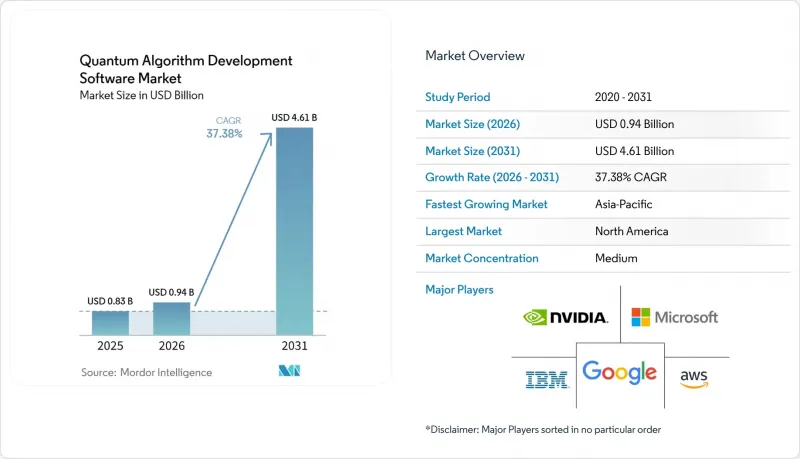
Mordor Intelligence에 의하면, 양자 알고리즘 개발 소프트웨어 시장 규모는 2025년 8억 3,000만 달러로 평가되었고, 2026년 9억 4,000만 달러에서 2031년까지 46억 1,000만 달러로 확대될 것으로 예측되며, 2026-2031년 연평균 성장률(CAGR)은 37.38%를 나타낼 전망입니다.
본 보고서는 제품 유형별(양자 오류 완화·오류 정정 소프트웨어 등), 도입 형태별(온프레미스, 클라우드, 하이브리드), 용도별(양자 머신러닝, 암호화·보안 등), 최종 사용자 산업별(자동차 및 항공우주, 화학·소재 등), 지역별로 분류되어 있습니다. 시장 예측은 금액(달러) 기준으로 제시되어 있습니다.
세계의 양자 알고리즘 개발 소프트웨어 시장 동향 및 인사이트
민관 양자 투자 확대
공공 및 민간 자금 지원에 힘입어 양자 알고리즘 개발 소프트웨어 시장의 우선순위에 변화가 생기고 있습니다. 2026년 5월, 미국 상무부는 ‘CHIPS and Science Act’에 따라 9개 양자 기업에 총 20억 1,000만 달러 규모의 의향서(LOI)를 발표했습니다. 이 지원 패키지에는 IBM에 10억 달러, 그리고 Atom Computing, D-Wave, Quantinuum, Rigetti, PsiQuantum에 각각 1억 달러가 포함되었습니다. 이러한 지원은 하드웨어 목표와 소프트웨어 통합의 마일스톤을 연계하는 것으로, 양자 기술 스택 전반에 걸친 개발을 뒷받침하는 것입니다. 또한, IBM은 2026년 6월, 향후 5년간 100억 달러 이상을 양자 컴퓨팅에 투자하겠다고 밝혔습니다. 이 회사는 양자 개발자의 70% 가까이가 Qiskit을 이용하고 있으며, 4조 회 이상의 회로 실행이 이루어지고 있다고 밝히며, 개발자용 도구가 양자 알고리즘 개발 소프트웨어 시장에서 여전히 중심적인 역할을 하고 있는 이유를 설명했습니다. 또한 상무부의 이 프로그램을 통해 소프트웨어 공급업체는 통합 파트너 및 자금 지원을 받는 고객 프로그램에 대해 보다 명확한 정보를 얻을 수 있습니다.
양자 하드웨어에 대한 클라우드 네이티브 액세스
클라우드 제공을 통해 개발자는 극저온 시스템을 구매하거나 전용 장비를 유지 관리할 필요 없이 양자 프로그램을 실행할 수 있습니다. IBM, Amazon Web Services 및 Microsoft는 2026년 중반까지 상용 양자 클라우드에 대한 접근을 제공했습니다. 이 모델을 통해 고객은 소프트웨어 개발 키트(SDK)나 서비스 인터페이스를 통해 실제 운영용 하드웨어에서 알고리즘을 테스트할 수 있게 됩니다. 2025년 매출의 72.49%를 클라우드가 차지하고 있는 것으로 나타나, 원격 접근이 이미 선호되는 도입 경로가 되었음을 보여줍니다. 2026년, Qiskit v2.5에서는 내결함성 컴파일을 위한 사전 설정 경로 관리자가 추가되었으며, 멀티스레드 트랜스파일러의 실행 기능이 확장되었습니다. 이러한 변경 사항으로 인해 대규모 회로 및 배치 워크로드의 컴파일 시간이 단축되었으며, 양자 알고리즘 개발 소프트웨어 시장에서 클라우드 기반 개발 환경의 실용적 가치가 향상되었습니다.
입증 가능한 양자 우위의 시기가 불투명
상업적으로 의미 있는 문제에서 재현 가능한 양자 우위가 확인되지 않은 점은 양자 알고리즘 개발 소프트웨어 시장에서 기업의 구매 결정을 계속해서 지연시키고 있습니다. 대규모 조직에서는 더 광범위한 도입을 위한 예산을 승인하기 전에 가치 입증을 요구하는 경우가 많습니다. 그러나 신뢰할 수 있는 가치 입증 파일럿을 수행하려면 의미 있는 테스트를 실행할 수 있는 충분한 소프트웨어 기능과 기술 자원이 필요합니다. 이로 인해 연구개발 예산이 풍부한 얼리 어답터에게 유리한 선순환이 형성되고 있습니다. DARPA의 ‘양자 벤치마킹 이니셔티브’는 양자 기술의 유용성에 대한 보다 엄격한 평가를 지원하는 것을 목표로 합니다. PsiQuantum사는 유틸리티 규모의 양자 컴퓨팅으로의 상업적 진입 경로를 평가하기 위해 1억 2,500만 달러 규모의 계약을 확대하여 수주했으나, 더 광범위한 보급을 위해서는 여전히 독립적인 검증이 필요합니다. 관련 문제 영역에서의 결과가 벤치마크를 통해 확인되기 전까지는 양자 알고리즘 개발 소프트웨어 시장은 광범위한 기업의 조달보다는 기술 선도 기업에 대한 의존도가 더 높아질 것입니다.
부문 분석
2025년, 양자 알고리즘 개발 플랫폼 및 SDK는 양자 알고리즘 개발 소프트웨어 시장 매출의 56.77%를 차지했습니다. 이 점유율은 개발자용 소프트웨어가 양자 알고리즘 개발 소프트웨어 시장에서 주요한 상업적 진입점임을 보여줍니다. Qiskit, PennyLane, TKET 및 Cirq는 개발자가 하드웨어 성능을 평가하는 데 필요한 프로그래밍, 컴파일 및 실행 기능을 제공합니다. 이러한 역할은 회로 기술에 그치지 않고, 사용자가 장치를 선택하고, 워크로드를 관리하며, 결과를 해석하는 방식에도 영향을 미치고 있습니다. 양자 시뮬레이션 소프트웨어, 최적화 소프트웨어 및 컴파일 도구는 보다 구체적인 기능을 필요로 하는 연구개발 중심의 기업 및 학술 팀에 도움이 되고 있습니다.
양자 오류 완화 및 오류 정정 소프트웨어는 2031년까지 연평균 성장률(CAGR) 38.45%를 나타낼 것으로 예측됩니다. 이 제품군의 양자 알고리즘 개발 소프트웨어 시장 규모는 상당한 노이즈와 제한된 충실도를 가진 하드웨어에서 실용적인 회로 결과를 얻어야 할 필요성과 밀접하게 관련되어 있습니다. NVIDIA는 2026년, 자사의 ‘Ising Decoder’가 컬러 코드의 논리 오류율에서 347.7배 이상의 개선을 달성했다고 보고했습니다. 또한 IBM은 회로에 하드웨어 효율이 뛰어난 오류 감지 루프를 자동으로 추가하는 NISQ 지원 도구 ‘Qiskit Paulice’를 출시했습니다. 이러한 진전은 오류 관리가 단순한 선택적 기능이 아니라 플랫폼의 핵심 요소로 자리 잡고 있는 이유를 보여줍니다. 한국의 Qunova Computing과 일본의 Quemix도 내결함성 알고리즘 분야에서 초기 수출 역량을 구축하고 있으며, 아시아태평양은 전문 제품공급원으로서 역할을 수행하고 있습니다.
2025년 양자 알고리즘 개발 소프트웨어 시장 매출 중 클라우드가 72.49%를 차지했습니다. 따라서 양자 알고리즘 개발 소프트웨어 시장은 극저온 인프라를 구매하거나 전용 물리 시스템을 운영하지 않고도 프로세서에 접근할 수 있다는 점에 의해 크게 형성되었습니다. 고객은 서비스에 가입하여 사용량에 따라 회로 실행 요금을 지불할 수 있습니다. 이러한 접근 방식은 초기 실험에 수반되는 재정적 부담을 줄여줍니다. 또한, 연구개발 및 비즈니스 팀이 서로 다른 시설에 위치해 있더라도 동일한 원격 접근 가능한 리소스 세트를 사용하여 작업을 수행할 수 있게 됩니다.
하이브리드 배포는 2026-2031년 연평균 성장률(CAGR) 39.07%를 나타낼 것으로 예측됩니다. 현재의 프로세서는 데이터 준비, 오류 사후 선별, 워크플로우 제어, 결과 해석 측면에서 여전히 고전적 시스템에 의존하고 있습니다. KQC는 2026년 6월, 금융, 소재, 물류 분야의 문제 모델링, 솔버 선택 및 실행을 수행하는 양자 AI 하이브리드 플랫폼인 ‘Qubiteer’를 출시했습니다. 이번 출시는 각 공급업체들이 하이브리드 운영을 단순한 개별 양자 구성 요소가 아닌 완전한 워크플로우로 제시하고 있음을 보여줍니다. 에어 갭 요건을 갖춘 정부 기관이나 방위 관련 기업의 경우, 온프레미스 배포가 여전히 소규모의 선택지로 남아 있습니다. 하이브리드의 성장이 반드시 클라우드 이용을 감소시키는 것은 아니며, 클라우드 시스템이 이러한 통합 워크플로우의 실행 기반으로서 점점 더 중요한 역할을 하고 있기 때문입니다.
지역별 분석
2025년, 북미는 양자 알고리즘 개발 소프트웨어 시장의 37.11% 점유율을 차지했습니다. 연방 정부 프로그램, 클라우드 플랫폼의 집중, 그리고 금융 서비스 및 정부 부문의 초기 수요가 이러한 위상을 뒷받침했습니다. ‘국가 양자 이니셔티브 법(National Quantum Initiative Act)’ 및 DARPA의 ‘양자 벤치마킹 이니셔티브(Quantum Benchmarking Initiative)’는 이 지역의 활동에 대한 지속적인 정책 프레임워크를 제공했습니다. 2026년 5월, 상무부는 9개 양자 기업에 대해 총 20억 1,000만 달러 규모의 의향서(LOI)를 발표했습니다. 이 지원 패키지에는 IBM에 10억 달러가 배정될 예정이었으며, 소프트웨어 통합의 주요 단계 달성에 연동된 자금 지원이 포함되어 있었습니다. 또한 IBM Quantum, Amazon Web Services Braket, Microsoft Azure Quantum도 사용자에게 주요 클라우드 기반 개발 환경에 대한 접근을 제공했습니다. 미국은 해당 지역 내에서 가장 큰 단일 수요국이었으나, 캐나다는 Xanadu, 1QBit, Agnostiq, Multiverse Computing을 통해 소프트웨어 및 하드웨어 역량을 강화했습니다.
2025년에는 유럽이 중요한 2위 점유율을 차지했습니다. 이 지역에서는 독일, 영국, 프랑스, 이탈리아가 활동의 주요 거점이 되었습니다. Classiq와 TEA TEK Group은 2026년 6월, 나폴리에 양자 컴퓨팅 허브를 설립하기 위해 수백만 유로 규모의 제휴를 발표했습니다. 이 이니셔티브는 유럽연합(EU) 전역의 양자 소프트웨어 연구 및 서비스를 대상으로 합니다. 영국은 2025년 4월, 양자 기술에 1억 2,100만 파운드(1억 5,400만 달러)를 투자하기로 결정했습니다. 이 자금은 부정 행위 감지 및 금융 범죄 대책에 적용하기 위한 것입니다. 또한, 2024년 4월 유럽연합이 발표한 ‘양자 보안 디지털 인프라 조정에 관한 양해각서’에 따라 암호화 소프트웨어 조달에 대한 관심도 높아졌습니다.
아시아태평양은 2031년까지 연평균 성장률(CAGR) 38.10%로 확대될 것으로 예측됩니다. 이러한 성장률로 인해 해당 지역은 양자 알고리즘 개발 소프트웨어 시장에서 가장 빠르게 성장하는 지역이 되었습니다. 일본은 특정 산업용도 및 국내 소프트웨어 개발 역량 강화를 위해 공공 자금과 기업 자본을 투입하고 있습니다. 리켄(RIKEN)은 2026년 3월, 오사카대학의 양자정보·양자생물학연구소와 공동으로 업그레이드된 양자 컴퓨터 클라우드 서비스 ‘Ei-II’를 재출시했습니다. 이 서비스를 통해 산업계 및 학계에서 알고리즘 연구에 대한 접근성이 확대되었습니다. 미즈호 리스는 2025년 4월, 내결함성 알고리즘 연구를 목적으로 Quemix사에 출자했으며, 한편 IPA의 2026년도 ‘Mitou Target’ 프로그램은 양자 소프트웨어 개발을 지원했습니다. Classiq와 QAI는 2026년 7월 한국에서 ‘Quantum-as-a-Service’ 현지 서비스를 시작했습니다. 남미, 중동 및 아프리카는 여전히 초기 단계에 있는 지역이었으나, 브라질에서는 기관들의 관심이 가장 높았으며, 사우디아라비아 중앙은행(SAMA)은 Multiverse Computing과 공동으로 중앙은행 결제 시스템을 위한 양자 최적화를 검토했습니다.
기타 혜택 :
- 엑셀 형식 시장 예측(ME) 시트
- 3개월간의 애널리스트 지원
자주 묻는 질문
목차
제1장 서론
제2장 조사 방법
제3장 개요
제4장 시장 구도
제5장 시장 규모 및 성장 예측
제6장 경쟁 구도
제7장 시장 기회 및 향후 전망
AJY 26.09.01According to Mordor Intelligence, the quantum algorithm development software market size is projected to expand from USD 0.83 billion in 2025 and USD 0.94 billion in 2026 to USD 4.61 billion by 2031, registering a CAGR of 37.38% between 2026 and 2031.
This report is Segmented by Product Type (Quantum Error Mitigation and Error Correction Software, and More), Deployment Mode (On-Premises, Cloud, and Hybrid), Application (Quantum Machine Learning, Cryptography and Security, and More), End-User Industry (Automotive and Aerospace, Chemicals and Materials, and More), and Geography. The Market Forecasts are Provided in Terms of Value (USD).
Global Quantum Algorithm Development Software Market Trends and Insights
Public and Private Quantum Investment Expansion
Public and private funding are changing the priorities of the quantum algorithm development software market. In May 2026, the U.S. Department of Commerce announced USD 2.01 billion in letters of intent for 9 quantum companies under the CHIPS and Science Act. The package included USD 1 billion for IBM and USD 100 million each for Atom Computing, D-Wave, Quantinuum, Rigetti, and PsiQuantum. The commitments tied hardware targets to software integration milestones, which support development across the quantum technology stack. IBM also committed more than USD 10 billion to quantum computing over 5 years in June 2026. The company stated that Qiskit was used by nearly 70% of quantum developers and had executed more than 4 trillion circuits, showing why developer tools remain central to the quantum algorithm development software market. The Department of Commerce program also gives software suppliers a clearer set of integration partners and funded customer programs.
Cloud-Native Access to Quantum Hardware
Cloud delivery lets developers run quantum programs without buying cryogenic systems or maintaining specialized equipment. IBM, Amazon Web Services, and Microsoft offered commercial quantum cloud access by mid-2026. This model enables customers to test algorithms on production hardware through software development kits and service interfaces. Cloud accounted for 72.49% of 2025 revenue, indicating that remote access was already the preferred deployment route. Qiskit v2.5 added preset pass managers for fault-tolerant compilation and expanded multithreaded transpiler execution in 2026. These changes reduced compilation time for larger circuits and batch workloads, improving the practical value of the quantum algorithm development software market's cloud-based development environments.
Uncertain Timing of Demonstrable Quantum Advantage
The lack of a reproducible quantum advantage on commercially meaningful problems continues to delay enterprise buying decisions in the quantum algorithm development software market. Large organizations often require proof of value before approving budgets for wider deployment. Yet credible proof-of-value pilots require sufficient software capabilities and technical resources to run meaningful tests. This creates a cycle that favors early adopters with larger research budgets. DARPA's Quantum Benchmarking Initiative is intended to support more rigorous evaluation of quantum utility. PsiQuantum received an expanded USD 125 million agreement to assess commercial routes to utility-scale quantum computing, but independent validation remains necessary for wider adoption. Until benchmarks confirm results on relevant problem classes, the quantum algorithm development software market will rely more heavily on technology leaders than on broad enterprise procurement.
Other drivers and restraints analyzed in the detailed report include:
- Industry Demand for Optimization and Simulation
- Post-Quantum Cryptography Migration Requirements
- Hardware Architecture Fragmentation and Limited Portability
For complete list of drivers and restraints, kindly check the Table Of Contents.
Segment Analysis
Quantum Algorithm Development Platforms and SDKs accounted for 56.77% of the quantum algorithm development software market revenue in 2025. This share showed that developer-facing software was the main commercial entry point for the quantum algorithm development software market. Qiskit, PennyLane, TKET, and Cirq provide the programming, compilation, and execution functions developers need to evaluate hardware performance. Their role is not limited to writing circuits because they also shape how users select devices, manage workloads, and interpret results. Quantum simulation software, optimization software, and compilation tools serve research-intensive enterprise and academic teams that need more targeted capabilities.
Quantum Error Mitigation and Error Correction Software is projected to grow at a 38.45% CAGR through 2031. The quantum algorithm development software market size for this product group is linked to the need for usable circuit results on hardware with meaningful noise and limited fidelity. NVIDIA reported in 2026 that its Ising Decoder delivered more than 347.7x improvement in logical error rates for color codes. IBM also released Qiskit Paulice, a NISQ-compatible tool that automatically adds hardware-efficient error-detection loops to circuits. These developments show why error management is becoming a core part of a platform rather than an optional feature. Qunova Computing in South Korea and Quemix in Japan are also building early export capabilities in fault-tolerant algorithms, giving the Asia-Pacific a role as a supplier of specialized products.
Cloud accounted for 72.49% of the revenue in the quantum algorithm development software market in 2025. The quantum algorithm development software market was therefore strongly shaped by the ability to access processors without buying cryogenic infrastructure or operating a dedicated physical system. Customers can subscribe to services and pay for circuit execution based on their usage. This approach reduces the financial commitment associated with early experimentation. It also allows research, development, and business teams to work with the same set of remotely accessible resources, even when they are located in different facilities.
Hybrid deployment is projected to grow at a 39.07% CAGR between 2026 and 2031. Current processors still rely on classical systems for data preparation, error post-selection, workflow control, and result interpretation. KQC launched Qubiteer in June 2026 as a quantum AI hybrid platform for problem modeling, solver selection, and execution across finance, materials, and logistics. The launch showed how suppliers are presenting hybrid operations as complete workflows rather than as a standalone quantum component. On-premises deployment remains a smaller option for government agencies and defense contractors with air-gap requirements. Hybrid growth does not necessarily reduce cloud use, as cloud systems increasingly serve as the execution backbone for these combined workflows.
Complete Report Scope:
- By Product Type
- Quantum Algorithm Development Platforms and SDKs
- Quantum Simulation Software
- Quantum Algorithm Optimization and Compilation Software
- Quantum Error Mitigation and Error Correction Software
- Other Product Types
- By Deployment Mode
- On-Premises
- Cloud
- Hybrid
- By Application
- Optimization
- Simulation and Modeling
- Quantum Machine Learning
- Cryptography and Security
- Other Applications
- By End-User Industry
- Banking, Financial Services, and Insurance (BFSI)
- Pharmaceutical and Biotechnology
- Government and Defense
- Automotive and Aerospace
- Chemicals and Materials
- Energy and Utilities
- Education and Research Institutions
- Other End-User Industries
- By Geography
- North America
- United States
- Canada
- Mexico
- South America
- Brazil
- Argentina
- Rest of South America
- Europe
- Germany
- United Kingdom
- France
- Italy
- Spain
- Russia
- Rest of Europe
- Asia-Pacific
- China
- Japan
- India
- South Korea
- Australia and New Zealand
- Rest of Asia-Pacific
- Middle East
- Saudi Arabia
- United Arab Emirates
- Turkey
- Rest of Middle East
- Africa
- South Africa
- Nigeria
- Rest of Africa
- North America
Geography Analysis
North America held 37.11% of the quantum algorithm development software market share in 2025. Federal programs, the concentration of cloud platforms, and early demand from financial services and government underpinned this position. The National Quantum Initiative Act and DARPA's Quantum Benchmarking Initiative provided a continuing policy framework for regional activity. In May 2026, the Department of Commerce announced USD 2.01 billion in letters of intent for 9 quantum companies. The package included an intended USD 1 billion allocation for IBM and connected funding to software integration milestones. IBM Quantum, Amazon Web Services Braket, and Microsoft Azure Quantum also gave users access to major cloud-based development environments. The United States was the largest single regional consumer, while Canada added software and hardware capabilities through Xanadu, 1QBit, Agnostiq, and Multiverse Computing.
Europe held a meaningful secondary share in 2025. Germany, the United Kingdom, France, and Italy were major centers of activity in the region. Classiq and TEA TEK Group announced a multi-million-euro partnership in June 2026 to establish a quantum computing hub in Naples. The initiative targets quantum software research and services across the European Union. The United Kingdom committed GBP 121 million (USD 154 million) to quantum technology in April 2025. The funding targeted fraud detection and financial crime applications. The European Union's April 2024 memorandum on coordinated quantum-safe digital infrastructure also increased attention on the procurement of cryptographic software.
Asia-Pacific is projected to expand at a 38.10% CAGR through 2031. This rate makes it the fastest-growing regional part of the quantum algorithm development software market. Japan is directing public funding and corporate capital toward specific industrial applications and domestic software capability. RIKEN relaunched the upgraded Ei-II quantum computer cloud service in March 2026 with Osaka University's Quantum Information and Quantum Biology Institute. The service broadened access for industrial and academic algorithm research. Mizuho Lease invested in Quemix in April 2025 for research on fault-tolerant algorithms, while the IPA 2026 Mitou Target program supported quantum software development. Classiq and QAI established a local Quantum-as-a-Service offering in South Korea in July 2026. South America, the Middle East, and Africa remained early-stage regions, although Brazil led institutional interest and Saudi Arabia's SAMA explored quantum optimization for central bank settlement systems with Multiverse Computing.
- IBM Corporation
- Google LLC
- Microsoft Corporation
- Amazon Web Services, Inc.
- NVIDIA Corporation
- Quantinuum Limited
- Xanadu Quantum Technologies Inc.
- IonQ, Inc.
- D-Wave Quantum Inc.
- Rigetti Computing, Inc.
- Q-CTRL Pty Ltd
- Riverlane Limited
- Classiq Technologies Ltd.
- QC Ware Corp.
- Zapata Computing Holdings Inc.
- 1QBit Information Technologies Inc.
- Algorithmiq Inc.
- Strangeworks, Inc.
- Phasecraft Limited
- Entropica Labs Pte. Ltd.
- ProteinQure Inc.
- Agnostiq Inc.
- Multiverse Computing S.L.
- Terra Quantum AG
- BlueQubit, Inc.
Additional Benefits:
- The market estimate (ME) sheet in Excel format
- 3 months of analyst support
TABLE OF CONTENTS
1 INTRODUCTION
- 1.1 Study Assumptions and Market Definition
- 1.2 Scope of the Study
2 RESEARCH METHODOLOGY
3 EXECUTIVE SUMMARY
4 MARKET LANDSCAPE
- 4.1 Market Overview
- 4.2 Market Drivers
- 4.2.1 Public and Private Quantum Investment Expansion
- 4.2.2 Cloud-Native Access to Quantum Hardware
- 4.2.3 Industry Demand for Optimization and Simulation
- 4.2.4 Post-Quantum Cryptography Migration Requirements
- 4.2.5 Hybrid Quantum-Classical Workflow Adoption
- 4.2.6 Hardware-Aware Software Innovation for NISQ and Fault-Tolerant Systems
- 4.3 Market Restraints
- 4.3.1 Uncertain Timing of Demonstrable Quantum Advantage
- 4.3.2 Hardware Architecture Fragmentation and Limited Portability
- 4.3.3 Quantum Talent Scarcity and High Training Costs
- 4.3.4 Benchmarking Difficulty and Unclear Return on Investment
- 4.4 Industry Value Chain Analysis
- 4.5 Regulatory Landscape
- 4.6 Technological Outlook
- 4.7 Impact of Macroeconomic Factors on the Market
- 4.8 Porter's Five Forces Analysis
- 4.8.1 Threat of New Entrants
- 4.8.2 Bargaining Power of Suppliers
- 4.8.3 Bargaining Power of Buyers
- 4.8.4 Threat of Substitutes
- 4.8.5 Intensity of Competitive Rivalry
5 MARKET SIZE AND GROWTH FORECASTS (VALUE)
- 5.1 By Product Type
- 5.1.1 Quantum Algorithm Development Platforms and SDKs
- 5.1.2 Quantum Simulation Software
- 5.1.3 Quantum Algorithm Optimization and Compilation Software
- 5.1.4 Quantum Error Mitigation and Error Correction Software
- 5.1.5 Other Product Types
- 5.2 By Deployment Mode
- 5.2.1 On-Premises
- 5.2.2 Cloud
- 5.2.3 Hybrid
- 5.3 By Application
- 5.3.1 Optimization
- 5.3.2 Simulation and Modeling
- 5.3.3 Quantum Machine Learning
- 5.3.4 Cryptography and Security
- 5.3.5 Other Applications
- 5.4 By End-User Industry
- 5.4.1 Banking, Financial Services, and Insurance (BFSI)
- 5.4.2 Pharmaceutical and Biotechnology
- 5.4.3 Government and Defense
- 5.4.4 Automotive and Aerospace
- 5.4.5 Chemicals and Materials
- 5.4.6 Energy and Utilities
- 5.4.7 Education and Research Institutions
- 5.4.8 Other End-User Industries
- 5.5 By Geography
- 5.5.1 North America
- 5.5.1.1 United States
- 5.5.1.2 Canada
- 5.5.1.3 Mexico
- 5.5.2 South America
- 5.5.2.1 Brazil
- 5.5.2.2 Argentina
- 5.5.2.3 Rest of South America
- 5.5.3 Europe
- 5.5.3.1 Germany
- 5.5.3.2 United Kingdom
- 5.5.3.3 France
- 5.5.3.4 Italy
- 5.5.3.5 Spain
- 5.5.3.6 Russia
- 5.5.3.7 Rest of Europe
- 5.5.4 Asia-Pacific
- 5.5.4.1 China
- 5.5.4.2 Japan
- 5.5.4.3 India
- 5.5.4.4 South Korea
- 5.5.4.5 Australia and New Zealand
- 5.5.4.6 Rest of Asia-Pacific
- 5.5.5 Middle East
- 5.5.5.1 Saudi Arabia
- 5.5.5.2 United Arab Emirates
- 5.5.5.3 Turkey
- 5.5.5.4 Rest of Middle East
- 5.5.6 Africa
- 5.5.6.1 South Africa
- 5.5.6.2 Nigeria
- 5.5.6.3 Rest of Africa
- 5.5.1 North America
6 COMPETITIVE LANDSCAPE
- 6.1 Market Concentration
- 6.2 Strategic Moves
- 6.3 Market Share Analysis
- 6.4 Company Profiles (includes Global Level Overview, Market Level Overview, Core Segments, Financials as available, Strategic Information, Market Rank/Share, Products and Services, Recent Developments)
- 6.4.1 IBM Corporation
- 6.4.2 Google LLC
- 6.4.3 Microsoft Corporation
- 6.4.4 Amazon Web Services, Inc.
- 6.4.5 NVIDIA Corporation
- 6.4.6 Quantinuum Limited
- 6.4.7 Xanadu Quantum Technologies Inc.
- 6.4.8 IonQ, Inc.
- 6.4.9 D-Wave Quantum Inc.
- 6.4.10 Rigetti Computing, Inc.
- 6.4.11 Q-CTRL Pty Ltd
- 6.4.12 Riverlane Limited
- 6.4.13 Classiq Technologies Ltd.
- 6.4.14 QC Ware Corp.
- 6.4.15 Zapata Computing Holdings Inc.
- 6.4.16 1QBit Information Technologies Inc.
- 6.4.17 Algorithmiq Inc.
- 6.4.18 Strangeworks, Inc.
- 6.4.19 Phasecraft Limited
- 6.4.20 Entropica Labs Pte. Ltd.
- 6.4.21 ProteinQure Inc.
- 6.4.22 Agnostiq Inc.
- 6.4.23 Multiverse Computing S.L.
- 6.4.24 Terra Quantum AG
- 6.4.25 BlueQubit, Inc.
7 MARKET OPPORTUNITIES AND FUTURE OUTLOOK
- 7.1 White-Space and Unmet-Need Assessment


