

|
시장보고서
상품코드
2118956
부식 방지 코팅 시장 : 시장 점유율 분석, 업계 동향 및 통계, 성장 예측(2026-2031년)Corrosion Protection Coating - Market Share Analysis, Industry Trends & Statistics, Growth Forecasts (2026 - 2031) |
||||||
 Mordor Intelligence
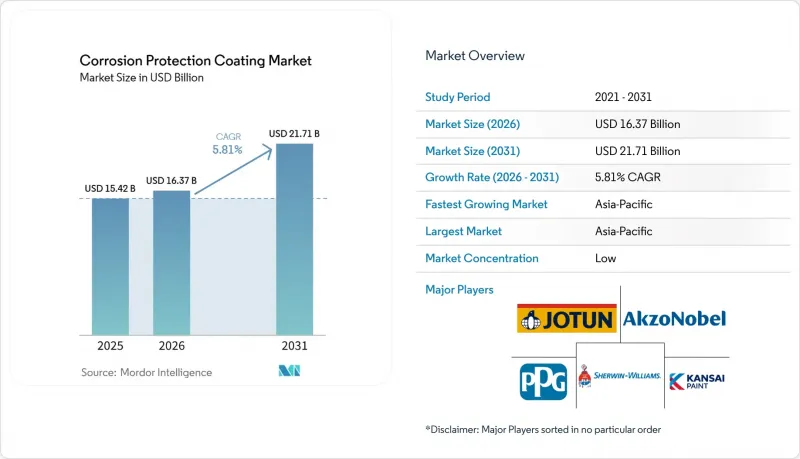
Mordor Intelligence에 의하면, 부식 방지 코팅 시장 규모는 2025년에 154억 2,000만 달러로 평가되었고, 예측 기간(2026-2031년) CAGR 5.81%로 확대될 것으로 예측되며, 2026년 163억 7,000만 달러에서 2031년에는 217억 1,000만 달러에 이를 전망입니다.
본 보고서는 수지 유형별(에폭시, 폴리우레탄 등), 기술별(수성, 용제계 등), 최종 사용자 산업별(선박, 석유 및 가스 등), 지역별(아시아태평양, 북미, 유럽, 남미, 중동 및 아프리카)로 분류되어 있습니다. 시장 전망은 금액(달러) 기준으로 제시되어 있습니다.
세계의 부식 방지 코팅 시장 동향 및 인사이트
인프라 개보수 및 유지 관리 활동에 대한 투자 확대
인프라 개보수는 여전히 여러 지역에서 부식 방지 코팅 수요를 견인하는 확실한 요인으로 작용하고 있습니다. 교량, 수처리 시설, 항만, 공항, 도로의 개보수에는 프로젝트 사양에 기반한 보호 시스템이 필요합니다. 교량의 철골이나 파이프라인망은 건설 후 유지보수가 필요하기 때문에 재도장 프로그램이 지속적인 수요를 창출하고 있습니다. 또한, 기존 구조물의 경우 신규 자산에 비해 더 복잡한 표면 처리, 봉쇄 대책 및 환경 관리가 필요합니다. 이러한 상황은 향후 가동 중단 위험을 줄이는 데 도움이 되는 고두께 에폭시 프라이머 및 폴리우레탄 탑코트의 사용을 촉진할 가능성이 있습니다. 동남아시아 및 걸프협력회의(GCC) 지역에서도 진행 중인 인프라 개발을 통해 초기 도장 수요가 증가하고 있습니다.
해상 풍력, 해양, 연안 인프라의 확장이 방청 코팅 수요를 견인
해상 풍력 발전은 가혹한 해양 환경 속에서 부식 방지 코팅 시장을 확대되고 있습니다. 전 세계 해상 풍력 발전 용량은 2025년에 57GW에 도달하고, 2030년까지 120GW를 넘어설 것으로 예측됩니다. 모노파일, 트랜지션 피스 및 어레이 간 케이블에는 수중 및 대기 환경에서 25년간의 노출을 견딜 수 있도록 설계된 시스템이 필요합니다. 이러한 요구 사항으로 인해 프리미엄급 아연, 에폭시, 폴리우레탄계 코팅 시스템이 선호되고 있으며, 이 시스템들은 표준 대기 환경 사양에 비해 30%에서 40% 더 높은 가격으로 책정되어 있습니다. 2010년대 중반에 설치된 북해 프로젝트는 대규모 유지보수 주기에 접어들고 있으며, 신규 건설에 더해 애프터마켓 수요도 증가하고 있습니다. 침식 방지 블레이드 보호에 관한 DNV-ST-0437의 요구 사항은 인증된 전문 제품을 보유한 공급업체를 우대하는 것입니다.
보호 코팅 시스템의 높은 표면 처리 및 도포 비용
복잡한 산업용 및 해양 개보수 공사에서 표면 처리는 첫 번째 코팅층을 도포하기 전에 총 비용의 40%에서 60%를 차지할 수 있습니다. 블라스팅 세척, 격리 조치, 환경 규제 준수 및 접근용 장비는 설치되는 보호 시스템의 총 비용을 상승시킵니다. 이 과제는 제한된 가동 중단 기간 동안 오래된 도막을 제거해야 하는 경우 더욱 두드러집니다. 북미와 유럽의 현장 인건비 급등으로 인해, 자산의 설계상 사용이 허용되는 경우 공장 도장 시스템이 더욱 매력적인 선택지가 되고 있습니다. 수성 공장용 프라이머를 사용하면 신축 철강재에 대한 현장 샌드블라스팅 처리의 필요성을 어느 정도 줄일 수 있지만, 기존 자산의 개보수 시 비용 구조는 변하지 않습니다. 소규모 사업자의 경우, 규격에 부합하는 시스템 도입 비용이 단기 예산을 초과할 때 재도장을 미루는 경우가 있으며, 그 결과 향후 수리나 교체 필요성이 높아지게 됩니다.
부문 분석
에폭시는 광범위한 부식 범주에서의 사용에 힘입어 2025년 부식 방지 코팅 시장 점유율의 39.92%를 차지했습니다. 이는 C3 대기 노출 환경부터 C5-M 해양 환경에 이르기까지, ISO 12944 및 NORSOK M-501에 승인된 시스템 라이브러리에서 확립되어 있습니다. 폴리우레탄은 일반적으로 에폭시 프라이머의 상도 코팅으로 사용되며, 자외선 저항성과 우수한 표면 마감 성능을 제공합니다. 이러한 조합은 해양 및 인프라 프로젝트에서 고품질의 다층 도장 사양을 뒷받침하고 있습니다. 아크릴 및 알키드 제품은 가격이 더 큰 영향을 미치는 수요가 낮은 C2 및 C3 용도에서 여전히 중요한 위치를 차지하고 있습니다. 이들은 일반 건설 및 경공업 유지보수 분야에서 일반적으로 사용됩니다.
비닐 에스테르는 2031년까지 연평균 성장률(CAGR) 6.73%를 나타낼 것으로 예측되며, 이는 수지 유형 중 가장 높은 성장률입니다. 비닐 에스테르 부식 방지 코팅 시장은 에폭시 코팅의 일반적인 사용 범위를 넘어서는 화학 물질 침지 관련 용도에서 혜택을 받고 있습니다. 배연 탈황 장치, 산 포집 설비 및 해수 담수화 설비가 주요 이용 사례입니다. 2026년에 발표된 조사에 따르면, 배합 에폭시 수지는 10 MPa의 수소 차단 성능을 발휘하는 반면, 비닐 에스테르 수지는 수소와 습기에 복합적으로 노출된 환경에서 더 우수한 성능을 보이는 것으로 밝혀졌습니다. 이러한 성능 차이는 수소 저장 및 수송 설비의 코팅 사양에 영향을 미칠 가능성이 있습니다. 염화고무는 여전히 틈새 시장인 선박용 프라이머로 사용되고 있지만, 실리콘 및 불소 수지 제품은 극한 온도 환경이나 단열재 하부 부식(CIU) 환경에서 사용이 확대되고 있습니다.
지역별 분석
2025년, 아시아태평양은 부식 방지 코팅 시장의 42.71%를 차지한 것으로 평가되었으며, 2031년까지 연평균 성장률(CAGR) 6.32%로 성장할 것으로 전망됩니다. 중국은 조선, 해상 풍력 발전, 액화천연가스(LNG) 터미널, 석유화학 단지를 견인력으로 삼아 해당 지역 소비량의 56% 이상을 차지했습니다. 그린 수소 개발은 기존 선박 및 석유 및 가스 분야 수요를 가속화하고 있습니다. 한국과 일본은 상업용 조선 및 선체, 밸러스트 탱크, 상부 구조물용 코팅 시스템에 대한 수요를 통해 시장에 기여하고 있습니다. 인도는 인프라 투자와 석유화학 생산 능력 확대를 통해 수요를 견인하고 있으며, 사양은 고성능 제품으로 전환되고 있습니다.
북미와 유럽은 각각 서로 다르지만 안정적인 수요 기반을 갖추고 있습니다. 미국의 인프라 지출은 교량, 수로, 수자원 관련 자산의 유지 관리 작업을 뒷받침하고 있는 반면, 정유시설 및 파이프라인의 턴어라운드 작업이 산업 용도료 수요를 견인하고 있습니다. 유럽연합(EU)의 2030년 재생에너지 목표에 따라 북해 및 발트해의 해상 풍력 발전 프로젝트에 대한 수요가 집중되고 있습니다. 2025년, 헴펠(Hempel)사는 부식 방지 용도의 ‘Avantguard 750 Pro’를 출시했습니다. 독일, 영국, 프랑스, 이탈리아는 산업용 유지보수 작업의 주요 거점으로 자리 잡고 있습니다.
남미, 중동 및 아프리카는 부식 방지 코팅 시장에서 비교적 낮은 점유율을 차지하고 있습니다. 브라질과 아르헨티나에서는 파이프라인 개보수 및 해양 프리솔트층 개발이 진행 중이며, 자산 유지보수 작업에서 침수 구역용 및 단열재 하부 부식 방지 시스템이 요구되고 있습니다. 사우디아라비아의 ‘비전 2030’ 프로그램과 걸프협력회의(GCC) 전역에 걸친 석유화학 산업의 확장이 내열성 및 내화학성 시스템에 대한 수요를 뒷받침하고 있습니다. 남아프리카 및 기타 사하라 이남 아프리카 국가들에서는 광업 인프라, 항만, 수처리 프로젝트를 통해 수요가 발생하고 있습니다. 이러한 시장에서는 국제 표준을 준수하는 1차 도장 사양이 점점 더 많이 채택되고 있습니다.
기타 혜택 :
- 엑셀 형식 시장 예측(ME) 시트
- 3개월간의 애널리스트 지원
자주 묻는 질문
목차
제1장 서론
제2장 조사 방법
제3장 개요
제4장 시장 구도
제5장 시장 규모 및 성장 예측
제6장 경쟁 구도
제7장 시장 기회 및 향후 전망
AJY 26.09.01According to Mordor Intelligence, the corrosion protection coating market size was estimated at USD 15.42 billion in 2025 and is projected to grow from USD 16.37 billion in 2026 to USD 21.71 billion by 2031, at a CAGR of 5.81% during the forecast period (2026-2031).
This report is Segmented by Resin Type (Epoxy, Polyurethane, and More), Technology (Water-Based, Solvent-Based, and More), End-User Industry (Marine, Oil and Gas, and More), and Geography (Asia-Pacific, North America, Europe, South America, and Middle-East and Africa). The Market Forecasts are Provided in Terms of Value (USD).
Global Corrosion Protection Coating Market Trends and Insights
Increasing Investments in Infrastructure Rehabilitation and Maintenance Activities
Infrastructure rehabilitation remains a reliable driver of demand for corrosion protection coatings across several regions. Bridge, water treatment, port, airport, and road upgrades require protective systems under project specifications. Recoating programs create recurring demand because bridge steel and pipeline networks require maintenance after their initial construction. Existing structures also require more complex surface preparation, containment, and environmental controls than new assets. These conditions can encourage the use of high-build epoxy primers and polyurethane topcoats, which help limit future shutdown risk. Southeast Asia and the Gulf Cooperation Council also add first-coat demand through ongoing infrastructure development.
Expansion of Offshore Wind, Marine, and Coastal Infrastructure Driving Demand for Protective Coatings
Offshore wind is expanding the corrosion protection coating market in a demanding marine application. Global offshore wind capacity reached 57 GW in 2025 and is expected to exceed 120 GW by 2030. Monopiles, transition pieces, and inter-array cabling need systems designed for 25-year exposure in immersion and atmospheric conditions. These requirements support premium zinc, epoxy, and polyurethane systems, which command a 30% to 40% premium over standard atmospheric specifications. North Sea projects installed during the mid-2010s are approaching major maintenance cycles, adding aftermarket demand beyond new construction. DNV-ST-0437 requirements for erosion-resistant blade protection favor suppliers with qualified specialist products.
High Surface Preparation and Application Costs for Protective Coating Systems
Surface preparation can account for 40% to 60% of the total cost of complex industrial and offshore rehabilitation work before the first coat is applied. Blast cleaning, containment, environmental compliance, and access equipment increase the overall cost of installed protective systems. This challenge is more pronounced when old coatings must be removed during limited operating shutdowns. Rising field labor costs in North America and Europe make shop-applied systems more attractive where asset design permits their use. Waterborne shop primers can reduce some field sandblasting requirements for new steel, but they do not change the cost structure of existing asset rehabilitation. Smaller operators may defer recoating when compliant systems exceed their short-term budgets, increasing the need for later repairs or replacements.
Other drivers and restraints analyzed in the detailed report include:
- Rising Adoption of Low-VOC and Water-Based Coating Technologies to Meet Environmental Regulations
- Advancements in Smart Coatings and Predictive Asset Monitoring Technologies
- Volatility in Raw Material Prices, Including Epoxy Resins and Solvents
For complete list of drivers and restraints, kindly check the Table Of Contents.
Segment Analysis
Epoxy held 39.92% of the corrosion protection coating market share in 2025, supported by its use across a wide range of corrosion categories. It is established in ISO 12944- and NORSOK M-501-approved system libraries, from C3 atmospheric exposure to C5-M offshore settings. Polyurethane typically serves as a topcoat over epoxy primers, providing ultraviolet resistance and improved surface finish performance. This combination supports premium multi-coat specifications in marine and infrastructure projects. Acrylic and alkyd products retain meaningful use in lower-demand C2 and C3 applications, where price has greater influence. Their use is common in general construction and light industrial maintenance.
Vinyl ester is forecast to record a 6.73% CAGR through 2031, the fastest rate among resin types. The corrosion protection coating market for vinyl ester benefits from applications involving chemical immersion beyond the typical operating range of epoxy coatings. Flue gas desulfurization equipment, acid containment, and desalination assets are important use cases. Research published in 2026 found that formulated epoxy can provide hydrogen-barrier protection at 10 MPa, while vinyl ester performs better under combined hydrogen and moisture exposure. This performance difference may influence coating specifications for hydrogen storage and transport assets. Chlorinated rubber remains a niche marine primer option, while silicone and fluoropolymer products are gaining use in extreme-temperature and corrosion-under-insulation settings.
Complete Report Scope:
- By Resin Type
- Epoxy
- Polyurethane
- Acrylic
- Alkyd
- Vinyl Ester
- Chlorinated Rubber
- Other Resin Types
- By Technology
- Water-Based
- Solvent-Based
- Powder Coatings
- Other Technologies
- By End-User Industry
- Marine
- Oil and Gas
- Petrochemical
- Infrastructure
- Power Generation
- Water Treatment
- Other End-User Industries
- By Geography
- Asia-Pacific
- China
- India
- Japan
- South Korea
- Rest of Asia-Pacific
- North America
- United States
- Canada
- Mexico
- Europe
- Germany
- United Kingdom
- France
- Italy
- Russia
- Rest of Europe
- South America
- Brazil
- Argentina
- Rest of South America
- Middle-East and Africa
- Saudi Arabia
- South Africa
- Rest of Middle-East and Africa
- Asia-Pacific
Geography Analysis
Asia-Pacific accounted for 42.71% of the corrosion protection coating market in 2025 and is projected to grow at a CAGR of 6.32% through 2031. China represented more than 56% of regional consumption, driven by shipbuilding, offshore wind, Liquefied Natural Gas (LNG) terminals, and petrochemical complexes. Green hydrogen development is adding to existing marine and oil-and-gas demand. South Korea and Japan contribute through commercial shipbuilding and demand for hull, ballast tank, and superstructure coating systems. India adds volume through infrastructure investment and expanding petrochemical capacity, with specifications shifting toward higher-performance products.
North America and Europe have distinct but stable demand bases. Infrastructure disbursements in the United States support maintenance work on bridges, waterways, and water assets, while refinery and pipeline turnaround activity drives demand for industrial coatings. The European Union's renewable energy targets for 2030 are concentrating demand on offshore wind projects in the North and Baltic Seas. In 2025, Hempel introduced Avantguard 750 Pro for corrosion protection applications. Germany, the United Kingdom, France, and Italy remain key locations for industrial maintenance work.
South America, the Middle-East, and Africa hold smaller shares of the corrosion protection coating market. Brazil and Argentina benefit from pipeline rehabilitation and offshore pre-salt development, with asset integrity work requiring immersion-zone and corrosion-under-insulation systems. Saudi Arabia's Vision 2030 program and petrochemical expansion across the Gulf Cooperation Council support demand for high-temperature, chemical-resistant systems. South Africa and other sub-Saharan countries generate demand through mining infrastructure, ports, and water treatment projects. These markets are increasingly adopting first-coat specifications aligned with international standards.
- Akzo Nobel N.V.
- Ashland Inc.
- Asian Paints Limited
- Axalta Coating Systems Ltd.
- Berger Paints India Limited
- Carboline Company
- Hempel A/S
- Jotun
- Kansai Paint Co.,Ltd.
- KCC Corporation
- Nippon Paint Holdings Co., Ltd.
- PPG Industries, Inc.
- RPM International Inc.
- Sika AG
- Teknos Group
- The Sherwin-Williams Company
- Tnemec
- Wacker Chemie AG
Additional Benefits:
- The market estimate (ME) sheet in Excel format
- 3 months of analyst support
TABLE OF CONTENTS
1 Introduction
- 1.1 Study Assumptions and Market Definition
- 1.2 Scope of the Study
2 Research Methodology
3 Executive Summary
4 Market Landscape
- 4.1 Market Overview
- 4.2 Market Drivers
- 4.2.1 Increasing Investments in Infrastructure Rehabilitation and Maintenance Activities
- 4.2.2 Expansion of Offshore Wind, Marine, and Coastal Infrastructure Driving Demand for Protective Coatings
- 4.2.3 Rising Adoption of Low-VOC and Water-Based Coating Technologies to Meet Environmental Regulations
- 4.2.4 Advancements in Smart Coatings and Predictive Asset Monitoring Technologies
- 4.2.5 Growing Corrosion Protection Requirements in Battery, Hydrogen, and Clean Energy Infrastructure
- 4.3 Market Restraints
- 4.3.1 High Surface Preparation and Application Costs for Protective Coating Systems
- 4.3.2 Volatility in Raw Material Prices, Including Epoxy Resins and Solvents
- 4.3.3 Lengthy Qualification and Approval Processes for Critical Industrial Applications
- 4.4 Value Chain Analysis
- 4.5 Porter's Five Forces Analysis
- 4.5.1 Threat of New Entrants
- 4.5.2 Bargaining Power of Suppliers
- 4.5.3 Bargaining Power of Buyers
- 4.5.4 Threat of Substitutes
- 4.5.5 Competitive Rivalry
5 Market Size and Growth Forecasts (Value and Volume)
- 5.1 By Resin Type
- 5.1.1 Epoxy
- 5.1.2 Polyurethane
- 5.1.3 Acrylic
- 5.1.4 Alkyd
- 5.1.5 Vinyl Ester
- 5.1.6 Chlorinated Rubber
- 5.1.7 Other Resin Types
- 5.2 By Technology
- 5.2.1 Water-Based
- 5.2.2 Solvent-Based
- 5.2.3 Powder Coatings
- 5.2.4 Other Technologies
- 5.3 By End-User Industry
- 5.3.1 Marine
- 5.3.2 Oil and Gas
- 5.3.3 Petrochemical
- 5.3.4 Infrastructure
- 5.3.5 Power Generation
- 5.3.6 Water Treatment
- 5.3.7 Other End-User Industries
- 5.4 By Geography
- 5.4.1 Asia-Pacific
- 5.4.1.1 China
- 5.4.1.2 India
- 5.4.1.3 Japan
- 5.4.1.4 South Korea
- 5.4.1.5 Rest of Asia-Pacific
- 5.4.2 North America
- 5.4.2.1 United States
- 5.4.2.2 Canada
- 5.4.2.3 Mexico
- 5.4.3 Europe
- 5.4.3.1 Germany
- 5.4.3.2 United Kingdom
- 5.4.3.3 France
- 5.4.3.4 Italy
- 5.4.3.5 Russia
- 5.4.3.6 Rest of Europe
- 5.4.4 South America
- 5.4.4.1 Brazil
- 5.4.4.2 Argentina
- 5.4.4.3 Rest of South America
- 5.4.5 Middle-East and Africa
- 5.4.5.1 Saudi Arabia
- 5.4.5.2 South Africa
- 5.4.5.3 Rest of Middle-East and Africa
- 5.4.1 Asia-Pacific
6 Competitive Landscape
- 6.1 Market Concentration
- 6.2 Strategic Moves
- 6.3 Market Share (%)/Ranking Analysis
- 6.4 Company Profiles (includes Global Overview, Market Overview, Core Segments, Financials as available, Strategic Information, Products and Services, and Recent Developments)
- 6.4.1 Akzo Nobel N.V.
- 6.4.2 Ashland Inc.
- 6.4.3 Asian Paints Limited
- 6.4.4 Axalta Coating Systems Ltd.
- 6.4.5 Berger Paints India Limited
- 6.4.6 Carboline Company
- 6.4.7 Hempel A/S
- 6.4.8 Jotun
- 6.4.9 Kansai Paint Co.,Ltd.
- 6.4.10 KCC Corporation
- 6.4.11 Nippon Paint Holdings Co., Ltd.
- 6.4.12 PPG Industries, Inc.
- 6.4.13 RPM International Inc.
- 6.4.14 Sika AG
- 6.4.15 Teknos Group
- 6.4.16 The Sherwin-Williams Company
- 6.4.17 Tnemec
- 6.4.18 Wacker Chemie AG
7 Market Opportunities and Future Outlook
- 7.1 White-Space and Unmet-Need Assessment
- 7.2 Bio-Based and Lower-Carbon Binder Formulations


