|
시장보고서
상품코드
2118975
수동적 방화 : 시장 점유율 분석, 업계 동향 및 통계, 성장 예측(2026-2031년)Passive Fire Protection - Market Share Analysis, Industry Trends & Statistics, Growth Forecasts (2026 - 2031) |
||||||
 Mordor Intelligence
수동적 방화 시장은 2025년에 48억 1,000만 달러로 평가되었습니다. 2026년 50억 2,000만 달러에서 2031년까지 64억 4,000만 달러에 이를 것으로 예상되며, 예측 기간(2026-2031년) CAGR은 5.11%를 나타낼 전망입니다.
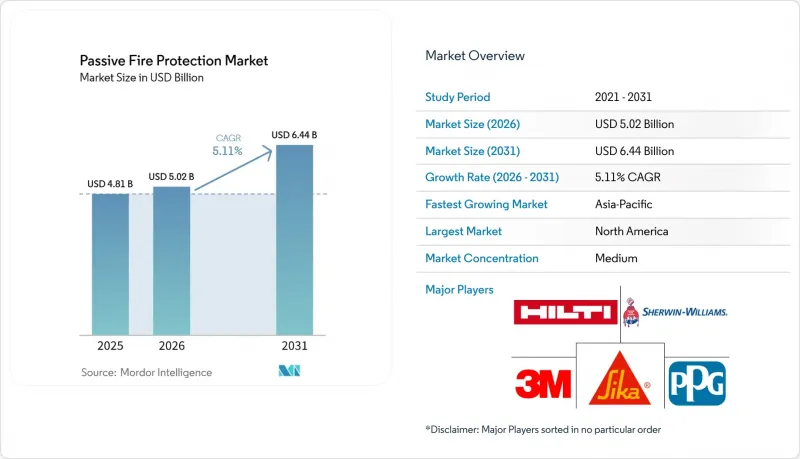
본 보고서는 제품 유형(팽창성 도료, 시멘트계 재료 등), 용도(구조용 강재 보호, 방화 구획 등), 최종 이용 산업(건축 및 건설, 석유 및 가스, 산업용 등), 지역(아시아태평양, 북미, 유럽, 남미, 중동 및 아프리카)별로 분류되어 있습니다. 시장 전망은 금액(달러) 기준으로 제시되어 있습니다.
세계의 수동적 방화 시장 동향 및 인사이트
엄격한 방화 규제 및 건축기준법 준수 요건 강화
방화 규정의 개정에 따라 수동적 방화 시장에서 인증 제품에 대한 수요가 확대되고 있습니다. 유럽연합 집행위원회는 2026년 3월, 위임 규정(EU) 2026/557을 공표했습니다. 이는 규정(EU) 2024/3110에 기반한 건설 제품에 대한 새로운 내화 성능 분류표를 정한 것입니다. 제조업체는 개정된 기준에 따라 보호 코팅, 보드, 렌더링 및 클래딩 시스템의 분류를 재검토한 후, 사양 수립자 및 승인 기관이 사용할 수 있는 뒷받침 증거를 제출해야 합니다. 이 작업은 제품이 완전한 조립품의 일부로 공급되는 경우에 특히 중요합니다. 이는 도료, 보드, 실링재, 바탕재 및 시공 세부 사항이 모두 시험 결과에 영향을 미치기 때문입니다. 이 과정으로 인해 승인이 다소 지연될 수 있지만, 확립된 시험 증거와 명확한 시공 지침을 갖춘 시스템의 가치를 높이는 결과로 이어집니다. 설계자가 조립품, 관통부, 구조 요소 및 프로젝트에 필요한 인도 기록의 불확실성을 줄여주는 시험을 거친 패키지를 선택함으로써 수동적 방화 시장은 혜택을 받게 됩니다. ISO 834, UL 263, ASTM E119, UL 1709 제5판, NORSOK M-501 개정 제7판 및 API RP 2218은 건축 및 에너지 분야의 성능 평가에서 여전히 중요한 표준입니다. 이는 프로젝트마다 서로 다른 화재 곡선, 노출 조건 및 합격 기준이 적용되기 때문입니다.
고층 빌딩 및 대규모 목조 구조물 건설 증가
대량 목재는 고층 건축물의 방화 사양에 변화를 가져오고 있습니다. 2024년판 국제 건축 기준(IBC)에서는 유형 IV-A, IV-B 및 IV-C 구조가 인증되었으며, 필요한 불연성 보호층과 다양한 내화 등급을 갖춘 최대 18층 높이의 매스 팀버 건축이 허용되었습니다. 유형 IV-A에서는 3시간의 내화 등급이, 유형 IV-C에서는 2시간의 내화 등급이 요구됩니다. 필요한 보호층은 목재 부재, 접합부, 설비 개구부 및 계획된 노출면과 연계하여 기능해야 하므로, 설계상의 고려 사항에 변화를 가져옵니다. 이러한 프로젝트에서는 단일 제품이 아닌 판재, 캡슐화, 관통부 실링을 조합하여 사용하는 경우가 많기 때문에 더 상세한 사양이 필요하며, 호환성이 보장되고 시험을 거친 시스템에 대한 수요가 증가하고 있습니다. Arup사의 지침에 따르면, 높이 35미터를 초과하는 대규모 목조 구조물에는 더 큰 수동적 방화 여유가 필요하며, 이로 인해 인증된 판재와 도료의 조합을 제공하고 각 조립체의 한계를 설명할 수 있는 공급업체가 유리해집니다. 따라서 대규모 목조 구조물의 사양이 더욱 상세해짐에 따라, 특히 프로젝트가 목재 고유의 탄화 거동에만 의존할 수 없는 경우, 수동적 방화 시장은 프로젝트별 부가가치를 높일 기회를 얻을 수 있습니다.
수동적 방화 시스템의 설치 비용 및 수명 주기 유지 비용의 높음
설치 비용은 특히 개보수 프로젝트에서 수동적 방화 보호 시장에 큰 제약 요인이 되고 있습니다. 신축 공사의 경우, 설비 공사, 마감 공사 및 접근 제한으로 인해 작업이 복잡해지기 전에 설계 단계에서 방화 비용을 계획하고 기본 건설 예산에 반영할 수 있습니다. 반면, 기존 건축물의 경우 복잡한 표면 처리, 접근 제한, 오래된 구조 형상에 맞춘 독자적인 도장 프로파일이 필요한 경우가 있어, 본래라면 표준적인 자재라 하더라도 시공 비용이 급등할 가능성이 있습니다. 또한, 프로젝트 팀은 작업 중 이용 구역에 미치는 영향, 작업 시간, 그리고 주변 마감재를 보호해야 할 필요성에 대해서도 계획해야 합니다. 에폭시계 팽창성 도료는 15-20년의 내구 기간 동안 점검이 필요하며, 경우에 따라 재도장이 필요할 수도 있습니다. 헴펠(Hempel)사에 따르면, EU의 다층 건물에 사용되는 구조용 강재에는 대부분의 경우 최소 60분의 내화 성능이 요구되는 반면, 중동의 많은 시공 사례에서는 120분의 내화 보호가 요구됩니다. 이러한 기준으로 인해 시멘트계 대체재에 비해 자재비 및 전문 기술자의 인건비가 증가할 가능성이 있으며, 비용 중심의 보수 공사에서 보수 진행을 지연시키는 요인이 될 수 있습니다.
부문별 분석
팽창성 도료는 2025년 수동적 방화 보호 시장에서 42.24%의 점유율을 차지했으며, 2031년까지 연평균 성장률(CAGR) 5.94%를 나타낼 것으로 예측됩니다. 이러한 위상은 구조용 강재에 대한 채택 및 대규모 목조 구조물에서의 중요성을 반영한 것입니다. 이 도료는 많은 시멘트계 제품보다 도막이 얇기 때문에 외관이나 설치 공간이 중요한 노출된 구조 부재에서 유리합니다. 또한, LEED 관련 재료 요건과의 적합성도 상업시설 인테리어에서의 채택을 촉진하고 있습니다. 시멘트계 재료는 높은 열용량과 확립된 시공 기법이 중시되는 중공업 및 해양 프로젝트에서 여전히 중요한 역할을 수행하고 있습니다. 팽창성 도료의 수동적 방화 시장 규모는 공급업체가 다양한 기재 및 프로젝트 조건에 걸친 성능을 입증할 수 있다는 점에 의해서도 뒷받침되고 있습니다.
시멘트계 제품은 탄화수소 화재 대책이 필요한 상황을 포함하여 많은 중공업 용도에서 여전히 비용 면에서의 우위를 유지하고 있습니다. 매스 팀버 건축에서는 건축 기준에 따라 구조용 목재 부재 위에 불연성 보호층을 설치해야 하므로, 보드 기반 외장재나 캡슐화 시스템이 주목받고 있습니다. ASTM은 2025년에 E2924를 개정하여, 구조용 강재에 도포되는 팽창성 도료에 관한 표준 시공 방법을 업데이트했습니다. 이번 개정을 통해 성능에 대한 문서화의 중요성이 높아졌으며, 검증된 시험 기록을 보유한 평판이 좋은 공급업체들이 유리한 입지를 점하고 있습니다. 방화 도료, 팽창성 스트립 및 하이브리드 제품은 여전히 전문성이 높은 분야에 국한되어 있으며, 방음이나 커튼월 관통부 등의 용도로 사용되고 있습니다. 수동적 방화 시장에서는 문서화된 방화 성능이나 저VOC 배합 옵션을 통해 이러한 제품들의 차별화가 진행되고 있습니다.
지역별 분석
2025년, 북미는 수동적 방화 시장에서 39.82%의 점유율을 차지했습니다. 미국에서는 상업용 건축물, 산업 시설의 유지보수 및 건축 기준에 따른 개보수 공사를 통해 수요가 뒷받침되었습니다. 대규모 목조 프로젝트에서는 판재, 캡슐화 및 실링을 결합한 검증된 방화 시스템에 대한 전문적인 수요가 증가하고 있습니다. 캐나다의 대규모 목조 건축물 캡슐화 지침에서는 관련 시공 기법에 대해 최소 2시간의 내화 성능이 요구됩니다. 이에 따라 공급업체는 목조 중층 및 고층 건축물을 위한 인증된 시스템을 공급할 수 있는 새로운 경로를 확보하게 됩니다.
유럽은 독일, 영국, 프랑스를 필두로 여전히 중요한 수익 지역으로 자리 잡고 있습니다. 독일의 산업 기반과 리모델링 수요는 팽창성 도료 및 방화·방수 제품의 지속적인 사용을 뒷받침하고 있습니다. 규정(EU) 2026/557에 따라 현재 관련 건축자재의 내화 등급 재검토가 요구되고 있습니다. 이에 따라 제조업체와 프로젝트 팀이 자사 시스템을 평가하는 과정에서 건축자재 공급망 전반에 걸쳐 사양 수립 활동이 활발해지고 있습니다. 또한, 유럽의 수동적 방화 시장은 건물의 에너지 성능 의무와 관련된 리모델링 활동에 의해서도 뒷받침되고 있습니다.
아시아태평양은 2026년부터 2031년에 걸쳐 연평균 성장률(CAGR) 6.13%를 나타낼 것으로 예측되며, 이는 지역별로는 가장 높은 성장률입니다. 이 지역에서는 도시화, 산업 성장, 그리고 건축물 안전 요건에 대한 관심 증가가 맞물려 시장을 견인하고 있습니다. 일본에서는 2025년 4월 이후, 높이 31미터를 초과하는 건물에 팽창성 도료의 도포가 의무화되었습니다. 한국의 그린빌딩 인증 제도에서는 2026년 1월 이후, 3시간의 수동적 방화 성능에 대해 가산점 조치가 마련되어 있어, 이를 통해 고성능 시스템의 도입이 촉진되고 있습니다. 중국에서는 도시 재생 및 인프라 정비로 인해 수요량이 높은 수준을 유지하고 있으며, 베트남, 인도네시아, 필리핀에서는 산업화의 진전과 안전 규제 강화에 따라 추가적인 잠재 수요가 예상됩니다. 남미, 중동 및 아프리카 시장 규모는 비교적 작지만, 산업 현대화, 에너지 프로젝트, 광업, 상업 건축으로 인해 이들 지역은 수동적 방화 시장에서 중요한 수요 지역으로 자리 잡고 있습니다.
기타 혜택 :
- 엑셀 형식 시장 예측(ME) 시트
- 3개월간의 애널리스트 지원
자주 묻는 질문
목차
제1장 서론
제2장 조사 방법
제3장 주요 요약
제4장 시장 구도
제5장 시장 규모 및 성장 예측
제6장 경쟁 구도
제7장 시장 기회 및 향후 전망
KTH 26.09.04According to Mordor Intelligence, the passive fire protection market was valued at USD 4.81 billion in 2025 and is estimated to grow from USD 5.02 billion in 2026 to reach USD 6.44 billion by 2031, at a CAGR of 5.11% during the forecast period (2026-2031).
This report is Segmented by Product Type (Intumescent Coatings, Cementitious Materials, and More), Application (Structural Steel Protection, Fire Compartmentation, and More), End-Use Industry (Building and Construction, Oil and Gas, Industrial, and More), and Geography (Asia-Pacific, North America, Europe, South America, and Middle-East and Africa). The Market Forecasts are Provided in Terms of Value (USD).
Global Passive Fire Protection Market Trends and Insights
Stringent Fire Safety Regulations and Increasing Building Code Compliance Requirements
Fire code revisions are expanding the need for certified products in the passive fire protection market. The European Commission published Delegated Regulation (EU) 2026/557 in March 2026, which set new fire-resistance performance classification tables for construction products under Regulation (EU) 2024/3110. Manufacturers must review the classification of protective coatings, boards, renderings, and cladding systems against the revised criteria, then provide the supporting evidence used by specifiers and approval bodies. The work is particularly important when a product is supplied as part of a complete assembly, since the coating, board, seal, substrate, and installation details all affect the tested outcome. This process can create short approval delays, but it also increases the value of systems with established test evidence and clear installation guidance. The passive fire protection market gains when specifiers select tested packages that reduce uncertainty across assemblies, penetrations, structural elements, and the handover records required for the project. ISO 834, UL 263, ASTM E119, UL 1709 Edition 5, NORSOK M-501 Revision 7, and API RP 2218 remain important standards for assessing performance in building and energy applications, because different projects use different fire curves, exposure conditions, and acceptance criteria.
Growing Construction of High-Rise Buildings and Mass Timber Structures
Mass timber is changing how fire protection is specified in taller buildings. The 2024 International Building Code recognized Types IV-A, IV-B, and IV-C construction, allowing mass timber buildings of up to 18 stories with required noncombustible protection layers and varying fire-resistance ratings. Type IV-A requires a 3-hour rating, while Type IV-C requires a 2-hour rating. The required layers change the design discussion because the protection must work with timber members, connections, service openings, and the planned exposed surfaces. These projects often require boards, encapsulation, and penetration seals together rather than a single product, creating a more detailed specification and a greater need for compatible, tested systems. Guidance from Arup states that mass timber structures above 35 meters require larger passive protection margins, which favors suppliers that can offer certified board-and-coating combinations and explain the limits of each assembly. The passive fire protection market, therefore, has an opportunity to capture greater value per project as mass timber specifications become more detailed, particularly where projects cannot rely on the inherent char behavior of timber alone.
High Installation and Lifecycle Maintenance Costs of Passive Fire Protection Systems
Installation cost is a significant restraint for the passive fire protection market, especially in renovation projects. New construction allows fire protection costs to be planned during design and included in the base-build budget, before services, finishes, and access restrictions complicate the work. Existing buildings can require complex surface preparation, restricted access, and tailored coating profiles around older structural geometry, which can make otherwise standard materials more expensive to apply. Project teams must also plan for the effect of occupied areas, working hours, and the need to protect surrounding finishes while the work is completed. Epoxy intumescent coatings may require inspection and, in some cases, recoating during a 15 to 20-year service period. Hempel notes that structural steel in multistory EU buildings often requires at least a 60-minute rating, while many Middle-East applications require 120-minute protection. These thresholds can raise material and specialist labor needs compared with cementitious alternatives, which can slow upgrades in cost-sensitive retrofit work.
Other drivers and restraints analyzed in the detailed report include:
- Expansion of High-Risk Industrial Facilities Across Oil and Gas, Energy, and Manufacturing Sectors
- Increasing Adoption of Low-VOC and Environmentally Compliant Passive Fire Protection Systems
- Lengthy Project Approval and Regulatory Compliance Processes
For complete list of drivers and restraints, kindly check the Table Of Contents.
Segment Analysis
Intumescent coatings held 42.24% of the passive fire protection market share in 2025 and is projected to grow at a 5.94% CAGR through 2031. Their position reflects their use of structural steel and their relevance in mass timber assemblies. The coatings offer a thinner applied profile than many cementitious options, which helps on exposed structural members where appearance and available space matter. Their compatibility with LEED-related material requirements also supports their use in commercial interiors. Cementitious materials remain relevant in heavy industrial and offshore projects where high thermal mass and established application practices are valued. The passive fire protection market size for intumescent coatings is also supported by suppliers' ability to document performance across several substrates and project conditions.
Cementitious products retain a cost advantage in many heavy industrial applications, including situations where hydrocarbon fire protection is needed. Board-based cladding and encapsulation systems are gaining attention in mass timber construction because building requirements call for noncombustible protection layers over structural wood members. ASTM revised E2924 in 2025, updating the standard practice for intumescent coatings applied to structural steel. The revision raises the importance of performance documentation and supports established suppliers with proven testing records. Fire collars, intumescent strips, and hybrid products remain more specialized, serving uses such as acoustic and curtain-wall penetrations. The passive fire protection market continues to differentiate these products through documented fire performance and lower-VOC formulation choices.
Complete Report Scope:
- By Product Type
- Intumescent Coatings
- Cementitious Materials
- Fireproofing Cladding
- Other Product Types
- By Application
- Structural Steel Protection
- Fire Compartmentation
- Opening Protection
- Penetration Seals and Firestopping
- By End-Use Industry
- Building and Construction
- Oil and Gas
- Industrial
- Transportation
- Energy and Power
- Other End-Use Industries
- By Geography
- Asia-Pacific
- China
- India
- Japan
- South Korea
- Rest of Asia-Pacific
- North America
- United States
- Canada
- Mexico
- Europe
- Germany
- United Kingdom
- France
- Italy
- Russia
- Rest of Europe
- South America
- Brazil
- Argentina
- Rest of South America
- Middle-East and Africa
- Saudi Arabia
- South Africa
- Rest of Middle-East and Africa
- Asia-Pacific
Geography Analysis
North America held a 39.82% share of the passive fire protection market in 2025. The United States supported demand through commercial construction, industrial maintenance, and code-driven replacement work. Mass timber projects are adding a specialized need for tested protection systems that combine boards, encapsulation, and seals. Canada's encapsulated mass timber guidance requires a minimum 2-hour fire-resistance rating in the relevant construction approach. This gives suppliers an additional route to supply certified systems for wood-based mid-rise and taller structures.
Europe remains an important revenue area, led by Germany, the United Kingdom, and France. Germany's industrial base and renovation needs support for the continued use of intumescent coatings and firestopping products. Regulation (EU) 2026/557 is now requiring a fresh review of fire-resistance classifications for relevant construction products. This increases specification activity across the construction materials supply chain as manufacturers and project teams assess their systems. The passive fire protection market in Europe is also supported by renovation activity linked to building energy performance obligations.
Asia-Pacific is forecast to grow at a 6.13% CAGR from 2026 to 2031, the highest regional rate. The region combines urbanization, industrial growth, and expanding attention to building safety requirements. Japan has required intumescent coatings on buildings taller than 31 m since April 2025. South Korea's Green Building Certification system has offered bonus points for 3-hour passive protection since January 2026, which supports the use of higher-performing systems. China's urban renewal and infrastructure work support high demand volumes, while Vietnam, Indonesia, and the Philippines offer further potential as industrialization and safety enforcement strengthen. South America and Middle-East and Africa are smaller, but industrial modernization, energy projects, mining, and commercial construction make them relevant demand areas for the passive fire protection market.
- 3M
- Akzo Nobel N.V.
- Carboline Company
- Etex Group
- Hempel A/S
- Hilti Corporation
- Isolatek International
- Jotun
- Lloyd Insulations (India) Limited
- Nullifire (Tremco CPG)
- PPG Industries, Inc.
- ROCKWOOL A/S
- Rudolf Hensel GmbH
- Sika AG
- The Sherwin-Williams Company
Additional Benefits:
- The market estimate (ME) sheet in Excel format
- 3 months of analyst support
TABLE OF CONTENTS
1 Introduction
- 1.1 Study Assumptions and Market Definition
- 1.2 Scope of the Study
2 Research Methodology
3 Executive Summary
4 Market Landscape
- 4.1 Market Overview
- 4.2 Market Drivers
- 4.2.1 Stringent Fire Safety Regulations and Increasing Building Code Compliance Requirements
- 4.2.2 Growing Construction of High-Rise Buildings and Mass Timber Structures
- 4.2.3 Expansion of High-Risk Industrial Facilities Across Oil and Gas, Energy, and Manufacturing Sectors
- 4.2.4 Increasing Adoption of Low-VOC and Environmentally Compliant Passive Fire Protection Systems
- 4.2.5 Rising Integration of Digital Fire Engineering and Building Information Modeling (BIM) in Building Design
- 4.3 Market Restraints
- 4.3.1 High Installation and Lifecycle Maintenance Costs of Passive Fire Protection Systems
- 4.3.2 Lengthy Project Approval and Regulatory Compliance Processes
- 4.3.3 Design and Installation Challenges in Space-Constrained Retrofit and Renovation Projects
- 4.4 Value Chain Analysis
- 4.5 Porter's Five Forces Analysis
- 4.5.1 Threat of New Entrants
- 4.5.2 Bargaining Power of Suppliers
- 4.5.3 Bargaining Power of Buyers
- 4.5.4 Threat of Substitutes
- 4.5.5 Competitive Rivalry
5 Market Size and Growth Forecasts (Value)
- 5.1 By Product Type
- 5.1.1 Intumescent Coatings
- 5.1.2 Cementitious Materials
- 5.1.3 Fireproofing Cladding
- 5.1.4 Other Product Types
- 5.2 By Application
- 5.2.1 Structural Steel Protection
- 5.2.2 Fire Compartmentation
- 5.2.3 Opening Protection
- 5.2.4 Penetration Seals and Firestopping
- 5.3 By End-Use Industry
- 5.3.1 Building and Construction
- 5.3.2 Oil and Gas
- 5.3.3 Industrial
- 5.3.4 Transportation
- 5.3.5 Energy and Power
- 5.3.6 Other End-Use Industries
- 5.4 By Geography
- 5.4.1 Asia-Pacific
- 5.4.1.1 China
- 5.4.1.2 India
- 5.4.1.3 Japan
- 5.4.1.4 South Korea
- 5.4.1.5 Rest of Asia-Pacific
- 5.4.2 North America
- 5.4.2.1 United States
- 5.4.2.2 Canada
- 5.4.2.3 Mexico
- 5.4.3 Europe
- 5.4.3.1 Germany
- 5.4.3.2 United Kingdom
- 5.4.3.3 France
- 5.4.3.4 Italy
- 5.4.3.5 Russia
- 5.4.3.6 Rest of Europe
- 5.4.4 South America
- 5.4.4.1 Brazil
- 5.4.4.2 Argentina
- 5.4.4.3 Rest of South America
- 5.4.5 Middle-East and Africa
- 5.4.5.1 Saudi Arabia
- 5.4.5.2 South Africa
- 5.4.5.3 Rest of Middle-East and Africa
- 5.4.1 Asia-Pacific
6 Competitive Landscape
- 6.1 Market Concentration
- 6.2 Strategic Moves
- 6.3 Market Share (%)/Ranking Analysis
- 6.4 Company Profiles (includes Global Overview, Market Overview, Core Segments, Financials as available, Strategic Information, Products and Services, and Recent Developments)
- 6.4.1 3M
- 6.4.2 Akzo Nobel N.V.
- 6.4.3 Carboline Company
- 6.4.4 Etex Group
- 6.4.5 Hempel A/S
- 6.4.6 Hilti Corporation
- 6.4.7 Isolatek International
- 6.4.8 Jotun
- 6.4.9 Lloyd Insulations (India) Limited
- 6.4.10 Nullifire (Tremco CPG)
- 6.4.11 PPG Industries, Inc.
- 6.4.12 ROCKWOOL A/S
- 6.4.13 Rudolf Hensel GmbH
- 6.4.14 Sika AG
- 6.4.15 The Sherwin-Williams Company
7 Market Opportunities and Future Outlook
- 7.1 White-Space and Unmet-Need Assessment