

|
시장보고서
상품코드
2118978
고무 가공용 화학제품 : 시장 점유율 분석, 업계 동향 및 통계, 성장 예측(2026-2031년)Rubber Processing Chemicals - Market Share Analysis, Industry Trends & Statistics, Growth Forecasts (2026 - 2031) |
||||||
 Mordor Intelligence
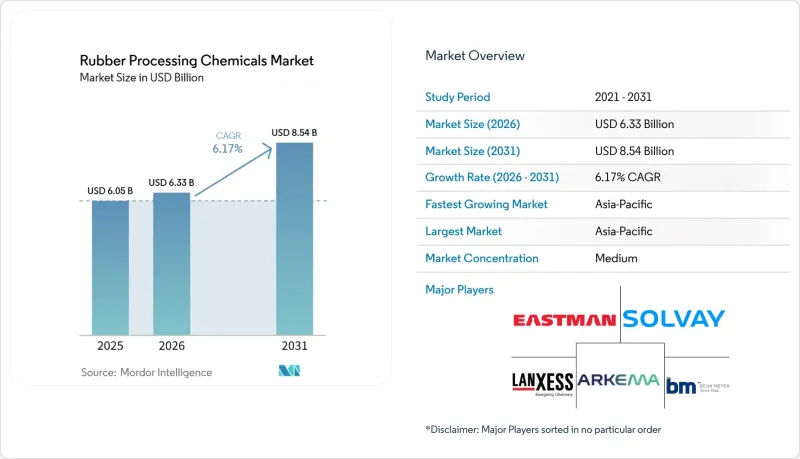
고무 가공용 화학제품 시장은 2025년에 60억 5,000만 달러 규모로 평가되었습니다. 2026년 63억 3,000만 달러에서 2031년까지 85억 4,000만 달러에 이를 것으로 예상되며, 예측 기간(2026-2031년) CAGR은 6.17%를 나타낼 전망입니다.
본 보고서는 제품 유형(노화 방지제, 가황 촉진제 등), 제형 유형(고체 및 액체), 용도(타이어, 비타이어 제품 등), 최종 이용 산업(자동차 및 운송, 건축 및 건설 등), 지역(아시아태평양, 북미, 유럽, 남미, 중동 및 아프리카)별로 분류되어 있습니다. 시장 전망은 금액(달러) 기준으로 제시되어 있습니다.
세계의 고무 가공용 화학제품 시장 동향 및 인사이트
전 세계 타이어 생산 및 자동차 제조의 확대
타이어 제조는 여전히 고무 처리 화학제품 시장의 구조적 수요를 지탱하는 주축입니다. 타이어 배합 및 가황 공정에서는 노화 방지제, 가황 촉진제, 가황제 및 기타 첨가제가 필요합니다. 중국, 인도, 일본, 한국의 자동차 생산은 지역 공급망 전반에 걸친 화학제품 수요의 지속을 뒷받침하고 있습니다. 인도의 생산 연계형 인센티브 제도에 따라 아폴로 타이어, MRF, JK 타이어 각사의 타이어 생산 능력 증강이 촉진되어 화학제품 조달 수요가 증가했습니다. 인도 표준국(BIS)의 인증 요건으로 인해 수입 고무용 화학제품의 승인 주기가 길어지고 있어, 인증된 배합을 보유한 가공업체들이 유리한 입장에 있습니다. 이러한 구조로 인해 국내 생산 능력이 발전함에 따라, 인도 내 비즈니스 기회는 전구체 원료 및 특수 첨가제로 점차 이동할 가능성이 있습니다.
전기차(EV) 및 고성능 타이어 분야의 첨단 고무 컴파운드에 대한 수요 증가
전기차용 타이어에는 배터리의 무게, 순간 토크, 낮은 구름 저항, 그리고 실내 소음 저감을 충족할 수 있는 컴파운드가 요구됩니다. 이러한 요건들은 실리카 충전 및 용액형 스티렌-부타디엔 고무(SBR) 컴파운드 시스템의 채택을 촉진하고 있습니다. 이러한 수요 증가에 따라, 실리카의 분산성을 향상시키는 가공 보조제나 열 스트레스를 제어하는 열화 방지제에 대한 수요가 증가하고 있습니다. 또한 공급업체에게는 타이어 성능을 저해하지 않으면서 변화하는 환경 요건을 충족하는 배합이 요구되고 있습니다. 따라서 기술 서비스와 용도 엔지니어링은 고무 가공용 화학제품 시장에서 점점 더 중요한 경쟁 수단이 되고 있습니다.
엄격한 환경 규제 및 화학 물질 안전에 관한 규정 준수 요건
화학 물질 안전에 관한 규제는 새로운 배합 개발을 지연시키거나, 시험을 의무화하거나, 공급업체의 인증 비용을 상승시킬 가능성이 있습니다. 유럽연합(EU)의 화학제품 등록, 평가, 허가 및 제한에 관한 규정(REACH)의 틀은 유럽의 타이어 및 산업용 고무 제조업체에 제품을 공급하는 공급업체에게 특히 중요합니다. 페닐렌디아민계 산화 방지제 및 오존 방지제에 대한 제한 평가는 널리 사용되는 열화 방지제 중 하나에 불확실성을 가져왔습니다. 공급업체는 배합 패키지를 변경하기 전에 대체품 평가, 기술 자료 작성 및 고객 승인을 유지해야 합니다. 이러한 요건은 등록된 소재와 검증된 성능 데이터를 보유한 기존 공급업체에게는 유리하게 작용할 수 있습니다. 또한, 유럽 시장으로의 범용 제품 수출에 의존하고 있는 제조업체 시장 진입을 지연시키는 요인이 될 수도 있습니다.
부문별 분석
2025년, 열화 방지제는 고무 가공용 화학제품 시장 점유율의 35.82%를 차지했습니다. 이러한 위상은 타이어 및 산업용 고무를 열, 산소, 오존, 피로로부터 보호하는 역할을 반영한 것입니다. 이러한 제품은 가혹한 사용 조건 하에서 제품 수명 연장에 기여합니다. 가황 촉진제에는 설펜아미드, 티아졸, 구아니딘 화합물 등이 포함됩니다. 이러한 물질은 타이어 및 비타이어용 고무 제품의 가황 속도와 가교 밀도에 영향을 미칩니다.
원소 유황, 황 공급제, 불용성 유황 등급 등을 포함하는 가황제는 여전히 가교 형성에 필수적입니다. 그 화학 기술은 성숙해 있지만, 생산량은 고무 제품 전체의 생산량과 밀접하게 연동되어 있습니다. 지연제 및 펩타이저는 고온 가공 및 천연 고무 재생 과정에서 특수한 기능을 수행합니다. 가공 보조제 및 촉진제는 2031년까지 연평균 성장률(CAGR) 6.83%를 나타낼 것으로 예측됩니다. 이러한 성장은 실리카 충전형·저회전저항 타이어 컴파운드 및 연속 혼련 시스템과 밀접한 관련이 있습니다. LANXESS는 2026년, 실리카 충전형 컴파운드용 ‘Aflux SD’를 출시하며, 성능과 규정 준수 특성을 겸비한 가공 제품으로의 전환을 상징하고 있습니다.
2025년 시점에서 고무 가공용 화학제품 시장 규모의 56.44%를 고체 제형이 차지했습니다. 펠릿형, 사전 분산형 및 분말형 형태는 대량 생산을 수행하는 타이어 및 고무 공장의 기존 취급 시스템에 적합합니다. 또한, 이러한 형태는 익숙한 투여 방법이 가능하며, 유효 성분 단위당 비용 면에서도 유리합니다. 고체 마스터배치는 투여의 일관성을 뒷받침하고, 생산 현장에서의 부유 분진을 최소화하는 데 도움이 됩니다. 사전 분산된 고체 형태는 신뢰할 수 있는 분산이 요구되는 정밀 컴파운딩에서 여전히 중요한 역할을 하고 있습니다.
액상 제형은 2031년까지 연평균 성장률(CAGR) 6.52%를 나타낼 것으로 예측됩니다. 컴파운더는 실리카 충전재의 균일한 분산이나 밀폐형 연속 믹서와의 호환성이 필요한 경우 액상 시스템을 채택합니다. 이러한 라인에서는 분말 투여보다 액체 주입이 더 정밀하게 제어된 공급을 가능하게 합니다. 또한, 액체 프로모터는 더 적은 기계적 혼합 에너지로 실리카 커플링제를 혼합하는 데에도 도움이 됩니다. LANXESS는 2025년 사우스캐롤라이나주에서 미국 고객을 대상으로 ‘Aflux 37’, ‘Aflux 42’, ‘Aktiplast PP’ 및 ‘Aktiplast 44’의 생산을 확대했습니다. 또한, 벌크 액체 형태로 공급하면 개별 고체 봉지에 비해 포장 폐기물을 줄일 수 있습니다.
지역별 분석
2025년, 아시아태평양은 고무 가공용 화학약품 시장의 46.84%를 차지했으며, 2031년까지 연평균 성장률(CAGR) 7.02%를 나타낼 것으로 예측됩니다. 중국은 타이어 생산 거점일 뿐만 아니라, 가속제 및 산화 방지제 공급에서의 위상으로 인해 수요를 주도하고 있습니다. 중국 제조업체들은 범용 가속제 및 산화 방지제 분야에서 치열한 경쟁을 펼치고 있습니다. 인도는 국내 타이어 생산 능력이 확대됨에 따라 중요한 성장 시장으로 부상하고 있습니다. BIS 인증 요건으로 인해 승인된 제품 및 공급업체가 요구되어 조달에 영향을 미치고 있습니다.
일본과 한국은 고부가가치의 노화 방지제 및 촉진제와 같은 화학제품을 공급하고 있습니다. 또한 이 지역에서는 첨단 타이어 컴파운드에 사용되는 특수 고무 소재공급도 뒷받침되고 있습니다. 태국과 인도네시아는 장갑, 호스, 산업용 고무 제품의 수출 지향형 생산을 통해 추가적인 수요를 창출하고 있습니다. 북미는 자동차 수요와 가공 촉진제의 현지 공급 확대에 힘입어 꾸준히 성장하고 있습니다. 랑세스(LANXESS)는 2025년에 사우스캐롤라이나주 부시 파크 공장을 확장하여 독일 및 중국으로부터의 수입 의존도를 낮췄습니다.
유럽에서는 규제 준수 비용과 자동차 생산의 변동성이 구매 결정에 영향을 미치고 있어 수요 증가세가 둔화되고 있습니다. 그럼에도 불구하고 저VOC 및 고위험물질(SVHC)을 포함하지 않는 특수 화학제품에는 여전히 기회가 있습니다. 독일, 영국, 프랑스는 프리미엄 타이어 및 특수 산업용 고무 제품의 중요한 거점으로 자리 잡고 있습니다. 남미, 중동 및 아프리카는 인프라, 광업, 농업 및 산업 개발의 혜택을 받고 있습니다. 브라질과 아르헨티나에서는 타이어 교체 수요와 산업용 고무 수요가 뒷받침되고 있습니다. 사우디아라비아는 산업화 프로그램의 일환으로 하류 제조 역량을 확대하고 있으며, 남아프리카공화국은 자동차 조립 및 광업을 통해 지역 수요를 뒷받침하고 있습니다.
기타 혜택 :
- 엑셀 형식 시장 예측(ME) 시트
- 3개월간의 애널리스트 지원
자주 묻는 질문
목차
제1장 서론
제2장 조사 방법
제3장 주요 요약
제4장 시장 구도
제5장 시장 규모 및 성장 예측
제6장 경쟁 구도
제7장 시장 기회 및 향후 전망
KTH 26.09.04According to Mordor Intelligence, the rubber processing chemicals market was valued at USD 6.05 billion in 2025 and is estimated to grow from USD 6.33 billion in 2026 to reach USD 8.54 billion by 2031, at a CAGR of 6.17% during the forecast period (2026-2031).
This report is Segmented by Product Type (Antidegradants, Accelerators, and More), Formulation Type (Solid and Liquid), Application (Tires, Non-Tire, and More), End-Use Industry (Automotive and Transportation, Building and Construction, and More), and Geography (Asia-Pacific, North America, Europe, South America, and Middle-East and Africa). The Market Forecasts are Provided in Terms of Value (USD).
Global Rubber Processing Chemicals Market Trends and Insights
Expansion of Global Tire Production and Automotive Manufacturing
Tire manufacturing remains the structural demand anchor for the rubber processing chemicals market. Tires require antidegradants, accelerators, vulcanizing agents, and other additives during compounding and curing. Automotive production in China, India, Japan, and South Korea supports continuing chemical demand across the regional supply chain. India's production-linked incentive program encouraged tire capacity additions by Apollo Tyres, MRF, and JK Tyre, which increased chemical procurement needs. Bureau of Indian Standards (BIS) certification requirements lengthen approval cycles for imported rubber chemicals and favor processors with qualified formulations. This framework may gradually shift India's opportunity toward precursor feedstocks and specialty additives as domestic capabilities develop.
Rising Demand for Advanced Rubber Compounds in Electric Vehicle (EV) and High-Performance Tires
Electric vehicle tires require compounds that can handle battery weight, instant torque, lower rolling resistance, and lower cabin noise. These requirements support silica-filled and solution styrene-butadiene rubber compound systems. This expansion increases demand for processing aids that improve silica dispersion and for antidegradants that manage thermal stress. Suppliers also need formulations that meet changing environmental requirements without compromising tire performance. Technical service and application engineering, therefore, become more important competitive tools in the rubber processing chemicals market.
Stringent Environmental Regulations and Chemical Safety Compliance Requirements
Chemical safety rules can delay new formulations, require testing, and raise qualification costs for suppliers. The European Union's Registration, Evaluation, Authorisation and Restriction of Chemicals (REACH) framework is especially important for suppliers that serve European tire and industrial rubber customers. The restriction assessment for phenylenediamine antioxidants and antiozonants created uncertainty for a widely used antidegradant class. Suppliers must evaluate alternatives, prepare technical dossiers, and maintain customer approvals before changing a compound package. These requirements can benefit established suppliers with registered materials and verified performance data. They can also slow entry by producers that rely on commodity exports to the European market.
Other drivers and restraints analyzed in the detailed report include:
- Growing Adoption of Low-VOC and Environmentally Friendly Rubber Processing Chemicals
- Increasing Demand for High-Performance and Durable Rubber Products
- Occupational Health and Safety Challenges Associated with Hazardous Rubber Additives
For complete list of drivers and restraints, kindly check the Table Of Contents.
Segment Analysis
Antidegradants held 35.82% of the rubber processing chemicals market share in 2025. Their position reflects their role in protecting tires and industrial rubber against heat, oxygen, ozone, and fatigue. They help extend service life in applications with demanding operating conditions. Accelerators include sulfenamide, thiazole, and guanidine compounds. These materials influence vulcanization speed and crosslink density across tire and non-tire rubber goods.
Vulcanizing agents, including elemental sulfur, sulfur donors, and insoluble sulfur grades, remain essential to crosslink formation. Their chemistry is mature, but their volumes closely follow total rubber goods production. Retarders and peptizers serve specialized functions in high-temperature mixing and natural rubber reclaiming. Processing aids and promoters are projected to grow at a 6.83% CAGR through 2031. Their growth is tied to silica-filled, low-rolling-resistance tire compounds and continuous mixing systems. LANXESS introduced Aflux SD in 2026 for silica-filled compounds, illustrating the shift toward processing products that combine performance and compliance features.
Solid formulations accounted for 56.44% of the rubber processing chemicals market size in 2025. Pelletized, pre-dispersed, and powder formats fit established handling systems in high-volume tire and rubber plants. They also offer familiar dosing practices and a favorable cost per active unit. Solid masterbatches support dosing consistency and help minimize airborne dust in production settings. Pre-dispersed solid formats remain important in precision compounding where reliable distribution is required.
Liquid formulations are forecast to grow at a 6.52% CAGR through 2031. Compounders use liquid systems when they need uniform dispersion in silica-filled materials and compatibility with closed continuous mixers. Liquid injection can give more controlled delivery than powder dosing in these lines. Liquid promoters also help introduce silica coupling agents with lower mechanical mixing energy. LANXESS expanded production of Aflux 37, Aflux 42, Aktiplast PP, and Aktiplast 44 in South Carolina during 2025 to serve U.S. customers. Bulk liquid delivery can also reduce packaging waste compared with individual solid bags.
Complete Report Scope:
- By Product Type
- Antidegradants
- Accelerators
- Vulcanizing Agents
- Processing Aids and Promoters
- Other Product Types
- By Formulation Type
- Solid
- Liquid
- By Application
- Tires
- Non-Tire
- Belts and Hoses
- Wires and Cables
- Footwear
- Industrial Rubber Goods
- Other Applications
- By End-Use Industry
- Automotive and Transportation
- Building and Construction
- Industrial Manufacturing
- Consumer Goods
- Healthcare
- Other End-Use Industries
- By Geography
- Asia-Pacific
- China
- India
- Japan
- South Korea
- Rest of Asia-Pacific
- North America
- United States
- Canada
- Mexico
- Europe
- Germany
- United Kingdom
- France
- Italy
- Russia
- Rest of Europe
- South America
- Brazil
- Argentina
- Rest of South America
- Middle-East and Africa
- Saudi Arabia
- South Africa
- Rest of Middle-East and Africa
- Asia-Pacific
Geography Analysis
Asia-Pacific accounted for 46.84% of the rubber processing chemicals market share in 2025 and is forecast to grow at a 7.02% CAGR through 2031. China is driving demand because of its tire production base and its position in accelerator and antioxidant supply. Chinese producers compete strongly in the commodity accelerator and antioxidant categories. India is an important growth market as domestic tire capacity expands. BIS certification requirements influence procurement by requiring approved products and suppliers.
Japan and South Korea contribute higher-value antidegradant and accelerator chemistries. The region also supports specialty rubber materials used in advanced tire compounds. Thailand and Indonesia provide additional demand through export-oriented production of gloves, hoses, and industrial rubber goods. North America is growing steadily, supported by automotive demand and more local supply of processing promoters. LANXESS expanded its Bushy Park facility in South Carolina during 2025, reducing dependence on imports from Germany and China.
Europe faces a slower demand environment because compliance costs and uneven automotive production affect purchasing decisions. It still offers opportunities for low-VOC and Substances of Very High Concern (SVHC)-free specialty chemicals. Germany, the United Kingdom, and France remain important centers for premium tires and specialty industrial rubber goods. South America and Middle-East, and Africa benefit from infrastructure, mining, agriculture, and industrial development. Brazil and Argentina support tire replacement and industrial rubber demand. Saudi Arabia is expanding downstream manufacturing capacity under industrialization programs, while South Africa supports regional demand through automotive assembly and mining.
- Arkema
- BEHN MEYER
- China Petrochemical Corporation
- Eastman Chemical Company
- Kemai Chemical Co., Ltd.
- Kumho Petrochemical
- LANXESS
- OUCHI SHINKO CHEMICAL INDUSTRIAL CO., LTD.
- PMC Rubber Chemicals
- Shandong Yanggu Huatai Chemical Co., Ltd.
- SI Group, Inc.
- Solvay
- Sumitomo Chemical Co., Ltd.
- Wacker Chemie AG
- Willing New Materials Technology Co., Ltd.
Additional Benefits:
- The market estimate (ME) sheet in Excel format
- 3 months of analyst support
TABLE OF CONTENTS
1 Introduction
- 1.1 Study Assumptions and Market Definition
- 1.2 Scope of the Study
2 Research Methodology
3 Executive Summary
4 Market Landscape
- 4.1 Market Overview
- 4.2 Market Drivers
- 4.2.1 Expansion of Global Tire Production and Automotive Manufacturing
- 4.2.2 Increasing Demand for High-Performance and Durable Rubber Products
- 4.2.3 Growing Adoption of Low-VOC and Environmentally Friendly Rubber Processing Chemicals
- 4.2.4 Rising Demand for Advanced Rubber Compounds in Electric Vehicle (EV) and High-Performance Tires
- 4.2.5 Growing Focus on Sustainable Rubber Processing and Circular Economy Initiatives
- 4.3 Market Restraints
- 4.3.1 Stringent Environmental Regulations and Chemical Safety Compliance Requirements
- 4.3.2 Performance Limitations of Bio-Based and Sustainable Rubber Processing Chemicals
- 4.3.3 Occupational Health and Safety Challenges Associated with Hazardous Rubber Additives
- 4.4 Value Chain Analysis
- 4.5 Porter's Five Forces Analysis
- 4.5.1 Threat of New Entrants
- 4.5.2 Bargaining Power of Suppliers
- 4.5.3 Bargaining Power of Buyers
- 4.5.4 Threat of Substitutes
- 4.5.5 Competitive Rivalry
5 Market Size and Growth Forecasts (Value)
- 5.1 By Product Type
- 5.1.1 Antidegradants
- 5.1.2 Accelerators
- 5.1.3 Vulcanizing Agents
- 5.1.4 Processing Aids and Promoters
- 5.1.5 Other Product Types
- 5.2 By Formulation Type
- 5.2.1 Solid
- 5.2.2 Liquid
- 5.3 By Application
- 5.3.1 Tires
- 5.3.2 Non-Tire
- 5.3.3 Belts and Hoses
- 5.3.4 Wires and Cables
- 5.3.5 Footwear
- 5.3.6 Industrial Rubber Goods
- 5.3.7 Other Applications
- 5.4 By End-Use Industry
- 5.4.1 Automotive and Transportation
- 5.4.2 Building and Construction
- 5.4.3 Industrial Manufacturing
- 5.4.4 Consumer Goods
- 5.4.5 Healthcare
- 5.4.6 Other End-Use Industries
- 5.5 By Geography
- 5.5.1 Asia-Pacific
- 5.5.1.1 China
- 5.5.1.2 India
- 5.5.1.3 Japan
- 5.5.1.4 South Korea
- 5.5.1.5 Rest of Asia-Pacific
- 5.5.2 North America
- 5.5.2.1 United States
- 5.5.2.2 Canada
- 5.5.2.3 Mexico
- 5.5.3 Europe
- 5.5.3.1 Germany
- 5.5.3.2 United Kingdom
- 5.5.3.3 France
- 5.5.3.4 Italy
- 5.5.3.5 Russia
- 5.5.3.6 Rest of Europe
- 5.5.4 South America
- 5.5.4.1 Brazil
- 5.5.4.2 Argentina
- 5.5.4.3 Rest of South America
- 5.5.5 Middle-East and Africa
- 5.5.5.1 Saudi Arabia
- 5.5.5.2 South Africa
- 5.5.5.3 Rest of Middle-East and Africa
- 5.5.1 Asia-Pacific
6 Competitive Landscape
- 6.1 Market Concentration
- 6.2 Strategic Moves
- 6.3 Market Share (%)/Ranking Analysis
- 6.4 Company Profiles (includes Global Overview, Market Overview, Core Segments, Financials as available, Strategic Information, Products and Services, and Recent Developments)
- 6.4.1 Arkema
- 6.4.2 BEHN MEYER
- 6.4.3 China Petrochemical Corporation
- 6.4.4 Eastman Chemical Company
- 6.4.5 Kemai Chemical Co., Ltd.
- 6.4.6 Kumho Petrochemical
- 6.4.7 LANXESS
- 6.4.8 OUCHI SHINKO CHEMICAL INDUSTRIAL CO., LTD.
- 6.4.9 PMC Rubber Chemicals
- 6.4.10 Shandong Yanggu Huatai Chemical Co., Ltd.
- 6.4.11 SI Group, Inc.
- 6.4.12 Solvay
- 6.4.13 Sumitomo Chemical Co., Ltd.
- 6.4.14 Wacker Chemie AG
- 6.4.15 Willing New Materials Technology Co., Ltd.
7 Market Opportunities and Future Outlook
- 7.1 White-Space and Unmet-Need Assessment


