

|
시장보고서
상품코드
2118985
외상성 뇌손상(TBI) 치료 : 시장 점유율 분석, 업계 동향 및 통계, 성장 예측(2026-2031년)Traumatic Brain Injury Treatment - Market Share Analysis, Industry Trends & Statistics, Growth Forecasts (2026 - 2031) |
||||||
 Mordor Intelligence
Mordor Intelligence에 의하면, 외상성 뇌손상(TBI) 치료 시장 규모는 2025년 21억 5,000만 달러로 평가되었습니다. 2026년 23억 달러에서 2031년까지 32억 달러로 확대되며 2026년부터 2031년까지 연평균 성장률(CAGR)은 6.88%를 나타낼 전망입니다.
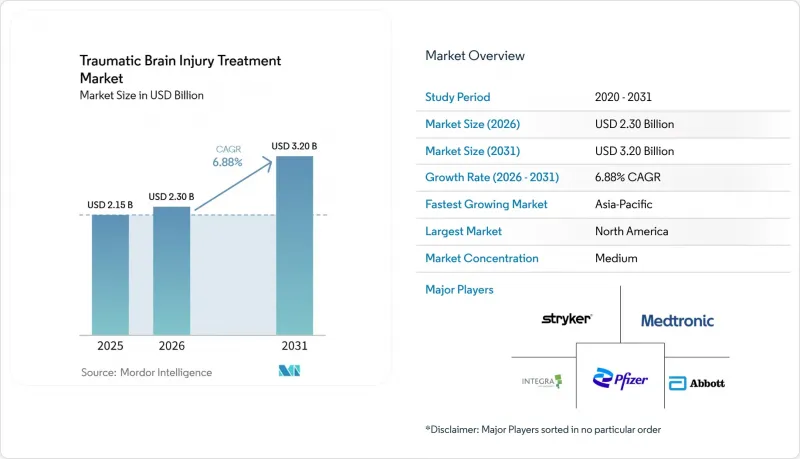
본 보고서에서는 시장을 치료 유형(즉시 응급처치 등), 치료 단계(병원 도착 전 및 응급 현장에서의 상태 안정화 등), 환자 연령(소아 환자 등), 외상 원인(낙상 등), 최종 사용자(병원 및 외상 센터 등), 유통 채널, 그리고 지역별로 분류하고 있습니다. 시장 규모 및 전망은 금액(달러) 기준으로 제시되어 있습니다.
세계의 외상성 뇌손상(TBI) 치료 시장 동향 및 인사이트
넘어짐, 교통사고, 스포츠로 인한 외상으로 발생하는 외상성 뇌손상(TBI) 발생률 증가
외상성 뇌손상(TBI) 치료 시장에서 가장 안정적인 수요원은 신규 부상 건수입니다. 미국에서는 2023년에 6만 8,663건의 TBI 관련 사망이 기록되었습니다. 전국적으로 볼 때, TBI 관련 입원의 거의 절반은 낙상 때문이었습니다. 스포츠 참여와 뇌진탕(콘커션) 대응 프로토콜의 보급으로 인해 경미한 부상도 기록된 임상 치료의 대상이 되고 있습니다. 인식 제고와 헬멧 착용으로 인해 사망률은 감소하는 반면, 지속적인 치료가 필요한 생존자의 수는 증가하고 있습니다.
신경 중환자 치료 및 외상 네트워크의 확대
병원이 보다 고도화된 외상 및 신경 중환자 치료 서비스를 구축하는 것은 외상성 뇌손상(TBI) 치료 시장에 긍정적인 영향을 미칩니다. 지정 외상 센터는 중증 손상 후의 급성기 분류 및 치료의 질을 높입니다. 브레인 트라우마 재단(Brain Trauma Foundation)의 지침은 중증 외상성 뇌손상(TBI) 치료 시 두개내압 모니터링과 체계적인 진정·진통 관리를 권장하고 있습니다. 이러한 노력은 모니터링용 카테터, 삼투압 이뇨제 및 혈관작용제에 대한 수요를 뒷받침하고 있습니다. 2025년 1월 연구에 따르면, 중환자 전문의가 주도하는 카테터 삽입은 신경외과 의사가 관리하는 삽입에 비해 두개내 고혈압에 노출되는 시간을 단축시키는 것으로 밝혀졌습니다. 프로토콜에 기반한 신경중환자실(Neuro-ICU) 치료의 보급으로 인해, 의료기기 및 의약품의 사용이 아직 충분히 정비되지 않은 의료 현장으로도 확대될 가능성이 있습니다.
널리 승인된 질환 수정제의 부재
따라서 외상성 뇌손상(TBI) 치료 시장은 여전히 증상 관리, 지지 요법, 수술, 모니터링 및 재활을 중심으로 전개되고 있습니다. SHINKEI Therapeutics사는 정맥 주사용 아만타딘 염산염 제제인 MR-301의 2상 임상시험 ‘SHINKEITBI’를 완료했습니다. 이 회사는 현재 3상 시험 설계안에 관한 FDA와의 2상 종료 시 회의 준비를 진행하고 있습니다. 현재의 처방 상황은 제네릭 의약품이나 적응증 외 사용 제품으로 분산되어 있어, 이는 대부분의 진출기업의 가격 결정력을 제한하고 있습니다. 미충족 의료 수요가 매우 크기 때문에 TBI에 특화된 질병 수정 치료제가 등장하면 경쟁 구도는 급격히 변화할 가능성이 있습니다. 그때까지는 약물 요법을 통한 수익이 독자적으로 개발하여 승인을 받은 치료제에서 나타나는 수준보다 낮은 상태를 유지할 것으로 보입니다.
부문별 분석
2025년, 외상성 뇌손상(TBI) 치료 시장에서 의약품이 차지하는 점유율은 41.25%였습니다. 삼투압 이뇨제, 항경련제, 진정제, 항우울제, 항정신병제 및 각성제가 급성기 및 만성기 치료를 뒷받침하고 있습니다. 이러한 광범위한 사용은 두개내압, 경련, 흥분 상태, 기분 증상 및 수면장애를 관리해야 할 필요성을 반영합니다. 가장 중증인 사례에 대해서는 응급 처치 및 수술이 시행됩니다. 감압 개두술, 혈종 제거술 및 두개내압 분산술은 집중 치료 단계에 속합니다. 이러한 시술의 시행은 중재적 치료가 필요할 정도로 심각한 손상을 입은 환자의 비율에 따라 제한됩니다. 이러한 시술에는 전문적인 팀과 장비가 필요하기 때문에 병원이 여전히 중심적인 역할을 하고 있습니다.
재활 치료 시장은 2031년까지 연평균 성장률(CAGR) 7.54%로 확대될 것으로 예측됩니다. 물리치료, 인지 치료, 언어 치료, 신경심리학적 치료는 부상 후 수년 동안 지속될 수 있는 기능 장애를 다루는 것입니다. 급성기를 극복하는 환자가 늘어남에 따라 외상성 뇌손상 재활 치료 시장 규모는 확대되고 있습니다. 디지털 치료, 가상현실(VR), 로봇 보조 재활, 적응형 프로그램 등이 환자의 적극적인 참여와 측정 가능한 회복을 지원하기 위해 활용되고 있습니다.
2025년에는 급성기 병원 및 신경 중환자실이 시장 점유율의 43.95%를 차지했습니다. 두개내압 모니터링, 진정, 뇌외과적 접근 및 다중 모드 모니터링으로 인해 입원 치료에는 막대한 자원이 필요합니다. 급성기 치료에서는 신속한 상태 안정을 통해 추가적인 신경학적 손상을 예방할 수 있는 기간을 관리합니다. 병원 도착 전 및 응급 현장에서의 상태 안정화는 이 치료 경로의 첫 번째 진입점이 됩니다. 고도 외상 생명 유지술(ATLS) 프로토콜은 조기 평가 및 이송 결정의 지침이 됩니다. 현장 평가 및 바이오마커 검사는 병원 도착 전의 트리아지를 개선할 가능성이 있습니다. 이 단계에서 외상성 뇌손상(TBI) 치료 시장은 여전히 병원의 대응 능력과 밀접하게 연결되어 있습니다.
만성기의 외래 및 지역사회 치료 시장은 2031년까지 연평균 성장률(CAGR) 8.02%를 나타낼 것으로 예측됩니다. 생존율 향상과 외래 관리에 대한 보험 급여 확대로 인해, 회복 후 환자들은 보다 장기적인 서비스로 전환되고 있습니다. 외상성 뇌손상(TBI)을 앓고 있는 재향군인은 인지 기능, 정신 상태 및 통증과 관련된 증상에 대해 지속적인 관리가 필요할 수 있습니다. 중등도 및 중증 손상을 입은 환자의 경우, 급성기 이후의 입원 재활이 여전히 중요합니다. 이러한 환자들은 지역사회로 복귀하기 전에 집중적인 치료가 필요한 경우가 많습니다. 이러한 상황으로 인해 병원, 재활 시설, 진료소, 재택 간병 서비스 제공업체 간의 원활한 연계와 전환의 중요성이 더욱 커지고 있습니다.
지역별 분석
2022년, 북미는 전 세계 외상성 뇌손상(TBI) 치료 시장 매출의 41.63%를 차지했습니다. 이 지역은 밀집된 외상 의료 네트워크, 광범위한 급성기 의료 서비스 범위, 그리고 바이오마커 진단의 조기 도입과 같은 이점을 가지고 있습니다. 애보트(Abbott)사의 전혈을 이용한 TBI 검사가 FDA 승인을 받음에 따라, 경미한 손상에 대한 현장(point-of-care) 평가가 가능해졌습니다. 미국은 지역별 매출에서 가장 큰 비중을 차지하고 있습니다. 2000년 이후 군인 중 외상성 뇌손상 사례 수가 48만 5,000건 이상에 달하는 것으로 나타나, 군 및 재향군인 의료 시스템에서 지속적인 수요가 예상됩니다. 또한 원격 모니터링에 대한 보험 급여도 퇴원 후 외래 진료 및 재택 간호를 뒷받침하고 있습니다.
아시아태평양은 2031년까지 연평균 성장률(CAGR) 8.22%를 나타낼 것으로 예측됩니다. 일본에서는 2024년 8월에 ‘아쿠고’가 조건부 승인을 받았고, 2025년 10월에 완전 승인을 받아 2026년 5월부터 국민건강보험 적용 대상이 되었습니다. 산바이오(SanBio)는 조기 도입을 위해 20-30곳의 전문 치료 센터를 목표로 삼고 있습니다. 또한 일본에서는 외상성 뇌손상(TBI) 모델을 통해 뇌혈관의 신경 보호 작용을 조사하는 학술 연구 프로그램도 진행되고 있습니다. 동아시아에서는 2021년에 952만 건의 외상성 뇌손상(TBI) 유병 사례가 기록되었으며, 해당 지역 전체 사례 수의 대부분을 중국이 차지하고 있습니다. 인도에서는 외상 의료의 확충과 교통사고로 인한 부상자의 부담이 증가하고 있는 점이 향후 수요를 뒷받침할 것으로 보이며, 기타 신흥 지역에서는 저비용 모니터링 및 진단 기술이 중요해질 가능성이 있습니다.
유럽에서는 독일, 영국, 프랑스, 이탈리아, 스페인에서 임상 기준이 확립되어 있습니다. 각국의 뇌신경외과 지침과 유럽의약품청(EMA)의 프레임워크가 치료 프로토콜에 영향을 미치고 있습니다. 2025년에 발표된 프랑스의 지침에서는 성인 및 소아 TBI의 급성기 관리가 종합적으로 다루어졌습니다. 이 지침은 모니터링, 외과 수술, 지혈 관련 제품에 대한 지속적인 투자를 뒷받침하고 있습니다. 2026년 1월에 발표된 독일의 연구에 따르면, 수술 후 합병증을 줄이기 위한 감압 개두술과 두개 성형술 사이의 최적 간격은 122.5일인 것으로 밝혀졌습니다. 중부 및 동유럽에서는 서유럽에 비해 외상성 뇌손상으로 인한 부담이 더 큽니다. 이러한 격차는 충족되지 않은 수요가 있으며, 치료 접근성을 확대할 여지가 있음을 시사합니다.
기타 혜택 :
- 엑셀 형식 시장 예측(ME) 시트
- 3개월간의 애널리스트 지원
자주 묻는 질문
목차
제1장 서론
제2장 조사 방법
제3장 개요
제4장 시장 구도
제5장 시장 규모 및 성장 예측
제6장 경쟁 구도
제7장 시장 기회 및 향후 전망
KTH 26.09.02According to Mordor Intelligence, the traumatic brain injury treatment market size is projected to expand from USD 2.15 billion in 2025 and USD 2.30 billion in 2026 to USD 3.20 billion by 2031, registering a CAGR of 6.88% between 2026 to 2031.
This report Segments the Industry Into by Treatment Type (Immediate Emergency Care, and More), Care Phase (Prehospital and Emergency Stabilization, and More), Patient Age (Pediatric Patients, and More), Cause of Injury (Falls, and More), End User (Hospitals and Trauma Centers, and More), Distribution Channel, and Geography. The Market Sizes and Forecasts are Provided in Terms of Value (USD).
Global Traumatic Brain Injury Treatment Market Trends and Insights
Rising TBI Incidence From Falls, Road Traffic, and Sports Injuries
The traumatic brain injury treatment market draws its most stable demand from the volume of new injuries. In the United States, 68,663 TBI-related deaths were recorded in 2023. Falls accounted for nearly half of TBI-related hospitalizations nationally. Sports participation and concussion protocols bring more mild injuries into documented clinical care. Better awareness and helmet use can reduce mortality while increasing the number of survivors needing continued care.
Expansion of Neurocritical Care and Trauma Networks
The traumatic brain injury treatment market benefits when hospitals build more capable trauma and neurocritical care services. Designated trauma centers increase the intensity of acute triage and treatment after severe injury. The Brain Trauma Foundation guidelines support intracranial pressure monitoring and structured sedation-analgesia management in severe TBI care. These practices support demand for monitoring catheters, osmolar diuretics, and vasoactive medicines. A January 2025 study found that intensivist-led catheter placement reduced intracranial hypertension exposure time compared with neurosurgeon-managed placement. The wider use of protocol-driven neuro-ICU care can extend device and medication use into less established settings.
Absence of Broadly Approved Disease-Modifying Pharmacotherapies
The traumatic brain injury treatment market, therefore, remains centered on symptom control, supportive medicines, surgery, monitoring, and rehabilitation. SHINKEI Therapeutics completed its Phase 2 SHINKEITBI trial for MR-301, an intravenous amantadine HCl formulation. The program is preparing for an End-of-Phase 2 FDA meeting on a potential Phase 3 design. Current prescribing remains dispersed across generic and off-label products, which limits pricing power for most participants. A TBI-specific disease-modifying treatment could rapidly change the competitive balance because the unmet need is significant. Until then, pharmacological revenue remains below the level associated with proprietary, approved therapies.
Other drivers and restraints analyzed in the detailed report include:
- Increasing Adoption of Objective Mild TBI Assessment
- Growth of Long-Term Neurorehabilitation and Survivorship Care
- Heterogeneous Injury Phenotypes and Weak Trial Endpoint Consistency
For complete list of drivers and restraints, kindly check the Table Of Contents.
Segment Analysis
Medications held 41.25% of the traumatic brain injury treatment market share in 2025. Osmolar diuretics, anti-seizure medicines, sedatives, antidepressants, antipsychotics, and stimulants support acute and chronic care. Their broad use reflects the need to manage intracranial pressure, seizures, agitation, mood symptoms, and sleep issues. Immediate emergency care and surgery address the most severe presentations. Decompressive craniectomy, hematoma evacuation, and intracranial pressure diversion are intensive episodes of care. Their utilization is limited by the share of patients with injuries severe enough to require intervention. Hospitals remain central because these procedures require specialized teams and equipment.
Rehabilitation therapies are projected to grow at a 7.54% CAGR through 2031. Physical, cognitive, speech, and neuropsychological therapies address deficits that can persist for years after injury. The traumatic brain injury treatment market size for rehabilitation expands as more patients survive the acute phase. Digital therapy, virtual reality, robotics-assisted rehabilitation, and adaptive programs are being used to support engagement and measurable recovery.
Acute hospital and neurocritical care held 43.95% of the market share in 2025. Intracranial pressure monitoring, sedation, neurosurgical access, and multimodal monitoring make inpatient treatment resource-intensive. The acute setting manages the period in which rapid stabilization can prevent further neurological harm. Prehospital and emergency stabilization provide the first entry point into this care pathway. Advanced trauma life support protocols guide early assessment and transport decisions. Field assessment and biomarker testing may improve triage before hospital arrival. The traumatic brain injury treatment market remains strongly tied to hospital capability during this stage.
Chronic outpatient and community care is forecast to grow at a 8.02% CAGR through 2031. Better survival and reimbursement for ambulatory management are shifting patients after recovery into longer-term services. Veterans with TBI may require continuing management for cognitive, psychiatric, and pain-related symptoms. Post-acute inpatient rehabilitation remains important for patients with moderate and severe injuries. These patients often need intensive therapy before returning to community settings. This mix increases the importance of coordinated transitions between hospital, rehabilitation, clinic, and home care providers.
Complete Report Scope:
- By Treatment Type
- Immediate Emergency Care
- Medications
- Diuretics and Hyperosmolar Agents
- Anti-Seizure Drugs
- Analgesics and Sedatives
- Antidepressants and Anxiolytics
- Antipsychotics and Neuropsychiatric Treatments
- Hemostatic Agents
- Stimulants and Dopaminergic Agents
- Other Medications
- Surgery
- Decompressive Craniectomy
- Hematoma Evacuation
- Cranioplasty and Skull-Fracture Repair
- Intracranial Pressure Diversion and Drainage
- Minimally Invasive and Image-Guided Neurosurgery
- Rehabilitation Therapies
- Physical and Occupational Therapy
- Speech, Language and Swallowing Therapy
- Cognitive Rehabilitation
- Neuropsychological and Behavioral Therapy
- Spasticity Management
- Other Rehabilitation Therapies
- By Care Phase
- Prehospital and Emergency Stabilization
- Acute Hospital and Neurocritical Care
- Post-Acute Inpatient Rehabilitation
- Chronic Outpatient and Community Care
- By Patient Age
- Pediatric Patients
- Adolescent Patients
- Adult Patients
- Geriatric Patients
- By Cause of Injury
- Falls
- Motor Vehicle Traffic Injuries
- Sports and Recreational Injuries
- Occupational and Industrial Injuries
- Military and Blast-Related Injuries
- Assault and Violence-Related Injuries
- Other Traumatic Causes
- By End User
- Hospitals and Trauma Centers
- Neurology and Neurosurgery Clinics
- Ambulatory Care Centers
- Home Care and Community Care
- Other End Users
- By Distribution Channel
- Hospital Pharmacies
- Retail and Independent Pharmacies
- Specialty Pharmacies
- Direct Institutional Procurement
- Online and Digital Channels
- By Geography
- North America
- United States
- Canada
- Mexico
- Europe
- Germany
- United Kingdom
- France
- Italy
- Spain
- Rest of Europe
- Asia-Pacific
- China
- Japan
- India
- Australia
- South Korea
- Rest of Asia-Pacific
- Middle East and Africa
- GCC
- South Africa
- Rest of Middle East and Africa
- South America
- Brazil
- Argentina
- Rest of South America
- North America
Geography Analysis
North America held 41.63% of the global traumatic brain injury treatment market revenue in 2025. The region benefits from dense trauma networks, extensive acute care coverage, and early use of biomarker diagnostics. The FDA clearance of Abbott's whole-blood TBI test supported point-of-care assessment for mild injuries. The United States contributes the largest regional revenue base. More than 485,000 TBI cases among service members since 2000 support a lasting demand in military and veterans' health systems. Remote monitoring reimbursement also supports outpatient and home care after discharge.
Asia-Pacific is forecast to grow at a 8.22% CAGR through 2031. Japan approved Akuugo conditionally in August 2024, granted full approval in October 2025, and listed it under National Health Insurance in May 2026. SanBio is targeting 20-30 specialized treatment centers for early deployment. Japan also has academic research programs exploring cerebrovascular neuroprotection in TBI models. East Asia recorded 9.52 million prevalent TBI cases in 2021, with China representing a large share of regional volume. India's trauma care expansion and road injury burden support future demand, while lower-cost monitoring and diagnostics may be important in other emerging regions.
Europe has established clinical standards across Germany, the United Kingdom, France, Italy, and Spain. National neurosurgery guidance and EMA frameworks influence treatment protocols. French guidelines released in 2025 covered the acute management of adult and pediatric TBI. The guidance supports continued investment in monitoring, surgical, and hemostatic products. A January 2026 published German study identified 122.5 days as an optimal interval between decompressive craniectomy and cranioplasty for reducing postoperative complications. Central and Eastern Europe have a higher TBI burden than Western Europe. This gap points to unmet need and room for broader treatment access.
- Cellvation, Inc.
- Dr. Reddy's Laboratories
- Hope Biosciences LLC
- Integra LifeSciences
- Ipsen Pharma SAS
- Medtronic
- Merz Therapeutics GmbH
- Oragenics, Inc.
- Oxeia Biopharmaceuticals, Inc.
- Pfizer
- SanBio Co., Ltd.
- SHINKEI Therapeutics, Inc.
- Stryker
- Sun Pharmaceuticals Industries
- Supernus Pharmaceuticals
- Teva Pharmaceutical Industries
- veriNOS Pharmaceuticals GmbH
- Viatris
Additional Benefits:
- The market estimate (ME) sheet in Excel format
- 3 months of analyst support
TABLE OF CONTENTS
1 Introduction
- 1.1 Study Assumptions and Market Definition
- 1.2 Scope of the Study
2 Research Methodology
3 Executive Summary
4 Market Landscape
- 4.1 Market Overview
- 4.2 Market Drivers
- 4.2.1 Rising TBI Incidence From Falls, Road Traffic, and Sports Injuries
- 4.2.2 Expansion of Neurocritical Care and Trauma Networks
- 4.2.3 Increasing Adoption of Objective Mild TBI Assessment
- 4.2.4 Growth of Long-Term Neurorehabilitation and Survivorship Care
- 4.2.5 Biomarker-Guided and Precision TBI Management
- 4.2.6 Intranasal, Cell-Based, and Neuroprotective Pipeline Innovation
- 4.3 Market Restraints
- 4.3.1 Absence of Broadly Approved Disease-Modifying Pharmacotherapies
- 4.3.2 Heterogeneous Injury Phenotypes and Weak Trial Endpoint Consistency
- 4.3.3 Time-Critical Treatment Windows and Delayed Care Pathways
- 4.3.4 Specialist, Rehabilitation and Advanced Monitoring Capacity Gaps
- 4.4 Value Chain Analysis
- 4.5 Regulatory Landscape
- 4.6 Technological Outlook
- 4.7 Porter's Five Forces Analysis
- 4.7.1 Threat of New Entrants
- 4.7.2 Bargaining Power of Suppliers
- 4.7.3 Bargaining Power of Buyers
- 4.7.4 Threat of Substitutes
- 4.7.5 Competitive Rivalry
5 Market Size & Growth Forecasts (Value, USD)
- 5.1 By Treatment Type
- 5.1.1 Immediate Emergency Care
- 5.1.2 Medications
- 5.1.2.1 Diuretics and Hyperosmolar Agents
- 5.1.2.2 Anti-Seizure Drugs
- 5.1.2.3 Analgesics and Sedatives
- 5.1.2.4 Antidepressants and Anxiolytics
- 5.1.2.5 Antipsychotics and Neuropsychiatric Treatments
- 5.1.2.6 Hemostatic Agents
- 5.1.2.7 Stimulants and Dopaminergic Agents
- 5.1.2.8 Other Medications
- 5.1.3 Surgery
- 5.1.3.1 Decompressive Craniectomy
- 5.1.3.2 Hematoma Evacuation
- 5.1.3.3 Cranioplasty and Skull-Fracture Repair
- 5.1.3.4 Intracranial Pressure Diversion and Drainage
- 5.1.3.5 Minimally Invasive and Image-Guided Neurosurgery
- 5.1.4 Rehabilitation Therapies
- 5.1.4.1 Physical and Occupational Therapy
- 5.1.4.2 Speech, Language and Swallowing Therapy
- 5.1.4.3 Cognitive Rehabilitation
- 5.1.4.4 Neuropsychological and Behavioral Therapy
- 5.1.4.5 Spasticity Management
- 5.1.4.6 Other Rehabilitation Therapies
- 5.2 By Care Phase
- 5.2.1 Prehospital and Emergency Stabilization
- 5.2.2 Acute Hospital and Neurocritical Care
- 5.2.3 Post-Acute Inpatient Rehabilitation
- 5.2.4 Chronic Outpatient and Community Care
- 5.3 By Patient Age
- 5.3.1 Pediatric Patients
- 5.3.2 Adolescent Patients
- 5.3.3 Adult Patients
- 5.3.4 Geriatric Patients
- 5.4 By Cause of Injury
- 5.4.1 Falls
- 5.4.2 Motor Vehicle Traffic Injuries
- 5.4.3 Sports and Recreational Injuries
- 5.4.4 Occupational and Industrial Injuries
- 5.4.5 Military and Blast-Related Injuries
- 5.4.6 Assault and Violence-Related Injuries
- 5.4.7 Other Traumatic Causes
- 5.5 By End User
- 5.5.1 Hospitals and Trauma Centers
- 5.5.2 Neurology and Neurosurgery Clinics
- 5.5.3 Ambulatory Care Centers
- 5.5.4 Home Care and Community Care
- 5.5.5 Other End Users
- 5.6 By Distribution Channel
- 5.6.1 Hospital Pharmacies
- 5.6.2 Retail and Independent Pharmacies
- 5.6.3 Specialty Pharmacies
- 5.6.4 Direct Institutional Procurement
- 5.6.5 Online and Digital Channels
- 5.7 By Geography
- 5.7.1 North America
- 5.7.1.1 United States
- 5.7.1.2 Canada
- 5.7.1.3 Mexico
- 5.7.2 Europe
- 5.7.2.1 Germany
- 5.7.2.2 United Kingdom
- 5.7.2.3 France
- 5.7.2.4 Italy
- 5.7.2.5 Spain
- 5.7.2.6 Rest of Europe
- 5.7.3 Asia-Pacific
- 5.7.3.1 China
- 5.7.3.2 Japan
- 5.7.3.3 India
- 5.7.3.4 Australia
- 5.7.3.5 South Korea
- 5.7.3.6 Rest of Asia-Pacific
- 5.7.4 Middle East and Africa
- 5.7.4.1 GCC
- 5.7.4.2 South Africa
- 5.7.4.3 Rest of Middle East and Africa
- 5.7.5 South America
- 5.7.5.1 Brazil
- 5.7.5.2 Argentina
- 5.7.5.3 Rest of South America
- 5.7.1 North America
6 Competitive Landscape
- 6.1 Market Concentration
- 6.2 Market Share Analysis
- 6.3 Company Profiles (includes Global Level Overview, Market Level Overview, Core Segments, Financials as available, Strategic Information, Market Rank/Share, Products and Services, Recent Developments)
- 6.3.1 Cellvation, Inc.
- 6.3.2 Dr. Reddy's Laboratories Limited
- 6.3.3 Hope Biosciences LLC
- 6.3.4 Integra LifeSciences Holdings Corporation
- 6.3.5 Ipsen Pharma SAS
- 6.3.6 Medtronic plc
- 6.3.7 Merz Therapeutics GmbH
- 6.3.8 Oragenics, Inc.
- 6.3.9 Oxeia Biopharmaceuticals, Inc.
- 6.3.10 Pfizer Inc.
- 6.3.11 SanBio Co., Ltd.
- 6.3.12 SHINKEI Therapeutics, Inc.
- 6.3.13 Stryker Corporation
- 6.3.14 Sun Pharmaceutical Industries Limited
- 6.3.15 Supernus Pharmaceuticals, Inc.
- 6.3.16 Teva Pharmaceutical Industries Ltd.
- 6.3.17 veriNOS Pharmaceuticals GmbH
- 6.3.18 Viatris Inc.
7 Market Opportunities and Future Outlook
- 7.1 White-Space and Unmet-Need Assessment


