

|
시장보고서
상품코드
2118992
진행성 신세포암 : 시장 점유율 분석, 업계 동향 및 통계, 성장 예측(2026-2031년)Advanced Renal Cell Carcinoma - Market Share Analysis, Industry Trends & Statistics, Growth Forecasts (2026 - 2031) |
||||||
 Mordor Intelligence
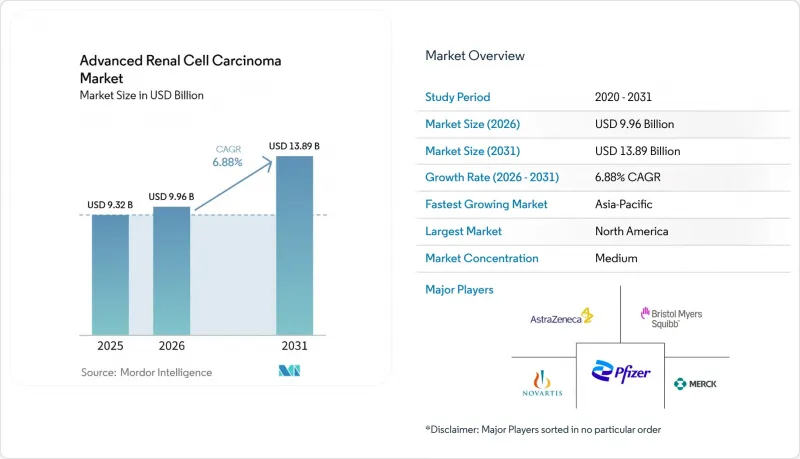
Mordor Intelligence에 의하면, 진행성 신세포암 시장 규모는 2025년에 93억 2,000만 달러로 평가되었습니다. 2026년 99억 6,000만 달러에서 2031년까지 138억 9,000만 달러에 이를 것으로 예상되며, 예측 기간(2026-2031년) CAGR은 6.88%를 나타낼 전망입니다.
본 보고서는 치료법별(면역요법, 표적요법, 병용요법, 기타), 치료 단계별(1차 치료, 2차 치료, 3차 치료 이상, 유지요법), 질환 아형별(명세포형, 유두상형, 기타),투여 경로별(경구, 정맥 내, 피하, 기타), 최종 사용자별(병원, 연구 기관, 기타), 지역별(북미, 유럽, 아시아태평양, 중동 및 아프리카, 남미)로 분류되어 있습니다. 예측치는 금액(달러)으로 표시되어 있습니다.
세계의 진행성 신세포암 시장 동향 및 인사이트
신세포암(RCC)의 발병률 및 진단 건수 증가
신장암 발생률은 상승하고 있으며, 전신 치료 대상이 되는 환자층이 확대되고 있습니다. 2025년 분석에 따르면, 65세 이상 성인에서 신장암 신규 환자 수는 1990년 7만 3건에서 2024년에는 20만 3,022건으로 증가했습니다. 고령 환자는 더 세심한 경과 관찰이 필요한 경우가 많으며, 여러 치료 단계에 걸쳐 치료를 지속하는 경우가 있습니다. 환자의 20%에서 30%는 진단 시점에 전이성 질환을 보이며, 추가로 30%에서 50%는 국소 치료 후 병세가 진행됩니다. 미국에서는 머크사가 2026년에 8만 건 이상의 신규 신장암 사례와 1만 5,000명 이상의 사망을 예상하고 있으며, 이는 진행성 질환에 대한 치료법에 대한 지속적인 수요를 뒷받침하고 있습니다.
면역요법 병용에 따른 지속적인 생존 이점
면역요법 병용을 통해 진행성 신세포암(RCC)의 많은 1차 치료에서 단일 요법에서 병용 요법으로의 전환이 진행되고 있습니다. 펨브롤리주맙과 악시티닙의 병용 요법은 장기 추적 조사에서 IMDC 위험군에 관계없이 지속적인 생존 이점이 입증되었습니다. 생존 기간의 연장으로 인해 1차 치료 실패 후 후속 치료를 받을 자격이 있는 환자 수가 증가하여, 치료 경로 전반에 걸쳐 수요가 확대됩니다. 효과적인 1차 치료를 통해 환자가 더 양호한 임상 상태로 후속 치료 단계로 넘어갈 수 있으므로, 진행성 신세포암 시장에도 긍정적인 영향을 미칩니다.
치료 관련 독성 및 치료 중단
치료 관련 독성은 진행성 신세포암 시장에서 새로운 병용 요법의 실질적인 활용을 제한할 가능성이 있습니다. HIF-2a 억제는 빈혈이나 저산소증을 유발할 수 있으며, 이를 모니터링하는 데 있어 자원이 제한된 의료 기관보다 전문 암 센터가 더 효과적으로 대응할 수 있는 경우가 있습니다. 체크포인트 억제제는 폐렴, 대장염, 내분비 장애 등의 면역 관련 이상반응을 유발할 가능성이 있어, 환자에게는 여러 의료팀의 협력적인 치료가 필요할 수 있습니다. 미국의 실제 임상 연구에 따르면, 면역요법 및 VEGF 억제제 기반 치료가 효과를 보이지 않은 후, 입원율은 2차 치료 시 22%에서 4차 치료 시 32.7%로 증가했습니다. 용량 감소, 치료 중단 및 치료 중지는 후기 치료의 임상적 및 상업적 가치를 저하시킬 가능성이 있습니다.
부문별 분석
2025년에는 면역요법이 전 세계 매출의 58.88%를 차지했습니다. PD-1 및 PD-L1 억제제는 특히 확립된 1차 치료의 병용 요법에서 계속해서 널리 사용되었습니다. 펨브롤리주맙, 니볼루맙 및 이필리맙을 기반으로 한 치료법은 모든 위험군에 걸친 임상적 근거에 뒷받침되어 지속적인 역할을 유지했습니다. 표적 치료는 가장 빠르게 성장하는 부문이며, 진행성 신세포암 시장 규모는 2026년부터 2031년까지 연평균 성장률(CAGR) 8.15%로 확대될 것으로 예측됩니다.
표적 치료의 성장은 HIF-2a 억제제의 역할과 차세대 VEGFR-TKI의 지속적인 사용을 반영합니다. 2025년 2월, 이전 치료를 받은 진행성 명세포형 신세포암에 대한 WELIREG가 유럽에서 승인됨에 따라, 이 범주는 유럽의 후기 치료에서 명확한 역할을 맡게 되었습니다. 사이토카인 기반 치료는 새로운 치료법에 대한 접근이 제한된 지역에서 제한적으로 사용되었지만, 세포독성 요법 및 기타 전신 요법은 특정 난치성 환자에게 여전히 중요한 역할을 하고 있습니다. 경구제 및 피하 투여제의 등장으로 인해 치료의 상당 부분이 정맥 주사 센터에서 이동할 가능성이 있으며, 진행성 신세포암 업계에서 전문 약국과 병원 채널 간의 균형에 변화가 생길 수 있습니다.
2025년, 1차 치료는 전 세계 매출의 64.34%를 차지했습니다. 이러한 상황은 초기 치료 비용이 높다는 점과, 임상의들이 진행성 질환을 처음 관리할 때 면역요법의 병용이 널리 이루어지고 있음을 반영합니다. 면역요법이나 VEGF 표적 약제에 대한 조기 노출이 이후의 치료 선택에 영향을 미치기 때문에 1차 치료 요법은 그 이후의 치료 방침을 형성했습니다. 3차 치료 이후 단계는 가장 빠르게 성장하는 부문이며, 이 부문의 진행성 신세포암 시장 규모는 2026년부터 2031년까지 연평균 성장률(CAGR) 9.80%로 확대될 것으로 예측됩니다.
치료 초기 단계의 생존율이 향상됨에 따라 후기 치료 단계의 성장도 가속화되었습니다. ASCO 2026에서 발표된 체계적 문헌고찰에 따르면, 면역관문억제제 치료 실패 후에도 TKI 기반 요법은 여전히 신뢰할 수 있는 2차 치료 옵션임이 밝혀졌습니다. 2026년 6월 보조 요법으로 펨브롤리주맙과 벨즈티판의 병용 요법이 승인됨에 따라, 수술 전후 치료와 전이성 치료의 경계가 모호해졌습니다. 전이성 재발 전에 면역요법을 받은 환자에게는 다른 치료 순서 전략이 필요할 수 있으며, 이로 인해 보조요법 후의 전향적 증거에 대한 수요가 생겨나고 있습니다.
지역별 분석
2025년, 북미는 전 세계 진행성 신세포암 시장 매출의 39.89%를 차지했습니다. 이 지역은 높은 질병 발병률, 신약에 대한 조기 접근, 그리고 치료 도입을 지원하는 공공 및 민간 보험 환급 제도의 혜택을 받았습니다. 미국 여성의 연령 조정 신장암 발생률은 10만 명당 8.7명으로, 이는 전 세계에서 보고된 발생률 중 가장 높은 수준 중 하나였습니다. 미국에서는 2026년 6월, 명세포형 신세포암(RCC)의 보조 요법으로 펨브롤리주맙과 벨즈티판의 병용 요법이 FDA 승인을 받았습니다. 한편, 캐나다와 멕시코는 매출 기여도는 낮았으나 치료 접근성 확대를 지속했습니다.
유럽은 진행성 신세포암 시장에서 두 번째로 큰 규모를 자랑하는 지역으로, 각국의 보험 적용 결정에 이어 유럽연합(EU) 27개 회원국 전체의 접근성을 뒷받침하는 승인 절차가 마련되어 있었습니다. 유럽연합 집행위원회는 2025년 2월 진행성 명세포형 신세포암에 대한 WELIREG를 조건부로 승인했으며, 2025년 5월에는 피하 투여형 니볼루맙을 승인했습니다. 독일은 여전히 주요 수익원이었으며, 남미에서는 접근성이 낮은 수준이긴 하지만 개선세가 보였습니다. 브라질과 아르헨티나에서는 조달 및 보험 적용 범위가 확대되었으나, 높은 약값과 보험 환급 제도의 불균형으로 인해 지역 내 보급은 여전히 제한적이었습니다.
아시아태평양은 진행성 신세포암 시장에서 가장 빠르게 성장하는 지역으로, 2026년부터 2031년까지 연평균 성장률(CAGR) 8.58%로 확대될 것으로 예측됩니다. 중국은 발병률 증가, 인프라 확충, 그리고 현지에서 개발된 치료 요법의 존재로 인해 이 성장의 중심적인 역할을 계속하고 있습니다. 2026년 5월, 중국 국가약품감독관리국(NMPA)은 VEGFR-TKI로 사전 치료를 받은 국소 진행성 또는 전이성 신세포암(RCC)에 대해 신틸리맙과 플루퀸티닙의 병용 요법을 승인했습니다. 일본의 신속 승인 제도와 인도, 한국, 호주의 종양학 네트워크 확대가 치료 접근성을 높이는 데 기여했지만, 한국에서는 여전히 보험 적용 범위에 미흡한 점이 발견되었습니다. 중동 및 아프리카에서는 GCC(걸프협력회의) 국가들의 조기 도입과 많은 사하라 이남 시장의 인프라 및 공급 측면의 장벽 사이에서 상황이 양극화되었으나, 아프리카 의약품청(Africa Medicines Agency)의 체계가 장기적인 기준 통일을 위한 길을 제시했습니다.
기타 혜택 :
- 엑셀 형식 시장 예측(ME) 시트
- 3개월간의 애널리스트 지원
자주 묻는 질문
목차
제1장 서론
제2장 조사 방법
제3장 개요
제4장 시장 구도
제5장 시장 규모 및 성장 예측(금액, 달러)
제6장 경쟁 구도
제7장 시장 기회 및 향후 전망
KTH 26.09.02According to Mordor Intelligence, the advanced renal cell carcinoma market size was valued at USD 9.32 billion in 2025 and is estimated to grow from USD 9.96 billion in 2026 to reach USD 13.89 billion by 2031, at a CAGR of 6.88% during the forecast period (2026-2031).
This report is Segmented by Therapy Type (Immunotherapy, Targeted Therapy, Combination, Others), Line of Therapy (First-Line, Second-Line, Third-Line+, Maintenance), Disease Subtype (Clear Cell, Papillary, Other), Route of Administration (Oral, IV, Subcutaneous, Other), End User (Hospitals, Institutes, Others), and Geography (North America, Europe, APAC, MEA, South America). Forecasts in Value (USD).
Global Advanced Renal Cell Carcinoma Market Trends and Insights
Rising Incidence and Diagnosis of RCC
Kidney cancer incidence is rising, expanding the addressable patient pool for systemic treatment. A 2025 analysis found that incident kidney cancer cases among adults aged 65 years and older increased from 70,003 in 1990 to 203,022 in 2024. Older patients often require closer monitoring and may continue treatment across multiple lines of care. Between 20% and 30% of patients present with metastatic disease at diagnosis, while another 30% to 50% progress after local treatment. In the United States, Merck projected more than 80,000 new kidney cancer cases and more than 15,000 deaths in 2026, supporting sustained demand for advanced disease therapies.
Durable Survival Benefit From Combination Immunotherapy
Combination immunotherapy has shifted many first-line advanced RCC settings away from single-agent approaches. Pembrolizumab plus axitinib has demonstrated sustained survival benefit across IMDC risk groups in long-term follow-up. Longer survival increases the number of patients eligible for subsequent therapy after first-regimen failure, extending demand across the treatment pathway. The advanced renal cell carcinoma market benefits as effective first-line care helps patients reach later treatment settings in better clinical condition.
Treatment-Related Toxicity and Discontinuation
Treatment-related toxicity can limit the practical use of new combinations in the advanced renal cell carcinoma market. HIF-2a inhibition can cause anemia and hypoxia, requiring monitoring that specialist oncology centers may manage more effectively than less-resourced settings. Checkpoint inhibitors can trigger immune-related adverse events, including pneumonitis, colitis, and endocrine disorders, and patients may need coordinated care across multiple medical teams. In a U.S. real-world study, inpatient admissions increased from 22% in second-line care to 32.7% in fourth-line care after immunotherapy and VEGF-based treatment failure. Dose reductions, treatment interruptions, and discontinuation can reduce the clinical and commercial value of later-line therapy.
Other drivers and restraints analyzed in the detailed report include:
- Expansion of Later-Line Treatment Options and Sequential Use
- Biomarker-Enabled HIF-2a Segmentation
- High Cost and Unequal Reimbursement
For complete list of drivers and restraints, kindly check the Table Of Contents.
Segment Analysis
Immunotherapy accounted for 58.88% of global revenue in 2025. PD-1 and PD-L1 inhibitors remained widely used, especially in established first-line combinations. Pembrolizumab-, nivolumab-, and ipilimumab-based regimens retained a durable role, supported by clinical evidence across risk groups. Targeted therapy is the fastest-growing segment, with the advanced renal cell carcinoma market size projected to rise at an 8.15% CAGR from 2026 to 2031.
Targeted therapy growth reflects the role of HIF-2a inhibitors and the continued use of next-generation VEGFR-TKIs. The February 2025 European approval of WELIREG for previously treated advanced clear cell RCC gave this category a defined role in European later-line care. Cytokine-based treatments retained limited use where access to newer therapies was restricted, while cytotoxic and other systemic therapies remained relevant for select refractory patients. Oral and subcutaneous forms may shift more treatment away from infusion centers, changing the balance between specialty pharmacy and hospital channels in the advanced renal cell carcinoma industry.
First-line treatment held 64.34% of global revenue in 2025. This position reflected the high cost of initial treatment and the broad use of immunotherapy combinations when clinicians first managed advanced disease. First-line regimens shaped subsequent care because earlier exposure to immunotherapy and VEGF-targeted agents influenced later treatment choices. Third-line and later treatment is the fastest-growing category, with the advanced renal cell carcinoma market size in this segment forecast to expand at a 9.80% CAGR from 2026 to 2031.
Later-line growth increased as survival improved in earlier stages of care. A systematic review presented at ASCO 2026 found that TKI-based regimens remained a reliable second-line option after immune checkpoint inhibitor failure. The June 2026 approval of pembrolizumab plus belzutifan in adjuvant care blurred the boundary between perioperative and metastatic treatment. Patients exposed to immunotherapy before metastatic recurrence may require different sequencing strategies, creating demand for prospective evidence after adjuvant therapy.
Complete Report Scope:
- By Therapy Type
- Immunotherapy
- PD-1 and PD-L1 Inhibitors
- CTLA-4 Inhibitors
- Cytokine-Based Immunotherapy
- Targeted Therapy
- VEGFR Tyrosine Kinase Inhibitors
- HIF-2- Inhibitors
- mTOR Inhibitors
- Multikinase and MET Inhibitors
- Combination Therapy
- IO-IO Combinations
- IO-TKI Combinations
- Targeted-Therapy Combinations
- Cytotoxic and Other Systemic Therapy
- Immunotherapy
- By Line of Therapy
- First-Line Treatment
- Second-Line Treatment
- Third-Line and Later Treatment
- Maintenance and Treatment Sequencing
- By Disease Subtype
- Clear Cell RCC
- Papillary RCC
- Other
- By Route of Administration and Form
- Oral
- Intravenous
- Subcutaneous
- Combination and Sequential Administration
- By End User
- Hospitals and Hospital Pharmacies
- Cancer Research Institutes
- Ambulatory Surgical Centers
- Academic and Research Institutes
- Others
- By Geography
- North America
- United States
- Canada
- Mexico
- Europe
- Germany
- United Kingdom
- France
- Italy
- Spain
- Rest of Europe
- Asia-Pacific
- China
- India
- Japan
- Australia
- South Korea
- Rest of Asia-Pacific
- Middle East and Africa
- GCC
- South Africa
- Rest of Middle East and Africa
- South America
- Brazil
- Argentina
- Rest of South America
- North America
Geography Analysis
North America held 39.89% of global advanced renal cell carcinoma market revenue in 2025. The region benefited from high disease incidence, early access to new medicines, and public and private reimbursement systems that supported treatment adoption. U.S. women had an age-standardized kidney cancer incidence rate of 8.7 per 100,000, among the highest rates reported globally. The United States received FDA approval for pembrolizumab plus belzutifan in adjuvant clear cell RCC in June 2026, while Canada and Mexico contributed less revenue but continued to expand access.
Europe was the second-largest regional area in the advanced renal cell carcinoma market, with approval pathways supporting access across 27 European Union member states after national reimbursement decisions. The European Commission conditionally approved WELIREG for advanced clear cell RCC in February 2025 and approved subcutaneous nivolumab in May 2025. Germany remained a major revenue center, while South America had lower but improving access. Brazil and Argentina expanded procurement and insurance coverage, although drug costs and fragmented reimbursement continued to limit regional uptake.
Asia-Pacific was the fastest-growing region in the advanced renal cell carcinoma market and is forecast to expand at an 8.58% CAGR from 2026 to 2031. China remained central to this growth due to rising incidence, expanding infrastructure, and locally developed regimens. In May 2026, China's NMPA approved sintilimab plus fruquintinib for locally advanced or metastatic RCC after prior VEGFR-TKI treatment. Japan's accelerated pathways and expanding oncology networks in India, South Korea, and Australia supported access, although South Korea still had reimbursement gaps. The Middle East and Africa remained split between early adoption in GCC states and infrastructure and supply barriers across many Sub-Saharan markets, while the Africa Medicines Agency framework offered a longer-term path to alignment.
- Abbvie
- Arcus Biosciences, Inc.
- Astellas Pharma
- AstraZeneca
- AVEO Oncology, Inc.
- Bayer
- BeiGene, Ltd.
- Bristol-Myers Squibb
- Eisai
- Exelixis, Inc.
- Roche
- HUTCHMED (China) Limited
- Ipsen Pharma SAS
- Johnson & Johnson
- Merck
- Novartis
- Ono Pharmaceutical
- Pfizer
- Regeneron Pharmaceuticals
- Sanofi
- Takeda Pharmaceuticals
- Telix Pharmaceuticals Limited
Additional Benefits:
- The market estimate (ME) sheet in Excel format
- 3 months of analyst support
TABLE OF CONTENTS
1 INTRODUCTION
- 1.1 Study Assumptions and Market Definition
- 1.2 Scope of the Study
2 RESEARCH METHODOLOGY
3 EXECUTIVE SUMMARY
4 MARKET LANDSCAPE
- 4.1 Market Overview
- 4.2 Market Drivers
- 4.2.1 Rising Incidence and Diagnosis of RCC
- 4.2.2 Durable Survival Benefit From Combination Immunotherapy
- 4.2.3 Expansion of Later-Line Treatment Options
- 4.2.4 Biomarker-Enabled HIF-2- Segmentation
- 4.2.5 Longer Treatment Duration and Sequential Regimen Use
- 4.2.6 Increasing Recognition of Oligometastatic and Site-Specific Management
- 4.3 Market Restraints
- 4.3.1 Treatment-Related Toxicity and Discontinuation
- 4.3.2 High Cost and Unequal Reimbursement
- 4.3.3 Treatment Sequencing Uncertainty After IO-TKI Failure
- 4.3.4 Limited Prospective Evidence in Non-Clear Cell RCC and Rare Hereditary Subtypes
- 4.4 Value / Supply-Chain Analysis
- 4.5 Regulatory Landscape
- 4.6 Technological Outlook
- 4.7 Porter's Five Forces Analysis
- 4.7.1 Threat of New Entrants
- 4.7.2 Bargaining Power of Suppliers
- 4.7.3 Bargaining Power of Buyers
- 4.7.4 Threat of Substitutes
- 4.7.5 Rivalry Among Existing Competitors
5 MARKET SIZE AND GROWTH FORECASTS ( VALUE, USD)
- 5.1 By Therapy Type
- 5.1.1 Immunotherapy
- 5.1.1.1 PD-1 and PD-L1 Inhibitors
- 5.1.1.2 CTLA-4 Inhibitors
- 5.1.1.3 Cytokine-Based Immunotherapy
- 5.1.2 Targeted Therapy
- 5.1.2.1 VEGFR Tyrosine Kinase Inhibitors
- 5.1.2.2 HIF-2- Inhibitors
- 5.1.2.3 mTOR Inhibitors
- 5.1.2.4 Multikinase and MET Inhibitors
- 5.1.3 Combination Therapy
- 5.1.3.1 IO-IO Combinations
- 5.1.3.2 IO-TKI Combinations
- 5.1.3.3 Targeted-Therapy Combinations
- 5.1.4 Cytotoxic and Other Systemic Therapy
- 5.1.1 Immunotherapy
- 5.2 By Line of Therapy
- 5.2.1 First-Line Treatment
- 5.2.2 Second-Line Treatment
- 5.2.3 Third-Line and Later Treatment
- 5.2.4 Maintenance and Treatment Sequencing
- 5.3 By Disease Subtype
- 5.3.1 Clear Cell RCC
- 5.3.2 Papillary RCC
- 5.3.3 Other
- 5.4 By Route of Administration and Form
- 5.4.1 Oral
- 5.4.2 Intravenous
- 5.4.3 Subcutaneous
- 5.4.4 Combination and Sequential Administration
- 5.5 By End User
- 5.5.1 Hospitals and Hospital Pharmacies
- 5.5.2 Cancer Research Institutes
- 5.5.3 Ambulatory Surgical Centers
- 5.5.4 Academic and Research Institutes
- 5.5.5 Others
- 5.6 By Geography
- 5.6.1 North America
- 5.6.1.1 United States
- 5.6.1.2 Canada
- 5.6.1.3 Mexico
- 5.6.2 Europe
- 5.6.2.1 Germany
- 5.6.2.2 United Kingdom
- 5.6.2.3 France
- 5.6.2.4 Italy
- 5.6.2.5 Spain
- 5.6.2.6 Rest of Europe
- 5.6.3 Asia-Pacific
- 5.6.3.1 China
- 5.6.3.2 India
- 5.6.3.3 Japan
- 5.6.3.4 Australia
- 5.6.3.5 South Korea
- 5.6.3.6 Rest of Asia-Pacific
- 5.6.4 Middle East and Africa
- 5.6.4.1 GCC
- 5.6.4.2 South Africa
- 5.6.4.3 Rest of Middle East and Africa
- 5.6.5 South America
- 5.6.5.1 Brazil
- 5.6.5.2 Argentina
- 5.6.5.3 Rest of South America
- 5.6.1 North America
6 COMPETITIVE LANDSCAPE
- 6.1 Market Concentration
- 6.2 Market Share Analysis
- 6.3 Company Profiles (includes Global Level Overview, Market Level Overview, Core Segments, Financials as available, Strategic Information, Market Rank/Share, Products and Services, Recent Developments)
- 6.3.1 AbbVie Inc.
- 6.3.2 Arcus Biosciences, Inc.
- 6.3.3 Astellas Pharma Inc.
- 6.3.4 AstraZeneca PLC
- 6.3.5 AVEO Oncology, Inc.
- 6.3.6 Bayer AG
- 6.3.7 BeiGene, Ltd.
- 6.3.8 Bristol-Myers Squibb Company
- 6.3.9 Eisai Co., Ltd.
- 6.3.10 Exelixis, Inc.
- 6.3.11 F. Hoffmann-La Roche Ltd.
- 6.3.12 HUTCHMED (China) Limited
- 6.3.13 Ipsen Pharma SAS
- 6.3.14 Johnson & Johnson
- 6.3.15 Merck & Co., Inc.
- 6.3.16 Novartis AG
- 6.3.17 Ono Pharmaceutical Co., Ltd.
- 6.3.18 Pfizer Inc.
- 6.3.19 Regeneron Pharmaceuticals, Inc.
- 6.3.20 Sanofi
- 6.3.21 Takeda Pharmaceutical Company Limited
- 6.3.22 Telix Pharmaceuticals Limited
7 MARKET OPPORTUNITIES AND FUTURE OUTLOOK
- 7.1 White-Space and Unmet-Need Assessment


