

|
시장보고서
상품코드
2119012
고체 냉각 : 시장 점유율 분석, 산업 동향 및 통계 데이터, 성장 예측(2026-2031년)Solid State Cooling - Market Share Analysis, Industry Trends & Statistics, Growth Forecasts (2026 - 2031) |
||||||
 Mordor Intelligence
Mordor Intelligence에 의하면, 고체 냉각(솔리드 스테이트 냉각) 시장 규모는 2025년에 9억 5,000만 달러로 평가되었습니다. 2026년 10억 2,000만 달러에서 2031년까지 15억 8,000만 달러로 확대되어 예측 기간(2026-2031년) CAGR은 9.15%가 된다고 전망되고 있습니다.
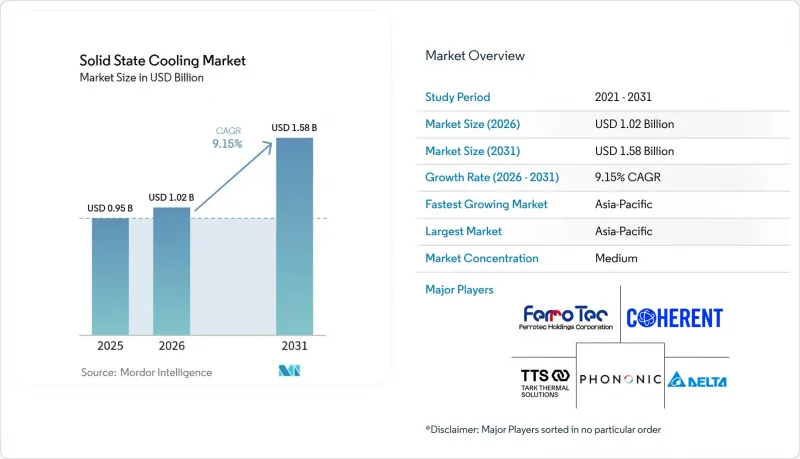
본 보고서는 제품 유형(냉각 시스템, 냉동 시스템), 기술(열전 냉각, 자기 열 냉각 등), 최종 사용자 산업(소비자용 전자기기, 의료 등), 지역(아시아태평양, 북미, 유럽, 남미, 중동 및 아프리카)별로 분류되어 있습니다. 시장 예측은 금액(달러) 기준으로 제시되어 있습니다.
세계의 고체 냉각 시장 동향 및 인사이트
전자기기 및 의료기기 분야에서 냉매를 사용하지 않는 냉각 기술에 대한 수요 증가
EU의 F-가스 규제에 따라 2026년 1월 1일부터 가정용 냉동 기기에서 F-가스 사용이 금지되는 한편, 미국의 ‘미국 혁신 및 제조법(AIM법)’에서는 하이드로플루오로카본(HFC)의 단계적 감축 체계가 정해져 있습니다. 이러한 요건으로 인해 각 OEM 업체들은 기존 냉매를 사용하는 냉각 설계의 평가 일정을 단축할 수밖에 없게 되었습니다. 이는 제품 팀이 장기적인 수명을 상정한 제품에서 인증 지연, 냉매 유지보수 의무, 문서 작성 부담 및 규제 변경으로 인한 위험을 회피해야 하기 때문입니다. 의료기기 제조업체 역시 열 관리 시스템을 선정할 때 장기적인 승인 절차를 고려해야 합니다. 열전식 기기는 냉매를 충전하지 않으며, 냉매 취급이 필요 없고, 사용 시점의 지구온난화지수(GWP)가 0입니다. 제조업체가 설계 주기가 수년 단위인 제품 플랫폼에 열 설계 아키텍처를 통합함으로써 고체 냉각 시장은 혜택을 볼 수 있습니다. 기존 장비가 계속 사용되고 있는 경우에도 지속가능성 관련 요건으로 인해 신제품에 대한 이러한 추세는 더욱 강화되고 있습니다. 이는 냉매를 사용하지 않는 설계로 인해 제품 문서화가 간소화되고, 향후 냉매 공급 가능성의 변화로 인한 위험이 완화되며, 규제 대상인 여러 지역에서 판매되는 제품에 대해 제조업체에 공통된 열 플랫폼을 제공할 수 있기 때문입니다.
전기차(EV) 배터리 및 전력 전자 장치에 대한 열 관리 요구 사항 증가
고체 배터리 설계에서는 저온 환경에서 정밀한 가열이 필요한 반면, 인버터, 차량용 충전기, 모터 컨트롤러는 모듈 수준에서 집중적인 열을 발생시킵니다. 차량 전체에서 발생하는 대량의 열을 제거하기 위해서는 여전히 기존의 액체 루프가 적합합니다. 반면, 열전 장치는 셀 계면, 전력 접합부, 충전 접점 부근의 국소적인 핫스팟을 관리함으로써 또 다른 요구 사항을 충족합니다. 이러한 부위에서는 온도 구배가 부품의 신뢰성, 충전의 일관성 및 고감도 전자 기기의 수명에 영향을 미칠 수 있습니다. 2026년 총설에서는 고체 배터리 모듈 내 국부적인 온도 구배 관리에 열전 냉각의 적용이 확대되고 있다고 기술되어 있습니다. 또한, 2026년에 발표된 연구에서는 갈륨 질화물 파워 디바이스에서 열전식 능동형 열 관리를 통해 성능과 신뢰성이 향상되었음이 입증되었습니다. 이러한 역할 분담은 고체 냉각 시장에 유익합니다. 정밀한 열 제어는 차량의 액체 냉각을 대체하는 것이 아니라 이를 보완할 수 있기 때문입니다. 이를 통해 차량 설계자는 액체 냉각 시스템을 광범위한 열 제거에 활용하고, 용량보다 국소적인 온도 정밀도가 더 중요한 부위에만 소형 고체 장치를 도입할 수 있게 됩니다.
높은 재료 비용, 에너지 효율 제약, 그리고 초기 단계의 제조
비스무스 텔루라이드 모듈은 동등한 용량을 가진 증기 압축식 부품에 비해 3-5배의 비용이 듭니다. 용량이 커질수록 이 비용 차이는 더욱 두드러집니다. 이는 규모가 확대됨에 따라 열전 계수(COP)가 압축기의 효율보다 더 빠르게 저하되기 때문입니다. 2025년 연구에서는 80W에서 COP 3.26을 달성한 수냉식 통합형 열전 냉각기가 보고되었으나, 그 설계는 여전히 특정 용도로 한정되어 있었습니다. 텔루르는 구리 제련의 부산물이며, 세계 생산량의 40%를 중국이 차지하고 있습니다. 따라서 신규 수주가 증가하거나 지정학적 상황으로 인해 기존 무역 패턴이 교란될 경우, 모듈 제조업체가 신속하게 공급량을 확대하기 어렵습니다. 이러한 집중화는 모듈 제조업체에 비용 측면의 불확실성을 초래하며, HVAC 및 상업용 냉동 분야에서의 열전 모듈 활용을 제한하고 있습니다. 또한, 자기 열 효과 및 전기 열 효과를 활용한 솔루션의 경우, 미래의 대체 기술로서의 가능성은 있으나 상업적 생산이 아직 초기 단계에 머물러 있어 추가적인 제약 요인으로 작용하고 있습니다.
부문별 분석
2025년 기준, 냉각 시스템은 고체 냉각 시장의 64.22%를 차지했습니다. 이 부문에는 능동적이고 국소적인 열 제어가 필요한 과학 기기, 의료 진단 기기, 반도체 계측 기기 및 소비자용 전자 기기가 포함됩니다. 이러한 지배적인 지위는 펠티에 효과 모듈의 성숙도와 페로테크, 크라이오솜, 크리스탈, TE 테크놀로지 등을 포함한 공급업체 기반을 반영합니다. 이러한 모듈은 40년 이상 산업 규모로 제조되어 왔으며, 장비 제조업체에게는 광범위한 성능 데이터, 확립된 인증 기준, 알려진 고장 모드, 그리고 제품 개발 주기를 지원할 수 있는 여러 공급업체가 제공되고 있습니다. 확립된 사용 실적을 바탕으로, 장비 설계자는 정밀 냉각을 위한 익숙한 부품 선택지를 확보할 수 있습니다. 규정(EU) 2024/573은 제품 인증에 시간이 소요되어 2025년 매출에는 완전히 반영되지는 않았으나, 그 방향성은 신제품 개발에서 냉매를 사용하지 않는 열 설계를 채택하는 데 박차를 가했습니다.
냉동 시스템 시장은 2026년부터 2031년까지 연평균 성장률(CAGR) 9.83%로 확대될 것으로 예측됩니다. 이러한 성장은 식품 소매 및 제약 업계의 콜드체인 분야에서 자기 열냉동 및 전기 열냉동의 조기 상용화를 반영한 것입니다. 제공된 분석에 따르면, Magnotherm사의 ‘Eclipse’ 캐비닛은 REWE사가 실시한 11주간의 시범 테스트에서 프로판식 냉장고보다 15% 더 높은 에너지 효율을 달성한 것으로 나타났으며, 이는 냉매를 사용하지 않는 냉동 기술이 운영 비용과 환경 요구 사항 양면에서 경쟁력을 갖추고 있음을 시사합니다. 기존의 열전식 미니 쿨러, 휴대용 백신 냉장고, 자동차용 음료 수납공간은 기존 수요 기반을 형성하고 있으며, 전기차(EV)의 보급과 Off-grid 의료용 콜드체인에 대한 수요에 힘입어 더욱 성장하고 있습니다. 고체 냉각 시장에서는 국소 냉각이 여전히 주요 제품 카테고리인 반면, 냉동 분야는 소규모 기반에서 점차 확대될 것으로 예측됩니다. 상업적 규모로의 확장은 비용 절감과 더불어, 주변 환경 조건, 유지보수 능력, 부하 프로파일, 제품 구성, 나아가 식품 보존 및 에너지 사용에 관한 지역별 요구 사항이 서로 다른 매장을 포함한 보다 광범위한 설치 환경에서 입증된 성능에 달려 있습니다.
지역별 분석
아시아태평양은 2025년에 고체 냉각 시장의 42.53%를 차지했으며, 2031년까지 연평균 성장률(CAGR) 9.73%로 성장할 것으로 전망됩니다. 이 지역은 가전제품 및 반도체 제조의 최대 거점입니다. 중국은 반도체 자급자족 프로그램, 전기차(EV) 생산, 그리고 친환경 기술로의 전환에 힘입어 지역 매출의 39%를 차지하고 있습니다. 한국은 안정적인 온도 관리가 필요한 공정 장비를 요구하는 메모리 및 디스플레이 생산을 통해 수요를 뒷받침하고 있습니다. 일본에서는 정밀 광학 기기, 과학 기기, 자동차용 파워 일렉트로닉스에서 발생하는 고부가가치 수요가 기여하고 있습니다. 인도에서는 생산 연계형 인센티브 프로그램 하에 전자기기 제조 및 의료 진단 분야의 생산 능력을 확대되고 있습니다. 중국, 러시아, 일본의 제조업체를 중심으로 한 이 지역의 모듈 공급망은 아시아태평양의 OEM 제조업체에 조달상의 우위를 제공하며, 현지에서의 설계 수주를 뒷받침하고 있습니다. 또한 이 공급망은 부품 공급업체에 대한 접근성이 용이하고, 장비 제조업체와 모듈 제조업체 간의 조율이 원활하며, 전자기기 및 반도체 고객의 요구 사항을 잘 파악하고 있는 등 시장에 폭넓은 제조거점을 제공합니다.
북미는 지역별 기준으로 두 번째로 큰 부문이며, AI 하이퍼스케일러, 방위용 전자기기, 반도체 계측, 의료 진단이 주요 수요원입니다. 미국 내 팹 건설에 따라 웨이퍼 검사 및 품질 관리용 공정 냉각기의 신규 도입이 진행되고 있지만, 진동 및 오염 관련 요건으로 인해 기존의 선택지는 제한적입니다. 2026년 3월, Phononic사는 AI 데이터센터용 제품 라인업을 확충하고, 자사의 시스템이 주요 하이퍼스케일러 각사에 도입되었다고 발표했습니다. 이를 통해 해당 지역은 워크로드에 따른 열 제어의 조기 도입 지역으로서의 입지를 확고히 했습니다. 유럽은 세 번째로 큰 지역으로, 독일과 영국이 자동차 엔지니어링, 산업 자동화, 의료 기술 분야 수요를 주도하고 있습니다. EU의 불소계 가스(F-가스) 규제로 인해 유럽의 냉동 장비 OEM 기업들에게는 냉매를 사용하지 않는 대안을 검토해야 할 명확한 단기적 이유가 생겼습니다.
남미 및 중동 및 아프리카는 여전히 규모가 작은 지역 부문입니다. 브라질은 제약 콜드체인, 통신 장비 냉각, 산업용 모니터링 수요를 주도하고 있는 반면, 아르헨티나에서는 전자기기 제조의 초기 단계 활동이 전개되고 있습니다. 사우디아라비아와 UAE는 국방력 현대화, 석유 및 가스 관련 전자기기, 스마트 시티 프로젝트를 통해 수요를 뒷받침하고 있습니다. 남아프리카공화국에서는 원격 의료 진단 및 Off-grid 검사 기기에 대한 수요가 있습니다. 압축기 유지보수가 어렵고 중앙 집중식 냉매 인프라를 이용할 수 없는 곳에서는 열전식 기기의 유지보수가 필요 없는 특성이 장점으로 작용합니다. 이러한 지역에서 고체 냉각 시장의 보급에는 더 긴 시간이 필요하지만, 그 용도는 모듈식 및 분산형 열 제어와 부합합니다. 특히, 외딴 지역의 사용 지점에서 냉각이 필요한 경우, 공간이 제한된 경우, 서비스 네트워크가 고르지 않은 경우, 그리고 사업자가 냉매 처리 인프라에 대한 의존을 피하고자 하는 경우에 적합합니다.
기타 혜택 :
- 엑셀 형식 시장 예측(ME) 시트
- 3개월간의 애널리스트 지원
자주 묻는 질문
목차
제1장 서론
제2장 분석 방법
제3장 주요 요약
제4장 시장 구도
제5장 시장 규모 및 성장률 예측
제6장 경쟁 구도
제7장 시장 기회 및 향후 전망
제1장 서론
제2장 분석 방법
제3장 주요 요약
제4장 시장 구도
제5장 시장 규모 및 성장률 예측
제6장 경쟁 구도
제7장 시장 기회 및 향후 전망
KTH 26.09.04According to Mordor Intelligence, the solid state cooling market size was estimated at USD 0.95 billion in 2025 and is estimated to grow from USD 1.02 billion in 2026 to USD 1.58 billion by 2031, at a CAGR of 9.15% during the forecast period (2026-2031).
This report is Segmented by Product Type (Cooling Systems and Refrigeration Systems), Technology (thermoelectric Cooling, Magnetocaloric Cooling, and More), End-User Industry (Consumer Electronics, Healthcare, and More), and Geography (Asia-Pacific, North America, Europe, South America, and Middle-East and Africa). The Market Forecasts are Provided in Terms of Value (USD).
Global Solid State Cooling Market Trends and Insights
Increasing Demand for Refrigerant-Free Cooling in Electronics and Medical Devices
The EU F-gas Regulation prohibits F-gases in domestic refrigeration from January 1, 2026, while the US American Innovation and Manufacturing (AIM) Act establishes a phasedown framework for hydrofluorocarbons. These requirements compress OEM evaluation schedules for cooling designs that use conventional refrigerants, as product teams must avoid delayed qualification, refrigerant servicing obligations, documentation burdens, and exposure to changing regulations in products intended for long operating lives. Medical device manufacturers must also account for lengthy authorization cycles when selecting thermal systems. Thermoelectric equipment carries no refrigerant charge, requires no refrigerant handling, and has zero global warming potential at the point of use. The solid-state cooling market can benefit when manufacturers incorporate thermal architecture into product platforms with multiyear design cycles. Sustainability requirements reinforce this preference for new products, even where existing equipment remains in service, because a refrigerant-free design can simplify product documentation, reduce exposure to future changes in refrigerant availability, and provide manufacturers with a common thermal platform for products sold across multiple regulated regions.
Growing Thermal Management Requirements for Electric Vehicle (EV) Batteries and Power Electronics
Solid-state battery designs require precise heating in cold conditions, while inverters, onboard chargers, and motor controllers generate concentrated heat at the module level. Conventional liquid loops remain appropriate for removing bulk heat from the vehicle. Thermoelectric devices address a different need by managing local hot spots near cell interfaces, power junctions, and charging contacts, where temperature gradients can affect component reliability, charging consistency, and the usable life of sensitive electronics. A 2026 review described the growing application of thermoelectric cooling to localized temperature-gradient management in solid-state battery modules. Research published in 2026 also documented improved performance and reliability from thermoelectric active thermal management in gallium nitride power devices. The solid-state cooling market benefits from this division of roles, as precision thermal control can complement, rather than replace, vehicle liquid cooling. This allows vehicle designers to direct liquid systems toward broad heat removal and deploy small solid-state units only at locations where local temperature accuracy is more critical than capacity.
High Material Costs, Energy Efficiency Constraints, and Early-Stage Manufacturing
Bismuth telluride modules cost 3-5 times as much as equivalent-capacity vapor-compression components. The cost difference becomes more pronounced at larger capacities because the thermoelectric coefficient of performance declines faster with scale than compressor efficiency. A 2025 study reported a water-cooled integrated thermoelectric cooler with a COP of 3.26 at 80 W, but the design remained application-specific. Tellurium is a byproduct of copper refining, and China accounts for 40% of global production, limiting module producers' ability to quickly increase supply when new orders rise or when geopolitical conditions disrupt established trading patterns. This concentration creates cost uncertainty for module manufacturers and limits the use of thermoelectric modules in HVAC and commercial refrigeration applications. Magnetocaloric and electrocaloric solutions present an additional constraint, as their commercial manufacturing remains in early stages despite their potential as future alternatives.
Other drivers and restraints analyzed in the detailed report include:
- Rising Adoption for Data Center Rack and Localized Cooling Applications
- Growing Demand for Precision and Low-Maintenance Cooling in Semiconductor and Industrial Equipment
- Integration Challenges with Existing HVAC and Refrigeration Infrastructure
For complete list of drivers and restraints, kindly check the Table Of Contents.
Segment Analysis
Cooling Systems accounted for 64.22% of the Solid State Cooling Market in 2025. This segment includes scientific instruments, medical diagnostics, semiconductor metrology, and consumer electronics that require active, localized thermal control. Its dominant position reflects the maturity of Peltier-effect modules and a supplier base that includes Ferrotec, Kryotherm, Crystal Ltd., and TE Technology. These modules have been manufactured at an industrial scale for more than 4 decades, providing equipment makers with extensive performance data, established qualification practices, known failure modes, and multiple suppliers capable of supporting product development cycles. Their established use provides equipment designers with familiar component options for precise cooling. Regulation (EU) 2024/573 was not fully reflected in 2025 revenue due to the time required for product qualifications, but its direction encouraged the adoption of refrigerant-free thermal designs in new product development.
Refrigeration Systems are forecast to expand at a 9.83% CAGR from 2026 to 2031. This growth reflects early commercial use of magnetocaloric and electrocaloric refrigeration in food retail and pharmaceutical cold chains. The supplied analysis described Magnotherm's Eclipse cabinet as achieving 15% higher energy efficiency than propane cases during an 11-week REWE pilot, indicating that refrigerant-free refrigeration could compete on both operating costs and environmental requirements. Established thermoelectric mini-coolers, portable vaccine refrigerators, and automotive beverage compartments provide an existing demand base, supported further by Electric Vehicle (EV) adoption and off-grid medical cold-chain needs. The Solid State Cooling Market is likely to see refrigeration expand from a smaller base while localized cooling remains the larger product category. Commercial scale will depend on cost reduction and proven performance across a wider set of installations, including stores with varying ambient conditions, maintenance capabilities, load profiles, product configurations, and local requirements for food preservation and energy use.
Complete Report Scope:
- By Product Type
- Cooling Systems
- Refrigeration Systems
- By Technology
- Thermoelectric Cooling
- Magnetocaloric Cooling
- Electrocaloric Cooling
- Other Solid-State Cooling Technologies
- By End-User Industry
- Consumer Electronics
- Healthcare
- Automotive
- Food and Beverage
- Aerospace and Defense
- Semiconductor Manufacturing
- Other End-user Industries
- By Geography
- Asia-Pacific
- China
- India
- Japan
- South Korea
- Rest of Asia-Pacific
- North America
- United States
- Canada
- Mexico
- Europe
- Germany
- United Kingdom
- France
- Italy
- Russia
- Rest of Europe
- South America
- Brazil
- Argentina
- Rest of South America
- Middle-East and Africa
- Saudi Arabia
- South Africa
- Rest of Middle-East and Africa
- Asia-Pacific
Geography Analysis
Asia-Pacific accounted for 42.53% of the solid state cooling market in 2025 and is forecast to grow at a 9.73% CAGR through 2031. The region has the largest consumer electronics and semiconductor manufacturing base. China accounted for 39% of regional revenue, driven by semiconductor self-sufficiency programs, electric vehicle (EV) production, and green technology transitions. South Korea supports demand through memory and display production, where process tools require stable temperatures. Japan contributes high-value demand from precision optics, scientific instruments, and automotive power electronics. India is expanding electronics manufacturing and medical diagnostics capacity under production-linked incentive programs. The regional module supply chain, centered on Chinese, Russian, and Japanese producers, provides Asia-Pacific OEMs with procurement advantages that support local design wins. This supply chain also gives the market a broad manufacturing base, including closer access to component suppliers, shorter coordination between equipment makers and module producers, and familiarity with the requirements of electronics and semiconductor customers.
North America is the second-largest regional segment, with AI hyperscalers, defense electronics, semiconductor metrology, and medical diagnostics as major sources of demand. U.S. fabrication construction supports new installations of process chillers for wafer inspection and quality control, where vibration and contamination requirements limit conventional options. In March 2026, Phononic expanded its AI data center portfolio and announced that its systems were deployed across major hyperscalers, positioning the region as an early adopter of workload-aware thermal control. Europe is the third-largest region, with Germany and the United Kingdom contributing demand for automotive engineering, industrial automation, and medical technology. The EU fluorinated gas (F-gas) regulations give European refrigeration OEMs a clear near-term reason to evaluate refrigerant-free alternatives.
South America and the Middle-East & Africa remain smaller regional segments. Brazil leads demand in pharmaceutical cold-chain, telecom cooling, and industrial monitoring, while Argentina is developing early electronics manufacturing activity. Saudi Arabia and the UAE support demand through defense modernization, oil and gas electronics, and smart-city projects. South Africa requires remote medical diagnostics and off-grid laboratory equipment. The maintenance-free nature of thermoelectric equipment is an advantage where compressor servicing is difficult and centralized refrigerant infrastructure is unavailable. The solid state cooling market faces a longer adoption path in these regions; however, its applications align with modular and distributed thermal control, particularly where cooling must operate at a remote point of use, space is limited, service networks are uneven, and operators seek to avoid dependence on refrigerant-handling infrastructure.
- Coherent Corp.
- Crystal Ltd.
- Delta Electronics, Inc.
- Ferrotec Corporation
- Gentherm Incorporated
- Komatsu Ltd.
- Kryotherm
- Laird Thermal Systems, Inc.
- Micropelt GmbH
- Phononic
- Solid State Cooling Systems
- Tark Thermal Solutions
- TE Technology, Inc.
- TEC Microsystems GmbH
- Thermion Company
Additional Benefits:
- The market estimate (ME) sheet in Excel format
- 3 months of analyst support
TABLE OF CONTENTS
1 Introduction
- 1.1 Study Assumptions and Market Definition
- 1.2 Scope of the Study
2 Research Methodology
3 Executive Summary
4 Market Landscape
- 4.1 Market Overview
- 4.2 Market Drivers
- 4.2.1 Increasing Demand for Refrigerant-Free Cooling Solutions in Electronics and Medical Devices
- 4.2.2 Growing Thermal Management Requirements for Electric Vehicle Batteries and Power Electronics
- 4.2.3 Rising Adoption of Solid-State Cooling for Data Center Rack and Localized Cooling Applications
- 4.2.4 Increasing Preference for Low-Maintenance Cooling Systems in Industrial Automation
- 4.2.5 Growing Demand for Precision Cooling in Semiconductor Manufacturing and Laboratory Equipment
- 4.2.6 Sustainability-Led Replacement of High-GWP Refrigerants
- 4.3 Market Restraints
- 4.3.1 High Material Costs and Lower Energy Efficiency Compared to Conventional Cooling Technologies
- 4.3.2 Integration Challenges with Existing HVAC and Conventional Refrigeration Systems
- 4.3.3 Limited Commercialization and Large-Scale Manufacturing of Electrocaloric and Magnetocaloric Technologies
- 4.4 Value Chain Analysis
- 4.5 Porter's Five Forces Analysis
- 4.5.1 Threat of New Entrants
- 4.5.2 Bargaining Power of Suppliers
- 4.5.3 Bargaining Power of Buyers
- 4.5.4 Threat of Substitutes
- 4.5.5 Competitive Rivalry
5 Market Size and Growth Forecasts (Value)
- 5.1 By Product Type
- 5.1.1 Cooling Systems
- 5.1.2 Refrigeration Systems
- 5.2 By Technology
- 5.2.1 Thermoelectric Cooling
- 5.2.2 Magnetocaloric Cooling
- 5.2.3 Electrocaloric Cooling
- 5.2.4 Other Solid-State Cooling Technologies
- 5.3 By End-User Industry
- 5.3.1 Consumer Electronics
- 5.3.2 Healthcare
- 5.3.3 Automotive
- 5.3.4 Food and Beverage
- 5.3.5 Aerospace and Defense
- 5.3.6 Semiconductor Manufacturing
- 5.3.7 Other End-user Industries
- 5.4 By Geography
- 5.4.1 Asia-Pacific
- 5.4.1.1 China
- 5.4.1.2 India
- 5.4.1.3 Japan
- 5.4.1.4 South Korea
- 5.4.1.5 Rest of Asia-Pacific
- 5.4.2 North America
- 5.4.2.1 United States
- 5.4.2.2 Canada
- 5.4.2.3 Mexico
- 5.4.3 Europe
- 5.4.3.1 Germany
- 5.4.3.2 United Kingdom
- 5.4.3.3 France
- 5.4.3.4 Italy
- 5.4.3.5 Russia
- 5.4.3.6 Rest of Europe
- 5.4.4 South America
- 5.4.4.1 Brazil
- 5.4.4.2 Argentina
- 5.4.4.3 Rest of South America
- 5.4.5 Middle-East and Africa
- 5.4.5.1 Saudi Arabia
- 5.4.5.2 South Africa
- 5.4.5.3 Rest of Middle-East and Africa
- 5.4.1 Asia-Pacific
6 Competitive Landscape
- 6.1 Market Concentration
- 6.2 Strategic Moves
- 6.3 Market Share (%)/Ranking Analysis
- 6.4 Company Profiles (includes Global Overview, Market Overview, Core Segments, Financials as available, Strategic Information, Products and Services, and Recent Developments)
- 6.4.1 Coherent Corp.
- 6.4.2 Crystal Ltd.
- 6.4.3 Delta Electronics, Inc.
- 6.4.4 Ferrotec Corporation
- 6.4.5 Gentherm Incorporated
- 6.4.6 Komatsu Ltd.
- 6.4.7 Kryotherm
- 6.4.8 Laird Thermal Systems, Inc.
- 6.4.9 Micropelt GmbH
- 6.4.10 Phononic
- 6.4.11 Solid State Cooling Systems
- 6.4.12 Tark Thermal Solutions
- 6.4.13 TE Technology, Inc.
- 6.4.14 TEC Microsystems GmbH
- 6.4.15 Thermion Company
7 Market Opportunities and Future Outlook
- 7.1 White-Space and Unmet-Need Assessment


