
|
시장보고서
상품코드
2119058
미국의 도시형 마이크로 창고 : 시장 점유율 분석, 산업 동향 및 통계 데이터, 성장 예측(2026-2031년)United States Urban Micro-Warehousing - Market Share Analysis, Industry Trends & Statistics, Growth Forecasts (2026 - 2031) |
||||||
 Mordor Intelligence
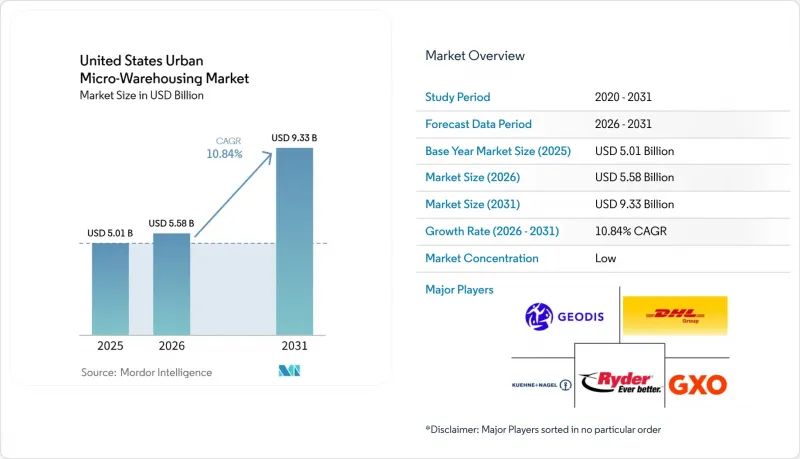
Mordor Intelligence에 의하면, 미국의 도시형 마이크로 창고 시장 규모는 2025년에 50억 1,000만 달러로 평가되었습니다. 2026년 55억 8,000만 달러에서 2031년까지 93억 3,000만 달러에 이를 것으로 추정되고 예측 기간(2026-2031년) CAGR은 10.84%를 나타낼 전망입니다.
당일 배송이나 1시간 이내 배송이 프리미엄 서비스에서 소비자의 일반적인 기대치로 변화함에 따라 수요가 증가하고 있으며, 이에 따라 소매업체와 3PL(제3자 물류)은 수요가 집중되는 도심에 더 가까운 곳에 재고를 배치할 수밖에 없는 상황입니다. 본 보고서는 시설 유형(다크 스토어, MFC, 소매점, 하이브리드), 온도 관리 유형(온도 관리 있음, 온도 관리 없음), 자동화 수준(수동, 반자동, 완전 자동), 최종 사용자 산업(전자상거래, 퀵커머스,식료품, FMCG, F&B;, 기타) 및 지역(북동부, 남동부, 중서부, 남서부, 서부)별로 분류되어 있습니다. 시장 예측은 금액(달러) 기준으로 제시되어 있습니다.
미국의 도시형 마이크로 창고 시장 동향 및 인사이트
당일·동시간 배송의 경제성
소비자에게의 배송 속도는 미국의 도시형 마이크로 창고 시장에서 가장 명확한 운영상 우선순위 중 하나입니다. 소매업체와 3PL(제3자 물류업체)은 장거리 운송비나 소포 배송 비용 증가를 감당하지 않고도 더 엄격한 배송 시간대를 충족하기 위해서는 도시 내 또는 그 바로 인근에 재고를 확보해야 합니다. 이러한 압박은 더 광범위한 디지털 소매 수요에서도 나타나고 있으며, 미국의 전자상거래 매출액은 2026년 1분기에 3,023억 달러에 달하고, 전년 동기 대비 9.7% 증가했습니다. 이 정도 규모가 되면 배송 지역이 넓어짐에 따라 단가가 낮은 주문의 이익률이 떨어지기 때문에 빈도가 높은 도심 주문에 대해서는 집중형 주문 처리 모델의 매력이 줄어들게 됩니다. 미국의 도심형 마이크로 창고 시장은 콤팩트한 도심 거점의 이점을 누리고 있습니다. 이를 통해 사업자는 배송 범위를 단축하고, 주문 마감 시간의 유연성을 높이며, 당일 배송 주문에 대한 재고 확보율을 향상시킬 수 있습니다. 이러한 서비스 수준이 프리미엄 서비스가 아닌 표준이 됨에 따라, 분산형 재고 관리의 경제성은 더 광범위한 소매업체에게도 정당화되기 쉬워지고 있습니다.
이용률이 낮은 도시 지역 산업용 공간의 브라운필드 전환
브라운필드의 용도 변경은 미국의 도시형 마이크로 창고 시장에서 사업 확장을 위한 가장 현실적인 수단 중 하나로 자리 잡고 있습니다. 2025년 5월, 미국 환경보호청(EPA)은 부지 평가, 정화 및 회전 대출 기금을 위해 2억 6,700만 달러 규모의 브라운필드 보조금을 발표했습니다. 이는 많은 도시 지역의 유휴 부지를 휴면 상태로 방치해 온 정화의 장벽 중 일부를 직접적으로 낮추는 조치입니다. 또한 EPA는 자사의 브라운필드 프로그램이 시작된 이래 420억 달러 이상의 정화 및 재개발 자금을 조달해 왔다고 지적하며, 공공 자금이 물류 분야의 더 대규모 민간 투자를 유치할 수 있다는 주장을 뒷받침하고 있습니다. 공간이 제한된 도시 지역에서는 이러한 부지가 희소한 그린필드 공급을 기다릴 필요 없이 소규모 물류 역량을 추가할 수 있는 몇 안 되는 수단 중 하나가 되고 있습니다. 따라서 미국의 도시형 마이크로 창고 시장에서는 기존의 임대 전략에만 의존하는 것이 아니라, 정화 일정, 현지 인허가, 재개발 순서를 적절히 관리할 수 있는 사업자가 유리합니다. 이는 오래된 산업 지구가 여전히 인구 밀집 주거지나 주요 교통망 근처에 위치한 지역에서 특히 중요한 의미를 지닙니다.
도시 부동산의 높은 마찰과 용도지역 제한
부동산 관련 장벽은 여전히 미국의 도시형 마이크로 창고 시장에서 가장 두드러진 제약 중 하나입니다. 가장 매력적인 배송 지역은 대개 토지가 희소하고, 개발 허가를 취득하기 어려우며, 인근 주거 지역의 반발로 인해 새로운 물류 프로젝트에 대한 반대가 발생하기 쉬운 장소와 겹칩니다. 따라서 모든 사업자가 긴 승인 절차를 기다리거나 장기간에 걸친 개발 전 비용을 감당할 수 있는 것은 아니기 때문에 부지 확보 자체가 경쟁 우위가 됩니다. 이러한 제약은 수요가 집중되어 있는 반면, 산업용지가 이미 부족하고 입지 조건이 좋은 소규모 부지가 시장에 거의 나오지 않는 연안 대도시권에서 특히 심각합니다. 미국의 도시형 마이크로 창고 시장은 이러한 상황 속에서도 성장이 가능하지만, 그 확대에는 브라운필드 재개발, 기존 시설의 개보수 전략, 그리고 지역과 견고한 관계를 구축하고 있는 기존 사업자가 유리하게 작용합니다. 그 결과, 진입 비용이 높아져 단기간에 의미 있는 도시 네트워크를 구축할 수 있는 사업자의 선택지가 좁아지게 됩니다.
부문별 분석
2025년, 마이크로 풀필먼트 센터는 미국의 도시형 마이크로 창고 시장 점유율의 38.14%를 차지하며 시장에서 가장 큰 시설 형태가 되었습니다. 그 우위는 전자상거래, 식료품, FMCG(일용소비재) 물류 전반에 걸친 폭넓은 유용성에 있으며, 사업자에게는 여러 수요 흐름에 대응할 수 있는 형태입니다. 다크 스토어를 활용한 풀필먼트는 2031년까지 연평균 성장률(CAGR)이 17.75%로, 가장 빠르게 성장하고 있는 시설 유형입니다. 이는 퀵 커머스나 전용 온라인 식료품 판매 모델에서 재고를 인근 지역에 더 가깝게 배치해야 하기 때문입니다. 미국의 도시형 마이크로 창고 시장에서 이 분야가 탄력을 받고 있는 이유는 다크 스토어가 좁은 부지 면적에서도 운영 가능하며, 광범위한 지역을 대상으로 한 상품 구성이 아닌 구매 빈도가 높은 상품군을 중심으로 구축할 수 있다는 점에 있습니다. 소매 매장을 거점으로 하는 풀필먼트 및 하이브리드 시설이 나머지 점유율을 차지하고 있으며, 오프라인 매장을 운영하는 소매업체들이 백야드 공간을 보다 생산적으로 활용할 방법을 모색함에 따라 그 중요성이 높아지고 있습니다.
이 부문의 전략적 분기점은 유연성과 자본 집약도의 차이에 있습니다. MFC(다중 카테고리 주문 처리 센터)는 더 폭넓은 상품 카테고리를 다루며, 사업자가 계절이나 주문 프로파일에 따른 수요 변동을 균형 있게 관리하는 데 도움이 됩니다. 반면, 다크 스토어는 주문 밀도가 이미 입증된 지역에서 가장 큰 효과를 발휘합니다. 배송 범위가 좁아 재구매와 예측 가능한 재고 보충이 가능해져 경제성이 향상되기 때문입니다. 하이브리드 시설은 그 중간에 위치하며, 사업자가 완전히 전문화된 형태로 즉시 전환하지 않고도 자동화를 시범적으로 도입하거나 지역별 처리 능력을 강화할 수 있는 수단을 제공합니다. 그 결과, 미국의 도시형 마이크로 창고 시장은 단일 운영 모델로 수렴하기보다는 여러 시설 형태를 지속적으로 지원하고 있습니다. 구매 금액, 서비스 수준, 인근 인구 밀도에 맞추어 시설 유형을 선택하는 사업자는 네트워크가 확대됨에 따라 이익률을 유지할 가능성이 높아집니다.
2025년 시점에서 미국의 도시형 마이크로 창고 시장 규모의 63.5%를 비온도 관리형 시설이 차지했으며, 상온형 거점이 시장의 중심을 차지했습니다. 의류, 가전제품, FMCG(일용소비재)는 여전히 도시 지역의 전자상거래에서 가장 큰 카테고리를 차지하고 있기 때문에 현재 수요의 대부분은 보다 단순한 시설 설계와 낮은 운영 위험을 선호하는 경향이 있습니다. 온도 관리형 시설은 2031년까지 연평균 성장률(CAGR)이 14.41%로 더 빠르게 성장하고 있습니다. 이는 식료품 배달, 의약품 콜드체인 수요, 그리고 밀키트 주문 처리에서 도시 지역 수요와 가까운 곳에 전용 냉장 용량이 필요하기 때문입니다. 미국의 도시형 마이크로 창고 시장에서 이 분야는 사업자들이 일반적인 소매 주문 처리에서 시간 및 온도에 민감한 카테고리로 전환함에 따라 확대되고 있습니다. 2025년 11월, 리네지(Lineage)사가 댈러스 메트로플렉스에서 완전 자동화된 냉장 시설의 착공을 시작한 것은 기관 투자자들이 여전히 자동화 중심의 콜드체인 용량을 확대하고 있음을 뒷받침하는 분명한 신호가 되었습니다.
과제는 콜드체인의 확장이 상온 창고보다 더 높은 운영 규율과 더 복잡한 설계를 요구한다는 점입니다. 화재 예방, 에너지 사용, 설비의 신뢰성이 더욱 중요해지는 이유는 고장이 발생할 경우 재고 손실의 위험이 더 신속하고 직접적으로 발생하기 때문입니다. 또한, 이 분야에서는 대규모 자본 동향도 관찰되는데, 예를 들어 2026년 5월에는 아메리콜드 리얼티 트러스트(Americold Realty Trust)가 EQT와 13억 달러 규모의 합작 투자를 시작하여 미국 내 12곳의 온도 관리 시설을 대상으로 했습니다. 의약품 보관에 관한 FDA의 콜드체인 규제와 식품 등급 운영에 관한 USDA의 요건 또한 이 부문의 시설 설계 및 공정 관리에 더 큰 영향을 미치고 있습니다. 그 결과, 미국의 도시형 마이크로 창고 시장에서 콜드체인은 여전히 강력한 성장 분야로 간주되는 한편, 보다 견고한 재무 기반, 규정 준수 대응 능력, 그리고 기술적인 운영 규율을 갖춘 사업자에게 유리한 분야이기도 하다는 인식이 확산되고 있습니다.
기타 혜택 :
- 엑셀 형식 시장 예측(ME) 시트
- 3개월간의 애널리스트 지원
자주 묻는 질문
목차
제1장 서론
제2장 분석 방법
제3장 주요 요약
제4장 시장 구도
제5장 시장 규모 및 성장률 예측(금액 기준, 2026-2031년)
제6장 경쟁 구도
제7장 시장 기회 및 향후 전망
KTH 26.09.04According to Mordor Intelligence, the United States urban micro-warehousing market size was valued at USD 5.01 billion in 2025 and is estimated to grow from USD 5.58 billion in 2026 to reach USD 9.33 billion by 2031, at a CAGR of 10.84% during the forecast period (2026-2031).
Demand is rising because same-day and same-hour delivery have shifted from premium services to normal consumer expectations, which is forcing retailers and 3PLs to place inventory closer to dense urban demand. This report is Segmented by Facility Type (Dark Store, MFC, Retail Store, Hybrid), by Temperature Type (Controlled, Non-Controlled), by Automation Level (Manual, Semi-Automated, Fully Automated), by End-User Industry (E-Commerce, Quick Commerce, Grocery, FMCG, F&B, and More), and by Geography (Northeast, Southeast, Midwest, Southwest, West). The Market Forecasts in Value (USD).
United States Urban Micro-Warehousing Market Trends and Insights
Same-Day and Same-Hour Delivery Economics
Speed to consumer has become one of the clearest operating priorities in the United States urban micro-warehousing market. Retailers and 3PLs now need inventory within city limits or very close to them if they want to support tighter delivery windows without absorbing higher line-haul and parcel costs. The pressure is visible in broader digital retail demand, with United States e-commerce sales reaching USD 302.3 billion in Q1 2026, up 9.7% year over year. That scale makes a centralized fulfillment model less attractive for high-frequency urban orders because longer shipping zones can weaken margin on lower-ticket baskets. The United States urban micro-warehousing market benefits from compact urban nodes, which let operators shorten delivery radii, increase order cut-off flexibility, and improve inventory availability for same-day orders. As these service levels become standard rather than premium, the economics of distributed stocking become easier to justify across a broader range of retailers.
Brownfield Conversion of Underused Urban Industrial Space
Brownfield conversion is becoming one of the most practical paths to expansion in the United States urban micro-warehousing market. In May 2025, the EPA announced USD 267 million in Brownfields Grants for site assessment, cleanup, and revolving loan funds, which directly lowers part of the remediation barrier that has kept many urban infill sites dormant. The EPA also noted that its Brownfields Program has leveraged more than USD 42 billion in cleanup and redevelopment since its inception, supporting the case that public funding can unlock larger private investment in logistics. In constrained urban corridors, these parcels often represent one of the few remaining routes to add small logistics capacity without waiting for rare greenfield supply. The United States urban micro-warehousing market, therefore, favors operators that can manage cleanup timelines, local approvals, and redevelopment sequencing rather than relying only on conventional leasing strategies. This is especially relevant where older industrial districts still sit close to dense residential demand and major transport links.
High Urban Real Estate Friction and Zoning Constraints
Real estate friction remains one of the clearest constraints on the United States urban micro-warehousing market. The most attractive delivery zones are often the same places where land is scarce, entitlements are difficult to obtain, and nearby residential uses raise opposition to new logistics projects. This makes site access a competitive advantage in itself because not every operator can wait through long approval cycles or absorb extended pre-development costs. The constraint is most acute in large coastal metros where demand is dense, but industrial land is already tightly held and rarely becomes available in small, well-located parcels. The United States urban micro-warehousing market can still grow under these conditions, but expansion tends to favor brownfield redevelopment, retrofit strategies, and incumbents with deeper local relationships. That raises entry costs and narrows the pool of players that can build meaningful urban networks at speed.
Other drivers and restraints analyzed in the detailed report include:
- Grocery and Quick Commerce Network Density Expansion
- Labor Scarcity in Dense Metropolitan Warehousing Markets
- Fire Code, Safety, and Insurance Cost Escalation for High-Density Automation
For complete list of drivers and restraints, kindly check the Table Of Contents.
Segment Analysis
Micro-fulfillment centers accounted for 38.14% of the United States urban micro-warehousing market share in 2025, which made them the largest facility format in the market. Their lead comes from broad usefulness across e-commerce, grocery, and FMCG flows, giving operators a format that can work across multiple demand streams. Dark-store-based fulfillment is the fastest-growing facility type, with a 17.75% CAGR through 2031, as quick commerce and dedicated e-grocery models require inventory to be closer to neighborhoods. This part of the United States urban micro-warehousing market is gaining ground because dark stores can be deployed in compact footprints and built around high-frequency baskets rather than broad regional assortment. Retail store-based fulfillment and hybrid facilities make up the remaining share and are becoming more relevant as physical retailers seek ways to use back-of-house space more productively.
The strategic split within this segment is between flexibility and capital intensity. MFCs support a wider range of categories, which helps operators balance demand variability across seasons and order profiles. Dark stores work best where order density is already proven, because their economics improve when a tight delivery radius produces repeat purchases and predictable replenishment. Hybrid facilities sit in the middle and give operators a way to test automation or add local capacity without moving immediately into a fully specialized format. That is why the United States urban micro-warehousing market continues to support more than one facility format rather than converging on a single operating model. Operators that match facility type to basket size, service promise, and neighborhood density are more likely to protect margins as networks scale.
Non-temperature-controlled facilities accounted for 63.5% of the United States urban micro-warehousing market size in 2025, keeping ambient nodes at the core of the market. Apparel, consumer electronics, and FMCG remain the largest urban e-commerce categories, so a large part of current demand still favors simpler facility designs and lower operating risk. Temperature-controlled sites are growing faster, at a 14.41% CAGR through 2031, because grocery delivery, pharmaceutical cold-chain needs, and meal-kit fulfillment require dedicated refrigerated capacity closer to city demand. This part of the United States' urban micro-warehousing market is expanding as operators move from general retail fulfillment into more time- and temperature-sensitive categories. A visible signal came in November 2025, when Lineage broke ground on a fully automated cold storage facility in the Dallas Metroplex, reinforcing that institutional players are still adding automation-led cold-chain capacity.
The challenge is that cold-chain expansion requires greater operational discipline and higher design complexity than ambient space. Fire protection, energy use, and equipment reliability matter more because failure carries a faster and more direct inventory-loss risk. The segment is also seeing larger capital moves, such as Americold Realty Trust's May 2026 USD 1.3 billion joint venture with EQT covering 12 United States temperature-controlled facilities. FDA cold-chain rules for pharmaceutical storage and USDA requirements for food-grade operations further shape site design and process control in this segment. As a result, the United States urban micro-warehousing market continues to treat cold-chain as a strong growth pocket, but also as one that favors operators with deeper balance sheets, compliance capability, and technical operating discipline.
Complete Report Scope:
- By Facility Type
- Dark Store-Based Fulfillment
- Micro-Fulfillment Center (MFC)-Based Fulfillment
- Retail Store-Based Fulfillment
- Hybrid Facility and Others
- By Temperature Type
- Temperature Controlled
- Non-Temperature Controlled
- By Automation Level
- Manual Operations
- Semi-Automated Facilities
- Fully Automated Facilities
- By End-User Industry
- E-commerce
- Quick Commerce
- Grocery Retail
- FMCG
- Food and Beverage
- Pharmaceuticals and Healthcare
- Consumer Electronics and Household Appliances
- Fashion and Lifestyle (Accessories, Apparel, Footwear)
- Industrial and B2B Distribution
- Others
- By Region
- Northeast
- Southeast
- Midwest
- Southwest
- West
List of Companies Covered in this Report:
- DHL Group
- GXO Logistics, Inc.
- Ryder System, Inc.
- GEODIS
- Kuehne+Nagel
- CMA CGM Group (Including CEVA Logistics)
- NFI Industries
- Lineage, Inc.
- Americold
- CJ Logistics
- Kenco Group
- Saddle Creek Logistics Services
- Radial, Inc.
- APL Logistics Ltd.
- Amazon.com, Inc.
- Stord, Inc.
- ODW Logistics
- ShipBob, Inc.
- ShipMonk
- International Distribution Services plc (IDS)
- A.P. Moller - Maersk (Including Visible SCM)
- Barrett Distribution Centers
Additional Benefits:
- The market estimate (ME) sheet in Excel format
- 3 months of analyst support
TABLE OF CONTENTS
1 Introduction
- 1.1 Study Assumptions and Market Definition
- 1.2 Scope of the Study
2 Research Methodology
3 Executive Summary
4 Market Landscape
- 4.1 Market Overview and Role of Urban Micro-Warehousing in Urban Logistics
- 4.2 Market Drivers
- 4.2.1 Same-Day and Same-Hour Delivery Economics
- 4.2.2 Brownfield Conversion of Underused Urban Industrial Space
- 4.2.3 Grocery and Quick Commerce Network Density Expansion
- 4.2.4 Labor Scarcity in Dense Metropolitan Warehousing Markets
- 4.2.5 De-Minimis Pressure and In-Market Stocking Optimization
- 4.2.6 Micro-Grid and Site-Level Energy Resilience for Automated Facilities
- 4.3 Market Restraints
- 4.3.1 High Urban Real Estate Friction and Zoning Constraints
- 4.3.2 Fire Code, Safety, and Insurance Cost Escalation for High-Density Automation
- 4.3.3 Limited SKU Economics for Low-Throughput Urban Sites
- 4.3.4 Local Traffic, Curbside, and Last-Mile Delivery Bottlenecks
- 4.4 Regulatory Framework
- 4.5 Value Chain and Distribution Channel Architecture Analysis
- 4.6 Technology Innovations Outlook
- 4.7 Porter's Five Forces Analysis
- 4.7.1 Threat of New Entrants
- 4.7.2 Bargaining Power of Suppliers
- 4.7.3 Bargaining Power of Buyers
- 4.7.4 Threat of Substitutes
- 4.7.5 Rivalry Among Competitors
- 4.8 Evolution of Urban Micro-Warehousing Requirements
- 4.9 Pricing and Cost Structure Analysis
- 4.10 Real Estate and Infrastructure Analysis
- 4.11 Consumer Behavior and Delivery Preferences Analysis
- 4.12 Sustainable Delivery Solutions and Green Logistics Initiatives
- 4.13 Impact of Geo-Political Events on Supply Chain Shifts
5 Market Size and Growth Forecasts (Value, 2026-2031)
- 5.1 By Facility Type
- 5.1.1 Dark Store-Based Fulfillment
- 5.1.2 Micro-Fulfillment Center (MFC)-Based Fulfillment
- 5.1.3 Retail Store-Based Fulfillment
- 5.1.4 Hybrid Facility and Others
- 5.2 By Temperature Type
- 5.2.1 Temperature Controlled
- 5.2.2 Non-Temperature Controlled
- 5.3 By Automation Level
- 5.3.1 Manual Operations
- 5.3.2 Semi-Automated Facilities
- 5.3.3 Fully Automated Facilities
- 5.4 By End-User Industry
- 5.4.1 E-commerce
- 5.4.2 Quick Commerce
- 5.4.3 Grocery Retail
- 5.4.4 FMCG
- 5.4.5 Food and Beverage
- 5.4.6 Pharmaceuticals and Healthcare
- 5.4.7 Consumer Electronics and Household Appliances
- 5.4.8 Fashion and Lifestyle (Accessories, Apparel, Footwear)
- 5.4.9 Industrial and B2B Distribution
- 5.4.10 Others
- 5.5 By Region
- 5.5.1 Northeast
- 5.5.2 Southeast
- 5.5.3 Midwest
- 5.5.4 Southwest
- 5.5.5 West
6 Competitive Landscape
- 6.1 Market Concentration
- 6.2 Key Strategic Moves
- 6.3 Market Share Analysis
- 6.4 Company Profiles (includes Global Level Overview, Market Level Overview, Core Segments, Financials as Available, Strategic Information, Market Rank/Share for Key Companies, Products & Services, and Recent Developments)
- 6.4.1 DHL Group
- 6.4.2 GXO Logistics, Inc.
- 6.4.3 Ryder System, Inc.
- 6.4.4 GEODIS
- 6.4.5 Kuehne+Nagel
- 6.4.6 CMA CGM Group (Including CEVA Logistics)
- 6.4.7 NFI Industries
- 6.4.8 Lineage, Inc.
- 6.4.9 Americold
- 6.4.10 CJ Logistics
- 6.4.11 Kenco Group
- 6.4.12 Saddle Creek Logistics Services
- 6.4.13 Radial, Inc.
- 6.4.14 APL Logistics Ltd.
- 6.4.15 Amazon.com, Inc.
- 6.4.16 Stord, Inc.
- 6.4.17 ODW Logistics
- 6.4.18 ShipBob, Inc.
- 6.4.19 ShipMonk
- 6.4.20 International Distribution Services plc (IDS)
- 6.4.21 A.P. Moller - Maersk (Including Visible SCM)
- 6.4.22 Barrett Distribution Centers
7 Market Opportunities and Future Outlook
- 7.1 White-space and Unmet-Need Assessment