

|
시장보고서
상품코드
2119064
아시아태평양의 와이어 및 케이블 : 시장 점유율 분석, 산업 동향 및 통계 데이터, 성장 예측(2026-2031년)Asia-Pacific Wire and Cable - Market Share Analysis, Industry Trends & Statistics, Growth Forecasts (2026 - 2031) |
||||||
 Mordor Intelligence
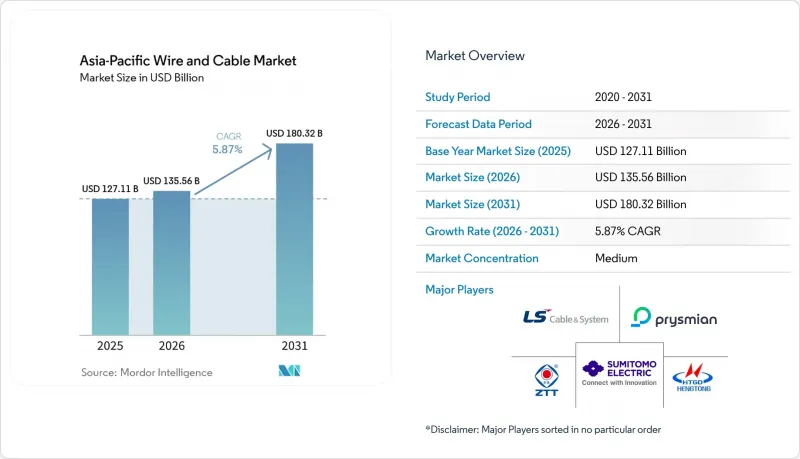
Mordor Intelligence에 의하면, 아시아태평양의 와이어 및 케이블 시장 규모는 2025년에 1,271억 1,000만 달러로 평가되었습니다. 2026년 1,355억 6,000만 달러에서 2031년까지 1,803억 2,000만 달러에 이를 것으로 예상되며, 예측 기간(2026-2031년) CAGR은 5.87%를 나타낼 전망입니다.
본 보고서는 전압(저전압, 중전압, 초고전압·고전압), 케이블 유형(전력 케이블, 광섬유 케이블 등), 도체(구리 등), 매설 방식(가공, 지하, 해저), 최종 사용자(건설(주택), 기타),절연(절연재 포함, 절연재 없음), 지역(중국, 인도, 기타)별로 분류되어 있습니다. 시장 예측은 금액(달러) 기준으로 제시되어 있습니다.
아시아태평양의 와이어 및 케이블 시장 동향 및 인사이트
재생에너지의 확대와 송전망의 현대화
중국 국가전망공사는 2026년부터 2030년에 걸쳐 15개의 초고압 송전선을 추가로 건설할 계획입니다. 이 계획으로 인해 성을 가로지르는 송전 용량이 35% 증가하고, 매년 200 GWh의 재생에너지 발전 용량이 전력망에 연결될 전망입니다. 산시성 북부와 안후이성 간 ±800 kV 초고압 직류 송전(UHVDC) 프로젝트는 2026년 6월 30일에 가동을 시작했습니다. 투자액은 205억 위안(30억 3,000만 달러)이며,송전 거리는 1,055 km, 정격 용량은 800만 kW입니다. 이러한 프로젝트에는 대량의 특수 고전압 케이블이 필요하며, 인증 공급업체에 대한 납기일이 연장되고 있습니다. 인도의 재생에너지 발전량 증가에 따라 발전소에서 송전망으로의 새로운 송전 용량도 필요해지고 있습니다. 인도 전력송전공사(Power Grid Corporation of India)는 2026년 6월, 카브다-나그푸르 간 HVDC 프로젝트를 위해 JBIC와 800억 엔(4억 9,000만 달러) 규모의 그린론 계약을 체결했습니다.
도시 인프라·전기화·스마트 시티에 대한 투자
아시아태평양의 와이어 및 케이블 시장에서는 도시 개발에 따라 저전압 배선 및 지하 배전 시스템에 대한 수요가 증가하고 있습니다. 프로젝트 사양상, 기본적인 건축용 전선보다 내화성, 저발연성, 무할로겐 케이블 제품이 점점 더 선호되는 추세입니다. 인도의 ‘BharatNet’ 프로그램은 2030년까지 27만 개의 마을을 광섬유 인프라로 연결하는 것을 목표로 하고 있습니다. 지하 전력 케이블 제조를 위해 제안된 1,000억 루피(10억 4,000만 달러) 규모의 실행 가능성 격차 자금 조달 방안은 대용량 케이블의 국내 수요를 충족시키는 데 도움이 될 수 있습니다. BIS(인도 표준국)의 적합성 요건 및 생산 연계형 인센티브 프로그램에 따라, 공식 조달처는 인증을 받은 국내 공급업체로 제한됩니다. 이를 통해 기존 생산자들은 규제되지 않은 수입품으로부터 일정한 보호를 받을 수 있습니다.
구리 및 알루미늄 가격 변동
구리 및 알루미늄 가격은 급격히 변동할 가능성이 있어 케이블 제조업체에 불확실성을 초래합니다. 가격 상승 전에 체결된 고정 가격 계약의 경우, 재료비가 계획 수준을 초과할 가능성이 있습니다. 저전압 용도에서는 알루미늄으로 대체함으로써 케이블 생산량을 유지할 수는 있겠지만, 단위당 수익은 감소할 가능성이 있습니다. 따라서 계약 가격이 고정된 경우, 장기적인 금속 가격 리스크 관리는 어렵습니다. 각 제조업체는 원자재 비용을 금속 기준 가격에 연동시키는 가격 조정 메커니즘을 모색하고 있습니다. 이러한 환경에서는 금속 가격 리스크를 관리하고, 비용 변동을 가격에 전가할 수 있는 제조업체가 우위를 점하게 됩니다.
부문별 분석
2025년, 전압별 매출액에서 저전압 케이블이 차지하는 비중은 52.84%였습니다. 이 규모는 중국, 인도, 동남아시아 전역의 건설 및 주거용 배전 수요를 반영하고 있습니다. 중전압 제품은 재생에너지 연결 및 도시 지역 배전망 업그레이드를 뒷받침하고 있습니다. 중국의 GB/T 규격 및 인도의 BIS 요건에 따라 XLPE 채택이 확대되고 있습니다. 초고압 및 고압 케이블은 2026년부터 2031년까지 연평균 성장률(CAGR) 6.48%로 확대될 것으로 예측됩니다. 이러한 케이블은 단가가 높으며 대규모 송전망 프로젝트와 관련이 있습니다.
산시성 북부-안후이성 간 ±800 kV 초고압 직류 송전(UHVDC) 프로젝트는 중국의 제15차 5개년 계획에 따른 최초의 UHVDC 송전선으로, 2026년 6월에 가동을 시작했습니다. 총 길이는 1,055km, 정격 용량은 800만 kW입니다. 티베트-광둥 간 초초고압 송전선로 건설은 2026년 4월에 착공되었으며, 노선 총 길이는 2,681km에 달할 전망입니다. 인도에서는 2027 회계연도부터 2032 회계연도에 걸쳐 5-6 락 크롤 규모의 송전 투자가 계획되어 있습니다(520억-620억 달러). 이 계획에서는 송전선의 연간 증설 목표를 2만 회로km로 설정하고 있습니다. 이러한 프로그램들은 인증을 받은 고전압 케이블 제조업체에 대한 수요를 뒷받침하고 있습니다.
2025년, 케이블 유형별 아시아태평양의 와이어 및 케이블 시장 매출액 중 전력 케이블이 60.92%를 차지했습니다. 유틸리티, 재생 에너지, 건설 및 산업 프로젝트가 이 거대한 시장 기반을 뒷받침하고 있습니다. 신호·제어용 제품은 산업 자동화 및 공정 시설에 활용되고 있습니다. 동축 케이블 및 데이터용 제품은 방송과 기존 라스트 마일 네트워크를 지속적으로 뒷받침하고 있습니다. 광섬유 케이블은 2026년부터 2031년까지 연평균 성장률(CAGR) 6.83%로 확대될 것으로 예측됩니다. 이러한 성장은 5G 네트워크, 데이터센터 건설, 그리고 각국의 광대역 계획에 기인합니다.
후루카와 전기 공업의 자회사인 Lightera사는 2026년 3월, 1만 3,824코어 광섬유 케이블의 양산을 시작했습니다. 이 제품은 고정된 케이블 단면 내의 광섬유 밀도를 높였습니다. Sterlite Technologies는 2026년 5월, AI 데이터센터용 광 연결 솔루션과 관련하여 11억 1,000만 달러 규모의 다년 계약을 수주했습니다. 이 회사의 ‘Neuralis’ 포트폴리오는 AI 데이터센터 특유의 요구 사항을 충족합니다. 따라서 아시아태평양의 와이어 및 케이블 시장은 기본적인 광대역용 광섬유와 컴퓨팅 클러스터용 고밀도 연결이라는 두 가지로 분화되고 있습니다. 첨단 광섬유 제조 기술을 보유한 공급업체는 후자의 분야에서 경쟁력을 발휘할 수 있습니다.
기타 혜택 :
- 엑셀 형식 시장 예측(ME) 시트
- 3개월간의 애널리스트 지원
자주 묻는 질문
목차
제1장 서론
제2장 분석 방법
제3장 주요 요약
제4장 시장 구도
제5장 시장 규모 및 성장률 예측
제6장 경쟁 구도
제7장 시장 기회 및 향후 전망
KTH 26.09.04According to Mordor Intelligence, the Asia-Pacific wire and cable market size was valued at USD 127.11 billion in 2025 and estimated to grow from USD 135.56 billion in 2026 to reach USD 180.32 billion by 2031, at a CAGR of 5.87% during the forecast period (2026-2031).
This report is Segmented by Voltage (Low, Medium, and Extra- and High-Voltage), Cable Type (Power, Fiber-Optic, and More), Conductor (Copper, and More), Installation (Overhead, Underground, and Submarine), End-User (Construction - Residential, and More), Insulation (Insulated, and Non-Insulated), and Geography (China, India, and More). The Market Forecasts are Provided in Terms of Value (USD).
Asia-Pacific Wire and Cable Market Trends and Insights
Renewable Energy Expansion and Grid Modernization
China's State Grid Corporation plans to build 15 additional ultra-high-voltage transmission lines between 2026 and 2030. The program is expected to raise cross-provincial transmission capacity by 35% and connect 200 GWh of renewable capacity each year. The Shaanbei-Anhui +-800 kV UHVDC project entered service on June 30, 2026, with a CNY 20.50 billion (USD 3.03 billion) investment, a route of 1,055 km, and a rated capacity of 8 million kW. Such projects require large volumes of specialty high-voltage cable and have extended delivery schedules for qualified suppliers. India's rising renewable output also requires new generation-to-transmission capacity. Power Grid Corporation of India signed a JPY 80 billion (USD 490 million) green loan agreement with JBIC in June 2026 for the Khavda-Nagpur HVDC project.
Urban Infrastructure, Electrification, and Smart-City Investment
Urban development is increasing demand for low-voltage wiring and underground distribution systems in the Asia-Pacific wire and cable market. Project specifications increasingly favor fire-resistant, low-smoke, zero-halogen cable products over basic building wire. India's BharatNet program aims to connect 270,000 villages with fiber infrastructure by 2030. A proposed INR 10,000 crore (USD 1.04 billion) viability gap funding scheme for underground power cable manufacturing could help meet domestic demand for high-capacity cables. BIS compliance requirements and the production-linked incentive program direct formal procurement toward certified domestic suppliers. This provides established producers with some protection against unregulated imports.
Copper and Aluminum Price Volatility
Copper and aluminum prices can change rapidly, creating uncertainty for cable manufacturers. Fixed-price contracts signed before a price increase can place material costs above planned levels. Aluminum substitution may preserve cable volumes in lower-voltage applications, but it can reduce revenue per unit. Long-term metal exposure is, therefore, difficult to manage when contract pricing is fixed. Producers are seeking price-adjustment mechanisms that link material costs to metal reference prices. This environment rewards manufacturers that can manage metal exposure and pass through cost changes.
Other drivers and restraints analyzed in the detailed report include:
- 5G, Cloud, and Data-Center Network Expansion
- Electric Vehicle and Charging-Infrastructure Electrification
- High Capital Intensity and Installation Complexity
For complete list of drivers and restraints, kindly check the Table Of Contents.
Segment Analysis
Low-voltage cables held 52.84% of revenue by voltage in 2025. Their scale reflects demand from construction and residential distribution across China, India, and Southeast Asia. Medium-voltage products support renewable connections and urban distribution upgrades. XLPE adoption is increasing under China's GB/T standards and India's BIS requirements. Extra- and high-voltage cables are projected to expand at a 6.48% CAGR from 2026 to 2031. These cables have higher unit values and are linked to large grid projects.
The Shaanbei-Anhui +-800 kV UHVDC project was commissioned in June 2026 as the first UHVDC line under China's 15th Five-Year Plan. It spans 1,055 km and has a rated capacity of 8 million kW. Construction of the Xizang-Guangdong UHV line began in April 2026, and the route will span 2,681 km. India's planned transmission investment is INR 5-6 lakh crore (USD 52-62 billion) over FY27-FY32. The plan targets annual additions of 20,000 circuit km of transmission lines. These programs support demand for qualified high-voltage cable producers.
Power cable held 60.92% of the Asia-Pacific wire and cable market revenue by cable type in 2025. Utilities, renewables, construction, and industrial projects support this large base. Signal and control products serve industrial automation and process facilities. Coaxial and data products continue to support broadcast and legacy last-mile networks. Fiber-optic cable is projected to expand at a 6.83% CAGR from 2026 to 2031. The growth reflects 5G networks, data center construction, and national broadband programs.
Furukawa Electric's Lightera subsidiary began mass production of a 13,824-count optical fiber cable in March 2026. The product raises fiber density within a fixed cable cross-section. Sterlite Technologies secured a USD 1.11 billion multi-year product award in May 2026 for AI data center optical connectivity. Its Neuralis portfolio addresses specialized AI data center requirements. The Asia-Pacific wire and cable market is therefore separating into basic broadband fiber and high-density connectivity for computing clusters. Suppliers with advanced fiber manufacturing can compete in the latter category.
Complete Report Scope:
- By Voltage
- Extra- and High-Voltage (Greater Than 35 kV)
- Medium-Voltage (1-35 kV)
- Low-Voltage (Less Than 1 kV)
- By Cable Type
- Power Cable
- Fiber-Optic Cable
- Signal and Control Cable
- Coaxial and Data Cable
- By Conductor Material
- Copper
- Aluminum
- Optical Glass/Polymer
- By Installation
- Overhead
- Underground
- Submarine
- By End-User Vertical
- Construction - Residential
- Construction - Commercial
- Power Infrastructure (Utilities and Renewables)
- Telecommunications and Data Centers
- Oil and Gas and Petrochemicals
- Automotive and Mobility
- Industrial Manufacturing
- By Insulation
- Insulated
- Non-Insulated
- By Country
- China
- India
- Japan
- South Korea
- Australia and New Zealand
- Rest of Asia-Pacific
List of Companies Covered in this Report:
- Prysmian S.p.A.
- HENGTONG GROUP CO.,LTD.
- Jiangsu Zhongtian Technology Co., Ltd.
- Sumitomo Electric Industries, Ltd.
- LS Cable & System
- Furukawa Electric Co., Ltd.
- Fujikura Ltd.
- Nexans
- Taihan Cable & Solution Co., Ltd.
- KEI Industries Limited
- Polycab India Limited
- Finolex Cables Limited
- R R Kabel Limited
- Sterlite Technologies Limited
- APAR Industries Limited
- NKT A/S
- Belden Inc.
- LEONI AG
- Amphenol Corporation
- TE Connectivity Ltd.
Additional Benefits:
- The market estimate (ME) sheet in Excel format
- 3 months of analyst support
TABLE OF CONTENTS
1 INTRODUCTION
- 1.1 Study Assumptions and Market Definition
- 1.2 Scope of the Study
2 RESEARCH METHODOLOGY
3 EXECUTIVE SUMMARY
4 MARKET LANDSCAPE
- 4.1 Market Overview
- 4.2 Market Drivers
- 4.2.1 Renewable Energy Expansion and Grid Modernization
- 4.2.2 Urban Infrastructure, Electrification, and Smart-City Investment
- 4.2.3 5G, Cloud, and Data-Center Network Expansion
- 4.2.4 Electric Vehicle and Charging-Infrastructure Electrification
- 4.2.5 AI Data-Center Power-Density and Liquid-Cooling Cable Requirements
- 4.2.6 Inter-Island Interconnection and Subsea Cable Localization
- 4.3 Market Restraints
- 4.3.1 Copper and Aluminum Price Volatility
- 4.3.2 High Capital Intensity and Installation Complexity
- 4.3.3 Inconsistent Standards and Substandard Cable Competition
- 4.3.4 Permitting, Right-of-Way, Vessel, and Port Bottlenecks
- 4.4 Industry Supply Chain Analysis
- 4.5 Regulatory Landscape
- 4.6 Technological Outlook
- 4.7 Impact of Macroeconomic Factors on the Market
- 4.8 Investment Analysis
- 4.9 Porter's Five Forces Analysis
- 4.9.1 Bargaining Power of Suppliers
- 4.9.2 Bargaining Power of Buyers
- 4.9.3 Threat of New Entrants
- 4.9.4 Threat of Substitutes
- 4.9.5 Intensity of Competitive Rivalry
5 MARKET SIZE AND GROWTH FORECASTS (VALUE)
- 5.1 By Voltage
- 5.1.1 Extra- and High-Voltage (Greater Than 35 kV)
- 5.1.2 Medium-Voltage (1-35 kV)
- 5.1.3 Low-Voltage (Less Than 1 kV)
- 5.2 By Cable Type
- 5.2.1 Power Cable
- 5.2.2 Fiber-Optic Cable
- 5.2.3 Signal and Control Cable
- 5.2.4 Coaxial and Data Cable
- 5.3 By Conductor Material
- 5.3.1 Copper
- 5.3.2 Aluminum
- 5.3.3 Optical Glass/Polymer
- 5.4 By Installation
- 5.4.1 Overhead
- 5.4.2 Underground
- 5.4.3 Submarine
- 5.5 By End-User Vertical
- 5.5.1 Construction - Residential
- 5.5.2 Construction - Commercial
- 5.5.3 Power Infrastructure (Utilities and Renewables)
- 5.5.4 Telecommunications and Data Centers
- 5.5.5 Oil and Gas and Petrochemicals
- 5.5.6 Automotive and Mobility
- 5.5.7 Industrial Manufacturing
- 5.6 By Insulation
- 5.6.1 Insulated
- 5.6.2 Non-Insulated
- 5.7 By Country
- 5.7.1 China
- 5.7.2 India
- 5.7.3 Japan
- 5.7.4 South Korea
- 5.7.5 Australia and New Zealand
- 5.7.6 Rest of Asia-Pacific
6 COMPETITIVE LANDSCAPE
- 6.1 Market Concentration
- 6.2 Strategic Moves
- 6.3 Vendor Positioning Analysis
- 6.4 Company Profiles (includes Global Level Overview, Market Level Overview, Core Segments, Financials as available, Strategic Information, Market Rank/Share, Products and Services, Recent Developments)
- 6.4.1 Prysmian S.p.A.
- 6.4.2 HENGTONG GROUP CO.,LTD.
- 6.4.3 Jiangsu Zhongtian Technology Co., Ltd.
- 6.4.4 Sumitomo Electric Industries, Ltd.
- 6.4.5 LS Cable & System
- 6.4.6 Furukawa Electric Co., Ltd.
- 6.4.7 Fujikura Ltd.
- 6.4.8 Nexans
- 6.4.9 Taihan Cable & Solution Co., Ltd.
- 6.4.10 KEI Industries Limited
- 6.4.11 Polycab India Limited
- 6.4.12 Finolex Cables Limited
- 6.4.13 R R Kabel Limited
- 6.4.14 Sterlite Technologies Limited
- 6.4.15 APAR Industries Limited
- 6.4.16 NKT A/S
- 6.4.17 Belden Inc.
- 6.4.18 LEONI AG
- 6.4.19 Amphenol Corporation
- 6.4.20 TE Connectivity Ltd.
7 MARKET OPPORTUNITIES AND FUTURE OUTLOOK
- 7.1 White-Space and Unmet-Need Assessment


