

|
시장보고서
상품코드
2119092
커넥티드 TV 광고 서비스 시장 : 시장 점유율 분석, 업계 동향 및 통계, 성장 예측(2026-2031년)Connected TV Advertising Services - Market Share Analysis, Industry Trends & Statistics, Growth Forecasts (2026 - 2031) |
||||||
 Mordor Intelligence
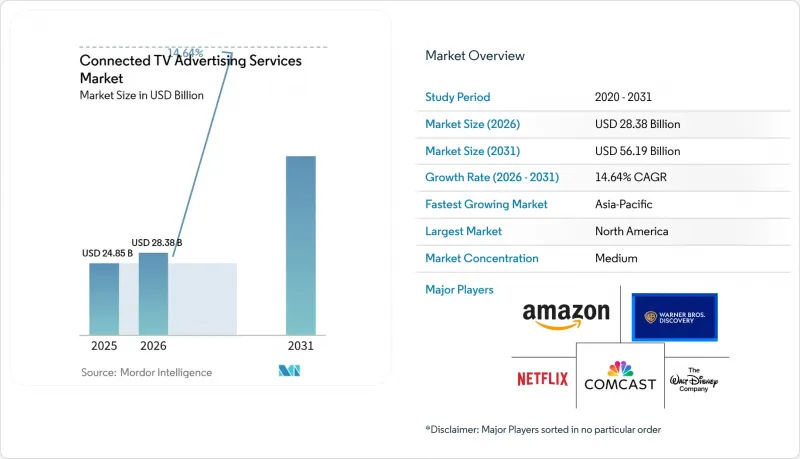
Mordor Intelligence에 의하면, 커넥티드 TV 광고 서비스 시장 규모는 2025년 248억 5,000만 달러로 평가되었고, 2026년에는 283억 8,000만 달러로 추정되고, 2031년까지 561억 9,000만 달러에 이를 것으로 예상되며, 2026-2031년 CAGR 14.64%로 성장할 전망입니다.
본 보고서는 서비스 유형별(미디어 기획·전략, 미디어 구매·활성화, 오디언스 데이터 서비스, 측정·어트리뷰션, 크리에이티브 적용·최적화), 광고주 업종별(소매 및 전자상거래, 미디어 및 엔터테인먼트, 자동차, 통신, 금융 서비스 등), 지역별로 분류되어 있습니다. 시장 예측은 금액(달러)으로 표시되어 있습니다.
세계의 커넥티드 TV 광고 서비스 시장 동향 및 인사이트
선형 방송에서 스트리밍으로의 예산 재분배 가속화
TV 광고 예산의 스트리밍으로의 전환은 2026년까지 구조적인 현상이 될 것으로 예측됩니다. Premion과 Advertiser Perceptions의 조사에 따르면, 미국 커넥티드 TV 광고주 대다수가 2026년에 지출을 늘릴 계획이며, 평균 증가 계획은 상당한 예산 확대를 시사하고 있습니다. 광고주들은 단순히 추가 지출을 하는 것이 아니라, 리니어 TV, 디스플레이 광고, 유료 검색, 소셜 미디어의 예산을 재분배하여 커넥티드 TV 투자에 충당하고 있습니다. 또한 이 조사에서는 커넥티드 TV에 대한 투자의 상당 부분이 리니어 TV 예산의 재분배를 통해 직접 충당되고 있음이 밝혀졌습니다. 커넥티드 TV 예산의 대부분은 통합형 또는 하이브리드형 대행사 팀이 관리하고 있으며, 이는 광고주가 전체 TV 환경에서 타겟 오디언스 도달, 광고 구매, 보고서 작성을 조정함에 따라 기획 실무가 변화하고 있음을 보여줍니다. 이러한 운영상의 변화는 커넥티드 TV 광고 서비스 시장에서 캠페인 계획, 인벤토리 선정, 노출 빈도 제어 및 측정 파트너 선정에 영향을 미치고 있습니다. 광고주들이 성과에 대한 보다 명확한 증거를 요구하는 가운데, 인증된 1인칭 데이터와 프리미엄 컨텐츠 권리를 보유한 플랫폼은 예산을 유지하는 데 유리한 입장에 있습니다.
프로그래매틱 및 셀프서비스형 구매로 광고주의 접근성 확대
프로그래매틱 인프라 덕분에 커넥티드 TV 광고 서비스 시장에 대한 접근성은 매니지드 서비스 모델을 넘어 확대되고 있습니다. Samsung Ads는 2026년 3분기부터 The Trade Desk 및 Google Display and Video 360을 통해 스마트 TV 홈 화면 인벤토리를 이용할 수 있게 될 것이라고 발표했습니다. 이번 제휴에서는 Magnite의 SpringServe가 광고 전달 레이어로 채택되어, 구매자는 주요 TV 인터페이스에 대한 프로그래매틱 접근 경로를 확보할 수 있게 됩니다. 자동화된 접근을 통해 소규모 광고주는 기존 직접 거래에 필요했던 예산을 들이지 않고도 커넥티드 TV를 테스트할 수 있게 됩니다. 한편, 기존 구매자는 더 많은 광고 슬롯에 대해 공통된 워크플로우 관리를 적용할 수 있게 됩니다. 또한 대행사 입장에서는 퍼블리셔, 기기, 캠페인 목표를 아우르며 도달 범위와 노출 빈도를 관리할 수 있는 유연성이 높아집니다. 셀프 서비스형 구매의 확대는 더 폭넓은 광고주층을 지원하는 동시에, 투명성이 높은 공급망, 판매자의 정보 공개, 그리고 신뢰할 수 있는 전달 보고서의 중요성을 높이고 있습니다.
크로스 플랫폼 측정 기준의 파편화는 여전히 지속되고 있습니다.
측정의 파편화는 커넥티드 TV 광고 서비스 시장의 구매자들에게 여전히 큰 운영상의 제약으로 작용하고 있습니다. IAB는 2025년 12월, ‘커넥티드 TV 표준 측정 가이드’를 발표했습니다. 이 가이드는 직접 및 입찰형 구매 경로에서의 노출, 가시성, 도달률, 빈도, 주의도에 대해 종합적으로 다루고 있습니다. 또한 IAB Europe은 2026년 4월, 커넥티드 TV 측정 프레임워크 및 투명성에 관한 원칙을 발표하고 공개 의견을 수렴했습니다. 이 프레임워크는 Amazon Ads, FreeWheel, Google, IAB UK, Magnite, Samsung Ads, YouTube와의 협력을 통해 마련되었습니다. 이러한 노력을 통해 공통된 정의가 확립되었으나, 특히 캠페인에서 서로 다른 플랫폼, 구매 경로, 보고 시스템이 사용되는 경우, 크로스 플랫폼 간 리치 중복 제거가 아직 일관되게 이루어지지 않고 있습니다. 그 결과, 광고주는 퍼블리셔와의 직접 거래와 프로그래매틱 거래의 성과를 비교할 때 여전히 어려움을 겪고 있으며, 이는 예산 결정의 지연을 초래할 수 있어 커넥티드 TV 광고 서비스 시장에서 독립적인 검증의 중요성을 더욱 높이고 있습니다.
부문 분석
2025년, 미디어 구매 및 활성화는 커넥티드 TV 광고 서비스 시장 점유율의 33.14%를 차지했습니다. 이러한 위상은 캠페인 실행에서 프로그래매틱 보장 거래, 프라이빗 마켓플레이스, 그리고 퍼블리셔와의 직접 협업이 수행하는 역할을 반영합니다. 기기 제조업체들이 구매자에게 스마트 TV의 홈 화면 공간을 제공하기 시작함에 따라, 해당 화면은 새로운 프로그래매틱 광고 인벤토리 소스로 자리 잡고 있습니다. 이를 통해 프리미엄 퍼블리셔, TV OS, 스트리밍 앱을 아우르며 광고 구매를 관리할 수 있는 서비스 제공업체들이 지원을 받고 있습니다. 또한 표준화된 측정 지침으로 인해 검증 및 성과 보고서에 대한 수요가 증가함에 따라, 측정 및 어트리뷰션 서비스의 중요성도 커지고 있습니다. IAB의 2025년 가이드라인은 바이사이드 및 셀사이드 조직에 직접 거래와 입찰 가능 거래를 아우르는 유효한 신호에 대한 공통 지침을 제공합니다.
오디언스 및 데이터 서비스는 2031년까지 연평균 성장률(CAGR) 15.12%로 확대될 것으로 예측됩니다. 구매자들은 프리미엄 동영상 인벤토리에 활용할 수 있는 상거래 데이터가 풍부하고 ID가 식별된 오디언스 부문을 더욱 중시하고 있습니다. WPP Media와 Criteo는 연간 총 상품 가치(GMV)가 1조 달러를 초과하는 17,000개 이상의 전자상거래 사이트에서 얻은 실시간 신호를 활용한 커넥티드 TV용 활성화 캠페인을 시작했습니다. 이 접근 방식은 엄선된 거래 ID를 활용하여 참여 중인 프리미엄 인벤토리 전반에 걸쳐 구매 의향이 높은 쇼핑객에게 도달합니다. 또한, 대행사가 공유 팀을 통해 선형 TV와 스트리밍 기획을 조율함에 따라 미디어 기획 및 전략도 변화하고 있습니다. 크리에이티브의 적응 및 최적화는 다이내믹 광고 삽입과 더욱 개인화된 동영상 제작의 혜택을 받고 있으며, 특히 커넥티드 TV 광고 서비스 시장에서 사내 제작 역량이 부족한 브랜드에게 유용합니다.
지역별 분석
2025년, 북미는 커넥티드 TV 광고 서비스 시장 점유율의 45.71%를 차지했습니다. 이 지역에서는 스트리밍의 보급이 진행되고 있으며, 리테일 미디어 활동이 활발하고, 프로그래매틱 인프라가 잘 갖춰져 있는 점이 맞물려 2026년에는 미국의 커넥티드 TV 업프론트 지출이 177억 3,000만 달러에 달하여, 프라임타임 선형 TV의 업프런트 지출인 169억 8,000만 달러를 넘어섰습니다. 월마트의 Vizio 및 Vibe.Co 인수 제안은 커머스 데이터, TV OS, 셀프서비스형 광고를 연계하는 해당 기업의 역량을 강화하는 것입니다. Roku는 9,000만 가구 이상의 활성 사용자를 보고했으며, 2025년에는 GAAP 기준 사상 첫 연간 흑자를 달성했습니다. 이 지역의 커넥티드 TV 광고 서비스 시장은 소매 데이터와 확립된 프리미엄 동영상 도달 범위를 결합할 수 있는 광고주들의 존재로 인해 혜택을 보고 있습니다.
아시아태평양은 2031년까지 연평균 성장률(CAGR) 14.91%로 확대될 것으로 예측되며, 커넥티드 TV 광고 서비스 시장에서 가장 두드러진 성장을 보일 것으로 전망됩니다. 이 지역에는 스트리밍 이용, 스마트 TV 보급, 프로그래매틱 광고 구매가 각각 서로 다른 출발점에서 확대되고 있는 시장들이 포함되어 있습니다. 호주와 한국은 디지털 동영상 환경이 보다 성숙해졌으며, 동의 획득 관행이 점차 정립되고 있습니다. 동남아시아는 여전히 광대역 인프라 구축과 커넥티드 기기에 대한 접근성 확대에 의존하고 있습니다. 인도에는 규모가 크고 지속적으로 성장하는 커넥티드 TV 시청자층이 존재하여, 선형 TV를 넘어선 새로운 광고주 도달 범위 창출로 이어지고 있습니다. 일본의 방송사 비디오 온 디맨드(VOD) 서비스 확대와 프로그래매틱 광고의 보급 확대도 이 지역 수요를 뒷받침하고 있습니다.
유럽은 두 번째로 큰 지역이며, 그 성장세가 계속해서 가속화되고 있습니다. 2025년 하반기, 유럽의 커넥티드 TV 광고 시청 횟수는 33% 증가했지만, 미국에서는 11% 증가에 그쳤습니다. 프랑스에서는 2025년 상반기, 커넥티드 TV 노출 수에서 프로그래매틱 광고의 점유율이 36%를 기록했습니다. GDPR(EU 개인정보보호규정) 및 ePrivacy 요건으로 인해 유럽 시장 전반에서 퍼스트 파티 데이터의 가치가 높아지면서 클린룸 파트너십의 중요성이 커지고 있습니다. 중동에서는 UAE와 사우디아라비아를 필두로 커넥티드 TV의 성장률이 전체 디지털 광고 시장의 성장률을 상회했습니다. 남미는 여전히 초기 단계에 있지만, 포르투갈어 및 스페인어 FAST 채널의 성장에 힘입어 브라질과 아르헨티나의 스마트 TV 보급 가구에 대한 도달 범위를 확대할 가능성이 있습니다.
기타 혜택 :
- 엑셀 형식 시장 예측(ME) 시트
- 3개월간의 애널리스트 지원
자주 묻는 질문
목차
제1장 서론
제2장 조사 방법
제3장 주요 요약
제4장 시장 구도
제5장 시장 규모 및 성장 예측
제6장 경쟁 구도
제7장 시장 기회 및 향후 전망
AJY 26.09.03According to Mordor Intelligence, the connected TV advertising services market size is expected to increase from USD 24.85 billion in 2025 to USD 28.38 billion in 2026 and reach USD 56.19 billion by 2031, growing at a CAGR of 14.64% over 2026-2031.
This report is Segmented by Service Type (Media Planning and Strategy, Media Buying and Activation, Audience and Data Services, Measurement and Attribution, and Creative Adaptation and Optimization), Advertiser Industry (Retail and Ecommerce, Media and Entertainment, Automotive, Telecom, Financial Services, and More), and Geography. The Market Forecasts are Provided in Terms of Value (USD).
Global Connected TV Advertising Services Market Trends and Insights
Linear-To-Streaming Budget Reallocation Accelerates
The television budget movement toward streaming is expected to become structural by 2026. A Premion and Advertiser Perceptions survey found that most U.S. connected TV advertisers planned to increase spending in 2026, with average planned increases indicating meaningful budget expansion. Advertisers are reallocating these budgets from linear television, display, paid search, and social media, rather than funding them only through incremental spending. The survey also found that a notable share of connected TV investment came directly from linear television reallocation. Integrated or hybrid agency teams managed a majority of connected TV budgets, indicating that planning practices are changing as advertisers coordinate audience delivery, buying, and reporting across television environments. This operational shift affects campaign planning, inventory selection, frequency control, and the selection of measurement partners within the connected TV advertising services market. Platforms with authenticated first-party data and premium content rights are better positioned to retain budgets as advertisers demand clearer evidence of outcomes.
Programmatic and Self-Serve Buying Broadens Advertiser Access
Programmatic infrastructure is extending access to the connected TV advertising services market beyond the managed-service model. Samsung Ads announced that Smart TV home screen inventory would become available through The Trade Desk and Google Display and Video 360 from Q3 2026. The arrangement uses Magnite's SpringServe as the ad-serving layer and gives buyers a programmatic route to a prominent television interface. Automated access can help smaller advertisers test connected TV without the budgets traditionally required for direct deals, while allowing established buyers to apply common workflow controls across more inventory. It also gives agencies more flexibility to manage reach and frequency across publishers, devices, and campaign objectives. The expansion of self-service buying supports a broader group of advertisers while increasing the importance of transparent supply paths, seller disclosures, and reliable delivery reporting.
Cross-Platform Measurement Standards Remain Fragmented
Measurement fragmentation remains a major operational constraint for buyers in the connected TV advertising services market. IAB published its Standardized Measurement Guide for Connected TV in December 2025, covering impressions, viewability, reach, frequency, and attention across direct and biddable buying paths. IAB Europe released a connected TV measurement framework and transparency principles for public comment in April 2026. The framework was developed with Amazon Ads, FreeWheel, Google, IAB UK, Magnite, Samsung Ads, and YouTube. These initiatives establish common definitions, but they do not yet deliver consistent cross-platform reach deduplication, especially where campaigns use different platforms, buying paths, and reporting systems. Buyers, therefore, continue to face difficulty comparing performance across direct publisher sales and programmatic transactions, which can delay budget decisions and make independent verification more important in the connected TV advertising services market.
Other drivers and restraints analyzed in the detailed report include:
- Live Sports and Premium Event Rights Shift to Streaming
- Shoppable and Interactive CTV Formats Improve Lower-Funnel Performance
- Privacy and Identity Signal Loss Weakens Household Resolution
For complete list of drivers and restraints, kindly check the Table Of Contents.
Segment Analysis
Media Buying and Activation held 33.14% of the connected TV advertising services market share in 2025. Its position reflects the role of programmatic guaranteed deals, private marketplaces, and direct publisher integrations in executing campaigns. Smart TV home screens are becoming another programmatic inventory source as device companies make those placements available to buyers. This supports service providers that can manage buying across premium publishers, TV operating systems, and streaming applications. Measurement and Attribution services are also becoming more important as standardized measurement guidance increases demand for verification and outcome reporting. IAB's 2025 guide gives buy-side and sell-side organizations a common reference for valid signals across direct and biddable transactions.
Audience and Data Services is projected to expand at a 15.12% CAGR through 2031. Buyers are placing greater value on commerce-enriched and identity-resolved audience segments that can be activated against premium video inventory. WPP Media and Criteo launched a connected TV activation using real-time signals from more than 17,000 e-commerce sites that represented over USD 1 trillion in annual gross merchandise value. The approach uses curated deal IDs to reach high-intent shoppers across participating premium inventory. Media Planning and Strategy is also changing as agencies coordinate linear television and streaming planning through shared teams. Creative Adaptation and Optimization benefits from dynamic ad insertion and more personalized video production, especially for brands that lack internal production capacity in the connected TV advertising services market.
Complete Report Scope:
- By Service Type
- Media Planning and Strategy
- Media Buying and Activation
- Audience and Data Services
- Measurement and Attribution
- Creative Adaptation and Optimization
- By Advertiser Industry
- Retail and Ecommerce
- Media and Entertainment
- Automotive
- Telecom
- Financial Services
- Healthcare
- Travel and Hospitality
- Other Advertiser Industries
- By Geography
- North America
- United States
- Canada
- Mexico
- South America
- Brazil
- Argentina
- Chile
- Colombia
- Rest of South America
- Europe
- United Kingdom
- Germany
- France
- Italy
- Spain
- Netherlands
- Nordics
- Russia
- Rest of Europe
- Asia-Pacific
- China
- Japan
- India
- South Korea
- Australia and New Zealand
- Southeast Asia
- Rest of Asia-Pacific
- Middle East
- Saudi Arabia
- United Arab Emirates
- Turkey
- Rest of Middle East
- Africa
- South Africa
- Nigeria
- Egypt
- Rest of Africa
- North America
Geography Analysis
North America held 45.71% of the connected TV advertising services market share in 2025. The region combines mature streaming adoption, retail media activity, and developed programmatic infrastructure. U.S. connected TV upfront spending reached USD 17.73 billion in 2026, surpassing USD 16.98 billion for primetime linear television upfront spending. Walmart's Vizio and proposed Vibe.Co acquisitions strengthen its ability to connect commerce data, TV operating systems, and self-service advertising. Roku reported more than 90 million active households and achieved its first full year of GAAP profitability in 2025. The connected TV advertising services market in the region benefits from buyers who can combine retail data with established premium video reach.
Asia-Pacific is projected to expand at a 14.91% CAGR through 2031, making it the fastest-growing regional area in the connected TV advertising services market. The region includes markets where streaming use, smart TV adoption, and programmatic buying are expanding from different starting points. Australia and South Korea have more mature digital video environments and are developing consent practices. Southeast Asia remains tied to broadband development and the growth of connected-device access. India has a large and growing connected TV audience, creating additional advertiser reach beyond linear television. Japan's broadcaster video-on-demand expansion and wider programmatic adoption also support regional demand.
Europe is the second-largest region and continues to gain momentum. European connected TV ad views grew 33% in the second half of 2025, compared with 11% in the United States. France recorded a 36% programmatic share of connected TV impressions in the first half of 2025. GDPR and ePrivacy requirements raise the value of first-party data and clean-room partnerships across European markets. In the Middle East, connected TV grew faster than the overall digital advertising environment, led by the UAE and Saudi Arabia. South America remains at an earlier stage, while FAST channel growth in Portuguese and Spanish can expand smart TV household reach in Brazil and Argentina.
- The Trade Desk, Inc.
- Google LLC
- Amazon.com, Inc.
- Roku, Inc.
- The Walt Disney Company
- Netflix, Inc.
- Comcast Corporation
- FreeWheel Media, Inc.
- Magnite, Inc.
- PubMatic, Inc.
- Innovid Corp.
- DoubleVerify Holdings, Inc.
- Integral Ad Science Holding Corp.
- Nexxen International Ltd.
- Samsung Electronics Co., Ltd.
- LG Electronics Inc.
- Yahoo Inc.
- Microsoft Corporation
- Viant Technology Inc.
- VideoAmp, Inc.
- iSpot.tv, Inc.
- Paramount Global
- Warner Bros. Discovery, Inc.
- Tatari, Inc.
- Simulmedia, Inc.
- OpenAP LLC.
Additional Benefits:
- The market estimate (ME) sheet in Excel format
- 3 months of analyst support
TABLE OF CONTENTS
1 INTRODUCTION
- 1.1 Study Assumptions and Market Definition
- 1.2 Scope of the Study
2 RESEARCH METHODOLOGY
3 EXECUTIVE SUMMARY
4 MARKET LANDSCAPE
- 4.1 Market Overview
- 4.2 Market Drivers
- 4.2.1 Linear-To-Streaming Budget Reallocation Accelerates
- 4.2.2 Programmatic and Self-Serve Buying Broadens Advertiser Access
- 4.2.3 Live Sports and Premium Event Rights Shift to Streaming
- 4.2.4 Shoppable and Interactive CTV Formats Improve Lower-Funnel Performance
- 4.2.5 TV Operating Systems Become New High-Attention Media Surfaces
- 4.2.6 Clean-Room Commerce Signals Sharpen Closed-Loop Targeting
- 4.3 Market Restraints
- 4.3.1 Cross-Platform Measurement Standards Remain Fragmented
- 4.3.2 Privacy and Identity Signal Loss Weakens Household Resolution
- 4.3.3 Creative and Metadata Fragmentation Slows Scaled Execution
- 4.3.4 Supply-Path Opacity and CTV Fraud Waste Premium Spend
- 4.4 Impact of Macroeconomic Factors on the Market
- 4.5 Industry Value Chain Analysis
- 4.6 Regulatory Landscape
- 4.7 Technological Outlook
- 4.8 Porter's Five Forces Analysis
- 4.8.1 Bargaining Power of Buyers
- 4.8.2 Bargaining Power of Suppliers
- 4.8.3 Threat of New Entrants
- 4.8.4 Threat of Substitutes
- 4.8.5 Intensity of Rivalry
5 MARKET SIZE AND GROWTH FORECASTS (VALUE)
- 5.1 By Service Type
- 5.1.1 Media Planning and Strategy
- 5.1.2 Media Buying and Activation
- 5.1.3 Audience and Data Services
- 5.1.4 Measurement and Attribution
- 5.1.5 Creative Adaptation and Optimization
- 5.2 By Advertiser Industry
- 5.2.1 Retail and Ecommerce
- 5.2.2 Media and Entertainment
- 5.2.3 Automotive
- 5.2.4 Telecom
- 5.2.5 Financial Services
- 5.2.6 Healthcare
- 5.2.7 Travel and Hospitality
- 5.2.8 Other Advertiser Industries
- 5.3 By Geography
- 5.3.1 North America
- 5.3.1.1 United States
- 5.3.1.2 Canada
- 5.3.1.3 Mexico
- 5.3.2 South America
- 5.3.2.1 Brazil
- 5.3.2.2 Argentina
- 5.3.2.3 Chile
- 5.3.2.4 Colombia
- 5.3.2.5 Rest of South America
- 5.3.3 Europe
- 5.3.3.1 United Kingdom
- 5.3.3.2 Germany
- 5.3.3.3 France
- 5.3.3.4 Italy
- 5.3.3.5 Spain
- 5.3.3.6 Netherlands
- 5.3.3.7 Nordics
- 5.3.3.8 Russia
- 5.3.3.9 Rest of Europe
- 5.3.4 Asia-Pacific
- 5.3.4.1 China
- 5.3.4.2 Japan
- 5.3.4.3 India
- 5.3.4.4 South Korea
- 5.3.4.5 Australia and New Zealand
- 5.3.4.6 Southeast Asia
- 5.3.4.7 Rest of Asia-Pacific
- 5.3.5 Middle East
- 5.3.5.1 Saudi Arabia
- 5.3.5.2 United Arab Emirates
- 5.3.5.3 Turkey
- 5.3.5.4 Rest of Middle East
- 5.3.6 Africa
- 5.3.6.1 South Africa
- 5.3.6.2 Nigeria
- 5.3.6.3 Egypt
- 5.3.6.4 Rest of Africa
- 5.3.1 North America
6 COMPETITIVE LANDSCAPE
- 6.1 Market Concentration
- 6.2 Strategic Moves
- 6.3 Market Share Analysis
- 6.4 Company Profiles (includes Global Level Overview, Market Level Overview, Core Segments, Financials as available, Strategic Information, Market Rank/Share, Products and Services, Recent Developments)
- 6.4.1 The Trade Desk, Inc.
- 6.4.2 Google LLC
- 6.4.3 Amazon.com, Inc.
- 6.4.4 Roku, Inc.
- 6.4.5 The Walt Disney Company
- 6.4.6 Netflix, Inc.
- 6.4.7 Comcast Corporation
- 6.4.8 FreeWheel Media, Inc.
- 6.4.9 Magnite, Inc.
- 6.4.10 PubMatic, Inc.
- 6.4.11 Innovid Corp.
- 6.4.12 DoubleVerify Holdings, Inc.
- 6.4.13 Integral Ad Science Holding Corp.
- 6.4.14 Nexxen International Ltd.
- 6.4.15 Samsung Electronics Co., Ltd.
- 6.4.16 LG Electronics Inc.
- 6.4.17 Yahoo Inc.
- 6.4.18 Microsoft Corporation
- 6.4.19 Viant Technology Inc.
- 6.4.20 VideoAmp, Inc.
- 6.4.21 iSpot.tv, Inc.
- 6.4.22 Paramount Global
- 6.4.23 Warner Bros. Discovery, Inc.
- 6.4.24 Tatari, Inc.
- 6.4.25 Simulmedia, Inc.
- 6.4.26 OpenAP LLC.
7 MARKET OPPORTUNITIES AND FUTURE OUTLOOK
- 7.1 White-Space and Unmet-Need Assessment


