

|
시장보고서
상품코드
2118037
커넥티드 TV 광고 시장 : 시장 점유율 분석, 업계 동향 및 통계, 성장 예측(2026-2031년)Connected TV Advertising - Market Share Analysis, Industry Trends & Statistics, Growth Forecasts (2026 - 2031) |
||||||
 Mordor Intelligence
Mordor Intelligence에 의하면, 커넥티드 TV 광고 시장 규모는 2025년에 463억 7,000만 달러로 평가되었고, 2026-2031년 CAGR 10.35%로 확대될 전망이며, 2031년에는 849억 1,000만 달러에 이를 것으로 예측됩니다.
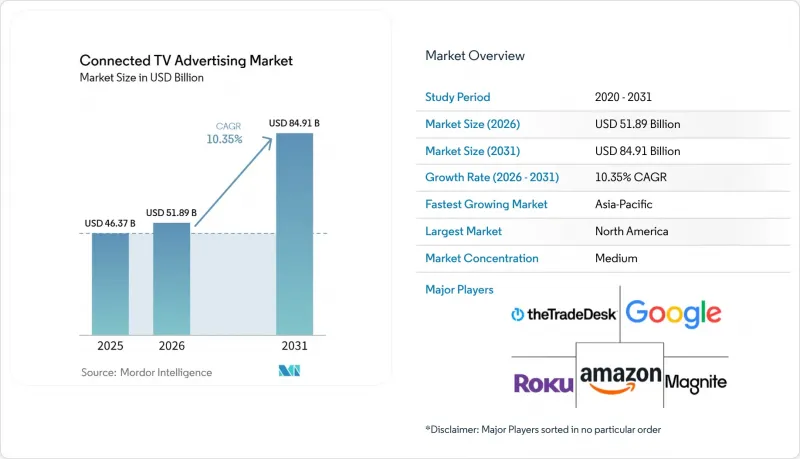
본 보고서는 광고 게재 위치별(프리롤, 미드롤, 포스트롤), 광고 형식별(동영상 광고, 디스플레이 광고, 인터랙티브 광고 등), 기기 유형별(스마트 TV, 게임기 등), 최종 사용자별(미디어 및 엔터테인먼트, 자동차 등), 지역별(북미, 남미, 유럽,아시아태평양, 중동 및 아프리카)로 분류되어 있습니다. 시장 예측은 금액(달러) 기준으로 제시되어 있습니다.
세계의 커넥티드 TV 광고 시장 동향 및 인사이트
선형 TV에서 스트리밍 시청자로의 전환
선형 TV에서 멀어지는 시청자의 움직임은 커넥티드 TV 광고 시장을 지탱하는 가장 기본적인 원동력으로 계속 작용하고 있습니다. 시청자들은 스트리밍 환경에서 보내는 시간이 늘어나고 있으며, 이에 따라 광고주가 가구 도달률과 반복 노출을 추구하는 대상이 변화하고 있습니다. 이러한 변화가 중요한 이유는 커넥티드 TV가 거실의 화면과 디지털 전송을 결합하고 있어, 기존의 TV 광고 구매에 비해 캠페인 관리가 더욱 강력해지기 때문입니다. 그 결과, 브랜드 예산은 기존의 시청 패턴이 회복되기를 기다리는 대신 시청자의 행동에 따라 배분되는 시장이 형성되고 있습니다. 또한, 이러한 시청자의 이동은 광고 인벤토리 증가와 구매자 수요가 같은 방향으로 나아가고 있기 때문에 커넥티드 TV 광고 시장의 장기적인 전망을 더욱 공고히 하고 있습니다.
광고 수익형 스트리밍 및 FAST 광고 슬롯의 확대
광고 포함 서비스와 FAST 채널의 확장으로 인해 커넥티드 TV 광고 시장 전체에서 판매 가능한 광고 슬롯의 양이 증가하고 있습니다. Gracenote의 보고서에 따르면, 주요 시장의 활성 FAST 채널 수는 2025년 3월 기준 1,610개를 넘어섰으며, 그 총수는 2023년 중반 대비 거의 2배로 증가했고, 2025년 동안 채널 수는 21% 증가했습니다. 이러한 성장에 힘입어 광고주는 기존의 구독형 동영상 모델과는 다른, 광범위한 도달 범위를 가진 시청 환경에 더 쉽게 접근할 수 있게 되었습니다. 또한 퍼블리셔의 입장에서도 단일 스트리밍 서비스에 의존하지 않고, 새로운 광고 부하, 패키징 모델, 시청자 그룹화를 시험적으로 도입할 여지가 넓어지고 있습니다. Wurl사는 FAST의 광고 수익이 2027년까지 120억 달러를 넘어설 것으로 예측하고 있으며, 이는 확장 가능한 동영상 광고 슬롯을 찾는 구매자들 수요를 커넥티드 TV 광고 시장이 계속해서 끌어들이고 있는 이유를 보여줍니다.
‘월드가든’ 전반에 걸친 측정 단편화
측정 방식의 파편화는 커넥티드 TV 광고 시장에서 지출의 급속한 성장을 저해하는 가장 뚜렷한 제약 요소 중 하나로 남아 있습니다. 광고주들은 여전히 주요 스트리밍 플랫폼마다 서로 다른 보고 방식, ID 프레임워크, 어트리뷰션 규칙에 직면해 있어 플랫폼 간 비교가 어려워지고 있습니다. 이는 특히 브랜드가 수년간 정착된 TV 광고 계획에서 예산을 전환할 때, 캠페인 지출과 비즈니스 성과 간의 명확한 연관성이 필수적이기 때문에 중요한 문제입니다. IAB는 2025년 이 문제에 대응하여 커넥티드 TV용 표준화된 전환 API 채택을 촉구하는 지침을 발표했습니다. 이는 광고주의 신뢰를 높이기 위해 시장에 여전히 공통된 측정 방법이 필요함을 보여줍니다. 이러한 기준이 더 널리 채택되기 전까지는 커넥티드 TV 광고 시장은 측정 가능성이 높은 디지털 채널과 비교하여 대규모 브랜드 예산이 재검토될 때 계속해서 마찰에 직면하게 될 것입니다.
부문 분석
2025년, 미드롤 광고는 커넥티드 TV 광고 시장 규모의 45.49%를 차지했으며, 이 형식은 수익 면에서 계속해서 1위를 유지했습니다. 이 부문은 시청 세션의 시작이나 끝이 아닌 도중에 배치된다는 장점이 있어, 프리미엄 스트리밍 서비스의 수익 창출에서 더욱 핵심적인 역할을 하고 있습니다. 커넥티드 TV 광고 시장에서 미드롤 광고 슬롯은 플랫폼이 기본적인 시청 경험을 변경하지 않고도 광고 부하를 관리할 수 있어 장편 컨텐츠에도 적합합니다. 따라서 광고가 포함된 요금제를 제공하는 프리미엄 구독 서비스와 광고 수익에 대한 의존도가 높은 FAST 서비스 모두에게 유용합니다. 이 부문이 현재 선두를 달리고 있다는 사실은 플랫폼들이 여전히 기존 컨텐츠의 휴식 시간에 자연스럽게 삽입할 수 있는 형식을 선호하고 있음을 시사합니다.
프리롤 광고는 2031년까지 연평균 성장률(CAGR) 10.81%를 나타낼 것으로 예측되며, 이는 광고주들이 여전히 도입이 간편하고 다양한 컨텐츠 유형에 쉽게 적용할 수 있는 형식을 중시하고 있음을 보여줍니다. 프리롤 광고 배치는 디지털 동영상 및 디스플레이 광고 캠페인을 통해 커넥티드 TV(CTV) 광고 시장에 진출하는 광고주에게 효과적입니다. 이는 익숙한 구매 논리와 광범위한 도달 목표와 부합하기 때문입니다. 포스트롤 광고도 여전히 배치 조합의 일부이지만, 캠페인 실행의 주된 역할을 담당하기보다는 메시지 노출을 확대하기 위해 사용되는 경우가 많아지고 있습니다. 2025년 12월에 발표된 IAB Tech Lab의 ‘CTV Ad Portfolio’는 일시 정지 광고, 메뉴 광고, 화면 보호기 광고, 인씬 광고, 스퀴즈백, 오버레이를 포함한 6가지 새로운 형식을 프로그래매틱 거래를 위해 표준화함으로써 광고 슬롯에 대한 논의의 폭을 넓혔습니다. 이러한 표준화를 통해 커넥티드 TV 광고 시장에서는 기존의 프리롤, 미드롤, 포스트롤이라는 구조를 넘어 시청자의 관심을 끌기 위한 새로운 기법이 제공되게 될 것입니다.
2025년 커넥티드 TV 광고 시장 규모 중 동영상 광고가 78.83%를 차지했으며, 이 포맷이 여전히 스트리밍 환경에서 광고주가 TV 화면을 어떻게 활용할지를 결정짓고 있음을 알 수 있습니다. 전체 화면 동영상은 커넥티드 TV 기기에서 도달률, 기억률, 브랜드 메시지를 전달하는 가장 직접적인 수단으로 자리 잡고 있습니다. 이러한 우위는 대부분의 프리미엄 스트리밍 광고 슬롯이 정지 이미지나 동반 형식이 아닌 동영상 전송을 중심으로 구성되어 있다는 사실에서도 드러납니다. 커넥티드 TV 광고 업계에서 이러한 점은 동영상 중심의 가격 책정, 광고 슬롯 계획, 캠페인 설계를 지속시키고 있습니다. 동영상은 계속해서 광고주의 기대와 플랫폼의 경제성 모두에 부합하고 있으므로, 이 부문의 위상이 급격히 약화될 가능성은 낮을 것으로 보입니다.
인터랙티브 광고는 2031년까지 연평균 성장률(CAGR) 11.12%로 확대될 것으로 예측되며, 이는 커넥티드 TV 광고 시장 전체에서 성과 중심의 활용 사례가 점점 더 중요해지고 있음을 보여줍니다. 인터랙티브성으로의 전환은 시청과 쇼핑,검색, 또는 반응 행동을 보다 직접적인 방식으로 연결할 수 있는 포맷에 대한 수요를 반영하고 있습니다. 디스플레이 광고는 커넥티드 TV 광고 시장에서 여전히 중요한 역할을 하고 있는데, 특히 홈 화면이나 재생/일시정지 화면에서는 플랫폼이 표준 동영상 슬롯 이외의 새로운 광고 슬롯을 창출할 수 있기 때문입니다. IAB Tech Lab의 2025년 포트폴리오는 수요 측 및 공급 측 플랫폼 간에 기존과는 다른 CTV 포맷을 프로그램 거래로 보다 쉽게 거래할 수 있도록 함으로써 이러한 변화를 뒷받침하고 있습니다. 이러한 포맷의 구매 및 측정이 쉬워짐에 따라, 커넥티드 TV 광고 업계에서는 동일한 화면 내에서 브랜딩 주도형과 전환 주도형 캠페인을 보다 폭넓게 조합할 수 있게 될 것입니다.
지역별 분석
2025년, 북미는 커넥티드 TV 광고 시장 규모의 38.42%를 차지했으며, 이 지역은 계속해서 1위를 유지했습니다. 이 지역은 성숙한 프로그래매틱 시스템, 광범위한 스트리밍 광고 슬롯, 그리고 커넥티드 TV 기기의 높은 가구 보급률과 같은 강점을 가지고 있습니다. 또한, 데이터 기반의 오디언스 구매와 프리미엄 컨텐츠를 결합한 시장으로서도 여전히 가장 발전된 지역입니다. 커넥티드 TV 광고 시장에서 이 점은 북미에 수익화 깊이와 거래 효율성 측면에서 강력한 우위를 가져다주고 있습니다. 2026년 6월 폭스(Fox)가 로쿠(Roku) 인수를 발표한 것은 컨텐츠, OS 도달 범위, 광고 인프라를 하나의 통합된 구조로 결합함으로써, 이 지역에서 플랫폼 지배권이 얼마나 가치 있는지를 보여주었습니다.
아시아태평양은 2031년까지 연평균 성장률(CAGR) 10.64%를 나타낼 것으로 예측되며, 커넥티드 TV 광고 시장에서 가장 빠르게 성장하는 지역이 될 전망입니다. 이러한 성장은 스마트 TV의 보급 확대, 광대역 이용 확대, 그리고 일부 국가에서 기존 TV 방송 구조의 정착도가 낮은 점에 힘입고 있습니다. 커넥티드 TV 광고 시장에서 일본은 특히 두드러집니다. 사이버에이전트의 보고서에 따르면, 일본의 CTV 동영상 광고 시장은 2025년에 전년 대비 127% 증가한 1,295억 엔(8억 6,900만 달러)에 달할 것으로 나타났습니다. 이 지역에서는 모든 국가가 동일한 속도로 발전하고 있는 것은 아니지만, 그 방향성은 분명하며 커넥티드 TV를 시청하는 가구 기반은 확대되고 있습니다. 따라서 예측 기간 동안 아시아태평양은 커넥티드 TV 광고 시장에 있어 중요한 성장 동력이 될 것입니다.
유럽에서는 디지털 동영상이 지역 광고 예산에서 차지하는 비중이 커짐에 따라 커넥티드 TV 광고 시장의 중요성이 높아지고 있습니다. IAB Europe의 보고서에 따르면, 2025년 유럽의 디지털 광고 지출은 1,311억 유로(1,478억 달러)에 달했으며, 동영상 광고가 디스플레이 광고 투자 전체의 절반 이상을 차지했습니다. 이는 커넥티드 TV가 이 지역 전체에서 진행 중인 동영상 분야의 확대와 밀접한 관련이 있기 때문에 중요한 의미를 지닙니다. 또한, 유럽에서는 데이터 이용 및 동의에 관한 규제가 여전히 중요하며, 이로 인해 퍼스트파티 데이터 관리와 클린룸 파트너십의 전략적 역할이 더욱 커지고 있습니다. 중동에서는 IAB MENA의 보고서에 따르면, 2025년에 CTV 광고가 31% 성장하여 디지털 시장 전체 성장률인 17.8%를 상회했습니다. 이는 이미 확립된 주요 지역을 넘어 커넥티드 TV를 통한 시청이 중요성을 더하고 있음을 보여줍니다. 아프리카에서는 광대역 보급이 확대되고 젊은 층 사이에서 스트리밍 이용이 더욱 확산됨에 따라, 커넥티드 TV 광고 시장에 있어 지속적인 장기적 기회가 될 수 있습니다.
기타 혜택 :
- 엑셀 형식 시장 예측(ME) 시트
- 3개월간의 애널리스트 지원
자주 묻는 질문
목차
제1장 서론
제2장 조사 방법
제3장 주요 요약
제4장 시장 구도
제5장 시장 규모 및 성장 예측
제6장 경쟁 구도
제7장 시장 기회 및 향후 전망
AJY 26.09.03According to Mordor Intelligence, the connected TV advertising market size was valued at USD 46.37 billion in 2025 and is projected to reach USD 84.91 billion by 2031, at a CAGR of 10.35% during 2026-2031.
This report is Segmented by Ad Placement (Pre-Roll, Mid-Roll, and Post-Roll), Ad Format (Video Ads, Display Ads, Interactive Ads, and More), Device Type (Smart TVs, Gaming Consoles, and More), End User (Media and Entertainment, Automotive, and More), and Geography (North America, South America, Europe, Asia-Pacific, Middle East, and Africa). The Market Forecasts are Provided in Terms of Value (USD).
Global Connected TV Advertising Market Trends and Insights
Streaming Audience Migration from Linear Television
Audience movement away from linear television remains the most basic force behind the connected TV advertising market. Viewers are spending more time in streaming environments, and that is changing where advertisers look for household reach and repeated exposure. This shift matters because connected TV combines the living room screen with digital delivery, which makes campaign control stronger than in traditional television buying. The result is a market where brand budgets are following audience behavior rather than waiting for old viewing patterns to return. That audience migration also strengthens the long-term case for the connected TV advertising market because inventory growth and buyer demand are moving in the same direction.
Expansion of Ad-Supported Streaming and FAST Inventory
The expansion of ad-supported services and FAST channels is increasing the amount of sellable inventory across the connected TV advertising market. Gracenote reported that active FAST channels in key markets reached more than 1,610 as of March 2025, and the total nearly doubled from mid-2023, with channel count rising 21% during 2025. That growth gives advertisers more access to broad-reach viewing environments that sit outside traditional subscription video models. It also gives publishers more room to test new ad loads, packaging models, and audience groupings without depending on a single type of streaming service. Wurl stated that FAST ad revenues are projected to exceed USD 12 billion by 2027, which shows why the connected TV advertising market continues to attract more demand from buyers looking for scalable video inventory.
Measurement Fragmentation Across Walled Gardens
Measurement fragmentation remains one of the clearest limits on faster spending growth in the connected TV advertising market. Buyers still face different reporting methods, identity frameworks, and attribution rules across major streaming platforms, which makes cross-platform comparison difficult. This matters because budget migration depends on a clear link between campaign spend and business outcomes, especially when brands are moving money from long-established television plans. IAB responded to this problem in 2025 with guidance that called for standardized Conversion API adoption for connected TV, which shows that the market still needs common measurement practices to improve advertiser confidence. Until those standards are used more widely, the connected TV advertising market will continue to face friction when large brand budgets are reviewed against more measurable digital channels.
Other drivers and restraints analyzed in the detailed report include:
- Programmatic Buying and Automated Yield Optimization
- Live Sports and Premium Event Monetization
- Limited Show-Level Transparency and Content Visibility
For complete list of drivers and restraints, kindly check the Table Of Contents.
Segment Analysis
Mid-roll ads held 45.49% of the connected TV advertising market size in 2025, which kept this format in the leading revenue position. The segment benefits from being placed inside the viewing session rather than at the start or the end, which makes it more central to monetization for premium streaming services. In the connected TV advertising market, mid-roll inventory also fits well with longer-form content where platforms can manage ad load without changing the basic viewing experience. That makes it useful for both premium subscription services with ad tiers and FAST services that depend more heavily on advertising revenue. The segment's current lead suggests that platforms still prefer formats that can be inserted naturally into established content breaks.
Pre-roll ads are projected to grow at a 10.81% CAGR through 2031, which shows that buyers still value formats that are simple to deploy and easy to scale across varied content types. Pre-roll placement works well for advertisers entering the connected TV advertising market from digital video and display campaigns because it aligns with familiar buying logic and broad reach goals. Post-roll ads remain part of the placement mix, though they are more often used to extend message exposure than to carry the core burden of campaign delivery. The IAB Tech Lab's CTV Ad Portfolio, published in December 2025, also widened the placement discussion by standardizing 6 new formats for programmatic trade, including pause ads, menu ads, screensaver ads, in-scene ads, squeezebacks, and overlays. That standardization gives the connected TV advertising market more ways to package attention beyond the traditional pre-roll, mid-roll, and post-roll structure.
Video ads accounted for 78.83% of the connected TV advertising market size in 2025, which shows that the format still defines how advertisers use the television screen in streaming environments. Full-screen video remains the most direct way to deliver reach, recall, and brand messaging on connected television devices. Its lead also reflects the fact that most premium streaming inventory is built around video delivery rather than static or companion formats. In the connected TV advertising industry, this keeps video at the center of pricing, inventory planning, and campaign design. The segment's position is unlikely to weaken quickly because video continues to match both advertiser expectations and platform economics.
Interactive ads are forecast to expand at an 11.12% CAGR through 2031, which signals that performance-led use cases are becoming more important across the connected TV advertising market. The move toward interactivity reflects demand for formats that can connect viewing with shopping, search, or response actions in a more direct way. Display ads still matter in the connected TV advertising market, especially on home screens and pause surfaces where platforms can create new inventory outside standard video pods. The IAB Tech Lab's 2025 portfolio supports this shift by making more nontraditional CTV formats easier to transact programmatically across demand and supply platforms. As these formats become easier to buy and measure, the connected TV advertising industry is likely to support a broader mix of branding and conversion-led campaigns on the same screen.
Complete Report Scope:
- Ad Placement
- Pre-roll ads
- Mid-roll ads
- Post-roll ads
- By Ad Format
- Video Ads
- Display Ads
- Interactive Ads
- Other Ad Formats (Audio Ads etc)
- By Device Type
- Smart TVs
- Gaming Consoles
- Other Device Types
- By End User
- Media and Entertainment
- Retail and E-Commerce
- Automotive
- Healthcare and Pharmaceuticals
- Financial Services
- Travel and Hospitality
- Other End Users
- By Geography
- North America
- United States
- Canada
- Mexico
- South America
- Brazil
- Argentina
- Chile
- Rest of South America
- Europe
- Germany
- United Kingdom
- France
- Italy
- Spain
- Rest of Europe
- Asia-Pacific
- China
- Japan
- India
- South Korea
- Australia
- Rest of Asia-Pacific
- Middle East
- Saudi Arabia
- United Arab Emirates
- Qatar
- Rest of Middle East
- Africa
- South Africa
- Egypt
- Nigeria
- Rest of Africa
- North America
Geography Analysis
North America held 38.42% of the connected TV advertising market size in 2025, which kept the region in the leading position. The region benefits from mature programmatic systems, broad streaming inventory, and high household use of connected television devices. It also remains the most developed market for packaging premium content with data-led audience buying. In the connected TV advertising market, this gives North America a strong advantage in monetization depth and transaction efficiency. Fox's announced acquisition of Roku in June 2026 showed how valuable platform control has become in this region because it combines content, operating system reach, and ad infrastructure in one proposed structure.
Asia-Pacific is forecast to grow at a 10.64% CAGR through 2031, making it the fastest-growing region in the connected TV advertising market. Growth is being supported by rising smart TV adoption, broader broadband availability, and a less entrenched linear television structure in several countries. Japan stands out within the connected TV advertising market because CyberAgent reported that the country's CTV video advertising market grew 127% year over year in 2025 to JPY 129.5 billion, (USD 869 million). The region is not moving at the same speed in every country, but the direction is clear and the base of connected viewing households is widening. That makes Asia-Pacific an important growth engine for the connected TV advertising market over the forecast period.
Europe is becoming more important to the connected TV advertising market as digital video gains a larger place in regional advertising budgets. IAB Europe reported that European digital ad spend reached EUR 131.1 billion (USD 147.8 billion), and video accounted for more than half of all display investment in 2025. This matters because connected television is part of the wider video expansion taking place across the region. Data use and consent rules also remain important in Europe, which gives first-party data management and clean-room partnerships a larger strategic role. In the Middle East, IAB MENA reported that CTV advertising grew 31% in 2025, ahead of overall digital market growth of 17.8%, which shows that connected viewing is gaining weight beyond the largest established regions. Africa remains a longer-term opportunity for the connected TV advertising market as broadband coverage improves and streaming adoption becomes more widespread across younger populations.
List of Companies Covered in this Report:
- Alphabet Inc.
- Amazon.com, Inc.
- Comcast Corporation
- Disney Advertising Sales LLC
- Google LLC
- Innovid Corp.
- LG Electronics Inc.
- Magnite, Inc.
- Microsoft Corporation
- NBCUniversal Media, LLC
- Nielsen Holdings plc
- Paramount Global
- PubMatic, Inc.
- Roku, Inc.
- Samsung Electronics Co., Ltd.
- Samba TV, Inc.
- The Trade Desk, Inc.
- Tremor International Ltd.
- Viant Technology Inc.
- Yahoo Inc.
Additional Benefits:
- The market estimate (ME) sheet in Excel format
- 3 months of analyst support
TABLE OF CONTENTS
1 INTRODUCTION
- 1.1 Study Assumptions and Market Definition
- 1.2 Scope of the Study
2 RESEARCH METHODOLOGY
3 EXECUTIVE SUMMARY
4 MARKET LANDSCAPE
- 4.1 Market Overview
- 4.2 Market Drivers
- 4.2.1 Streaming Audience Migration From Linear Television
- 4.2.2 Expansion of Ad-Supported Streaming and FAST Inventory
- 4.2.3 Programmatic Buying and Automated Yield Optimization
- 4.2.4 Live Sports and Premium Event Monetization
- 4.2.5 Retail Media and Commerce-Linked CTV Activation
- 4.2.6 Privacy-Safe First-Party Data and Contextual Targeting
- 4.3 Market Restraints
- 4.3.1 Measurement Fragmentation Across Walled Gardens
- 4.3.2 Limited Show-Level Transparency and Content Visibility
- 4.3.3 Fraud Risk and Misrepresented Inventory
- 4.3.4 Premium Live Inventory Cost and Yield Protection Pressure
- 4.4 Industry Value Chain Analysis
- 4.5 Regulatory Landscape
- 4.6 Technological Outlook
- 4.7 Porter's Five Forces Analysis
- 4.7.1 Bargaining Power of Suppliers
- 4.7.2 Bargaining Power of Buyers
- 4.7.3 Threat of New Entrants
- 4.7.4 Threat of Substitutes
- 4.7.5 Competitive Rivalry
5 MARKET SIZE AND GROWTH FORECASTS (VALUE)
- 5.1 Ad Placement
- 5.1.1 Pre-roll ads
- 5.1.2 Mid-roll ads
- 5.1.3 Post-roll ads
- 5.2 By Ad Format
- 5.2.1 Video Ads
- 5.2.2 Display Ads
- 5.2.3 Interactive Ads
- 5.2.4 Other Ad Formats (Audio Ads etc)
- 5.3 By Device Type
- 5.3.1 Smart TVs
- 5.3.2 Gaming Consoles
- 5.3.3 Other Device Types
- 5.4 By End User
- 5.4.1 Media and Entertainment
- 5.4.2 Retail and E-Commerce
- 5.4.3 Automotive
- 5.4.4 Healthcare and Pharmaceuticals
- 5.4.5 Financial Services
- 5.4.6 Travel and Hospitality
- 5.4.7 Other End Users
- 5.5 By Geography
- 5.5.1 North America
- 5.5.1.1 United States
- 5.5.1.2 Canada
- 5.5.1.3 Mexico
- 5.5.2 South America
- 5.5.2.1 Brazil
- 5.5.2.2 Argentina
- 5.5.2.3 Chile
- 5.5.2.4 Rest of South America
- 5.5.3 Europe
- 5.5.3.1 Germany
- 5.5.3.2 United Kingdom
- 5.5.3.3 France
- 5.5.3.4 Italy
- 5.5.3.5 Spain
- 5.5.3.6 Rest of Europe
- 5.5.4 Asia-Pacific
- 5.5.4.1 China
- 5.5.4.2 Japan
- 5.5.4.3 India
- 5.5.4.4 South Korea
- 5.5.4.5 Australia
- 5.5.4.6 Rest of Asia-Pacific
- 5.5.5 Middle East
- 5.5.5.1 Saudi Arabia
- 5.5.5.2 United Arab Emirates
- 5.5.5.3 Qatar
- 5.5.5.4 Rest of Middle East
- 5.5.6 Africa
- 5.5.6.1 South Africa
- 5.5.6.2 Egypt
- 5.5.6.3 Nigeria
- 5.5.6.4 Rest of Africa
- 5.5.1 North America
6 COMPETITIVE LANDSCAPE
- 6.1 Market Concentration
- 6.2 Strategic Moves
- 6.3 Vendor Positioning Analysis
- 6.4 Company Profiles (includes Global Level Overview, Market Level Overview, Core Segments, Financials as available, Strategic Information, Products and Services, Recent Developments)
- 6.4.1 Alphabet Inc.
- 6.4.2 Amazon.com, Inc.
- 6.4.3 Comcast Corporation
- 6.4.4 Disney Advertising Sales LLC
- 6.4.5 Google LLC
- 6.4.6 Innovid Corp.
- 6.4.7 LG Electronics Inc.
- 6.4.8 Magnite, Inc.
- 6.4.9 Microsoft Corporation
- 6.4.10 NBCUniversal Media, LLC
- 6.4.11 Nielsen Holdings plc
- 6.4.12 Paramount Global
- 6.4.13 PubMatic, Inc.
- 6.4.14 Roku, Inc.
- 6.4.15 Samsung Electronics Co., Ltd.
- 6.4.16 Samba TV, Inc.
- 6.4.17 The Trade Desk, Inc.
- 6.4.18 Tremor International Ltd.
- 6.4.19 Viant Technology Inc.
- 6.4.20 Yahoo Inc.
7 MARKET OPPORTUNITIES AND FUTURE OUTLOOK
- 7.1 White-Space and Unmet-Need Assessment


