

|
시장보고서
상품코드
2119105
지오신세틱 클레이 라이너 시장 : 시장 점유율 분석, 업계 동향 및 통계, 성장 예측(2026-2031년)Geosynthetic Clay Liners - Market Share Analysis, Industry Trends & Statistics, Growth Forecasts (2026 - 2031) |
||||||
 Mordor Intelligence
Mordor Intelligence에 의하면, 지오신세틱 클레이 라이너 시장은 2025년에 5억 876만 달러 규모로 평가되었고, 2026년 5억 3,455만 달러에서 2031년까지 6억 8,857만 달러에 이를 것으로 예측되며, 예측 기간 CAGR은 5.19%로 성장이 전망됩니다(2026-2031년).
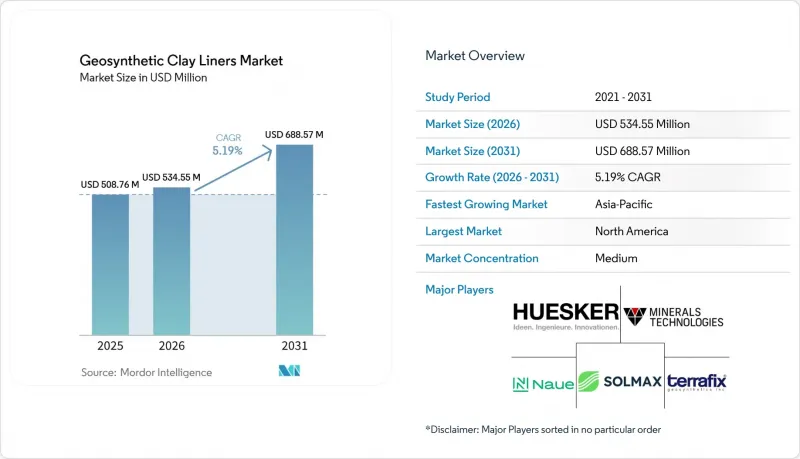
본 보고서는 제품 유형별(보강형 GCL, 비보강형 GCL, 다성분형 및 코팅형 GCL), 용도별(매립지, 격리 및 폐수 처리, 도로 및 토목 건설, 광업, 기타 용도), 지역별(아시아태평양, 북미, 유럽, 남미, 중동 및 아프리카)로 분류되어 있습니다. 시장 예측은 금액(달러) 기준으로 제시되어 있습니다.
세계의 지오신세틱 클레이 라이너 시장 동향 및 인사이트
매립지 및 지하수 보호 요건의 강화
지오신세틱 클레이 라이너 시장은 매립지의 격리 요건을 규정하는 환경 규제와 밀접한 관련이 있습니다. 미국 환경보호청(EPA)의 서브타이틀 D 요건 및 EU의 매립지 지침은 매립지 프로젝트에서 중요한 규정 준수 기준이 되고 있습니다. 독일은 2025년 4월 개정안에 이어 2026년 3월 2일 개정판 BQS 5-5를 공표했습니다. 이 규격에서는 매립지 표면 밀봉에 사용되는 지오신세틱 클레이 라이너(GCL)에 대해 양이온 교환 내구성 시험 및 독립적인 생산 감시를 의무화하고 있습니다. 이러한 요건은 성능이 문서화된 자재를 우선적으로 사용하도록 하는 것으로, 대규모 토공이 현실적으로 어려운 장소에서는 다짐 점토의 사용이 제한될 수 있습니다. 튀르키예에서는 도시 고형 폐기물 매립지 수가 2003년 15곳에서 2022년 93곳으로 증가했으며, 이는 규제와 기술적 역량이 설계된 봉쇄 시스템의 활용을 어떻게 확대할 수 있는지를 보여줍니다. 또한, 오래된 매립 셀의 경우에도 GCL은 수직 및 수평 공간이 제한된 현장에도 적합하기 때문에 폐쇄를 위한 좋은 기회가 됩니다.
광업용 침출 패드 및 광미 격리 시설의 확대
지오신세틱 클레이 라이너(GCL) 시장은 더욱 엄격해지는 광미 저류 기준의 보급에 힘입어 성장하고 있습니다. 국제광업 및 금속협의회(ICMM)는 2025년 2월에 광미 관리 지침을 개정했습니다. 볼리덴 타라 마인즈(Boliden Tara Mines)는 2025년 8월, ‘광미 관리에 관한 세계 산업 기준’에 대한 자체 평가를 통해 완전한 준수를 보고했습니다. 이 회사의 6단계 시설에서는 복합 GCL과 고밀도 폴리에틸렌(HDPE) 라이너 시스템을 주요 차단층으로 채택하고 있습니다. 테크 리소시스(Tech Resources)사도 2025년 8월 5일, 가동을 중단한 광미 저류 시설에 대해 해당 기준을 준수한다고 보고했습니다. 히프 리치 패드나 증발지에서는 액체의 화학적 성질이 부식성이 높고 변동하기 쉬우므로 적합성 검토가 필요합니다. GCL의 사용은 광산 복구 분야로도 확대되고 있으며, 그곳에서는 모세관 차단 시스템을 통해 산의 발생이나 침출수의 유출량을 줄일 수 있습니다.
부식성 액체의 화학적 부적합과 양이온 교환
화학적 적합성 문제는 부식성 유체가 수반되는 프로젝트에서 지오신세틱 클레이 라이너 시장의 확장을 제한하는 요인이 될 수 있습니다. 2025년 논문에서는 경사진 지오멤브레인·GCL 시스템을 통한 누출이 조사되었으며, 누출량은 침출수의 수두에 따라 비선형적으로 변화하는 것으로 밝혀졌습니다. 따라서 가동 조건 하에서는 벤토나이트의 미세한 열화라도 더 큰 영향을 미칠 가능성이 있습니다. Knight Piesold사의 사례 연구에 따르면, 대조 시험에서 팽윤 지수가 29였던 반면, 실제 현장의 침출수에서는 8까지 감소한 것으로 기록되었습니다. 제안된 제품은 그 특성이 현장의 화학적 환경에 적합하지 않았기 때문에 채택되지 않았습니다. 복잡한 광산 프로젝트의 경우, 적합성 시험에 8-12주가 소요될 수 있습니다. 이러한 소요 시간은 조달을 지연시킬 가능성이 있으며, 내화학성이 주요 선정 요인이 되는 경우에는 HDPE 지오멤브레인이 우선적으로 선택되는 경향이 있습니다.
부문 분석
2025년, 보강형 GCL은 매출의 57.34%를 차지했으며, 매립지 라이너, 저수지, 광산 사면에서의 폭넓은 활용을 통해 지오신세틱 클레이 라이너 시장을 주도했습니다. 니들펀치 보강은 토사 하중이나 사면 조건이 까다로운 곳에서 요구되는 전단 강도를 지지합니다. 이 구조에서는 서로 맞물리는 섬유를 이용하여 지오텍스타일 기판과 벤토나이트 코어를 결합시킵니다. 독일의 2026년판 BQS 5-5 규격에서는 보강 섬유에 대한 80℃에서의 전단 크리프 시험이 규정되어 있습니다. 이 요건으로 인해 매립지 밀폐용 보강 제품에 대한 기술 기준이 상향 조정됩니다. 또한, 시험 결과를 입증하고 관리된 생산 체계를 확립할 수 있는 공급업체가 우대받게 됩니다.
지오신세틱 클레이 라이너(GCL) 시장에서는 비보강형 GCL이 계속해서 완만한 사면의 토목 공사에 활용되고 있습니다. 도로 노반의 방수나 저수지의 라이닝 등, 저비용이 중시되고 높은 내부 전단 강도가 필요하지 않은 상황에서는 이러한 제품을 사용할 수 있습니다. 다성분형 및 코팅형 GCL은 2026-2031년 연평균 성장률(CAGR) 6.23%로 확대될 것으로 예측됩니다. 이러한 제품의 설계는 수분 차단과 가스 저감을 지원하는 차단 기능을 겸비하고 있습니다. 오스트리아의 ONORM S 2073:2026 규격에서는 매립지 구조물에 사용되는 지오신세틱 씰링 멤브레인에 대해 최소 50년의 내구 연한을 요구하고 있습니다. 이에 따라 장기적인 사용에 견딜 수 있는 복합 시스템이 더욱 중요시되고 있습니다. 따라서 지오신세틱 클레이 라이너 업계에서는 표준적인 재료 선택이 아닌, 프로젝트 조건에 기반한 제품 선정으로 전환되고 있습니다.
지역별 분석
2025년, 북미는 전 세계 매출의 35.48%를 차지했습니다. EPA(미국 환경보호청)의 규제 대상인 매립 셀 및 유해 폐기물 격리 활동이 이 지역의 주요 수요 기반을 형성하고 있습니다. 미국 수요는 신규 매립지 건설에서 폐쇄 및 캡 설치로 전환되고 있습니다. 이는 부지 제약으로 인해 다짐 점토의 사용이 제한되는 상황에서 고성능 등급 제품에 유리하게 작용하고 있습니다. 캐나다의 광업 부문 및 멕시코의 산업 확장에 따라 봉쇄 프로젝트가 증가하고 있습니다. 규제, 시험 역량 및 확립된 시공 관행이 프리미엄 제품을 뒷받침하고 있기 때문에 이 지역은 계속해서 중요한 위치를 차지하고 있습니다.
아시아태평양은 2026-2031년 연평균 성장률(CAGR) 6.45%를 나타낼 것으로 예측되며, 지오신세틱 클레이 라이너 시장에서 지역별 가장 높은 성장률을 나타낼 것입니다. 이 지역에서는 매립지 규제 변경, 인프라 건설, 광산 복원 및 폐수 처리 프로젝트가 결합되어 수요를 견인하고 있습니다. 중국의 국가 표준 GB/T 32151.49-2026은 폐기물 매립 시설 운영자에 대한 온실가스 산정 및 보고 요건을 규정하고 있습니다. 이에 따라 매립 시설에서 공학적으로 설계된 봉쇄 대책에 대한 관심이 높아지고 있습니다. 인도, 호주, 한국 및 아세안(ASEAN) 국가들은 인프라, 수처리, 광산 복원을 통해 시장에 기여하고 있습니다. 이 지역의 전망에는 엄격한 성능 요건이 요구되는 프로젝트에서 기술적으로 진보된 GCL이 더 널리 활용되는 경향도 반영되어 있습니다.
지오신세틱 클레이 라이너 시장에서 유럽은 독일, 프랑스, 영국 및 북유럽 국가들을 중심으로 전개되고 있습니다. EU의 매립 지침 및 각국의 요건이 조달을 주도하고 있으며, 독일의 2026년판 BQS 5-5는 이 지역의 기술적 지침이 되고 있습니다. 남미에서는 칠레의 구리 침출 사업 및 브라질의 폐기물 관리 프로젝트에 시장이 집중되어 있습니다. 중동 및 아프리카에서는 물 부족이 인프라 선택지를 좌우하고 있기 때문에 저수지 라이닝 및 운하 방수 분야에서 장기적인 잠재력이 기대됩니다. 사우디아라비아와 남아프리카공화국은 이러한 물 관련 용도의 대표적인 사례입니다. 또한, 이 지역에서는 GCL의 지속적인 도입을 위해 적절한 시공 능력과 재료 시험 체계의 구축도 요구되고 있습니다.
기타 혜택 :
- 엑셀 형식 시장 예측(ME) 시트
- 3개월간의 애널리스트 지원
자주 묻는 질문
목차
제1장 서론
제2장 조사 방법
제3장 주요 요약
제4장 시장 구도
제5장 시장 규모 및 성장 예측
제6장 경쟁 구도
제7장 시장 기회 및 향후 전망
AJY 26.09.03According to Mordor Intelligence, the geosynthetic clay liners market was valued at USD 508.76 million in 2025 and is estimated to grow from USD 534.55 million in 2026 to reach USD 688.57 million by 2031, at a CAGR of 5.19% during the forecast period (2026-2031).
This report is Segmented by Product Type (Reinforced GCLs, Non-Reinforced GCLs, and Multicomponent and Coated GCLs), Application (Landfills, Containment and Wastewater Treatment, Roadways and Civil Construction, Mining, and Other Applications), and Geography (Asia-Pacific, North America, Europe, South America, and Middle-East and Africa). The Market Forecasts are Provided in Terms of Value (USD).
Global Geosynthetic Clay Liners Market Trends and Insights
Tightening Landfill and Groundwater Protection Requirements
The geosynthetic clay liners market is closely tied to environmental rules that define landfill containment requirements. US EPA Subtitle D requirements and the EU Landfill Directive provide important compliance baselines for landfill projects. Germany published the revised BQS 5-5 on March 2, 2026, following its April 2025 revision. The standard requires cation-exchange durability tests and independent production monitoring for GCLs used in landfill surface seals. These requirements favor materials with documented performance and may limit the use of compacted clay where extensive earthworks are impractical. Turkey increased its municipal solid waste landfill count from 15 in 2003 to 93 in 2022, showing how regulation and engineering capacity can widen the use of engineered containment systems. Older landfill cells also create a closure opportunity because GCLs can fit sites with limited vertical and lateral space.
Expansion of Mining Leach Pads and Tailings Containment
The geosynthetic clay liners market is gaining from more demanding tailings storage practices. The International Council on Mining and Metals updated its tailings management guidance in February 2025. Boliden Tara Mines reported full self-assessed conformance with the Global Industry Standard on Tailings Management in August 2025. Its Stage 6 facility uses a composite GCL and High-Density Polyethylene (HDPE) liner system as the primary barrier. Teck Resources also reported conformance for its inactive tailings storage facilities on August 5, 2025. Heap leach pads and evaporation ponds require compatibility work because their liquids can have aggressive and variable chemistry. GCL use also extends to mine reclamation, where capillary barrier systems can reduce acid generation and leachate flux.
Chemical Incompatibility and Cation Exchange in Aggressive Liquids
Chemical compatibility can restrict the geosynthetic clay liners market in projects with aggressive liquid streams. A 2025 paper examined leakage through inclined geomembrane-GCL systems and found that leakage changes nonlinearly with leachate head. Minor bentonite degradation can therefore have larger consequences under operating conditions. A Knight Piesold case study recorded a control swell index of 29 that fell to 8 in the actual site leachate. The proposed product was disqualified because its properties did not suit the site chemistry. Compatibility testing can take 8 to 12 weeks on complex mining projects. This timing can slow procurement and favor HDPE geomembranes when chemical resistance is the primary selection factor.
Other drivers and restraints analyzed in the detailed report include:
- Rising Water-Containment and Wastewater Infrastructure Investment
- Site-Specific Polymer-Enhanced GCL Demand for Aggressive Leachates
- Installation Damage, Premature Hydration, and Quality Assurance Failures
For complete list of drivers and restraints, kindly check the Table Of Contents.
Segment Analysis
Reinforced GCLs held 57.34% of revenue in 2025 and led the geosynthetic clay liners market through broad use in landfill liners, reservoirs, and mining slopes. Needle-punch reinforcement supports the shear strength required where overburden loads or slopes are demanding. The structure uses interlocking fibers to connect geotextile carriers with the bentonite core. Germany's 2026 BQS 5-5 includes shear-creep testing at 80 °C for reinforcing fibers. This requirement raises the technical standard for reinforced products in landfill sealing. It also favors suppliers that can provide test evidence and controlled production.
Within the geosynthetic clay liners market, non-reinforced GCLs continue to serve low-slope civil construction work. Road subgrade waterproofing and pond lining can use these products where lower cost matters and high internal shear strength is not needed. Multicomponent and coated GCLs are forecast to expand at a 6.23% CAGR from 2026 to 2031. Their design combines barrier functions that can support hydraulic containment and gas attenuation. Austria's ONORM S 2073:2026 sets a minimum 50-year service-life requirement for geosynthetic sealing membranes used in landfill structures. These places added importance to composite systems built for long service periods. The geosynthetic clay liners industry is therefore shifting toward product selection based on project conditions rather than a standard material choice.
Complete Report Scope:
- By Product Type
- Reinforced GCLs
- Non-Reinforced GCLs
- Multicomponent and Coated GCLs
- By Application
- Landfills
- Containment and Wastewater Treatment
- Roadways and civil construction
- Mining
- Other Applications
- By Geography
- Asia-Pacific
- China
- India
- Japan
- South Korea
- ASEAN Countries
- Rest of Asia-Pacific
- North America
- United States
- Canada
- Mexico
- Europe
- Germany
- United Kingdom
- France
- Italy
- Spain
- NORDIC Countries
- Russia
- Rest of Europe
- South America
- Brazil
- Argentina
- Rest of South America
- Middle-East and Africa
- Saudi Arabia
- South Africa
- Rest of Middle-East and Africa
- Asia-Pacific
Geography Analysis
North America held 35.48% of global revenue in 2025. EPA-regulated landfill cells and hazardous-waste containment activity provide the region's core demand base. The United States' demand is shifting from new landfill construction toward closure and cap installation. This favors high-performance grades where land availability limits the use of compacted clay. Canada's mining sector and Mexico's industrial expansion add containment projects. The region remains important because regulation, testing capacity, and established installation practices support premium products.
Asia-Pacific is forecast to grow at a 6.45% CAGR from 2026 to 2031, the fastest regional rate in the geosynthetic clay liners market. The region combines landfill rule changes, infrastructure construction, mining rehabilitation, and wastewater projects. China's national standard GB/T 32151.49-2026 establishes greenhouse gas accounting and reporting requirements for waste landfill operators. This adds attention to engineered containment at landfill facilities. India, Australia, South Korea, and ASEAN countries contribute through infrastructure, water treatment, and mine rehabilitation. The regional outlook also reflects wider use of technically advanced GCLs in projects with demanding performance requirements.
For the geosynthetic clay liners market, Europe is centered on Germany, France, the United Kingdom, and the Nordic countries. The EU Landfill Directive and national requirements guide procurement, while Germany's 2026 BQS 5-5 has become a technical reference for the region. South America is concentrated in Chile's copper leach activity and Brazil's waste management projects. The Middle-East and Africa have long-term potential in reservoir lining and canal waterproofing as water scarcity shapes infrastructure choices. Saudi Arabia and South Africa represent examples of these water-related uses. These regions also need appropriate installation capacity and material testing for sustained adoption.
- ABG Limited
- AGRU America, Inc.
- Garware Technical Fibres Ltd.
- Geofabrics Australasia Pty Ltd.
- Geo-Synthetics Systems LLC (GSI)
- GGL
- Global Synthetics
- HUESKER International
- Maharshee Geomembrane (India) Pvt. Ltd.
- Minerals Technologies Inc.
- Naue GmbH & Co. KG
- Polyfabrics Australasia Pty Ltd
- Shanghai Yingfan Engineering Material Co., Ltd.
- Solmax
- terrafix Geosynthetics
- Wall Tag Pte Ltd.
Additional Benefits:
- The market estimate (ME) sheet in Excel format
- 3 months of analyst support
TABLE OF CONTENTS
1 Introduction
- 1.1 Study Assumptions and Market Definition
- 1.2 Scope of the Study
2 Research Methodology
3 Executive Summary
4 Market Landscape
- 4.1 Market Overview
- 4.2 Market Drivers
- 4.2.1 Tightening Landfill and Groundwater Protection Requirements
- 4.2.2 Space-Saving and Faster Installation Versus Compacted Clay Liners
- 4.2.3 Expansion of Mining Leach Pads and Tailings Containment
- 4.2.4 Rising Water-Containment and Wastewater Infrastructure Investment
- 4.2.5 Site-Specific Polymer-Enhanced GCL Demand for Aggressive Leachates
- 4.2.6 GCL Performance Specifications Embedded in Composite Barrier Designs
- 4.3 Market Restraints
- 4.3.1 Chemical Incompatibility and Cation Exchange in Aggressive Liquids
- 4.3.2 Installation Damage, Premature Hydration, and Quality Assurance Failures
- 4.3.3 Limited Standardization Across Applications and Jurisdictions
- 4.3.4 Long-Term Uncertainty Under Desiccation, Thermal Cycling, and Gas Exposure
- 4.4 Value Chain Analysis
- 4.5 Porter's Five Forces Analysis
- 4.5.1 Threat of New Entrants
- 4.5.2 Bargaining Power of Suppliers
- 4.5.3 Bargaining Power of Buyers
- 4.5.4 Threat of Substitutes
- 4.5.5 Competitive Rivalry
5 Market Size and Growth Forecasts (Value)
- 5.1 By Product Type
- 5.1.1 Reinforced GCLs
- 5.1.2 Non-Reinforced GCLs
- 5.1.3 Multicomponent and Coated GCLs
- 5.2 By Application
- 5.2.1 Landfills
- 5.2.2 Containment and Wastewater Treatment
- 5.2.3 Roadways and civil construction
- 5.2.4 Mining
- 5.2.5 Other Applications
- 5.3 By Geography
- 5.3.1 Asia-Pacific
- 5.3.1.1 China
- 5.3.1.2 India
- 5.3.1.3 Japan
- 5.3.1.4 South Korea
- 5.3.1.5 ASEAN Countries
- 5.3.1.6 Rest of Asia-Pacific
- 5.3.2 North America
- 5.3.2.1 United States
- 5.3.2.2 Canada
- 5.3.2.3 Mexico
- 5.3.3 Europe
- 5.3.3.1 Germany
- 5.3.3.2 United Kingdom
- 5.3.3.3 France
- 5.3.3.4 Italy
- 5.3.3.5 Spain
- 5.3.3.6 NORDIC Countries
- 5.3.3.7 Russia
- 5.3.3.8 Rest of Europe
- 5.3.4 South America
- 5.3.4.1 Brazil
- 5.3.4.2 Argentina
- 5.3.4.3 Rest of South America
- 5.3.5 Middle-East and Africa
- 5.3.5.1 Saudi Arabia
- 5.3.5.2 South Africa
- 5.3.5.3 Rest of Middle-East and Africa
- 5.3.1 Asia-Pacific
6 Competitive Landscape
- 6.1 Market Concentration
- 6.2 Strategic Moves
- 6.3 Market Share (%)/Ranking Analysis
- 6.4 Company Profiles (includes Global Overview, Market Overview, Core Segments, Financials as available, Strategic Information, Products and Services, and Recent Developments)
- 6.4.1 ABG Limited
- 6.4.2 AGRU America, Inc.
- 6.4.3 Garware Technical Fibres Ltd.
- 6.4.4 Geofabrics Australasia Pty Ltd.
- 6.4.5 Geo-Synthetics Systems LLC (GSI)
- 6.4.6 GGL
- 6.4.7 Global Synthetics
- 6.4.8 HUESKER International
- 6.4.9 Maharshee Geomembrane (India) Pvt. Ltd.
- 6.4.10 Minerals Technologies Inc.
- 6.4.11 Naue GmbH & Co. KG
- 6.4.12 Polyfabrics Australasia Pty Ltd
- 6.4.13 Shanghai Yingfan Engineering Material Co., Ltd.
- 6.4.14 Solmax
- 6.4.15 terrafix Geosynthetics
- 6.4.16 Wall Tag Pte Ltd.
7 Market Opportunities and Future Outlook
- 7.1 White-Space and Unmet-Need Assessment


