

|
시장보고서
상품코드
2119202
지오신세틱 시멘트계 복합 매트 시장 : 시장 점유율 분석, 업계 동향 및 통계, 성장 예측(2026-2031년)Geosynthetic Cementitious Composite Mats - Market Share Analysis, Industry Trends & Statistics, Growth Forecasts (2026 - 2031) |
||||||
 Mordor Intelligence
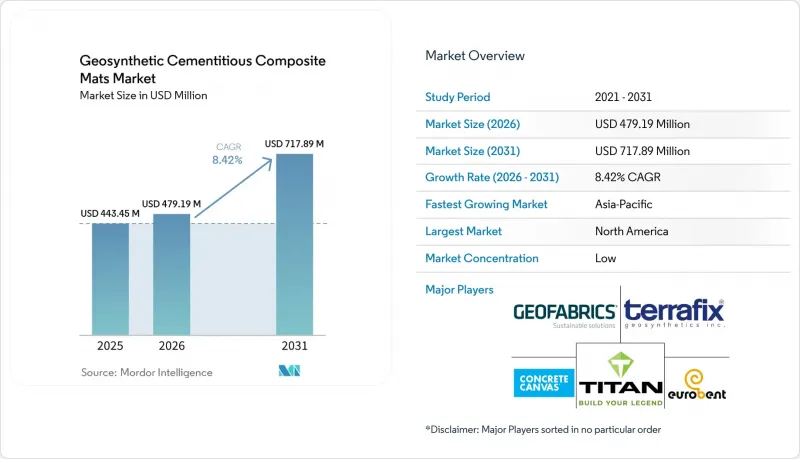
Mordor Intelligence에 의하면, 지오신세틱 시멘트계 복합 매트 시장 규모는 2025년에 4억 4,345만 달러로 평가되었고, 2026년 4억 7,919만 달러로 추정되고, 예측 기간(2026-2031년) CAGR 8.42%로 성장이 전망되며, 2031년까지 7억 1,789만 달러에 이를 것으로 예측됩니다.
본 보고서는 재료 유형별(폴리프로필렌(PP), 폴리에스터, 기타), 형태별(와이드 롤, 성형 매트, 배치 롤, 패널), 용도별(침식 방지, 사면 안정화, 기타), 최종 용도별(토목, 운송, 기타), 지역별(아시아태평양, 북미, 유럽, 기타)로 분류되어 있습니다. 시장 예측은 금액(달러) 기준으로 제시되어 있습니다.
세계의 지오신세틱 시멘트계 복합 매트 시장 동향 및 인사이트
인프라 개보수 및 복원력 강화를 위한 지출
인프라 개보수 지출은 지오신세틱 시멘트계 복합 매트 시장을 뒷받침하고 있습니다. 이는 많은 공공 자산이 장기간의 서비스 중단 없이 수리가 필요하기 때문입니다. 교통, 배수, 상수도, 에너지 회랑은 지역 사회와 경제 활동을 혼란에 빠뜨릴 수 있는 기상 관련 피해에 노출되어 있습니다. ‘재난에 강한 인프라를 위한 연합(Coalition for Disaster Resilient Infrastructure)’의 보고서에 따르면, 재난 위험에 노출된 인프라 자산의 78%를 교통 및 에너지 자산이 차지하고 있어, 복원력이 뛰어난 보호 시스템에 대한 관심이 높아지고 있습니다. GCCM은 접근 제한, 차선 폐쇄, 배수 일정 등의 제약으로 인해 기존 타설 콘크리트 사용이 제한되는 선형 자산에 적합합니다. 보호된 수로, 사면 또는 성토는 더 광범위한 교통 시스템이나 수계 시스템에서 필수적인 부분으로 남아 있기 때문에 프로젝트 소유자는 제한된 유지 관리 기간 내에 완료할 수 있는 접근 방식을 필요로 하는 경우가 많습니다. 따라서 납기 조정은 단순한 시공상의 세부 사항에 그치지 않고, 자재 선정에 있어 중요한 요소가 됩니다. ASTM D8364/D8364M-21(2026)은 GCCM 자재에 대한 공인된 사양 체계를 제공하여 조달 시 기술적 심사를 지원합니다. 따라서 프로젝트 소유자가 신속한 시공과 명확한 제품 성능을 겸비한 보수 방법을 우선시한다면, 지오신세틱 시멘트계 복합 매트 시장은 그 혜택을 누릴 수 있습니다.
시공 신속화 및 프로젝트 인건비 절감
시공 신속화는 특히 공사 기간이 짧은 현장에서 지오신세틱 시멘트계 복합 매트 시장에 실질적인 이점이 됩니다. GCCM은 공장에서 조립된 상태로 납품되므로, 현장에서 콘크리트 혼합이나 기존 방식의 거푸집 공사가 필요하지 않습니다. 이러한 취급 방식 덕분에 험준한 지형, 외딴 지역의 운하, 철도 배수로, 도로 성토 등에서 필요한 장비를 줄일 수 있습니다. 이는 시공사가 접근 제한에 직면했거나, 차선 통제 및 운하 배수에 할애할 수 있는 시간이 제한적인 경우에 특히 중요합니다. ASTM 요건에 따라 시공사나 발주처는 기존 방식에만 의존하지 않고, 정의된 성능 특성에 기반하여 자재 등급을 비교할 수 있습니다. 이 장점은 작업 인력을 줄이고 시공 과정을 단축함으로써 핵심 인프라에 미치는 영향을 최소화할 수 있는 경우에 가장 두드러집니다.
분사 콘크리트, 지오텍스타일, 리프랩, 식생 시스템과의 경쟁
지오신세틱 시멘트계 복합 매트 시장은 프로젝트 유형이나 지역에 따라 다양한 경쟁 자재에 직면해 있습니다. 분사 콘크리트는 높은 압축 강도가 필요한 구조용 사면 공사에 계속해서 적합할 가능성이 있습니다. 립랩은 육로 접근이 가능한 광범위한 하천 제방 보호 프로젝트에서 비용 면에서의 우위를 유지할 수 있을 것으로 보입니다. 지오텍스타일만을 사용한 시스템은 경질 보호가 아닌, 여과나 배수가 프로젝트의 주요 목적인 경우에 여전히 유효합니다. 또한, 수리학적 보호의 필요성보다 생물 다양성이나 경관 유지와 같은 목표가 중시되는 경우에는 식생 시스템이 선택될 가능성이 있습니다. GCCM 공급업체는 인증된 시멘트계 복합재가 수리학적 하중, 표면 내구성, 짧은 시공 기간 측면에서 더 적합함을 입증해야 합니다.
부문 분석
2025년, 지오신세틱 시멘트계 복합 매트 시장 점유율 중 폴리프로필렌은 41.84%를 차지했습니다. 이러한 위상은 자외선 내성, 건조 포틀랜드 시멘트 배합과의 적합성, 주요 생산 지역에서의 광범위한 입수 가능성을 반영합니다. 폴리프로필렌은 확립된 용도에서 성능과 원자재 비용 간의 실용적인 균형을 제공합니다. 이는 시멘트계 층에 안정적인 지오텍스타일 배후층과 신뢰할 수 있는 취급 특성이 요구되는 상황에서 사용됩니다. 이 소재는 광범위한 침식 방지, 수로 라이닝, 토목 공사 프로젝트에 적합합니다.
지오신세틱 시멘트계 복합 매트 시장에서 복합 소재는 2031년까지 연평균 성장률(CAGR) 8.91%를 나타낼 것으로 예측됩니다. 이 소재는 섬유, 지오그리드, 배수, 인장 하중 전달 또는 내화학성 등의 기능을 설치된 단일 층에 통합하고 있습니다. 지반 보강이나 화학적·구조적 노출이 수반되는 용도 등, 표면 보호 이상의 기능이 필요한 프로젝트에 적합합니다. 폴리에스터 기질은 섬유의 강성으로 인해 지속적인 수압 하에서 크리프를 줄일 수 있으므로, 인장 강도가 중요한 요건이 되는 상황에서 계속해서 활용되고 있습니다. 이 특성은 배수, 보강, 보호 피복을 제공하기 위해 별도의 층이 필요한 경우에 특히 중요합니다. 통합형 제품은 시공 시스템을 단순화하고, 현장에서 조정이 필요한 접합부를 줄일 수 있습니다. EuroGeo 8에서 발표된 연구에 따르면, 관리된 재활용 흐름에서 얻은 재생 폴리프로필렌은 고성능 지오신세틱 용도에 기술적으로 적합한 것으로 밝혀졌습니다. 또한, Fraunhofer CCPE는 재생 폴리프로필렌과 폴리에스터를 가공하여 산업 요구 사항을 충족하는 지오텍스타일을 제조할 수 있다고 보고했으며, 이는 재생 소재를 포함한 배합에 대한 향후 관심을 높이는 계기가 될 것입니다.
2025년에는 지오신세틱 시멘트계 복합 매트 시장 점유율 중 와이드 롤이 43.56%를 차지했습니다. 이 형태는 광범위한 사면, 성토, 수로에 적합하며, 길고 연속적인 피복으로 이음매를 줄여 시공의 번거로움을 경감시킬 수 있습니다. 와이드 롤은 야외 인프라 공사 현장에서 표준 플랜트 설비를 사용하여 전개할 수 있습니다. 이 형태의 사용은 자재의 연속성과 신속한 시공이 조달 결정에 영향을 미치는 대규모 배수 및 침식 방지 공사에서 특히 중요합니다. 또한, 이 형태는 장거리 용수로 및 도로변 용도로도 실용적입니다.
지오신세틱 시멘트계 복합 매트 시장에서 패널 시장은 2031년까지 연평균 성장률(CAGR) 8.78%로 확대될 것으로 예측됩니다. 이러한 성장은 공간이 제한된 도시 배수, 수처리, 개보수 프로젝트에서 모듈식 솔루션에 대한 수요를 반영하고 있습니다. 패널은 좁은 공간에서도 보다 정밀한 치수 관리가 가능하며, 자재관리이 용이합니다. 성형 매트는 불규칙한 칼버트의 단면 형상, 교대, 비표준 수로 형상에 대응합니다. 이러한 장소에서는 현장에서 절단을 수행할 경우 폐기물이 발생하거나 품질상의 위험이 발생할 가능성이 있습니다. 배치 롤은 와이드 롤을 이용한 전면 포설과 맞춤형 유닛의 중간적 솔루션을 필요로 하는 지방자치단체의 빗물 배수 및 교통 인프라 프로젝트에 적합합니다. 패널이나 성형 매트의 형태는 작업자의 작업 현장 접근이 제한된 경우에도 자재를 임시로 보관하기 쉽게 해줍니다. 이를 통해 프로젝트 팀은 특정 현장의 형상이나 취급상의 제약에 맞는 형태를 선택할 수 있습니다. 이러한 형태적 선택지를 통해 사용 범위는 개방된 현장에만 국한되지 않고, 공간이 제한된 인프라에서의 유지 관리 작업에도 대응할 수 있습니다.
지역별 분석
2025년, 북미는 지오신세틱 시멘트계 복합 매트(GCCM) 시장의 36.40%를 차지했습니다. 이 지역에서는 교통, 빗물 관리, 배수, 수자원 인프라 분야에서 GCCM의 확고한 활용이 성장 동력이 되고 있습니다. 고속도로, 성토, 배수 시스템에 대한 정기적인 개보수 수요는 서비스 중단을 최소화하면서 시공할 수 있는 자재에 대한 수요를 뒷받침하고 있습니다. ASTM D8364/D8364M-21(2026)은 미국과 캐나다의 기술적 조달을 지원하는 널리 인정받는 자재 사양을 제공합니다. 서부 수자원 관리 구역에서도 관개 시스템에 내구성이 뛰어난 수로 라이닝 및 침투 제어 솔루션이 요구되고 있어 관련 기회를 제공합니다. 이 지역은 성숙한 프로젝트 실행 환경을 갖추고 있어, 문서화, 시공업체의 숙련도, 성능 시험이 자재 선정에 영향을 미칠 수 있습니다. 이에 따라 기술적 뒷받침과 신속한 현지 공급이 가능한 공급업체에 대한 수요가 뒷받침되고 있습니다.
아시아태평양은 2031년까지 연평균 성장률(CAGR) 8.98%로 확대될 것으로 예상되며, 지오신세틱 시멘트계 복합 매트 시장에서 가장 두드러진 성장을 보일 전망입니다. 관개 수로 개보수, 철도 성토 공사, 홍수 대책, 광업 인프라가 이 지역 수요를 뒷받침하고 있습니다. 인도네시아의 외딴 지역에서 진행 중인 농업용 수로 프로젝트에서는 기존 자재의 운송이 어려운 상황에서 운반의 용이성이 자재 선정에 어떤 영향을 미치는지가 입증되었습니다. 인도와 동남아시아에서는 수자원 관리 및 인프라 정비 프로그램을 통해 비즈니스 기회가 창출되고 있습니다. 중국은 대규모 토목 공사 기반과 사면·배수 보호에 대한 수요가 있어 여전히 중요한 시장입니다. 일본, 한국, 아세안(ASEAN) 국가에서는 수리 용도나 지진 활동이 활발한 지역에서의 용도에 있어, 더 높은 사양의 제품에 대한 수요가 증가하고 있습니다. 이 지역의 프로젝트 구성에는 대규모 유틸리티과 외딴 지역의 지역 프로젝트가 모두 포함되어 있어, 그 결과 다양한 형태의 자재와 성능 등급에 대한 수요가 발생하고 있습니다. 따라서 광범위한 인프라 수요를 프로젝트 수준의 사양으로 구체화하기 위해서는 현지에서의 기술 지원이 중요합니다.
유럽은 철도 사업자, 고속도로 관리 기관, 수로 당국이 유지 관리 및 개보수용 자재를 필요로 하고 있기 때문에 지오신세틱 시멘트계 복합 매트 시장에서 여전히 중요한 위치를 차지하고 있습니다. 이 지역에서의 제품 선정에 있어서는 성능 관련 문서와 자재 사용량 절감이 점점 더 중요하게 여겨지고 있습니다. 남미에서는 수로 투자, 도로 개보수, 건조한 농업 지역의 관개 네트워크를 통해 수요가 발생하고 있습니다. 중동 및 아프리카에서는 운하 라이닝, 송수 인프라, 광산 현장 보호가 수요를 뒷받침하고 있습니다. 국제금융공사(IFC) 보고서에 따르면, 자연재해는 저·중소득 국가에서 연간 3,900억 달러의 손실을 초래하고 있으며, 이는 회복력 있는 인프라 투자의 가치를 뒷받침합니다. 이 지역에서는 조달 체계 내에서 ASTM에 따른 GCCM 사양에 대한 이해가 깊어짐에 따라, 향후 더 많은 도입이 이루어질 가능성이 있습니다. 이러한 전망은 기술자, 시공사, 조달 팀이 GCCM 자재의 사양 수립 및 시공에 얼마나 신속하게 적응할 수 있는지에 달려 있습니다. 물 부족, 침식 위험, 인프라 접근 제한은 신속하게 설치할 수 있는 라이닝 솔루션을 고려해야 할 실용적인 이유가 됩니다.
기타 혜택
- 엑셀 형식 시장 예측(ME) 시트
- 3개월간의 애널리스트 지원
자주 묻는 질문
목차
제1장 서론
제2장 조사 방법
제3장 주요 요약
제4장 시장 구도
제5장 시장 규모 및 성장 예측
제6장 경쟁 구도
제7장 시장 기회 및 향후 전망
AJY 26.09.03According to Mordor Intelligence, the geosynthetic cementitious composite mats market size was valued at USD 443.45 million in 2025 and estimated to grow from USD 479.19 million in 2026 to reach USD 717.89 million by 2031, at a CAGR of 8.42% during the forecast period (2026-2031).
This report is Segmented by Material Type (Polypropylene (PP), Polyester, and More), Form (Wide Rolls, Preformed Mats, Batched Rolls, and Panels), Application (Erosion Control, Slope Stabilization, and More), End-Use (Civil Engineering, Transportation, and More), and Geography (Asia-Pacific, North America, Europe, and More). The Market Forecasts are Provided in Terms of Value (USD).
Global Geosynthetic Cementitious Composite Mats Market Trends and Insights
Infrastructure Rehabilitation and Resilience Spending
Infrastructure rehabilitation spending supports the geosynthetic cementitious composite mats market because many public assets need repair without lengthy service interruptions. Transport, drainage, water, and energy corridors are exposed to weather-related damage that can disrupt communities and economic activity. The Coalition for Disaster Resilient Infrastructure reported that transport and energy assets accounted for 78% of hazard-exposed infrastructure assets, increasing attention on resilient protection systems. GCCMs are suited to linear assets where access, lane closures, and dewatering schedules limit the use of conventional poured concrete. A protected channel, slope, or embankment can remain an essential part of a wider transport or water system, so project owners often need an approach that fits within a restricted maintenance period. This makes delivery timing an important part of material selection, not simply a construction detail. ASTM D8364/D8364M-21(2026) provides a recognized specification framework for GCCM materials, which supports technical review during procurement. The geosynthetic cementitious composite mats market can therefore benefit when project owners prioritize repair methods that combine rapid installation with defined product performance.
Faster Installation and Lower Project Labor Requirements
Faster installation is a practical advantage for the geosynthetic cementitious composite mats market, especially on sites with short work windows. GCCMs arrive as factory-assembled materials and avoid on-site concrete mixing and conventional formwork. Their handling approach can reduce equipment needs on difficult terrain, remote canals, railway drainage routes, and road embankments. This matters where contractors face constrained access or limited time for lane closures and canal dewatering. ASTM requirements help contractors and owners compare material classes against defined performance properties rather than rely solely on established methods. The benefit is strongest where a smaller work crew and a shorter installation sequence can reduce disruption to essential infrastructure.
Competition from Shotcrete, Geotextiles, Riprap and Vegetative Systems
The geosynthetic cementitious composite mats market faces different competing materials across project types and geographies. Shotcrete may remain suitable for structural slope work that requires high compressive strength. Riprap can retain a cost advantage on broad riverbank protection projects where land access is available. Geotextile-only systems remain relevant when filtration and drainage are the main project objectives rather than hard armor. Vegetative systems may be selected where biodiversity and visual landscape goals carry greater weight than hydraulic protection needs. GCCM suppliers need to demonstrate where certified cementitious composites offer a stronger fit for hydraulic loads, surface durability, and short installation windows.
Other drivers and restraints analyzed in the detailed report include:
- Rising Demand for Erosion and Slope Protection
- Water-Management and Canal-Rehabilitation Investments
- Installation Quality and Contractor Skill Gaps
For complete list of drivers and restraints, kindly check the Table Of Contents.
Segment Analysis
Polypropylene held 41.84% of the geosynthetic cementitious composite mats market share in 2025. Its position reflects UV stability, compatibility with dry Portland cement formulations, and broad availability across major producing regions. Polypropylene provides a practical balance between performance and raw material cost for established applications. It is used where the cementitious layer requires a stable geotextile backing and reliable handling properties. The material is relevant to a wide range of erosion-control, channel-lining, and civil engineering projects.
Composite is projected to grow at a CAGR of 8.91% through 2031 in the geosynthetic cementitious composite mats market. It combines fiber, geogrid, drainage, tensile-load-transfer, or chemical-resistance functions within one installed layer. It is suited to projects that need more than surface protection, such as ground reinforcement and applications with chemical or structural exposure. Polyester backings continue to serve tensile-critical requirements where fiber stiffness can reduce creep under sustained hydraulic load. This capability is relevant when project teams would otherwise need separate layers to provide drainage, reinforcement, and protective cover. Integrated products can simplify the installed system and reduce interfaces that require field coordination. Research presented at EuroGeo 8 found that recycled polypropylene from managed recycling streams can be technically suitable for high-performance geosynthetic uses. Fraunhofer CCPE also reported that recycled polypropylene and polyester can be processed into geotextiles meeting industrial requirements, supporting future interest in recycled-content formulations.
Wide rolls accounted for 43.56% of the geosynthetic cementitious composite mats market share in 2025. This format is suited to extensive slopes, embankments, and channels where long, continuous coverage reduces seams and installation effort. Wide rolls can be deployed with standard plant equipment on open infrastructure sites. Their use is particularly relevant to large drainage and erosion-control contracts where material continuity and rapid coverage influence procurement decisions. The format also remains practical for long-distance canal and roadside applications.
Panels are projected to expand at a CAGR of 8.78% through 2031 in the geosynthetic cementitious composite mats market. Their growth reflects demand for modular solutions in constrained urban drainage, water treatment, and rehabilitation projects. Panels can offer more precise dimensional control and easier material handling in confined spaces. Preformed mats address irregular culvert profiles, bridge abutments, and nonstandard canal geometries where site cutting could create waste or quality risks. Batched rolls serve municipal stormwater and transportation projects that need a middle ground between wide-roll coverage and customized units. Panel and preformed formats can also make material staging easier where crews have restricted access to the work area. They allow project teams to select a form that fits the geometry and handling limitations of a given site. These form options extend use beyond open sites and support maintenance work in space-constrained infrastructure.
Complete Report Scope:
- By Material Type
- Polypropylene (PP)
- Polyester
- Composite
- Geogrid-Reinforced
- Other Material Types
- By Form
- Wide Rolls
- Preformed Mats
- Batched Rolls
- Panels
- By Application
- Erosion Control
- Slope Stabilization
- Ground Reinforcement
- Canal Lining
- Containment Systems
- Mining Vent Walls and Surface Protection
- Other Applications
- By End-Use
- Civil Engineering
- Environmental Applications
- Transportation
- Water Treatment and Water Infrastructure
- Mining
- Other End-Uses
- By Geography
- Asia-Pacific
- China
- India
- Japan
- South Korea
- ASEAN Countries
- Rest of Asia-Pacific
- North America
- United States
- Canada
- Mexico
- Europe
- Germany
- United Kingdom
- France
- Italy
- NORDIC Countries
- Rest of Europe
- South America
- Brazil
- Argentina
- Rest of South America
- Middle-East and Africa
- Saudi Arabia
- South Africa
- Rest of Middle-East and Africa
- Asia-Pacific
Geography Analysis
North America held 36.40% of the geosynthetic cementitious composite mats market share in 2025. The region benefits from established use of GCCMs in transportation, stormwater management, drainage, and water infrastructure. Recurring rehabilitation needs in highways, embankments, and drainage systems support demand for materials that can be installed with limited service disruption. ASTM D8364/D8364M-21(2026) provides a recognized material specification that supports technical procurement in the United States and Canada. Western water districts also provide a relevant opportunity because irrigation systems need durable canal lining and seepage-control solutions. The region has a mature project-delivery environment in which documentation, contractor familiarity, and performance testing can affect material selection. This supports demand for suppliers that can provide technical evidence and responsive local availability.
Asia-Pacific is projected to expand at a CAGR of 8.98% through 2031, making it the fastest-growing geography in the geosynthetic cementitious composite mats market. Irrigation canal rehabilitation, rail embankment construction, flood protection, and mining infrastructure support regional demand. Remote agricultural canal projects in Indonesia have demonstrated how portability can influence material selection, where conventional inputs are difficult to transport. India and Southeast Asia offer opportunities through water management and infrastructure programs. China remains significant because of its large civil engineering base and need for slope and drainage protection. Japan, South Korea, and ASEAN countries add demand for higher-specification products in hydraulic and seismically active applications. The regional mix includes both large public works and remote local projects, which creates demand for several material forms and performance classes. Local technical support is therefore important for converting broad infrastructure needs into project-level specifications.
Europe remains important to the geosynthetic cementitious composite mats market because rail operators, motorway agencies, and waterway authorities require materials for maintenance and rehabilitation. Product selection in the region increasingly considers performance documentation and lower material use. South America provides demand through waterway investment, road rehabilitation, and irrigation networks in dry agricultural areas. The Middle-East and Africa are supported by canal lining, water-conveyance infrastructure, and mining site protection. The International Finance Corporation (IFC) reported that natural hazards cause USD 390 billion in annual losses in low- and middle-income countries, reinforcing the value of resilient infrastructure investment. These regions may see further adoption as procurement frameworks become more familiar with ASTM-based GCCM specifications. Their outlook depends on how quickly engineers, contractors, and procurement teams become comfortable specifying and installing GCCM materials. Water scarcity, erosion exposure, and infrastructure access limitations provide practical reasons for considering rapid-install lining solutions.
- Amplified Concrete Solutions Global, LLC
- Bermuller & Co GmbH
- Changzhou Pioneer Textile Technology Co.,Ltd.
- Concrete Canvas Ltd.
- Eurobent Sp. z o.o.
- Geofabrics Australasia Pty Ltd.
- Kenviro
- Officine Maccaferri Spa
- PGATech Group of Companies
- Shandong Longxiang New Materials Co., Ltd.
- SOPREMA
- TECHFABINDIA
- terrafix Geosynthetics
- Titan Environmental
Additional Benefits:
- The market estimate (ME) sheet in Excel format
- 3 months of analyst support
TABLE OF CONTENTS
1 Introduction
- 1.1 Study Assumptions and Market Definition
- 1.2 Scope of the Study
2 Research Methodology
3 Executive Summary
4 Market Landscape
- 4.1 Market Overview
- 4.2 Market Drivers
- 4.2.1 Infrastructure Rehabilitation and Resilience Spending
- 4.2.2 Faster Installation and Lower Project Labor Requirements
- 4.2.3 Rising Demand for Erosion and Slope Protection
- 4.2.4 Water-Management and Canal-Rehabilitation Investments
- 4.2.5 Remote-Site Deployment and Reduced Equipment Requirements
- 4.2.6 Lower Material Use and Embodied-Carbon Advantages
- 4.3 Market Restraints
- 4.3.1 Competition from Shotcrete, Geotextiles, Riprap and Vegetative Systems
- 4.3.2 Installation Quality and Contractor Skill Gaps
- 4.3.3 GCCM Specification, Certification and Procurement Familiarity Gaps
- 4.3.4 Cementitious Formulation and Polymer-Backing Exposure to Circularity Requirements
- 4.4 Value Chain Analysis
- 4.5 Porter's Five Forces Analysis
- 4.5.1 Threat of New Entrants
- 4.5.2 Bargaining Power of Suppliers
- 4.5.3 Bargaining Power of Buyers
- 4.5.4 Threat of Substitutes
- 4.5.5 Competitive Rivalry
5 Market Size and Growth Forecasts (Value)
- 5.1 By Material Type
- 5.1.1 Polypropylene (PP)
- 5.1.2 Polyester
- 5.1.3 Composite
- 5.1.4 Geogrid-Reinforced
- 5.1.5 Other Material Types
- 5.2 By Form
- 5.2.1 Wide Rolls
- 5.2.2 Preformed Mats
- 5.2.3 Batched Rolls
- 5.2.4 Panels
- 5.3 By Application
- 5.3.1 Erosion Control
- 5.3.2 Slope Stabilization
- 5.3.3 Ground Reinforcement
- 5.3.4 Canal Lining
- 5.3.5 Containment Systems
- 5.3.6 Mining Vent Walls and Surface Protection
- 5.3.7 Other Applications
- 5.4 By End-Use
- 5.4.1 Civil Engineering
- 5.4.2 Environmental Applications
- 5.4.3 Transportation
- 5.4.4 Water Treatment and Water Infrastructure
- 5.4.5 Mining
- 5.4.6 Other End-Uses
- 5.5 By Geography
- 5.5.1 Asia-Pacific
- 5.5.1.1 China
- 5.5.1.2 India
- 5.5.1.3 Japan
- 5.5.1.4 South Korea
- 5.5.1.5 ASEAN Countries
- 5.5.1.6 Rest of Asia-Pacific
- 5.5.2 North America
- 5.5.2.1 United States
- 5.5.2.2 Canada
- 5.5.2.3 Mexico
- 5.5.3 Europe
- 5.5.3.1 Germany
- 5.5.3.2 United Kingdom
- 5.5.3.3 France
- 5.5.3.4 Italy
- 5.5.3.5 NORDIC Countries
- 5.5.3.6 Rest of Europe
- 5.5.4 South America
- 5.5.4.1 Brazil
- 5.5.4.2 Argentina
- 5.5.4.3 Rest of South America
- 5.5.5 Middle-East and Africa
- 5.5.5.1 Saudi Arabia
- 5.5.5.2 South Africa
- 5.5.5.3 Rest of Middle-East and Africa
- 5.5.1 Asia-Pacific
6 Competitive Landscape
- 6.1 Market Concentration
- 6.2 Strategic Moves
- 6.3 Market Share (%)/Ranking Analysis
- 6.4 Company Profiles (includes Global Overview, Market Overview, Core Segments, Financials as available, Strategic Information, Products and Services, and Recent Developments)
- 6.4.1 Amplified Concrete Solutions Global, LLC
- 6.4.2 Bermuller & Co GmbH
- 6.4.3 Changzhou Pioneer Textile Technology Co.,Ltd.
- 6.4.4 Concrete Canvas Ltd.
- 6.4.5 Eurobent Sp. z o.o.
- 6.4.6 Geofabrics Australasia Pty Ltd.
- 6.4.7 Kenviro
- 6.4.8 Officine Maccaferri Spa
- 6.4.9 PGATech Group of Companies
- 6.4.10 Shandong Longxiang New Materials Co., Ltd.
- 6.4.11 SOPREMA
- 6.4.12 TECHFABINDIA
- 6.4.13 terrafix Geosynthetics
- 6.4.14 Titan Environmental
7 Market Opportunities and Future Outlook
- 7.1 White-Space and Unmet-Need Assessment


