

|
시장보고서
상품코드
2119106
토목합성재료 침식 방지 제품 시장 : 시장 점유율 분석, 업계 동향 및 통계, 성장 예측(2026-2031년)Geosynthetic Erosion Control Products - Market Share Analysis, Industry Trends & Statistics, Growth Forecasts (2026 - 2031) |
||||||
 Mordor Intelligence
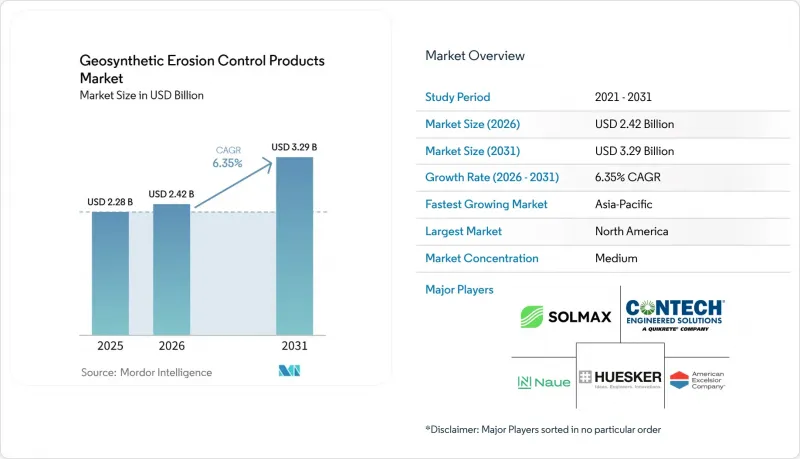
Mordor Intelligence에 의하면, 토목합성재료 침식 방지 제품 시장 규모는 2025년에 22억 8,000만 달러로 평가되었고, 2026년 24억 2,000만 달러에서 2031년까지 32억 9,000만 달러에 이를 것으로 추정되며, 예측 기간(2026-2031년) CAGR은 6.35%를 나타낼 전망입니다.
본 보고서는 제품 유형별(침식 방지 블랭킷, 지오셀 등), 소재별(폴리프로필렌, 폴리에틸렌 등), 제품 형태별(롤 제품 등), 용도별(도로·고속도로 건설 등), 지역별(아시아태평양, 북미, 유럽, 남미, 중동 및 아프리카)로 분류되어 있습니다. 시장 전망은 금액(달러) 기준으로 제시되어 있습니다.
세계의 토목합성재료 침식 방지 제품 시장 동향 및 인사이트
건설 허가 시 침식 방지 대책 의무화
토목합성재료 침식 방지 제품 시장은 침식 및 토사 관리를 임의 구매가 아닌 프로젝트의 필수 요건으로 규정하는 규제에 힘입어 수요가 뒷받침되고 있습니다. EPA(미국 환경보호청)의 건설 일반 허가에서는 1에이커 이상의 토지를 훼손하는 프로젝트를 포함하여, 대상 현장에서 사업자가 효과적인 침식 및 토사 관리 대책을 설계, 설치, 유지하도록 의무화하고 있습니다. 이 허가는 2025년 4월에 개정되어 연방 전속 관할권이 적용되는 토지까지 적용 범위가 확대되었으며, 2027년 2월 16일에 만료될 예정입니다. 이 체계는 지반 정리, 수로 보호 및 지반 안정화 작업에 사용되는 블랭킷, 매트,및 관련 시스템에 대한 수요를 뒷받침하고 있습니다. 주 정부의 허가 조건에서는 연방 요건 외에도 추가 서류 및 제품 성능 기록이 요구됩니다. 또한, 연방도로청(FHWA)과 지오신세틱 재료 협회(GMA)는 모바일 애플리케이션를 통해 현장 시공 지침을 제공하고 있으며, 시공 품질에 대한 문서화에 대한 관심이 높아지고 있습니다.
고속도로, 성토 및 수력 인프라 확장
토목합성재료 침식 방지 제품 시장은 토목 인프라 공사의 규모 및 시기와 밀접한 관련이 있습니다. 연방도로청의 2026 회계연도 예산은 726억 달러에 달하며, 이 중 641억 달러는 요청액이고, 85억 달러는 선지급 배정액입니다. 또한, ‘인프라 투자 및 고용법’은 2026 회계연도까지의 5년 동안 총액 3,500억 달러에 달하는 연방 보조 도로 프로그램을 지원하고 있습니다. 도로 정지 공사에서는 사면, 중앙분리대, 배수로, 성토 등의 토양이 노출되므로, 건설사는 공사의 전 공정을 통해 침식 방지재를 사용합니다. 개보수나 확장 공사에서는 공간이 제한된 구간에서 사면 정지가 필요한 경우가 있으며, 이러한 상황에서는 인도 중앙도로연구소(Central Road Research Institute)의 제품이 선호되고 있습니다. 또한, 산사태가 발생하기 쉬운 지역의 도로 프로젝트에서 지오신세틱의 이용이 확대됨에 따라, 시공사는 제한된 작업 공간에서도 신속하게 설치할 수 있게 되었습니다. 인도 중앙도로연구소의 조사에서도 산사태가 발생하기 쉽고 생태계에 민감한 구릉지대의 도로 프로젝트에서 지오신세틱의 이용이 증가하고 있는 것으로 지적되고 있습니다.
합성 폴리머 및 천연섬유 원료의 가격 변동
토목합성재료 침식 방지 제품 시장은 폴리프로필렌, 폴리에틸렌, 코코야자 섬유, 황마, 대마의 가격 변동 영향을 지속적으로 받고 있습니다. 폴리프로필렌과 폴리에틸렌은 석유화학제품으로, 그 가격은 원유, 나프타, 프로파일렌 시장 상황에 따라 변동할 가능성이 있습니다. 2025년 6월 이스라엘-이란 분쟁 당시 폴리머 원자재 가격은 상승했으나, 2025년 7월에는 수급 상황이 안정되면서 폴리프로필렌 시장도 안정을 되찾았습니다. 소규모 제조업체는 프로젝트 입찰에 가격 조정 조항을 포함시키는 경우가 있으며, 이로 인해 가격 리스크의 상당 부분이 구매자에게 전가되어 공공 조달 절차에 영향을 미칠 수 있습니다. 또한 천연섬유 소재는 남아시아 및 동남아시아의 몬순 패턴과 소규모 농가의 수확 주기에 여전히 영향을 받기 쉬운 상황입니다. 이러한 비용 변동은 통합된 원자재 공급 체계나 헤지 능력을 갖추지 못한 중견 공급업체의 가격 책정 유연성을 저하시킬 가능성이 있습니다.
부문 분석
2025년, 침식 방지 블랭킷은 토목합성재료 침식 방지 제품 시장 점유율의 26.46%를 차지하며 가장 큰 제품 카테고리가 되었습니다. 이러한 위상은 다양한 경사도, 기후, 식생 정착 기간을 가진 사면에 대응할 수 있는 능력을 반영합니다. 시공 업체는 전문 인력이 없어도 완만한 사면에 블랭킷을 신속하게 시공할 수 있기 때문에 규정 준수와 식생 정착을 병행해야 하는 고속도로나 상업용 지반 정리 프로젝트에 적합합니다. 지오텍스타일은 여과 및 분리 요구 사항을 충족하는 반면, 수압식 침식 방지 제품은 롤 형태의 제품을 시공하기 어려운 현장을 지원합니다. 지오셀은 성토재의 3차원적 구속이 필요한 급경사 성토나 광산 복구 현장에서 사용됩니다.
이러한 범주를 통해 공급업체는 일시적인 지표면 보호부터 보다 영구적인 구조적 안정화에 이르기까지 대응하는 제품군을 제공할 수 있습니다. 이들을 조합하여 사용함으로써, 프로젝트 팀이 노출된 지면을 모두 단일한 공학적 조건으로 취급하는 것이 아니라, 강우량, 경사도, 토양 상태, 현장 접근성, 예상되는 식생 및 필요한 보호 기간에 맞추어 제품을 선정하고 있음을 알 수 있습니다. 일반적인 현장에서는 식생이 정착될 때까지 침식 방지 블랭킷이 신속한 피복 기능을 제공합니다. 더 복잡한 장소에서는 유사한 사양 수립 과정을 통해 노출 상황이나 구조적 요건에 더 적합한 지오셀, 지오텍스타일 또는 수압식 시공 제품이 프로젝트에 채택됩니다.
잔디 보강 매트 시장은 2031년까지 연평균 성장률(CAGR) 7.25%로 확대될 것으로 예측되며, 이는 제품 유형 분류 중 가장 높은 성장률입니다. 그 용도는 더 높은 수리학적 응력 하에서 식생을 통한 보강이 요구되는 홍수 방어, 수로 보강 및 해안 호안 공사에서 확대되고 있습니다. 이러한 시스템은 적절한 프로젝트에서 경질 방호 공법을 대체하거나 보완할 수 있습니다. 아메리칸 엑셀시어(American Excelsior)사는 2026년 2월, 100% 재생 섬유를 사용하고 수리 현상 시 부력을 방지하기 위해 섬유의 비중을 1 이상으로 설정한 ‘Recyclex TRM’ 시리즈를 출시했습니다. 이 제품의 사례는 각 제조업체가 새로운 사양에서 재생 소재 사용을 강조하는 것과 수리학적 성능을 어떻게 결합해 나갈지를 보여줍니다.
2025년, 폴리프로필렌은 토목합성재료 침식 방지 제품 시장에서 39.27%의 점유율을 차지하며 계속해서 주요 소재로서의 위상을 유지했습니다. 자외선 저항성, 화학적 안정성, 기계적 강도, 그리고 비용 경쟁력 있는 제조 공정이 그 위상을 뒷받침하고 있습니다. 이러한 특징 덕분에 폴리프로필렌은 인프라 회랑 및 고속도로 사업에서 널리 사용되는 롤형 제품에 적합합니다. 폴리에스터는 높은 인장 강도를 가진 지오그리드 백업형 잔디 보강 매트에서 여전히 중요한 역할을 하고 있습니다. 폴리에틸렌은 지오셀 벽 구조나 그 특유의 재료 특성이 요구되는 기타 용도에 사용되고 있습니다. 그러나 침식 방지 분야에서는 어느 재료도 폴리프로필렌의 폭넓은 용도에는 미치지 못하고 있습니다.
확립된 폴리프로필렌 공급망은 다양한 건설 지역에서 제품의 가용성을 뒷받침하고 있습니다. 이러한 가용성은 시공사가 여러 현장에서 일관된 사양을 필요로 할 때 중요합니다. 익숙한 소재라면 프로젝트의 기본적인 워크플로우를 변경하지 않고도 기존 제조 및 유통 채널을 통해 조달, 설치, 검사, 교체가 가능하기 때문입니다. 그 기술적 특성은 광범위한 기후 조건과 건설 환경에서 사용될 수 있게 해줍니다. 이러한 확고한 위상은 다른 폴리머의 필요성을 배제하는 것은 아니지만, 특히 프로젝트에서 익숙한 성능 특성, 확립된 제조 방법, 쉽게 접근할 수 있는 유통망, 그리고 일반적인 건설 및 안정화 용도에서의 사용 실적이 요구되는 경우,폴리프로필렌이 많은 표준 침식 방지 설계에서 여전히 기준 소재로 남아 있는 이유를 설명해 줍니다.
천연섬유는 2031년까지 연평균 성장률(CAGR) 7.03%를 나타낼 것으로 예측되며, 재료 분류 중 1위를 차지하고 있습니다. 토목합성재료 침식 방지 제품 시장에서 천연섬유에 대한 수요는 합성망에서 전환이 진행 중인 교통 인프라 프로젝트나 생분해성 재료가 필요한 복원 현장에 집중되어 있습니다. 천연섬유 매트릭스는 토종 종자와 결합함으로써 단일 시공 공정으로 토양 안정화와 식생 정착을 촉진할 수 있습니다. Naue GmbH & Co. KG는 2025년 9월, 바이오플라스틱 필라멘트, 코코넛, 황마 등 바이오의 재생 가능한 소재를 사용한 ‘Secumat Green 3D Mesh’를 출시했습니다. 이 제품은 생분해될 때까지 최대 10년 동안 식생을 지지하도록 설계되었습니다.
지역별 분석
2025년, 북미는 전 세계 매출의 35.21%를 차지하며 최대 지역 시장으로서의 위상을 유지했습니다. 연방 및 주 정부의 빗물 관리 규제 시행이 건설 중인 현장 전반에 걸쳐 이 제품의 채택을 촉진했습니다. 한편, ‘인프라 투자 및 고용법(IIJA)’에 따라 2025 회계연도에는 연방 고속도로 기금으로 620억 달러가 투입되었으며, 2026 회계연도 연방 고속도로청(FHWA)의 예산은 726억 달러에 달했습니다. 이러한 수준의 도로 투자로 인해, 고속도로 프로젝트 전반에 걸친 사면 및 성토 용도의 토목합성재료 침식 방지 제품에 대한 시장 수요가 증가했습니다. 미국토목학회(ASCE)가 수립한 플라스틱 기반 침식 방지 자재 배제를 위한 프레임워크는 교통 기관에 조달 요건을 갱신하기 위한 지침을 제공했습니다. 캐나다에서는 파이프라인 관련 수요가 기여했으며, 멕시코에서는 광산 복구 활동에 따른 수요가 더해졌습니다. 이러한 용도로 인해 지역 수요 기반은 미국의 고속도로 건설 범위를 넘어 확대되었습니다.
아시아태평양은 2031년까지 연평균 성장률(CAGR) 7.17%를 나타낼 것으로 예측되며, 가장 빠르게 성장하는 지역 시장이 될 전망입니다. 중국에서는 2026년 7월 1일 JTG/T 3332-2026이 시행되어 2012년 고속도로용 토목합성재료 규격을 대체했습니다. 개정된 규격은 고속도로 건설에 있어 노반 보강, 배수, 사면 보호 및 품질 검수를 포괄하고 있으며, 공공 도로 공사에서 제품의 성능과 문서화된 품질의 중요성이 높아지고 있습니다. 일본에서는 2026년 4월, 지오신세틱-시멘트계 복합 매트 기술이 ‘신기술 정보 시스템(NETIS)’의 권장 기술로 정부로부터 인증받았습니다. 한편, 인도에서는 산사태가 발생하기 쉬운 지형에서의 도로 공사로 인해 침식 방지 및 사면 안정화 재료의 새로운 이용 사례가 생겨났습니다. 따라서 도로, 수리, 연안 공사에 대한 수요가 이 지역 전체의 토목합성재료 침식 방지 제품 시장을 지탱하고 있습니다.
유럽에서는 환경 규제 준수 및 친환경 건설 요건이 인프라 사양에 영향을 미치고 있어 안정적인 수요가 지속되고 있습니다. 이 지역에서는 자재 선정 시 지속가능성 기준이 중시되며, 생분해성 제품이나 재생 소재를 포함한 제품이 선호되고 있습니다. 이러한 동향은 토목합성재료 침식 방지 제품 시장에서 천연섬유로의 전환을 촉진하고 있습니다. 남미에서는 지형이 다양한 지역에서의 도로 확장, 광산 복원, 농업 인프라가 수요 요인으로 작용하고 있습니다. 중동 및 아프리카에서는 인프라 구축과 광업 활동을 통해 새로운 프로젝트 기회가 창출되고 있습니다. 다만, 시공사들의 제품에 대한 이해도에는 여전히 편차가 있습니다. 나우에(Nauwe)사는 2025년 6월, TeMa South Africa사를 남아프리카 및 사하라 이남 아프리카의 대리점으로 지정했습니다. 이번 지정을 통해 그동안 서비스 범위가 제한적이었던 지역의 고객층에 대한 현지 제품 접근성과 기술 지원이 향상되었으며, 프로젝트 팀이 현지 설계 및 설치 지침이 필요한 시스템을 활용할 수 있도록 지원하고 있습니다.
기타 혜택 :
- 엑셀 형식 시장 예측(ME) 시트
- 3개월간의 애널리스트 지원
자주 묻는 질문
목차
제1장 서론
제2장 조사 방법
제3장 주요 요약
제4장 시장 구도
제5장 시장 규모 및 성장 예측
제6장 경쟁 구도
제7장 시장 기회 및 향후 전망
AJY 26.09.03According to Mordor Intelligence, the geosynthetic erosion control products market size was valued at USD 2.28 billion in 2025 and is estimated to grow from USD 2.42 billion in 2026 to reach USD 3.29 billion by 2031, at a CAGR of 6.35% during the forecast period (2026-2031).
This report is Segmented by Product Type (Erosion Control Blankets, Geocells, and More), Material (Polypropylene, Polyethylene, and More), Product Form (Rolled Products and More), Application (Road and Highway Construction and More), and Geography (Asia-Pacific, North America, Europe, South America, and Middle-East and Africa). The Market Forecasts are Provided in Terms of Value (USD).
Global Geosynthetic Erosion Control Products Market Trends and Insights
Mandatory Erosion-Control Measures in Construction Permitting
The geosynthetic erosion control products market receives demand support from regulations that make erosion and sediment management a project requirement rather than an optional purchase. The EPA Construction General Permit requires operators to design, install, and maintain effective erosion and sediment controls on covered sites, including projects that disturb 1 acre or more. The permit was modified in April 2025 to extend coverage to Lands of Exclusive Federal Jurisdiction, and it is scheduled to expire on February 16, 2027. This framework supports demand for blankets, mats, and related systems used in grading, channel protection, and stabilization activities. State permit conditions require additional documentation and product performance records beyond federal requirements. The Federal Highway Administration and the Geosynthetic Materials Association have also made field-installation guidance available through a mobile application, increasing the focus on documented installation quality.
Highway, Embankment, and Hydraulic Infrastructure Expansion
The geosynthetic erosion control products market is closely tied to the scale and timing of civil infrastructure work. The Federal Highway Administration budget for fiscal year 2026 reached USD 72.6 billion, including a USD 64.1 billion request and USD 8.5 billion in advance appropriations. The Infrastructure Investment and Jobs Act also supports a 5-year federal-aid highway program totaling USD 350 billion through fiscal year 2026. Highway grading exposes soil across slopes, medians, drainage channels, and embankments, so contractors use erosion-control materials throughout construction sequencing. Rehabilitation and widening work may require slope grading in constrained corridors, which favors products from the Central Road Research Institute in India. Also, the growing use of geosynthetics on road projects in landslide-prone areas allows contractors to install quickly in a limited workspace. Research from India's Central Road Research Institute also noted the growing use of geosynthetics on road projects in landslide-prone, ecologically sensitive hilly terrain.
Synthetic Polymer and Natural-Fiber Raw-Material Price Volatility
The geosynthetic erosion control products market remains exposed to price fluctuations in polypropylene, polyethylene, coir, jute, and hemp. Polypropylene and polyethylene are petrochemical materials, and their prices can move with crude oil, naphtha, and propylene market conditions. Polymer feedstock prices rose during the June 2025 Israeli-Iranian conflict before demand and supply conditions stabilized the polypropylene market in July 2025. Smaller fabricators may include escalation clauses in project bids, shifting more price risk to buyers and affecting public procurement processes. Natural-fiber materials also remain sensitive to monsoon patterns and smallholder harvest cycles in South and Southeast Asia. These cost movements can reduce pricing flexibility for mid-tier suppliers that lack integrated raw-material supply or hedging capacity.
Other drivers and restraints analyzed in the detailed report include:
- Climate-Driven Flood, Slope, and Coastal Protection Spending
- Preference for Biodegradable, Recycled, and Efficient Installation Systems
- Installation Damage, Uneven Familiarity, and Competing Methods
For complete list of drivers and restraints, kindly check the Table Of Contents.
Segment Analysis
Erosion control blankets accounted for 26.46% of the geosynthetic erosion control products market share in 2025, making them the largest product category. Their position reflects their ability to serve slopes with varied gradients, climates, and vegetation-establishment periods. Contractors can deploy blankets quickly on moderate slopes without specialized labor, making them suitable for highway and commercial grading projects where compliance and vegetation establishment must progress together. Geotextiles address filtration and separation requirements, while hydraulically applied erosion-control products support sites where rolled installation is difficult. Geocells are used on steeper embankments and mining reclamation sites that require three-dimensional confinement of infill material.
These categories give suppliers a product range that addresses temporary surface protection and more permanent structural stabilization. Their combined use shows how project teams match products to rainfall, grade, soil condition, site access, expected vegetation, and required protection duration, rather than treating all exposed ground as a single engineering condition. On routine sites, erosion control blankets provide rapid coverage while plant cover develops. In more complex locations, the same specification process can direct projects toward geocells, geotextiles, or hydraulically applied products that better match exposure and structural requirements.
Turf reinforcement mats are projected to advance at a 7.25% CAGR through 2031, the highest rate within the product type classification. Their use is expanding in flood defense, channel lining, and coastal revetment work that requires vegetated reinforcement under higher hydraulic stress. These systems can replace or complement hard-armor approaches in suitable projects. American Excelsior introduced the Recyclex TRM family in February 2026 with 100% recycled fibers and fiber-specific gravity above 1 to prevent flotation during hydraulic events. This product example shows how manufacturers are combining recycled-content claims with hydraulic performance in new specifications.
Polypropylene captured 39.27% of the geosynthetic erosion control products market share in 2025 and remained the leading material. UV resistance, chemical stability, mechanical strength, and cost-competitive manufacturing support its position. These features make polypropylene suitable for rolled products used across infrastructure corridors and highway programs. Polyester remains relevant in high-tensile, geogrid-backed turf reinforcement mats. Polyethylene is used in geocell wall structures and other applications that require its specific material properties. However, neither material has matched polypropylene's breadth of use in erosion control.
The established polypropylene supply chain also supports product availability across diverse construction regions. This availability matters when contractors need repeatable specifications across multiple sites, as a familiar material can be procured, installed, inspected, and replaced through existing manufacturing and distribution channels without changing the basic project workflow. Its technical characteristics support use across a wide range of climatic conditions and construction settings. This established position does not eliminate the need for other polymers, but it explains why polypropylene remains the reference material for many standard erosion-control designs, particularly when projects require familiar performance characteristics, established fabrication methods, readily available distribution, and a record of use across common construction and stabilization applications.
Natural fibers are forecast to grow at a 7.03% CAGR through 2031, leading the material classification. Within the geosynthetic erosion control products market, demand for natural fibers is concentrated in transportation projects that are moving away from synthetic netting and in restoration sites that require biodegradable materials. Natural-fiber matrices can be combined with native seeds to support soil stabilization and vegetation establishment in a single installation sequence. Naue GmbH & Co. KG introduced Secumat Green 3D Mesh in September 2025 using bio-based and renewable materials, including bioplastic filaments, coconut, and jute. The product is designed to support vegetation for up to 10 years before biodegradation.
Complete Report Scope:
- By Product Type
- Erosion Control Blankets
- Turf Reinforcement Mats
- Geocells
- Geotextiles
- Hydraulically Applied Erosion Control Products
- Other Products
- By Material
- Polypropylene
- Polyethylene
- Polyester
- Natural Fibers
- Other Materials
- By Product Form
- Rolled Products
- Modular Products
- Loose-Fill and Hydraulically Applied Products
- Other Product Types
- By Application
- Road and Highway Construction
- Slope Stabilization
- Coastal and Shoreline Protection
- Mining and Landfills
- Agriculture and Landscaping
- Stormwater Management
- Other Applications
- By Geography
- Asia-Pacific
- China
- India
- Japan
- South Korea
- ASEAN Countries
- Rest of Asia-Pacific
- North America
- United States
- Canada
- Mexico
- Europe
- Germany
- United Kingdom
- France
- Italy
- NORDIC Countries
- Russia
- Rest of Europe
- South America
- Brazil
- Argentina
- Rest of South America
- Middle-East and Africa
- Saudi Arabia
- South Africa
- Rest of Middle-East and Africa
- Asia-Pacific
Geography Analysis
North America accounted for 35.21% of global revenue in 2025, maintaining its position as the largest regional market. Federal and state stormwater enforcement supported adoption across active construction sites, while the Infrastructure Investment and Jobs Act (IIJA) deployed USD 62 billion in federal highway funding during fiscal year 2025, and the fiscal year 2026 Federal Highway Administration (FHWA) budget reached USD 72.6 billion. This level of road investment increased the market's exposure to geosynthetic erosion control products for slope and embankment applications across highway projects. The American Society of Civil Engineers (ASCE) framework for eliminating plastic-based erosion-control materials provided transportation agencies with a basis for updating procurement requirements. Canada contributed pipeline-related demand, while Mexico added demand from mining reclamation activities. These applications broadened the regional demand base beyond U.S. highway construction.
Asia-Pacific is forecast to expand at a CAGR of 7.17% through 2031, making it the fastest-growing regional market. China implemented JTG/T 3332-2026 on July 1, 2026, replacing the 2012 highway geosynthetics specification. The revised standard covers subbase reinforcement, drainage, slope protection, and quality acceptance in highway construction, increasing the importance of product performance and documented quality for public road work. Japan received a government designation for geosynthetic cementitious composite mat technology as a New Technology Information System (NETIS) Recommended Technology in April 2026, while India's roadwork in landslide-prone terrain created additional use cases for erosion-control and slope-stabilization materials. Therefore, road, hydraulic, and coastal construction needs support the geosynthetic erosion control products market across the region.
Europe continues to record stable demand, as environmental compliance and green construction requirements influence infrastructure specifications. The region favors biodegradable and recycled-content products, guided by sustainability criteria in material selection. This trend supports the natural-fiber direction within the geosynthetic erosion control products market. In South America, demand is linked to road expansion, mining reclamation, and agricultural infrastructure in areas with variable terrain. The Middle-East and Africa offer new project opportunities through infrastructure and mining activity, although contractor familiarity remains uneven. Naue appointed TeMa South Africa as its representative for South Africa and sub-Saharan Africa in June 2025. This appointment improved local product access and technical support for a regional customer base with limited coverage, helping project teams use systems that require local design and installation guidance.
- ABG Limited
- ACF West, Inc.
- American Excelsior Company
- BonTerra Limited
- BontexGeo Group
- Carthage Mills
- Contech Engineered Solutions LLC
- Fibertex Nonwovens A/S
- HUESKER International
- Naue GmbH & Co. KG
- Nedia Enterprises, Inc.
- Officine Maccaferri Spa
- Officine Maccaferri Spa
- Solmax
- Strata Geosystems
- Tensar, A Division of CMC
- Thrace Group
- Western Excelsior Corporation
Additional Benefits:
- The market estimate (ME) sheet in Excel format
- 3 months of analyst support
TABLE OF CONTENTS
1 Introduction
- 1.1 Study Assumptions and Market Definition
- 1.2 Scope of the Study
2 Research Methodology
3 Executive Summary
4 Market Landscape
- 4.1 Market Overview
- 4.2 Market Drivers
- 4.2.1 Mandatory Erosion-Control Measures in Construction Permitting
- 4.2.2 Highway, Embankment, and Hydraulic Infrastructure Expansion
- 4.2.3 Climate-Driven Flood, Slope, and Coastal Protection Spending
- 4.2.4 Preference for Biodegradable and Recycled Erosion-Control Products
- 4.2.5 Labor-Saving Rolled Product Installation Systems
- 4.2.6 Digital Monitoring and Performance-Based Project Specifications
- 4.3 Market Restraints
- 4.3.1 Synthetic Polymer and Natural-Fiber Raw-Material Price Volatility
- 4.3.2 Installation Damage and Performance Variability
- 4.3.3 Limited Contractor Familiarity and Specification Inconsistency
- 4.3.4 Competition from Riprap, Concrete, Hydroseeding, and Conventional Civil Works
- 4.4 Value Chain Analysis
- 4.5 Porter's Five Forces Analysis
- 4.5.1 Threat of New Entrants
- 4.5.2 Bargaining Power of Suppliers
- 4.5.3 Bargaining Power of Buyers
- 4.5.4 Threat of Substitutes
- 4.5.5 Competitive Rivalry
5 Market Size and Growth Forecasts (Value)
- 5.1 By Product Type
- 5.1.1 Erosion Control Blankets
- 5.1.2 Turf Reinforcement Mats
- 5.1.3 Geocells
- 5.1.4 Geotextiles
- 5.1.5 Hydraulically Applied Erosion Control Products
- 5.1.6 Other Products
- 5.2 By Material
- 5.2.1 Polypropylene
- 5.2.2 Polyethylene
- 5.2.3 Polyester
- 5.2.4 Natural Fibers
- 5.2.5 Other Materials
- 5.3 By Product Form
- 5.3.1 Rolled Products
- 5.3.2 Modular Products
- 5.3.3 Loose-Fill and Hydraulically Applied Products
- 5.3.4 Other Product Types
- 5.4 By Application
- 5.4.1 Road and Highway Construction
- 5.4.2 Slope Stabilization
- 5.4.3 Coastal and Shoreline Protection
- 5.4.4 Mining and Landfills
- 5.4.5 Agriculture and Landscaping
- 5.4.6 Stormwater Management
- 5.4.7 Other Applications
- 5.5 By Geography
- 5.5.1 Asia-Pacific
- 5.5.1.1 China
- 5.5.1.2 India
- 5.5.1.3 Japan
- 5.5.1.4 South Korea
- 5.5.1.5 ASEAN Countries
- 5.5.1.6 Rest of Asia-Pacific
- 5.5.2 North America
- 5.5.2.1 United States
- 5.5.2.2 Canada
- 5.5.2.3 Mexico
- 5.5.3 Europe
- 5.5.3.1 Germany
- 5.5.3.2 United Kingdom
- 5.5.3.3 France
- 5.5.3.4 Italy
- 5.5.3.5 NORDIC Countries
- 5.5.3.6 Russia
- 5.5.3.7 Rest of Europe
- 5.5.4 South America
- 5.5.4.1 Brazil
- 5.5.4.2 Argentina
- 5.5.4.3 Rest of South America
- 5.5.5 Middle-East and Africa
- 5.5.5.1 Saudi Arabia
- 5.5.5.2 South Africa
- 5.5.5.3 Rest of Middle-East and Africa
- 5.5.1 Asia-Pacific
6 Competitive Landscape
- 6.1 Market Concentration
- 6.2 Strategic Moves
- 6.3 Market Share (%)/Ranking Analysis
- 6.4 Company Profiles (includes Global Level Overview, Market Level Overview, Core Segments, Financials as available, Strategic Information, Products and Services, Recent Developments)
- 6.4.1 ABG Limited
- 6.4.2 ACF West, Inc.
- 6.4.3 American Excelsior Company
- 6.4.4 BonTerra Limited
- 6.4.5 BontexGeo Group
- 6.4.6 Carthage Mills
- 6.4.7 Contech Engineered Solutions LLC
- 6.4.8 Fibertex Nonwovens A/S
- 6.4.9 HUESKER International
- 6.4.10 Naue GmbH & Co. KG
- 6.4.11 Nedia Enterprises, Inc.
- 6.4.12 Officine Maccaferri Spa
- 6.4.13 Officine Maccaferri Spa
- 6.4.14 Solmax
- 6.4.15 Strata Geosystems
- 6.4.16 Tensar, A Division of CMC
- 6.4.17 Thrace Group
- 6.4.18 Western Excelsior Corporation
7 Market Opportunities and Future Outlook
- 7.1 White-Space and Unmet-Need Assessment


