

|
시장보고서
상품코드
2119107
지오셀 : 시장 점유율 분석, 업계 동향 및 통계, 성장 예측(2026-2031년)Geocells - Market Share Analysis, Industry Trends & Statistics, Growth Forecasts (2026 - 2031) |
||||||
 Mordor Intelligence
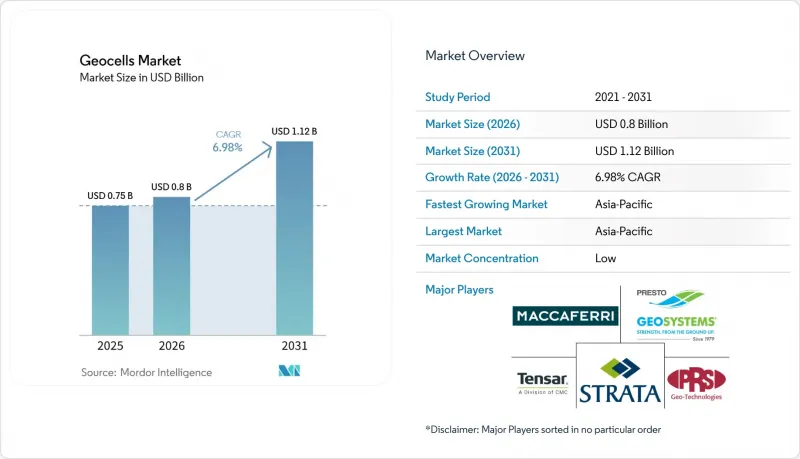
Mordor Intelligence에 의하면, 지오셀 시장은 2025년에 7억 5,000만 달러 규모로 평가되었습니다. 2026년 8억 달러에서 2031년까지 11억 2,000만 달러에 이를 것으로 예상되며, 예측 기간(2026-2031년) CAGR은 6.98%를 나타낼 전망입니다.
본 보고서는 소재별(HDPE, 폴리프로필렌, 기타 소재), 용도별(도로·고속도로, 철도, 사면·수로 보호, 흙막이·옹벽, 기타 용도), 지역별(아시아태평양, 북미, 유럽, 남미, 중동 및 아프리카)로 분류되어 있습니다. 시장 예측은 금액(달러)으로 표시되어 있습니다.
세계의 지오셀 시장 동향 및 인사이트
도로, 철도, 항만에 대한 인프라 투자
도로, 철도, 항만에 대한 투자는 지오셀 시장의 주요 수요 원천으로 계속 남아 있습니다. 아시아, 중동, 남미의 대규모 프로젝트에서는 연약 지반, 기복이 심한 지형, 그리고 골재 운송 비용의 높음에 직면하는 경우가 많습니다. 이러한 조건으로 인해 셀룰러 구속 시스템은 신축 공사 및 개보수 공사 모두에서 중요한 역할을 하고 있습니다. 지오셀을 활용하면 현지에서 구할 수 있는 자재나 품질이 낮은 충진재를 사용할 수 있어, 외딴 지역이나 하천변 현장에서 유용합니다. 이러한 장점은 남아시아 및 동남아시아의 구릉 지대 프로젝트의 경제성을 향상시킬 수 있습니다. 철도 프로젝트에서도 밸러스트 및 노반의 구속을 통해 횡방향 변위를 억제하고 유지보수 주기를 연장할 수 있어 수요가 발생하고 있습니다. 이러한 효과는 규격을 충족하는 품질의 골재를 대량으로 수입하지 않고도 실용적인 지반 개량 수단이 필요한 현장에서 가장 두드러집니다.
지속 가능한 지반 안정화 및 골재 사용량 절감
골재 사용량 감축은 지반이 취약한 도로 건설 분야에서 지오셀 시장에 분명한 이점을 제공합니다. 2024년 비포장 도로 설계 기법에 대한 검토 보고서에 따르면, 전형적인 취약 지반 조건에서 지오셀을 사용함으로써 노반층의 골재 필요량을 27% 줄일 수 있는 것으로 나타났습니다. 2025년의 현장 검증 연구에 따르면, 지오셀을 이용한 보강을 통해 지지력 계수가 3.14에서 5.14로 증가한 것으로 밝혀졌습니다. 동 연구에서는 규정된 시험 조건 하에서 두께 0.20 m의 노반층에 두께 0.15 m의 신규 폴리머 합금(NPA) 지오셀 층을 시공했을 경우, 골재를 56.5% 절감할 수 있었다고 보고되었습니다. 골재 반입 횟수가 줄어들면 연료 소비량, 차량 통행량, 현장 혼잡도 및 시공 기간을 줄일 수 있습니다. 이러한 이점은 매립 탄소와 자재 효율을 고려한 조달 관행과 부합합니다.
시공의 복잡성과 시공업체의 기술 요건
지오셀 시공에는 작업자가 패널을 펼치고, 앵커 핀을 설치하며, 충진재를 적절히 다짐해야 합니다. 앵커 간격이 불균일하거나 다짐이 불충분하면 구속 효율이 저하될 수 있습니다. 일부 지방 시장에서는 시공업체가 셀룰러 구속 시스템 시공 경험이 부족한 경우가 있습니다. 시공상의 결함은 시공 방법이 아닌 제품 자체에서 기인할 수 있으며, 이는 공공 부문 구매자의 신뢰를 저해할 수 있습니다. 분산된 시공업체 기반 전반에 걸쳐 공식 인증이나 현장 교육 체계를 구축하는 데는 시간이 걸립니다. 일부 제조업체는 미리 전개된 패널이나 보다 간편한 앵커 설치 지침을 제공하고 있지만, 이러한 방식은 하중이 작은 용도에 적합합니다. 이러한 제약은 주요 대도시권 이외의, 가격에 민감한 공공 공사 현장에서 가장 두드러지게 나타납니다.
부문별 분석
2025년, HDPE는 지오셀 시장 점유율의 65.43%를 차지했습니다. 이러한 위상은 도로, 철도, 항만 프로젝트에서의 확고한 활용 실적은 물론, 북미, 유럽, 아시아태평양 전반에 걸친 안정적인 공급을 반영한 것입니다. 기술자들은 인장 강도, 내화학성, 그리고 익숙한 토목 공학 사양과의 적합성을 이유로 일반적으로 HDPE를 선택합니다. 또한, 이 소재는 표준 지반 안정화 공사에서 비용 경쟁력 있는 가격 책정이라는 이점도 가지고 있습니다. 기존의 HDPE는 지속적인 동적 하중 하에서 크리프 변형이 발생할 가능성이 있어, 영구적인 고하중 구조물로의 사용이 제한될 수 있습니다. 2024년 연구에서는 폴리머 블렌드 지오셀 시트의 탄성 및 점소성 거동이 조사되었으며, 까다로운 용도에서의 재료 선정 중요성이 입증되었습니다. 이러한 제한으로 인해 철도 노반이나 컨테이너 야드 플랫폼에서 더 고성능의 배합 재료에 대한 수요가 발생하고 있습니다.
폴리프로필렌 시장은 2026년부터 2031년까지 연평균 성장률(CAGR) 8.12%로 확대될 것으로 예측됩니다. 단위 중량이 가벼워 임시 진입로, 조경 현장 및 중간 정도의 하중이 가해지는 침식 방지 프로젝트에서 취급이 용이하고 신속한 설치가 가능합니다. 폴리에스터 및 섬유계 제품은 내화학성과 내가수분해성이 높은 비용을 정당화하는 특수한 수로 및 해안선 용도에서 계속해서 활용되고 있습니다. 신규 폴리머 합금 제품은 첨단 소재 중에서도 더 높은 성능을 자랑하는 부문을 형성하고 있습니다. 이러한 시스템은 긴 설계 수명이 요구되는 공항 포장, 고속철도 노반 및 중량물용 항만 플랫폼에 적합합니다. ISO/TR 18228-5 : 2025 및 지속적으로 발전하는 셀룰러 컨피nement 시험 요건에 따라, 사양 준수에 필요한 기본 성능 수준이 높아질 가능성이 있습니다. 그 결과, 널리 사용되는 HDPE 시스템과 영구적인 고하중 용도를 위한 프리미엄 제품 간에 더욱 명확한 구분이 생겨날 것입니다.
지역별 분석
2025년, 아시아태평양은 지오셀 시장 점유율의 40.13%를 차지했습니다. 또한, 이 지역은 2026년부터 2031년까지 연평균 성장률(CAGR) 7.84%를 나타낼 것으로 예측됩니다. 중국, 인도, 인도네시아, 베트남, 필리핀의 대규모 교통 인프라 프로젝트가 도로 보강 및 사면 안정화에 대한 수요를 뒷받침하고 있습니다. 산악 지대, 열대성 강우, 그리고 변화무쌍한 노반 조건으로 인해 구속 시스템의 중요성이 높아지고 있습니다. 현지 생산, 지역 내 유통, 그리고 각국 고유의 규격 준수는 입찰 경쟁력에도 영향을 미칠 수 있습니다. 일본, 한국, 호주는 보다 성숙한 시장이며, 구매자들은 내구성, 품질 기준 및 수명이 긴 인프라에 중점을 두고 있습니다. 현지 파트너를 보유한 공급업체는 인증 및 현지 조달 요건에 보다 효과적으로 대응할 수 있습니다.
북미에서는 도로 보수 및 연약 노반 프로젝트로 인해 실용적인 안정화 솔루션에 대한 수요가 발생하고 있습니다. 캐나다에서는 영구동토층 및 북부 지역의 도로 보수 분야에서 전문적인 비즈니스 기회도 존재합니다. 유럽에서는 노후화된 교통 인프라와 친환경 조달 기준으로 인해 골재 사용 효율이 높은 시스템에 대한 관심이 높아지고 있습니다. 나우에(Nauwe)사는 2026년 1월, 배수용 지오신세틱 ‘Secudrain WAS 7’에 대해 독일 철도(Deutsche Bahn)의 고성능 인증을 갱신했으며, 이 인증은 2029년 1월까지 유효합니다. 이번 갱신은 철도 인프라 공급망에서 장기적인 기관 인증이 얼마나 중요한지를 보여줍니다. 유럽의 구매자들은 입증된 성능과 환경적 실적을 중시하는 경향이 있습니다.
남미, 중동 및 아프리카에서는 향후 의미 있는 비즈니스 기회가 예상됩니다. 열대 지역이나 충적지에서의 도로 개보수 공사에서는 외부에서 반입하는 골재를 최소화하면서 연약 지반을 안정화시키는 시스템이 유리하게 작용할 가능성이 있습니다. 중동에서는 사막 지대 프로젝트에서 느슨한 모래질 토양으로 인해 기존의 입자재에 의한 지반 안정화가 비용이 많이 들기 때문에 수요가 발생하고 있습니다. 사우디아라비아의 인증 요건은 현지 공사를 둘러싸고 어떤 공급업체가 경쟁에 참여할 수 있는지에 영향을 미칠 가능성이 있습니다. 사하라 이남 아프리카에서는 장기적인 인프라 수요가 크지만, 공공 지출의 변동성과 시공업체의 교육 체계 부족으로 인해 단기적인 도입이 제한될 가능성이 있습니다. 기후 영향에 취약한 도로, 성토, 배수 시스템은 이 지역 전반에 걸쳐 여전히 중요한 적용 사례로 남아 있습니다. 프로젝트 파이프라인을 지속적인 수요로 전환하기 위해서는 공급의 신뢰성과 시공사에 대한 지원이 중요합니다.
기타 혜택 :
- 엑셀 형식 시장 예측(ME) 시트
- 3개월간의 애널리스트 지원
자주 묻는 질문
목차
제1장 서론
제2장 조사 방법
제3장 개요
제4장 시장 구도
제5장 시장 규모 및 성장 예측
제6장 경쟁 구도
제7장 시장 기회 및 향후 전망
KTH 26.09.02According to Mordor Intelligence, the geocells market was valued at USD 0.75 billion in 2025 and is estimated to grow from USD 0.80 billion in 2026 to reach USD 1.12 billion by 2031, at a CAGR of 6.98% during the forecast period (2026-2031).
This report is Segmented by Material (HDPE, Polypropylene, Other Materials), Application (Roads and Highways, Railways, Slope and Channel Protection, Earth Retention and Retaining Walls, Other Applications), and Geography (Asia-Pacific, North America, Europe, South America, and Middle-East and Africa). The Market Forecasts are Provided in Terms of Value (USD).
Global Geocells Market Trends and Insights
Infrastructure Investment in Roads, Railways and Ports
Road, rail, and port investments remain the main source of demand for the geocells market. Large projects in Asia, the Middle-East, and South America often face soft soils, uneven terrain, and high aggregate transport costs. These conditions make cellular confinement systems relevant to both new construction and rehabilitation work. Geocells can allow the use of locally available or marginal infill, which is useful at remote and riverside sites. That advantage can improve project economics in hilly parts of South and Southeast Asia. Rail projects also create demand because ballast and subgrade confinement can limit lateral movement and extend maintenance intervals. The effect is strongest where engineers need a practical ground-improvement option without importing large volumes of specification-grade aggregate.
Sustainable Soil Stabilization and Aggregate Reduction
Aggregate reduction gives the geocells market a clear case in weak-subgrade road construction. A 2024 review of unpaved-road design methods reported that geocells can reduce base-course aggregate requirements by 27% in typical weak-subgrade conditions. A 2025 field-validated study found that geocell reinforcement increased the bearing-capacity factor from 3.14 to 5.14. The same study reported 56.5% aggregate savings for a 0.15 m novel polymeric alloy (NPA) geocell layer in a 0.20 m base course under the stated test conditions. Fewer aggregate deliveries can reduce fuel use, vehicle traffic, site congestion, and construction time. These benefits align with procurement practices that consider embodied carbon and material efficiency.
Installation Complexity and Contractor Skill Requirements
Geocell installation requires crews to expand panels, place anchor pins, and compact infill correctly. Uneven anchor spacing or poor compaction can reduce confinement efficiency. In some rural markets, contractors have limited experience with cellular confinement systems. A weak installation can be attributed to the product rather than the work method, which can reduce confidence among public buyers. Formal certification and field training take time to build across a dispersed contractor base. Some manufacturers offer pre-expanded panels and simpler anchoring guidance, but those formats are better suited to lower-load applications. This constraint is most visible in price-sensitive public works outside major urban markets.
Other drivers and restraints analyzed in the detailed report include:
- Rising Slope Failure and Erosion-Control Requirements
- Lifecycle-Cost Optimization in Infrastructure Projects
- Competition from Geogrids, Geotextiles and Conventional Systems
For complete list of drivers and restraints, kindly check the Table Of Contents.
Segment Analysis
HDPE accounted for 65.43% of the geocells market share in 2025. Its position reflects established use in road, rail, and port projects, as well as supply availability across North America, Europe, and the Asia-Pacific. Engineers commonly select HDPE for its tensile strength, chemical resistance, and fit with familiar civil-engineering specifications. The material also benefits from cost-competitive pricing in standard ground-stabilization work. Conventional HDPE can experience creep deformation under sustained dynamic loading, which can restrict its use in permanent, high-load structures. A 2024 study examined elastic-viscoplastic behavior in polymer-blend geocell sheets, supporting the importance of material selection for demanding applications. These limits create an opening for higher-performance formulations in railbeds and container-yard platforms.
Polypropylene is projected to expand at an 8.12% CAGR from 2026 to 2031. Lower unit weight supports handling and rapid deployment at temporary access roads, landscaping sites, and moderate-load erosion-control projects. Polyester and textile-based products continue to serve specialized channel and shoreline applications where chemical and hydrolytic resistance justify a higher cost. Novel Polymeric Alloy products form a higher-performance tier within advanced materials. These systems are positioned for airport pavements, high-speed rail subgrades, and heavy port platforms that require long design lives. ISO/TR 18228-5:2025 and evolving cellular-confinement testing expectations can raise the baseline performance required for specification eligibility. The result is a clearer split between widely used HDPE systems and premium products for permanent heavy-duty applications.
Complete Report Scope:
- By Material
- HDPE
- Polypropylene
- Other Materials (including Polyester, Textile)
- By Application
- Roads and Highways
- Railways
- Slope and Channel Protection
- Earth Retention and Retaining Walls
- Other Applications (Airports and runways, Ports and container yards, Working platforms, Parking areas, Landfills, and Landscaping and shoreline protection)
- By Geography
- Asia-Pacific
- China
- India
- Japan
- South Korea
- ASEAN Countries
- Rest of Asia-Pacific
- North America
- United States
- Canada
- Mexico
- Europe
- Germany
- United Kingdom
- France
- Italy
- Spain
- NORDIC Countries
- Russia
- Rest of Europe
- South America
- Brazil
- Argentina
- Rest of South America
- Middle-East and Africa
- Saudi Arabia
- South Africa
- Rest of Middle-East and Africa
- Asia-Pacific
Geography Analysis
Asia-Pacific held 40.13% of the geocells market share in 2025. The region is also forecast to grow at a 7.84% CAGR from 2026 to 2031. Large transport projects in China, India, Indonesia, Vietnam, and the Philippines support demand for road reinforcement and slope stabilization. Mountainous terrain, tropical rainfall, and variable subgrade conditions increase the relevance of confinement systems. Local manufacturing, regional distribution, and compliance with country-specific standards can affect tender competitiveness. Japan, South Korea, and Australia are more mature markets where buyers focus on resilience, quality standards, and long-life infrastructure. Suppliers with local partners can respond more effectively to certification and local-content requirements.
In North America, road rehabilitation and soft-subgrade projects create a need for practical stabilization solutions. Canada also offers a specialized opportunity in permafrost and northern road rehabilitation. In Europe, aging transport assets and environmental procurement criteria support interest in aggregate-efficient systems. Naue renewed its Deutsche Bahn High-Performance Qualification for the Secudrain WAS 7 drainage geosynthetic in January 2026, and the qualification remains valid through January 2029. The renewal shows the importance of long-term institutional qualification in rail-infrastructure supply chains. European buyers often place greater weight on documented performance and environmental credentials.
South America, and Middle-East and Africa offer meaningful future opportunities. Road rehabilitation in tropical and alluvial terrain can favor systems that stabilize soft ground with less imported aggregate. In the Middle-East, desert projects create demand where loose sandy soils make conventional granular stabilization costly. Saudi certification requirements can influence which suppliers compete for local work. Sub-Saharan Africa has a large long-term infrastructure need, but uneven public spending and limited contractor training can constrain near-term adoption. Climate-exposed roads, embankments, and drainage systems remain relevant use cases across these regions. Supply reliability and contractor support will be important to convert project pipelines into recurring demand.
- ABG Limited
- ACE Geosynthetics
- Geo Products
- Geofabrics Australasia Pty Ltd.
- HUESKER International
- Naue GmbH & Co. KG
- Officine Maccaferri Spa
- Polyfabrics Australasia Pty Ltd
- Presto Products Company
- PRS Geo-Technologies
- RADMAT BUILDING PRODUCTS LLC
- Solmax
- Strata Geosystems
- Tensar, A Division of CMC
- Terram Geosynthetics Pvt. Ltd.
- TMP Geosynthetics
Additional Benefits:
- The market estimate (ME) sheet in Excel format
- 3 months of analyst support
TABLE OF CONTENTS
1 Introduction
- 1.1 Study Assumptions and Market Definition
- 1.2 Scope of the Study
2 Research Methodology
3 Executive Summary
4 Market Landscape
- 4.1 Market Overview
- 4.2 Market Drivers
- 4.2.1 Infrastructure Investment in Roads, Railways and Ports
- 4.2.2 Sustainable Soil Stabilization and Aggregate Reduction
- 4.2.3 Rising Slope Failure and Erosion-Control Requirements
- 4.2.4 Lifecycle-Cost Optimization in Infrastructure Projects
- 4.2.5 Geocell Adoption in Climate-Vulnerable Infrastructure
- 4.2.6 Performance-Based Specifications for Cellular Confinement
- 4.3 Market Restraints
- 4.3.1 Installation Complexity and Contractor Skill Requirements
- 4.3.2 Competition from Geogrids, Geotextiles and Conventional Systems
- 4.3.3 Inconsistent Geocell Performance Specifications
- 4.3.4 Long-Term Creep and Deformation Concerns in Conventional HDPE Systems
- 4.4 Value Chain Analysis
- 4.5 Porter's Five Forces Analysis
- 4.5.1 Bargaining Power of Suppliers
- 4.5.2 Bargaining Power of Buyers
- 4.5.3 Threat of New Entrants
- 4.5.4 Threat of Substitutes
- 4.5.5 Competitive Rivalry
5 Market Size and Growth Forecasts (Value)
- 5.1 By Material
- 5.1.1 HDPE
- 5.1.2 Polypropylene
- 5.1.3 Other Materials (including Polyester, Textile)
- 5.2 By Application
- 5.2.1 Roads and Highways
- 5.2.2 Railways
- 5.2.3 Slope and Channel Protection
- 5.2.4 Earth Retention and Retaining Walls
- 5.2.5 Other Applications (Airports and runways, Ports and container yards, Working platforms, Parking areas, Landfills, and Landscaping and shoreline protection)
- 5.3 By Geography
- 5.3.1 Asia-Pacific
- 5.3.1.1 China
- 5.3.1.2 India
- 5.3.1.3 Japan
- 5.3.1.4 South Korea
- 5.3.1.5 ASEAN Countries
- 5.3.1.6 Rest of Asia-Pacific
- 5.3.2 North America
- 5.3.2.1 United States
- 5.3.2.2 Canada
- 5.3.2.3 Mexico
- 5.3.3 Europe
- 5.3.3.1 Germany
- 5.3.3.2 United Kingdom
- 5.3.3.3 France
- 5.3.3.4 Italy
- 5.3.3.5 Spain
- 5.3.3.6 NORDIC Countries
- 5.3.3.7 Russia
- 5.3.3.8 Rest of Europe
- 5.3.4 South America
- 5.3.4.1 Brazil
- 5.3.4.2 Argentina
- 5.3.4.3 Rest of South America
- 5.3.5 Middle-East and Africa
- 5.3.5.1 Saudi Arabia
- 5.3.5.2 South Africa
- 5.3.5.3 Rest of Middle-East and Africa
- 5.3.1 Asia-Pacific
6 Competitive Landscape
- 6.1 Market Concentration
- 6.2 Strategic Moves
- 6.3 Market Share (%)/Ranking Analysis
- 6.4 Company Profiles (includes Global Overview, Market Overview, Core Segments, Financials as available, Strategic Information, Products and Services, and Recent Developments)
- 6.4.1 ABG Limited
- 6.4.2 ACE Geosynthetics
- 6.4.3 Geo Products
- 6.4.4 Geofabrics Australasia Pty Ltd.
- 6.4.5 HUESKER International
- 6.4.6 Naue GmbH & Co. KG
- 6.4.7 Officine Maccaferri Spa
- 6.4.8 Polyfabrics Australasia Pty Ltd
- 6.4.9 Presto Products Company
- 6.4.10 PRS Geo-Technologies
- 6.4.11 RADMAT BUILDING PRODUCTS LLC
- 6.4.12 Solmax
- 6.4.13 Strata Geosystems
- 6.4.14 Tensar, A Division of CMC
- 6.4.15 Terram Geosynthetics Pvt. Ltd.
- 6.4.16 TMP Geosynthetics
7 Market Opportunities and Future Outlook
- 7.1 White-Space and Unmet-Need Assessment


