

|
시장보고서
상품코드
2119154
남미의 5G 코어 네트워크 : 시장 점유율 분석, 업계 동향 및 통계, 성장 예측(2026-2031년)South America 5G Core Network - Market Share Analysis, Industry Trends & Statistics, Growth Forecasts (2026 - 2031) |
||||||
 Mordor Intelligence
Mordor Intelligence에 의하면, 남미의 5G 코어 네트워크 시장 규모는 2025년에 3억 1,011만 달러로 평가되었습니다. 2026년 3억 7,014만 달러에서 증가해, 2031년까지 연평균 복합 성장률(CAGR) 19.48%로 성장하여 9억 111만 달러에 이를 것으로 추정되고 있습니다.
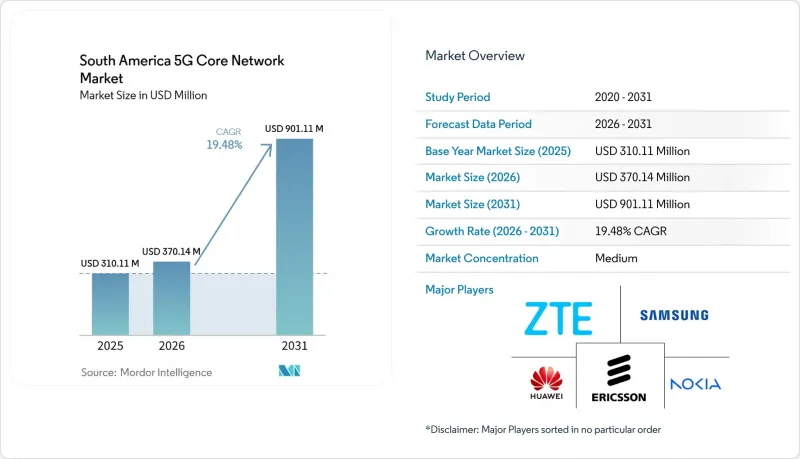
본 보고서는 구성 요소(솔루션 및 서비스),구축 모델(On-Premise/전용, 퍼블릭 클라우드, 하이브리드 및 텔레콤 엣지 클라우드), 최종 사용자(통신 사업자 및 기업), 네트워크 기능(네트워크 노출 기능, 사용자 플레인 기능, 용도 기능, 통합 데이터 관리 등), 국가별로 분류되어 있습니다. 시장 전망은 금액(달러) 기준으로 제시되어 있습니다.
남미의 5G 코어 네트워크 시장 동향 및 인사이트
5G SA(Standalone) 도입 확대가 남미의 5G 코어 네트워크 시장 수요를 견인
브라질에서의 SA 방식 전개는 해당 국가를 지역 도입 주기보다 앞서게 하여 코어 네트워크 수요의 주요 원천이 되고 있습니다. 정부는 2026년 3월, 2026년 말까지 브라질 인구의 80%가 5G에 접속할 수 있게 되며 2,220개 이상의 지자체에서 서비스가 제공될 전망이라고 발표했습니다. 이러한 커버리지 달성 노력을 통해 통신 사업자들은 독립형 방식의 용량 및 관련 소프트웨어를 지속적으로 확충해야 합니다. 따라서 남미의 5G 코어 네트워크 시장은 단기적인 소비자 수요 변화뿐만 아니라, 규제상의 이정표에 연동된 조달 활동으로부터도 혜택을 받고 있습니다. 또한, 단말기 공급 개시나 인증, 기업용 이용 사례 확립에 시간이 소요되는 경우, 전개 속도 자체가 서비스 제공업체에 업무 기회를 창출하기도 합니다. 이러한 요인들이 복합적으로 작용하여 전개, 테스트, 운영, 유지보수에 대한 지속적인 투자가 뒷받침되고 있습니다.
레거시 EPC에서 클라우드 네이티브 코어 아키텍처로의 통신 사업자 전환
통신 사업자들은 기존의 진화형 패킷 코어(EPC) 플랫폼에서 5G 독립형(SA) 서비스를 지원할 수 있는 클라우드 네이티브 코어 시스템으로 전환하고 있습니다. AMD의 보고서에 따르면, 조사 대상 통신 사업자의 33%는 2025년 시점에서 이미 5G 코어 기능의 대부분을 클라우드 네이티브 인프라로 이전했으며, 추가로 30%는 2026년 말까지 이전을 완료할 계획입니다. 이러한 전환에는 분산형 네트워크 기능을 처리할 수 있는 새로운 소프트웨어, 가상화 인프라 및 운영 방식이 필요합니다. 텔레포니카와 AWS는 비보(Vivo)를 위해 클라우드와 통신 사업자 시설 전반에 걸쳐 마베니어(Mavenir), 노키아(Nokia), Oracle(Oracle)의 네트워크 기능을 활용한 5G 독립형 코어 구성을 실증했습니다. 이러한 멀티 벤더 모델로 인해 중남미의 5G 코어 네트워크 시장에서 통합 기술의 중요성이 커지고 있습니다. 또한 이를 통해 통신 사업자는 제어 기능을 중앙 집중화하면서도 성능에 민감한 기능을 사용자와 가까운 곳에 배치할 수 있게 됩니다.
주파수 대역 준비 지연 및 5G SA 도입 일정의 불균일
브라질을 제외한 지역에서는 주파수 대역 준비 상황에 차이가 나타나고 있으며, 이로 인해 일부 국가에서 독립형 코어에 대한 투자 개시가 지연되고 있습니다. 아르헨티나에서는 2026년 3월 말 기준으로 약 2,300곳의 5G 기지국이 설치되었으나, 스탠드얼론 서비스의 기업 대상 수익화는 여전히 초기 단계에 머물러 있었습니다. 무선 네트워크 구축, 주파수 대역 접근, 그리고 비즈니스 수요가 동시에 진전되지 않을 경우 코어 네트워크 업그레이드를 정당화하기 어려워지기 때문에 남미의 5G 코어 네트워크 시장은 영향을 받고 있습니다. 볼리비아는 2026년에야 5G 주파수 할당 절차를 시작했을 뿐이며, 이는 해당 국가의 투자 주기가 여전히 초기 단계에 있음을 보여줍니다. 안데스 지역과 리버 플레이트 지역의 일부 시장에서도 대규모 독립형 프로그램이 시작되기 전에 4G 기지국 밀도 향상에 주력하고 있습니다. 이러한 차이로 인해 지역 내 수요는 균일하지 않게 되며, 주파수 상황이 명확한 국가들에 단기적인 기회가 집중될 것입니다.
부문별 분석
2025년에는 솔루션이 남미의 5G 코어 네트워크 시장 점유율의 61.45%를 차지했습니다. 이는 통신 사업자가 서비스 계층을 확장하기 전에 기반이 되는 독립형 소프트웨어를 도입해야 함을 반영합니다. 패킷 코어 소프트웨어는 독립형 아키텍처에 필요한 코어 트래픽 및 제어 기능을 지원하기 때문에 핵심 가치 범주로 자리 잡고 있습니다. 네트워크 기능 가상화(NFV) 인프라도 가상화된 기능을 위한 컴퓨팅 환경을 제공함으로써 중요한 역할을 하고 있습니다. 오케스트레이션 및 관리 도구는 통신 사업자가 분산된 거점 간에 이러한 기능을 조정하는 데 도움이 됩니다. Vivo의 클라우드 도입 실증 실험에서는 Mavenir, Nokia, Oracle의 코어 기능이 퍼블릭 클라우드 인프라 및 통신 사업자의 데이터센터 전반에 걸쳐 작동하는 것이 입증되었습니다. 이러한 도입 사례는 솔루션 구매에 여러 인프라 및 소프트웨어 공급업체가 관여하는 경우가 많은 이유를 여실히 보여줍니다.
독립형 네트워크 도입 기반에는 도입, 통합, 지원 및 유지보수가 필요하기 때문에 서비스 시장은 2031년까지 연평균 성장률(CAGR) 21.39%로 확대될 것으로 예측됩니다. 통신 사업자는 기능을 레거시 플랫폼에서 가상화 환경으로 이전할 때 통합 및 도입 서비스가 필요합니다. 코어 네트워크 가동 개시 후에는 통신 사업자가 가용성, 보안, 성능을 유지해야 하므로 지원 계약의 중요성이 높아집니다. 컨설팅 및 자문 서비스는 OSS와 BSS의 정합성 확보, 네트워크 슬라이스 설계, 애플리케이션 프로그래밍 인터페이스(API)의 수익화도 지원합니다. 따라서 남미의 5G 코어 네트워크 시장에서는 초기 소프트웨어 도입 후에도 지속적인 서비스 수익을 창출할 수 있습니다. 이러한 추세로 인해 단일 플랫폼 판매에 따른 초기 투자 의존도가 낮아지고, 현지 제공 역량의 가치가 높아집니다.
통신 사업자들은 데이터 제어, 사용자 플레인의 저지연, 그리고 업계 고유의 요구 사항 준수를 필요로 하기 때문에 2025년에는 On-Premise 및 전용 시스템이 수익의 52.21%를 차지했습니다. 이 모델은 에너지, 공공 안전 및 예측 가능한 로컬 성능이 필요한 기타 용도 분야에서 여전히 중요성을 유지하고 있습니다. 또한 클라우드 가용성이 여전히 제한적이거나 데이터 상주 요건으로 인해 퍼블릭 클라우드로의 완전한 도입이 저해되는 경우에도 통신 사업자는 일반적으로 이 모델을 채택하고 있습니다. 로컬 배포를 통해 사용자 플레인 처리를 무선 네트워크 및 엔터프라이즈 용도 근처에서 유지할 수 있습니다. 이 모델에서 남미의 5G 코어 네트워크 시장 규모는 현재 신뢰할 수 있는 트래픽 관리 및 운영 제어가 우선시되고 있음을 반영합니다. 또한, 많은 통신 사업자가 기존 플랫폼을 한 번에 모두 교체하는 대신 클라우드 네이티브 시스템을 단계적으로 도입하고 있는 점도 반영되어 있습니다.
하이브리드 및 텔레콤 엣지 클라우드 도입은 중앙 집중식 클라우드 기능과 엣지 기반 사용자 플레인 용량을 결합하기 때문에 남미의 5G 코어 네트워크 시장에서 2031년까지 연평균 성장률(CAGR) 20.27%로 확대될 것으로 예측됩니다. Vivo사의 개념 증명(PoC)에서는 5G 독립형(SA) 코어 기능이 AWS 인프라와 통신 사업자가 소유한 데이터센터 모두에서 작동할 수 있음이 입증되었습니다. 이러한 접근 방식을 통해 지연에 민감한 처리는 산업 현장 근처에서 유지하면서, 기타 기능에서는 중앙 집중형 클라우드 리소스를 활용할 수 있게 됩니다. 퍼블릭 클라우드 도입도 진전되고 있지만, 통신 사업자들은 여전히 대용량 사용자 플레인 워크로드에 드는 비용을 면밀히 검토하고 있습니다. 엣지 컴퓨팅 및 네트워크 슬라이싱에 관한 표준 규격은 이러한 설계상의 선택에 대한 공통된 기술적 기반을 제공합니다. 기업들이 저지연 및 위치 기반 연결성을 요구함에 따라, 이 도입 모델의 중요성은 점점 더 커지고 있습니다.
기타 혜택 :
- 엑셀 형식 시장 예측(ME) 시트
- 3개월간의 애널리스트 지원
자주 묻는 질문
목차
제1장 서론
제2장 조사 방법
제3장 주요 요약
제4장 시장 구도
제5장 시장 규모 및 성장 예측
제6장 경쟁 구도
제7장 시장 기회 및 향후 전망
KTH 26.09.04According to Mordor Intelligence, the South America 5G core network market size was valued at USD 310.11 million in 2025 and is estimated to increase from USD 370.14 million in 2026 to reach USD 901.11 million by 2031, at a CAGR of 19.48% during the forecast period (2026-2031).
This report is Segmented by Component (Solutions, and Services), Deployment Model (On-Premises/Dedicated, Public Cloud, and Hybrid and Telco Edge Cloud), End-User (Telecom Operators, and Enterprises), Network Function (Network Exposure Function, User Plane Function, Application Function, Unified Data Management, and More), and Country. The Market Forecasts are Provided in Terms of Value (USD).
South America 5G Core Network Market Trends and Insights
Rising 5G Standalone Rollouts Driving South America 5G Core Network Market Demand
Brazil's standalone rollout has put it ahead of the regional deployment cycle and made it the primary source of core network demand. The government stated in March 2026 that 80% of Brazil's population is expected to have 5G access by the end of 2026, with coverage in more than 2,220 municipalities. These coverage commitments require operators to keep adding standalone capacity and related software. The South America 5G core network market, therefore, benefits from procurement that is tied to regulatory milestones, not only to short-term changes in consumer demand. The pace of rollout can also create work for service providers when device availability, certification, and enterprise use cases take longer to develop. This combination supports continued spending on deployment, testing, operations, and maintenance.
Operator Shift from Legacy EPC to Cloud-Native Core Architectures
Operators are moving from older evolved packet core platforms toward cloud-native core systems that can support 5G standalone services. AMD reported that 33% of surveyed operators had already placed most 5G core functions on cloud-native infrastructure in 2025, while another 30% targeted completion by the end of 2026. The change requires new software, virtualized infrastructure, and operating practices capable of handling distributed network functions. Telefonica and AWS demonstrated a 5G standalone core configuration for Vivo that used network functions from Mavenir, Nokia, and Oracle across cloud and operator facilities. This type of multi-vendor model raises the importance of integration skills in the South America 5G core network market. It also allows operators to centralize control functions while keeping performance-sensitive functions closer to users.
Delayed Spectrum Readiness and Uneven 5G Standalone Timelines
Spectrum readiness outside Brazil remains uneven, which slows the start of standalone core investment in several countries. Argentina had around 2,300 5G sites by the end of March 2026, but enterprise monetization of standalone services was still in its early stages. The South America 5G core network market is affected because a core upgrade becomes more difficult to justify when radio deployment, spectrum access, and business demand do not advance together. Bolivia began its 5G spectrum award process in 2026, indicating that its investment cycle is still in its early stages. Some Andean and River Plate markets are also focused on 4G densification before larger standalone programs begin. These differences make regional demand less uniform and concentrate near-term opportunities in countries with clearer spectrum conditions.
Other drivers and restraints analyzed in the detailed report include:
- Network Slicing Demand from Enterprise and Public Sector Use Cases
- Public Sector Digitalization Programs Accelerating 5G Core Investment
- High Integration Complexity with Existing 4G and Legacy OSS/BSS Stacks
For complete list of drivers and restraints, kindly check the Table Of Contents.
Segment Analysis
Solutions are expected to hold 61.45% of the South America 5G core network market share in 2025, reflecting the need to deploy foundational standalone software before operators expand service layers. Packet-core software represents the central value category because it supports the core traffic and control functions required for a standalone architecture. Network function virtualization infrastructure also plays an important role by providing the computing environment for virtualized functions. Orchestration and management tools help operators coordinate these functions across distributed locations. Vivo's cloud deployment demonstration showed that core functions from Mavenir, Nokia, and Oracle could operate across public cloud infrastructure and operator data centers. Such deployments show why solution purchases often involve multiple infrastructure and software suppliers.
Services are projected to expand at a 21.39% CAGR through 2031 as the installed base of standalone networks requires deployment, integration, support, and maintenance. Operators need integration and deployment services when they move functions from legacy platforms to virtualized environments. Support contracts become more important after a core goes live, as operators must maintain availability, security, and performance. Consulting and advisory services also support OSS and BSS alignment, network slice design, and application programming interface monetization. Therefore, the South America 5G core network market can generate recurring service revenue after the initial software implementation. This pattern reduces reliance on a single upfront platform sale and increases the value of local delivery capabilities.
On-premises and dedicated systems are expected to account for 52.21% of revenue in 2025, as operators require data control, low user-plane latency, and compliance with sector-specific requirements. This model remains relevant for energy, public safety, and other applications that require predictable local performance. Operators also commonly use this model when cloud availability remains limited, or data residency requirements discourage full public cloud deployment. Local deployments can keep user plane processing close to the radio network and enterprise applications. The South America 5G core network market size for this model reflects the current priority placed on reliable traffic management and operational control. It also reflects that many operators are gradually introducing cloud-native systems rather than replacing every existing platform at once.
Hybrid and telco edge cloud deployment is projected to expand at a 20.27% CAGR through 2031 in the South America 5G core network market, as it combines centralized cloud functions with edge-based user-plane capacity. Vivo's proof of concept showed that 5G standalone core functions could operate across AWS infrastructure and operator-owned data centers. This approach can keep latency-sensitive processing close to industrial sites while allowing other functions to use centralized cloud resources. Public cloud adoption is also advancing, although operators continue to assess costs for high-volume user-plane workloads. Standards covering edge computing and network slicing provide a common technical basis for these design choices. The deployment model is becoming increasingly important as enterprises seek low-latency, location-sensitive connectivity.
Complete Report Scope:
- By Component
- Solutions
- Packet-Core Software
- NFV Infrastructure
- Orchestration and Management
- Services
- Integration and Deployment
- Consulting and Advisory
- Support and Maintenance
- Solutions
- By Deployment Model
- On-Premise/Dedicated
- Public Cloud
- Hybrid and Telco Edge Cloud
- By End-User
- Telecom Operators
- Enterprises
- Manufacturing
- Energy and Utilities
- Transportation and Logistics
- Public Safety and Emergency
- Smart Cities and Municipalities
- By Network Function
- Network Exposure Function (NEF)
- User Plane Function (UPF)
- Application Function (AF)
- Unified Data Management (UDM)
- Session Management Function (SMF)
- Network Slice Selection Function (NSSF)
- Policy Control Function (PCF)
- Network Repository Function (NRF)
- Authentication Server Function (AUSF)
- Access and Mobility Management (AMF)
- By Country
- Brazil
- Argentina
- Rest of South America
List of Companies Covered in this Report:
- Ericsson
- Nokia
- Huawei Technologies Co., Ltd.
- ZTE Corporation
- Samsung Electronics Co., Ltd.
- Mavenir Systems, Inc.
- Oracle Corporation
- Cisco Systems, Inc.
- Hewlett Packard Enterprise Development LP
- Dell Technologies Inc.
- Red Hat, Inc.
- NEC Corporation
- Juniper Networks, Inc.
- Amdocs Limited
- Comarch SA
- IBM Corporation
- HCLTech
- Tech Mahindra Limited
Additional Benefits:
- The market estimate (ME) sheet in Excel format
- 3 months of analyst support
TABLE OF CONTENTS
1 INTRODUCTION
- 1.1 Study Assumptions and Market Definition
- 1.2 Scope of the Study
2 RESEARCH METHODOLOGY
3 EXECUTIVE SUMMARY
4 MARKET LANDSCAPE
- 4.1 Market Overview
- 4.2 Market Drivers
- 4.2.1 Rising 5G Standalone Rollouts Across Major South American Networks
- 4.2.2 Operator Shift From Legacy EPC to Cloud Native Core Architectures
- 4.2.3 Network Slicing Demand From Enterprise and Public Sector Use Cases
- 4.2.4 Public Sector Digitalization Programs Accelerating 5G Core Investment
- 4.2.5 Multi-Access Edge Integration for Low Latency Industrial Connectivity
- 4.2.6 Vendor Open RAN and Core Modernization Bundling Strategies
- 4.3 Market Restraints
- 4.3.1 Delayed Spectrum Readiness and Uneven 5G Standalone Timelines
- 4.3.2 High Integration Complexity With Existing 4G and Legacy OSS BSS Stacks
- 4.3.3 Currency Volatility Affecting Multi-Year Core Network Procurement
- 4.3.4 Limited Telecom Capex Outside Tier-1 Operators
- 4.4 Value Chain Analysis
- 4.5 Regulatory Landscape
- 4.6 Technological Outlook
- 4.7 PESTLE Analysis
- 4.8 Porter's Five Forces Analysis
- 4.8.1 Threat of New Entrants
- 4.8.2 Bargaining Power of Buyers
- 4.8.3 Bargaining Power of Suppliers
- 4.8.4 Threat of Substitutes
- 4.8.5 Competitive Rivalry
5 MARKET SIZE AND GROWTH FORECASTS (VALUE)
- 5.1 By Component
- 5.1.1 Solutions
- 5.1.1.1 Packet-Core Software
- 5.1.1.2 NFV Infrastructure
- 5.1.1.3 Orchestration and Management
- 5.1.2 Services
- 5.1.2.1 Integration and Deployment
- 5.1.2.2 Consulting and Advisory
- 5.1.2.3 Support and Maintenance
- 5.1.1 Solutions
- 5.2 By Deployment Model
- 5.2.1 On-Premise/Dedicated
- 5.2.2 Public Cloud
- 5.2.3 Hybrid and Telco Edge Cloud
- 5.3 By End-User
- 5.3.1 Telecom Operators
- 5.3.2 Enterprises
- 5.3.2.1 Manufacturing
- 5.3.2.2 Energy and Utilities
- 5.3.2.3 Transportation and Logistics
- 5.3.2.4 Public Safety and Emergency
- 5.3.2.5 Smart Cities and Municipalities
- 5.4 By Network Function
- 5.4.1 Network Exposure Function (NEF)
- 5.4.2 User Plane Function (UPF)
- 5.4.3 Application Function (AF)
- 5.4.4 Unified Data Management (UDM)
- 5.4.5 Session Management Function (SMF)
- 5.4.6 Network Slice Selection Function (NSSF)
- 5.4.7 Policy Control Function (PCF)
- 5.4.8 Network Repository Function (NRF)
- 5.4.9 Authentication Server Function (AUSF)
- 5.4.10 Access and Mobility Management (AMF)
- 5.5 By Country
- 5.5.1 Brazil
- 5.5.2 Argentina
- 5.5.3 Rest of South America
6 COMPETITIVE LANDSCAPE
- 6.1 Market Concentration
- 6.2 Strategic Moves
- 6.3 Market Share Analysis
- 6.4 Company Profiles (includes Global Level Overview, Market Level Overview, Core Segments, Financials as available, Strategic Information, Market Rank/Share, Products and Services, Recent Developments)
- 6.4.1 Ericsson
- 6.4.2 Nokia
- 6.4.3 Huawei Technologies Co., Ltd.
- 6.4.4 ZTE Corporation
- 6.4.5 Samsung Electronics Co., Ltd.
- 6.4.6 Mavenir Systems, Inc.
- 6.4.7 Oracle Corporation
- 6.4.8 Cisco Systems, Inc.
- 6.4.9 Hewlett Packard Enterprise Development LP
- 6.4.10 Dell Technologies Inc.
- 6.4.11 Red Hat, Inc.
- 6.4.12 NEC Corporation
- 6.4.13 Juniper Networks, Inc.
- 6.4.14 Amdocs Limited
- 6.4.15 Comarch SA
- 6.4.16 IBM Corporation
- 6.4.17 HCLTech
- 6.4.18 Tech Mahindra Limited
7 MARKET OPPORTUNITIES AND FUTURE OUTLOOK
- 7.1 White-Space and Unmet-Need Assessment


