|
시장보고서
상품코드
2119156
전기자동차용 절연재 : 시장 점유율 분석, 업계 동향 및 통계, 성장 예측(2026-2031년)Electric Vehicle Insulation - Market Share Analysis, Industry Trends & Statistics, Growth Forecasts (2026 - 2031) |
||||||
 Mordor Intelligence
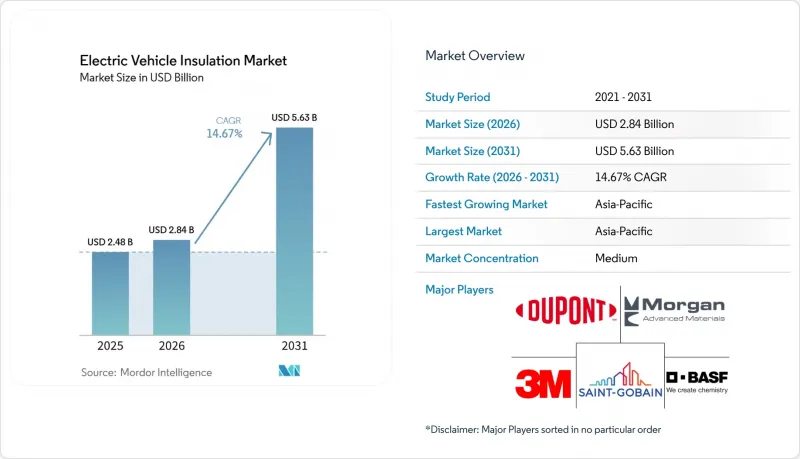
Mordor Intelligence에 의하면, 전기자동차용 절연재 시장은 2025년에 24억 8,000만 달러 규모로 평가되었습니다. 2026년 28억 4,000만 달러에서 2031년까지 56억 3,000만 달러에 이를 것으로 예상되며, 예측 기간(2026-2031년) CAGR은 14.67%를 나타낼 전망입니다.
본 보고서는 소재 유형(폴리우레탄 폼, 폴리이미드 등), 차량 구동 방식(배터리식 전기차(BEV) 등), 차량 유형(승용차 등), 용도(배터리 팩 및 배터리 하우징, 전기 모터 등), 지역(아시아태평양, 북미, 유럽 등)별로 분류되어 있습니다. 시장 전망은 금액(달러) 기준으로 제시되어 있습니다.
세계의 전기자동차용 절연재 시장 동향 및 인사이트
배터리 에너지 밀도의 향상 및 급속 충전 기능에 대한 수요 증가
최신 니켈-망간-코발트(NMC) 및 인산철리튬(LFP) 셀의 에너지 밀도 향상으로 인해 배터리 팩 내 열 현상의 심각성이 증가하고 있습니다. 2026년에 발표된 미국 자동차 기술자 협회(SAE)의 조사에 따르면, 더 두껍고 에너지 밀도가 높은 셀의 경우, 동등한 에너지 용량을 가진 팩당 50%-60% 더 높은 절연 저항이 필요하다고 합니다. 이로 인해 절연 성능은 셀의 에너지 정격과 더욱 밀접하게 관련되어 있습니다. 800V 충전 시스템의 보급으로 인해 버스바, 커넥터, 팩 하우징, 배터리 차단 장치 및 고전압 인터록 루프 전반에 걸쳐 추가적인 수요가 발생하고 있습니다. IEC 62196-1 : 2025에서는 최대 1,500V DC 및 800A에서 충전 플러그 및 커넥터의 성능 요건이 규정되어 있습니다. 그 결과, 전기자동차용 절연재 시장은 고속 충전 및 방전 사이클 중에도 열적 및 유전적 특성이 안정적인 다층 소재로 전환되고 있습니다.
엄격한 열 폭주 보호 및 고전압 안전 규정
중국의 GB 38031-2025는 2026년 7월 1일부터 시행되며, 배터리 시스템에 대해 단일 셀에서 열 폭주가 발생한 후 최소 120분 동안 화재나 폭발을 방지할 것을 의무화하고 있습니다. 또한, 이 규정은 연기가 차량 실내로 유입되는 것을 금지하고 있습니다. 이러한 강화된 격리 요건으로 인해 셀 간 및 팩 주변에 전용으로 설계된 장벽의 필요성이 높아지고 있습니다. 유럽에서는 내화성 하우징 및 시스템 격리에 대해 UNECE R100.3 요건이 채택되어 있는 반면, 북미의 시험에는 셀에서 완전한 탑재 상태에 이르기까지의 UL 9540A 평가가 포함됩니다. 여러 규제 체계를 아우르는 시험 실적을 보유한 공급업체는 전 세계 자동차 프로그램을 지원하는 데 유리한 입장에 있습니다. 따라서 전기자동차용 절연재 시장에서는 초기 소재 비용의 저렴함보다 인증된 성능이 더욱 중요시되고 있습니다.
에어로겔, 세라믹, 폴리이미드 등 첨단 단열재의 높은 비용
에어로겔, 세라믹 섬유, 폴리이미드 필름은 뛰어난 열적 및 유전적 특성을 갖추고 있지만, 기존의 발포 소재보다 비용이 높습니다. 또한, 이러한 가공 방법에는 특수한 생산 능력이 필요하며, 이는 공급 확대에 제약이 될 수 있습니다. 2025년 2월 아스펜 에어로겔(Aspen Aerogel)사가 조지아주 공장 건설 계획을 중단한 것은 대규모 고정 투자를 통해 에어로겔의 생산 능력을 확대하는 것이 얼마나 어려운지를 보여줍니다. 중국의 새로운 배터리 안전 규제로 인해 차량 1대당 배터리 팩 비용이 15%-20% 증가할 것으로 예측됩니다. 비용에 민감한 차종을 취급하는 OEM은 고성능 단열 솔루션 도입에 신중을 기할 가능성이 있습니다. 전기차 단열 시장에서는 배터리 시스템에 사용되는 부품 수를 줄일 수 있기 때문에 열적 기능과 전기적 기능을 겸비한 소재에 대한 수요는 여전히 존재합니다.
부문별 분석
2025년에는 폴리우레탄 폼이 22.73%로 가장 큰 점유율을 차지했습니다. 이는 확립된 공급 기반과 단열 및 진동 감쇠 용도로의 활용에 힘입은 결과입니다. 배터리 팩 조립에서 폴리우레탄 폼의 열전도율은 0.020-0.030 W/m·K로 보고되었습니다. 실리콘 고무는 열 사이클 하에서 유연한 밀봉 용도로 여전히 유용합니다. 폴리이미드 필름은 셀 간 배리어에서 높은 절연 내력을 발휘하는 반면, 운모 복합재는 난연성이 필수적인 상황에서 사용됩니다. 세라믹 섬유, 유리 섬유, 폴리에스터 필름 및 폴리에틸렌은 특정 단열 용도나 라이너 용도로 계속해서 활용되고 있습니다. 에어로겔의 채택은 팩 설계에서 하나의 인증된 복합재가 여러 가지 단일 기능 소재를 대체하는 상황에서 확대될 가능성이 있습니다.
에어로겔 시장 규모는 2031년까지 연평균 성장률(CAGR) 18.83%로 확대될 것으로 예측됩니다. 두께 0.5-3 mm로 열전달을 억제하므로 배터리 팩의 공간 확보에 기여합니다. 2025년 조사에 따르면, 2mm 두께의 에어로겔 시트는 최고 온도가 600-800°C에 달하는 셀 연소 사고에서 200-400°C의 온도 저하를 가져왔습니다. 이러한 성능은 중국 배터리 규격에서 정한 120분간의 열폭주 억제 요건을 충족합니다. 전기차(EV)용 단열재 시장에서 첨단 열차단재 시장 규모는 밀집 배치된 셀 간의 직접적인 보호가 필요한 배터리 설계에 힘입어 성장하고 있습니다.
2025년, 배터리식 전기차(BEV)는 전기차 단열재 수요의 66.71%를 차지했으며, 2031년까지 연평균 성장률(CAGR) 16.71%를 나타낼 것으로 예측됩니다. BEV 배터리 시스템에서는 셀, 모듈, 팩, 고전압 배선 및 충전 연결부 전반에 걸쳐 절연이 필요합니다. 팩의 대용량화 및 에너지 밀도 향상에 따라 차량 1대당 사용되는 단열재 및 유전체의 양이 증가하고 있습니다. 800V BEV 플랫폼으로의 전환에 따라 주요 전기 인터페이스 간에 더 긴 표면 거리 및 더 높은 절연 저항이 요구됩니다. 전기자동차용 절연재 시장은 BEV의 배터리 및 전력 시스템의 복잡화와 직접적인 관련이 있습니다.
하이브리드 전기차(HEV)는 배터리 팩이 비교적 작기 때문에 주로 모터나 전력 전자 장치 주변에 절연재가 사용됩니다. 플러그인 하이브리드 전기차(PHEV)는 20-40 kWh의 배터리 팩을 지원하기 때문에 중간 수준의 솔루션이 필요합니다. 이러한 차량에서도 제한된 패키지 공간 내에서 열을 관리하고, 전압 스트레스를 견디며, 부품을 절연하는 소재가 여전히 요구되고 있습니다. 연료전지 전기차(FCEV)는 고전압 연료전지 스택, 수소 저장 시스템 및 파워 일렉트로닉스를 결합하고 있어, 서로 다른 절연 요구 사항을 가지고 있습니다. 한국과 일본은 현대자동차(Hyundai) 및 도요타(Toyota)의 프로그램을 통해 연료전지 자동차 분야의 중요한 거점으로 자리매김하고 있습니다. 전기자동차용 절연재 시장은 이러한 다양한 추진 시스템의 조합으로 인해 혜택을 보고 있지만, 재료 수요의 주된 원천은 여전히 BEV가 차지하고 있습니다.
지역별 분석
아시아태평양은 2025년에 세계 수요의 51.83%를 차지했으며, 2031년까지 연평균 성장률(CAGR) 15.69%로 성장할 것으로 전망됩니다. 중국, 한국, 일본, 인도는 이 지역 내 전기차 생산 및 배터리 제조의 핵심 거점입니다. 중국의 GB 38031-2025 규격에 따라, 국내에서 판매되는 배터리 시스템에 대한 절연 요건이 강화되었습니다. 중국의 자동차 부품 공급업체들은 열 전파 방지 설계와 내열성 세퍼레이터를 채택하고 있습니다. 인도 에너지 저장 연합(India Energy Storage Alliance)에 따르면, 인도에서는 2025-26 회계연도에 255만 대의 전기차가 판매되었습니다. 이 지역의 전기자동차용 절연재 시장 점유율은 높은 생산 대수와 배터리 팩에 대한 더욱 엄격한 안전 규격이 모두 반영된 결과입니다.
인도의 전기차 보급률은 2025 회계연도 상반기 8%에서 2026 회계연도 상반기에는 11.43%에 달했습니다. 2026 회계연도 상반기 판매 대수는 154만 대에 달했으며, 이수레차, 삼륜차, 승용차 분야 수요를 뒷받침하고 있습니다. 일본과 한국은 여전히 중요한 프리미엄 사양 시장입니다. 양국의 차량 프로그램에서는 배터리 보호, 내구성 및 고전압 성능이 극히 중시되고 있습니다. 또한, 중국 제조업체들이 완성차 및 배터리 시스템을 수출하고 있기 때문에 중국의 배터리 기준은 국내 자동차 시장을 넘어 공급망에도 영향을 미치고 있습니다. 이러한 시스템이 다른 지역으로 확대됨에 따라, 전기자동차용 절연재 시장은 중국의 배터리 안전 요건과의 연관성이 점점 더 강해지고 있습니다.
유럽과 북미는 규제 조건이 서로 다르지만 여전히 중요한 수요 거점입니다. 유럽에서는 UNECE R100.3에 기반한 내화성 배터리 하우징 요건으로 인해 신차 프로그램에서 절연재 사용량이 증가하고 있습니다. 북미에서는 국내 배터리 공장과 OEM 프로그램이 절연재에 대한 기초적인 수요를 뒷받침하고 있습니다. 800V 시스템의 도입이 예상에 따라, 이 지역에서는 고유전율 소재에 대한 수요가 촉진되고 있습니다. 남미, 중동 및 아프리카는 신흥 수요 거점으로 부상하고 있습니다. 중국의 자동차 수출에 따라 중국 사양의 배터리 팩 및 관련 절연 요건이 이러한 개발도상국 시장으로도 도입되고 있습니다. 전기자동차용 절연재 시장은 플릿 프로그램, 전기 버스 조달, 충전 인프라 확충을 통해 이들 지역에서 발전해 나갈 것으로 예측됩니다.
기타 혜택 :
- 엑셀 형식 시장 예측(ME) 시트
- 3개월간의 애널리스트 지원
자주 묻는 질문
목차
제1장 서론
제2장 조사 방법
제3장 주요 요약
제4장 시장 구도
제5장 시장 규모 및 성장 예측
제6장 경쟁 구도
제7장 시장 기회 및 향후 전망
KTH 26.09.04According to Mordor Intelligence, the electric vehicle insulation market was valued at USD 2.48 billion in 2025 and is estimated to grow from USD 2.84 billion in 2026 to reach USD 5.63 billion by 2031, at a CAGR of 14.67% during the forecast period (2026-2031).
This report is Segmented by Material Type (Polyurethane Foam, Polyimide, and More), Vehicle Propulsion (Battery Electric Vehicles (BEVs), and More), Vehicle Type (Passenger Vehicles, and More), Application (Battery Pack and Battery Housing, Electric Motor, and More), and Geography (Asia-Pacific, North America, Europe, and More). The Market Forecasts are Provided in Terms of Value (USD).
Global Electric Vehicle Insulation Market Trends and Insights
Increasing Battery Energy Density and Demand for Fast-Charging Capabilities
Higher energy density in modern Nickel Manganese Cobalt (NMC) and Lithium Iron Phosphate (LFP) cells increases the severity of thermal events within battery packs. Society of Automotive Engineers (SAE) research published in 2026 stated that thicker and more energetic cells require 50%-60% more insulation resistance per pack with equivalent energy capacity. This makes insulation performance more closely tied to the energy rating of the cell. The spread of 800 V charging systems adds further demands across busbars, connectors, pack enclosures, battery disconnect units, and high-voltage interlock loops. IEC 62196-1:2025 sets performance requirements for charging plugs and connectors at up to 1,500 V DC and 800 A. The Electric Vehicle Insulation Market is consequently moving toward multi-layer materials with thermal and dielectric properties that remain stable during high-rate charging and discharge cycles.
Stringent Thermal Runaway Protection and High-Voltage Safety Regulations
China's GB 38031-2025 took effect on July 1, 2026, and requires battery systems to prevent fire and explosion for at least 120 minutes after thermal runaway in a single cell. The rule also prohibits smoke from entering the vehicle cabin. This extended containment requirement has increased the need for purpose-designed barriers between cells and around the pack. Europe uses UNECE R100.3 requirements for fireproof housing and system separation, while North American testing includes UL 9540A evaluation from cell to full installation level. Suppliers with test records across multiple regulatory systems are better positioned to support global vehicle programs. The electric vehicle insulation market is therefore placing greater weight on certified performance rather than low initial material cost.
High Cost of Advanced Insulation Materials such as Aerogels, Ceramics, and Polyimides
Aerogels, ceramic fiber, and polyimide films offer strong thermal and dielectric performance, but they have higher costs than conventional foam materials. Their processing methods require specialized production capacity and can limit supply expansion. The cancellation of Aspen Aerogels' planned Georgia facility in February 2025 showed the difficulty of scaling aerogel capacity through large, fixed investments. China's new battery safety rules are expected to increase power battery system costs by 15%-20% per vehicle pack. Original Equipment Manufacturers (OEMs) in cost-sensitive vehicle categories may be slower to adopt premium insulation solutions. The electric vehicle insulation market still has room for materials that combine thermal and electrical functions, because they can reduce the number of components used in a battery system.
Other drivers and restraints analyzed in the detailed report include:
- Growing Electrification of Commercial Vehicles, Buses, and Heavy-Duty Trucks
- Rising Demand for Lightweight Insulation Materials to Improve Vehicle Range
- Lack of Standardization in High-Voltage Insulation and Charging Systems
For complete list of drivers and restraints, kindly check the Table Of Contents.
Segment Analysis
Polyurethane foam held the largest share at 22.73% in 2025, supported by its established supply base and its use in thermal insulation and vibration damping. Its thermal conductivity was reported at 0.020-0.030 W/m*K in battery pack assemblies. Silicone rubber remains useful for flexible sealing under thermal cycling. Polyimide films support high dielectric strength in cell-to-cell barriers, while mica composites are used where flame resistance is critical. Ceramic fiber, fiberglass, polyester film, and polyethylene continue to serve defined thermal or liner applications. Aerogel adoption can grow where one certified composite replaces several single-function materials in pack designs.
Aerogel is projected to grow at an 18.83% CAGR through 2031. It contains heat transfer at thicknesses of 0.5-3 mm, which helps preserve battery pack space. A 2025 study reported that a 2 mm aerogel sheet created a 200-400°C temperature drop during cell combustion events that peaked at 600-800°C. Such performance supports the 120-minute thermal-runaway containment requirement under China's battery standard. The electric vehicle insulation market size for advanced thermal barriers is supported by battery designs that need direct protection between closely packed cells.
Battery Electric Vehicles (BEVs) held 66.71% of the electric vehicle insulation demand in 2025 and are forecast to grow at a 16.71% CAGR through 2031. Their battery systems require insulation across cells, modules, packs, high-voltage wiring, and charging connections. Larger and more energy-dense packs increase the amount of thermal and dielectric material used per vehicle. The move to 800 V BEV platforms requires greater creepage distances and higher insulation resistance across key electrical interfaces. The electric vehicle insulation market has a direct connection to the growing complexity of BEV batteries and power systems.
Hybrid Electric Vehicles (HEVs) use insulation mainly around motors and power electronics because their battery packs are smaller. Plug-in Hybrid Electric Vehicles need intermediate-level solutions for their 20-40 kWh battery packs. These vehicles still require materials that manage heat, resist voltage stress, and isolate components inside a limited package space. Fuel-cell electric vehicles have different insulation needs because they combine high-voltage fuel-cell stacks, hydrogen storage systems, and power electronics. South Korea and Japan remain important locations for fuel-cell vehicle activity through Hyundai and Toyota programs. The electric vehicle insulation market benefits from this varied propulsion mix, although BEVs remain the leading source of material demand.
Complete Report Scope:
- By Material Type
- Polyurethane Foam
- Polyimide
- Silicone Rubber
- Ceramic Fiber
- Fiberglass
- Polyester Film
- Polyethylene
- Aerogel
- Mica and Mica Composites
- Other Material Types
- By Vehicle Propulsion
- Battery Electric Vehicles (BEVs)
- Hybrid Electric Vehicles (HEVs)
- Plug-in Hybrid Electric Vehicles (PHEVs)
- Fuel Cell Electric Vehicles (FCEVs)
- By Vehicle Type
- Passenger Vehicles
- Commercial Vehicles
- Two-Wheelers
- Heavy-Duty Vehicles
- Electric Buses
- Other Vehicle Types
- By Application
- Battery Pack and Battery Housing
- Battery Cell and Module
- Electric Motor
- Power Electronics
- Charging System
- High-Voltage Cables and Wiring Harnesses
- Other Applications
- By Geography
- Asia-Pacific
- China
- India
- Japan
- South Korea
- Rest of Asia-Pacific
- North America
- United States
- Canada
- Mexico
- Europe
- Germany
- United Kingdom
- France
- Italy
- Russia
- Rest of Europe
- South America
- Brazil
- Argentina
- Rest of South America
- Middle-East and Africa
- Saudi Arabia
- South Africa
- Rest of Middle-East and Africa
- Asia-Pacific
Geography Analysis
Asia-Pacific held 51.83% of global demand in 2025 and is forecast to grow at a 15.69% CAGR through 2031. China, South Korea, Japan, and India provide the region's core electric vehicle production and battery manufacturing base. China's GB 38031-2025 standard is increasing insulation requirements for battery systems sold in the country. China's vehicle suppliers are incorporating non-thermal-propagation designs and high-temperature-resistant diaphragms. India recorded 2.55 million electric vehicle sales in FY2025-26, according to the India Energy Storage Alliance. The region's electric vehicle insulation market share reflects both high production volumes and stronger safety specifications for battery packs.
India's electric vehicle penetration reached 11.43% in the first half of 2026, compared with 8% in the first half of 2025. Sales reached 1.54 million units in the first half of 2026, supporting demand in two-wheelers, three-wheelers, and passenger vehicles. Japan and South Korea remain important premium-specification markets. Their vehicle programs place significant importance on battery protection, durability, and high-voltage performance. China's battery standard also influences supply chains beyond its domestic vehicle market because Chinese producers export complete vehicles and battery systems. The electric vehicle insulation market is becoming more connected to Chinese battery-safety requirements as these systems move into other regions.
Europe and North America remain important demand centers with different regulatory conditions. Europe's requirements for fireproof battery housing under UNECE R100.3 are increasing insulation content in new vehicle programs. In North America, domestic battery plants and OEM programs maintain baseline demand for insulation materials. The expected adoption of 800 V systems supports high-dielectric materials in the region. South America, and Middle-East, and Africa represent emerging demand centers. Chinese vehicle exports bring China-specified battery packs and associated insulation requirements into these developing markets. The electric vehicle insulation market is expected to develop in these regions through fleet programs, electric bus procurement, and broader charging infrastructure.
- 3M
- Adler Pelzer Holding GmbH
- Aspen Aerogels, Inc.
- Autoneum
- BASF
- DuPont
- Elmelin Ltd.
- Freudenberg Group
- Henkel AG & Co. KGaA
- Isovolta AG
- Morgan Advanced Materials plc
- Rogers Corporation
- Saint-Gobain
- Shin-Etsu Chemical Co., Ltd
- Tecman Holdings Ltd,
Additional Benefits:
- The market estimate (ME) sheet in Excel format
- 3 months of analyst support
TABLE OF CONTENTS
1 Introduction
- 1.1 Study Assumptions and Market Definition
- 1.2 Scope of the Study
2 Research Methodology
3 Executive Summary
4 Market Landscape
- 4.1 Market Overview
- 4.2 Market Drivers
- 4.2.1 Increasing Battery Energy Density and Demand for Fast-Charging Capabilities
- 4.2.2 Stringent Thermal Runaway Protection and High-Voltage Safety Regulations
- 4.2.3 Growing Electrification of Commercial Vehicles, Buses, and Heavy-Duty Trucks
- 4.2.4 Rising Demand for Lightweight Insulation Materials to Improve Vehicle Range
- 4.2.5 Increasing Adoption of Cell-to-Pack and Structural Battery Architectures
- 4.3 Market Restraints
- 4.3.1 High Cost of Advanced Insulation Materials such as Aerogels, Ceramics, and Polyimides
- 4.3.2 Lack of Standardization in High-Voltage Insulation and Charging Systems
- 4.3.3 Recycling and End-of-Life Challenges for Multi-Layer Insulation Materials
- 4.4 Value Chain Analysis
- 4.5 Porter's Five Forces Analysis
- 4.5.1 Threat of New Entrants
- 4.5.2 Bargaining Power of Suppliers
- 4.5.3 Bargaining Power of Buyers
- 4.5.4 Threat of Substitutes
- 4.5.5 Competitive Rivalry
- 4.6 Regulatory Landscape
5 Market Size and Growth Forecasts (Value)
- 5.1 By Material Type
- 5.1.1 Polyurethane Foam
- 5.1.2 Polyimide
- 5.1.3 Silicone Rubber
- 5.1.4 Ceramic Fiber
- 5.1.5 Fiberglass
- 5.1.6 Polyester Film
- 5.1.7 Polyethylene
- 5.1.8 Aerogel
- 5.1.9 Mica and Mica Composites
- 5.1.10 Other Material Types
- 5.2 By Vehicle Propulsion
- 5.2.1 Battery Electric Vehicles (BEVs)
- 5.2.2 Hybrid Electric Vehicles (HEVs)
- 5.2.3 Plug-in Hybrid Electric Vehicles (PHEVs)
- 5.2.4 Fuel Cell Electric Vehicles (FCEVs)
- 5.3 By Vehicle Type
- 5.3.1 Passenger Vehicles
- 5.3.2 Commercial Vehicles
- 5.3.3 Two-Wheelers
- 5.3.4 Heavy-Duty Vehicles
- 5.3.5 Electric Buses
- 5.3.6 Other Vehicle Types
- 5.4 By Application
- 5.4.1 Battery Pack and Battery Housing
- 5.4.2 Battery Cell and Module
- 5.4.3 Electric Motor
- 5.4.4 Power Electronics
- 5.4.5 Charging System
- 5.4.6 High-Voltage Cables and Wiring Harnesses
- 5.4.7 Other Applications
- 5.5 By Geography
- 5.5.1 Asia-Pacific
- 5.5.1.1 China
- 5.5.1.2 India
- 5.5.1.3 Japan
- 5.5.1.4 South Korea
- 5.5.1.5 Rest of Asia-Pacific
- 5.5.2 North America
- 5.5.2.1 United States
- 5.5.2.2 Canada
- 5.5.2.3 Mexico
- 5.5.3 Europe
- 5.5.3.1 Germany
- 5.5.3.2 United Kingdom
- 5.5.3.3 France
- 5.5.3.4 Italy
- 5.5.3.5 Russia
- 5.5.3.6 Rest of Europe
- 5.5.4 South America
- 5.5.4.1 Brazil
- 5.5.4.2 Argentina
- 5.5.4.3 Rest of South America
- 5.5.5 Middle-East and Africa
- 5.5.5.1 Saudi Arabia
- 5.5.5.2 South Africa
- 5.5.5.3 Rest of Middle-East and Africa
- 5.5.1 Asia-Pacific
6 Competitive Landscape
- 6.1 Market Concentration
- 6.2 Strategic Moves
- 6.3 Market Share (%)/Ranking Analysis
- 6.4 Company Profiles (includes Global Overview, Market Overview, Core Segments, Financials as available, Strategic Information, Products and Services, and Recent Developments)
- 6.4.1 3M
- 6.4.2 Adler Pelzer Holding GmbH
- 6.4.3 Aspen Aerogels, Inc.
- 6.4.4 Autoneum
- 6.4.5 BASF
- 6.4.6 DuPont
- 6.4.7 Elmelin Ltd.
- 6.4.8 Freudenberg Group
- 6.4.9 Henkel AG & Co. KGaA
- 6.4.10 Isovolta AG
- 6.4.11 Morgan Advanced Materials plc
- 6.4.12 Rogers Corporation
- 6.4.13 Saint-Gobain
- 6.4.14 Shin-Etsu Chemical Co., Ltd
- 6.4.15 Tecman Holdings Ltd,
7 Market Opportunities and Future Outlook
- 7.1 White-Space and Unmet-Need Assessment