

|
시장보고서
상품코드
2119189
양자 통신 시장 : 시장 점유율 분석, 업계 동향 및 통계, 성장 예측(2026-2031년)Quantum Communication - Market Share Analysis, Industry Trends & Statistics, Growth Forecasts (2026 - 2031) |
||||||
 Mordor Intelligence
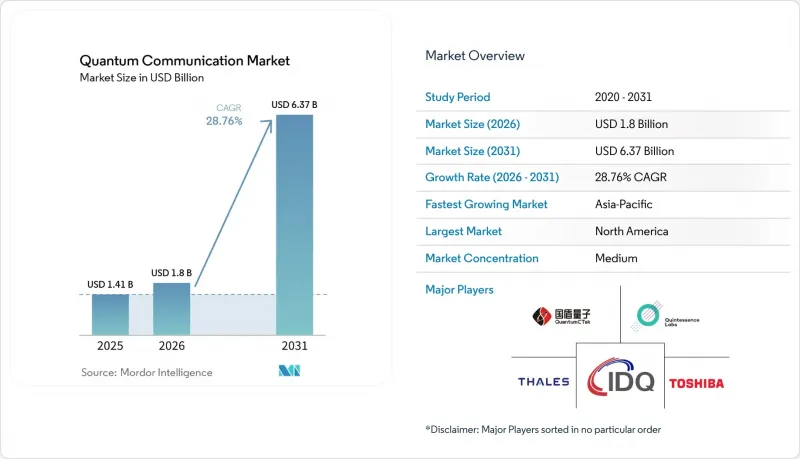
Mordor Intelligence에 의하면, 양자 통신 시장 규모는 2025년 14억 1,000만 달러로 평가되었고, 2026년 18억 달러에서 2031년까지 63억 7,000만 달러로 확대될 것으로 예측되며, 2026-2031년 연평균 복합 성장률(CAGR)은 28.76%를 나타낼 전망입니다.
본 보고서는 제공 서비스별(솔루션 및 서비스), 배포 방식별(온프레미스 및 클라우드), 조직 규모별(대기업 및 중소기업), 업종별(은행, 금융서비스 및 보험(BFSI), 정부·국방, 헬스케어, 항공우주, IT 및 통신, 에너지·유틸리티, 학술·연구, 기타), 지역별로 분류되어 있습니다. 시장 전망은 금액(달러) 기준으로 제시되어 있습니다.
세계의 양자 통신 시장 동향 및 인사이트
‘지금 수집, 나중에 복호화’라는 위험으로 인한 양자 보안으로의 전환 압력 고조
양자 통신 시장은 장기간 기밀 유지가 필요한 데이터에 대해 긴급성을 띠게 된 위협 모델로부터 혜택을 받고 있습니다. NIST는 2024년에 포스트 양자암호화의 핵심이 될 표준을 확정했으며, 2025년에는 백업 키 캡슐화 메커니즘으로 HQC를 채택했습니다. 이를 통해 구매자들은 장기적인 계획 수립을 위한 보다 명확한 전환 경로를 확보할 수 있게 되었습니다. 그 후, 백악관은 2026년 6월, 2030년 12월 31일까지 포스트 양자 키 확립과 2031년 12월 31일까지 디지털 서명 전환에 대해 연방 정부 차원의 확고한 기한을 설정했습니다. 또한 NIST는 포스트 양자로의 전환을 ‘미래에만 국한된 우려 사항’이 아닌 ‘현재의 위험 관리 과제’로 규정했습니다. 이는 수십 년에 걸쳐 기록을 보관하는 부문에 중요한 의미를 지닙니다. 이러한 압박은 양자 통신 시장에서 예산 승인을 앞당기는 데 박차를 가하고 있으며, 특히 대응이 늦어질 경우 기밀성이 높은 아카이브, 서명 시스템, 장기 보존되는 암호화 기록이 위험에 노출될 우려가 있는 부문에서 두드러집니다. 그 결과, 양자 통신 시장은 기술의 성숙도와 마찬가지로 규정 준수 일정에 의해서도 주도되고 있습니다.
주권적 보안 링크를 위한 국방·국가안보 조달
양자 통신 시장은 또한 주권적 관리를 중시하고 더 높은 도입 비용을 감당할 수 있는 국방 부문의 구매자들에 의해서도 견인되고 있습니다. 2026년 6월 백악관 지침에 따라 양자 보안으로의 전환을 위한 연방 정부의 이니셔티브이 확대되면서, 기밀 시스템을 지원하는 각 기관 및 계약업체 전체에 있어 이 문제가 중요해졌습니다. CNSA 2.0에 따른 NSA의 지침에 따르면, 2027년 1월 1일 이후 새로 조달되는 국가안보 시스템은 포스트 양자 알고리즘을 지원해야 하며, 향후 조달을 위한 명확한 기한이 설정되어 있습니다. 유럽의 정부 네트워크 동향 또한 주권 기반의 안전한 통신이 개념 단계에서 운영 환경으로 전환되고 있음을 보여줍니다. 예를 들어, 덴마크에서는 2025년에 10개 부처 거점에 걸친 양자 보안 네트워크가 가동을 시작했습니다. 이러한 프로그램이 양자 통신 시장에 중요한 이유는 국방 수준의 조달이 기술 기준을 수립하고, 이것이 나중에 금융, 통신, 인프라 부문의 도입에 영향을 미치는 경우가 많기 때문입니다. 또한, 이러한 프로그램은 단일 하드웨어를 판매하는 것보다 엄격한 인증, 관리, 통합 요건을 충족할 수 있는 공급업체를 우선시하는 경향이 있습니다.
양자 등급 하드웨어 및 네트워크 통합의 높은 자본 집약도
양자 통신 시장은 특히 도입에 특수한 하드웨어, 정밀한 광 설계, 네트워크 적응이 요구되는 경우 여전히 큰 비용 장벽에 직면해 있습니다. 이 과제는 전용 광섬유 환경, 엄격한 물리적 관리, 기존 보안 환경과의 심층적인 통합이 필요한 프로젝트에서 가장 두드러지게 나타납니다. 각 벤더는 재설계의 필요성을 줄이기 위해 노력하고 있습니다. 예를 들어, ID Quantique와 IonQ는 2025년에 ‘Clavis XG Multiplex’를 도입할 예정이며, 이를 통해 기존 도시권 광섬유 인프라 위에서 양자 트래픽과 기존 트래픽의 공존이 가능해집니다. 통신 사업자 주도형 모델도 이러한 전환을 뒷받침하고 있습니다. Orange Business는 단순한 장비 판매가 아닌 상용 서비스로서, 2025년에 Toshiba와 공동으로 ‘Quantum Defender’를 출시할 예정입니다. Quantropi는 2026년에 Nokia와의 통합을 실현한 D-QKD 플랫폼을 일반에 공개할 예정이며, 통신 사업자 및 기업을 위해 하드웨어에 의존하지 않는 도입 경로를 지원함으로써 이러한 전환을 더욱 가속화할 것으로 예측됩니다. 이러한 진전에도 불구하고, 저비용 패키지가 더 널리 이용 가능해지기 전까지는 양자 통신 시장이 중규모 조직보다는 대규모 구매자에게 더 접근하기 쉬운 상태가 지속될 것으로 보입니다.
부문 분석
‘솔루션’ 부문은 2025년 양자 통신 시장 매출의 58.97%를 차지한 것으로 평가되었으며, 기업 및 정부 기관이 암호화 하드웨어의 직접 소유를 선호함에 따라 2031년까지 연평균 성장률(CAGR) 30.34%로 확대될 것으로 전망됩니다. 이러한 추세는 중요 인프라 환경에서 키 생성 통제권을 유지해야 할 필요성을 반영한 것입니다. 솔루션 부문에서는 양자 키 배분(QKD) 시스템이 계속해서 주요 수익원이 될 전망입니다. 2025년 6월, Orange Business와 Toshiba는 파리 대도시권 전역에서 양자 키 배포와 포스트 양자암호화를 결합한 프랑스 최초의 상용 양자 보안 네트워크 서비스를 시작할 예정입니다. 양자 난수 생성기(QRNG)에 대해서도 전문적인 보안 용도의 범위를 넘어 보급이 확대될 것으로 전망됩니다. 팔로알토 네트웍스는 벤더 간 상호 운용성을 지원하기 위해 2025년 1월에 QRNG 오픈 API 프레임워크를 도입할 예정이며, 한편,OVHcloud는 2025년 9월까지 호스팅 중인 약 500만 개의 웹사이트 SSL 인증서를 보호하기 위해 QRNG로 생성된 엔트로피를 활용할 전망입니다.
단일 광자 검출기, 양자 메모리, 포토닉 집적 회로 등의 양자 통신용 구성 요소에 대해서는 계속해서 공급이 부족해 높은 이익률을 유지할 것으로 예측됩니다. 이러한 전문 공급업체의 집중이 가격 책정 우위를 뒷받침하고 있습니다. 또한, 기업들이 하이브리드 양자·고전 환경을 관리하기 위한 도구를 요구함에 따라, 포스트 양자 키 관리 소프트웨어나 크립토애자일 미들웨어와 같은 솔루션에 대한 조달 측면의 관심이 높아질 것으로 예측됩니다. 서비스 부문은 2025년 양자 통신 시장에서 차지하는 비중이 줄어들 것으로 예상되지만, 도입 및 통합을 통해 막대한 수익 기회가 창출될 전망입니다. 2026년 5월에는 Terra Quantum과 Merqury Cybersecurity가 몰타의 Melita가 운영 중인 통신 광섬유 네트워크에 양자 키 배분(QKD) 링크를 도입하여, ETSI 표준을 준수하는 REST API를 통해 수만 건의 키 요청을 처리할 전망입니다. BFSI(은행 및 금융 및 보험) 및 국방 기관이 암호화 민첩성 요구 사항, 전문 기술 부족, 온프레미스 인프라 운영 비용과 같은 과제를 해결해 나가면서 전문 서비스, 교육, 지원, 관리형 키 프로비저닝 시장은 확대될 것으로 예측됩니다.
2025년에는 온프레미스 배포가 매출의 67.32%를 차지한 것으로 평가되었으며, 이는 양자 통신 시장이 여전히 물리적으로 관리되는 환경을 선호하는 경향을 보여줍니다. 이러한 경향은 보관, 가시성, 운영상 격리가 여전히 핵심 요구 사항인 국방, 정부, 금융 결제 네트워크에서 가장 두드러집니다. 이러한 환경의 대부분에서 QKD의 보안상 이점은 키 배포 환경에 대한 엄격한 관리에 의존하기 때문에 공유 인프라의 도입은 어렵습니다. 따라서 양자 통신 시장의 도입 기반 대부분은 사업자가 네트워크 상태를 직접 관리할 수 있는 온프레미스형을 중심으로 구축되어 있습니다. 많은 규제 대상 시스템에서는 신뢰 경계를 신속하게 변경할 수 없기 때문에 이러한 도입 기반은 예측 기간 동안 계속해서 중요한 위치를 차지할 것으로 예측됩니다.
클라우드 구축 방식의 양자 통신 시장 규모는 2026-2031년 연평균 성장률(CAGR) 29.21%로 확대될 것으로 예측되며, 가장 빠르게 성장하는 구축 방식이 될 전망입니다. 이러한 성장은 포토닉스 부문의 소규모 구매자들에게 있어 복잡성으로 인한 장벽을 낮추는 소프트웨어 정의형 및 구독 기반 모델에 대한 수요 증가를 반영합니다. Quantropi의 D-QKD 플랫폼은 2026년에 일반 제공이 시작될 전망이며, Nokia의 보안 관리 서버와의 통합을 통해 통신 사업자 및 기업용 도입에서 하드웨어에 의존하지 않는 접근 방식을 지원합니다. 또한 Orange Business는 2025년에 Toshiba와 공동으로 파리 대도시권에서 ‘Quantum Defender’의 상용화를 실현하여, 통신 사업자가 양자 보안 네트워크를 관리형 서비스로 제공할 수 있음을 보여주었습니다. 그 결과, 양자 통신 시장에서는 모든 고객이 초기부터 막대한 설비 투자를 할 필요가 없는 제2의 도입 경로가 생겨나고 있습니다.
지역별 분석
북미는 2025년에 양자 통신 시장 점유율의 23.98%를 차지한 것으로 평가되었으며, 지역별로는 가장 큰 기여를 할 것으로 보입니다. 미국이 이 지역을 주도하고 있으며, 연방 정부의 의무화 및 계약업체의 의무로 인해 공공 기관 및 국방 관련 공급망 전반에서 전환 계획이 가속화되고 있습니다. 2026년 6월에 발령될 백악관 대통령령을 통해 포스트 양자 기술로의 전환에 관한 연방 정부의 확고한 기한이 설정될 것으로 예상되며, 조기 도입 결정에 대한 규정 준수 근거가 강화될 전망입니다. 캐나다도 이 지역의 위상을 뒷받침하고 있으며, 2026년 4월까지 연방 정부의 계획 요건이 수립될 전망이고, 2025년에는 선정된 양자 관련 기업에 3억 3,400만 캐나다 달러(2억 4,300만 달러)가 지원될 예정입니다.
아시아태평양은 2026-2031년 연평균 성장률(CAGR) 29.11%로 확대될 것으로 예측되며, 양자 통신 시장에서 가장 빠르게 성장하는 지역이 될 전망입니다. 중국의 캐리어급 네트워크는 2025년까지 1만 km를 넘어설 것으로 예상되며, 지상 광섬유와 위성 지상국을 결합하여 해당 지역에 국가 규모의 도입 완료된 레퍼런스 모델을 제공할 것으로 전망됩니다. 인도는 ‘국가 양자 미션(National Quantum Mission)’의 일환으로 2026년 4월에 1,000km QKD 달성이라는 이정표를 맞이할 예정이며, 2031년까지 위성을 통합한 2,000km 백본 구축을 목표로 하고 있습니다. 일본, 한국, 싱가포르도 정부 및 금융 부문을 위한 보안 통신 프로그램을 추진하고 있어 지역 전체 수요를 뒷받침하고 있습니다. 유럽은 EuroQCI 및 관련 각국 프로그램을 통해 경쟁력을 유지하고 있습니다. 덴마크는 2025년에 10개 부처 거점에 걸친 양자 보안 네트워크를 가동할 전망이며, 한편 ETSI는 2026년에도 지역적 표준 기반 강화를 지속할 것으로 예측됩니다.
남미, 중동 및 아프리카는 양자 통신 시장에서 여전히 초기 단계에 있으며, 활동은 정책 수립, 선정된 시범 사업, 중요 인프라 계획에 중점을 두고 있습니다. 남미에서는 브라질이 가장 활발한 초기 시장이며, 은행 간 보안 통신 및 금융 부문의 활용 사례에 관심이 집중되고 있습니다. 중동에서는 양자 보안 프로그램을 주권 클라우드 구상 및 중요 인프라 보호와 연계하고 있으며, 운영 요건이 성숙해짐에 따라 향후 조달을 촉진할 것으로 전망됩니다. 아프리카는 여전히 인지도 형성의 초기 단계에 있지만, 보다 광범위한 표준화 프레임워크에 참여함으로써 지역 프로그램이 양자 통신 시장 전체에서 현재 형성되고 있는 상호 운용성 방향에 부합하는 데 도움이 될 것입니다.
기타 혜택
- 엑셀 형식 시장 예측(ME) 시트
- 3개월간의 애널리스트 지원
자주 묻는 질문
목차
제1장 서론
제2장 조사 방법
제3장 주요 요약
제4장 시장 구도
제5장 시장 규모 및 성장 예측
제6장 경쟁 구도
제7장 시장 기회 및 향후 전망
AJY 26.09.03According to Mordor Intelligence, the quantum communication market size is projected to expand from USD 1.41 billion in 2025 and USD 1.80 billion in 2026 to USD 6.37 billion by 2031, registering a CAGR of 28.76% between 2026 to 2031.
This report is Segmented by Offering (Solutions, and Services), Deployment Mode (On-Premises, and Cloud), Organization Size (Large Enterprises, and Small and Medium Enterprises), Vertical (BFSI, Government and Defense, Healthcare, Aerospace, IT and Telecommunications, Energy and Utilities, Academia and Research, and More), and Geography. The Market Forecasts are Provided in Terms of Value (USD).
Global Quantum Communication Market Trends and Insights
Rising Quantum-Safe Migration Pressure from Harvest-Now, Decrypt-Later Risk
The quantum communication market is benefiting from a threat model that has become urgent for data with long confidentiality lives. NIST finalized core post-quantum standards in 2024 and selected HQC as a backup key encapsulation mechanism in 2025, providing buyers with a clearer migration path for long-term planning. The White House then set firm federal deadlines in June 2026 for post-quantum key establishment by December 31, 2030, and digital signature migration by December 31, 2031. NIST also framed post-quantum migration as a current risk-management issue rather than a future-only concern, which matters for sectors that retain records for decades. That pressure supports earlier budget approvals in the quantum communication market, especially where delayed action could expose sensitive archives, signing systems, and long-life encrypted records. The result is that the quantum communication market is being pulled forward by compliance calendars as much as by technology readiness.
Defense And National Security Procurement for Sovereign Secure Links
The quantum communication market is also being driven by defense buyers who value sovereign control and can absorb higher deployment costs. The White House order in June 2026 widened the federal push for quantum-safe migration and made the issue relevant across agencies and contractors that support sensitive systems. NSA guidance under CNSA 2.0 requires new national security system acquisitions to support post-quantum algorithms starting January 1, 2027, creating a clear procurement cutoff for future buys. Government network activity in Europe also shows that sovereign secure communications are moving from concept work into operational environments, as Denmark activated a quantum-secure network across 10 ministry sites in 2025. These programs matter for the quantum communication market because defense-grade procurement often sets technical standards that later influence financial, telecom, and infrastructure deployments. They also favor vendors that can meet strict certification, control, and integration requirements rather than selling stand-alone hardware.
High Capital Intensity for Quantum-Grade Hardware and Network Integration
The quantum communication market continues to face a significant cost barrier, particularly when deployments require specialized hardware, precise optical design, and network adaptation. This challenge is most evident in projects that require dedicated fiber conditions, strict physical control, and deep integration with legacy security environments. Vendors are working to reduce redesign requirements. For instance, ID Quantique and IonQ are expected to introduce Clavis XG Multiplex in 2025, enabling quantum and classical traffic to coexist on existing metropolitan fiber infrastructure. Carrier-led models are also supporting this transition. Orange Business is expected to launch Quantum Defender with Toshiba in 2025 as a commercial service rather than a pure equipment sale. Quantropi is expected to further advance this shift in 2026 by making its D-QKD platform generally available with Nokia integration, supporting hardware-agnostic deployment paths for carriers and enterprises. Despite these developments, the quantum communication market is likely to remain more accessible to large buyers than to mid-sized organizations until lower-cost packaging becomes more widely available.
Other drivers and restraints analyzed in the detailed report include:
- Fiber And Satellite Hybridization Expanding Deployable Use Cases
- Enterprise Crypto-Agility and Zero-Trust Program Alignment
- Limited Standardization Across Protocols, Test Methods, And Certification
For complete list of drivers and restraints, kindly check the Table Of Contents.
Segment Analysis
The Solutions segment is expected to account for 58.97% of the quantum communication market revenue in 2025, and it is projected to expand at a 30.34% CAGR through 2031, as enterprises and government agencies favor direct ownership of cryptographic hardware. This preference reflects the need to retain control over key generation in critical infrastructure settings. Quantum Key Distribution systems are expected to remain the primary revenue contributor within solutions. In June 2025, Orange Business and Toshiba are expected to launch France's first commercial quantum-safe network service, combining Quantum Key Distribution and post-quantum cryptography across the greater Paris area. Quantum Random Number Generators are also expected to move beyond specialized security applications. Palo Alto Networks is expected to introduce its QRNG Open API framework in January 2025 to support interoperability across vendors, while OVHcloud is expected to use QRNG-generated entropy to secure SSL certificates for nearly 5 million hosted websites by September 2025.
Quantum communication components, including single-photon detectors, quantum memories, and photonic integrated circuits, are expected to remain supply-constrained and command high margins. This concentration of specialist suppliers supports their pricing position. Other solutions, including post-quantum key management software and crypto-agile middleware, are expected to receive greater procurement attention as enterprises seek tools to manage hybrid quantum-classical environments. The Services segment is expected to represent a smaller share of the quantum communication market in 2025, although deployment and integration are likely to generate substantial billing opportunities. In May 2026, Terra Quantum and Merqury Cybersecurity are expected to deploy a Quantum Key Distribution link on Melita's active telecom fiber network in Malta, processing tens of thousands of key requests through an ETSI-aligned REST API. Professional services, training, support, and managed key provisioning are expected to expand as BFSI and defense organizations address crypto-agility requirements, limited specialist skills, and the cost of operating on-premises infrastructure.
On-premises deployment is expected to account for 67.32% of revenue in 2025, showing that the quantum communication market still leans toward physically controlled environments. This pattern is strongest in defense, government, and financial clearing networks, where custody, visibility, and operational isolation remain central requirements. In many of these settings, QKD's security promise depends on tight control over the key distribution environment, making shared infrastructure a difficult fit. The quantum communication market has therefore built much of its installed base around on-premises models, where operators can directly manage network conditions. This installed base is expected to remain important through the forecast period because many regulated systems cannot shift their trust boundaries quickly.
The quantum communication market size for cloud deployment is projected to expand at a 29.21% CAGR from 2026 to 2031, making it the fastest-growing deployment mode. This growth reflects rising demand for software-defined and subscription-based models that reduce the complexity barrier for smaller buyers in photonics. Quantropi's D-QKD platform is expected to reach general availability in 2026 with integration into Nokia's Security Management Server, supporting a hardware-agnostic approach for carrier and enterprise deployments. Orange Business also commercialized Quantum Defender in the greater Paris area in 2025 with Toshiba, showing how telecom operators can package quantum-safe networking as a managed service. As a result, the quantum communication market is creating a second adoption path that does not require every customer to begin with heavy capital spending.
Complete Report Scope:
- By Offering
- Solutions
- Quantum Communication Components
- Quantum Key Distribution Solutions
- Quantum Random Number Generator
- Other Solutions
- Services
- Professional Services
- Training and Consulting
- Deployment and Integration
- Support and Maintenance
- Other Services
- Solutions
- By Deployment Mode
- On-Premises
- Cloud
- By Organization Size
- Large Enterprises
- Small and Medium Enterprises
- By Vertical
- BFSI
- Government and Defense
- Healthcare
- Aerospace
- IT and Telecommunications
- Energy and Utilities
- Academia and Research
- Other Verticals
- By Geography
- North America
- United States
- Canada
- Mexico
- South America
- Brazil
- Argentina
- Rest of South America
- Europe
- Germany
- United Kingdom
- France
- Rest of Europe
- Asia-Pacific
- China
- Japan
- India
- South Korea
- Rest of Asia-Pacific
- Middle East
- Saudi Arabia
- United Arab Emirates
- Rest of the Middle East
- Africa
- South Africa
- Nigeria
- Rest of Africa
- North America
Geography Analysis
North America is expected to hold 23.98% of the quantum communication market share in 2025, making it the largest regional contributor. The United States leads the region, as federal mandates and contractor obligations are accelerating migration planning across public agencies and defense-linked supply chains. The White House order issued in June 2026 is expected to set firm federal deadlines for post-quantum migration, strengthening the compliance case for earlier deployment decisions. Canada also supports the region's position, with federal planning requirements expected by April 2026 and CAD 334 million (USD 243 million) directed to selected quantum companies in 2025.
Asia-Pacific is projected to expand at a CAGR of 29.11% from 2026 to 2031, making it the fastest-growing region in the quantum communication market. China's carrier-grade network is expected to exceed 10,000 km by 2025 and to combine terrestrial fiber with satellite ground stations, providing the region with a deployed national-scale reference model. India is expected to reach a 1,000-km QKD milestone in April 2026 under the National Quantum Mission and target a 2,000-km backbone with satellite integration by 2031. Japan, South Korea, and Singapore are also advancing secure communications programs for government and financial applications, supporting broader regional demand. Europe remains competitive through EuroQCI and related national programs. Denmark is expected to activate a quantum-secure network across 10 ministry sites in 2025, while ETSI is expected to continue strengthening the regional standards base in 2026.
South America, the Middle East, and Africa remain earlier-stage parts of the quantum communication market, with activity focused on policy work, selective pilots, and critical infrastructure planning. Brazil is the most active early market in South America, with interest focused on secure interbank communication and financial-sector use cases. The Middle East is linking quantum-safe programs to sovereign cloud agendas and critical infrastructure protection, which should support future procurement as operational requirements mature. Africa remains at an earlier awareness stage, but participation in broader standards frameworks should help regional programs align with the interoperability direction now forming across the quantum communication market.
- Toshiba Corporation
- Thales S.A.
- ID Quantique SA
- QuintessenceLabs Pty Ltd
- QuantumCTek Co., Ltd.
- Qubitekk, Inc.
- Quantum Xchange, Inc.
- MagiQ Technologies, Inc.
- Arqit Quantum Inc.
- Aliro Quantum, Inc.
- HEQA Security B.V.
- Crypta Labs Limited
- SpeQtral Pte. Ltd.
- QNu Labs Private Limited
- QphoX B.V.
- Qunnect, Inc.
- LuxQuanta Technologies S.L.
- Quantropi Inc.
Additional Benefits:
- The market estimate (ME) sheet in Excel format
- 3 months of analyst support
TABLE OF CONTENTS
1 INTRODUCTION
- 1.1 Study Assumptions and Market Definition
- 1.2 Scope of the Study
2 RESEARCH METHODOLOGY
3 EXECUTIVE SUMMARY
4 MARKET LANDSCAPE
- 4.1 Market Overview
- 4.2 Market Drivers
- 4.2.1 Rising Quantum-Safe Migration Pressure From Harvest-Now, Decrypt-Later Risk
- 4.2.2 Defense And National Security Procurement For Sovereign Secure Links
- 4.2.3 Fiber And Satellite Hybridization Expanding Deployable Use Cases
- 4.2.4 Enterprise Crypto-Agility And Zero-Trust Program Alignment
- 4.2.5 Interoperability Demand Across Multi-Vendor Quantum Security Stacks
- 4.2.6 Specialized Demand From Critical Infrastructure And High-Value Transaction Networks
- 4.3 Market Restraints
- 4.3.1 High Capital Intensity For Quantum-Grade Hardware And Network Integration
- 4.3.2 Limited Standardization Across Protocols, Test Methods, And Certification
- 4.3.3 Shortage Of Quantum Optics And Photonics Deployment Talent
- 4.3.4 Export Controls And Sovereignty Rules Fragment Cross-Border Rollouts
- 4.4 Industry Value Chain Analysis
- 4.5 Regulatory Landscape
- 4.6 Technological Outlook
- 4.7 Pricing Analysis
- 4.8 Porter's Five Forces Analysis
- 4.8.1 Bargaining Power Of Suppliers
- 4.8.2 Bargaining Power Of Buyers
- 4.8.3 Threat Of New Entrants
- 4.8.4 Threat Of Substitutes
- 4.8.5 Industry Rivalry Analysis
5 MARKET SIZE AND GROWTH FORECASTS (VALUE)
- 5.1 By Offering
- 5.1.1 Solutions
- 5.1.1.1 Quantum Communication Components
- 5.1.1.2 Quantum Key Distribution Solutions
- 5.1.1.3 Quantum Random Number Generator
- 5.1.1.4 Other Solutions
- 5.1.2 Services
- 5.1.2.1 Professional Services
- 5.1.2.2 Training and Consulting
- 5.1.2.3 Deployment and Integration
- 5.1.2.4 Support and Maintenance
- 5.1.2.5 Other Services
- 5.1.1 Solutions
- 5.2 By Deployment Mode
- 5.2.1 On-Premises
- 5.2.2 Cloud
- 5.3 By Organization Size
- 5.3.1 Large Enterprises
- 5.3.2 Small and Medium Enterprises
- 5.4 By Vertical
- 5.4.1 BFSI
- 5.4.2 Government and Defense
- 5.4.3 Healthcare
- 5.4.4 Aerospace
- 5.4.5 IT and Telecommunications
- 5.4.6 Energy and Utilities
- 5.4.7 Academia and Research
- 5.4.8 Other Verticals
- 5.5 By Geography
- 5.5.1 North America
- 5.5.1.1 United States
- 5.5.1.2 Canada
- 5.5.1.3 Mexico
- 5.5.2 South America
- 5.5.2.1 Brazil
- 5.5.2.2 Argentina
- 5.5.2.3 Rest of South America
- 5.5.3 Europe
- 5.5.3.1 Germany
- 5.5.3.2 United Kingdom
- 5.5.3.3 France
- 5.5.3.4 Rest of Europe
- 5.5.4 Asia-Pacific
- 5.5.4.1 China
- 5.5.4.2 Japan
- 5.5.4.3 India
- 5.5.4.4 South Korea
- 5.5.4.5 Rest of Asia-Pacific
- 5.5.5 Middle East
- 5.5.5.1 Saudi Arabia
- 5.5.5.2 United Arab Emirates
- 5.5.5.3 Rest of the Middle East
- 5.5.6 Africa
- 5.5.6.1 South Africa
- 5.5.6.2 Nigeria
- 5.5.6.3 Rest of Africa
- 5.5.1 North America
6 COMPETITIVE LANDSCAPE
- 6.1 Market Concentration
- 6.2 Strategic Moves
- 6.3 Market Share Analysis
- 6.4 Company Profiles (includes Global Level Overview, Market Level Overview, Core Segments, Financials as available, Strategic Information, Market Rank/Share, Products and Services, Recent Developments)
- 6.4.1 Toshiba Corporation
- 6.4.2 Thales S.A.
- 6.4.3 ID Quantique SA
- 6.4.4 QuintessenceLabs Pty Ltd
- 6.4.5 QuantumCTek Co., Ltd.
- 6.4.6 Qubitekk, Inc.
- 6.4.7 Quantum Xchange, Inc.
- 6.4.8 MagiQ Technologies, Inc.
- 6.4.9 Arqit Quantum Inc.
- 6.4.10 Aliro Quantum, Inc.
- 6.4.11 HEQA Security B.V.
- 6.4.12 Crypta Labs Limited
- 6.4.13 SpeQtral Pte. Ltd.
- 6.4.14 QNu Labs Private Limited
- 6.4.15 QphoX B.V.
- 6.4.16 Qunnect, Inc.
- 6.4.17 LuxQuanta Technologies S.L.
- 6.4.18 Quantropi Inc.
7 MARKET OPPORTUNITIES AND FUTURE OUTLOOK
- 7.1 White-Space And Unmet-Need Assessment
- 7.2 Roadmap For Quantum Network Commercialization
- 7.3 Ecosystem Analysis


