|
시장보고서
상품코드
2119200
납땜 재료 시장 : 시장 점유율 분석, 업계 동향 및 통계, 성장 예측(2026-2031년)Solder Materials - Market Share Analysis, Industry Trends & Statistics, Growth Forecasts (2026 - 2031) |
||||||
 Mordor Intelligence
Mordor Intelligence에 의하면, 납땜 재료 시장 규모는 2025년에 50억 4,000만 달러로 평가되었고, 2026년 52억 5,000만 달러에서 2031년까지 67억 2,000만 달러에 이를 것으로 예측되며, 예측 기간(2026-2031년) CAGR은 5.06%를 나타낼 전망입니다.
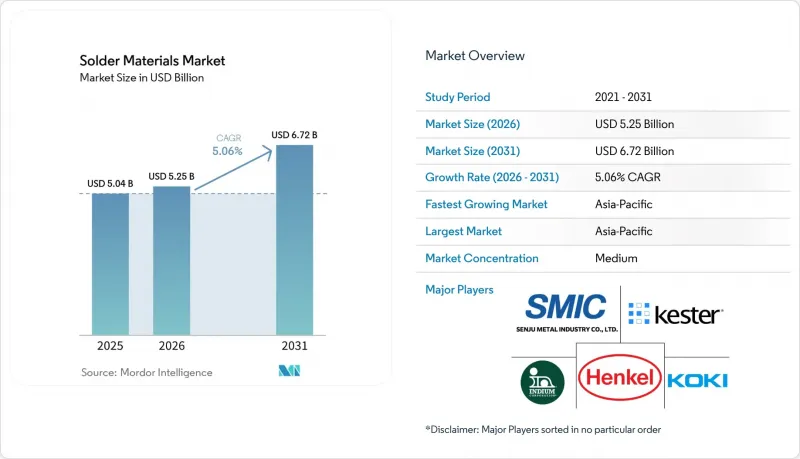
본 보고서는 유형별(납계 납땜 재료 및 무연 납땜 재료), 제품 유형별(페이스트, 와이어, 기타), 공정 유형별(웨이브 솔더링, 리플로우 솔더링, 기타), 최종 이용 산업별(가전, 자동차, 기타), 지역별(아시아태평양, 북미, 유럽, 남미, 중동 및 아프리카)로 분류되어 있습니다. 제시된 시장 예측은 금액(달러) 기준입니다.
세계의 납땜 재료 시장 동향 및 인사이트
전자기기 제조 및 인쇄회로기판(PCB) 조립의 확대
전자기기 제조의 성장은 납땜 재료 시장 내 솔더 페이스트, 솔더 와이어, 솔더 바, 플럭스의 지속적인 소비를 뒷받침하고 있습니다. 클라우드 하드웨어, AI 인프라, 전기차용 전자기기 조립 활동 증가에 따라 이러한 재료가 필요한 기판의 수가 증가하고 있습니다. 인도는 2025년 4월 8일, 국내 전자 부품 제조를 강화하기 위해 2,291억 9,000만 루피(약 27억 달러)의 예산을 투입한 ‘전자 부품 제조 계획’을 승인했습니다. 이 프로그램은 인쇄회로기판(PCB) 제조 능력 개발을 지원하고, 국내 조립 거점을 확대했습니다. 인도, 베트남, 태국, 멕시코에 신설되는 생산 거점은 현지에서의 자재 조달 가능성, 관리된 보관 환경, 공정 지원, 신속한 공급 체계를 필요로 합니다. 이에 따라 여러 지역에 걸쳐 승인 취득, 유통, 공정 시험, 일관된 기술 지원을 관리할 수 있는 혼합 제조업체가 유리해집니다.
자동차의 전동화와 차량당 반도체 탑재량 증가
자동차의 전동화에 따라 파워 모듈, 배터리 관리 시스템, 게이트 드라이버, 고전압 제어 장비에서 솔더에 대한 수요가 증가하고 있습니다. 이러한 용도에서는 광범위한 온도 변화, 반복되는 열 사이클, 진동, 지속적인 전기적 부하를 견딜 수 있는 상호 연결이 요구됩니다. 이러한 요구 사항으로 인해, 까다로운 자동차 프로그램에서는 표준 SAC305보다 강화된 합금이 유리합니다. KOKI는 2025년 6월, 가혹한 작동 조건에 노출되는 자동차 및 산업용 어셈블리용 ‘SB6NX58-G850’을 출시했습니다. 이 제품은 이러한 용도에서 공극이 적고 신뢰성이 높은 솔더 접합에 대한 수요를 반영한 것입니다. 자동차 제조업체들이 안전성이 극히 중요한 전자 기기를 위해 보다 전문적인 합금 시스템을 인증하고, 장기적인 생산 프로그램에 이를 채택하게 된다면 납땜 재료 시장은 그 혜택을 누리게 될 것입니다.
주석, 은 구리, 납의 가격 변동
SAC305는 중량 기준으로 96.5%의 주석을 포함하고 있기 때문에 금속 가격은 여전히 납땜 재료 시장에 직접적인 위험 요인으로 작용하고 있습니다. 가격 변동은 특히 재료비가 판매 가격의 대부분을 차지하는 표준 와이어나 바 제품의 경우, 조립 업체나 배합 업체의 이익률에 영향을 미칩니다. 일반적으로 사용되는 솔더 합금에서 주요 금속의 역할을 대규모로 대체할 수 있는 물질은 존재하지 않습니다. 국제에너지기구(IEA) 보고서에 따르면, 2025년 1월부터 2026년 4월에 걸쳐 공급 상황이 여전히 핍박한 가운데, 주석과 비철금속의 가격이 급등했습니다. 비용 압박은 공급 계약의 유연성이 제한적이고, 고객이 생산 설정을 변경하지 않고 인증된 합금을 요구할 때 가장 심각합니다. AIM Solder의 REL61과 같은 저은 대체재는 대량 생산을 하는 전자기기 제조업체에 제품을 공급하는 공급업체의 비용 경쟁력을 향상시킬 수 있습니다.
부문 분석
2025년 기준, 무연 솔더 소재는 총 매출의 68.14%를 차지했으며, 2031년까지 연평균 성장률(CAGR) 5.14%를 나타낼 것으로 예측됩니다. 그 역할은 전자기기, 자동차, 산업 장비 분야의 규정 준수 요건에 의해 뒷받침되고 있습니다. 주석, 은 구리를 포함하는 SAC305는 RoHS 준수 SMT 실장 분야에서 계속해서 표준 합금으로 자리 잡고 있습니다. 비스무트, 안티몬, 인듐 첨가제는 자동차용 제어 장치 및 파워 모듈에서 열 피로 성능을 향상시킬 수 있습니다. 2025년 11월 EU의 RoHS 면제 조항 7(a) 개정에 따라, 영향을 받는 고융점 납 솔더 용도에 대해 명확한 규정 준수 일정이 도입되었습니다. 이에 따라 지속적인 면제가 적용되지 않는 용도에서 납계 재료의 적용 범위는 좁아지게 됩니다.
납계 납땜 재료는 여전히 특정 군용 전자 기기 및 항공우주 분야의 다이 부착 용도로 사용되고 있습니다. 그 사용은 유효한 적용 제외 및 인증된 용도 요건에 따라 달라집니다. 저온 비스무트-주석 합금은 열에 민감한 플렉서블 기판, 웨어러블 기기, 카메라 모듈에서의 사용이 증가하고 있습니다. 이러한 합금은 SAC305의 240℃와 비교하여 160℃ 부근에서 리플로우가 가능합니다. 부품이나 기판의 민감도가 공정 온도를 제한하는 경우, 열에 노출되는 시간이 적은 것은 유리합니다. 따라서 납땜 재료 산업에서는 고신뢰성 용도와 온도에 민감한 용도 모두에서 무연화가 진행되고 있습니다. 납땜 재료 시장에서 성능이나 면제 조건이 사용을 허용하는 분야에서는 납 함유 제품이 소규모이긴 하지만 전문적인 역할을 유지하고 있습니다.
페이스트는 2025년에 총 매출의 34.82%를 차지한 것으로 평가되었으며, 2031년까지 연평균 성장률(CAGR) 5.92%로 성장할 것으로 전망됩니다. 이러한 위상은 새로운 전자 기기 설계에서 표면실장기술(SMT)의 활용을 반영합니다. 또한, 페이스트는 유형 5부터 유형 7의 분말 등급을 필요로 하는 첨단 패키징 용도도 지원합니다. Indium Corporation은 2026년 3월, 저은 함량 SAC105 및 SAC0307 합금용 유형 5 무할로겐 페이스트 ‘Indium12.9HF’로 『Circuits Assembly』 지의 신제품 도입(NPI) 상을 수상했습니다. 이 제품은 01005 크기의 미세 패턴 인쇄용으로 설계되었습니다. 이러한 제품 요구 사항은 납땜 재료 시장에서 페이스트가 기여하는 가치를 입증합니다.
와이어 솔더는 스루홀 부품 및 커넥터용 셀렉티브 솔더링과 로봇 납땜 용도로 공급되고 있습니다. 바 솔더는 웨이브 납땜 탱크에서 사용되며, 특히 가전제품 및 산업용 전자기기 조립에 활용됩니다. 플럭스는 모든 공정에서 소비되고 있으며, 무할로겐 및 노클린 화학 성분으로의 전환이 진행되고 있습니다. 분말과 프리폼은 시장 점유율은 작지만, 고부가가치 제품 위치를 차지하고 있습니다. 프리폼은 파워 디바이스의 다이 부착에 사용되며, 합금 부피의 정확도가 열전달 및 장기적인 접합 신뢰성에 영향을 미칩니다. 납땜 재료 산업에서는 각 형태가 고유한 조립 요구 사항에 맞추어 사용됩니다. 제품 선정은 기판 설계, 제조 방법, 정밀도 요구 사항, 예상되는 사용 환경에 따라 결정됩니다.
지역별 분석
아시아태평양은 2025년에 총 매출의 52.69%를 차지한 것으로 평가되었으며, 2031년까지 연평균 성장률(CAGR) 5.78%로 성장할 것으로 전망됩니다. 중국은 광범위한 인쇄회로기판(PCB) 및 전자기기 조립 기반을 갖추고 있어 여전히 주요 지역 소비 거점으로 자리 잡고 있습니다. 한국은 반도체 패키징 및 메모리 제조 사업을 통해 미세 패턴용 페이스트와 고성능 소재에 대한 수요를 뒷받침하고 있습니다. 일본은 자동차용 등급 및 첨단 패키징용 합금을 비롯한 고정밀·고신뢰성 소재 분야에서 여전히 중요한 위치를 차지하고 있습니다. 센주 금속 공업과 KOKI 등은 이러한 특수한 요구 사항을 충족하는 공급업체 중 한 축을 담당하고 있습니다. 베트남, 태국, 말레이시아의 전자기기 수탁 제조(EMS) 생산 능력이 확대됨에 따라 동남아시아의 중요성이 높아지고 있습니다.
인도 역시 전자기기 생산 거점을 확대되고 있습니다. 새로운 PCB 제조 시설의 건설로 인해 국내외 공급업체의 페이스트 및 와이어에 대한 현지 수요가 발생할 가능성이 있습니다. 북미의 납땜 재료 시장은 방위, 항공우주, 의료기기, 첨단 패키징 분야에 중점을 두고 있습니다. 이러한 용도에는 기술적 인증이나 고객별 합금 인증이 필요합니다. 유럽에서는 특히 독일과 이탈리아에서 자동차용 전자기기 및 산업기계 생산에 따른 수요가 발생하고 있습니다. EU의 RoHS 규정 변경에 따라 특정 고융점 납 용도에 대한 단기적인 인증 작업이 증가하고 있습니다.
남미, 중동 및 아프리카는 각각 서로 다른 제조 특성을 지닌 수요 지역입니다. 브라질에서는 ‘조나 프랑카 데 마나우스’의 틀 아래, 소비재 및 산업용 기기를 위한 국내 전자기기 조립이 이루어지고 있습니다. 아르헨티나에서는 가전제품용 전자기기 제조가 유지되고 있습니다. 사우디아라비아와 아랍에미리트에서는 산업 투자 및 자유무역지역 내 활동을 통해 전자기기 조립 수요가 확대되고 있습니다. 남아프리카에서는 광업 및 에너지 분야의 전자기기 유지보수 수요를 뒷받침하고 있습니다. 이 지역들은 납땜 재료 시장에 있어 성장세가 두드러지는 분야이며, 장기적으로는 현지 조달 정책 및 산업화 프로그램에 의해 뒷받침되고 있습니다.
기타 혜택
- 엑셀 형식 시장 예측(ME) 시트
- 3개월간의 애널리스트 지원
자주 묻는 질문
목차
제1장 서론
제2장 조사 방법
제3장 주요 요약
제4장 시장 구도
제5장 시장 규모 및 성장 예측
제6장 경쟁 구도
제7장 시장 기회 및 향후 전망
AJY 26.09.03According to Mordor Intelligence, the solder materials market size was valued at USD 5.04 billion in 2025 and estimated to grow from USD 5.25 billion in 2026 to reach USD 6.72 billion by 2031, at a CAGR of 5.06% during the forecast period (2026-2031).
This report is Segmented by Type (Lead-Based Solder Materials and Lead-Free Solder Materials), Product Type (Paste, Wire, and More), Process Type (Wave Soldering, Reflow Soldering, and More), End-Use Industry (Consumer Electronics, Automotive, and More), and Geography (Asia-Pacific, North America, Europe, South America, and Middle-East and Africa). The Market Forecasts Provided are in Terms of Value (USD).
Global Solder Materials Market Trends and Insights
Expansion of Electronics Manufacturing and PCB Assembly
Electronics manufacturing growth supports recurring consumption of solder paste, wire, bar, and flux in the solder materials market. Assembly activity for cloud hardware, AI infrastructure, and electric-vehicle electronics increases the number of boards that require these materials. India approved the Electronics Component Manufacturing Scheme on April 8, 2025, with an outlay of INR 22,919 crore (approximately USD 2.7 billion) to strengthen domestic electronics component manufacturing. The program supported the development of Printed Circuit Board (PCB) fabrication capacity and expanded the domestic assembly base. New production hubs in India, Vietnam, Thailand, and Mexico require local material availability, controlled storage, process support, and responsive supply arrangements. This favors formulators that can manage approvals, distribution, process trials, and consistent technical support across several regions.
Automotive Electrification and Rising Semiconductor Content Per Vehicle
Automotive electrification is increasing solder requirements in power modules, battery management systems, gate drivers, and high-voltage control equipment. These applications require interconnects that can tolerate wide temperature changes, repeated thermal cycles, vibration, and sustained electrical loading. This requirement favors reinforced formulations over standard SAC305 in demanding automotive programs. KOKI introduced SB6NX58-G850 in June 2025 for automotive and industrial assemblies exposed to harsh operating conditions. The product reflects demand for lower-void, high-reliability solder joints in these applications. The solder materials market benefits when automotive customers qualify more specialized alloy systems for safety-critical electronics and use them across longer production programs.
Tin, Silver, Copper, and Lead Price Volatility
Metal prices remain a direct risk for the solder materials market because SAC305 contains 96.5% tin by weight. Price changes affect margins for assemblers and formulators, especially in standard wire and bar products where material costs form a large share of selling prices. There is no mass-scale substitute for the core metal roles within commonly used solder alloys. The International Energy Agency reported sharply rising tin and base-metal prices between January 2025 and April 2026 while supply conditions remained tight. Cost pressure is most acute where supply agreements offer limited flexibility and customers require qualified alloys without changes to production settings. Low-silver alternatives such as AIM Solder's REL61 can improve the cost position of suppliers serving high-volume electronics manufacturing.
Other drivers and restraints analyzed in the detailed report include:
- Lead-Free Conversion Driven by RoHS and Related Substance Restrictions
- Miniaturization, Fine-Pitch Assembly, and Advanced Semiconductor Packaging
- Higher Processing Windows and Qualification Costs for Lead-Free Alloys
For complete list of drivers and restraints, kindly check the Table Of Contents.
Segment Analysis
Lead-free solder materials held 68.14% of overall revenue in 2025 and are projected to grow at a 5.14% CAGR through 2031. Their role is supported by compliance needs in electronics, automotive, and industrial equipment. SAC305, with tin, silver, and copper, remains a standard alloy for RoHS-compliant SMT assembly. Bismuth, antimony, and indium additives can improve thermal-fatigue performance for automotive control units and power modules. The November 2025 EU restructuring of RoHS Exemption 7(a) introduced a defined compliance timetable for affected high-melting-temperature lead solder uses. This narrows the addressable base for lead-based materials in applications without a continuing exemption.
Lead-based solder materials still serve certain military electronics and aerospace die-attach applications. Their use depends on valid exemptions and qualified application requirements. Low-temperature bismuth-tin alloys are gaining use in heat-sensitive flexible substrates, wearables, and camera modules. These alloys can reflow near 160 °C, compared with 240 °C for SAC305. The lower thermal exposure is useful where component or substrate sensitivity limits process temperatures. The solder materials industry is therefore seeing lead-free growth across both high-reliability and temperature-sensitive applications. The solder materials market retains a smaller, specialized role for lead-based products where performance and exemption conditions allow their use.
Paste held 34.82% of overall revenue in 2025 and is forecast to grow at a 5.92% CAGR through 2031. Its position reflects surface-mount technology use in new electronics designs. Paste also supports advanced packaging applications that require Type 5 through Type 7 powder grades. Indium Corporation received a Circuits Assembly New Product Introduction (NPI) Award in March 2026 for Indium12.9HF, a Type 5 halogen-free paste for low-silver SAC105 and SAC0307 alloys. The product was designed for 01005 fine-feature printing. These product requirements support the value contribution of paste within the solder materials market.
Wire solder supplies selective and robotic soldering applications for through-hole parts and connectors. Bar solder is used in wave-soldering baths, particularly for consumer and industrial electronic assemblies. Flux is consumed across process types, with ongoing movement toward halogen-free and no-clean chemistries. Powder and preforms occupy smaller but higher-value product positions. Preforms are used in power-device die attach, where accurate alloy volume affects heat transfer and long-term joint reliability. The solder materials industry uses each format for a distinct assembly need. Product selection depends on board design, production method, precision requirements, and the expected service environment.
Complete Report Scope:
- By Type
- Lead-Based Solder Materials
- Lead-Free Solder Materials
- By Product Type
- Paste
- Wire
- Bar
- Flux
- Powder
- Preforms
- Other Products
- By Process Type
- Wave Soldering
- Reflow Soldering
- Selective Soldering
- Robotic Soldering
- Laser Soldering
- By End-Use Industry
- Consumer Electronics
- Automotive
- Industrial Equipment
- Building and Electrical Infrastructure
- Telecommunications
- Aerospace and Defense
- Medical Electronics
- Other End-Use Industries
- By Geography
- Asia-Pacific
- China
- India
- Japan
- South Korea
- Rest of Asia-Pacific
- North America
- United States
- Canada
- Mexico
- Europe
- Germany
- United Kingdom
- France
- Italy
- Russia
- Rest of Europe
- South America
- Brazil
- Argentina
- Rest of South America
- Middle-East and Africa
- Saudi Arabia
- South Africa
- Rest of Middle-East and Africa
- Asia-Pacific
Geography Analysis
Asia-Pacific held 52.69% of overall revenue in 2025 and is forecast to grow at a 5.78% CAGR through 2031. China remains a major regional consumption center because of its broad PCB and electronics assembly base. South Korea supports fine-feature paste and performance demand through its semiconductor packaging and memory manufacturing operations. Japan remains important in precision and high-reliability materials, including automotive-grade and advanced packaging alloys. Senju Metal Industry and KOKI are among the suppliers serving these specialized requirements. Southeast Asia is becoming more important as electronics manufacturing services (EMS) capacity expands in Vietnam, Thailand, and Malaysia.
India is also expanding its electronics production base. New PCB fabrication facilities can create local demand for paste and wire from domestic and international suppliers. The solder materials market in North America is weighted toward defense, aerospace, medical devices, and advanced packaging. These uses require technical qualifications and customer-specific alloy certifications. Europe has demand from automotive electronics and industrial machinery production, especially in Germany and Italy. EU RoHS changes are increasing near-term qualification work for certain high-melting-temperature lead applications.
South America and Middle-East and Africa represent demand areas with different manufacturing profiles. Brazil has domestic electronics assembly for consumer goods and industrial equipment under the Zona Franca de Manaus framework. Argentina retains electronics manufacturing for domestic appliance applications. Saudi Arabia and the United Arab Emirates provide developing electronics assembly demand through industrial investment and free-trade-zone activity. South Africa supports mining and energy electronics maintenance needs. These regions represent developing areas for the solder materials market, supported by local-content policies and industrialization programs over the longer term.
- AIM Solder
- Balver Zinn GmbH
- DUKSAN Holdings
- Fusion Inc.
- Henkel AG & Co. KGaA
- Indium Corporation
- Kester
- KOKI Company Ltd.
- MacDermid Alpha Electronics Solutions
- Nihon Superior Co., Ltd.
- Qualitek International, Inc.
- Senju Metal Industry Co., Ltd.
- Stannol GmbH & Co. KG
- Tamura Corporation
Additional Benefits:
- The market estimate (ME) sheet in Excel format
- 3 months of analyst support
TABLE OF CONTENTS
1 Introduction
- 1.1 Study Assumptions and Market Definition
- 1.2 Scope of the Study
2 Research Methodology
3 Executive Summary
4 Market Landscape
- 4.1 Market Overview
- 4.2 Market Drivers
- 4.2.1 Expansion of Electronics Manufacturing and PCB Assembly
- 4.2.2 Automotive Electrification and Rising Semiconductor Content per Vehicle
- 4.2.3 Lead-Free Conversion Driven by RoHS and Related Substance Restrictions
- 4.2.4 Miniaturization, Fine-Pitch Assembly, and Advanced Semiconductor Packaging
- 4.2.5 Qualification Demand for High-Reliability Electronics in Harsh Environments
- 4.3 Market Restraints
- 4.3.1 Tin, Silver, Copper, and Lead Price Volatility
- 4.3.2 Higher Processing Windows and Qualification Costs for Lead-Free Alloys
- 4.3.3 Reliability and Thermal-Fatigue Risk in High-Density Assemblies
- 4.4 Value Chain Analysis
- 4.5 Porter's Five Forces Analysis
- 4.5.1 Threat of New Entrants
- 4.5.2 Bargaining Power of Suppliers
- 4.5.3 Bargaining Power of Buyers
- 4.5.4 Threat of Substitutes
- 4.5.5 Competitive Rivalry
5 Market Size and Growth Forecasts (Value)
- 5.1 By Type
- 5.1.1 Lead-Based Solder Materials
- 5.1.2 Lead-Free Solder Materials
- 5.2 By Product Type
- 5.2.1 Paste
- 5.2.2 Wire
- 5.2.3 Bar
- 5.2.4 Flux
- 5.2.5 Powder
- 5.2.6 Preforms
- 5.2.7 Other Products
- 5.3 By Process Type
- 5.3.1 Wave Soldering
- 5.3.2 Reflow Soldering
- 5.3.3 Selective Soldering
- 5.3.4 Robotic Soldering
- 5.3.5 Laser Soldering
- 5.4 By End-Use Industry
- 5.4.1 Consumer Electronics
- 5.4.2 Automotive
- 5.4.3 Industrial Equipment
- 5.4.4 Building and Electrical Infrastructure
- 5.4.5 Telecommunications
- 5.4.6 Aerospace and Defense
- 5.4.7 Medical Electronics
- 5.4.8 Other End-Use Industries
- 5.5 By Geography
- 5.5.1 Asia-Pacific
- 5.5.1.1 China
- 5.5.1.2 India
- 5.5.1.3 Japan
- 5.5.1.4 South Korea
- 5.5.1.5 Rest of Asia-Pacific
- 5.5.2 North America
- 5.5.2.1 United States
- 5.5.2.2 Canada
- 5.5.2.3 Mexico
- 5.5.3 Europe
- 5.5.3.1 Germany
- 5.5.3.2 United Kingdom
- 5.5.3.3 France
- 5.5.3.4 Italy
- 5.5.3.5 Russia
- 5.5.3.6 Rest of Europe
- 5.5.4 South America
- 5.5.4.1 Brazil
- 5.5.4.2 Argentina
- 5.5.4.3 Rest of South America
- 5.5.5 Middle-East and Africa
- 5.5.5.1 Saudi Arabia
- 5.5.5.2 South Africa
- 5.5.5.3 Rest of Middle-East and Africa
- 5.5.1 Asia-Pacific
6 Competitive Landscape
- 6.1 Market Concentration
- 6.2 Strategic Moves
- 6.3 Market Share (%)/Ranking Analysis
- 6.4 Company Profiles (includes Global Overview, Market Overview, Core Segments, Financials as available, Strategic Information, Products and Services, and Recent Developments)
- 6.4.1 AIM Solder
- 6.4.2 Balver Zinn GmbH
- 6.4.3 DUKSAN Holdings
- 6.4.4 Fusion Inc.
- 6.4.5 Henkel AG & Co. KGaA
- 6.4.6 Indium Corporation
- 6.4.7 Kester
- 6.4.8 KOKI Company Ltd.
- 6.4.9 MacDermid Alpha Electronics Solutions
- 6.4.10 Nihon Superior Co., Ltd.
- 6.4.11 Qualitek International, Inc.
- 6.4.12 Senju Metal Industry Co., Ltd.
- 6.4.13 Stannol GmbH & Co. KG
- 6.4.14 Tamura Corporation
7 Market Opportunities and Future Outlook
- 7.1 White-Space and Unmet-Need Assessment