
|
시장보고서
상품코드
2119201
아스팔트 유화제 시장 : 시장 점유율 분석, 업계 동향 및 통계, 성장 예측(2026-2031년)Bitumen Emulsifiers - Market Share Analysis, Industry Trends & Statistics, Growth Forecasts (2026 - 2031) |
||||||
 Mordor Intelligence
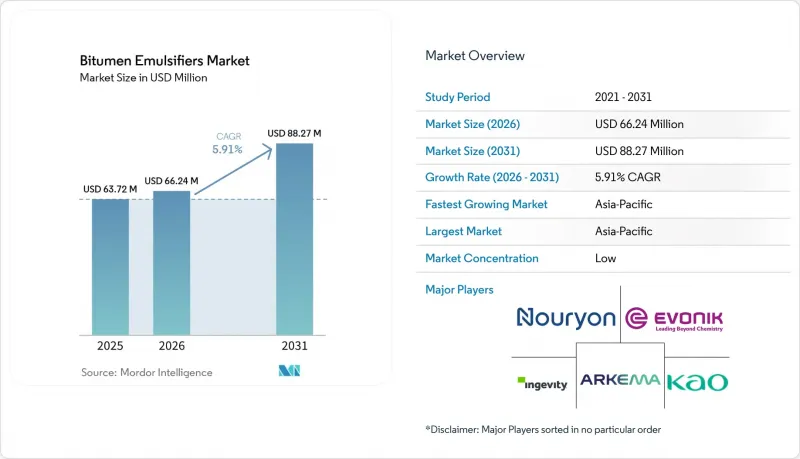
Mordor Intelligence에 의하면, 아스팔트 유화제 시장 규모는 2025년에 6,372만 달러로 평가되었고, 예측 기간(2026-2031년) CAGR 5.91%로 확대될 전망이며, 2026년 6,624만 달러에서 2031년에는 8,827만 달러에 이를 전망입니다.
본 보고서는 제품 유형별(양이온성 유화제, 음이온성 유화제, 기타), 경화 유형별(급경화형, 중경화형, 기타), 용도별(표면 처리, 기타), 최종 사용자 산업별(도로·고속도로 건설, 기타), 지역별(아시아태평양, 북미, 유럽, 남미, 중동 및 아프리카)로 분류되어 있습니다. 시장 전망은 금액(달러) 기준으로 제시되어 있습니다.
세계의 아스팔트 유화제 시장 동향 및 인사이트
도로 인프라 확충 및 고속도로 유지 관리에 대한 투자 증가
아시아태평양 및 북미의 정부 주도 도로 정비 사업이 아스팔트 유화제의 단기적인 수요를 뒷받침하고 있습니다. 유지 관리 공사에서는 표면 처리, 택 코트, 포그 실, 마이크로 서피싱 등의 용도로 유화제가 사용되고 있습니다. 인도 국도청(NHAI)은 2025-26 회계연도에 5,313km의 국도 건설을 완료하고, 2조 4,436억 2,000만 루피(290억 달러)의 자본 지출을 보고했습니다. 중국의 교통 분야 고정자산 투자액은 2025년에 3조 6,700억 위안(5,505억 달러)에 달했습니다. 이러한 사업 규모는 신규 도로 건설과 기존 자산의 유지 관리 모두를 뒷받침하고 있습니다. 공공 기관이 포장 보전을 우선시할 경우, 아스팔트 유화제 시장은 그 혜택을 누리게 됩니다.
중국은 2025년에 6만 7,500km의 농촌 도로를 신설하여 농촌 도로망의 총 연장은 471만 km에 달했습니다. 농촌 도로는 운송 거리가 비용을 증가시키고 유연성을 저하시키기 때문에 핫믹스 플랜트를 통한 공급이 어렵습니다. 따라서 외딴 지역의 일상적인 유지 관리에는 상온 시공형 에멀젼 시스템이 적합합니다. 또한, 잘 정비된 도로망에서도 전면적인 재건설보다 보전에 예산이 배정되는 경향이 강해지고 있습니다. 이러한 경향은 칩 실, 포그 실, 마이크로 서피싱에 사용되는 특수 등급 제품에 대한 수요를 부추기고 있습니다. 유지 관리 예산이 신규 건설비보다 빠르게 증가하는 지역에서는 아스팔트 유화제 시장이 혜택을 볼 것입니다.
콜드 믹스 아스팔트, 슬러리 실, 마이크로 서피싱 기술의 채택 확대
콜드 믹스 아스팔트 시스템은 핫 믹스 아스팔트 시스템보다 에너지 소비량이 적습니다. 2025년 동료 심사를 거친 연구에 따르면, 콜드 믹스 아스팔트의 에너지 사용량은 80MJ/t, 핫 믹스 아스팔트는 279MJ/t로 보고되었습니다. 동 연구에서는 콜드 믹스 아스팔트의 수명 주기 동안 온실가스 배출량이 42.7% 감소했다고 보고하고 있습니다. 또한, 콜드 믹스 아스팔트의 시공 비용은 1km당 1만 2,193달러로 산출되었으며, 자재비는 동등한 핫 믹스 아스팔트에 비해 57% 저렴합니다. 이러한 비용적, 환경적 차이로 인해 지방 자치 단체의 각 기관은 사양을 재검토하도록 권장받고 있습니다. 예산 제약이 있는 유지 관리 프로그램에서 이러한 시스템이 채택될 경우, 아스팔트 유화제 시장은 그 혜택을 누리게 될 것입니다.
펜실베이니아주 제3지구에서는 2020-2024년 마이크로 서피싱을 통해 229마일 이상의 도로를 보전했습니다. 이 프로그램은 2025년 3월 국제 슬러리 서피싱 협회(ISSA)로부터 ‘포장 보전 우수상’을 수상했습니다. 콜드 믹스의 경화에 대한 예측 모델링을 통해 현장 성능에 대한 불확실성이 감소할 것으로 기대됩니다. 인용된 연구에 따르면, 2026-2027년에 걸쳐 경화 동역학에 관한 AI 기반 모델링이 더욱 발전할 것으로 지적되고 있습니다. 경화 제어의 향상으로 인해, 기존에는 핫믹스 사양이 유지되어 온 교통량이 많은 노선에서도 사용이 가능해집니다. 이에 따라 아스팔트 유화제 시장에서 연결형 및 중결형 배합에 대한 수요가 발생할 것입니다.
개발도상국 도로 시장에서의 아스팔트 에멀젼 기술 도입 제한
개발도상국 도로 시장에서는 아스팔트 에멀젼의 사양 수립, 제조, 시공을 일관되게 수행할 기술적 역량이 부족한 경우가 많습니다. 이로 인해 인프라 지출이 에멀젼 수요로 이어지는 데 제약이 따르고 있습니다. 도로망이 확대되고 있음에도 불구하고, 시공업체의 지식 부족, 플랜트의 가용성 저하, 사양 변경에 대한 거부감이 도입을 저해하는 요인으로 작용하고 있습니다. 또한, 에멀전은 온도에 민감하고 컷백 아스팔트보다 저장 기간이 짧기 때문에 적절한 보관 및 유통 체계가 필요합니다. 이러한 요건들로 인해 동남아시아 및 아프리카 일부 지역에서 도입이 지연되고 있습니다. 현지 공급망이 정기적인 납품이나 신뢰할 수 있는 현장 지원을 제공하지 못할 경우, 운영상의 과제는 막대합니다.
이러한 제약은 유화제의 화학적 특성 선택에 그치지 않습니다. 시공업체에게는 신뢰할 수 있는 물류 체계, 훈련된 작업자, 유화제를 활용한 유지 관리 방법을 허용하는 사양도 필요합니다. 이러한 체제를 확립하는 데는 수년이 소요될 수 있습니다. 이러한 지원 인프라가 정비되기 전까지는 아스팔트 유화제 시장이 도로 투자가 시사하는 잠재력을 충분히 발휘할 수 없습니다. 다만, 외딴 지역의 프로젝트에서는 핫믹스 운송 비용이 높아질 가능성이 있으므로, 지방 도로 확장은 여전히 실용적인 활용 사례로 남아 있습니다. 시장의 발전은 기술 서비스, 시공업체 교육, 현지 공급망에 좌우될 것입니다. 운송 및 제조 관련 규제가 강화됨에 따라 규제 요건 준수가 더욱 중요한 과제로 대두되고 있습니다.
부문 분석
2025년 기준, 양이온성 유화제는 제품 유형별 점유율의 57.14%를 차지했으며, 아스팔트 유화제 시장에서 가장 큰 제품 카테고리가 되고 있습니다. 이러한 위상은 양전하를 띤 계면활성제와 도로 건설에 주로 사용되는 음전하를 띤 골재와의 호환성이 좋다는 점을 반영하며, 이를 통해 시공업체에는 폭넓게 적용 가능한 배합 경로가 제공됩니다. 양이온성 유화제는 표준 도로 용도에 사용되는 반면, 카르복시산 또는 수지산 화학에 기반한 음이온성 유화제는 유럽의 석회암 골재 시장에서 사용되고 있으며, 소나무 로진이나 톨오일을 기반으로 한 배합에서도 주목을 받고 있습니다. 비이온성 유화제는 기질의 표면 전하가 변동하는 한랭지, 방수, 지붕 공사 용도에서 유연성을 발휘합니다. 제품 선정은 골재의 거동, 기후, 시공 방법, 완성된 에멀전의 요구되는 작업성에 따라 달라집니다.
양이온성 및 특수 유화제는 2031년까지 연평균 성장률(CAGR) 7.34%를 나타낼 것으로 예측됩니다. 이러한 등급에 대한 수요는 고농도 폴리머에서 표준 양이온성 계면활성제가 불안정해지기 쉬운 스티렌-부타디엔-스티렌(SBS) 함량이 높은 폴리머 개질 에멀젼을 안정화시키는 능력에 의해 주도되고 있습니다. 2026년 리그닌에 관한 연구에 따르면, 바이오 개질제는 안정적인 양이온성 유화를 실현하며, 기능성 유화제로서의 역할과 생체 고분자 개질제로서의 역할을 겸비하고 있는 것으로 나타났습니다. 전반적인 수요는 여전히 양이온성 화학제품이 가장 강하지만, 이익률 향상 가능성은 가혹한 포장 조건에 대응하는 양이온성 및 바이오 특수 등급에 집중되어 있습니다. 이로 인해 아스팔트 유화제 시장에서 명확한 프리미엄 시장 기회가 창출되고 있습니다.
2025년 시점에서 급속 경화형 유화제는 경화 유형별 시장 점유율의 37.82%를 차지했습니다. 이들은 칩 실, 택 코트, 프라임 코트, 포그 실 등의 스프레이식 노면 처리에 널리 사용되고 있습니다. 이러한 용도에서는 골재 살포 전에 도포 후의 급속한 경화가 요구되기 때문입니다. 중경화형 및 완경화형 제품은 콜드 믹스 아스팔트, 슬러리 실, 마이크로 서피싱에 적합하며, 이러한 공정에서는 작업 가능 시간이 길수록 혼합 및 포설 시 적절한 골재 피복률과 입자 간 충진을 달성하기 쉬워집니다. 각 경화 유형은 각각 다른 작업 가능 기간에 대응하며, 시공업체는 배합의 거동을 기상 조건, 골재 특성, 설비, 교통 규제 요건에 맞추어 조정할 수 있습니다. 이러한 폭넓은 경화 거동 덕분에 아스팔트 유화제 시장은 신속한 보수 공사에서부터 장기간에 걸친 콜드 믹스 용도에 이르기까지 폭넓은 역할을 수행하고 있습니다.
초고속 경화형 유화제는 2031년까지 연평균 성장률(CAGR) 6.81%를 나타낼 것으로 예측됩니다. 이 유화제는 몇 분 이내에 노면을 교통에 개방해야 하는 프로젝트를 위해 설계되었으며, 4-6시간에 걸친 야간 차선 통제가 이루어지는 도시 지역의 유지 관리에서 그 중요성이 점점 더 커지고 있습니다. 이러한 프로젝트에서는 특히 상업 활동을 방해하지 않고 통제 시간을 연장할 수 없는 경우, 아침 교통이 재개되기 전에 예측 가능한 혼합, 신속한 분해 및 경화가 요구됩니다. 속경화형 제품도 이러한 요구 사항의 일부를 충족하고 있지만, 초속경화형 기술이 엄격한 교통 재개 요건에 더 적합합니다. 도시들이 예방적 유지보수 및 야간 작업 프로그램을 확대함에 따라 이 시장의 성장은 더욱 가속화될 것으로 보입니다.
지역별 분석
아시아태평양은 2025년에 세계 시장 규모의 48.53%를 차지한 것으로 평가되었으며, 2031년까지 연평균 성장률(CAGR) 6.68%로 성장할 것으로 전망됩니다. 2025년 중국의 교통 인프라 투자액 3조 6,700억 위안(5,400억 달러)은 550만 km가 넘는 도로망을 뒷받침했습니다. 인도는 2025 회계연도에 아스팔트 수요의 35-36%를 수입하고 있어, 정유시설 관련 중간 제품에 영향을 미치는 공급 차질에 대한 노출도가 높아지고 있습니다. 일본과 한국은 성숙한 유지 관리 주도형 시장으로, 초고속 경화형 및 폴리머 개질 등급에 대한 수요를 뒷받침하고 있습니다. 외딴 지역의 도로 유지관리는 아시아태평양 전역의 아스팔트 유화제 시장에 추가적인 성장 동력이 될 것으로 보입니다.
북미 시장은 포장 보전 프로그램과 도로 유지 관리 도급 사업에 의해 뒷받침되고 있습니다. 2024년 7월, Nouryon은 미국 내 아스팔트 첨가제에 대해 Brenntag Specialties와 판매 계약을 체결했습니다. Colas는 The Miller Group을 통해 캐나다 더럼 지역에서 7년간의 도로 유지 관리 계약을 수주했으며, 2026년 8월부터 계약이 시작되었습니다. 이러한 다년 계약은 종합 도로 도급업체에 서비스를 제공하는 공급업체에게 수요 전망을 예측하기 쉽게 만들어 주며, 유지 보수 자재에 대한 지속적인 수요를 뒷받침하고 있습니다.
유럽 시장은 도로 자산의 노후화, 환경 제품 선언(EPD) 요건, 탈탄소화 노력에 의해 형성되고 있습니다. 남미에서는 열대 기후가 교통 재개까지 소요되는 시간이 짧은 유지 관리 방식에 적합하기 때문에 도로 정비 사업의 성장 가능성이 있습니다. 중동 및 아프리카는 도로 현대화가 기존의 걸프 지역 인프라 프로젝트를 넘어 확대됨에 따라 새로운 수요 지역으로 부상하고 있습니다. 이러한 지역에서는 물류, 사양, 시공업체 교육이 여전히 결정적인 요인으로 작용하고 있기 때문에 아스팔트 유화제 시장의 확산 경로는 각기 다릅니다.
기타 혜택
- 엑셀 형식 시장 예측(ME) 시트
- 3개월간의 애널리스트 지원
자주 묻는 질문
목차
제1장 서론
제2장 조사 방법
제3장 주요 요약
제4장 시장 구도
제5장 시장 규모 및 성장 예측
제6장 경쟁 구도
제7장 시장 기회 및 향후 전망
AJY 26.09.03According to Mordor Intelligence, the bitumen emulsifiers market size was estimated at USD 63.72 million in 2025 and is estimated to grow from USD 66.24 million in 2026 to USD 88.27 million by 2031, at a CAGR of 5.91% during the forecast period (2026-2031).
This report is Segmented by Product Type (Cationic Emulsifiers, Anionic Emulsifiers, and More), Setting Type (Rapid Setting, Medium Setting, and More), Application (Surface Treatment and More), End-User Industry (Road and Highway Construction and More), and Geography (Asia-Pacific, North America, Europe, South America, and Middle-East and Africa). The Market Forecasts are Provided in Terms of Value (USD).
Global Bitumen Emulsifiers Market Trends and Insights
Increasing Road Infrastructure Development and Highway Maintenance Investments
Government-backed road programs across Asia-Pacific and North America are supporting near-term demand for bitumen emulsifiers. Maintenance work uses emulsifiers across surface treatments, tack coats, fog seals, and microsurfacing applications. India's National Highways Authority of India (NHAI) completed 5,313 km of national highways in 2025-26 and reported capital expenditure of INR 244,362 crore (USD 29 billion). China's transport fixed-asset investment reached CNY 3.67 trillion (USD 550.5 billion) in 2025. The scale of these programs supports both new road construction and the maintenance of existing assets. The bitumen emulsifiers market benefits when public agencies prioritize pavement preservation.
China added 67,500 km of rural roads in 2025, bringing its rural road network to 4.71 million km. Rural roads are difficult to serve with hot-mix plants because transport distances raise costs and reduce flexibility. Cold-applied emulsion systems are therefore suitable for routine maintenance in remote locations. Mature road networks are also directing more spending toward preservation rather than full reconstruction. This pattern favors specialty grades used in chip seals, fog seals, and microsurfacing. The bitumen emulsifiers market stands to benefit where maintenance budgets grow faster than greenfield construction spending.
Growing Adoption of Cold-Mix Asphalt, Slurry Seal, and Micro Surfacing Technologies
Cold-mix asphalt systems consume less energy than hot-mix asphalt systems. A 2025 peer-reviewed study reported energy use of 80 MJ/t for cold-mix asphalt and 279 MJ/t for hot-mix asphalt. The same study reported a 42.7% reduction in life-cycle greenhouse gas emissions for cold-mix asphalt. It also benchmarked cold-mix asphalt construction cost at USD 12,193 per km, with material costs 57% lower than comparable hot-mix alternatives. These cost and environmental differences are encouraging municipal agencies to reconsider specifications. The bitumen emulsifiers market benefits when these systems are adopted for budget-constrained maintenance programs.
Pennsylvania's District 3 preserved more than 229 miles of roadway through microsurfacing from 2020 to 2024. The program received the International Slurry Surfacing Association's Excellence in Pavement Preservation Award in March 2025. Predictive modeling for cold-mix curing is expected to reduce uncertainty around field performance. The cited study identifies further development of AI-based modeling for curing kinetics during 2026-27. Better curing control can support use on higher-traffic routes that have historically retained hot-mix specifications. This creates demand for slow-setting and medium-setting formulations in the bitumen emulsifiers market.
Limited Adoption of Bitumen Emulsion Technologies in Developing Road Markets
Developing road markets often lack the technical capacity to consistently specify, produce, and apply bitumen emulsions. This limits the conversion of infrastructure spending into demand for emulsifiers. Contractor familiarity, plant availability, and specification inertia can suppress adoption even as road networks expand. Emulsions also require suitable storage and distribution because they are temperature-sensitive and have shorter shelf lives than cutback bitumen. These requirements slow adoption across parts of Southeast Asia and Africa. The operational challenge is significant where local supply chains cannot provide regular delivery and reliable field support.
The constraint is not limited to the choice of emulsifier chemistry. Contractors also need reliable logistics, trained crews, and specifications that recognize emulsion-based maintenance methods. These capabilities can take several years to establish. The bitumen emulsifiers market cannot fully capture the potential implied by road investment until this supporting infrastructure is in place. Rural road expansion still creates a practical use case because remote projects can face high hot-mix transport costs. Market development will depend on technical service, contractor training, and local supply networks. Regulatory requirements pose an additional compliance challenge as transport and manufacturing rules become more demanding.
Other drivers and restraints analyzed in the detailed report include:
- Rising Demand for Polymer-Modified and High-Performance Bitumen Emulsions
- Stringent Environmental Regulations Promoting Low-Emission Road Construction Materials
- Competition for Conventional Hot Mix Asphalt in Large-Scale Infrastructure Projects
For complete list of drivers and restraints, kindly check the Table Of Contents.
Segment Analysis
Cationic emulsifiers held 57.14% of product-type share in 2025, making them the largest product class in the bitumen emulsifiers market. Their position reflects the compatibility between positively charged surfactants and the predominantly negatively charged aggregates used in road construction, which gives contractors a broadly applicable formulation route. Cationic systems serve standard road applications, while anionic emulsifiers based on carboxylic-acid or resin-acid chemistry are used in European limestone-aggregate markets and are receiving attention in formulations based on pine rosin and tall oil. Non-ionic emulsifiers offer flexibility in cold-climate, waterproofing, and roofing applications where substrate surface charge varies. Product selection depends on aggregate behavior, climate, application method, and the required workability of the finished emulsion.
Amphoteric and specialty emulsifiers are forecast to grow at a 7.34% CAGR through 2031. Demand for these grades is driven by their ability to stabilize polymer-modified emulsions with high styrene-butadiene-styrene (SBS) content, where standard cationic surfactants become unreliable at elevated polymer concentrations. Research from 2026 on lignin indicates that bio-based modifiers can provide stable cationic emulsification and combine a functional emulsifier role with a biopolymeric modifier role. Overall demand remains strongest for cationic chemistry, while margin potential is concentrated in amphoteric and bio-based specialty grades that address demanding pavement conditions. This creates distinct premium opportunities within the bitumen emulsifiers market.
Rapid-setting emulsifiers accounted for 37.82% of the setting-type share in 2025. They are widely used in spray surface treatments, including chip seals, tack coats, prime coats, and fog seals, because these applications require a fast break after application before aggregate trafficking. Medium-setting and slow-setting products support cold-mix asphalt, slurry seal, and microsurfacing, where longer workability helps achieve appropriate aggregate coverage and interparticle packing during mixing and laying. Each setting class serves a distinct operating window, allowing contractors to match formulation behavior with weather, aggregate properties, equipment, and traffic-control requirements. This range of setting behavior gives the bitumen emulsifiers market a role across both rapid preservation work and longer-duration cold-mix applications.
Quick-setting emulsifiers are forecast to grow at a 6.81% CAGR through 2031. They are designed for projects where a surface must open to traffic within minutes, a requirement that is increasingly relevant for urban maintenance during overnight lane closures lasting 4-6 hours. These programs require predictable mixing, rapid breaking, and curing before morning traffic returns, particularly when closures cannot be extended without disrupting commercial activity. Rapid-setting products address some of these needs, but quick-setting chemistry more closely matches strict return-to-traffic requirements. Growth will be supported as cities expand their preventive maintenance and overnight work programs.
Complete Report Scope:
- By Product Type
- Cationic Emulsifiers
- Anionic Emulsifiers
- Non-ionic Emulsifiers
- Amphoteric and Specialty Emulsifiers
- By Setting Type
- Rapid Setting
- Medium Setting
- Slow Setting
- Quick Setting
- By Application
- Surface Treatment
- Chip Seal
- Tack Coat
- Prime Coat
- Fog Seal
- Mixing
- Cold Mix Asphalt
- Slurry Seal
- Micro-surfacing
- Cold In-place Recycling
- Full-depth Reclamation
- Waterproofing and Roofing
- Industrial Coatings and Adhesives
- Dust Suppression and Soil Stabilization
- Surface Treatment
- By End-User Industry
- Road and Highway Construction
- Airport Infrastructure
- Building and Construction
- Industrial Infrastructure
- Other End-User Industries
- By Geography
- Asia-Pacific
- China
- India
- Japan
- South Korea
- Rest of Asia-Pacific
- North America
- United States
- Canada
- Mexico
- Europe
- Germany
- United Kingdom
- France
- Italy
- Russia
- Rest of Europe
- South America
- Brazil
- Argentina
- Rest of South America
- Middle-East and Africa
- Saudi Arabia
- South Africa
- Rest of Middle-East and Africa
- Asia-Pacific
Geography Analysis
Asia-Pacific accounted for 48.53% of global market value in 2025 and is forecast to grow at a CAGR of 6.68% through 2031. China's CNY 3.67 trillion (USD 0.54 trillion) in transport investment in 2025 supported a total road network exceeding 5.5 million km. India imported 35-36% of its bitumen requirement in FY25, increasing exposure to supply disruptions affecting refinery-linked intermediates. Japan and South Korea are mature, maintenance-led markets that support demand for quick-setting and polymer-modified grades. Remote road maintenance needs further support for the bitumen emulsifiers market across the Asia-Pacific region.
North America is supported by pavement preservation programs and road maintenance contracting. In July 2024, Nouryon entered a distribution agreement with Brenntag Specialties for asphalt additives in the United States. Through The Miller Group, Colas secured a seven-year road maintenance contract in the Durham region of Canada, which began in August 2026. Multi-year contracts of this nature improve demand visibility for suppliers serving integrated road contractors, supporting continued demand for preservation materials.
Europe's market is shaped by aging road assets, environmental product declaration requirements, and decarbonization commitments. South America has growth potential for road programs, as tropical-climate conditions favor fast return-to-traffic maintenance methods. The Middle-East and Africa are emerging demand areas as road modernization expands beyond traditional Gulf infrastructure projects. In these regions, the bitumen emulsifiers market follows a different adoption path, as logistics, specifications, and contractor training remain decisive factors.
- Arkema
- BASF
- Colas
- Croda International Plc
- Evonik Industries AG
- Ingevity
- Kao Corporation
- Macismo International Ltd
- Marathon Petroleum LP
- McAsphalt Industries Limited
- Nouryon
- Opal Paints Products Pvt. Ltd.
- Petrochem Specialities
- T-Pave International Pte Ltd
- Zydex Group
Additional Benefits:
- The market estimate (ME) sheet in Excel format
- 3 months of analyst support
TABLE OF CONTENTS
1 Introduction
- 1.1 Study Assumptions and Market Definition
- 1.2 Scope of the Study
2 Research Methodology
3 Executive Summary
4 Market Landscape
- 4.1 Market Overview
- 4.2 Market Drivers
- 4.2.1 Increasing Road Infrastructure Development and Highway Maintenance Investments
- 4.2.2 Growing Adoption of Cold Mix Asphalt, Slurry Seal, and Micro-surfacing Technologies
- 4.2.3 Rising Demand for Polymer-Modified and High-Performance Bitumen Emulsions
- 4.2.4 Stringent Environmental Regulations Promoting Low-Emission Road Construction Materials
- 4.2.5 Growing Use of Bio-based and Renewable Feedstock Emulsifier Technologies
- 4.3 Market Restraints
- 4.3.1 Limited Adoption of Bitumen Emulsion Technologies in Developing Road Markets
- 4.3.2 Competition from Conventional Hot Mix Asphalt in Large-Scale Infrastructure Projects
- 4.3.3 Regulatory Compliance Challenges for Specialty Chemical Manufacturing and Transportation
- 4.4 Value Chain Analysis
- 4.5 Porter's Five Forces Analysis
- 4.5.1 Threat of New Entrants
- 4.5.2 Bargaining Power of Suppliers
- 4.5.3 Bargaining Power of Buyers
- 4.5.4 Threat of Substitutes
- 4.5.5 Competitive Rivalry
5 Market Size and Growth Forecasts (Value)
- 5.1 By Product Type
- 5.1.1 Cationic Emulsifiers
- 5.1.2 Anionic Emulsifiers
- 5.1.3 Non-ionic Emulsifiers
- 5.1.4 Amphoteric and Specialty Emulsifiers
- 5.2 By Setting Type
- 5.2.1 Rapid Setting
- 5.2.2 Medium Setting
- 5.2.3 Slow Setting
- 5.2.4 Quick Setting
- 5.3 By Application
- 5.3.1 Surface Treatment
- 5.3.1.1 Chip Seal
- 5.3.1.2 Tack Coat
- 5.3.1.3 Prime Coat
- 5.3.1.4 Fog Seal
- 5.3.2 Mixing
- 5.3.2.1 Cold Mix Asphalt
- 5.3.2.2 Slurry Seal
- 5.3.2.3 Micro-surfacing
- 5.3.2.4 Cold In-place Recycling
- 5.3.2.5 Full-depth Reclamation
- 5.3.3 Waterproofing and Roofing
- 5.3.4 Industrial Coatings and Adhesives
- 5.3.5 Dust Suppression and Soil Stabilization
- 5.3.1 Surface Treatment
- 5.4 By End-User Industry
- 5.4.1 Road and Highway Construction
- 5.4.2 Airport Infrastructure
- 5.4.3 Building and Construction
- 5.4.4 Industrial Infrastructure
- 5.4.5 Other End-User Industries
- 5.5 By Geography
- 5.5.1 Asia-Pacific
- 5.5.1.1 China
- 5.5.1.2 India
- 5.5.1.3 Japan
- 5.5.1.4 South Korea
- 5.5.1.5 Rest of Asia-Pacific
- 5.5.2 North America
- 5.5.2.1 United States
- 5.5.2.2 Canada
- 5.5.2.3 Mexico
- 5.5.3 Europe
- 5.5.3.1 Germany
- 5.5.3.2 United Kingdom
- 5.5.3.3 France
- 5.5.3.4 Italy
- 5.5.3.5 Russia
- 5.5.3.6 Rest of Europe
- 5.5.4 South America
- 5.5.4.1 Brazil
- 5.5.4.2 Argentina
- 5.5.4.3 Rest of South America
- 5.5.5 Middle-East and Africa
- 5.5.5.1 Saudi Arabia
- 5.5.5.2 South Africa
- 5.5.5.3 Rest of Middle-East and Africa
- 5.5.1 Asia-Pacific
6 Competitive Landscape
- 6.1 Market Concentration
- 6.2 Strategic Moves
- 6.3 Market Share (%)/Ranking Analysis
- 6.4 Company Profiles (includes Global Overview, Market Overview, Core Segments, Financials as available, Strategic Information, Products and Services, and Recent Developments)
- 6.4.1 Arkema
- 6.4.2 BASF
- 6.4.3 Colas
- 6.4.4 Croda International Plc
- 6.4.5 Evonik Industries AG
- 6.4.6 Ingevity
- 6.4.7 Kao Corporation
- 6.4.8 Macismo International Ltd
- 6.4.9 Marathon Petroleum LP
- 6.4.10 McAsphalt Industries Limited
- 6.4.11 Nouryon
- 6.4.12 Opal Paints Products Pvt. Ltd.
- 6.4.13 Petrochem Specialities
- 6.4.14 T-Pave International Pte Ltd
- 6.4.15 Zydex Group
7 Market Opportunities and Future Outlook
- 7.1 White-Space and Unmet-Need Assessment