|
시장보고서
상품코드
2119637
아프리카의 역청 시장 : 점유율 분석, 업계 동향과 통계, 성장 예측(2026-2031년)Africa Bitumen - Market Share Analysis, Industry Trends & Statistics, Growth Forecasts (2026 - 2031) |
||||||
 Mordor Intelligence
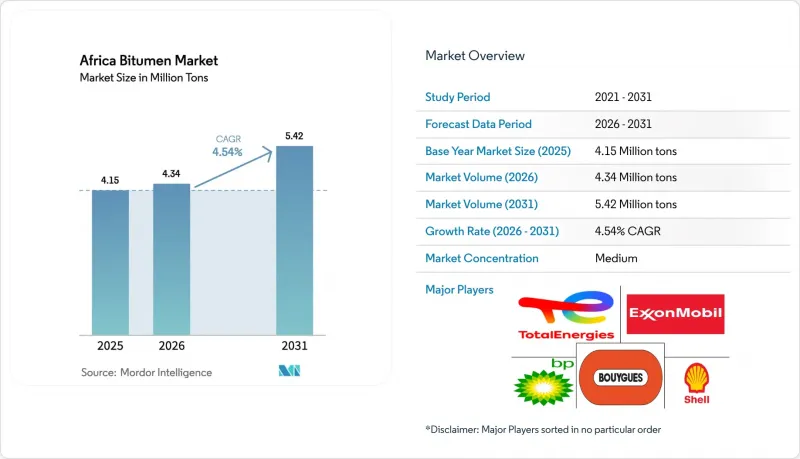
Mordor Intelligence에 의하면, 아프리카의 역청 시장 규모는 2025년 415만 톤에서 2026년에는 434만 톤으로 확대되어 2026년부터 2031년까지 CAGR 4.54%로 성장을 지속하여, 2031년에는 542만 톤에 이를 것으로 예측됩니다.
급속한 도시 인구 증가, 도로 건설에 대한 공공 부문의 사상 최대 수준의 지출, 그리고 특수 바인더로의 점진적인 전환이 맞물려, 각국의 재정 상황이 어려워지는 가운데서도 아프리카 역청 시장은 장기적인 성장이 예상됩니다.
본 보고서는 제품 유형(포장용, 경질용, 산화용, 아스팔트 에멀젼, 폴리머 개질 아스팔트, 기타), 용도(도로 건설, 방수, 접착제, 기타 용도) 및 지역(남아프리카공화국, 나이지리아, 이집트,알제리, 모로코, 케냐, 에티오피아, 탄자니아, 코트디부아르 및 아프리카의 기타 지역)별로 분류되어 있습니다. 시장 전망은 수량(톤) 기준으로 제시되어 있습니다.
아프리카 역청 시장 동향 및 인사이트
정부 자금에 의한 도로망 확충이 진행 중
2024년부터 2026년까지 아프리카 각국 정부는 전략적 고속도로 회랑에 250억 달러 이상을 배정하고 있으며, 이러한 재정적 투입으로 인해 아프리카 역청 시장의 잠재 수요가 증가하고 있습니다. 나이지리아의 라고스-카라발 해안 고속도로에만 20억 달러의 예산이 편성되었으며, 2029년 개통까지 연간 약 18만 톤의 폴리머 개질 바인더가 소비될 전망입니다. 케냐는 총 연장 440킬로미터의 우사히히 고속도로를 위해 36억 달러의 혼합 자금 조달을 확보하여 2026년 착공을 실현했습니다. 이 프로젝트에서는 입찰 서류에 온간 혼합 아스팔트 사용 조항이 포함되어 있습니다. 2025년 7월에 개통된 알제리의 남북 고속도로 시파-베르와기아 구간은 고온 건조한 미기후 속에서 ‘일대일로’ 이니셔티브 자금이 콘크리트보다 아스팔트를 우선시하는 경향을 보여주었습니다. 모로코의 게르시프-나도르 구간 도로 건설에는 아프리카개발은행으로부터 2억 4,600만 유로의 대출이 제공되어, 2028년까지 나도르 웨스트 메드 항구에서 출발하는 화물 운송이 성능 등급 인증 아스팔트 포장을 따라 운행될 것이 확실해졌습니다. 현재 다자간 금융 기관들은 수명 주기 비용 모델의 제시를 의무화하고 있기 때문에 대부분의 토목 공사 계약에서 포장재의 내구 연한을 2배로 연장하는 고성능 폴리머 개질 오버레이의 채택이 정당화되고 있으며, 표면상의 예산이 정체된 상황에서도 구조적인 수요가 발생하고 있습니다.
방수·지붕용 막재 수요 가속화
사하라 이남의 도시에서는 인구가 연간 3.5%의 속도로 증가하고 있으며, 이에 따라 구식 타르지를 대신하여 아타틱 폴리프로필렌(APP)이나 스티렌-부타디엔-스티렌(SBS)으로 제작된 방수 시트를 지정하는 중층 콘크리트 건축물이 급증하고 있습니다. 남아프리카 과학산업연구위원회는 2024년, 나노 개질 에멀전이 지붕 표면 온도를 최대 18% 낮춘다고 보고했습니다. 이에 따라 요하네스버그의 개발업자들은 지붕의 수명을 10년에서 25년으로 연장하는 반사성 코팅을 표준화하고 있습니다. 나이지리아 부동산 부문은 2024년에 6.2% 성장했으며, 라고스의 건설업자들은 현재 매립지에서 만성적인 문제인 염분을 함유한 지하수에 내성이 있는 자가 접착형 방수 시트를 채택하고 있습니다. 케냐의 2025년 건축 기준법에서는 3층을 초과하는 모든 건축물에 방수 공사가 의무화되어 있어, 이로 인해 아스팔트 방수 시트 공급업체는 도시 지역에서 고정 고객 기반을 자동으로 확보하게 됩니다. 방수 공사의 수익은 공공 예산 변동의 영향을 비교적 덜 받기 때문에 방수 시트 사업으로 다각화하고 있는 정유업체들은 고속도로 건설 예산 배분이 지연될 때에도 수익 변동을 완화할 수 있습니다.
VOC/온실가스 배출 규제 강화
남아프리카공화국의 ‘기후 변화법’은 탄소 예산 제도를 도입하고 있으며, 아스팔트 생산자는 2030년까지 매년 공장 수준의 배출량을 2-3% 감축해야 할 의무가 있습니다. 이 규제로 인해 투수성 등급의 역청 생산 비용이 직접적으로 상승하고 있습니다. 또한, ‘탄소세법’에 따라 CO2e 1톤당 190랜드의 세금이 부과되며, 이는 아스팔트 1톤당 3.15톤의 CO2e로 산정됩니다. 이 세율은 매년 4월에 인플레이션율에 2%를 가산한 만큼 인상됩니다. 케냐 국가환경관리청은 2025년부터 배기가스 내 VOC(휘발성 유기화합물) 농도를 50 mg/m³로 제한했습니다. 이로 인해 나이로비 산업지대에 위치한 각 공장에서 50만 달러가 넘는 개조 비용이 발생하게 되었습니다. 이집트 환경부는 현재 역청을 생산하는 모든 증류탑에 연속 배기가스 모니터링 장치 설치를 의무화하고 있으며, 100만 달러에 달하는 규정 준수 장비 도입 비용을 마련할 수 없는 소규모 민간 정제업체들은 사실상 시장에서 배제되고 있습니다. 그 결과 발생한 규제 준수를 위한 차익 거래로 인해, 각 블렌더 기업들은 모잠비크나 탄자니아로 이전할 수밖에 없게 되었으며, 완제품을 규제 대상 시장으로 역수입하고 있습니다. 이로 인해 공급망이 세분화되고, 국내 투자가 저해되고 있습니다.
부문 분석
2025년, 포장용 바인더는 아프리카 역청 시장 점유율의 57.45%를 유지하며, 알제리, 이집트, 탄자니아를 가로지르는 장거리 고속도로의 최저가 입찰 요건을 충족하고 있습니다. 한편, 폴리머 개질 등급은 연평균 성장률(CAGR) 7.12%를 기록하며, 남아프리카공화국과 케냐의 주요 교통 회랑에서 사양을 재정의하고 있습니다. 에멀전도 꾸준히 시장 점유율을 확대되고 있습니다. 이는 양이온계 표면 처리가 오버레이 공사비의 3분의 1 비용으로 포장 수명을 5년 연장하기 때문입니다. 산화 등급 수요는 나이지리아와 이집트의 지붕 공사 주기에 연동되어 추이하는 반면, 하드 등급은 여전히 파이프 코팅에 사용되는 틈새 제품 수준에 머물러 있습니다. 사솔(Sasol)사가 실시하고 있는 리그닌 강화 바이오 바인더 시험에서는 아스팔트의 15%를 사탕수수 찌꺼기에서 추출한 화합물로 대체하고 있으며, 이는 차선 마모 저항성을 저해하지 않으면서 탄소세 요건을 충족하는 미래의 혼합 가능성을 시사합니다.
가격 실현 상황에는 현저한 차이가 보입니다. 포장용 등급은 진공 잔류물과 동등한 가격으로 거래되고 있는 반면, 폴리머 개질 등급은 톤당 140-180달러의 프리미엄이 붙으며, 에멀젼은 턴키 방식의 마이크로 서피싱 서비스 계약과 세트로 판매될 경우 110달러의 마진을 가져다줍니다. 탄소세는 바인더 1톤당 부과되므로, 특수 등급의 경우 포장 주기가 긴 만큼 세금 부담을 장기간에 걸쳐 상각할 수 있으며, 원유 가격이 변동하더라도 폴리머 개질 등급 공급업체는 가격 결정력을 유지할 수 있습니다. 투자자들은 프로젝트의 수익성을 처리량뿐만 아니라 첨가제 라인의 유연성 측면에서도 평가했습니다. 테마(Tema)사의 새로운 7,500톤 규모의 저장 허브는 인라인 주입을 통해 1시간 이내에 SBS와 EVA 개질제를 전환하여 자산 가동률을 극대화할 수 있음을 보여줍니다.
기타 혜택:
- 엑셀 형식 시장 예측(ME) 시트
- 3개월간의 애널리스트 지원
자주 묻는 질문
목차
제1장 서론
제2장 조사 방법
제3장 개요
제4장 시장 구도
제5장 시장 규모와 성장 예측
제6장 경쟁 구도
제7장 시장 기회와 향후 전망
JHS 26.09.03According to Mordor Intelligence, the Africa bitumen market size is expected to grow from 4.15 Million tons in 2025 to 4.34 Million tons in 2026 and is forecast to reach 5.42 Million tons by 2031 at 4.54% CAGR over 2026-2031.The combination of rapid urban population growth, record public-sector spending on roads, and a gradual pivot toward specialty binders positions the Africa bitumen market for lengthy expansion even as sovereign balance sheets tighten.
This report is Segmented by Product Type (Paving Grade, Hard Grade, Oxidised Grade, Bitumen Emulsions, Polymer-Modified Bitumen, and Others), Application (Road Construction, Waterproofing, Adhesives, and Other Applications), and Geography (South Africa, Nigeria, Egypt, Algeria, Morocco, Kenya, Ethiopia, Tanzania, Cote D'Ivoire, and Rest of Africa). The Market Forecasts are Provided in Terms of Volume (Tons).
Africa Bitumen Market Trends and Insights
Growing Government-Funded Road-Network Expansion
Between 2024 and 2026, African sovereigns earmarked more than USD 25 billion for strategic highway corridors, a fiscal commitment that elevates the addressable volume for the Africa bitumen market. Nigeria's Lagos-Calabar coastal highway alone is budgeted at USD 2 billion and will consume roughly 180,000 tons of polymer-modified binder annually before commissioning in 2029. Kenya secured USD 3.6 billion in blended finance for the 440-kilometer Usahihi Expressway, unlocking a 2026 ground-breaking that embeds warm-mix-asphalt clauses into bid documents. Algeria's Chiffa-Berrouaghia stretch of the North-South highway, opened in July 2025, demonstrated how Belt and Road Initiative capital prefers asphalt over concrete in hot, arid micro-climates. Morocco's Guercif-Nador link received a EUR 246 million African Development Bank loan, ensuring freight traffic from the Nador West Med port will ride on performance-graded asphalt by 2028. Because multilateral lenders now require lifecycle-cost models, most engineering contracts justify premium polymer-modified overlays that double pavement life, adding structural demand even where headline budgets stay flat.
Accelerating Demand for Waterproofing and Roofing Membranes
Sub-Saharan cities are adding residents at 3.5% per year, propelling a surge in mid-rise concrete structures that specify atactic-polypropylene (APP) or styrene-butadiene-styrene (SBS) membranes over outdated tar-paper. The South African Council for Scientific and Industrial Research reported in 2024 that nano-modified emulsions lower rooftop surface temperatures by up to 18%, prompting Johannesburg developers to standardize reflective coatings that extend roof life from 10 to 25 years. Nigeria's real-estate sector grew 6.2% in 2024, and builders in Lagos now specify self-adhesive membranes capable of resisting saline groundwater, a chronic problem on reclaimed land. Kenya's 2025 building code mandates waterproofing for any structure exceeding three stories, automatically granting bitumen membrane suppliers a captive urban client base. Because waterproofing revenue is relatively immune to public-budget cycles, refiners that diversify into membranes cushion volatility when highway allocations are delayed.
Tightening VOC / GHG Emission Regulations
South Africa's Climate Change Act imposes a carbon-budget system that forces asphalt producers to trim plant-level emissions 2-3% annually until 2030, a rule that directly inflates production costs for penetration-grade bitumen. The Carbon Tax Act further levies ZAR 190 per ton CO2e, calculated at 3.15 tons CO2e per ton of bitumen, and the rate escalates at inflation plus 2% every April. Kenya's National Environment Management Authority capped stack VOCs at 50 mg/m3 in 2025, triggering retrofit bills topping USD 500,000 for every plant in Nairobi's industrial belt. Egypt's environment ministry now requires continuous emissions monitors on every distillation column producing bitumen, effectively sidelining small private refiners that cannot justify USD 1 million of compliance gear. The resulting compliance arbitrage encourages blenders to relocate to Mozambique and Tanzania, then back-haul finished product into regulated markets, fragmenting supply chains and undermining in-country investment.
Other drivers and restraints analyzed in the detailed report include:
- Rapid Adoption of Polymer-Modified and Emulsified Bitumen
- Urbanization-Led Road Maintenance and Rehabilitation Spend
- Concrete and Block-Paving Substitution in Urban Arterials
For complete list of drivers and restraints, kindly check the Table Of Contents.
Segment Analysis
Paving-grade binder retained 57.45% Africa bitumen market share in 2025, satisfying lowest-cost bids on long-haul highways across Algeria, Egypt, and Tanzania. Yet polymer-modified grades are registering a 7.12% CAGR, redefining specifications for corridors in South Africa and Kenya. Emulsions are climbing steadily because cationic surface dressing extends pavement life five years for one-third of overlay cost. Oxidized-grade demand tracks roofing cycles in Nigeria and Egypt, while hard-grade remains a niche used in pipe coating. Sasol's lignin-enhanced bio-binder trial, swapping 15% of bitumen for bagasse derivatives, hints at future blends that satisfy carbon levies without sacrificing rut resistance.
Price realization differs markedly: paving-grade trades at vacuum-residue parity; polymer-modified grades fetch premiums of USD 140-180 per ton; emulsions deliver USD 110 margins when sold with turnkey micro-surfacing service contracts. Because carbon taxes apply per ton of binder, specialty grades amortize levies over longer pavement cycles, giving polymer-modified suppliers pricing power even when crude swings. Investors gauge project returns not only on throughput but also on additive-line optionality; Tema's new 7,500-ton storage hub illustrates how in-line dosing can pivot between SBS and EVA modifiers in under an hour, maximizing asset utilization.
Complete Report Scope:
- By Product Type
- Paving Grade
- Hard Grade
- Oxidised Grade
- Bitumen Emulsions
- Polymer-Modified Bitumen
- Others (Cut-back Bitumen, natural / recycled)
- By Application
- Road Construction
- Waterproofing
- Adhesives
- Other Applications (Road Maintenance and Rehabilitation, Industrial Coatings, etc.)
- By Geography
- South Africa
- Nigeria
- Egypt
- Algeria
- Morocco
- Kenya
- Ghana
- Ethiopia
- Tanzania
- Cote d'Ivoire
- Rest of Africa
List of Companies Covered in this Report:
- All bitumen Cameroon
- Asphalt and Bitumen West Co.
- BP p.l.c.
- Exxon Mobil Corporation
- GOIL Plc
- HOLCIM
- Indian Oil Corporation Ltd
- Kraton Corporation
- Marathon Petroleum Corporation
- Nynas AB
- RAHA Bitumen, Inc.
- Richmond Group (Nigeria)
- Rubis Asphalt
- Sasol
- Shell plc
- Suncor Energy Inc.
- Tekfalt Binders (Pty) Ltd
- THE Bouygues group
- Tiger Bitumen
- TotalEnergies
- Wabeco Petroleum Ltd
Additional Benefits:
- The market estimate (ME) sheet in Excel format
- 3 months of analyst support
TABLE OF CONTENTS
1 Introduction
- 1.1 Study Assumptions and Market Definition
- 1.2 Scope of the Study
2 Research Methodology
3 Executive Summary
4 Market Landscape
- 4.1 Market Overview
- 4.2 Market Drivers
- 4.2.1 Growing Government-Funded Road-Network Expansion
- 4.2.2 Accelerating Demand for Waterproofing and Roofing Membranes
- 4.2.3 Rapid Adoption of Polymer-Modified and Emulsified Bitumen
- 4.2.4 Urbanization-Led Road Maintenance and Rehabilitation Spend
- 4.2.5 Commercialization of Nigeria's Native Bitumen Reserves
- 4.3 Market Restraints
- 4.3.1 Tightening VOC / GHG Emission Regulations
- 4.3.2 Concrete And Block-Paving Substitution in Urban Arterials
- 4.3.3 Crude Oil Price Volatility Inflating Feedstock Costs
- 4.4 Value Chain Analysis
- 4.5 Porter's Five Forces
- 4.5.1 Bargaining Power of Suppliers
- 4.5.2 Bargaining Power of Buyers
- 4.5.3 Threat of New Entrants
- 4.5.4 Threat of Substitutes
- 4.5.5 Degree of Competition
5 Market Size and Growth Forecasts (Volume)
- 5.1 By Product Type
- 5.1.1 Paving Grade
- 5.1.2 Hard Grade
- 5.1.3 Oxidised Grade
- 5.1.4 Bitumen Emulsions
- 5.1.5 Polymer-Modified Bitumen
- 5.1.6 Others (Cut-back Bitumen, natural / recycled)
- 5.2 By Application
- 5.2.1 Road Construction
- 5.2.2 Waterproofing
- 5.2.3 Adhesives
- 5.2.4 Other Applications (Road Maintenance and Rehabilitation, Industrial Coatings, etc.)
- 5.3 By Geography
- 5.3.1 South Africa
- 5.3.2 Nigeria
- 5.3.3 Egypt
- 5.3.4 Algeria
- 5.3.5 Morocco
- 5.3.6 Kenya
- 5.3.7 Ghana
- 5.3.8 Ethiopia
- 5.3.9 Tanzania
- 5.3.10 Cote d'Ivoire
- 5.3.11 Rest of Africa
6 Competitive Landscape
- 6.1 Market Concentration
- 6.2 Strategic Moves
- 6.3 Market Share(%) Analysis
- 6.4 Company Profiles (includes Global-level Overview, Market-level Overview, Core Segments, Financials, Strategic Information, Market Rank / Share, Products and Services, Recent Developments)
- 6.4.1 All bitumen Cameroon
- 6.4.2 Asphalt and Bitumen West Co.
- 6.4.3 BP p.l.c.
- 6.4.4 Exxon Mobil Corporation
- 6.4.5 GOIL Plc
- 6.4.6 HOLCIM
- 6.4.7 Indian Oil Corporation Ltd
- 6.4.8 Kraton Corporation
- 6.4.9 Marathon Petroleum Corporation
- 6.4.10 Nynas AB
- 6.4.11 RAHA Bitumen, Inc.
- 6.4.12 Richmond Group (Nigeria)
- 6.4.13 Rubis Asphalt
- 6.4.14 Sasol
- 6.4.15 Shell plc
- 6.4.16 Suncor Energy Inc.
- 6.4.17 Tekfalt Binders (Pty) Ltd
- 6.4.18 THE Bouygues group
- 6.4.19 Tiger Bitumen
- 6.4.20 TotalEnergies
- 6.4.21 Wabeco Petroleum Ltd
7 Market Opportunities and Future Outlook
- 7.1 White-space and Unmet-Need Assessment
- 7.2 Research and Development on High Performance Bitumen Products