
|
시장보고서
상품코드
2119237
CO2 포집 용매 및 고체 흡착제 : 시장 점유율 분석, 업계 동향 및 통계, 성장 예측(2026-2031년)CO2 Capture Solvents and Solid Sorbents - Market Share Analysis, Industry Trends & Statistics, Growth Forecasts (2026 - 2031) |
||||||
 Mordor Intelligence
Mordor Intelligence에 의하면, CO2 포집 용매 및 고체 흡착제 시장 규모는 2025년에 30억 달러로 평가되었습니다. 예측 기간(2026-2031년) CAGR 11.91%로 성장을 지속하여, 2031년까지 52억 6,000만 달러에 이를 것으로 예측됩니다.
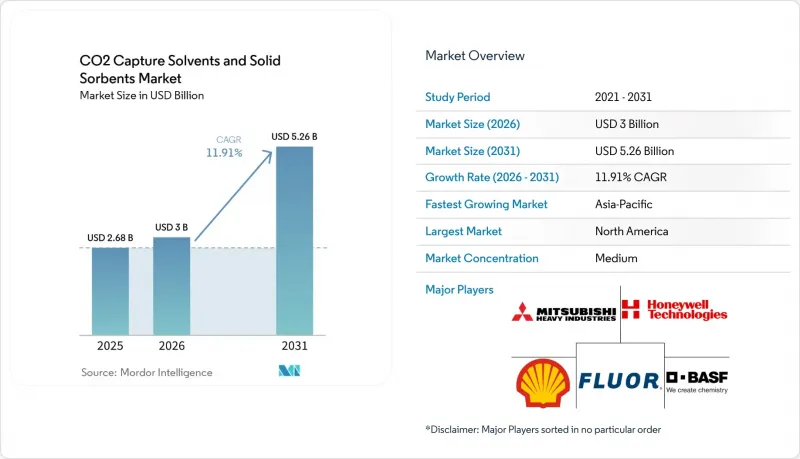
본 보고서는 제품 유형(액체 용매 및 고체 흡착제), 회수 방식(연소 후 회수, 연소 전 회수, 기타), 공정(흡수, 흡착, 기타), 배출원 산업(발전, 시멘트, 철강·금속, 기타), 지역(아시아태평양, 북미, 유럽, 기타)별로 분류되어 있습니다. 시장 전망은 금액(달러) 기준으로 제시되어 있습니다.
세계의 CO2 포집 용매 및 고체 흡착제 시장 동향 및 인사이트
회수의 경제성을 뒷받침하는 탄소 가격과 세액 공제
CO2 포집 용매 및 고체 흡착제 시장은 세액 공제 및 탄소 가격 제도를 통해 보다 명확한 상업적 신호를 받고 있습니다. 미국 국세청(IRS)은 2026년 5월, 섹션 45Q 세액 공제에 대한 인플레이션 조정 계수를 1.4639로 확정했습니다. 그 결과, 2026년 안전한 지하 저장 시설에 대한 세액 공제액은 CO2 1톤당 29.28달러에 달했습니다. ‘One Big Beautiful Bill Act’에 따르면, 직접 공기 포집(DAC) 시설은 1톤당 36달러의 기본 세액 공제 대상이 됩니다. 이러한 인센티브로 인해 포집 설비의 기대 수익률이 향상되어, 프런트엔드 엔지니어링 단계에서 용매 및 흡착제 선정이 앞당겨지게 될 것입니다. 또한, EU 배출권 거래 제도(ETS)의 준수 조건에 따라 대상 시설에 대해 에너지 감사 및 탄소 중립 계획의 유지가 의무화되어 있어, 이에 따른 대응 지연의 여지가 줄어들고 있습니다.
산업 부문의 넷제로 공약과 배출 감축 의무
기업의 배출량 감축 목표는 대출 조건, 투자자의 기대, 오프테이크 계약과 점점 더 밀접하게 연결되고 있습니다. 따라서 CO₂ 포집 용매 및 고체 흡착제 시장은 단순한 자발적 선언이 아닌, 검증 가능한 배출 감축이 필요한 프로젝트에 기여하고 있습니다. EU의 4단계 규정에서는 성능 요건을 충족하지 못하는 시설에 대해 무료 할당량을 탄소 중립 계획과 연계하고 있습니다. LeadIT 트래커에 따르면, 2025년 시점에서 시멘트 부문에서 175건 이상의 CCUS 프로젝트가 확인되었습니다. ISO 14064에 따른 산정 기준과 탄소 국경 조정 메커니즘(CBAM)으로 인해, 신뢰할 수 있는 탄소 함유량 데이터의 제공이 더욱 요구되고 있습니다. 이러한 환경은 회수를 통해 배출 감축을 입증할 수 있는 시멘트, 철강, 정제 시설의 CO2 포집 용매 및 고체 흡착제 시장을 뒷받침하고 있습니다.
용매 재생에 따른 에너지 손실
열 재생은 CO2 포집 용매 및 고체 흡착제 시장에 있어 여전히 중요한 운영상의 제약 요인으로 남아 있습니다. 시판되는 아민계 시스템은 일반적으로 CO₂ 1톤을 회수할 때마다 3.0-3.5GJ의 리보일러 부하를 필요로 합니다. 2-아미노-2-메틸-1-프로판올(AMP) 및 피페라진 CESAR1을 포함한 혼합 용매는 파일럿 시험 및 검증된 모델링에서 모노에탄올아민에 비해 리보일러 부하를 20%-25% 감소시켰습니다. 최적화된 시스템이라 하더라도 CO2 농도나 열 통합 상황에 따라 호스트 플랜트의 효율을 5%-15% 저하시킬 가능성이 있습니다. 저비용 폐열이나 인근의 재생 가능 전력을 이용할 수 없는 시설에서는 투자 수익성이 더욱 어려워집니다. 이러한 제약으로 인해 흡착법 및 기타 저에너지 회수 방식에 대한 관심이 높아지고 있습니다.
부문 분석
2025년, CO2 포집 용매 및 고체 흡착제 시장 매출액 중 액체 용매가 63.44%를 차지했습니다. 이러한 위상은 발전소 및 산업 시설의 흡수탑·재생탑 시스템에서 오랜 기간 동안 축적된 운영 실적을 반영한 것입니다. 모노에탄올아민과 혼합 아민은 가동 중인 연소 후 회수 플랜트에서 계속해서 주요 용매로 사용되고 있습니다. Selexol이나 Rectisol과 같은 물리적 용매는 연소 전 회수나 천연가스 탈황 처리 용도로 활용되고 있습니다. 이온 액체, 저수분 용매, 효소 기반 시스템은 여전히 상용화의 초기 단계에 있습니다. 액체 시스템은 대유량의 안정적인 CO₂ 스트림을 통해 기존 설비 레이아웃을 유지할 수 있는 경우에 특히 적합합니다. 많은 계획 중인 프로젝트에서 확립된 흡수 구성이 채택되고 있기 때문에 이 제품 부문은 CO2 포집 용매 및 고체 흡착제 산업에서 여전히 중심적인 위치를 차지하고 있습니다. 이러한 지속적인 역할은 대규모 현장을 위한 공정 라이선스 및 엔지니어링 경험이 이용 가능하다는 점도 반영하고 있습니다.
고체 흡착제는 2026년부터 2031년까지 연평균 성장률(CAGR) 13.42%로 확대될 것으로 예측됩니다. 지지체 부착 아민, 제올라이트, 활성탄, 금속-유기 골격체(MOF)는 액체 시스템과는 다른 운전 특성을 가지고 있습니다. 고베제강소, 아토미스, 나가세산업은 2025년 11월, 하루 30kg의 처리 능력을 갖춘 일본 최초의 산업 규모 MOF를 이용한 CO₂ 포집 실증 실험을 완료했습니다. 각사는 2026년도 중에 1톤 규모의 시험 실시를 검토하고 있습니다. IDEX와 Nuada는 2026년 7월, 프랑스에서 연간 최대 1만 톤의 생물 유래 CO₂를 회수할 수 있는 능력을 갖춘 산업 규모의 MOF 진공 흡착 장치를 발표했습니다. 이러한 프로젝트들은 고체 소재가 단순한 실험실 단계에 그치지 않고 실제 산업 환경에서 시험되고 있음을 보여줍니다. 그 가능성이 가장 높은 분야는 소형 시스템이나 재생에 소요되는 에너지 절감이 중요한 용도입니다.
2025년, 연소 후 포집은 CO₂ 포집 용매 및 고체 흡착제 시장의 57.82%를 차지했습니다. 이는 석탄·가스 화력 발전소, 시멘트 가마, 산업용 보일러에서 널리 이용되고 있습니다. 이러한 환경에서의 신규 및 개보수 프로젝트 대부분에서는 액체 아민 시스템이 일반적으로 채택되고 있습니다. 한편, 연소 전 회수는 수소 제조 및 통합 가스화 공정에서 여전히 중요한 역할을 수행하고 있습니다. Selexol과 Rectisol은 이러한 공정에서 고압·고농도공급 유량의 이점을 누리고 있습니다. 독일 Catch4Climate의 산소 연소식 시멘트 공장은 2026년 5월에 첫 클링커를 생산했으며, 2026년 6월에 첫 산소 연소 캠페인을 완료했습니다. 이러한 포집 경로의 조합을 통해 CO₂ 포집 용매 및 고체 흡착제 시장은 기존 배기가스 처리 및 새로운 산업 설계 모두를 충족시킬 수 있게 됩니다.
직접 공기 포집(DAC)은 2026년부터 2031년까지 연평균 성장률(CAGR) 12.05%를 나타낼 것으로 예측됩니다. 텍사스주 서부에서 진행 중인 1PointFive의 STRATOS 프로젝트는 액체 용매 기술을 활용하여 연간 50만 톤의 CO2를 포집하도록 설계되었습니다. 이 시설은 현재 시운전 단계에 있으며, 2026년에 지하 주입이 시작될 전망입니다. Climeworks는 ‘Project Cypress Hub’의 일환으로 2026년 중 루이지애나주에서 3세대 고체 흡착제 기술의 건설을 시작할 예정입니다. 이 회사는 톤당 회수 비용을 250-350달러로 책정하고, 기존 시스템에 비해 모듈당 에너지 소비량을 50% 절감하는 것을 목표로 하고 있습니다. 직접 공기 포집(DAC)은 고체 흡착제 시스템과 액체 용매 시스템 모두를 지원합니다. 따라서 CO₂ 포집 용매와 고체 흡착제에 대한 시장 수요는 이 두 가지 주요 제품군 전반에 걸쳐 확대되고 있습니다.
지역별 분석
2025년, 북미는 CO2 포집 용매 및 고체 흡착제 시장 매출의 36.21%를 차지했습니다. 미국에서는 섹션 45Q에 따른 인센티브와 암모니아, 수소, 전력, 산업 분야 프로젝트에 대한 연방 정부의 자금 지원을 결합하고 있습니다. 에너지부는 와바쉬 저탄소 암모니아 프로젝트에 ‘에너지 도미넌스 파이낸스(Energy Dominance Finance)’의 일환으로 15억 달러를 지원했습니다. 캐나다는 탄소 가격 제도와 대규모 배출 사업자를 위한 체계를 추진하고 있으며, 하이델베르크 머티리얼즈(Heidelberg Materials)는 2026년 하반기에 에드먼턴 프로젝트를 시작할 예정입니다. 멕시코는 여전히 시장 기여도가 낮으며, 그 활동은 천연가스 처리 및 정유시설 용도와 관련이 있습니다. 북미의 비즈니스 기회는 저장 인프라에 따라 달라집니다. 이는 회수 프로젝트가 자금 조달이 가능해지기 위해서는 저장 용량이 필요하기 때문입니다.
아시아태평양은 2026년부터 2031년까지 연평균 성장률(CAGR) 13.16%를 나타낼 것으로 예측됩니다. 일본은 국내 CCS 실증 사업과 국제적인 저탄소 암모니아 공급망을 추진하고 있습니다. 미쓰비시 중공업은 2025년 7월, 홋카이도 전력의 토마토 아츠마 발전소에 건설될 일본 최대 규모의 CO₂ 회수 플랜트의 기본 설계 계약을 수주했습니다. 한국의 ‘한국 탄소 포집·활용·저장(K-CCUS)’ 로드맵은 철강, 전력, 석유화학 시설에서의 도입에 중점을 두고 있습니다. 중국의 프로젝트는 석탄 화력 발전소와 철강 시설에 집중되어 있습니다. 일본과 한국은 노후화된 중공업 자산의 개보수에 사용되는 아민계 시스템에 대한 CO₂ 포집 용매 및 고체 흡착제 시장 수요를 뒷받침하고 있습니다. 고베제강소, 아토미스, 나가세산업이 진행하는 프로젝트 역시 차세대 흡착제 개발의 현지화에 대한 지역적 관심을 보여주고 있습니다.
유럽에서는 노르웨이의 ‘Longship’ 프로그램이 2025년 6월에 운영상의 주요 이정표를 달성했습니다. 여기에는 브레비크(Brevik)의 시멘트 CCS 플랜트와 SLB 기술을 활용한 Twence의 폐기물 에너지화(WtE)를 통한 CO2 포집 프로젝트가 포함됩니다. 독일의 홀심(Holcim)사의 ‘Carbon2Business’ 프로젝트는 연간 120만 톤의 CO₂ 회수를 목표로 하고 있는 반면, 벨기에에서 진행 중인 동사의 ‘GO4ZERO’ 프로젝트는 2029년까지 연간 110만 톤의 회수를 예상하고 있습니다. 독일의 ‘이산화탄소 저장법(KSpTG)’은 2025년 11월에 시행되어, 해상로의 CO2 수출이 가능해졌습니다. 남미는 여전히 초기 단계에 있지만, 브라질의 프레솔트층에서 진행되는 석유 및 가스 사업은 천연가스 탈황 거점으로 자리 잡고 있습니다. 중동 및 아프리카는 아시아 에너지 시장을 겨냥한 블루 암모니아 수출 계획을 통해 그 중요성을 높이고 있습니다.
기타 혜택
- 엑셀 형식 시장 예측(ME) 시트
- 3개월간의 애널리스트 지원
자주 묻는 질문
목차
제1장 서론
제2장 조사 방법
제3장 주요 요약
제4장 시장 구도
제5장 시장 규모 및 성장 예측
제6장 경쟁 구도
제7장 시장 기회 및 향후 전망
KTH 26.09.10According to Mordor Intelligence, the CO2 capture solvents and solid sorbents market size was valued at USD 3.00 billion in 2025 and is forecast to reach USD 5.26 billion by 2031, at a CAGR of 11.91% during the forecast period (2026-2031).
This report is Segmented by Product Type (Liquid Solvents and Solid Sorbents), Capture Route (Post-Combustion Capture, Pre-Combustion Capture, and More), Process (Absorption, Adsorption, and More), Source Industry (Power Generation, Cement, Steel and Metals, and More), and Geography (Asia-Pacific, North America, Europe, and More). The Market Forecasts are Provided in Terms of Value (USD).
Global CO2 Capture Solvents and Solid Sorbents Market Trends and Insights
Carbon-Price and Tax-Credit Support for Capture Economics
The CO2 capture solvents and solid sorbents market is receiving a clearer commercial signal from tax credits and carbon-pricing systems. The Internal Revenue Service confirmed a 1.4639 inflation adjustment factor for the Section 45Q credit in May 2026. The resulting 2026 credit for secure geological storage was USD 29.28 per metric ton of CO2. Direct air capture facilities qualify for a USD 36 per metric ton base credit under the One Big Beautiful Bill Act. These incentives improve the expected return on capture equipment and bring solvent and sorbent selection forward during front-end engineering work. EU Emissions Trading System (ETS) compliance conditions also require eligible installations to maintain energy audits and carbon-neutrality plans, which reduce the scope for delayed action.
Industrial Net-Zero Commitments and Emissions-Reduction Mandates
Corporate emissions targets are increasingly tied to loan conditions, investor expectations, and offtake agreements. The CO2 capture solvents and solid sorbents market, therefore, serves projects that need verifiable emissions reductions instead of voluntary statements. EU Phase 4 rules link free allocation to carbon-neutrality plans for installations that do not meet performance requirements. The LeadIT tracker identified more than 175 CCUS projects in the cement sector as of 2025. ISO 14064 accounting practices and the Carbon Border Adjustment Mechanism add pressure for credible carbon-content data. This environment supports the CO2 capture solvents and solid sorbents market at cement, steel, and refining facilities, where capture can document emissions reductions.
Solvent Regeneration Energy Penalty
Thermal regeneration remains a material operating constraint for the CO2 capture solvents and solid sorbents market. Commercial amine systems typically require 3.0 to 3.5 GJ of reboiler duty per metric ton of captured CO2. Blended solvents, including including 2-amino-2-methyl-1-propanol (AMP) and piperazine CESAR1, have reduced reboiler duty by 20% to 25% against monoethanolamine in pilot work and validated modeling. Even optimized systems can reduce host-plant efficiency by 5% to 15%, depending on CO2 concentration and heat integration. Facilities without low-cost waste heat or nearby renewable electricity face a more difficult investment case. This limitation increases interest in adsorption and other lower-energy regeneration approaches.
Other drivers and restraints analyzed in the detailed report include:
- Blue Hydrogen and Low-Carbon Ammonia Project Buildout
- Retrofit Demand from Hard-to-Abate Industrial Assets
- Degradation, Corrosion, Emissions, and Waste-Handling Costs
For complete list of drivers and restraints, kindly check the Table Of Contents.
Segment Analysis
Liquid solvents held 63.44% of the CO2 capture solvents and solid sorbents market revenue in 2025. Their position reflects long operating experience with absorber-stripper systems at power plants and industrial facilities. Monoethanolamine and blended amines remain the main solvents used in operating post-combustion plants. Physical solvents such as Selexol and Rectisol serve pre-combustion capture and natural-gas sweetening applications. Ionic liquids, water-lean solvents, and enzymatic systems remain at earlier commercial stages. Liquid systems are particularly relevant where high-volume, steady CO2 streams support conventional equipment layouts. The product segment remains central to the CO2 capture solvents and solid sorbents industry because many planned projects use established absorption configurations. Its continued role also reflects the availability of process licenses and engineering experience for large sites.
Solid sorbents are forecast to expand at a 13.42% CAGR from 2026 to 2031. Supported amines, zeolites, activated carbon, and metal-organic frameworks (MOF) offer different operating characteristics from liquid systems. Kobe Steel, Atomis, and Nagase completed Japan's first industrial-scale MOF-based CO2 capture demonstration at 30 kg per day in November 2025. The partners are examining metric-ton-scale testing during fiscal 2026. IDEX and Nuada announced an industrial-scale MOF vacuum-adsorption unit in France in July 2026 with the capacity to capture up to 10,000 metric tons of biogenic CO2 each year. These projects show that solid materials are being tested in operating industrial settings rather than only in laboratory programs. Their opportunity is strongest in applications where a compact system or lower regeneration energy is important.
Post-combustion capture accounted for 57.82% of the CO2 capture solvents and solid sorbents market share in 2025. It is widely used for coal and gas power plants, cement kilns, and industrial boilers. Liquid amine systems are the usual choice for many new and retrofit applications in these settings. Pre-combustion capture remains important in hydrogen production and integrated gasification. Selexol and Rectisol benefit from high-pressure, high-concentration feed streams in those processes. The Catch4Climate oxy-fuel cement plant in Germany produced its first clinker in May 2026 and completed its first oxygen campaign in June 2026. The route mix allows the CO2 capture solvents and solid sorbents market to address both established flue-gas treatment and newer industrial designs.
Direct air capture is projected to grow at a 12.05% CAGR from 2026 to 2031. 1PointFive's STRATOS project in West Texas is designed to capture 500,000 metric tons of CO2 per year using liquid solvent technology. The facility is progressing through start-up, with underground injection expected in 2026. Climeworks plans to begin construction on its Generation 3 solid-sorbent technology in Louisiana during 2026 as part of the Project Cypress Hub. Climeworks targets capture costs of USD 250 to USD 350 per metric ton and a 50% energy reduction per module relative to current systems. Direct air capture supports both solid sorbent and liquid solvent systems. It therefore broadens the CO2 capture solvents and solid sorbents market demand across the two main product groups.
Complete Report Scope:
- By Product Type
- Liquid Solvents
- Amines
- Physical Solvents
- Others (Ionic Liquids, Water-Lean and Enzymatic Solvents)
- Solid Sorbents
- Supported Amines
- Zeolites
- Activated Carbon
- Others (MOFs, Alkali and Metal-Oxide Sorbents)
- Liquid Solvents
- By Capture Route
- Post-Combustion Capture
- Pre-Combustion Capture
- Direct Air Capture (DAC)
- Other Capture Routes (BECCS, Oxy-Fuel Capture)
- By Process
- Absorption
- Adsorption
- Temperature Swing Adsorption (TSA)
- Vacuum Swing Adsorption (VSA)
- Other Processes (TVSA, Moisture-Swing, Electrochemical Regeneration)
- By Source Industry
- Power Generation
- Cement
- Steel and Metals
- Oil, Gas and Chemicals
- Other Source Industries (Hydrogen and Ammonia, Waste-to-Energy, Pulp and Paper, Maritime)
- By Geography
- Asia-Pacific
- China
- India
- Japan
- South Korea
- ASEAN Countries
- Rest of Asia-Pacific
- North America
- United States
- Canada
- Mexico
- Europe
- Germany
- United Kingdom
- France
- Italy
- NORDIC Countries
- Rest of Europe
- South America
- Brazil
- Argentina
- Rest of South America
- Middle-East and Africa
- Saudi Arabia
- South Africa
- Rest of Middle-East and Africa
- Asia-Pacific
Geography Analysis
North America held 36.21% of the CO2 capture solvents and solid sorbents market revenue in 2025. The United States combines Section 45Q incentives with federal financing for projects in ammonia, hydrogen, power, and industry. The Department of Energy provided USD 1.5 billion in Energy Dominance Financing for the Wabash Low-Carbon Ammonia project. Canada is advancing carbon-pricing and large-emitter frameworks, while Heidelberg Materials is planning its Edmonton project for late 2026. Mexico remains a smaller contributor, with activity linked to natural-gas processing and refinery applications. North American opportunity also depends on storage infrastructure because capture projects need injection capacity to become financeable.
Asia-Pacific is forecast to grow at a 13.16% CAGR from 2026 to 2031. Japan is advancing domestic CCS demonstrations and international low-carbon ammonia supply chains. Mitsubishi Heavy Industries was awarded the basic design contract for Japan's largest CO2 capture plant at Hokkaido Electric Power's Tomato-Atsuma Power Station in July 2025. South Korea's Korea Carbon Capture, Utilization and Storage (K-CCUS) roadmap focuses on deployment at steel, power, and petrochemical facilities. China's projects are concentrated at coal power and steel sites. Japan and South Korea are supporting the CO2 capture solvents and solid sorbents market demand for amine systems used to retrofit aging heavy-industrial assets. The Kobe Steel, Atomis, and Nagase project also shows regional interest in localizing next-generation sorbent development.
In Europe, Norway's Longship program reached operational milestones in June 2025, including the Brevik cement CCS plant and Twence's waste-to-energy carbon-capture project using SLB technology. Holcim's Carbon2Business project in Germany targets 1.2 million metric tons of CO2 capture each year, while its GO4ZERO project in Belgium is designed for 1.1 million metric tons annually by 2029. Germany's Kohlendioxid-Speicherungsgesetz (KSpTG) took effect in November 2025 and enables offshore CO2 export. South America remains at an early stage, although Brazil's pre-salt oil and gas operations provide a natural-gas sweetening base. The Middle-East and Africa are gaining relevance through blue ammonia export plans directed toward Asian energy markets.
- Air Liquide
- Air Products and Chemicals, Inc.
- BASF
- Carbon Clean Solutions Limited
- Climeworks
- Fluor Corporation
- Honeywell International Inc
- JGC HOLDINGS CORPORATION
- KBR, Inc.
- Linde PLC
- MITSUBISHI HEAVY INDUSTRIES, LTD.
- Shell plc
- SLB
- Svante Technologies Inc.
- Technip Energies N.V.
Additional Benefits:
- The market estimate (ME) sheet in Excel format
- 3 months of analyst support
TABLE OF CONTENTS
1 Introduction
- 1.1 Study Assumptions and Market Definition
- 1.2 Scope of the Study
2 Research Methodology
3 Executive Summary
4 Market Landscape
- 4.1 Market Overview
- 4.2 Market Drivers
- 4.2.1 Carbon-Price and Tax-Credit Support for Capture Economics
- 4.2.2 Industrial Net-Zero Commitments and Emissions-Reduction Mandates
- 4.2.3 Blue Hydrogen and Low-Carbon Ammonia Project Buildout
- 4.2.4 Retrofit Demand From Hard-to-Abate Industrial Assets
- 4.2.5 Carbon Capture Contracts Moving From Pilot to Infrastructure-Backed Procurement
- 4.2.6 Modular and Lower-Energy Capture Materials Reaching Commercial Deployment
- 4.3 Market Restraints
- 4.3.1 Solvent Regeneration Energy Penalty
- 4.3.2 Degradation, Corrosion, Emissions, and Waste-Handling Costs
- 4.3.3 CO2 Transport, Storage Permitting, and Long-Term Liability Delays
- 4.3.4 Site-Specific Flue-Gas Impurities and Retrofit Space Constraints
- 4.4 Value and Supply-Chain Analysis
- 4.5 Porter's Five Forces Analysis
- 4.5.1 Bargaining Power of Suppliers
- 4.5.2 Bargaining Power of Buyers
- 4.5.3 Threat of New Entrants
- 4.5.4 Threat of Substitutes
- 4.5.5 Competitive Rivalry
5 Market Size and Growth Forecasts (Value)
- 5.1 By Product Type
- 5.1.1 Liquid Solvents
- 5.1.1.1 Amines
- 5.1.1.2 Physical Solvents
- 5.1.1.3 Others (Ionic Liquids, Water-Lean and Enzymatic Solvents)
- 5.1.2 Solid Sorbents
- 5.1.2.1 Supported Amines
- 5.1.2.2 Zeolites
- 5.1.2.3 Activated Carbon
- 5.1.2.4 Others (MOFs, Alkali and Metal-Oxide Sorbents)
- 5.1.1 Liquid Solvents
- 5.2 By Capture Route
- 5.2.1 Post-Combustion Capture
- 5.2.2 Pre-Combustion Capture
- 5.2.3 Direct Air Capture (DAC)
- 5.2.4 Other Capture Routes (BECCS, Oxy-Fuel Capture)
- 5.3 By Process
- 5.3.1 Absorption
- 5.3.2 Adsorption
- 5.3.3 Temperature Swing Adsorption (TSA)
- 5.3.4 Vacuum Swing Adsorption (VSA)
- 5.3.5 Other Processes (TVSA, Moisture-Swing, Electrochemical Regeneration)
- 5.4 By Source Industry
- 5.4.1 Power Generation
- 5.4.2 Cement
- 5.4.3 Steel and Metals
- 5.4.4 Oil, Gas and Chemicals
- 5.4.5 Other Source Industries (Hydrogen and Ammonia, Waste-to-Energy, Pulp and Paper, Maritime)
- 5.5 By Geography
- 5.5.1 Asia-Pacific
- 5.5.1.1 China
- 5.5.1.2 India
- 5.5.1.3 Japan
- 5.5.1.4 South Korea
- 5.5.1.5 ASEAN Countries
- 5.5.1.6 Rest of Asia-Pacific
- 5.5.2 North America
- 5.5.2.1 United States
- 5.5.2.2 Canada
- 5.5.2.3 Mexico
- 5.5.3 Europe
- 5.5.3.1 Germany
- 5.5.3.2 United Kingdom
- 5.5.3.3 France
- 5.5.3.4 Italy
- 5.5.3.5 NORDIC Countries
- 5.5.3.6 Rest of Europe
- 5.5.4 South America
- 5.5.4.1 Brazil
- 5.5.4.2 Argentina
- 5.5.4.3 Rest of South America
- 5.5.5 Middle-East and Africa
- 5.5.5.1 Saudi Arabia
- 5.5.5.2 South Africa
- 5.5.5.3 Rest of Middle-East and Africa
- 5.5.1 Asia-Pacific
6 Competitive Landscape
- 6.1 Market Concentration
- 6.2 Strategic Moves
- 6.3 Market Share (%)/Ranking Analysis
- 6.4 Company Profiles (includes Global Overview, Market Overview, Core Segments, Financials as available, Strategic Information, Products and Services, and Recent Developments)
- 6.4.1 Air Liquide
- 6.4.2 Air Products and Chemicals, Inc.
- 6.4.3 BASF
- 6.4.4 Carbon Clean Solutions Limited
- 6.4.5 Climeworks
- 6.4.6 Fluor Corporation
- 6.4.7 Honeywell International Inc
- 6.4.8 JGC HOLDINGS CORPORATION
- 6.4.9 KBR, Inc.
- 6.4.10 Linde PLC
- 6.4.11 MITSUBISHI HEAVY INDUSTRIES, LTD.
- 6.4.12 Shell plc
- 6.4.13 SLB
- 6.4.14 Svante Technologies Inc.
- 6.4.15 Technip Energies N.V.
7 Market Opportunities and Future Outlook
- 7.1 White-Space and Unmet-Need Assessment