|
시장보고서
상품코드
2119251
배터리 열폭주 전파 차단 소재 : 시장 점유율 분석, 업계 동향 및 통계, 성장 예측(2026-2031년)Battery Thermal Runaway Propagation Barrier Materials - Market Share Analysis, Industry Trends & Statistics, Growth Forecasts (2026 - 2031) |
||||||
 Mordor Intelligence
Mordor Intelligence에 의하면, 배터리 열폭주 전파 차단 소재 시장은 2025년에 7억 2,000만 달러 규모로 평가되었습니다. 2026년 8억 달러에서 2031년까지 13억 5,000만 달러에 이를 것으로 예상되며, 예측 기간(2026-2031년) CAGR은 10.85%를 나타낼 전망입니다.
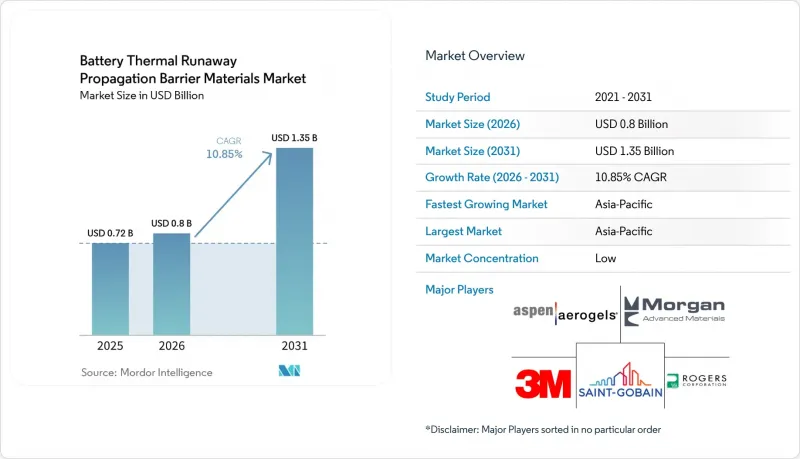
본 보고서는 소재 유형(마이카, 에어로겔, 기타), 형태 유형(시트·패드, 코팅, 기타), 배터리 화학 조성(NMC 및 NCA 배터리, LFP 및 LMFP 배터리, 기타),용도(전기차, 산업용, 기타), 지역(아시아태평양, 북미, 기타)별로 분류되어 있습니다. 시장 예측은 금액(미 달러) 기준으로 제시되어 있습니다.
세계의 배터리 열폭주 전파 차단 소재 시장 동향 및 인사이트
중국 및 북미의 열전파 방지 규제 준수 의무
중국의 GB 38031-2025는 2026년 7월 1일부터 신규 등록되는 차종에 대해 시행되며, 기존 차종에 대해서도 2027년 7월 1일까지 준수해야 합니다. 이 규격에서는 열폭주 발생 후 2시간 동안 발화 및 폭발이 일어나지 않아야 하며, 또한 연기가 승객실로 유입되어서는 안 됩니다. 또한, 하부 충격 시험과 급속 충전 후 300사이클의 에이징 시험, 그리고 이에 이어지는 외부 단락 시험도 포함되어 있습니다. 이러한 시험을 통해 기계적 및 열적 스트레스 하에서 배리어의 내구성이 배터리 열폭주 전파 차단 소재 시장의 인증 요건이 되고 있습니다. 북미에서는 에너지 저장 시스템용 언더라이터스 래버러토리스(UL) 9540A 시험과 고전압 자동차 배터리용 FMVSS 305a 초안 요건에 따라 공급업체를 위한 별도의 적합성 평가 경로가 마련되어 있습니다. 그 결과, 차량과 고정형 에너지 저장 시스템 양쪽의 안전 요건을 모두 충족하는 수동형 배리어에 대한 수요가 발생하고 있습니다.
셀-투-팩(Cell-to-Pack) 및 셀-투-바디(Cell-to-Body) 구조를 통한 배터리 팩의 고밀도화
셀-투-팩 설계에서는 중간 모듈 층을 제거하여 셀 활용률을 40-50%에서 60-70%로 높입니다. 이 아키텍처에서는 셀 간의 열 전달을 제한하던 모듈 하우징의 벽도 제거됩니다. 2026년 연구에 따르면, 셀-투-팩 모듈에서 열 폭주 시의 열 전달은 셀 계면에서의 배리어의 열전도율과 기계적 거동에 직접적으로 의존하는 것으로 밝혀졌습니다. 셀-투-바디 설계에서는 배터리 하우징이 차량 구조의 일부가 되므로 충돌 하중과 압축 응력이 가해집니다. 따라서 배터리 열폭주 전파 차단 소재 시장은 컨포멀 성형 부품, 정밀 펀칭, 사출 성형, 코팅 기법으로 전환되고 있습니다. 안전 부품은 점점 더 소형화되는 팩 형태에 맞추어져야 하므로, 경량이며 얇은 소재가 여전히 중요시되고 있습니다.
에어로겔과 첨단 다층 배리어 시스템의 높은 비용
에어로겔 배리어는 특히 비용 제한이 엄격한 대량 생산형 LFP 프로그램에서 운모나 세라믹 섬유와 같은 대체 소재보다 단위 면적당 비용이 더 높습니다. Aspen Aerogels는 2025년 조지아주 스테이츠버러에서 계획했던 3억 2,500만 달러 규모의 시설 건설을 중단하고, 로드아일랜드주의 생산 능력과 외부 위탁 생산에 주력했습니다. 이 결정은 대규모 자동차용 에어로겔 생산에 수반되는 높은 자본 집약도와 가동률의 위험을 여실히 보여줍니다. 또한, 배리어 소재는 압축, 통기, 충돌 하중 하에서도 열 기능을 유지해야 하므로, 저비용 소재로는 요구 사항이 까다로운 팩 설계에 적합하지 않을 수 있습니다. Alkegen은 2025년 6월, 기존 에어로겔에 필요했던 캡슐화 공정을 생략하기 위한 저분진 방식을 채택하여 자사의 ‘AlkeGel’ 섬유·에어로겔 복합재의 본격적인 생산을 시작했습니다. 이러한 접근 방식을 통해 팩 조립 단계의 비용 문제를 해결할 수 있지만, 소재 선정은 여전히 각 프로그램의 안전성과 가격 목표에 따라 달라집니다.
부문 분석
2025년 매출에서 운모가 차지하는 비중은 34.18%로, 배터리 열 폭주 전파 차단 소재 시장에서 주요 소재 범주로 자리 잡았습니다. 절연 내압은 11kV를 초과하고 내열성은 1,000°C 이상이므로 셀 간 및 모듈 수준의 용도에 대응하고 있습니다. 마이카는 비용 절감과 검증된 열적·전기적 성능을 겸비하고 있어 대량 생산되는 LFP 및 NMC 프로그램에서 여전히 중요한 역할을 하고 있습니다. 셀-투-팩 설계에서는 일반적인 평면적인 틈새가 아닌, 3차원적인 프리즘형 셀 표면에 적합한 소재에 대한 수요가 증가하고 있습니다. 이에 따라 특정 팩 레이아웃에 맞추어 복잡한 마이카 부품을 성형, 절단, 조립할 수 있는 공급업체가 유리한 위치를 차지하게 됩니다.
에어로겔 시장은 2031년까지 연평균 성장률(CAGR) 12.02%로 확대될 것으로 예상되며, 이는 배터리 열폭주 전파 차단 소재 산업 내 소재 유형 중 가장 높은 성장률입니다. Aspen Aerogels는 2024년 전기차용 열 차단재 매출이 3억 달러를 넘어섰다고 보고했으며, 이 매출의 대부분은 단일 OEM과의 거래에서 비롯된 것입니다. 세라믹 섬유와 세라믹 페이퍼는 NMC 및 NCA 모듈의 배리어 등 지속적인 난연성이 요구되는 용도에 적합합니다. 팽창성 소재는 수동형인 운모나 에어로겔과 달리, 열을 가하면 탄화층을 형성하는 반응을 보입니다. 따라서 배터리 열폭주 전파 차단 소재 시장에는 확립된 단열 제품과 더 가혹한 이용 사례를 위한 능동형 반응 소재가 모두 포함되어 있습니다.
2025년에는 시트 및 패드가 매출의 34.31%를 차지하며, 배터리 열폭주 전파 차단 소재 시장에서 형태별 점유율 1위를 기록했습니다. 이 형태는 셀, 모듈,또는 구조 부품 사이에 배치할 수 있어, 마이카, 에어로겔, 세라믹 섬유 제품 전반에 걸쳐 널리 사용되고 있습니다. Rogers Corporation의 ‘ProCell EV Firewall 300’ 시리즈는 틈새 충진, 진동 제어, 열 전파 방지 기능을 하나의 실리콘 엘라스토머 부품에 통합하고 있습니다. 성형 부품은 셀 배리어, 모듈 커버, 버스바 절연재 등 복잡한 팩 형태에 대응하고 있습니다. ElringKlinger의 ‘ElroForm TP’는 1,300°C까지의 내열성을 갖추고 있으며, 이러한 용도에서 UL 94 V-0 인증을 획득했습니다.
코팅 시장은 2031년까지 연평균 성장률(CAGR) 11.71%를 나타낼 것으로 예측됩니다. 코팅 분야의 배터리 열폭주 전파 차단 소재 시장 규모는 셀-투-팩(cell-to-pack) 및 셀-투-바디(cell-to-body) 설계에 의해 뒷받침되고 있으며, 밀집 배열된 셀 사이에서는 직접 도포가 유일하게 실용 가능한 형태가 될 수 있습니다. 딥 코팅, 스프레이 코팅, 스크린 인쇄를 통해 별도의 인서트를 추가하지 않고도 셀 표면에 따라 배리어 재료를 형성할 수 있습니다. 스미토모 이공은 2026년 2월, 배터리 셀 사이에 배치되는 실리카 에어로겔 함유 절연 시트에 대해 미국 특허 제12,562,415호를 취득했습니다. ISO 12405 및 IEC 62619의 시험 조건에서도 전기적, 기계적, 열적 스트레스 하에서 기능을 유지할 수 있는 소재가 요구되고 있습니다. 따라서 코팅은 안전 성능과 컴팩트한 팩 통합을 양립시키는 수단이 됩니다.
지역별 분석
아시아태평양은 2025년 매출의 44.47%를 차지했으며, 2031년까지 연평균 성장률(CAGR) 11.86%를 나타낼 것으로 예측되는데, 이는 배터리 열폭주 전파 차단 소재 시장에서 지역별 가장 높은 성장률입니다. 중국은 셀 생산, 배터리 팩 조립, 자동차용 수요, 에너지 저장 시스템(BESS) 도입을 다른 지역에서는 찾아볼 수 없는 규모로 모두 갖추고 있습니다. 중국에서는 2025년에 63GW의 신규 BESS 용량이 추가되어, 전기차에 이어 두 번째로 큰 수요 채널이 창출되었습니다. GB 38031-2025의 시행에 따라 열 전파 성능은 중국 내 배터리 인증의 핵심 요소가 되었습니다. 일본과 한국도 전고체 배터리 개발 및 향후 OEM 인증 프로그램을 통해 기여하고 있습니다.
북미에서는 2026년 말까지 국내 배터리 저장 용량이 60GW를 넘어설 것으로 예상되며, 그 대부분은 유틸리티급 리튬이온 시스템에 기인합니다. 이에 따라 자동차용 팩과는 다른 캐비닛 및 랙용 배리어에 대한 요구 사항이 대두되고 있습니다. Aspen Aerogels는 2026년 1분기, General Motors와의 장기 전기차용 열 차단재 공급 계약에 따라 3,760만 달러 규모의 상업적 합의를 달성했습니다. 이 파트너십은 플랫폼별 공급 계약이 지닌 고부가가치 및 집중적인 특성을 반영하고 있습니다. 브라질과 아르헨티나에서는 국내 배터리 계획 및 재생 에너지 통합과 관련된 초기 단계의 비즈니스 기회가 예상됩니다.
유럽에서는 차량 안전성, 추적성, 에너지 저장 설비 조달 요건으로 인해 배터리 열폭주 전파 차단 소재 시장에서의 수익 기여도가 높아지고 있습니다. UNECE R100.3 및 EU 배터리 규정 2023/1542에 따라 방화 대책, 시스템 분리, 책임 있는 조달, 사용 후 배터리 처리에 대한 관심이 높아지고 있습니다. ElringKlinger는 2026년까지의 혁신적인 배터리 셀 하우징 설계에 대해 ‘유럽 공동 중요 프로젝트(IPCEI)’ 자금으로 3,380만 유로(약 3,700만 달러)를 수령했습니다. 이탈리아의 MACSE 경매에서는 2028년까지의 납품을 조건으로 10GWh 규모의 유틸리티급 에너지 저장 시스템 계약이 체결되었습니다. 한편, 영국의 장주기 에너지 저장(LDES) 계획에서는 2035년까지 2.7-7.7GWh의 도입을 목표로 하고 있습니다. 중동 및 아프리카에서는 사우디아라비아의 재생에너지 저장 프로젝트가 수요를 주도하고 있으며, 남아프리카공화국의 송전망 투자가 미래 수요를 뒷받침하고 있습니다.
기타 혜택
- 엑셀 형식 시장 예측(ME) 시트
- 3개월간의 애널리스트 지원
자주 묻는 질문
목차
제1장 서론
제2장 조사 방법
제3장 주요 요약
제4장 시장 구도
제5장 시장 규모 및 성장 예측
제6장 경쟁 구도
제7장 시장 기회 및 향후 전망
KTH 26.09.10According to Mordor Intelligence, the battery thermal runaway propagation barrier materials market was valued at USD 0.72 billion in 2025 and is estimated to grow from USD 0.80 billion in 2026 to reach USD 1.35 billion by 2031, at a CAGR of 10.85% during the forecast period (2026-2031).
This report is Segmented by Material Type (Mica, Aerogel, and More), Form Type (Sheets and Pads, Coatings, and More), Battery Chemistry (NMC and NCA Batteries, LFP and LMFP Batteries, and More), Application (Electric Vehicles, Industrial Applications, and More), and Geography (Asia-Pacific, North America, and More). The Market Forecasts are Provided in Terms of Value (USD).
Global Battery Thermal Runaway Propagation Barrier Materials Market Trends and Insights
Mandatory Thermal Propagation Compliance in China and North America
China's GB 38031-2025 took effect for newly declared vehicle models on July 1, 2026, and requires existing models to comply by July 1, 2027. The standard requires a two-hour no-fire, no-explosion outcome after thermal runaway, while smoke must not enter the passenger compartment. It also includes bottom-impact testing and a post-fast-charging sequence of 300 aging cycles followed by an external short-circuit test. These tests make barrier durability under mechanical and thermal stress a qualification requirement for the battery thermal runaway propagation barrier materials market. In North America, Underwriters Laboratories (UL) 9540A testing for storage systems and draft FMVSS 305a requirements for high-voltage vehicle batteries create separate compliance paths for suppliers. The result is demand for passive barriers that address both vehicle and stationary-storage safety conditions.
Battery Pack Densification Through Cell-to-Pack and Cell-to-Body Architectures
Cell-to-pack designs remove the intermediate module layer and increase cell utilization from 40-50% to 60-70%. This architecture also removes module housing walls that had limited heat transfer between cells. A 2026 study found that heat transfer during thermal runaway in cell-to-pack modules depends directly on barrier conductivity and mechanical behavior at the cell interface. Cell-to-body designs add crash loads and compressive stress because the battery enclosure becomes part of the vehicle structure. The battery thermal runaway propagation barrier materials market is therefore moving toward conformal parts, precision die-cutting, injection molding, and coating methods. Low-weight and thin materials remain important because safety components must fit into increasingly compact pack geometries.
High Cost of Aerogel and Advanced Multilayer Barrier Systems
Aerogel barriers cost more per unit area than mica or ceramic fiber alternatives, especially in high-volume LFP programs with tight cost limits. Aspen Aerogels stopped its planned USD 325 million facility in Statesboro, Georgia, in 2025 and focused on Rhode Island capacity and external fabrication. The decision showed the capital intensity and utilization risk associated with large-scale automotive aerogel production. Barriers must also preserve their thermal function under compression, venting, and crash loads, which can make a low-cost material unsuitable for a demanding pack design. Alkegen started full-scale production of its AlkeGel fiber-aerogel composite in June 2025, using a low-dust format intended to remove the encapsulation step required by conventional aerogels. This approach addresses cost at the pack assembly stage, although material selection still depends on the safety and price targets of each program.
Other drivers and restraints analyzed in the detailed report include:
- Rising Energy Density and Faster Charging Requirements
- Expansion of Grid-Scale Battery Energy Storage Systems
- Recycling, End-of-Life Separation and Material Traceability Constraints
For complete list of drivers and restraints, kindly check the Table Of Contents.
Segment Analysis
Mica held 34.18% of 2025 revenue, making it the leading material category in the battery thermal runaway propagation barrier materials market. Its dielectric strength exceeds 11 kV, and its temperature resistance is above 1,000 °C, supporting cell-to-cell and module-level applications. Mica remains relevant in high-volume LFP and NMC programs because it combines cost control with established thermal and electrical performance. Cell-to-pack designs increase the need for materials that fit three-dimensional prismatic cell surfaces rather than regular planar gaps. This favors suppliers that can mold, die-cut, and assemble complex mica components for specific pack layouts.
Aerogel is forecast to expand at a 12.02% CAGR through 2031, the fastest rate among material types in the battery thermal runaway propagation barrier materials industry. Aspen Aerogels reported more than USD 300 million in EV thermal barrier revenue during 2024, with most of that revenue linked to a single OEM relationship. Ceramic fiber and ceramic paper remain suited to applications that require sustained flame resistance, including NMC and NCA module barriers. Intumescent materials provide a char-forming response under heat, unlike passive mica and aerogel formats. The battery thermal runaway propagation barrier materials market thus contains both established insulation products and active-response materials for more severe use cases.
Sheets and pads held 34.31% of revenue in 2025, the largest form type share within the battery thermal runaway propagation barrier materials market. This format is established across mica, aerogel, and ceramic fiber products because it can be placed between cells, modules, or structural components. Rogers Corporation's ProCell EV Firewall 300 series combines gap filling, vibration management, and thermal propagation protection in one silicone elastomeric component. Molded parts support complex pack geometries, including cell barriers, module covers, and busbar insulation. ElringKlinger's ElroForm TP is rated to 1,300 °C and has UL 94 V-0 certification for these applications.
Coatings are forecast to grow at an 11.71% CAGR through 2031. The battery thermal runaway propagation barrier materials market size for coatings is supported by cell-to-pack and cell-to-body designs, where direct application may be the only workable geometry between closely arranged cells. Dip-coating, spray coating, and screen printing allow barriers to follow cell surfaces without adding separate inserts. Sumitomo Riko received US Patent 12,562,415 in February 2026 for a silica-aerogel-containing insulation sheet between battery cells. ISO 12405 and IEC 62619 testing conditions also favor materials that maintain their function under electrical, mechanical, and thermal stress. Coatings, therefore, offer a route to combine safety performance with compact pack integration.
Complete Report Scope:
- By Material Type
- Mica
- Aerogel
- Ceramic Fiber and Ceramic Paper
- Intumescent Materials
- Other Material Types
- By Form Type
- Sheets and Pads
- Coatings
- Molded Parts
- Other Form Types
- By Battery Chemistry
- NMC and NCA Batteries
- LFP and LMFP Batteries
- Solid-State Batteries
- Other Battery Chemistries
- By Application
- Electric Vehicles
- Battery Energy Storage Systems
- Industrial Applications
- Other Applications
- By Geography
- Asia-Pacific
- China
- India
- Japan
- South Korea
- Rest of Asia-Pacific
- North America
- United States
- Canada
- Mexico
- Europe
- Germany
- United Kingdom
- France
- Italy
- Rest of Europe
- South America
- Brazil
- Argentina
- Rest of South America
- Middle-East and Africa
- Saudi Arabia
- South Africa
- Rest of Middle-East and Africa
- Asia-Pacific
Geography Analysis
Asia-Pacific held 44.47% of 2025 revenue and is forecast to grow at an 11.86% CAGR through 2031, the highest regional rate in the battery thermal runaway propagation barrier materials market. China combines cell production, battery pack assembly, automotive demand, and storage deployment at a scale unmatched by other regions. China added 63 GW of new BESS capacity in 2025, creating a second demand channel beyond electric vehicles. The enforcement of GB 38031-2025 makes thermal propagation performance a central part of battery qualification in the country. Japan and South Korea also contribute through solid-state cell development and future OEM qualification programs.
In North America, domestic battery storage capacity is projected to exceed 60 GW by the end of 2026, with most capacity in utility-scale lithium-ion systems. This creates requirements for cabinet and rack barriers that differ from automotive pack requirements. Aspen Aerogels reached a USD 37.6 million commercial settlement with General Motors in the first quarter of 2026 under a long-term EV thermal barrier supply agreement. The relationship reflects the high-value and concentrated nature of platform-specific supply arrangements. Brazil and Argentina represent earlier-stage opportunities linked to domestic battery plans and renewable energy integration.
Europe has a growing revenue contribution in the battery thermal runaway propagation barrier materials market because of vehicle safety, traceability, and storage procurement requirements. UNECE R100.3 and the EU Battery Regulation 2023/1542 increase attention to fire protection, system separation, responsible sourcing, and end-of-life treatment. ElringKlinger received EUR 33.8 million (approximately USD 37 million) in Important Projects of Common European Interest (IPCEI) funding for an innovative battery cell housing design through 2026. Italy's MACSE auction contracted 10 GWh of utility-scale storage for delivery by 2028, while Great Britain's long-duration storage plan targets 2.7-7.7 GWh by 2035. The Middle-East and Africa drive demand through renewable storage projects in Saudi Arabia, and grid investment in South Africa supports later demand.
- 3M
- Alkegen
- Aspen Aerogels, Inc.
- DuPont
- ElringKlinger AG
- KULR Technology Group, Inc.
- L&L Products
- Morgan Advanced Materials plc
- Pyrophobic Systems Ltd.
- Rochling SE & Co. KG
- Rogers Corporation
- Saint-Gobain
- Sumitomo Riko Company Limited
- Von Roll Holding AG
- Zotefoams plc
Additional Benefits:
- The market estimate (ME) sheet in Excel format
- 3 months of analyst support
TABLE OF CONTENTS
1 Introduction
- 1.1 Study Assumptions and Market Definition
- 1.2 Scope of the Study
2 Research Methodology
3 Executive Summary
4 Market Landscape
- 4.1 Market Overview
- 4.2 Market Drivers
- 4.2.1 Mandatory Thermal Propagation Compliance in China and North America
- 4.2.2 Battery Pack Densification Through Cell-to-Pack and Cell-to-Body Architectures
- 4.2.3 Rising Energy Density and Faster Charging Requirements
- 4.2.4 Expansion of Grid-Scale Battery Energy Storage Systems
- 4.2.5 Integration of Thermal, Mechanical and Electrical Protection in Single Components
- 4.2.6 Qualification Demand for Low-Weight, Thin and Moldable Barrier Systems
- 4.3 Market Restraints
- 4.3.1 High Cost of Aerogel and Advanced Multilayer Barrier Systems
- 4.3.2 Lengthy OEM Qualification and Validation Cycles
- 4.3.3 Material Performance Trade-Offs Under Compression, Venting and Crash Loads
- 4.3.4 Recycling, End-of-Life Separation and Material Traceability Constraints
- 4.4 Value Chain Analysis
- 4.5 Porter's Five Forces
- 4.5.1 Threat of New Entrants
- 4.5.2 Bargaining Power of Suppliers
- 4.5.3 Bargaining Power of Buyers
- 4.5.4 Threat of Substitutes
- 4.5.5 Competitive Rivalry
5 Market Size and Growth Forecasts (Value)
- 5.1 By Material Type
- 5.1.1 Mica
- 5.1.2 Aerogel
- 5.1.3 Ceramic Fiber and Ceramic Paper
- 5.1.4 Intumescent Materials
- 5.1.5 Other Material Types
- 5.2 By Form Type
- 5.2.1 Sheets and Pads
- 5.2.2 Coatings
- 5.2.3 Molded Parts
- 5.2.4 Other Form Types
- 5.3 By Battery Chemistry
- 5.3.1 NMC and NCA Batteries
- 5.3.2 LFP and LMFP Batteries
- 5.3.3 Solid-State Batteries
- 5.3.4 Other Battery Chemistries
- 5.4 By Application
- 5.4.1 Electric Vehicles
- 5.4.2 Battery Energy Storage Systems
- 5.4.3 Industrial Applications
- 5.4.4 Other Applications
- 5.5 By Geography
- 5.5.1 Asia-Pacific
- 5.5.1.1 China
- 5.5.1.2 India
- 5.5.1.3 Japan
- 5.5.1.4 South Korea
- 5.5.1.5 Rest of Asia-Pacific
- 5.5.2 North America
- 5.5.2.1 United States
- 5.5.2.2 Canada
- 5.5.2.3 Mexico
- 5.5.3 Europe
- 5.5.3.1 Germany
- 5.5.3.2 United Kingdom
- 5.5.3.3 France
- 5.5.3.4 Italy
- 5.5.3.5 Rest of Europe
- 5.5.4 South America
- 5.5.4.1 Brazil
- 5.5.4.2 Argentina
- 5.5.4.3 Rest of South America
- 5.5.5 Middle-East and Africa
- 5.5.5.1 Saudi Arabia
- 5.5.5.2 South Africa
- 5.5.5.3 Rest of Middle-East and Africa
- 5.5.1 Asia-Pacific
6 Competitive Landscape
- 6.1 Market Concentration
- 6.2 Strategic Moves
- 6.3 Market Share (%)/Ranking Analysis
- 6.4 Company Profiles (includes Global Overview, Market Overview, Core Segments, Financials as available, Strategic Information, Products and Services, and Recent Developments)
- 6.4.1 3M
- 6.4.2 Alkegen
- 6.4.3 Aspen Aerogels, Inc.
- 6.4.4 DuPont
- 6.4.5 ElringKlinger AG
- 6.4.6 KULR Technology Group, Inc.
- 6.4.7 L&L Products
- 6.4.8 Morgan Advanced Materials plc
- 6.4.9 Pyrophobic Systems Ltd.
- 6.4.10 Rochling SE & Co. KG
- 6.4.11 Rogers Corporation
- 6.4.12 Saint-Gobain
- 6.4.13 Sumitomo Riko Company Limited
- 6.4.14 Von Roll Holding AG
- 6.4.15 Zotefoams plc
7 Market Opportunities and Future Outlook
- 7.1 White-Space and Unmet-Need Assessment