

|
시장보고서
상품코드
2119297
물리적 AI 플랫폼 : 시장 점유율 분석, 업계 동향 및 통계, 성장 예측(2026-2031년)Physical AI Platforms - Market Share Analysis, Industry Trends & Statistics, Growth Forecasts (2026 - 2031) |
||||||
 Mordor Intelligence
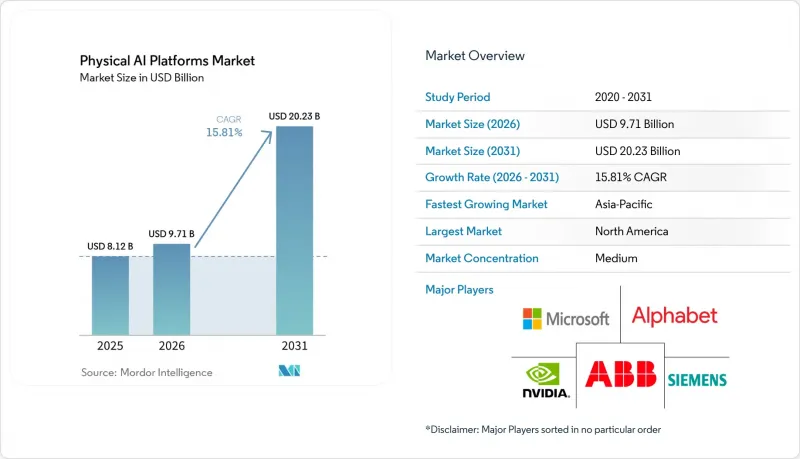
Mordor Intelligence에 의하면, 물리적 AI 플랫폼 시장 규모는 2025년에 81억 2,000만 달러로 평가되었습니다. 2026년 97억 1,000만 달러에서 확대해, 2031년까지 202억 3,000만 달러에 이를 것으로 예측되며, 2026년부터 2031년까지 CAGR은 15.81%를 나타낼 전망입니다.
본 보고서는 구성 요소(하드웨어, 소프트웨어, 서비스), 플랫폼 제품(로보틱스 소프트웨어 플랫폼 등), 도입 형태(온디바이스, 클라우드 기반), 용도(제조·산업 자동화, 창고 자동화·물류 등), 최종 사용자 산업(자동차 제조업체 등), 지역별로 분류되어 있습니다. 시장 전망은 금액(달러) 기준으로 제시되어 있습니다.
세계의 물리적 AI 플랫폼 시장 동향 및 인사이트
휴머노이드 로봇, AMR 및 코봇의 상용화
휴머노이드 로봇, 자율 이동 로봇(AMR) 및 협업 로봇(코봇)의 상용화는 물리적 AI 플랫폼 시장의 주요 수요 원천이 되고 있습니다. 2024년부터 2025년에 걸쳐 개발자들은 연구용 프로토타입에서 창고, 물류 거점 및 경공업 분야의 초기 실증 실험으로 전환했습니다. 도입은 소수의 기업에 집중된 상태로 남아 있으며, 토트 박스 취급이나 자재 운반과 같은 반복적인 작업으로 제한되어 있었습니다. 이러한 추세로 인해 현재의 비즈니스 기회는 공장 전체로의 광범위한 도입보다는 기술적으로 뛰어난 초기 사용자에 대한 의존도가 높아지고 있습니다. NVIDIA Jetson Thor는 보스턴 다이내믹스의 ‘Atlas’와 애질리티 로보틱스의 ‘Digit’에 채택되어, 연산 계층과 시뮬레이션, 모델, 안전 도구의 선택을 연계했습니다.
적응형 제조 및 자율 물류에 대한 수요
고정식 자동화 시스템은 제품 구성, 공장 레이아웃, 공급 상황의 변화에는 그다지 적합하지 않습니다. 물리적 AI 플랫폼을 통해 기계는 대규모 재프로그래밍 없이도 위치가 어긋난 부품, 익숙하지 않은 제품, 변화하는 작업 영역에 대응할 수 있게 됩니다. 이에 따라 가치 제안은 단순한 사이클 타임 단축에서 공장 및 창고 전체에 걸친 운영상의 유연성으로 변화하고 있습니다. ABB, Fanuc, KUKA, 야스카와 전기는 NVIDIA Omniverse 라이브러리와 Isaac 프레임워크를 활용하여 디지털 트윈을 통해 용도를 테스트하는 동시에, Jetson 모듈을 컨트롤러에 연결하여 로컬 AI 추론을 수행하고 있습니다. 창고 구매 담당자들은 자동화 투자를 검토할 때 단순한 인건비 절감뿐만 아니라 처리 능력의 상한선을 높일 수 있는 능력을 점점 더 중요하게 여기고 있습니다. 이에 따라 구매 근거가 공급망에 대한 설비 투자로 전환되면서, 물리적 AI 플랫폼 시장을 뒷받침할 수 있는 프로젝트의 범위가 확대되고 있습니다.
높은 통합 비용과 장기간에 걸친 시운전 주기
생산 현장에 물리적 AI를 통합하려면 기계나 프로세서를 구매하는 것만으로는 충분하지 않습니다. 맞춤형 지그, 센서 보정, 안전성 검증, 네트워크 변경, 직원 교육 등으로 인해 복잡한 환경에서는 시운전 기간이 12-18개월을 초과하기도 합니다. 고급 휴머노이드 시스템의 단가는 15만-50만 달러였으나, 주류 제조업의 경제성 측면에서는 2만-5만 달러 수준의 비용이 요구됩니다. 구동 부품은 부품표(BOM) 총액의 40%에서 60%를 차지했습니다. 또한, 통합 작업에 수반되는 위험은 시스템 통합사업자에 크게 부담으로 작용하지만, 인증 파트너는 여전히 많은 지역에서 제한적입니다. 산업용 고객은 종종 99.99%의 가동률을 요구하지만, 범용 휴머노이드가 이를 실현할 수 있었던 것은 주로 제한적이고 반복적인 작업에 국한되어 있습니다.
부문별 분석
2025년 물리적 AI 플랫폼 시장에서 하드웨어가 시장 점유율의 45.12%를 차지했습니다. 이는 프로세서, 액추에이터, 센서가 초기 도입 비용의 대부분을 차지했기 때문입니다. 엣지 추론 시스템은 이 부문에서 중요한 경쟁 분야로 부상하고 있습니다. NVIDIA Jetson Thor는 로컬 AI 처리 및 안전성을 고려한 아키텍처를 통해 현재 진행 중인 휴머노이드 및 자율 주행 로봇 프로그램을 지원하고 있습니다. 퀄컴 스냅드래곤 플랫폼 및 인텔 모듈은 저전력 및 비용 중심의 도입 요구를 충족하고 있습니다. 하드웨어 수요는 제조, 물류 및 기타 통제된 환경에서 상용 목적으로 도입되는 로봇의 수와 밀접한 관련이 있습니다.
소프트웨어 시장은 2031년까지 연평균 성장률(CAGR) 17.16%로 확대될 것으로 예측되며, 물리적 AI 플랫폼 시장에서 가장 빠르게 성장하는 분야가 될 것입니다. 기반 모델, 시뮬레이션 소프트웨어, 차량 관리 및 로봇 제어 시스템은 더 광범위하게 배포된 기존 하드웨어 기반 전반에서 재사용이 가능합니다. 이러한 재사용을 통해 신규 기계 구매에 전적으로 의존하지 않는 지속적인 수익 기회가 창출됩니다. 서비스에는 시스템 통합, 로봇 서비스(RaaS) 제공, 원격 모니터링, 수명 주기 지원 등이 포함됩니다. 구매자들은 개별 기능보다 즉시 도입 가능한 시스템을 점점 더 선호하고 있습니다. 따라서 물리적 AI 플랫폼 시장에서는 하드웨어에 대한 지출이 여전히 막대한 반면, 소프트웨어 및 서비스에 장기적인 가치의 원천이 있습니다.
2025년 기준, 로봇 소프트웨어 플랫폼은 물리적 AI 플랫폼 시장 점유율의 29.87%를 차지했습니다. 이 점유율은 미들웨어, 동작 계획, 로봇 OS 및 플릿 관리 용도의 광범위한 도입 실적을 반영합니다. 이러한 도구는 기계 간의 예측 가능한 협력이 요구되는 산업 시설이나 물류 거점에서 사용되고 있습니다. 또한, 확립된 소프트웨어 플랫폼은 기존 컨트롤러 및 운영 프로세스와의 통합도 지원합니다. 고객은 서로 다른 기종이나 장비 공급업체가 혼재된 환경에서도 신뢰할 수 있는 오케스트레이션이 필요하기 때문에 이러한 플랫폼의 역할은 여전히 중요합니다. 이러한 도입 실적은 이미 구축된 시스템에 지장을 주지 않고 AI 기능을 추가할 수 있는 공급업체에게 견고한 출발점이 됩니다.
AI 모델 개발 플랫폼은 2031년까지 연평균 성장률(CAGR) 19.02%로 확대될 것으로 예측됩니다. 비전·언어·액션 모델에는 기계 전체에 걸친 훈련, 평가, 배포 및 정책 업데이트를 위한 도구가 필요합니다. NVIDIA는 Isaac GR00T와 Hugging Face의 LeRobot을 통합하여 오픈소스 환경을 통해 로봇 공학 및 AI 개발자 커뮤니티를 연결했습니다. 시뮬레이션 및 디지털 트윈 플랫폼은 사용자가 자율 주행 지게차나 기타 이동형 시스템을 실제로 도입하기 전에 검증하는 데 도움이 됩니다. KION Group, 액센츄어, 지멘스는 GXO를 위한 창고 디지털 트윈 관련 업무에서 NVIDIA Mega Omniverse Blueprint를 활용했습니다. 엣지 플랫폼은 지연 시간, 연결성 또는 데이터 저장 위치의 제약으로 인해 클라우드에서의 추론이 제한되는 환경에 도입하는 데 도움이 됩니다. 기타 제품 유형으로는 클라우드 플랫폼, 로봇 공학 미들웨어, 그리고 엣지와 클라우드 리소스를 조정하는 운영 체제가 포함됩니다.
지역별 분석
2025년, 북미는 물리적 AI 플랫폼 시장의 34.58%를 차지했습니다. 이 지역에는 플랫폼 개발사, 성숙한 클라우드 인프라, 선진적인 로보틱스 프로그램, 그리고 확대되는 국방 조달이 집중되어 있습니다. NVIDIA, Figure AI, Agility Robotics는 미국에 본사를 두고 있으며, 시뮬레이션 및 로봇 공학 소프트웨어 개발자 중 상당수도 마찬가지로 미국에 기반을 두고 있습니다. 2026 회계연도 미국 예산에 포함된 134억 달러 규모의 자율 시스템 예산으로 인해, 자율 시스템 전용 연방 지출 예산이 마련되었습니다. NVIDIA의 Isaac 및 GR00T 생태계는 로봇 공학 개발과 기반 모델 연구를 연결하는 개발자 기반의 혜택을 받고 있습니다. 캐나다는 자동차 분야로의 통합 및 응용 로봇공학 연구를 지원하고 있습니다. 멕시코에서는 국경을 초월한 제조 및 공급망의 현지화가 진행됨에 따라 전개 기반이 발전하고 있습니다.
유럽은 독일이 산업 자동화의 탄탄한 기반을 갖추고 있으며, 해당 지역이 주권 AI 컴퓨팅에 투자하고 있어 물리적 AI 플랫폼 시장에서 확고한 입지를 다지고 있습니다. KUKA는 NVIDIA GTC 2026에서 AMP 플랫폼을 발표하고, 오하이오주에 위치한 KTPO의 285대 로봇이 배치된 지프 랭글러 및 글래디에이터 차체 제조 공장에 알파 버전을 도입했습니다. 유리히 연구센터는 결정론적 로보틱스 추론을 위해 저비트 정밀도 처리를 채택한 엣지 AI 칩 ‘Automaton Engine’을 개발했습니다. NEURA Robotics는 2026년 6월 시리즈 C 라운드에서 14억 달러를 조달했으며, 수주 잔고와 전략적 도입 파이프라인의 합계가 10억 달러를 넘어섰다고 보고했습니다. ISO 10218 : 2025 및 유럽 기계 규정에 따라 CE 마크가 부착된 제품을 위해 설계된 안전 아키텍처의 가치가 높아지고 있습니다. 영국, 프랑스, 이탈리아, 스페인은 항공우주, 물류, 의료 로봇 분야에서의 활동을 지원하고 있습니다. 러시아 시장 진입은 지정학적 상황과 수출 규제로 인해 여전히 제한적입니다.
아시아태평양은 2031년까지 연평균 성장률(CAGR) 17.24%로 확대될 것으로 예상되며, 이는 물리적 AI 플랫폼 시장에서 가장 높은 성장률입니다. 일본과 중국은 이 지역의 성장을 주도하는 주요 동력이 되고 있습니다. 일본에서는 가와사키 중공업, 오므론, 후지쯔, 소프트뱅크가 제조, 모빌리티, 인프라 용도로 NVIDIA의 물리적 AI 스택을 채택했습니다. 또한 야스카와 전기도 2026년 7월, NVIDIA와 공동으로 클라우드에서 엣지에 이르는 정책 워크플로우 검증을 수행했습니다. 일본의 제조업, 정보 기술, 의료 분야의 인력 부족은 직접적인 비용 측면을 넘어선 도입을 촉진하고 있습니다. 텐센트는 2026년 7월, Hy-Embodied 파운데이션 모델 시리즈와 업데이트된 Tairos 임바디드 AI 플랫폼을 출시했습니다. 한국에서는 전자 및 자동차 생산 분야에서 물리적 AI가 활용되고 있지만, 인도, 호주, 싱가포르, 남미, 중동 및 아프리카에서는 산업, 농업, 광업, 인프라 분야에서의 활용 사례가 여전히 초기 단계에 머물러 있습니다.
기타 혜택 :
- 엑셀 형식 시장 예측(ME) 시트
- 3개월간의 애널리스트 지원
자주 묻는 질문
목차
제1장 서론
제2장 조사 방법
제3장 개요
제4장 시장 구도
제5장 시장 규모 및 성장 예측
제6장 경쟁 구도
제7장 시장 기회 및 향후 전망
KTH 26.09.02According to Mordor Intelligence, the physical AI platforms market size was valued at USD 8.12 billion in 2025 and estimated to expand from USD 9.71 billion in 2026 to reach USD 20.23 billion by 2031, at a CAGR of 15.81% during the forecast period 2026-2031.
This report is Segmented by Component (Hardware, Software, and Services), Platform Product (Robotics Software Platforms, and More ), Deployment (On-Device, and Cloud-Based), Application (Manufacturing and Industrial Automation, Warehouse Automation and Logistics, and More), End-User Industry (Automotive Manufacturers, and More), and Geography. The Market Forecasts are Provided in Terms of Value (USD).
Global Physical AI Platforms Market Trends and Insights
Commercialization of Humanoid Robots, AMRs, and Cobots
Commercial use of humanoid robots, autonomous mobile robots, and collaborative robots is a major source of demand for the Physical AI Platforms Market. Developers moved from research prototypes to early pilots in warehouses, logistics sites, and light manufacturing during 2024 and 2025. Deployment remained concentrated among a small group of companies and in repetitive tasks such as tote handling and material transport. This pattern makes the current opportunity more dependent on technically capable early users than on broad deployment across factories. NVIDIA Jetson Thor was adopted by Boston Dynamics for Atlas and by Agility Robotics for Digit, linking the compute layer with the choice of simulation, models, and safety tools.
Demand for Adaptive Manufacturing and Autonomous Logistics
Fixed automation is less suited to changes in product mix, floor layouts, and supply conditions. Physical AI platforms allow machines to respond to misaligned parts, unfamiliar products, and changing work areas without extensive reprogramming. This changes the value proposition from cycle-time reduction alone to operating flexibility across the factory and warehouse. ABB, FANUC, KUKA, and Yaskawa use NVIDIA Omniverse libraries and Isaac frameworks to test applications through digital twins and connect Jetson modules to controllers for local AI inference. Warehouse buyers increasingly consider the ability to increase throughput ceilings, not only direct labor replacement, when reviewing automation investments. This shifts the purchase case toward supply-chain capital spending and broadens the set of projects that can support the Physical AI Platforms Market.
High Integration Costs and Long Commissioning Cycles
Integrating physical AI into production sites requires more than buying machines and processors. Custom fixtures, sensor calibration, safety validation, network changes, and staff training can extend commissioning beyond 12 to 18 months in complex settings. Advanced humanoid systems had unit prices between USD 150,000 and USD 500,000, while mainstream manufacturing economics require costs between USD 20,000 and USD 50,000. Actuation components represented 40% to 60% of the total bill of materials. Integration risk also falls heavily on systems integrators, while certified partners remain limited in many locations. Industrial customers often require 99.99% uptime, a standard that general-purpose humanoids have mainly demonstrated in narrow and repetitive work.
Other drivers and restraints analyzed in the detailed report include:
- Maturation of Edge AI Inference and Multimodal Perception
- Simulation-First Development and Digital Twin Adoption
- Certification, Liability, and Functional Safety Complexity
For complete list of drivers and restraints, kindly check the Table Of Contents.
Segment Analysis
Hardware accounted for 45.12% of the Physical AI Platforms Market share in 2025 because processors, actuators, and sensors accounted for a large share of early deployment costs. Edge inference systems are an important area of competition within this category. NVIDIA Jetson Thor supports current humanoid and autonomous mobile robot programs with local AI processing and a safety-capable architecture. Qualcomm Snapdragon platforms and Intel modules address lower-power and more cost-sensitive deployments. Hardware demand remains linked to the number of robots entering commercial use across manufacturing, logistics, and other controlled environments.
Software is projected to expand at a 17.16% CAGR through 2031, making it the fastest-growing component in the Physical AI Platforms Market. Foundation models, simulation software, fleet management, and robot control systems can be reused across larger installed hardware bases. This reuse supports recurring revenue opportunities that do not depend entirely on new machine purchases. Services include systems integration, robotics-as-a-service offerings, remote monitoring, and lifecycle support. Buyers increasingly seek deployment-ready systems rather than standalone capabilities. The Physical Artificial Intelligence (AI) Platforms Market therefore has a longer-term value pool in software and services, even while hardware spending remains substantial.
Robotics Software Platforms accounted for 29.87% of the Physical Artificial Intelligence Platforms Market share in 2025. Their position reflects the broad installed base of middleware, motion planning, robot operating systems, and fleet-management applications. These tools are used in industrial facilities and logistics sites where machines need predictable coordination. Established software platforms also support integration with existing controllers and operating processes. Their role remains important because customers need reliable orchestration across mixed fleets and equipment suppliers. This installed base provides a durable starting point for suppliers that can add AI capabilities without disrupting deployed systems.
AI Model Development Platforms are projected to expand at a 19.02% CAGR through 2031. Vision-language-action models require tools for training, evaluation, deployment, and policy updates across machines. NVIDIA integrated Isaac GR00T and Hugging Face LeRobot to connect robotics and AI developer communities through an open-source environment. Simulation and digital twin platforms help users validate autonomous forklifts and other mobile systems before physical deployment. KION Group, Accenture, and Siemens used NVIDIA Mega Omniverse Blueprint in work related to warehouse digital twins for GXO. Edge platforms serve deployments where latency, connectivity, or data residency limit cloud inference. Other product types include cloud platforms, robotics middleware, and operating systems that coordinate edge and cloud resources.
Complete Report Scope:
- By Component
- Hardware
- Software
- Services
- By Platform Product
- Robotics Software Platforms
- Simulation and Digital Twin Platforms
- AI Model Development Platforms
- Edge AI Platforms
- Other Platform Products (Cloud-Based Physical AI Platforms, Robotics Middleware Frameworks, Autonomous Machine Operating Systems)
- By Deployment
- On-Device
- Cloud-Based
- By Application
- Manufacturing and Industrial Automation
- Warehouse Automation and Logistics
- Autonomous Vehicles and Mobility
- Healthcare and Medical Robotics
- Agriculture and Agricultural Robotics
- Aerospace, Defense, and Security
- Other Applications (Energy, Mining, and Utilities, Construction and Infrastructure, Retail, Hospitality, and Smart Buildings, Consumer and Household Robotics)
- By End-User Industry
- Automotive Manufacturers
- Electronics and Semiconductor Manufacturers
- Logistics and Warehousing Operators
- Healthcare Providers
- Other End-User Industries (Government and Defense Organizations, Energy and Mining Companies, Small and Medium-Sized Enterprises)
- By Geography
- North America
- United States
- Canada
- Mexico
- South America
- Brazil
- Argentina
- Chile
- Rest of South America
- Europe
- Germany
- United Kingdom
- France
- Italy
- Spain
- Russia
- Rest of Europe
- Asia-Pacific
- China
- Japan
- South Korea
- India
- Australia
- Singapore
- Rest of Asia-Pacific
- Middle East
- Saudi Arabia
- United Arab Emirates
- Israel
- Turkey
- Rest of Middle East
- Africa
- South Africa
- Egypt
- Rest of Africa
- North America
Geography Analysis
North America accounted for 34.58% of the Physical AI Platforms Market in 2025. The region brings together platform developers, mature cloud infrastructure, advanced robotics programs, and growing defense procurement. NVIDIA, Figure AI, and Agility Robotics are based in the United States, as are many developers of simulation and robotics software. The USD 13.4 billion US FY2026 autonomy budget created a dedicated federal spending line for autonomous systems. NVIDIA's Isaac and GR00T ecosystems benefit from a developer base that bridges robotics development and foundation-model work. Canada supports automotive integration and applied robotics research. Mexico offers a developing deployment base as cross-border manufacturing and supply-chain localization advance.
Europe has a strong position in the Physical Artificial Intelligence Platforms Market because Germany has a deep industrial automation base, and the region is investing in sovereign AI computing. KUKA launched its AMP platform at NVIDIA GTC 2026 and deployed an alpha version at KTPO's 285-robot Jeep Wrangler and Gladiator body shop in Ohio. Forschungszentrum Julich developed the Automaton Engine, an edge AI chip that uses low-bit precision processing for deterministic robotics inference. NEURA Robotics raised to USD 1.4 billion in the June 2026 Series C round and reported an order book and strategic deployment pipeline exceeding USD 1 billion. ISO 10218:2025 and the European Machinery Regulation raise the value of safety architectures designed for CE-marked products. The United Kingdom, France, Italy, and Spain support activity in aerospace, logistics, and healthcare robotics. Russia's participation remains limited by geopolitical conditions and export controls.
Asia-Pacific is projected to expand at a 17.24% CAGR through 2031, the fastest rate in the Physical AI Platforms Market. Japan and China are the leading engines of regional growth. Kawasaki Heavy Industries, OMRON, Fujitsu, and SoftBank adopted NVIDIA's physical AI stack for manufacturing, mobility, and infrastructure uses in Japan. Yaskawa Electric also validated cloud-to-edge policy workflows with NVIDIA in July 2026. Japan's labor shortages in manufacturing, information technology, and healthcare encourage adoption beyond direct cost considerations. Tencent released the Hy-Embodied foundation model series and an updated Tairos embodied AI platform in July 2026. South Korea is applying physical AI in electronics and automotive production, while India, Australia, Singapore, South America, the Middle East, and Africa remain earlier-stage locations for industrial, agriculture, mining, and infrastructure use cases.
- NVIDIA Corporation
- Microsoft Corporation
- Alphabet Inc.
- ABB Ltd.
- Siemens AG
- Amazon Web Services, Inc.
- Rockwell Automation, Inc.
- Qualcomm Technologies, Inc.
- Scale AI, Inc.
- Intel Corporation
- FANUC Corporation
- Yaskawa Electric Corporation
- KUKA AG
- Boston Dynamics, Inc.
- Figure AI, Inc.
- Agility Robotics, Inc.
- Physical Intelligence, Inc.
- Covariant, Inc.
- NEURA Robotics GmbH
- Teradyne, Inc.
- OMRON Corporation
- Hexagon AB
Additional Benefits:
- The market estimate (ME) sheet in Excel format
- 3 months of analyst support
TABLE OF CONTENTS
1 INTRODUCTION
- 1.1 Study Assumptions and Market Definition
- 1.2 Scope of the Study
2 RESEARCH METHODOLOGY
3 EXECUTIVE SUMMARY
4 MARKET LANDSCAPE
- 4.1 Market Overview
- 4.2 Market Drivers
- 4.2.1 Commercialization of Humanoid Robots, AMRs, and Cobots
- 4.2.2 Demand for Adaptive Manufacturing and Autonomous Logistics
- 4.2.3 Maturation of Edge AI Inference and Multimodal Perception
- 4.2.4 Simulation-First Development and Digital Twin Adoption
- 4.2.5 Scarcity of Labor for Unstructured Physical Work
- 4.2.6 Expansion of Safety-Critical Autonomy in Defense and Infrastructure
- 4.3 Market Restraints
- 4.3.1 High Integration Costs and Long Commissioning Cycles
- 4.3.2 Certification, Liability, and Functional Safety Complexity
- 4.3.3 Non-Standardized Hardware and Software Interfaces
- 4.3.4 Insufficient Real-World 3D Training Data and Edge-Case Reliability
- 4.4 Industry Value-Chain Analysis
- 4.5 Regulatory Landscape
- 4.6 Technological Outlook
- 4.7 Porter's Five Forces Analysis
- 4.7.1 Intensity of Competitive Rivalry
- 4.7.2 Threat of New Entrants
- 4.7.3 Bargaining Power of Suppliers
- 4.7.4 Bargaining Power of Buyers
- 4.7.5 Threat of Substitutes
5 MARKET SIZE AND GROWTH FORECASTS (VALUE)
- 5.1 By Component
- 5.1.1 Hardware
- 5.1.2 Software
- 5.1.3 Services
- 5.2 By Platform Product
- 5.2.1 Robotics Software Platforms
- 5.2.2 Simulation and Digital Twin Platforms
- 5.2.3 AI Model Development Platforms
- 5.2.4 Edge AI Platforms
- 5.2.5 Other Platform Products (Cloud-Based Physical AI Platforms, Robotics Middleware Frameworks, Autonomous Machine Operating Systems)
- 5.3 By Deployment
- 5.3.1 On-Device
- 5.3.2 Cloud-Based
- 5.4 By Application
- 5.4.1 Manufacturing and Industrial Automation
- 5.4.2 Warehouse Automation and Logistics
- 5.4.3 Autonomous Vehicles and Mobility
- 5.4.4 Healthcare and Medical Robotics
- 5.4.5 Agriculture and Agricultural Robotics
- 5.4.6 Aerospace, Defense, and Security
- 5.4.7 Other Applications (Energy, Mining, and Utilities, Construction and Infrastructure, Retail, Hospitality, and Smart Buildings, Consumer and Household Robotics)
- 5.5 By End-User Industry
- 5.5.1 Automotive Manufacturers
- 5.5.2 Electronics and Semiconductor Manufacturers
- 5.5.3 Logistics and Warehousing Operators
- 5.5.4 Healthcare Providers
- 5.5.5 Other End-User Industries (Government and Defense Organizations, Energy and Mining Companies, Small and Medium-Sized Enterprises)
- 5.6 By Geography
- 5.6.1 North America
- 5.6.1.1 United States
- 5.6.1.2 Canada
- 5.6.1.3 Mexico
- 5.6.2 South America
- 5.6.2.1 Brazil
- 5.6.2.2 Argentina
- 5.6.2.3 Chile
- 5.6.2.4 Rest of South America
- 5.6.3 Europe
- 5.6.3.1 Germany
- 5.6.3.2 United Kingdom
- 5.6.3.3 France
- 5.6.3.4 Italy
- 5.6.3.5 Spain
- 5.6.3.6 Russia
- 5.6.3.7 Rest of Europe
- 5.6.4 Asia-Pacific
- 5.6.4.1 China
- 5.6.4.2 Japan
- 5.6.4.3 South Korea
- 5.6.4.4 India
- 5.6.4.5 Australia
- 5.6.4.6 Singapore
- 5.6.4.7 Rest of Asia-Pacific
- 5.6.5 Middle East
- 5.6.5.1 Saudi Arabia
- 5.6.5.2 United Arab Emirates
- 5.6.5.3 Israel
- 5.6.5.4 Turkey
- 5.6.5.5 Rest of Middle East
- 5.6.6 Africa
- 5.6.6.1 South Africa
- 5.6.6.2 Egypt
- 5.6.6.3 Rest of Africa
- 5.6.1 North America
6 COMPETITIVE LANDSCAPE
- 6.1 Market Concentration
- 6.2 Strategic Moves
- 6.3 Market Share Analysis
- 6.4 Company Profiles (includes Global Level Overview, Market Level Overview, Core Segments, Financials as available, Strategic Information, Market Rank/Share, Products and Services, Recent Developments)
- 6.4.1 NVIDIA Corporation
- 6.4.2 Microsoft Corporation
- 6.4.3 Alphabet Inc.
- 6.4.4 ABB Ltd.
- 6.4.5 Siemens AG
- 6.4.6 Amazon Web Services, Inc.
- 6.4.7 Rockwell Automation, Inc.
- 6.4.8 Qualcomm Technologies, Inc.
- 6.4.9 Scale AI, Inc.
- 6.4.10 Intel Corporation
- 6.4.11 FANUC Corporation
- 6.4.12 Yaskawa Electric Corporation
- 6.4.13 KUKA AG
- 6.4.14 Boston Dynamics, Inc.
- 6.4.15 Figure AI, Inc.
- 6.4.16 Agility Robotics, Inc.
- 6.4.17 Physical Intelligence, Inc.
- 6.4.18 Covariant, Inc.
- 6.4.19 NEURA Robotics GmbH
- 6.4.20 Teradyne, Inc.
- 6.4.21 OMRON Corporation
- 6.4.22 Hexagon AB
7 MARKET OPPORTUNITIES AND FUTURE OUTLOOK
- 7.1 White-Space and Unmet-Need Assessment


