
|
시장보고서
상품코드
2119324
CAMARA API 생태계 : 시장 점유율 분석, 업계 동향 및 통계, 성장 예측(2026-2031년)CAMARA API Ecosystem - Market Share Analysis, Industry Trends & Statistics, Growth Forecasts (2026 - 2031) |
||||||
 Mordor Intelligence
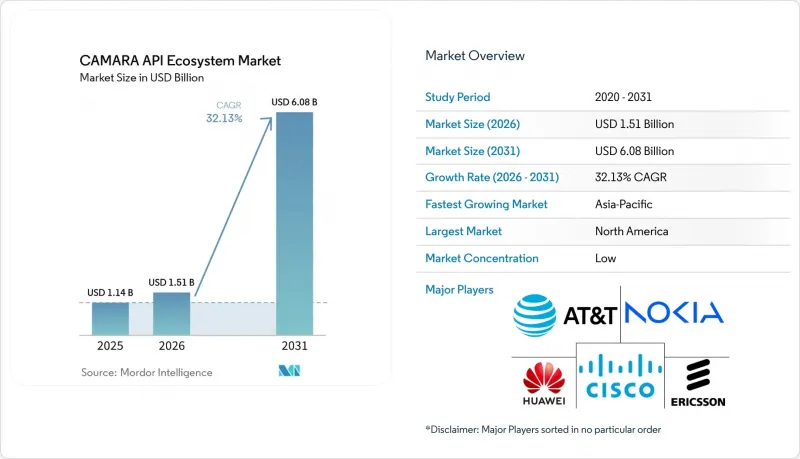
Mordor Intelligence에 의하면, CAMARA API 생태계 시장 규모는 2025년 11억 4,000만 달러로 평가되었습니다. 2026년에는 15억 1,000만 달러로 확대되어 2031년까지 60억 8,000만 달러에 이를 것으로 예측되며, 2026년부터 2031년까지 연평균 복합 성장률(CAGR)은 32.13%를 나타낼 전망입니다.
본 보고서는 API 카테고리(인증 및 사기 방지 API 등), API 성숙도(안정판 API, 초기판 API, 기타 API 성숙도), 배포 모델(통신 사업자에 의한 직접 제공 등), 최종 사용자 산업(은행 및 금융 서비스·보험, 전자상거래·소매, 통신 등),및 지역별로 분류되어 있습니다. 시장 전망은 금액(달러) 기준으로 제시되어 있습니다.
세계의 CAMARA API 생태계 시장 동향 및 인사이트
GSMA Open Gateway의 확대와 CAMARA의 표준화
CAMARA API 생태계 시장은 기업이 각 통신 사업자의 네트워크별로 개별 기술 인터페이스를 다룰 필요성을 줄여주는 공통 프레임워크의 혜택을 받고 있습니다. 2026년 초까지 86개의 통신 사업자 그룹과 61개의 채널 파트너가 GSMA Open Gateway의 접근 방식을 지지했습니다. 채널 파트너가 개발자에게 상용 API로 가는 더 폭넓은 경로를 제공하고 있기 때문에 이 모델은 현재 유통과 표준화를 중심으로 전개되고 있습니다. Twilio는 2026년 모바일 월드 콩그레스(Mobile World Congress)에서 하루 3,080만 건의 CAMARA API 트랜잭션을 보고하며, 단일 상호 운용 가능한 채널을 통해 처리량이 어떻게 확대될 수 있는지를 보여주었습니다. CAMARA는 2025년 가을 메타 릴리스에서 10개의 안정 버전 API를 포함한 60개의 API를 공개하며, 통신 사업자와 통합 업체에 보다 명확한 릴리스 일정을 제공했습니다. 2025년부터 이용 가능해질 GSMA 및 TM Forum의 적합성 프로그램은 인증을 받은 도입 환경이 마켓플레이스 및 채널 파트너와 협력할 수 있도록 지원합니다.
인증 및 사기 방지 API에 대한 수요
인증 및 사기 방지 분야는 CAMARA API 생태계 시장에서 여전히 수요의 핵심 원천으로 남아 있습니다. 이는 통신 사업자가 다른 ID 제공업체에서는 재현할 수 없는 신호를 보유하고 있기 때문입니다. 이러한 신호에는 SIM 상태, 번호 이동 기록, 단말기 교체 시기 등이 포함됩니다. Sekura.ID의 CAMARA SIM Swap API를 활용 중인 영국의 한 은행은 거래 승인 과정에서 1초도 채 되지 않는 시간 내에 부정 행위 감지 알림을 수신할 수 있었습니다. 2025년, 네트워크 API를 도입하는 개발자들에게 금융 서비스, 소프트웨어, 정부 부문이 주요 목표 산업으로 부상했습니다. SMS를 통한 일회용 비밀번호에서 네트워크 네이티브 인증으로의 전환에 따라, SMS 집계 서비스에서 통신사나 CAMARA 준수 채널로 가치가 이동할 가능성이 있습니다. 금융 기관은 특히 유럽에서 KYC Match나 SIM Swap API를 이용할 때, 개인 데이터 처리에 대한 정당한 근거를 확립해야 합니다.
개인정보 보호, 동의 및 데이터 보호 관련 요건
개인정보 보호 및 동의에 관한 요건은 API가 개인정보를 활용하는 CAMARA API 생태계 시장의 확장을 지연시킬 가능성이 있습니다. 전화번호 검증, 기기 위치 정보 및 KYC 관련 기능의 경우, GDPR(EU 개인정보보호규정)이나 이에 상응하는 법률이 적용되는 시장에서 상용화를 진행하기 전에 통신 사업자가 유효한 법적 근거를 확립해야 합니다. CAMARA의 ‘신원 및 동의 관리’ 워킹그룹은 2025년 6월, 옵트인 또는 옵트아웃 메커니즘을 갖춘 API에는 3-레그 액세스 토큰이 필요하다고 밝혔습니다. 이 요건으로 인해 소비자용 용도의 온보딩이 더 어려워질 수 있습니다. 2025년 하반기에는 ‘Consent Info API’와 병행하여 별도의 ‘Consent Management API’가 제안되었으며, 이는 동의 관련 아키텍처가 여전히 정교화되고 있음을 보여줍니다. GDPR(EU 개인정보보호규정)의 시행 현황과 법적 해석은 회원국마다 다르기 때문에 유럽의 사업자들은 추가적인 검토 작업에 직면할 가능성이 있습니다.
부문 분석
2025년, 인증 및 사기 방지 API는 시장의 34.21%를 차지했습니다. 은행과 보험사는 SIM 스왑, 번호 검증, KYC를 활용하여 신속하고 신뢰할 수 있는 확인을 수행하고 있습니다. 2024년 이후 ‘KYC Match’ 도입을 결정한 프랑스의 통신 사업자는 이 API를 통해 은행 고객의 신원 사기를 50% 가까이 줄일 수 있었다고 보고했습니다. Vodafone의 CAMARA 준수 ‘Scam Signal API’는 영국 은행과의 3개월간 시범 운영을 통해 사기 감지율을 30% 향상시켰습니다.
컴퓨팅 서비스 API는 2031년까지 연평균 성장률(CAGR) 33.18%를 나타낼 것으로 예측됩니다. ‘Simple Edge Discovery’를 통해 용도는 근접성이나 네트워크 성능을 기반으로 엣지 영역을 식별할 수 있게 됩니다. 이를 통해 개발자가 네트워크 토폴로지를 이해할 필요 없이 저지연 추론 처리가 가능해집니다. 위치 정보, 통신, 품질, 디바이스 관련 API는 물류, 소매, 자동차, IoT 용도에도 활용되고 있습니다. 2026년 3월에 실시된 노키아의 ‘Network as Code’와 Google Cloud 간의 통합에서는 CAMARA API가 AI 에이전트의 워크로드 결정에 실시간 네트워크 컨텍스트를 제공할 수 있음이 입증되었습니다.
2025년에는 안정화 버전 API가 시장의 62.42%를 차지했습니다. 기업들은 버전이 문서화되고, 호환성이 보장되며, 확립된 준수 요건을 갖춘 인터페이스를 선호합니다. 2025년 가을 메타 릴리스에는 사기 방지, 서비스 품질(QoS), 엣지 디스커버리를 포괄하는 10개의 안정화 API가 포함되었습니다. 이 릴리스 일정을 통해 통신 사업자는 프로덕션 환경 도입을 평가할 수 있는 명확한 기준을 확보할 수 있습니다. 또한, GSMA와 TM Forum의 공동 인증을 통해 서비스 제공업체는 공통 인증 프로세스를 거쳐 CAMARA 서비스 API 및 TM Forum Operate API를 모두 지원할 수 있게 됩니다.
초기 API는 2031년까지 연평균 성장률(CAGR) 34.17%를 나타낼 것으로 예측됩니다. CAMARA는 2025년 가을 릴리스에서 23개의 새로운 초기 API를 추가했습니다. 2026년 초에 승인된 MCP 활성화 프로그램에서는 AI 에이전트가 네트워크 기능을 감지하고 활용할 수 있도록 설계 지침 개정이 진행되고 있습니다. ‘기타’ 범주에는 InHomeDeviceManagement 및 RainfallIntensity와 같은 샌드박스 API가 포함됩니다. 개인 데이터 API는 안정 버전으로 전환되기 전에 CAMARA의 신원 확인 및 동의 요건을 충족해야 하며, 이는 성숙도 전환 속도에 영향을 미치고 있습니다.
지역별 분석
2025년, 북미는 CAMARA API 생태계 시장의 34.12%를 차지했습니다. 이 지역은 AT&T, T-Mobile, Verizon의 초기 ‘Open Gateway’ 이니셔티브의 혜택을 받았습니다. 2025년, Vonage는 미국의 3대 주요 통신사 모두에 걸쳐 통합된 CAMARA API 액세스를 제공하는 최초공급자가 되었습니다. 은행 및 핀테크 분야 수요가 SMS 인증에서 네트워크 네이티브 인증으로의 전환을 촉진하고 있습니다. 또한, 이 지역에는 기업이 여러 네트워크에 접근할 수 있도록 지원하는 확립된 CPaaS 생태계가 존재합니다.
유럽은 CAMARA API 생태계 시장에서 두 번째로 큰 지역입니다. 프랑스는 Bouygues Telecom, Free, Orange, SFR이 공동으로 KYC Match API를 출시한 최초의 국가가 되었으며, 2025년까지 20개 이상의 기업이 이 API 세트를 채택했습니다. 독일, 영국, 스페인,이탈리아에서는 SIM 스왑, 전화번호 인증, 연령 확인 도입이 진행되고 있습니다. Orange의 LiveNet 부문과 2026년 7월로 예정된 MCP 제공업체로의 구현을 통해, 프랑스는 에이전트 기반 API 활용이 활발한 시장 중 하나가 되었습니다. GDPR(EU 개인정보보호규정) 요건으로 인해 개인 데이터 API 처리는 더욱 복잡해지고 있습니다.
아시아태평양은 2031년까지 연평균 성장률(CAGR) 33.21%를 나타낼 것으로 예측됩니다. KDDI, Singtel, Reliance Jio, Bharti Airtel, Telstra, NTT 도코모, 소프트뱅크가 이 지역의 생태계 내에서 사업을 전개하고 있습니다. KDDI는 서비스 품질(QoS) 표준화에 기여했으며, 일본 내 지방 자치단체의 본인 확인을 위한 KYC API를 도입했습니다. 남미는 여전히 초기 단계에 있지만, 브라질은 향후 확장이 예상됩니다. 중동 및 아프리카의 통신 사업자들은 SIM 스왑 및 번호 확인 API를 도입하고 있는 반면, 아랍에미리트, 사우디아라비아, 카타르에서는 API 플랫폼을 디지털 경제 프로그램과 연계하고 있습니다. Viettel Solutions와 Aduna는 2026년 3월, 베트남의 데이터 보호 및 사이버 보안 요건을 충족하는 파트너십 협약을 체결했습니다.
기타 혜택 :
- 엑셀 형식 시장 예측(ME) 시트
- 3개월간의 애널리스트 지원
자주 묻는 질문
목차
제1장 서론
제2장 조사 방법
제3장 주요 요약
제4장 시장 구도
제5장 시장 규모 및 성장 예측
제6장 경쟁 구도
제7장 시장 기회 및 향후 전망
KTH 26.09.10According to Mordor Intelligence, the CAMARA API ecosystem market size is projected to expand from USD 1.14 billion in 2025 to USD 1.51 billion in 2026, and to USD 6.08 billion by 2031, registering a CAGR of 32.13% between 2026 and 2031.
This report is Segmented by API Category (Authentication and Fraud Prevention APIs, and More), API Maturity (Stable APIs, Initial APIs, and Other API Maturity), Deployment Model (Direct Operator Exposure, and More), End-User Industry (Banking, Financial Services and Insurance, E-Commerce and Retail, Telecommunications, and More), and Geography. The Market Forecasts are Provided in Terms of Value (USD).
Global CAMARA API Ecosystem Market Trends and Insights
Expansion of GSMA Open Gateway and CAMARA Standardization
The CAMARA API Ecosystem Market benefits from a common framework that reduces the need for enterprises to work with a separate technical interface in each operator network. By early 2026, 86 operator groups and 61 channel partners were aligned around the GSMA Open Gateway approach. The model is now centered on distribution and standardization because channel partners provide developers with a broader path to commercial APIs. Twilio reported 30.8 million CAMARA API transactions per day at Mobile World Congress 2026, demonstrating how volume can scale through a single interoperable channel. CAMARA issued 60 APIs in its Fall 2025 meta-release, including 10 stable APIs, providing operators and integrators with a clearer release schedule. The GSMA and TM Forum conformance program, available from 2025, helps certified deployments connect with marketplaces and channel partners.
Demand for Authentication and Fraud Prevention APIs
Authentication and fraud prevention remain a central source of demand in the CAMARA API Ecosystem Market because operators possess signals that other identity providers cannot replicate. These signals include SIM status, number portability records, and device swap timing. A United Kingdom bank using Sekura. ID's CAMARA SIM Swap API received fraud responses in less than 1 second within its transaction approval process. Financial services, software, and government were the 3 leading target industries for developers deploying network APIs in 2025. The shift from SMS one-time passwords to network-native verification can move value from SMS aggregation to operators and CAMARA-compliant channels. Financial institutions must still establish a valid basis for personal data processing when using KYC Match or SIM Swap APIs, particularly in Europe.
Privacy, Consent, and Data Protection Requirements
Privacy and consent requirements can slow the CAMARA API Ecosystem Market, where APIs use personal information. Number verification, device location, and KYC-related functions require operators to establish a valid legal basis before commercial deployment in markets governed by GDPR or comparable laws. CAMARA's Identity and Consent Management working group stated in June 2025 that 3-legged access tokens are required for APIs with opt-in or opt-out mechanisms. This requirement can make onboarding more demanding for consumer-facing applications. A separate Consent Management API was proposed in late 2025 alongside the Consent Info API, showing that the consent architecture was still being refined. European operators may face additional review work because GDPR enforcement and legal interpretation vary across member states.
Other drivers and restraints analyzed in the detailed report include:
- 5G, Edge, and IoT Monetization
- Enterprise Demand for Real-Time Network Intelligence
- OSS/BSS and Legacy Network Integration Costs
For complete list of drivers and restraints, kindly check the Table Of Contents.
Segment Analysis
Authentication and Fraud Prevention APIs held 34.21% of the market in 2025. Banks and insurers use SIM Swap, Number Verification, and KYC to ensure fast, reliable checks. The French operators that committed to KYC Match after 2024 reported that the API helped banking clients reduce identity fraud by nearly 50%. Vodafone's CAMARA-compliant Scam Signal API improved fraud detection by 30% during a 3-month pilot with a United Kingdom bank.
Computing Services APIs are forecast to grow at a 33.18% CAGR through 2031. Simple Edge Discovery enables an application to identify an edge zone based on proximity and network performance. This can support low-latency inference without requiring developers to understand network topology. Location, communication, quality, and device APIs also serve logistics, retail, automotive, and IoT applications. Nokia's Network as Code integration with Google Cloud in March 2026 showed how CAMARA APIs can supply real-time network context for AI-agent workload decisions.
Stable APIs accounted for 62.42% of the market in 2025. Enterprises favor interfaces with documented versions, compatibility commitments, and established conformance requirements. The Fall 2025 meta-release included 10 stable APIs covering fraud prevention, quality of service, and edge discovery. The release schedule provides operators with a clear point for assessing production deployment. Joint GSMA and TM Forum certification also allows service providers to cover CAMARA Service APIs and TM Forum Operate APIs through a common certification process.
Initial APIs are forecast to grow at a 34.17% CAGR through 2031. CAMARA added 23 new Initial APIs in the Fall 2025 release. The MCP Enablement Program, approved in early 2026, is adapting design guidance so AI agents can discover and use network capabilities. The Others category includes sandbox APIs such as InHomeDeviceManagement and RainfallIntensity. Personal-data APIs must meet CAMARA's identity and consent requirements before moving to stable status, which affects the pace of this maturity transition.
Complete Report Scope:
- By API Category
- Authentication and Fraud Prevention APIs
- Location Services APIs
- Communication Services APIs
- Communication Quality APIs
- Device Information APIs
- Computing Services APIs
- Other API Categories
- By API Maturity
- Stable APIs
- Initial APIs
- Other API Maturity
- By Deployment Model
- Direct Operator Exposure
- Aggregator-Mediated Exposure
- Marketplace-Mediated Exposure
- Other Deployment Models
- By End-User Industry
- Banking, Financial Services and Insurance
- E-Commerce and Retail
- Telecommunications
- Information Technology and Software
- Healthcare
- Government and Public Sector
- Media and Entertainment
- Other End-User Industries
- By Geography
- North America
- United States
- Canada
- Mexico
- South America
- Brazil
- Argentina
- Chile
- Rest of South America
- Europe
- Germany
- United Kingdom
- France
- Italy
- Spain
- Rest of Europe
- Asia-Pacific
- China
- Japan
- India
- South Korea
- Australia
- Rest of Asia-Pacific
- Middle East
- United Arab Emirates
- Saudi Arabia
- Qatar
- Rest of Middle East
- Africa
- South Africa
- Egypt
- Nigeria
- Rest of Africa
- North America
Geography Analysis
North America held 34.12% of the CAMARA API Ecosystem Market in 2025. The region benefited from early Open Gateway commitments by AT&T, T-Mobile, and Verizon. Vonage became the first provider to offer aggregated CAMARA API access across all 3 major United States carriers in 2025. Banking and fintech demand support the move from SMS authentication to network-native verification. The region also has an established CPaaS ecosystem that helps enterprises reach multiple networks.
Europe is the second-largest regional area in the CAMARA API Ecosystem Market. France became the first country where Bouygues Telecom, Free, Orange, and SFR jointly launched the KYC Match API, with more than 20 companies adopting the API set by 2025. Germany, the United Kingdom, Spain, and Italy are advancing deployments of SIM Swap, Number Verification, and Age Verification. Orange's LiveNet unit and its July 2026 MCP provider implementation place France among the active markets for agent-based API use. GDPR requirements add complexity to personal data APIs.
Asia-Pacific is forecast to grow at a 33.21% CAGR through 2031. KDDI, Singtel, Reliance Jio, Bharti Airtel, Telstra, NTT Docomo, and SoftBank operate within the regional ecosystem. KDDI contributed to the standardization of quality of service and deployed KYC APIs for local government identity verification in Japan. South America remains in the early stages, with Brazil identified for future expansion. Middle East and Africa operators are introducing SIM Swap and Number Verification APIs, while the United Arab Emirates, Saudi Arabia, and Qatar align API platforms with digital economy programs. Viettel Solutions and Aduna signed a partnership framework in March 2026 that addresses Vietnam's data-protection and cybersecurity requirements.
- Accenture plc
- Aduna Network S.L.
- Alkira, Inc.
- B-Yond, Inc.
- BICS SA
- Bharti Airtel Limited
- BTS Group AB
- Comviva Technologies Limited
- Enea AB
- Ericsson AB
- Graphiant, Inc.
- Heksagon Network AB
- Infobip Limited
- Kentik Technologies, Inc.
- LotusFlare, Inc.
- Nokia Corporation
- Obkio Inc.
- PhoenixNAP, LLC
- Sekura.id Limited
- Shabodi Technologies Inc.
- Sinch AB
- Syniverse Technologies, LLC
- Vonage Holdings Corp.
- Socure, Inc.
Additional Benefits:
- The market estimate (ME) sheet in Excel format
- 3 months of analyst support
TABLE OF CONTENTS
1 INTRODUCTION
- 1.1 Study Assumptions and Market Definition
- 1.2 Scope of the Study
2 RESEARCH METHODOLOGY
3 EXECUTIVE SUMMARY
4 MARKET LANDSCAPE
- 4.1 Market Overview
- 4.2 Market Drivers
- 4.2.1 Expansion of GSMA Open Gateway and CAMARA Standardization
- 4.2.2 Demand for Authentication and Fraud Prevention APIs
- 4.2.3 5G, Edge, and IoT Monetization
- 4.2.4 Enterprise Demand for Real-Time Network Intelligence
- 4.2.5 Build-Once, Deploy-Everywhere API Portability
- 4.2.6 Conformance Tooling and Federated Marketplace Scale
- 4.3 Market Restraints
- 4.3.1 Privacy, Consent, and Data Protection Requirements
- 4.3.2 OSS/BSS and Legacy Network Integration Costs
- 4.3.3 Operator-Specific Commercial and Onboarding Friction
- 4.3.4 Sparse Local Demand Signals Outside Leading Markets
- 4.4 Impact of Macroeconomic Factors on the Market
- 4.5 Industry Value-Chain Analysis
- 4.6 Technology Outlook
- 4.7 Regulatory Landscape
- 4.8 Porter's Five Forces Analysis
- 4.8.1 Threat of New Entrants
- 4.8.2 Bargaining Power of Suppliers
- 4.8.3 Bargaining Power of Buyers
- 4.8.4 Threat of Substitutes
- 4.8.5 Intensity of Competitive Rivalry
5 MARKET SIZE AND GROWTH FORECASTS (VALUE)
- 5.1 By API Category
- 5.1.1 Authentication and Fraud Prevention APIs
- 5.1.2 Location Services APIs
- 5.1.3 Communication Services APIs
- 5.1.4 Communication Quality APIs
- 5.1.5 Device Information APIs
- 5.1.6 Computing Services APIs
- 5.1.7 Other API Categories
- 5.2 By API Maturity
- 5.2.1 Stable APIs
- 5.2.2 Initial APIs
- 5.2.3 Other API Maturity
- 5.3 By Deployment Model
- 5.3.1 Direct Operator Exposure
- 5.3.2 Aggregator-Mediated Exposure
- 5.3.3 Marketplace-Mediated Exposure
- 5.3.4 Other Deployment Models
- 5.4 By End-User Industry
- 5.4.1 Banking, Financial Services and Insurance
- 5.4.2 E-Commerce and Retail
- 5.4.3 Telecommunications
- 5.4.4 Information Technology and Software
- 5.4.5 Healthcare
- 5.4.6 Government and Public Sector
- 5.4.7 Media and Entertainment
- 5.4.8 Other End-User Industries
- 5.5 By Geography
- 5.5.1 North America
- 5.5.1.1 United States
- 5.5.1.2 Canada
- 5.5.1.3 Mexico
- 5.5.2 South America
- 5.5.2.1 Brazil
- 5.5.2.2 Argentina
- 5.5.2.3 Chile
- 5.5.2.4 Rest of South America
- 5.5.3 Europe
- 5.5.3.1 Germany
- 5.5.3.2 United Kingdom
- 5.5.3.3 France
- 5.5.3.4 Italy
- 5.5.3.5 Spain
- 5.5.3.6 Rest of Europe
- 5.5.4 Asia-Pacific
- 5.5.4.1 China
- 5.5.4.2 Japan
- 5.5.4.3 India
- 5.5.4.4 South Korea
- 5.5.4.5 Australia
- 5.5.4.6 Rest of Asia-Pacific
- 5.5.5 Middle East
- 5.5.5.1 United Arab Emirates
- 5.5.5.2 Saudi Arabia
- 5.5.5.3 Qatar
- 5.5.5.4 Rest of Middle East
- 5.5.6 Africa
- 5.5.6.1 South Africa
- 5.5.6.2 Egypt
- 5.5.6.3 Nigeria
- 5.5.6.4 Rest of Africa
- 5.5.1 North America
6 COMPETITIVE LANDSCAPE
- 6.1 Market Concentration
- 6.2 Strategic Moves
- 6.3 Market Share Analysis
- 6.4 Company Profiles (includes Global Level Overview, Market Level Overview, Core Segments, Financials as available, Strategic Information, Market Rank/Share, Products and Services, Recent Developments)
- 6.4.1 Accenture plc
- 6.4.2 Aduna Network S.L.
- 6.4.3 Alkira, Inc.
- 6.4.4 B-Yond, Inc.
- 6.4.5 BICS SA
- 6.4.6 Bharti Airtel Limited
- 6.4.7 BTS Group AB
- 6.4.8 Comviva Technologies Limited
- 6.4.9 Enea AB
- 6.4.10 Ericsson AB
- 6.4.11 Graphiant, Inc.
- 6.4.12 Heksagon Network AB
- 6.4.13 Infobip Limited
- 6.4.14 Kentik Technologies, Inc.
- 6.4.15 LotusFlare, Inc.
- 6.4.16 Nokia Corporation
- 6.4.17 Obkio Inc.
- 6.4.18 PhoenixNAP, LLC
- 6.4.19 Sekura.id Limited
- 6.4.20 Shabodi Technologies Inc.
- 6.4.21 Sinch AB
- 6.4.22 Syniverse Technologies, LLC
- 6.4.23 Vonage Holdings Corp.
- 6.4.24 Socure, Inc.
7 MARKET OPPORTUNITIES AND FUTURE OUTLOOK
- 7.1 White-Space and Unmet-Need Assessment