
|
시장보고서
상품코드
2123321
사물인터넷(IoT) 플랫폼 시장 : 점유율 분석, 업계 동향과 통계, 성장 예측(2026-2031년)Internet Of Things (IoT) Platform - Market Share Analysis, Industry Trends & Statistics, Growth Forecasts (2026 - 2031) |
||||||
 Mordor Intelligence
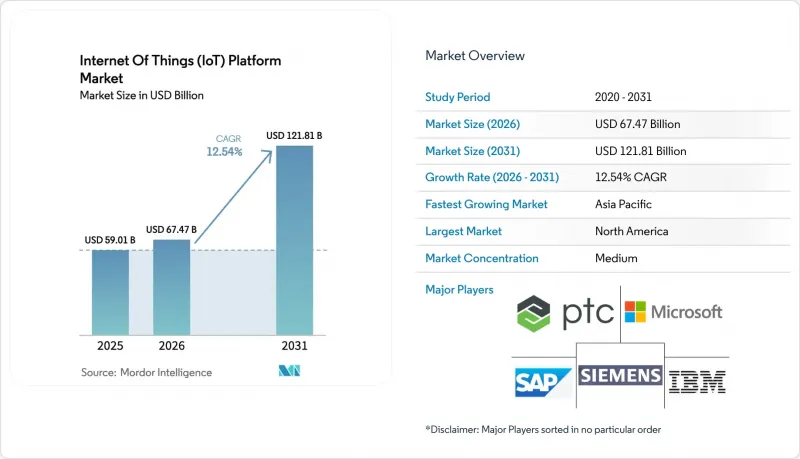
Mordor Intelligence에 의하면, 사물인터넷(IoT) 플랫폼 시장 규모는 2025년 590억 1,000만 달러에서 2026년에는 674억 7,000만 달러로 확대되어 2031년까지 1,218억 1,000만 달러에 이를 것으로 예상되고 있어 2026년부터 2031년까지 CAGR 12.54%로 성장할 전망입니다.
본 보고서는 도입 형태(On-Premise, 클라우드/SaaS, 하이브리드), 플랫폼 계층(용도 지원, 디바이스 관리 등), 최종 사용자 산업(산업, 커넥티드 빌딩 등), 기업 규모(중소기업, 대기업) 및 지역별로 분류되어 있습니다. 시장 전망은 금액(달러) 기준으로 제시되어 있습니다.
세계 사물인터넷(IoT) 플랫폼 시장 동향 및 인사이트
클라우드 네이티브 IoT 플랫폼의 급속한 보급
탄력적인 확장성, 종량제 과금, 데이터 레이크 및 머신러닝 서비스와의 원활한 통합 덕분에 클라우드 네이티브 아키텍처는 IoT 워크로드에서 표준적인 선택지가 되었습니다. On-Premise형 미들웨어에서 Kubernetes상의 컨테이너화된 마이크로서비스로 전환하고 있는 기업들은 릴리스 주기 단축 및 인프라 오버헤드 감소를 보고하고 있습니다. Azure IoT Hub나 AWS IoT Core와 같은 관리형 서비스에서는 엣지 오케스트레이션과 실시간 스트림 처리가 통합되어 있어, 통합에 소요되는 노력이 약 40% 감소한 것으로 추정됩니다. 그러나 소수의 하이퍼스케일 제공업체에 대한 의존은 벤더 종속성 우려와 운영 리스크의 집중을 초래하기 때문에 많은 도입 기업들이 하이브리드 배포를 시도하고 있습니다.
센서 및 모듈 비용 하락
2024년부터 2025년까지 NB-IoT 및 LTE-M 모듈의 평균 가격은 15-20% 하락했으며, 대량 구매 시 단가가 5달러 미만으로 떨어졌습니다. 이에 따라 물류, 농업, 공공 서비스 분야에서의 도입이 더욱 현실화되고 있습니다. 성숙한 공정 노드에서 발생하는 반도체 공급 과잉이 계속해서 가격을 끌어내리고 있어, 이전에는 비용 면에서 실현하기 어려웠던 고밀도 센서 네트워크 구축이 가능해졌습니다. 하드웨어 비용의 하락은 연결된 기기당 요금을 부과하는 플랫폼 공급업체에게 지속적인 수익 증가로 직결되어, 사물인터넷(IoT) 플랫폼 시장의 성장 궤도를 더욱 공고히 하고 있습니다. 가격 하락은 아시아태평양에서 가장 두드러지게 나타나고 있으며, 이 지역의 현지 생산 능력이 모듈 공급업체 간의 경쟁을 심화시키고 있습니다.
사이버 보안 및 데이터 개인정보 보호에 대한 우려 고조
주목을 끄는 정보 유출 사건이 잇달아 발생함에 따라, 광범위하게 분산된 기기가 방어하기 어려운 방대한 공격 표면을 만들어내고 있어, IoT 프로젝트에 대한 이사회 차원의 감시가 강화되고 있습니다. 의료기기 제조업체는 개정된 FDA 지침에 따라 소프트웨어 BOM(부품 명세서) 및 취약점 관리 프로세스를 제공해야 할 의무가 있습니다. 유럽에서는 플랫폼 사업자가 보안 패치를 제공하고, 사고를 감지한 후 24시간 이내에 보고해야 할 의무가 있습니다. 이러한 요건으로 인해, 특히 중소규모 벤더의 경우 규정 준수 비용이 증가하고 있습니다. GDPR(EU 개인정보보호규정)(일반 데이터 보호 규정)과 같은 개인정보 보호 규제는 국경을 넘는 데이터 유통을 더욱 복잡하게 만들어 전 세계적인 확장성을 제약할 뿐만 아니라, 소비자 및 헬스케어 분야에서의 도입에 절차상의 부담을 가중시키고 있습니다.
부문 분석
2025년에는 하이브리드 아키텍처가 가장 빠르게 성장한 도입 모델이 될 것이며, 조직이 클라우드의 탄력성과 엣지 수준의 지연 요건 사이에서 균형을 맞추는 가운데 2031년까지 연평균 성장률(CAGR) 13.22%로 성장할 전망입니다. 온디맨드 확장성 측면에서는 클라우드 및 SaaS 형태가 계속해서 우위를 차지하고 있으며, 2025년에는 이 두 가지가 합쳐서 IoT 플랫폼 시장 점유율의 62.29%를 차지했습니다. 그러나 국방 및 중요 인프라 등의 분야에서 적용되는 규제 지침에 따라, 에어 갭 네트워크가 필요한 워크로드의 경우 On-Premise 방식이 여전히 유효한 선택지입니다. 각 벤더는 이에 대응하여 클라우드, 엣지, On-Premise 각 노드 간에 컨테이너를 원활하게 마이그레이션할 수 있는 오케스트레이션 프레임워크를 제공합니다.
이러한 변화는 분산 컴퓨팅을 향한 보다 광범위한 아키텍처 재구성을 부각시키고 있습니다. 산업 자동화나 자율 시스템에서 10밀리초 미만의 지연 시간 목표를 달성하기 위해서는 중앙 집중형 데이터센터로의 왕복 지연을 허용할 수 없기 때문입니다. 또한 하이브리드 설계는 국내에서의 로컬 처리를 의무화하는 데이터 주권 관련 법령도 충족합니다. 그 결과, 하이브리드 도입에 따른 IoT 플랫폼 시장 규모는 순수 클라우드 모델이나 순수 On-Premise 모델의 성장률을 상회할 것으로 예측됩니다. 그러나 DevOps 담당자가 부족한 조직에서는 운영의 복잡성이 여전히 장벽으로 작용하고 있는 것으로 지적되고 있습니다.
2025년에는 용도 이네이블먼트 계층이 지출의 42.51%를 차지했으나, 기업이 기술적 대시보드에서 처방적 엔진으로 전환함에 따라 고급 분석 구성 요소는 더욱 빠르게 확대되고 있으며, 연평균 성장률(CAGR)은 12.97%로 증가하고 있습니다. 현재 널리 대중화된 디바이스 관리 및 연결 서비스는 주로 총 소유 비용(TCO)과 무선 업데이트(OTA)의 효율성 측면에서 경쟁하고 있습니다. 도메인별 데이터 모델, 디지털 트윈 도구, AI를 활용한 이상 감지를 제공하는 벤더들은 경쟁 우위를 유지하고 있습니다. 예를 들어, SAP의 인메모리 분석은 스트리밍 형식의 센서 입력과 직접 통합되어 생산 라인의 거의 실시간 최적화를 가능하게 합니다.
엣지 측의 가속 칩이나 GPU 탑재 서버의 등장으로 인해, 분석 처리를 로컬에서 수행해야 할지, 클라우드에서 수행해야 할지에 대한 논의가 더욱 활발해지고 있습니다. 엣지에서의 추론은 지연을 최소화하지만, 고정밀 모델의 재학습에는 여전히 중앙 집중형 연산 능력이 효과적입니다. 따라서 IoT 플랫폼 시장의 분석 분야 규모는 클라우드상의 훈련 파이프라인과 엣지상의 추론 엔진 사이에서 양극화되어 있으며, 이 연속체를 아우르는 오케스트레이션 능력이 요구되고 있습니다.
지역별 분석
2025년에는 하이퍼스케일 클라우드 인프라의 존재와 조달 규칙을 명확히 하는 연방 정부의 사이버 보안 지침에 힘입어 북미가 37.59%의 점유율로 도입을 주도했습니다. 미국은 제조 자동화 및 에너지 그리드 현대화에 초점을 맞춘 산업용 IoT 도입을 주도하는 한편, 캐나다는 임업 및 광업 분야에서 IoT를 활용한 자원 관리를 확대되고 있습니다. 멕시코의 스마트 팩토리 투자는 공급망을 미국의 소비 거점에 가까운 곳으로 재배치하는 니어쇼어링 추세의 혜택을 받고 있습니다. 그 규모에도 불구하고, 초기 도입 부문이 포화 상태에 도달함에 따라 지역 성장은 둔화되고 있으며, 추가적인 기회는 주로 기존 설비의 개보수 및 규정 준수에 따른 업그레이드에 국한되고 있습니다.
아시아태평양은 가장 성장세가 두드러지는 지역으로, 2031년까지 연평균 성장률(CAGR) 13.67%로 확대될 것으로 전망됩니다. 중국의 국가 주도 제조업 정책, 인도의 ‘디지털 인디아(Digital India)’ 구상, 일본의 ‘Society 5.0’ 프로그램이 맞물리면서 커넥티드 팩토리, 스마트 시티, 헬스케어 분야에 대한 높은 투자가 지속되고 있습니다. 화웨이(Huawei)나 알리바바 클라우드(Alibaba Cloud)와 같은 제공업체들은 현지 규제 및 언어에 맞추어 서비스를 최적화하고 있으며, 이로 인해 서유럽 기존 기업들에 대한 경쟁 압력이 강화되고 있습니다. 5G 보급률 상승과 센서 가격 하락에 힘입어 동남아시아 및 오세아니아의 농촌 지역과 산업 지대의 IoT 플랫폼 시장은 더욱 확대되고 있습니다.
유럽은 규제 형성에서 매우 중요한 역할을 담당하고 있으며, 사이버 복원력 법 및 GDPR(EU 개인정보보호규정)(일반 데이터 보호 규정)을 통해 사이버 보안과 개인정보 보호가 조달 기준에 반영되고 있습니다. 독일은 인더스트리 4.0 자금을 활용하여 이산형 제조업의 디지털화를 추진하고 있는 반면, 프랑스와 이탈리아는 농업 및 교통 분야에 IoT를 통합하고 있습니다. 지역별 데이터 주권에 관한 규정에 따라 하이브리드형 또는 On-Premise형 아키텍처에 대한 수요가 증가하고 있습니다. 그 밖의 지역에서는 중동 및 아프리카가 석유 및 가스, 유틸리티, 스마트시티 메가 프로젝트에서 IoT 도입을 가속화하고 있는 반면, 남미에서는 정밀 농업 및 도시 모빌리티 플랫폼의 시범 운영이 진행되고 있습니다. 이 지역들의 절대적인 규모는 여전히 작지만, 위성 통신이나 저전력 네트워크와 같은 대체 수단의 도입을 뒷받침하는 새로운 시장 개척의 기회가 기대되고 있습니다.
기타 혜택:
- 엑셀 형식 시장 예측(ME) 시트
- 3개월간의 애널리스트 지원
자주 묻는 질문
목차
제1장 서론
제2장 조사 방법
제3장 주요 요약
제4장 시장 구도
제5장 시장 규모와 성장 예측
제6장 경쟁 구도
제7장 시장 기회와 향후 전망
JHS 26.09.09According to Mordor Intelligence, the internet of things platform market size is expected to increase from USD 59.01 billion in 2025 to USD 67.47 billion in 2026 and reach USD 121.81 billion by 2031, growing at a CAGR of 12.54% over 2026-2031.
This report is Segmented by Deployment (On-Premise, Cloud/SaaS, and Hybrid), Platform Layer (Application Enablement, Device Management, and More), End-User Industry (Industrial, Connected Building, and More), Enterprise Size (Small and Medium Enterprises, and Large Enterprises), and Geography. The Market Forecasts are Provided in Terms of Value (USD).
Global Internet Of Things (IoT) Platform Market Trends and Insights
Rapid Adoption of Cloud-Native IoT Platforms
Elastic scalability, pay-per-use billing, and seamless integration with data lake and machine-learning services have made cloud-native architectures the default choice for IoT workloads. Enterprises migrating from on-premises middleware to containerized microservices on Kubernetes are reporting shorter release cycles and lower infrastructure overhead. Managed offerings such as Azure IoT Hub and AWS IoT Core now bundle edge orchestration and real-time stream processing, reducing integration effort by an estimated 40%. Nevertheless, dependency on a handful of hyperscale providers raises vendor-lock-in concerns and concentrates operational risk, prompting many adopters to experiment with hybrid deployments.
Declining Sensor and Module Costs
Between 2024 and 2025, average prices for NB-IoT and LTE-M modules fell 15-20%, pushing unit costs below USD 5 in high volumes and expanding deployment feasibility in logistics, agriculture, and utilities. Semiconductor oversupply in mature process nodes continues to depress pricing, enabling high-density sensor networks that were previously cost-prohibitive. Lower hardware costs translate directly into greater recurring revenue for platform vendors that charge per connected device, reinforcing the growth trajectory of the Internet of Things (IoT) platform market. Price declines are most pronounced in Asia Pacific, where local fabrication capacity intensifies competition among module suppliers.
Heightened Cyber-Security and Data-Privacy Concerns
High-profile breaches have increased board-level scrutiny of IoT projects, as widely distributed devices create vast, hard-to-defend attack surfaces. Medical device makers must now provide software bills of materials and vulnerability management processes under updated FDA guidance. In Europe, platforms must issue security patches and file incident reports within 24 hours of detection. These requirements inflate compliance costs, especially for smaller vendors. Privacy rules such as GDPR further complicate cross-border data flows, constraining global scalability and adding procedural overhead to deployments in consumer and healthcare segments.
Other drivers and restraints analyzed in the detailed report include:
- Growing Automation and Big Data Analytics Becoming a Key Asset
- Increasing Regulatory Push for Industrial Digitalization
- Market Fragmentation and Interoperability Issues
For complete list of drivers and restraints, kindly check the Table Of Contents.
Segment Analysis
Hybrid architectures represented the fastest-growing deployment model in 2025, advancing at a 13.22% CAGR through 2031 as organizations balance cloud elasticity with edge-level latency demands. On-demand scalability continues to favour cloud and SaaS arrangements, which collectively retained 62.29% of the Internet of Things (IoT) platform market share in 2025. Even so, regulatory directives in sectors such as defense and critical infrastructure keep on-premises options viable for workloads that require air-gapped networks. Vendors are responding by offering orchestration frameworks that enable seamless container migration across cloud, edge, and on-premises nodes.
The shift underscores a broader re-architecture toward distributed compute, where sub-10-millisecond latency targets in industrial automation and autonomous systems cannot tolerate round-trip delays to centralized data centers. Hybrid designs also satisfy data-sovereignty statutes that obligate local processing within national borders. Consequently, the IoT platform market size attributable to hybrid installations is projected to outpace growth in pure cloud or pure on-premises models. Organizations lacking DevOps personnel, however, cite operational complexity as a lingering obstacle.
Application enablement layers absorbed 42.51% of spending in 2025, but advanced analytics components are scaling faster, rising at a 12.97% CAGR as firms migrate from descriptive dashboards to prescriptive engines. Device management and connectivity services, now widely commoditized, compete primarily on total cost of ownership and over-the-air update efficiencies. Vendors that deliver domain-specific data models, digital-twin tooling, and AI-powered anomaly detection hold a competitive advantage. For example, SAP's in-memory analytics integrate directly with streaming sensor inputs, allowing near-real-time optimization of production lines.
Edge-side acceleration chips and GPU-enabled servers amplify the debate over whether analytics should reside locally or in the cloud. While edge inference minimizes latency, high-fidelity model retraining still benefits from centralized compute power. The Internet of Things (IoT) platform market size allocation to analytics is therefore bifurcating between cloud-resident training pipelines and edge-resident inference engines, demanding orchestration capabilities that span this continuum.
Complete Report Scope:
- By Deployment
- On-premise
- Cloud/SaaS
- Hybrid
- By Platform Layer
- Application Enablement
- Device Management
- Advanced Analytics
- Connectivity
- Cloud Storage/IaaS
- By End-user Industry
- Industrial
- Connected Building
- Smart Home
- Mobility
- Healthcare
- Agriculture
- Rest of End-user Industries
- By Enterprise Size
- Small and Medium Enterprises (SMEs)
- Large Enterprises
- By Geography
- North America
- United States
- Canada
- Mexico
- South America
- Brazil
- Argentina
- Rest of South America
- Europe
- Germany
- United Kingdom
- France
- Italy
- Spain
- Russia
- Rest of Europe
- Asia Pacific
- China
- Japan
- India
- South Korea
- Australia and New Zealand
- Rest of Asia Pacific
- Middle East
- United Arab Emirates
- Saudi Arabia
- Turkey
- Rest of Middle East
- Africa
- South Africa
- Nigeria
- Rest of Africa
- North America
Geography Analysis
North America led deployments with a 37.59% share in 2025, anchored by the presence of hyperscale cloud infrastructure and federal cybersecurity guidelines that clarify procurement rules. The United States dominates industrial IoT rollouts focused on manufacturing automation and energy grid modernization, while Canada scales IoT-driven resource management in forestry and mining. Mexico's smart-factory investments benefit from near-shoring trends that re-route supply chains closer to U.S. consumption hubs. Notwithstanding its size, regional growth is moderating as early adopter segments reach saturation, leaving incremental opportunities primarily in brownfield retrofits and compliance-driven upgrades.
Asia Pacific is the fastest-growing territory, slated to expand at a 13.67% CAGR through 2031. China's sovereign manufacturing directives, India's Digital India initiative, and Japan's Society 5.0 program converge to sustain high investment in connected factories, smart cities, and healthcare. Domestic providers such as Huawei and Alibaba Cloud tailor offerings to local regulations and language, thereby intensifying competitive pressure on Western incumbents. Rising 5G penetration and falling sensor prices further enlarge the Internet of Things (IoT) platform market in rural and industrial zones across Southeast Asia and Oceania.
Europe occupies a pivotal role in regulatory shaping, with the Cyber Resilience Act and GDPR embedding cybersecurity and privacy into procurement criteria. Germany leverages Industrie 4.0 funding to digitalize discrete manufacturing, while France and Italy integrate IoT into agriculture and transportation. Regional data-sovereignty provisions foster demand for hybrid or on-premises architectures. Elsewhere, the Middle East and Africa accelerate IoT adoption in oil and gas, utilities, and smart-city megaprojects, whereas South America pilots' precision agriculture and urban mobility platforms. Although their absolute volumes remain smaller, these regions present greenfield prospects that invite satellite connectivity and low-power network alternatives.
- IBM Corporation
- Microsoft Corporation
- Amazon Web Services, Inc.
- PTC Inc.
- SAP SE
- Siemens AG
- Cisco Systems Inc.
- Oracle Corporation
- GE Digital LLC
- Hitachi Ltd
- Software AG
- ABB Ltd
- Schneider Electric SE (AVEVA Group plc)
- Robert Bosch GmbH
- Google LLC (Google Cloud Platform)
- Huawei Technologies Co. Ltd.
- Nokia Corporation
- Arm Holdings plc
- Telit Communications plc
- Ericsson AB
Additional Benefits:
- The market estimate (ME) sheet in Excel format
- 3 months of analyst support
TABLE OF CONTENTS
1 INTRODUCTION
- 1.1 Study Assumptions and Market Definition
- 1.2 Scope of the Study
2 RESEARCH METHODOLOGY
3 EXECUTIVE SUMMARY
4 MARKET LANDSCAPE
- 4.1 Market Overview
- 4.2 Market Drivers
- 4.2.1 Rapid Adoption of Cloud-Native IoT Platforms
- 4.2.2 Declining Sensor and Module Costs
- 4.2.3 Growing Automation and Big Data Analytics Becoming a Key Asset
- 4.2.4 Increasing Regulatory Push for Industrial Digitalization
- 4.2.5 Emergence of TinyML-Enabled On-Device Analytics
- 4.2.6 Expansion of Satellite IoT Connectivity for Remote Assets
- 4.3 Market Restraints
- 4.3.1 Market Fragmentation and Interoperability Issues
- 4.3.2 Heightened Cyber-Security and Data-Privacy Concerns
- 4.3.3 Edge-Cloud Integration Complexity
- 4.3.4 Shortage of Full-Stack IoT Developers and Standards
- 4.4 Industry Value Chain Analysis
- 4.5 Regulatory Landscape
- 4.6 Technological Outlook
- 4.7 Porter's Five Forces Analysis
- 4.7.1 Threat of New Entrants
- 4.7.2 Bargaining Power of Buyers/Consumers
- 4.7.3 Bargaining Power of Suppliers
- 4.7.4 Threat of Substitutes
- 4.7.5 Intensity of Competitive Rivalry
- 4.8 Impact of Macroeconomic Factors on the Market
5 MARKET SIZE AND GROWTH FORECASTS (VALUE)
- 5.1 By Deployment
- 5.1.1 On-premise
- 5.1.2 Cloud/SaaS
- 5.1.3 Hybrid
- 5.2 By Platform Layer
- 5.2.1 Application Enablement
- 5.2.2 Device Management
- 5.2.3 Advanced Analytics
- 5.2.4 Connectivity
- 5.2.5 Cloud Storage/IaaS
- 5.3 By End-user Industry
- 5.3.1 Industrial
- 5.3.2 Connected Building
- 5.3.3 Smart Home
- 5.3.4 Mobility
- 5.3.5 Healthcare
- 5.3.6 Agriculture
- 5.3.7 Rest of End-user Industries
- 5.4 By Enterprise Size
- 5.4.1 Small and Medium Enterprises (SMEs)
- 5.4.2 Large Enterprises
- 5.5 By Geography
- 5.5.1 North America
- 5.5.1.1 United States
- 5.5.1.2 Canada
- 5.5.1.3 Mexico
- 5.5.2 South America
- 5.5.2.1 Brazil
- 5.5.2.2 Argentina
- 5.5.2.3 Rest of South America
- 5.5.3 Europe
- 5.5.3.1 Germany
- 5.5.3.2 United Kingdom
- 5.5.3.3 France
- 5.5.3.4 Italy
- 5.5.3.5 Spain
- 5.5.3.6 Russia
- 5.5.3.7 Rest of Europe
- 5.5.4 Asia Pacific
- 5.5.4.1 China
- 5.5.4.2 Japan
- 5.5.4.3 India
- 5.5.4.4 South Korea
- 5.5.4.5 Australia and New Zealand
- 5.5.4.6 Rest of Asia Pacific
- 5.5.5 Middle East
- 5.5.5.1 United Arab Emirates
- 5.5.5.2 Saudi Arabia
- 5.5.5.3 Turkey
- 5.5.5.4 Rest of Middle East
- 5.5.6 Africa
- 5.5.6.1 South Africa
- 5.5.6.2 Nigeria
- 5.5.6.3 Rest of Africa
- 5.5.1 North America
6 COMPETITIVE LANDSCAPE
- 6.1 Market Concentration
- 6.2 Strategic Moves
- 6.3 Market Share Analysis
- 6.4 Company Profiles {(includes Global Level Overview, Market Level Overview, Core Segments, Financials as Available, Strategic Information, Market Rank/Share for Key Companies, Products and Services, and Recent Developments)}
- 6.4.1 IBM Corporation
- 6.4.2 Microsoft Corporation
- 6.4.3 Amazon Web Services, Inc.
- 6.4.4 PTC Inc.
- 6.4.5 SAP SE
- 6.4.6 Siemens AG
- 6.4.7 Cisco Systems Inc.
- 6.4.8 Oracle Corporation
- 6.4.9 GE Digital LLC
- 6.4.10 Hitachi Ltd
- 6.4.11 Software AG
- 6.4.12 ABB Ltd
- 6.4.13 Schneider Electric SE (AVEVA Group plc)
- 6.4.14 Robert Bosch GmbH
- 6.4.15 Google LLC (Google Cloud Platform)
- 6.4.16 Huawei Technologies Co. Ltd.
- 6.4.17 Nokia Corporation
- 6.4.18 Arm Holdings plc
- 6.4.19 Telit Communications plc
- 6.4.20 Ericsson AB
7 MARKET OPPORTUNITIES AND FUTURE OUTLOOK
- 7.1 White-space and Unmet-need Assessment