
|
시장보고서
상품코드
2119339
하이브리드 통신사 클라우드 오케스트레이션 : 시장 점유율 분석, 업계 동향 및 통계, 성장 예측(2026-2031년)Hybrid Telco Cloud Orchestration - Market Share Analysis, Industry Trends & Statistics, Growth Forecasts (2026 - 2031) |
||||||
 Mordor Intelligence
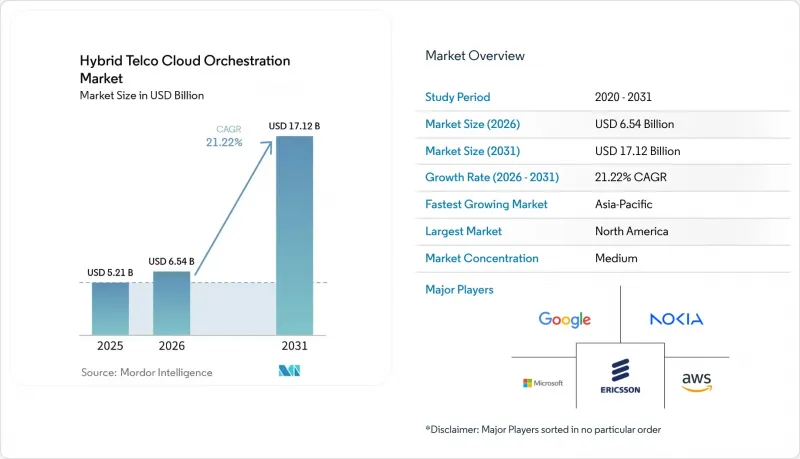
Mordor Intelligence에 의하면, 하이브리드 통신사 클라우드 오케스트레이션 시장 규모는 2025년 52억 1,000만 달러로 평가되었습니다. 2026년에는 65억 4,000만 달러로 확대되어 2031년까지 171억 2,000만 달러에 이를 것으로 예측되며, 2026년부터 2031년에 걸쳐 CAGR 21.22%로 성장할 전망입니다.
본 보고서는 구성 요소(플랫폼 등), 배포 방식(퍼블릭 클라우드 등), 클라우드 서비스 모델(IaaS 등), 용도(네트워크 기능 수명 주기 관리 등), 최종 사용자(모바일 네트워크 사업자 등), 기술(NFV 등), 조직 규모(대기업, 중소기업) 및 지역별로 분류되어 있습니다. 시장 전망은 금액(달러) 기준으로 제시됩니다.
세계의 하이브리드 통신사 클라우드 오케스트레이션 시장 동향 및 인사이트
5G 독립형(SA) 및 클라우드 네이티브 코어의 확대
5G 독립형 코어의 도입은 하이브리드 통신사 클라우드 오케스트레이션 시장의 주요 수요 원천이 되고 있습니다. 이는 이 아키텍처가 4G 앵커 코어를 배제하고, 프라이빗 및 퍼블릭 인프라에 걸쳐 클라우드 네이티브 네트워크 기능을 필요로 하기 때문입니다. 노키아는 2025년 1분기 말 기준으로 각 통신 사업자에 의해 52건의 5G 독립형 코어가 상용화되었다고 보고하며, 상용화가 광범위한 통신 사업자로 확산되고 있음을 보여주었습니다. 퍼블릭 클라우드의 용량을 활용하여 On-Premise NFV를 운영하는 통신 사업자는 이 두 도메인에 걸쳐 있는 VNF와 CNF를 모두 관리하는 컨트롤 플레인이 필요합니다. NTT 도코모와 NEC는 2026년 3월, 에이전트형 AI와 GitOps 파이프라인을 활용하여 AWS 상에서 일본 최초의 상용 5G 코어를 구축했습니다. 이를 통해 도입 시간을 80% 단축하고, 복잡한 사고 대응 시간을 50% 단축하는 데 성공했습니다. 이러한 성과로 인해 통신 사업자의 라이프사이클 관리 자동화 및 폐쇄 루프 운영에 대한 기대가 높아지고 있으며, 이러한 운영상의 이점을 레거시 기능과 컨테이너화된 기능 모두에 적용할 수 있다면 하이브리드 통신사 클라우드 오케스트레이션 시장이 혜택을 보게 될 것입니다. 스탠드얼론 방식의 도입 결정이 지연되면, 클라우드 네이티브 도구에 대한 벤더의 관심이 높아짐에 따라 향후 현대화가 어려워질 가능성이 있습니다.
하이브리드 및 멀티 클라우드 환경에서의 워크로드 이식성
통신 사업자들은 지연 시간에 민감한 사용자 플레인 기능을 On-Premise에 유지하면서, 트래픽 관리, 제어 플레인 및 분석 워크로드를 여러 클라우드 환경에 분산하고 있습니다. 이러한 설계로 인해 하이브리드 통신사 클라우드 오케스트레이션 시장의 핵심이 되는 조정 필요성이 대두됩니다. O2 Telefonica는 2026년 3월, 프로덕션 규모의 5G 코어 네트워크 기능을 자사 데이터센터 내의 AWS Outposts로 이전하여, On-Premise에서의 제어를 유지하면서 노키아의 클라우드 네이티브 코어와 AWS의 기능을 결합했습니다. On-Premise형 클라우드 확장 기능을 통해 통신 사업자는 기밀성이 높은 네트워크 기능에 대한 물리적 통제권을 포기하지 않고도 클라우드 도구를 활용할 수 있습니다. 이는 완전한 퍼블릭 클라우드 이전을 위한 일시적인 조치가 아니라, 영구적인 아키텍처 계층으로 자리 잡고 있습니다. 이러한 구성으로 인해 프라이빗 클러스터, 로컬 클라우드 확장 기능 및 퍼블릭 리전을 아우르는 공통 정책의 필요성이 높아지고 있으며, 그 결과 하이브리드 통신사 클라우드 오케스트레이션 시장은 단일 클라우드 운영 모델이 아닌 실용적인 워크로드 이식성에 의존하게 될 것입니다.
레거시 OSS/BSS 및 네트워크 통합의 복잡성
레거시 OSS 및 BSS 시스템은 하이브리드 통신사 클라우드 오케스트레이션 시장의 보급을 지연시키고 있습니다. 이는 수년에 걸쳐 운영되어 온 맞춤형 통합을 문서화하거나 대체하기 어렵기 때문입니다. 5G 서비스를 위한 BSS 플랫폼 현대화의 필요성은 널리 인식되고 있지만, 레거시 시스템에 대한 의존 관계를 해소하기 어렵기 때문에 실행이 계획보다 지연되는 경우가 많습니다. 가동 중인 서비스에 대한 리스크로 인해 구형 시스템은 계획된 일정에 따라 폐기되기보다는 점차 성능이 저하되는 경우가 많습니다. TM Forum의 ‘Open Digital Architecture’는 통신 사업자가 단계적인 분리를 실현할 수 있도록 표준 프레임워크를 제공합니다. Axiata Digital Labs는 자사의 ‘Axonect Hybrid Cloud Orchestrator’에 ‘Open Digital Architecture’와 ‘Open APIs’를 채택하여, 3억 5,000만 명의 가입자에게 서비스를 제공하는 11개국에 걸친 사업 거점 전반에 걸쳐 적응을 지원했습니다. Amdocs는 2026년 2월, 모든 BSS 또는 OSS 스택에서 작동하는 ‘aOS’ 에이전트형 운영 체제를 도입하여, 자동화된 오케스트레이션 도입 전에 시스템을 전면적으로 교체해야 할 필요성을 줄였습니다.
부문 분석
2025년에는 솔루션이 58.81%를 차지하여, 관리, 분석, 폐쇄 루프 자동화를 결합한 통합 스택에 대한 수요를 반영했습니다. 통신 사업자들은 여러 개의 개별 제품보다 단일 프레임워크를 선호하는 경향이 있습니다. 후자의 경우 새로운 통합 작업이 발생할 가능성이 있기 때문입니다. 솔루션의 점유율은 NFV 오케스트레이션 도구의 높은 성숙도와 4G에서 5G로 전환하는 과정에서 구축된 벤더와의 관계도 반영하고 있습니다. 통신 사업자들이 플랫폼 운영 및 지원을 전문 공급업체에 위탁하는 경향이 강화됨에 따라, 서비스 분야는 2031년까지 연평균 성장률(CAGR) 22.09%로 확대될 것으로 예측됩니다. 이러한 변화는 사내 클라우드 네이티브 기술 인력의 지속적인 부족에 대응하기 위한 것입니다.
플랫폼 제품은 여러 공급업체가 제공하는 네트워크 기능을 위한 공유 인프라 계층으로서 그 중요성이 커지고 있습니다. Red Hat OpenShift, 라쿠텐 심포니의 클라우드 네이티브 플랫폼, 그리고 VMware Telco Cloud Platform은 이러한 수평적 접근 방식을 구현하고 있습니다. 도이치 텔레콤은 2026년 2월, GitOps 기반 자동화를 활용한 유선 및 모바일 통신의 핵심 기능을 위한 공유 인프라 모델로 ‘Horizontal TelCo Cloud’를 소개했습니다. 이 회사의 클라우드 자동화 모델은 쿠버네티스 사용자 정의 리소스 정의(CRD)를 통해 CNF의 라이프사이클을 관리합니다. 이러한 구조를 통해 통신 사업자는 네트워크 기능을 인프라에서 분리하고, 재작업을 최소화하며 새로운 서비스 모델을 도입할 수 있습니다. 또한, 하이브리드 통신사 클라우드 오케스트레이션 시장은 공급업체 간의 통합 부담을 경감하는 플랫폼에 의해 뒷받침되고 있습니다.
2025년 기준, 하이브리드 통신사 클라우드 오케스트레이션 시장에서 프라이빗 클라우드는 38.21%의 점유율을 차지했으며, 2031년까지 연평균 성장률(CAGR) 21.58%로 확대될 것으로 예측됩니다. 규제 규칙 및 지연 요건으로 인해 많은 통신 사업자는 사용자 플레인 기능을 퍼블릭 클라우드 리전에 완전히 배치할 수 없습니다. 프라이빗 클라우드에는 통신 사업자가 소유한 하드웨어뿐만 아니라, 퍼블릭 클라우드 제공업체가 제공하는 On-Premise 확장 기능이 점점 더 많이 통합되고 있습니다. 이러한 설계로 인해 기존의 로컬 배포를 뛰어넘는 소프트웨어 및 서비스가 필요한 하이브리드 환경이 구축됩니다. 퍼블릭 클라우드는 지연 시간 요구 사항이 그리 엄격하지 않은 제어 플레인 및 관리 워크로드를 지원합니다.
하이브리드 클라우드 모델은 일부 기능이 레거시 인프라에 남아 있는 네트워크를 통신 사업자가 관리하는 데 도움이 됩니다. 유럽 집행위원회는 멀티 클라우드 오케스트레이터 하에서 프라이빗 클라우드, 퍼블릭 클라우드 및 엣지 노드를 결합한 모델을 유럽 통신 인프라의 목표 아키텍처로 제시하고 있습니다. O2 Telefonica의 AWS Outposts 도입 사례는 통신 사업자가 자사 데이터센터 내에 프로덕션 환경의 5G 코어 기능을 배치할 수 있음을 보여주었습니다. 이 모델을 통해 퍼블릭 클라우드 도구를 활용하면서도 현지 운영 통제권을 유지할 수 있습니다. 또한 정책의 일관성과 워크로드의 이식성을 플랫폼의 핵심 요건으로 삼고 있어, 하이브리드 통신사 클라우드 오케스트레이션 시장에는 이 모델의 운영을 용이하게 할 수 있는 공급업체에게 진입 여지가 있습니다.
2025년에는 통신 사업자들이 오케스트레이션 및 분석 기능에 대해 종량제 조달 방식을 채택한 결과, SaaS 점유율은 41.08%를 차지했습니다. 이 모델을 통해 막대한 초기 라이선스 비용 부담을 피할 수 있으며, 도입에 필요한 엔지니어링 노력을 줄일 수 있습니다. 노키아의 AWS 기반 5G 코어 SaaS는 벨기에의 Citymesh 상용 모바일 서비스를 지원했습니다. SaaS는 고객이 완전한 사내 플랫폼이 아닌, 미리 정의된 서비스를 필요로 하는 경우에 특히 효과적입니다.
IaaS는 통신 사업자가 컨테이너화된 네트워크 기능을 위한 인프라 용량을 조달함에 따라 2031년까지 연평균 성장률(CAGR) 23.04%로 확대될 것으로 예측됩니다. 이 접근 방식에서는 인프라 공급업체와 워크로드 관리 공급업체가 동일한 기업일 필요가 없으므로 유연성을 유지할 수 있습니다. PaaS는 Kubernetes 상에서 자동화 파이프라인이나 DevOps 도구를 구축하는 통신 사업자에게 유용합니다. 라쿠텐 모바일은 2026년 1월, ‘라쿠텐 클라우드’상의 컨테이너화된 5G 코어 환경에서 E-코어를 탑재한 인텔 제온 6 프로세서의 검증을 실시했습니다. 이번 검증은 계획 중인 상용 5G 코어의 활용 및 향후 MEC 평가를 지원하기 위한 것입니다. 이러한 도입은 상용 네트워크 기능을 위한 클라우드 인프라의 표준화에 기여하고 있으며, 더 많은 통신 사업자가 상용 클라우드 호스팅 검증을 진행함에 따라 하이브리드 통신사 클라우드 오케스트레이션 시장도 혜택을 볼 것으로 기대됩니다.
지역별 분석
2025년, 하이브리드 통신사 클라우드 오케스트레이션 시장에서 북미는 32.78%의 점유율을 차지하며 1위를 기록했습니다. 5G 독립형(SA) 운영, 프라이빗 네트워크, 그리고 인근에 위치한 하이퍼스케일러의 인프라가 수요를 뒷받침했습니다. 통신 사업자들이 내부 클라우드 팀을 같은 속도로 확충하지 못한 채 전환을 진행하는 가운데, 매니지드 서비스 및 IT 제공업체들이 도입 및 운영 업무를 더 많이 담당하게 되었으며, 하이브리드 통신사 클라우드 오케스트레이션 시장은 이러한 제공업체들의 제공 능력에 의존하고 있습니다. TELUS는 멀티 벤더 환경 전반에 걸쳐 일관성을 확보하기 위해 클라우드 네이티브 스택을 구축했습니다. 멕시코 시장의 발전은 5G 독립형(SA) 라이선싱, 주파수 대역 할당, 그리고 통신 사업자의 자본 투자 약속과 계속해서 밀접한 관련이 있습니다.
아시아태평양은 2031년까지 연평균 성장률(CAGR) 22.43%를 나타낼 것으로 예측됩니다. 일본은 첨단 5G 코어 네트워크 도입과 AI를 활용한 하이브리드 운영을 결합하고 있는 반면, 인도는 상용 5G 네트워크와 국내 장비 도입 프로그램을 통해 수요를 확대되고 있습니다. NTT 도코모의 AWS 기반 상용 5G 코어 네트워크는 구축 기간을 80% 단축하고, 복잡한 사고 대응 시간을 50% 단축했습니다. 한국과 호주는 Open RAN 상호운용성 표준을 준수하는 클라우드 네이티브 플랫폼을 추진하고 있습니다. 중국은 규모가 방대하지만, 국내 공급망을 우선시하는 경향으로 인해 국제 벤더의 진입이 제한되고 있습니다.
유럽에서는 NIS2에 따라 주권 요건을 준수하는 정책의 적용과 감사 가능성이 요구되고 있습니다. 텔레포니카 독일의 ‘Blue Planet’ 도입으로 무선 액세스, 전송, 코어 영역에 걸친 오케스트레이션이 확장되었습니다. 걸프협력회의(GCC) 회원국의 통신 사업자들은 데이터 거주 요건을 충족하는 제공업체에 그린필드 사업 기회를 제공합니다. 남미에서는 브라질과 콜롬비아에서 진전이 보이는 반면, 아프리카에서의 도입은 클라우드 인프라 밀도 및 캐리어급 기술 인력 부족으로 인해 여전히 제약을 받고 있습니다.
기타 혜택 :
- 엑셀 형식 시장 예측(ME) 시트
- 3개월간의 애널리스트 지원
자주 묻는 질문
목차
제1장 서론
제2장 조사 방법
제3장 주요 요약
제4장 시장 구도
제5장 시장 규모 및 성장 예측
제6장 경쟁 구도
제7장 시장 기회 및 향후 전망
KTH 26.09.10According to Mordor Intelligence, the hybrid telco cloud orchestration market size is expected to increase from USD 5.21 billion in 2025 to USD 6.54 billion in 2026 and reach USD 17.12 billion by 2031, growing at a CAGR of 21.22% over 2026-2031.
This report is Segmented by Component (Platforms, and More), Deployment (Public Cloud, and More), Cloud Service Model (IaaS, and More), Application (Network Function Lifecycle Management, and More), End User (Mobile Network Operators, and More), Technology (NFV, and More), Organization Size (Large Enterprises, and SMEs), and Geography. The Market Forecasts are Provided in Terms of Value (USD).
Global Hybrid Telco Cloud Orchestration Market Trends and Insights
5G Standalone and Cloud-Native Core Expansion
5G standalone core deployment is a major source of demand for the Hybrid telco cloud orchestration market because the architecture removes the 4G anchor core and requires cloud-native network functions across private and public infrastructure. Nokia reported 52 live 5G standalone core operator deployments at the end of the first quarter of 2025, showing that commercial adoption had reached a broad operator base. Operators running on-premises NFV with public cloud capacity need a control plane that manages both VNFs and CNFs across the two domains. NTT DOCOMO and NEC launched Japan's first commercial 5G Core on AWS in March 2026, using agentic AI and GitOps pipelines that reduced deployment time by 80% and response time for complex incidents by 50%. These results raise operator expectations for automated lifecycle management and closed-loop operations, and the Hybrid telco cloud orchestration market benefits when these operating gains can be applied across both legacy and containerized functions. Delayed standalone decisions can make later modernization harder as cloud-native tools receive greater vendor attention.
Hybrid and Multi-Cloud Workload Portability
Operators are distributing traffic management, control-plane, and analytics workloads across more than one cloud environment while keeping latency-sensitive user-plane functions on-premises. This design creates a coordination need that is central to the Hybrid telco cloud orchestration market. O2 Telefonica moved production-scale 5G Core network functions to AWS Outposts in its own data center during March 2026, combining Nokia's cloud-native core with AWS capabilities while retaining on-premises control. On-premises cloud extensions can give operators cloud tooling without giving up physical control of sensitive network functions. They are becoming a lasting architectural layer rather than a temporary step before complete public-cloud migration. This arrangement increases the requirement for common policies across private clusters, local cloud extensions, and public regions, and the Hybrid telco cloud orchestration market therefore depends on practical workload portability rather than a single-cloud operating model.
Legacy OSS/BSS and Network Integration Complexity
Legacy OSS and BSS systems slow Hybrid telco cloud orchestration market adoption because long-running custom integrations are difficult to document and replace. The need to modernize BSS platforms for 5G services is widespread, but execution often falls behind plan because legacy dependencies are difficult to unwind. Live-service risks mean that older systems often degrade gradually instead of being retired on a planned timeline. TM Forum's Open Digital Architecture gives operators a standard framework for incremental decoupling. Axiata Digital Labs used Open Digital Architecture and Open APIs in its Axonect Hybrid Cloud Orchestrator to support adaptation across 11 country operations serving 350 million subscribers. Amdocs introduced its aOS agentic operating system in February 2026 to operate over any BSS or OSS stack, reducing the need for full replacement before automated orchestration is introduced.
Other drivers and restraints analyzed in the detailed report include:
- NFV, CNF, and Open RAN Modernization
- Edge-Cloud Federation for Low-Latency Services
- Cybersecurity, Data Sovereignty, and Compliance Exposure
For complete list of drivers and restraints, kindly check the Table Of Contents.
Segment Analysis
Solutions held 58.81% in 2025, reflecting demand for integrated stacks that combine management, analytics, and closed-loop automation. Operators often prefer a single framework over several point products because the latter can create new integration work. The solutions position also reflects the established maturity of NFV orchestration tools and vendor relationships formed during the move from 4G to 5G. Services are projected to expand at a 22.09% CAGR through 2031 as operators use specialist providers for platform operations and support. This shift responds to continuing gaps in internal cloud-native skills.
Platform products are gaining importance as shared infrastructure layers for network functions from several suppliers. Red Hat OpenShift, Rakuten Symphony's Cloud-Native Platform, and VMware Telco Cloud Platform illustrate this horizontal approach. Deutsche Telekom described its Horizontal TelCo Cloud in February 2026 as a shared infrastructure model for fixed and mobile core functions using GitOps-based automation. Its cloud automation model manages CNF lifecycles through Kubernetes Custom Resource Definitions. This structure can let operators separate network functions from infrastructure and adopt new service models with less rework, and the Hybrid telco cloud orchestration market is supported by platforms that reduce the integration burden across suppliers.
Private cloud held 38.21% of the Hybrid telco cloud orchestration market share in 2025 and is projected to expand at a 21.58% CAGR through 2031. Regulatory rules and latency needs prevent many operators from placing user-plane functions fully in public cloud regions. Private cloud increasingly includes on-premises extensions from public cloud providers instead of only operator-owned hardware. This design creates a hybrid environment with software and services needs beyond those of traditional local deployments. Public cloud supports control-plane and management workloads where latency requirements are less demanding.
Hybrid cloud models help operators manage networks where some functions remain on legacy infrastructure. The European Commission identifies private cloud, public cloud, and edge nodes under a multi-cloud orchestrator as the target architecture for European telecommunications infrastructure. O2 Telefonica's AWS Outposts deployment showed how an operator can place production 5G Core functions in its own data center. This model preserves local operating control while using public-cloud tools. It also makes policy consistency and workload portability core platform requirements, and the Hybrid telco cloud orchestration market has room for suppliers that can make this model easier to operate.
SaaS held 41.08% in 2025 as operators used consumption-based procurement for orchestration and analytics functions. The model avoids large upfront license commitments and can reduce the engineering effort needed for deployment. Nokia's 5G Core SaaS with AWS supported Citymesh's commercial mobile service in Belgium. SaaS can be especially relevant where customers need defined services rather than a complete in-house platform.
IaaS is projected to expand at a 23.04% CAGR through 2031 as operators source infrastructure capacity for containerized network functions. This approach can preserve flexibility because the infrastructure supplier and workload-management supplier need not be the same company. PaaS is relevant for operators building automation pipelines and DevOps tools on Kubernetes. Rakuten Mobile verified Intel Xeon 6 processors with E-cores in a containerized 5G Core environment on Rakuten Cloud during January 2026. The verification supported planned commercial 5G Core use and future MEC evaluation. These deployments help normalize cloud infrastructure for commercial network functions, and the Hybrid telco cloud orchestration market can benefit as more operators validate commercial cloud hosting.
Complete Report Scope:
- By Component
- Platforms
- Solutions
- Services
- By Deployment
- Public Cloud
- Private Cloud
- Hybrid Cloud
- By Cloud Service Model
- Infrastructure as a Service (IaaS)
- Platform as a Service (PaaS)
- Software as a Service (SaaS)
- By Application
- Network Function Lifecycle Management
- Service Design, Fulfillment, and Activation
- Network Slicing and Quality-on-Demand
- Traffic Management and Policy Control
- Cloud Migration and Modernization
- Edge Computing and Multi-access Edge Computing
- Billing, Charging, and Provisioning
- Network Assurance and Closed-Loop Automation
- By End User
- Mobile Network Operators
- Fixed and Converged Operators
- Enterprise and Private Network Operators
- Managed Service Providers
- Cloud Service Providers
- Government and Defense Communications Agencies
- By Technology
- Network Functions Virtualization (NFV)
- Cloud-Native Network Functions (CNFs)
- Software-Defined Networking (SDN)
- Open RAN and Cloud RAN
- Kubernetes and Container Orchestration
- Artificial Intelligence and Machine Learning
- Service Mesh and API-Based Orchestration
- By Organization Size
- Large Enterprises
- Small and Medium Enterprises
- By Geography
- North America
- United States
- Canada
- Mexico
- South America
- Brazil
- Argentina
- Colombia
- Rest of South America
- Europe
- Germany
- United Kingdom
- France
- Italy
- Spain
- Russia
- Rest of Europe
- Asia-Pacific
- China
- Japan
- South Korea
- India
- Australia
- Rest of Asia-Pacific
- Middle East
- Saudi Arabia
- United Arab Emirates
- Turkey
- Rest of Middle East
- Africa
- South Africa
- Nigeria
- Egypt
- Rest of Africa
- North America
Geography Analysis
North America led the Hybrid telco cloud orchestration market with a 32.78% share in 2025. Active 5G standalone operations, private networks, and nearby hyperscaler infrastructure supported demand. Managed service and IT providers are taking more deployment and operations work as operators migrate without expanding internal cloud teams at the same pace, and the Hybrid telco cloud orchestration market depends on their delivery capacity. TELUS built a cloud-native stack for consistency across a multi-vendor environment. Mexico's development remains linked to 5G standalone licensing, spectrum assignments, and operator capital commitments.
Asia-Pacific is projected to expand at a 22.43% CAGR through 2031. Japan combines advanced 5G core deployment with AI-assisted hybrid operations, while India adds demand through commercial 5G networks and domestic equipment programs. NTT DOCOMO's commercial 5G Core on AWS reduced deployment time by 80% and complex incident response time by 50%. South Korea and Australia are advancing cloud-native platforms aligned with Open RAN interoperability standards. China is substantial in scale, but domestic supply-chain preferences limit international vendor access.
Europe requires sovereign-compatible policy enforcement and auditability under NIS2. Telefonica Germany's Blue Planet deployment extended orchestration across radio access, transport, and core domains. Gulf Cooperation Council operators offer greenfield opportunities for providers that meet data-residency requirements. South America is advancing in Brazil and Colombia, while African adoption remains constrained by cloud infrastructure density and available carrier-grade skills.
- Amazon Web Services, Inc.
- Microsoft Corporation
- Google LLC
- International Business Machines Corporation
- Broadcom Inc.
- Nokia Corporation
- Telefonaktiebolaget LM Ericsson
- Oracle Corporation
- Cisco Systems, Inc.
- Huawei Investment & Holding Co., Ltd.
- ZTE Corporation
- Telefonica Tech
- Amdocs Limited
- Rakuten Symphony, Inc.
- Mavenir Systems, Inc.
- Juniper Networks, Inc.
- Red Hat, Inc.
- Wind River Systems, Inc.
- NEC Corporation
- Samsung Electronics Co., Ltd.
- Hewlett Packard Enterprise Company
- Tata Consultancy Services Limited
- Netcracker Technology Corporation
- Ciena Corporation
Additional Benefits:
- The market estimate (ME) sheet in Excel format
- 3 months of analyst support
TABLE OF CONTENTS
1 INTRODUCTION
- 1.1 Study Assumptions and Market Definition
- 1.2 Scope of the Study
2 RESEARCH METHODOLOGY
3 EXECUTIVE SUMMARY
4 MARKET LANDSCAPE
- 4.1 Market Overview
- 4.2 Market Drivers
- 4.2.1 5G Standalone and Cloud-Native Core Expansion
- 4.2.2 Hybrid and Multi-Cloud Workload Portability
- 4.2.3 NFV, CNF, and Open RAN Modernization
- 4.2.4 Edge-Cloud Federation for Low-Latency Services
- 4.2.5 Intent-Based Automation and Autonomous Network Operations
- 4.2.6 Operator Platform Federation and Network API Monetization
- 4.3 Market Restraints
- 4.3.1 Legacy OSS/BSS and Network Integration Complexity
- 4.3.2 Cybersecurity, Data Sovereignty, and Compliance Exposure
- 4.3.3 Shortage of Carrier-Grade Cloud-Native Skills
- 4.3.4 Cross-Cloud Exit Costs and Incomplete Interoperability
- 4.4 Impact of Macroeconomic Factors on the Market
- 4.5 Industry Value Chain Analysis
- 4.6 Regulatory Landscape
- 4.7 Technological Outlook
- 4.8 Porter's Five Forces Analysis
- 4.8.1 Bargaining Power of Suppliers
- 4.8.2 Bargaining Power of Buyers
- 4.8.3 Threat of New Entrants
- 4.8.4 Threat of Substitutes
- 4.8.5 Rivalry Among Existing Competitors
5 MARKET SIZE AND GROWTH FORECASTS (VALUE)
- 5.1 By Component
- 5.1.1 Platforms
- 5.1.2 Solutions
- 5.1.3 Services
- 5.2 By Deployment
- 5.2.1 Public Cloud
- 5.2.2 Private Cloud
- 5.2.3 Hybrid Cloud
- 5.3 By Cloud Service Model
- 5.3.1 Infrastructure as a Service (IaaS)
- 5.3.2 Platform as a Service (PaaS)
- 5.3.3 Software as a Service (SaaS)
- 5.4 By Application
- 5.4.1 Network Function Lifecycle Management
- 5.4.2 Service Design, Fulfillment, and Activation
- 5.4.3 Network Slicing and Quality-on-Demand
- 5.4.4 Traffic Management and Policy Control
- 5.4.5 Cloud Migration and Modernization
- 5.4.6 Edge Computing and Multi-access Edge Computing
- 5.4.7 Billing, Charging, and Provisioning
- 5.4.8 Network Assurance and Closed-Loop Automation
- 5.5 By End User
- 5.5.1 Mobile Network Operators
- 5.5.2 Fixed and Converged Operators
- 5.5.3 Enterprise and Private Network Operators
- 5.5.4 Managed Service Providers
- 5.5.5 Cloud Service Providers
- 5.5.6 Government and Defense Communications Agencies
- 5.6 By Technology
- 5.6.1 Network Functions Virtualization (NFV)
- 5.6.2 Cloud-Native Network Functions (CNFs)
- 5.6.3 Software-Defined Networking (SDN)
- 5.6.4 Open RAN and Cloud RAN
- 5.6.5 Kubernetes and Container Orchestration
- 5.6.6 Artificial Intelligence and Machine Learning
- 5.6.7 Service Mesh and API-Based Orchestration
- 5.7 By Organization Size
- 5.7.1 Large Enterprises
- 5.7.2 Small and Medium Enterprises
- 5.8 By Geography
- 5.8.1 North America
- 5.8.1.1 United States
- 5.8.1.2 Canada
- 5.8.1.3 Mexico
- 5.8.2 South America
- 5.8.2.1 Brazil
- 5.8.2.2 Argentina
- 5.8.2.3 Colombia
- 5.8.2.4 Rest of South America
- 5.8.3 Europe
- 5.8.3.1 Germany
- 5.8.3.2 United Kingdom
- 5.8.3.3 France
- 5.8.3.4 Italy
- 5.8.3.5 Spain
- 5.8.3.6 Russia
- 5.8.3.7 Rest of Europe
- 5.8.4 Asia-Pacific
- 5.8.4.1 China
- 5.8.4.2 Japan
- 5.8.4.3 South Korea
- 5.8.4.4 India
- 5.8.4.5 Australia
- 5.8.4.6 Rest of Asia-Pacific
- 5.8.5 Middle East
- 5.8.5.1 Saudi Arabia
- 5.8.5.2 United Arab Emirates
- 5.8.5.3 Turkey
- 5.8.5.4 Rest of Middle East
- 5.8.6 Africa
- 5.8.6.1 South Africa
- 5.8.6.2 Nigeria
- 5.8.6.3 Egypt
- 5.8.6.4 Rest of Africa
- 5.8.1 North America
6 COMPETITIVE LANDSCAPE
- 6.1 Market Concentration
- 6.2 Strategic Moves
- 6.3 Market Share Analysis
- 6.4 Company Profiles (includes Global Level Overview, Market Level Overview, Core Segments, Financials as available, Strategic Information, Market Rank/Share, Products and Services, Recent Developments)
- 6.4.1 Amazon Web Services, Inc.
- 6.4.2 Microsoft Corporation
- 6.4.3 Google LLC
- 6.4.4 International Business Machines Corporation
- 6.4.5 Broadcom Inc.
- 6.4.6 Nokia Corporation
- 6.4.7 Telefonaktiebolaget LM Ericsson
- 6.4.8 Oracle Corporation
- 6.4.9 Cisco Systems, Inc.
- 6.4.10 Huawei Investment & Holding Co., Ltd.
- 6.4.11 ZTE Corporation
- 6.4.12 Telefonica Tech
- 6.4.13 Amdocs Limited
- 6.4.14 Rakuten Symphony, Inc.
- 6.4.15 Mavenir Systems, Inc.
- 6.4.16 Juniper Networks, Inc.
- 6.4.17 Red Hat, Inc.
- 6.4.18 Wind River Systems, Inc.
- 6.4.19 NEC Corporation
- 6.4.20 Samsung Electronics Co., Ltd.
- 6.4.21 Hewlett Packard Enterprise Company
- 6.4.22 Tata Consultancy Services Limited
- 6.4.23 Netcracker Technology Corporation
- 6.4.24 Ciena Corporation
7 MARKET OPPORTUNITIES AND FUTURE OUTLOOK
- 7.1 White-Space and Unmet-Need Assessment