

|
시장보고서
상품코드
2119342
지역 통신 파트너 및 시스템 통합업체 매핑 : 시장 점유율 분석, 업계 동향 및 통계, 성장 예측(2026-2031년)Local Telecom Partner and System Integrator Mapping - Market Share Analysis, Industry Trends & Statistics, Growth Forecasts (2026 - 2031) |
||||||
 Mordor Intelligence
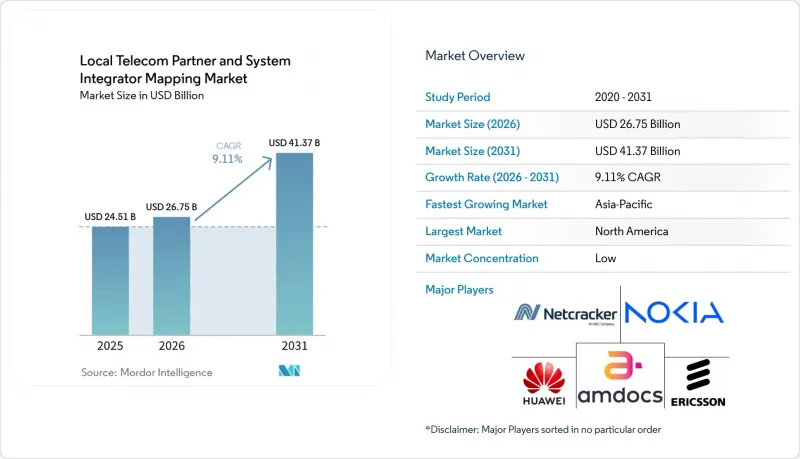
에 의하면, 지역 통신 파트너 및 시스템 통합업체 매핑 시장 규모는 2025년 245억 1,000만 달러로 평가되었습니다. 2026년에는 267억 5,000만 달러로 확대되어 2031년까지 413억 7,000만 달러에 이를 것으로 예상되고 2026년부터 2031년에 걸쳐 CAGR 9.11%로 성장할 전망입니다.
본 보고서는 파트너 유형(독립 시스템 통합업체 등), 서비스 유형(컨설팅 및 자문 서비스 등), 통합 분야(네트워크 통합 등), 배포 모델(클라우드, 하이브리드 등), 고객 유형(Tier 1 모바일 네트워크 사업자 등) 및 지역별로 분류되어 있습니다. 시장 전망은 금액(달러) 기준으로 제시되어 있습니다.
세계의 지역 통신 파트너 및 시스템 통합업체 매핑 : 시장 동향 및 인사이트
5G, 오픈 RAN 및 네트워크 현대화 프로그램
Open RAN에서 통신 사업자는 서로 다른 공급업체가 제조한 무선 장치, 분산형 장치, 집중형 장치 및 서비스 관리 계층을 연결해야 합니다. 이러한 구조로 인해 인터페이스, 테스트 절차 및 현장 도입 요건을 잘 이해하고 있는 현지 시스템 통합 업체에 대한 수요가 증가하고 있습니다. 2026년 2월, 캡제미니와 도이치 텔레콤은 O-RAN 및 레거시 RAN 환경 모두에서 작동하는 지능형 RAN 자동화 플랫폼을 개발했습니다. 도이치 텔레콤은 이 플랫폼을 유럽 전역에서 활용할 뿐만 아니라 전 세계 통신 사업자를 위한 소프트웨어 서비스로 제공할 수 있도록 준비를 진행 중이라고 발표했습니다. 지역 통신 파트너 및 시스템 통합업체 매핑을 위해 이러한 플랫폼은 여전히 개별 통신 사업자의 환경에서 도입, 검증 및 라이프사이클 지원이 필요하기 때문에 시장 기회가 창출되고 있습니다. 2025년 10월, 보다폰이 독일 및 기타 유럽 국가에서 가상화 RAN 및 Open RAN 솔루션 제공업체로 삼성을 선정했을 때, 시스템 통합 서비스도 포함되어 있었으며, 이는 장비 공급업체들이 도입 프로그램에서 더 큰 역할을 추구하고 있음을 보여줍니다.
클라우드 네이티브 OSS 및 BSS의 변혁
클라우드 네이티브 OSS 및 BSS 프로그램을 통해 통합 작업은 일회성 구현에서 지속적인 활동으로 변화하고 있습니다. 통신 사업자는 모듈형 용도과 클라우드 기반 서비스를 도입하는 동시에 레거시 인터페이스를 계속 가동해야 합니다. 이로 인해 서비스 제공을 중단하지 않고 운영, 과금, 재고 관리, 오케스트레이션 시스템을 연동할 수 있는 전문가에 대한 수요가 지속적으로 발생하고 있습니다. 많은 통신 사업자가 모든 시스템에 공통적으로 적용할 수 있는 단일 전환 경로를 채택할 수 없기 때문에 이러한 요구 사항으로 인해 지역 통신 파트너 및 시스템 통합업체 매핑 시장이 혜택을 보고 있습니다. TM Forum의 ‘Open Digital Architecture(ODA)’ 이니셔티브에는 2025년부터 2026년에 걸쳐 시행될 ‘카탈리스트 프로젝트’가 포함되어 있으며, 이는 인공지능을 활용하여 레거시 코드에서 로직을 추출하고 용도를 ODA 준수 구성 요소로 재설계하는 것입니다. 이 이니셔티브는 개방형 인터페이스를 통해 공통의 목표 아키텍처가 제공되는 경우에도 레거시 시스템의 현대화가 여전히 현실적인 도입 과제임을 보여줍니다.
레거시 시스템의 상호 운용성 제약
레거시 OSS 및 BSS 시스템은 그 프로세스나 데이터 구조가 모듈식이며 API 기반 아키텍처를 전제로 구축되지 않았기 때문에 여전히 큰 제약으로 남아 있습니다. 각 연결에서 구형 재고 관리, 과금, 오케스트레이션 로직을 새로운 용도과 조화시키기 위해 별도의 추상화 계층이 필요할 수 있습니다. 개방형 표준은 불일치를 완화할 수는 있지만, 데이터 형식, 액세스 제어 또는 과거의 맞춤화에 따른 차이를 해소해 주지는 않습니다. TM Forum의 레거시 현대화 추진 이니셔티브는 이 업계가 ODA 준수 환경을 위해 레거시 비즈니스 로직을 추출하고 재구축하는 방법을 적극적으로 모색하고 있음을 보여줍니다. 지역 통신 파트너 및 시스템 통합업체 매핑 시장에서는 새로운 기능을 도입하기 전에 팀이 이러한 제약 사항을 해결해야 하기 때문에 도입 주기가 길어지는 경향이 있습니다. 또한, 기존 시스템과의 연동에 할당되는 자원은 클라우드 네이티브 기능이나 자동화 프로그램의 개발을 지연시킬 가능성도 있습니다.
부문 분석
2025년 기준, 기존 통신 장비 벤더는 지역 통신 파트너 및 시스템 통합업체 매핑 시장에서 41.23%의 점유율을 차지했습니다. 이러한 위상은 오랜 기간 이어져 온 조달 관계와 장비 및 소프트웨어 납품에 통합 작업을 포함시키는 능력을 반영합니다. 통신 사업자가 확립된 네트워크 지원이나 검증된 공급 자원을 필요로 하는 상황에서는 기존 벤더가 우위를 유지하고 있습니다. 신흥 통신 기술 벤더는 2031년까지 연평균 성장률(CAGR) 10.34%를 나타낼 것으로 예측됩니다. 이러한 벤더들이 제공하는 클라우드 네이티브 및 인공지능(AI)에 중점을 둔 솔루션은 구매자가 독자적인 사양의 스택에 의존하기를 원하지 않는 새로운 Open RAN 및 사설 네트워크 프로그램에 적합합니다.
통신 사업자들은 장비 공급 입찰과 소프트웨어 및 통합 서비스 제공에 관한 입찰을 분리하는 경향이 강해지고 있어, 유연한 도구와 신속한 도입 방식을 갖춘 신흥 벤더들에게 더 명확한 시장 진입 기회가 생기고 있습니다. 독립 시스템 통합업체는 통신 사업자가 멀티 벤더 프로그램에서 단일 공급업체에 대한 의존도를 제한하고자 할 때 혜택을 받게 됩니다. 한편, 클라우드 인프라가 네트워크, OSS, BSS 워크로드와 더욱 밀접하게 통합됨에 따라 클라우드 서비스 제공업체도 동일한 시장에 진입하고 있습니다. Amdocs는 2025 회계연도 매출이 45억 3,000만 달러였다고 보고했는데, 이는 대규모 OSS 및 BSS 계약에 일반적으로 요구되는 막대한 자원을 반영한 것입니다. 지역 통신 파트너 및 시스템 통합업체 매핑 시장은 기존 벤더, 독립 통합업체, 그리고 동일한 변혁 프로그램의 서로 다른 부분을 담당하는 클라우드 전문 제공업체에 의해 형성되고 있습니다. 이들 그룹 간의 균형은
2025년, 시스템 통합 및 도입은 지역 통신 파트너 및 시스템 통합업체 매핑 시장 규모에서 36.14%를 차지했습니다. 네트워크 업그레이드, 클라우드 도입, 신규 서비스 출시 과정에서 시스템 간 연동은 여전히 필수적입니다. 많은 Open RAN 프로그램의 멀티 벤더 구조는 각 프로젝트에 필요한 조정 작업을 증가시키고 있습니다. 전환 및 현대화 서비스는 2031년까지 연평균 성장률(CAGR) 10.46%를 나타낼 것으로 예측됩니다. 이는 OSS 및 BSS 프로그램을 계획 단계에서 실행 단계로 전환하는 통신 사업자의 수가 증가하고 있음을 반영합니다.
대규모 변혁 프로젝트가 본격적인 운영 단계에 접어든 후에도 통신 사업자는 지속적인 운영상의 복잡성과 시스템 유지보수 관리에 여전히 지원이 필요하기 때문에 관리형 네트워크 및 IT 서비스의 중요성은 더욱 높아집니다. 멀티벤더 Open RAN 환경은 끊임없이 진화하는 적합성 요건을 충족해야 하므로, 테스트, 보증, 인증에 대한 관심이 높아지고 있습니다. 한편, 자동화된 장애 해결이 널리 보급되고 있음에도 불구하고 기술 지원 및 라이프사이클 서비스는 여전히 필수적입니다. 지역 통신 파트너 및 시스템 통합업체 매핑 시장은 단일 활동만으로는 전체 변혁 프로세스를 포괄할 수 없기 때문에 계속해서 광범위한 서비스 유형을 기반으로 하고 있습니다. 이전, 테스트, 관리형 제공을 결합한 공급업체는 초기 도입 완료 후에도 지속적으로 관여할 수 있습니다. 이러한 지속성을 통해 네트워크와 비즈니스 시스템이 끊임없이 변화하는 상황에서도 고객은 제공에 관한 노하우를 유지할 수 있습니다.
지역별 분석
2025년, 북미는 지역 통신 파트너 및 시스템 통합업체 매핑 매출 점유율에서 36.49%를 차지했습니다. 이 지역은 Tier 1 변혁 프로그램과 국내 파트너와의 협력을 강화하는 정책 조치의 혜택을 받고 있습니다. Amdocs와 AWS는 2026년 2월, 인공지능(AI)을 활용한 통신 현대화를 지원하기 위한 다년간의 제휴를 발표했으며, 북미의 Tier 1 통신 서비스 제공업체를 대상으로 대규모 프로그램이 진행 중입니다. 또한, 2026년 4월에 채택된 FCC 규정에 따라 정부 및 중요 인프라 계약의 자격 인증 절차도 변경되었습니다. 유럽은 지역별 시장 점유율 2위를 차지하고 있으며, 노키아와 에릭슨의 마켓플레이스 협력 및 5개 통신 사업자가 실시하는 ‘European Edge Continuum’ 실증 실험 등 Open RAN과 관련된 멀티벤더 프로그램으로 전환되고 있습니다.
아시아태평양은 2031년까지 10.92%라는 가장 높은 연평균 성장률(CAGR)을 나타낼 전망입니다. 그린필드 5G 투자, 공공 디지털 인프라 프로그램, 그리고 클라우드 네이티브 네트워크 아키텍처가 일본, 한국, 인도, 동남아시아 전역 수요를 뒷받침하고 있습니다. 라쿠텐 모바일과 라쿠텐 심포니는 2026년 2월 일본 국내에서 O-RAN 준수 RAN 지능형 컨트롤러의 상용화를 완료하며, Open RAN 통합이 전국 규모로 상용화 단계에 접어들었음을 입증했습니다. 인도의 ‘2024년 통신 사이버 보안 규정’에서는 네트워크 보호 조치와 사고 보고가 의무화되어 있어, 인증된 보안 역량을 갖춘 파트너에 대한 수요가 증가하고 있습니다. 이 지역의 지역 통신 파트너 및 시스템 통합업체 매핑 시장은 국내 보안 및 운영 요건을 충족하면서 새로운 네트워크를 통합해야 할 필요성에 힘입어 성장하고 있습니다.
남미, 중동 및 아프리카는 1세대 5G 구축, 광섬유 확장, 국가 주도의 네트워크 투자를 중심으로 신흥 성장층을 형성하고 있습니다. 브라질은 통신 사업자들이 5G 독립형(SA) 구축을 추진하고 OSS 및 BSS 현대화를 진행하는 가운데, 남미 지역의 통합 노력을 주도하고 있습니다. 아랍에미리트(UAE)와 사우디아라비아는 5G 코어, OSS 혁신 및 파트너 생태계 프로그램에 대해 전 세계 시스템 통합 업체들과 협력하고 있습니다. 한편, 남아프리카공화국, 나이지리아, 이집트는 4G에서 5G로의 전환과 광섬유망 확장을 통해 아프리카 수요를 뒷받침하고 있습니다. 프로젝트가 네트워크 구축에서 지속적인 운영, 보증 및 현대화 작업으로 전환됨에 따라, 지역 통신 파트너 및 시스템 통합업체 매핑 시장은 그 혜택을 누릴 수 있습니다.
기타 혜택 :
- 엑셀 형식 시장 예측(ME) 시트
- 3개월간의 애널리스트 지원
자주 묻는 질문
목차
제1장 서론
제2장 조사 방법
제3장 주요 요약
제4장 시장 구도
제5장 시장 규모 및 성장 예측
제6장 경쟁 구도
제7장 시장 기회 및 향후 전망
KTH 26.09.10According to Mordor Intelligence, the local telecom partner and system integrator mapping market size is expected to increase from USD 24.51 billion in 2025 to USD 26.75 billion in 2026 and reach USD 41.37 billion by 2031, growing at a CAGR of 9.11% over 2026-2031.
This report is Segmented by Partner Type (Independent System Integrators, and More), Service Type (Consulting and Advisory Services, and More), Integration Domain (Network Integration, and More), Deployment Model (Cloud, Hybrid, and More), Customer Type (Tier-1 Mobile Network Operators, and More), and Geography. The Market Forecasts are Provided in Terms of Value (USD).
Global Local Telecom Partner and System Integrator Mapping Market Trends and Insights
5G, Open RAN, and Network Modernization Programs
Open RAN requires operators to connect radio units, distributed units, centralized units, and service management layers from different suppliers. This structure increases the need for local system integrators who understand interfaces, testing procedures, and field deployment requirements. In February 2026, Capgemini and Deutsche Telekom developed an intelligent RAN automation platform that operates across O-RAN and legacy RAN environments. Deutsche Telekom said it was preparing the platform for use across its European footprint and as a software service for operators worldwide. The Local telecom partner and system integrator mapping market benefits because these platforms still require deployment, validation, and lifecycle support in individual operator environments. Samsung's selection by Vodafone in October 2025 to provide virtualized RAN and Open RAN solutions in Germany and other European countries also included system integration services, showing that equipment suppliers are pursuing a larger role in delivery programs.
Cloud-Native OSS and BSS Transformation
Cloud-native OSS and BSS programs change integration work from a one-time implementation into an ongoing activity. Operators must keep legacy interfaces running while introducing modular applications and cloud-based services. This creates a continuing need for specialists who can connect operational, billing, inventory, and orchestration systems without disrupting service delivery. The Local telecom partner and system integrator mapping market gains from this requirement because many operators cannot use a single migration path across all systems. TM Forum's Open Digital Architecture work includes a 2025 to 2026 catalyst project that applies artificial intelligence to extract logic from legacy code and redesign applications into ODA-compliant components. This work indicates that legacy modernization remains a practical delivery issue, even where open interfaces provide a common target architecture.
Legacy-System Interoperability Constraints
Legacy OSS and BSS systems remain a major constraint because their processes and data structures were not built for modular, API-based architectures. Each connection may require a separate abstraction layer to align old inventory, billing, and orchestration logic with newer applications. Open standards can reduce variation, but they do not remove differences in data formats, access controls, or historic customizations. TM Forum's legacy modernization catalyst shows that the sector is actively seeking ways to extract and restructure legacy business logic for ODA-compliant environments. The Local telecom partner and system integrator mapping market faces longer delivery cycles when teams must resolve these constraints before new capabilities can be introduced. Capacity used for bridging old systems may also delay work on cloud-native functions and automation programs.
Other drivers and restraints analyzed in the detailed report include:
- Expansion of B2B2X and Partner Monetization Models
- Rising Demand for Local Delivery and Regulatory Expertise
- Prolonged Integration Timelines and Budget Overruns
For complete list of drivers and restraints, kindly check the Table Of Contents.
Segment Analysis
Incumbent telecom equipment vendors held 41.23% of the Local telecom partner and system integrator mapping market share in 2025. Their position reflects long procurement relationships and their ability to package integration work with equipment and software deliveries. Incumbents retain an advantage where operators require established network support and proven delivery resources. Challenger telecom technology vendors are projected to grow at a 10.34% CAGR through 2031. Their cloud-native and artificial intelligence-focused offerings suit new Open RAN and private network programs where buyers do not want to rely on a proprietary stack.
Operators are increasingly separating tenders for equipment supply from tenders for software and integration delivery, creating a clearer opening for challengers with flexible tools and faster implementation methods. Independent system integrators benefit when operators want to limit dependence on a single supplier across multi-vendor programs, while cloud service providers enter the same space as cloud infrastructure becomes more closely integrated with network, OSS, and BSS workloads. Amdocs reported fiscal 2025 revenue of USD 4.53 billion, reflecting the resource depth typically required in large OSS and BSS contracts. The Local telecom partner and system integrator mapping market is shaped by established vendors, independent integrators, and cloud-focused providers that address different parts of the same transformation program. The balance between these groups depends on whether
Systems integration and implementation accounted for 36.14% of the Local telecom partner and system integrator mapping market size in 2025. Connecting systems remains necessary across network upgrades, cloud adoption, and new service launches. The multi-vendor structure of many Open RAN programs increases the coordination required for each project. Migration and modernization services are forecast to grow at a CAGR of 10.46% through 2031. This reflects the number of operators moving OSS and BSS programs from planning to execution.
Managed network and IT services become more relevant after major transformation projects reach production, as operators still need help managing ongoing operational complexity and system maintenance. Testing, assurance, and certification receive greater attention because multi-vendor Open RAN environments must meet evolving conformance requirements, while technical support and lifecycle services remain necessary despite the wider adoption of automated fault resolution. The Local telecom partner and system integrator mapping market continues to rely on a broad range of service types because no single activity can cover the full transformation process. Providers that combine migration, testing, and managed delivery can stay involved after the initial implementation is complete. This continuity gives customers a way to retain delivery knowledge as network and business systems continue to change.
Complete Report Scope:
- By Partner Type
- Independent System Integrators
- Incumbent Telecom Equipment Vendors
- Challenger Telecom Technology Vendors
- Cloud Service Providers
- Other Partner Types
- By Service Type
- Consulting and Advisory Services
- Network Design and Planning
- Systems Integration and Implementation
- Migration and Modernization Services
- Testing, Assurance, and Certification
- Managed Network and IT Services
- Technical Support and Lifecycle Services
- By Integration Domain
- Network Integration
- Operations Support Systems Integration
- Business Support Systems Integration
- Cloud and Data Center Integration
- Application and API Integration
- Security and Identity Integration
- Partner Ecosystem and Settlement Integration
- By Deployment Model
- Cloud
- Hybrid
- On-Premises
- By Customer Type
- Tier-1 Mobile Network Operators
- Tier-2 and Tier-3 Mobile Network Operators
- Fixed Broadband Operators
- Cable and Converged Operators
- MVNOs and MVNEs
- Internet Service Providers
- Enterprises and Government Agencies
- By Geography
- North America
- United States
- Canada
- Mexico
- South America
- Brazil
- Argentina
- Chile
- Rest of South America
- Europe
- Germany
- United Kingdom
- France
- Italy
- Spain
- Rest of Europe
- Asia-Pacific
- China
- Japan
- India
- South Korea
- Australia
- Rest of Asia-Pacific
- Middle East
- United Arab Emirates
- Saudi Arabia
- Qatar
- Rest of Middle East
- Africa
- South Africa
- Egypt
- Nigeria
- Rest of Africa
- North America
Geography Analysis
North America held 36.49% of the Local telecom partner and system integrator mapping revenue share in 2025. The region benefits from Tier-1 transformation programs and policy measures that increase the importance of domestic partner engagement. Amdocs and AWS announced a multi-year collaboration in February 2026 to support artificial intelligence-driven telecom modernization, with a large-scale program underway at a North American Tier-1 communications service provider. The FCC rules adopted in April 2026 also change qualification processes for government and critical infrastructure contracts. Europe holds the second-largest regional position and is shifting toward multi-vendor programs linked to Open RAN, including Nokia and Ericsson marketplace cooperation and the European Edge Continuum demonstration by 5 operators.
Asia-Pacific is projected to record the fastest CAGR of 10.92% through 2031. Greenfield 5G investment, public digital infrastructure programs, and cloud-native network architecture support demand across Japan, South Korea, India, and Southeast Asia. Rakuten Mobile and Rakuten Symphony completed a national commercial rollout of O-RAN-compliant RAN Intelligent Controllers in Japan in February 2026, demonstrating that Open RAN integration has entered commercial production at a national scale. India's Telecom Cyber Security Rules, 2024, require network protection measures and incident reporting, increasing the need for partners with certified security capabilities. The Local telecom partner and system integrator mapping market in the region is supported by the need to integrate new networks while meeting domestic security and operating requirements.
South America, the Middle East, and Africa form an emerging growth tier centered on first-generation 5G deployment, fiber expansion, and sovereign network investment. Brazil leads South American integration efforts as operators advance 5G standalone deployments and modernize OSS and BSS. The United Arab Emirates and Saudi Arabia are working with global system integrators for 5G core, OSS transformation, and partner ecosystem programs, while South Africa, Nigeria, and Egypt are supporting African demand through 4G-to-5G migration and fiber expansion. The Local telecom partner and system integrator mapping market can benefit as projects move from network construction into recurring operation, assurance, and modernization work.
- Amdocs Limited
- Netcracker Technology Corporation
- Telefonaktiebolaget LM Ericsson
- Nokia Corporation
- Huawei Technologies Co., Ltd.
- ZTE Corporation
- Ciena Corporation
- Mavenir Systems, Inc.
- Cerillion plc
- Tecnotree Oyj
- Subex Limited
- Optiva Inc.
- Ribbon Communications Inc.
- Aviat Networks, Inc.
- Comtech Telecommunications Corp.
- Radisys Corporation
- Harmonic Inc.
- Parallel Wireless, Inc.
- JSC Ingenium
- Hansen Technologies Limited
- MATRIXX Software, Inc.
- Qvantel Oy
Additional Benefits:
- The market estimate (ME) sheet in Excel format
- 3 months of analyst support
TABLE OF CONTENTS
1 INTRODUCTION
- 1.1 Study Assumptions and Market Definition
- 1.2 Scope of the Study
2 RESEARCH METHODOLOGY
3 EXECUTIVE SUMMARY
4 MARKET LANDSCAPE
- 4.1 Market Overview
- 4.2 Market Drivers
- 4.2.1 5G, Open RAN, and Network Modernization Programs
- 4.2.2 Cloud-Native OSS and BSS Transformation
- 4.2.3 Expansion of B2B2X and Partner Monetization Models
- 4.2.4 Rising Demand for Local Delivery and Regulatory Expertise
- 4.2.5 AI-Based Network Automation and Assurance
- 4.2.6 Fragmentation of Telecom Technology Vendor Ecosystems
- 4.3 Market Restraints
- 4.3.1 Legacy-System Interoperability Constraints
- 4.3.2 Prolonged Integration Timelines and Budget Overruns
- 4.3.3 Telecom Data-Security and Sovereignty Requirements
- 4.3.4 Shortage of Certified Telecom Integration Specialists
- 4.4 Impact of Macroeconomic Factors on the Market
- 4.5 Industry Value-Chain Analysis
- 4.6 Technology Outlook
- 4.7 Regulatory Landscape
- 4.8 Porter's Five Forces Analysis
- 4.8.1 Threat of New Entrants
- 4.8.2 Bargaining Power of Suppliers
- 4.8.3 Bargaining Power of Buyers
- 4.8.4 Threat of Substitutes
- 4.8.5 Intensity of Competitive Rivalry
5 MARKET SIZE AND GROWTH FORECASTS (VALUE)
- 5.1 By Partner Type
- 5.1.1 Independent System Integrators
- 5.1.2 Incumbent Telecom Equipment Vendors
- 5.1.3 Challenger Telecom Technology Vendors
- 5.1.4 Cloud Service Providers
- 5.1.5 Other Partner Types
- 5.2 By Service Type
- 5.2.1 Consulting and Advisory Services
- 5.2.2 Network Design and Planning
- 5.2.3 Systems Integration and Implementation
- 5.2.4 Migration and Modernization Services
- 5.2.5 Testing, Assurance, and Certification
- 5.2.6 Managed Network and IT Services
- 5.2.7 Technical Support and Lifecycle Services
- 5.3 By Integration Domain
- 5.3.1 Network Integration
- 5.3.2 Operations Support Systems Integration
- 5.3.3 Business Support Systems Integration
- 5.3.4 Cloud and Data Center Integration
- 5.3.5 Application and API Integration
- 5.3.6 Security and Identity Integration
- 5.3.7 Partner Ecosystem and Settlement Integration
- 5.4 By Deployment Model
- 5.4.1 Cloud
- 5.4.2 Hybrid
- 5.4.3 On-Premises
- 5.5 By Customer Type
- 5.5.1 Tier-1 Mobile Network Operators
- 5.5.2 Tier-2 and Tier-3 Mobile Network Operators
- 5.5.3 Fixed Broadband Operators
- 5.5.4 Cable and Converged Operators
- 5.5.5 MVNOs and MVNEs
- 5.5.6 Internet Service Providers
- 5.5.7 Enterprises and Government Agencies
- 5.6 By Geography
- 5.6.1 North America
- 5.6.1.1 United States
- 5.6.1.2 Canada
- 5.6.1.3 Mexico
- 5.6.2 South America
- 5.6.2.1 Brazil
- 5.6.2.2 Argentina
- 5.6.2.3 Chile
- 5.6.2.4 Rest of South America
- 5.6.3 Europe
- 5.6.3.1 Germany
- 5.6.3.2 United Kingdom
- 5.6.3.3 France
- 5.6.3.4 Italy
- 5.6.3.5 Spain
- 5.6.3.6 Rest of Europe
- 5.6.4 Asia-Pacific
- 5.6.4.1 China
- 5.6.4.2 Japan
- 5.6.4.3 India
- 5.6.4.4 South Korea
- 5.6.4.5 Australia
- 5.6.4.6 Rest of Asia-Pacific
- 5.6.5 Middle East
- 5.6.5.1 United Arab Emirates
- 5.6.5.2 Saudi Arabia
- 5.6.5.3 Qatar
- 5.6.5.4 Rest of Middle East
- 5.6.6 Africa
- 5.6.6.1 South Africa
- 5.6.6.2 Egypt
- 5.6.6.3 Nigeria
- 5.6.6.4 Rest of Africa
- 5.6.1 North America
6 COMPETITIVE LANDSCAPE
- 6.1 Market Concentration
- 6.2 Strategic Moves
- 6.3 Market Share Analysis
- 6.4 Company Profiles (includes Global Level Overview, Market Level Overview, Core Segments, Financials as available, Strategic Information, Market Rank/Share, Products and Services, Recent Developments)
- 6.4.1 Amdocs Limited
- 6.4.2 Netcracker Technology Corporation
- 6.4.3 Telefonaktiebolaget LM Ericsson
- 6.4.4 Nokia Corporation
- 6.4.5 Huawei Technologies Co., Ltd.
- 6.4.6 ZTE Corporation
- 6.4.7 Ciena Corporation
- 6.4.8 Mavenir Systems, Inc.
- 6.4.9 Cerillion plc
- 6.4.10 Tecnotree Oyj
- 6.4.11 Subex Limited
- 6.4.12 Optiva Inc.
- 6.4.13 Ribbon Communications Inc.
- 6.4.14 Aviat Networks, Inc.
- 6.4.15 Comtech Telecommunications Corp.
- 6.4.16 Radisys Corporation
- 6.4.17 Harmonic Inc.
- 6.4.18 Parallel Wireless, Inc.
- 6.4.19 JSC Ingenium
- 6.4.20 Hansen Technologies Limited
- 6.4.21 MATRIXX Software, Inc.
- 6.4.22 Qvantel Oy
7 MARKET OPPORTUNITIES AND FUTURE OUTLOOK
- 7.1 White-Space and Unmet-Need Assessment


