

|
시장보고서
상품코드
2124319
시스템 통합사업자 시장 : 점유율 분석, 업계 동향과 통계, 성장 예측(2026-2031년)System Integrators - Market Share Analysis, Industry Trends & Statistics, Growth Forecasts (2026 - 2031) |
||||||
 Mordor Intelligence
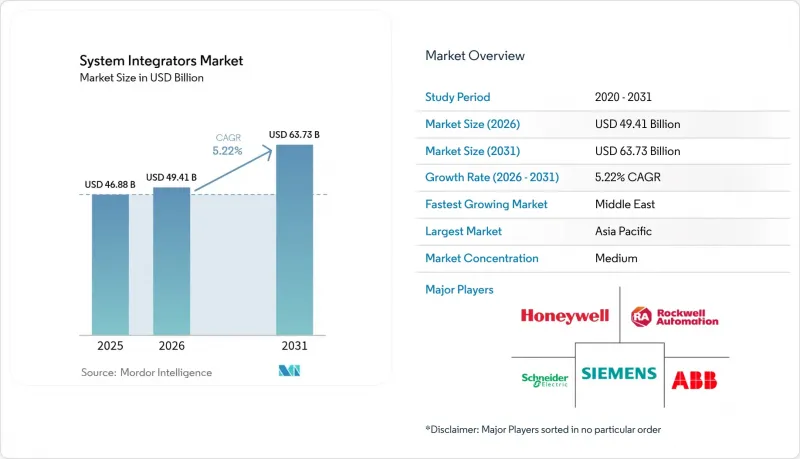
에 의하면, 시스템 통합사업자 시장 규모는 2025년에 468억 8,000만 달러로 평가되었고 2026년 494억 1,000만 달러에서 2031년까지 637억 3,000만 달러에 이를 것으로 추정되고 있어 예측 기간(2026-2031년) CAGR은 5.22%를 나타낼 전망입니다.
본 보고서는 서비스 유형별(하드웨어 통합, 기타), 기술별(통합 공정 제어, 제조 실행 시스템, 기타), 기업 규모별(대기업, 중소기업), 최종 사용자 산업별(석유 및 가스, 자동차·전기차 제조, 항공우주 및 방위, 기타), 지역별로 분류되어 있습니다. 시장 예측은 금액(달러) 기준으로 제시되어 있습니다.
세계 시스템 통합사업자 시장 동향 및 인사이트
턴키 방식의 OT-IT 융합 프로젝트에 대한 수요
기업들은 프로그래머블 로직 컨트롤러(PLC), 히스토리안, 제조 실행 시스템(MES), 전사적 자원 관리(ERP) 소프트웨어를 통합된 아키텍처로 통합할 수 있는 책임감 있는 단일 파트너를 찾고 있습니다. 2025년, 지멘스는 1,200건 이상의 이러한 프로젝트를 납품했으며, 그중 68%는 운영 개시 전에 사업자가 공정 변경을 시뮬레이션할 수 있는 클라우드 기반 디지털 트윈을 채택했습니다. Omron과 Accenture는 2027년까지 연간 매출 3억 달러를 목표로 하는 전략적 제휴를 체결했으며, 이는 하드웨어 벤더가 IT 통합업체와 제휴하여 전문 지식을 결집하고 있는 현실을 여실히 보여줍니다. ISA-95 데이터 모델 및 IEC 62443 보안 제어 준수를 통해 표준화된 인터페이스가 벤더 종속성을 완화함에 따라 도입이 가속화되고 있습니다. 시스템 통합사업자 시장이 발전함에 따라 턴키 방식이 표준 계약 모델로 자리 잡고 있으며, 자산 소유자는 프로젝트 완료에 따른 위험을 전문 업체에 전가할 수 있게 되었습니다. 참조 아키텍처와 인증 요건을 숙지한 통합업체는 가격 결정력을 높이고, 장기적이고 견고한 관계를 구축할 수 있습니다.
재생에너지 자산의 디지털화 가속화
풍력 발전소, 태양광 발전소, 배터리 저장 시설에서는 에너지 생산량을 극대화하고 구성 요소의 수명을 연장하기 위해 모니터링 및 제어 데이터 수집(SCADA)과 상태 모니터링 계층이 도입되고 있습니다. Naturgy는 2025년에 유럽의 전체 재생에너지 포트폴리오에 통합된 모니터링 및 제어 플랫폼을 구축한 후, 운영 및 유지보수 비용을 18% 절감했습니다. 국제에너지기구(IEA)는 2030년까지 전 세계 재생에너지 설비 용량의 연간 증가량이 500기가와트를 넘어설 것으로 예측하고 있으며, 이에 따라 시스템 통합사업자들은 터빈, 인버터, 계통 균형 조정 알고리즘에서 발생하는 데이터를 통합해야 할 필요성에 직면해 있습니다. 엣지 게이트웨이에서는 현재 계통 혼잡 시 자율적으로 출력을 억제하는 머신러닝 모델이 가동 중이며, 주파수를 안정화하면서 수익을 확보하고 있습니다. 따라서 시스템 통합사업자 시장의 비즈니스 기회는 전력 회사, OEM의 보증 요건, 규제 당국의 보고 요건을 충족하는 사이버 보안이 뛰어난 표준 규격 준수 솔루션을 제공할 수 있는지 여부에 달려 있습니다. 고가용성 및 계통 서비스 참여를 장려하는 지역 정책은 프로젝트 파이프라인을 더욱 확대하는 요인이 될 것입니다.
프로젝트의 범위 확대 위험이 높음
문서화되지 않은 레거시 자산, 프로젝트 후반에 발생하는 사이버 보안 요구 사항, 끊임없이 변화하는 규제 체크리스트로 인해 통합 범위가 확대되는 경우가 빈번합니다. 2025년 맥킨지 조사에 따르면, 자동화 프로젝트의 47%가 이러한 범위 확대로 인해 예산을 20% 이상 초과한 것으로 나타났습니다. 서비스 마진이 낮은 상황에서 사업을 전개하는 시스템 통합사업자에게 예산 초과가 수익성을 저해할 뿐만 아니라, 납기 지연으로 인해 고객의 신뢰를 잃게 될 수도 있습니다. 시스템 통합사업자 시장에 미치는 부정적인 영향을 완화하기 위해, 기업들은 현재 비용을 확정하기 전에 요구 사항을 명확히 하기 위해 레이저 스캔, 네트워크 토폴로지 매핑, 디지털 트윈 검증 등을 포함하는 유료 디스커버리 단계를 실시했습니다. 또한, 변경 지시에 대한 엄격한 관리를 수반하는 고정 가격 계약도 일반화되어, 변동 위험의 일부를 자산 소유자에게 전가하고 있습니다. 이러한 조치는 재무적 변동을 억제하지만, 양측이 세부적인 책임 분담에 대해 협상해야 하기 때문에 판매 주기가 장기화될 가능성이 있습니다.
부문 분석
하드웨어 통합은 2026년부터 2031년 사이에 연평균 성장률(CAGR) 5.27%를 나타낼 것으로 예측되며, 2025년에는 시스템 통합사업자 시장 매출의 40.83%를 차지하여, 1위를 차지했던 소프트웨어 및 디지털 통합의 우위를 뒤엎게 될 것입니다. 이러한 변화는 그린필드 재생에너지 발전소의 급증, 중동의 석유화학 플랜트 확장, 배터리 셀 기가팩토리 건설을 반영한 것입니다. 이 모든 것들은 소프트웨어 오버레이가 작동하기 전에 물리적 제어반, 현장 계측 기기, 배전반, 견고한 산업용 네트워크 백본을 필요로 합니다. 통합업체들은 공장 인수 시험을 마친 패널을 현장에서 배선된 상태로 출하함으로써 고객의 신뢰를 확보하고, 시운전 시간을 단축하며, 수정 작업을 최소화하고 있습니다. 컨설팅과 교육은 플랜트 현장의 인력이 부족하기 때문에 안정적인 수익원으로 계속 자리 잡고 있습니다. 따라서 각 통합업체는 기술 개발 모듈과 지속적인 사이버 보안 패치 적용을 가동 시간을 보장하는 관리형 서비스 계약에 포함시키고 있습니다. 애프터서비스 및 유지보수는 성과 기반 서비스 수준 계약(SLA)을 통해 보상이 가동 중단 시간 방지와 연동되므로 이익률이 높으며, 통합업체의 인센티브와 고객의 생산 목표 간에 일관성이 형성되고 있습니다.
모듈식 자동화로의 전환 또한 이 부문을 형성하고 있습니다. 에머슨의 웹상에서 구성 가능한 스키드 시스템은 12주 이내에 출하가 가능하며, 표준화가 속도를 얼마나 향상시키는지 보여주고 있습니다. 생명과학 부문의 고객은 일회용 바이오리액터의 신속한 전환을 중시하는 반면, 식음료 기업은 비수기 동안 가동을 중단해도 자본이 묶이지 않는 확장성이 뛰어난 스키드를 높이 평가합니다. 이러한 추세가 확산됨에 따라 시스템 통합 시장에서는 하드웨어 통합 팀이 소프트웨어 엔지니어와 더욱 긴밀히 협력하여 통합 패키지를 제공하게 될 것입니다. 이를 통해 물리적 설치부터 가상 시운전에 이르는 직선적인 워크플로가 더 짧은 중요 경로로 집약될 것이 보장됩니다. 공정 계장도에서 전기 회로도를 자동으로 생성하는 도구는 엔지니어링 공수를 더욱 단축시켜, 높은 수익률을 내는 최적화 서비스에 자원을 배분할 수 있게 해줍니다.
통합 공정 제어(프로그래머블 로직 컨트롤러, 분산 제어 시스템, 모니터링·제어·데이터 수집)는 2025년 시스템 통합사업자 시장의 36.71%를 차지했으나, 브라운필드 공장이 기존 하드웨어의 수명을 최대한 연장하려고 함에 따라 성숙기에 접어들고 있습니다. 대조적으로, 산업용 IoT(IIoT) 및 엣지 플랫폼은 이상 감지 및 품질 예측을 위한 1초 미만의 실시간 추론에 대한 이해관계자 수요에 힘입어 2031년까지 연평균 성장률(CAGR) 5.31%로 성장할 전망입니다. 엣지 노드는 지연을 줄이고 클라우드로의 데이터 전송 비용을 절감하는 동시에, 기밀성이 높은 텔레메트리 데이터의 국경 간 전송을 금지하는 데이터 주권 관련 규정에도 대응합니다. 제조 실행 시스템(MES)의 도입은 이산형 제조업, 특히 자동차 및 항공우주 산업에서 가속화되고 있습니다. 이러한 산업에서는 일련번호가 부여된 이력 관리와 ISO 규격 준수가 요구되므로, 모든 작업 지시에 대한 세심한 조정이 필요합니다. 로보틱스 및 머신 비전의 통합은 자동차 도장 공장에서 전자상거래(EC) 물류 창고로 확대되고 있으며, 자율 주행 로봇과 비전 유도형 피킹 시스템이 연중무휴 24시간 주문 처리(fulfillment)를 주도하고 있습니다.
IEC 62443의 의무화로 인해 사이버 보안 솔루션은 이제 필수 요건이 되었습니다. 요코가와 전기는 2025년 계약의 89%에 전용 보안 평가가 포함되어 있음을 밝혔습니다. 이는 2년 전의 34%에서 크게 증가한 수치로, 보안이 더 이상 추가 옵션이 아니라 표준 업무 범위의 요소가 되었음을 입증합니다. 기술의 폭이 넓어짐에 따라 시스템 통합 시장에서는 실시간 결정론적 제어, 쿠버네티스 기반 마이크로서비스, 제로 트러스트 네트워크 아키텍처를 이해하는 다분야에 걸친 팀이 요구되고 있습니다. 센서에서 클라우드에 이르는 데이터 경로를 위해, 사전에 검증된 암호화 및 ID 관리 기능을 갖춘 레퍼런스 설계를 제공하는 업체들은 도입을 가속화하고 인증 관련 장벽을 낮춤으로써 더 큰 시장 점유율을 확보하고 있습니다.
지역별 분석
2025년, 아시아태평양은 시스템 통합사업자 시장 매출의 33.53%를 차지했습니다. 이는 중국의 방대한 도입 기반, 인도의 생산 연계형 인센티브 프로그램, 회복탄력성을 추구하는 공급망의 다각화 거점으로서 동남아시아의 역할을 반영한 것입니다. 전자, 제약, 자동차 각 조립 라인에서 진행 중인 공장 업그레이드는 하드웨어 개조와 엣지 분석 도입을 결합한 프로젝트를 지속적으로 추진하고 있으며, 각국의 데이터 주권 관련 규제로 인해 국내 엔지니어링 자원에 대한 안정적인 수요가 발생하고 있습니다. 현지 파트너십을 구축하고 중국어(만다린) 및 힌디어를 구사하는 프로젝트 매니저를 보유한 시스템 통합사업자는 시운전 주기를 지속적으로 단축하고 있으며, 문서화된 기술 이전을 요구하는 지방 규제 당국으로부터 신뢰를 쌓아가고 있습니다. 한국, 일본, 싱가포르에서 5G 프라이빗 네트워크의 구축이 가속화됨에 따라 초저지연 제어 루프에 대한 수요가 증가하여, 이산형 제조 및 물류 부문의 시스템 통합사업자 시장 규모가 확대되고 있습니다.
북미는 여전히 주요 시장으로 남아 있습니다. 이는 리쇼어링 노력이 IEC 62443 및 NIST 프레임워크에 따른 종단간 사이버 보안 준수를 필요로 하는 전기차 배터리 기가팩토리 및 반도체 팹 건설을 촉진하고 있기 때문입니다. 석유, 가스, 화학 산업의 브라운필드 현대화도 노후화된 제어 네트워크가 소프트웨어 정의 아키텍처로 전환됨에 따라 추가적인 비즈니스 기회를 창출하고 있습니다. 에너지 효율이 높은 생산을 장려하는 연방 정부의 세제 혜택 또한 예측 유지보수를 위한 개보수 공사 자금 조달을 가능하게 하여, 통합업체들이 엣지 게이트웨이, 히스토리안 업그레이드, 디지털 트윈을 단일 프로젝트 범위에 통합하도록 촉진하고 있습니다. 2026년 자본 예산은 여전히 신중한 태도가 유지되고 있지만, 다년간의 마스터 서비스 계약을 통해 시스템 통합사업자는 수익 전망을 확보하고, 메가 프로젝트의 시작 간격에도 전문 인력을 지속적으로 확보할 수 있게 되었습니다. 이러한 동향으로 인해 상품 가격이 크게 변동하더라도 시스템 통합사업자 시장 전망은 안정적입니다.
중동은 가장 빠르게 성장하는 지역으로, 2031년 연평균 성장률(CAGR)은 5.24%로 예측됩니다. 이는 사우디아라비아 공공투자기금(PIF)의 NEOM 스마트 시티 인프라에 대한 자금 배분과 아랍에미리트의 ‘오퍼레이션 3,000억’ 제조 프로그램이 뒷받침하고 있습니다. 현지 조달 비율에 관한 정부의 의무화 조치로 인해, 시스템 통합사업자는 대부분의 경우 국내 유력 기업과의 합작 투자를 통해 리야드, 아부다비, 무스카트에 엔지니어링 센터를 설립해야 합니다. 주바이르와 루와이스에 위치한 그린필드 석유화학 단지에 더해, 유틸리티 규모의 태양광 발전소 및 수소 플랜트에는 통합 제어실, 안전 계장 시스템, 실시간 자산 성과 대시보드가 필요하며, 이로 인해 시스템 통합사업자 시장의 사업 범위는 공정 및 전력 두 부문으로 확대되고 있습니다. 유럽에서는 탄소 국경 조정 메커니즘에 따라, 특히 독일, 프랑스, 북유럽 국가에서 제조업체들이 에너지 가시화를 위해 디지털화를 추진하고 있어, 견조하기는 하지만 성장 속도는 둔화되는 추세입니다. 남미와 아프리카는 규모는 작지만 전략적으로 중요한 시장이며, 브라질, 나이지리아, 남아프리카공화국에서는 광업 및 식품 가공 프로젝트가 모듈식 자동화 스키드와 원격 모니터링 패키지를 통해 인프라 부족을 보완할 수 있는 시스템 통합사업자에 집중되고 있습니다.
기타 혜택
- 엑셀 형식 시장 예측(ME) 시트
- 3개월간의 애널리스트 지원
자주 묻는 질문
목차
제1장 서론
제2장 조사 방법
제3장 주요 요약
제4장 시장 구도
제5장 시장 규모와 성장 예측
제6장 경쟁 구도
제7장 시장 기회와 향후 전망
JHS 26.09.11According to Mordor Intelligence, the system integrators market size was valued at USD 46.88 billion in 2025 and estimated to grow from USD 49.41 billion in 2026 to reach USD 63.73 billion by 2031, at a CAGR of 5.22% during the forecast period (2026-2031).
This report is Segmented by Service Type (Hardware Integration, and More), Technology (Integrated Process Control, Manufacturing Execution Systems, and More), Enterprise Size (Large Enterprises and Small and Medium Enterprises), End-User Industry (Oil and Gas, Automotive and EV Manufacturing, Aerospace and Defense, and More), and Geography. The Market Forecasts are Provided in Terms of Value (USD).
Global System Integrators Market Trends and Insights
Demand for Turn-Key OT-IT Convergence Projects
Enterprises want one accountable partner who can stitch programmable logic controllers, historians, manufacturing execution systems, and enterprise resource planning software into a unified architecture. In 2025, Siemens delivered more than 1,200 such projects, and 68% featured cloud-based digital twins that let operators simulate process changes before go-live. OMRON and Accenture formed a strategic alliance targeting USD 300 million in annual revenue by 2027, underscoring how hardware vendors are teaming up with IT integrators to pool expertise. Conformance with ISA-95 data models and IEC 62443 security controls is accelerating uptake because standardized interfaces reduce vendor lock-in. As the system integrators market evolves, turn-key scope is becoming the default contracting model, allowing asset owners to shift project-completion risk to specialists. Those integrators that master reference architectures and certification requirements gain pricing power and stickier multiyear relationships.
Acceleration of Renewable-Energy Asset Digitalization
Wind-turbine farms, solar parks, and battery-storage facilities are installing supervisory control and data acquisition and condition-monitoring layers to maximize energy yield and extend component life. Naturgy cut operations and maintenance costs by 18% after rolling out a unified supervisory control platform across its European renewable portfolio in 2025. The International Energy Agency expects annual global renewable-capacity additions to exceed 500 gigawatts through 2030, forcing integrators to harmonize data from turbines, inverters, and grid-balancing algorithms. Edge gateways now host machine-learning models that autonomously curtail output during grid-congestion events, preserving revenue while stabilizing frequency. The opportunity for the system integrators market therefore hinges on offering cyber-secure, standards-based solutions that satisfy utilities, OEM warranties, and regulatory reporting. Regional policies that reward high availability and grid services participation further amplify project pipelines.
High Project Scope-Creep Risk
Undocumented legacy assets, late-stage cybersecurity demands, and evolving regulatory checklists frequently inflate integration scope. A 2025 McKinsey survey found 47% of automation projects blew budgets by more than 20% because of such creep. Overshoot hits profitability for integrators who operate on thin service margins and strains client trust when deadlines slip. To blunt the drag on the system integrators market, firms now run paid discovery phases that include laser scanning, network-topology mapping, and digital-twin validation to lock requirements before cost commitments. Fixed-price contracts with strict change-order governance are also commonplace, shifting some variance risk back to asset owners. While these measures temper financial volatility, they can prolong sales cycles as both sides negotiate granular responsibilities.
Other drivers and restraints analyzed in the detailed report include:
- 5G-Enabled Edge Computing Use-Cases
- Regulatory Push for Cyber-Secure SCADA Retrofits
- Procurement Delays in Capital Goods
For complete list of drivers and restraints, kindly check the Table Of Contents.
Segment Analysis
Hardware Integration is projected to post a 5.27% CAGR between 2026 and 2031, reversing the 2025 leadership of Software and Digital Integration that held a 40.83% revenue slice of the system integrators market. The swing reflects a surge of greenfield renewable-energy plants, petrochemical expansions in the Middle East, and battery-cell gigafactories, all of which demand physical control cabinets, field instrumentation, power-distribution boards, and hardened industrial-networking backbones before any software overlay can function. Integrators secure loyalty by shipping factory-acceptance-tested panels that arrive on-site pre-wired, cutting commissioning time and minimizing rework. Consulting and Training remains a steady earner because plant-floor talent is scarce; integrators therefore bundle skills-development modules and ongoing cybersecurity patching into managed-service contracts that guarantee uptime. After-Sales Support and Maintenance is margin rich because performance-based service-level agreements tie compensation to avoided downtime, creating alignment between integrator incentives and customer production goals.
A shift toward modular automation also shapes this segment. Emerson's web-configurable skid systems, able to ship within 12 weeks, illustrate how standardization boosts velocity. Life-sciences clients value rapid changeovers for single-use bioreactors, while food-and-beverage firms appreciate scalable skids that can idle during off-seasons without stranding capital. As these patterns propagate, the system integrators market will see Hardware Integration teams collaborate more with software engineers to deliver converged packages, ensuring the linear workflow from physical installation to virtual commissioning collapses into a shorter critical path. Tools that auto-generate electrical schematics from process-and-instrumentation diagrams further compress engineering hours, freeing resources for higher-margin optimization services.
Integrated Process Control-programmable logic controllers, distributed control systems, and supervisory control and data acquisition-accounted for 36.71% of the system integrators market share in 2025 but is approaching maturity as brownfield factories squeeze extra life from existing hardware. In contrast, Industrial Internet of Things and Edge Platforms will expand at a 5.31% CAGR through 2031, driven by stakeholders' demand for sub-second, real-time inference for anomaly detection and quality prediction. Edge nodes reduce latency, lower cloud egress costs, and address data-sovereignty rules that forbid sensitive telemetry from crossing borders. Manufacturing Execution Systems adoption is building momentum in discrete industries, especially automotive and aerospace, where serialized genealogy and compliance with ISO standards require granular orchestration of every work order. Robotics and Machine Vision integration is spilling out of automotive paint shops into ecommerce warehouses, where autonomous mobile robots and vision-guided picking systems drive 24/7 fulfillment.
Cyber-Security Solutions are now table stakes thanks to IEC 62443 mandates. Yokogawa revealed that 89% of its 2025 contracts bundled dedicated security assessments, up from 34% two years earlier, confirming that security is no longer an add-on but a default work-scope element. As technology breadth widens, the system integrators market needs multidisciplinary teams that understand real-time deterministic control, Kubernetes-based microservices, and zero-trust network architectures. Providers that create reference designs for sensor-to-cloud data paths, complete with pre-validated encryption and identity management, accelerate deployment and reduce certification friction, thereby snagging larger wallet share.
Complete Report Scope:
- By Service Type
- Hardware Integration
- Software and Digital Integration
- Consulting and Training
- After-Sales Support and Maintenance
- By Technology
- Integrated Process Control (PLC, DCS, SCADA)
- Manufacturing Execution Systems (MES)
- Robotics and Machine Vision
- IIoT and Edge Platforms
- Cyber-Security Solutions
- By Enterprise Size
- Large Enterprises
- Small and Medium Enterprises (SMEs)
- By End-User Industry
- Oil and Gas
- Automotive and EV Manufacturing
- Aerospace and Defense
- Healthcare and Life Sciences
- Energy and Power
- Chemicals and Petrochemicals
- Food and Beverage
- Other End-User Industries
- By Geography
- North America
- United States
- Canada
- Mexico
- South America
- Brazil
- Argentina
- Rest of South America
- Europe
- Germany
- United Kingdom
- France
- Italy
- Spain
- Rest of Europe
- Asia-Pacific
- China
- Japan
- India
- South Korea
- ASEAN
- Rest of Asia-Pacific
- Middle East
- Saudi Arabia
- United Arab Emirates
- Rest of Middle East
- Africa
- South Africa
- Nigeria
- Egypt
- Rest of Africa
- North America
Geography Analysis
Asia-Pacific accounted for 33.53% of the system integrators market's revenue in 2025, reflecting China's vast installed base, India's production-linked incentive programs, and Southeast Asia's role as a diversification hub for supply chains seeking resilience. Ongoing factory upgrades across electronics, pharmaceuticals, and automotive assembly lines continue to drive projects that blend hardware retrofits with edge analytics deployments, and national data-sovereignty rules create steady demand for in-country engineering resources. Integrators that cultivate local partnerships and Mandarin- or Hindi-speaking project managers consistently shorten commissioning cycles, building credibility with provincial regulators who require documented technology transfer. As 5G private-network rollouts accelerate in South Korea, Japan, and Singapore, demand for ultra-low-latency control loops is widening the addressable system integrators market across discrete manufacturing and logistics.
North America remains a heavyweight because reshoring initiatives are driving the construction of electric-vehicle battery gigafactories and semiconductor fabs that require end-to-end cybersecurity compliance under IEC 62443 and NIST frameworks. Brownfield modernizations in oil, gas, and chemicals add another tranche of work as aging control networks migrate toward software-defined architectures. Federal tax incentives that reward energy-efficient production have also unlocked funding for predictive-maintenance retrofits, prompting integrators to bundle edge gateways, historian upgrades, and digital twins in a single scope. Although capital budgets in 2026 stay cautious, multiyear master-service agreements give integrators revenue visibility, helping them keep specialized talent on the bench between megaproject releases. This dynamic underpins a stable outlook for the system integrators market even if commodity prices swing widely.
The Middle East is the fastest-growing region, with a projected 5.24% CAGR through 2031, fueled by Saudi Arabia's Public Investment Fund allocations to NEOM's smart-city infrastructure and the United Arab Emirates' Operation 300bn manufacturing program. Sovereign mandates for local-content ratios oblige integrators to establish engineering centers in Riyadh, Abu Dhabi, and Muscat, often through joint ventures with national champions. Greenfield petrochemical complexes in Jubail and Ruwais, plus utility-scale solar and hydrogen plants, require integrated control rooms, safety-instrumented systems, and real-time asset-performance dashboards, expanding the system integrators market footprint across both process and power verticals. Europe shows steady but lower-trajectory growth as carbon-border adjustment rules push manufacturers to digitize for energy visibility, especially in Germany, France, and the Nordics. South America and Africa stay smaller but strategic, as Brazil, Nigeria, and South Africa channel mining and food-processing projects toward integrators who can offset infrastructure gaps with modular automation skids and remote-monitoring packages.
- ABB Ltd.
- Siemens AG
- Rockwell Automation, Inc.
- Schneider Electric SE
- Honeywell International Inc.
- Emerson Electric Co.
- Yokogawa Electric Corporation
- John Wood Group PLC
- TESCO CONTROLS, Inc.
- STADLER + SCHAAF Mess- und Regeltechnik GmbH
- Prime Controls, LP
- MAVERICK Technologies, LLC
- Adsyst Automation Ltd.
- George T. Hall Company
- Avanceon Ltd.
- Wunderlich-Malec Engineering, Inc.
- Burrow Global, LLC
- ATS Corporation
- HCLTech (Industrial and Digital SI Practice)
- Accenture plc (Industry X)
- Fetch Robotics Inc. (Zebra Technologies)
- Korber Supply Chain GmbH
- Cimcorp Oy
- Manhattan Associates Inc.
- Swisslog Holding AG
- Siemens Logistics GmbH
- Bastian Solutions LLC
- Fives Group
- Hai Robotics Co., Ltd.
Additional Benefits:
- The market estimate (ME) sheet in Excel format
- 3 months of analyst support
TABLE OF CONTENTS
1 INTRODUCTION
- 1.1 Study Assumptions and Market Definition
- 1.2 Scope of the Study
2 RESEARCH METHODOLOGY
3 EXECUTIVE SUMMARY
4 MARKET LANDSCAPE
- 4.1 Market Overview
- 4.2 Market Drivers
- 4.2.1 Demand for Turn-Key OT-IT Convergence Projects
- 4.2.2 Acceleration of Renewable-Energy Asset Digitalization
- 4.2.3 5G-Enabled Edge Computing Use-Cases
- 4.2.4 Regulatory Push for Cyber-Secure SCADA Retrofits
- 4.2.5 Rising Adoption of Modular Automation
- 4.2.6 Shortage of Plant-Floor Automation Talent
- 4.3 Market Restraints
- 4.3.1 High Project Scope-Creep Risk
- 4.3.2 Procurement Delays in Capital Goods
- 4.3.3 Fragmented Vendor Ecosystem
- 4.3.4 Critical Liability Exposure in Safety-Critical Plants
- 4.4 Value Chain Analysis
- 4.5 Regulatory Landscape
- 4.6 Impact of Macroeconomic Factors on the Market
- 4.7 Porter's Five Forces Analysis
- 4.7.1 Bargaining Power of Suppliers
- 4.7.2 Bargaining Power of Buyers
- 4.7.3 Threat of New Entrants
- 4.7.4 Threat of Substitutes
- 4.7.5 Competitive Rivalry
5 MARKET SIZE AND GROWTH FORECASTS (VALUE)
- 5.1 By Service Type
- 5.1.1 Hardware Integration
- 5.1.2 Software and Digital Integration
- 5.1.3 Consulting and Training
- 5.1.4 After-Sales Support and Maintenance
- 5.2 By Technology
- 5.2.1 Integrated Process Control (PLC, DCS, SCADA)
- 5.2.2 Manufacturing Execution Systems (MES)
- 5.2.3 Robotics and Machine Vision
- 5.2.4 IIoT and Edge Platforms
- 5.2.5 Cyber-Security Solutions
- 5.3 By Enterprise Size
- 5.3.1 Large Enterprises
- 5.3.2 Small and Medium Enterprises (SMEs)
- 5.4 By End-User Industry
- 5.4.1 Oil and Gas
- 5.4.2 Automotive and EV Manufacturing
- 5.4.3 Aerospace and Defense
- 5.4.4 Healthcare and Life Sciences
- 5.4.5 Energy and Power
- 5.4.6 Chemicals and Petrochemicals
- 5.4.7 Food and Beverage
- 5.4.8 Other End-User Industries
- 5.5 By Geography
- 5.5.1 North America
- 5.5.1.1 United States
- 5.5.1.2 Canada
- 5.5.1.3 Mexico
- 5.5.2 South America
- 5.5.2.1 Brazil
- 5.5.2.2 Argentina
- 5.5.2.3 Rest of South America
- 5.5.3 Europe
- 5.5.3.1 Germany
- 5.5.3.2 United Kingdom
- 5.5.3.3 France
- 5.5.3.4 Italy
- 5.5.3.5 Spain
- 5.5.3.6 Rest of Europe
- 5.5.4 Asia-Pacific
- 5.5.4.1 China
- 5.5.4.2 Japan
- 5.5.4.3 India
- 5.5.4.4 South Korea
- 5.5.4.5 ASEAN
- 5.5.4.6 Rest of Asia-Pacific
- 5.5.5 Middle East
- 5.5.5.1 Saudi Arabia
- 5.5.5.2 United Arab Emirates
- 5.5.5.3 Rest of Middle East
- 5.5.6 Africa
- 5.5.6.1 South Africa
- 5.5.6.2 Nigeria
- 5.5.6.3 Egypt
- 5.5.6.4 Rest of Africa
- 5.5.1 North America
6 COMPETITIVE LANDSCAPE
- 6.1 Market Concentration
- 6.2 Strategic Moves
- 6.3 Market Share Analysis
- 6.4 Company Profiles (includes Global Level Overview, Market Level Overview, Core Segments, Financials as available, Strategic Information, Market Rank/Share, Products and Services, Recent Developments)
- 6.4.1 ABB Ltd.
- 6.4.2 Siemens AG
- 6.4.3 Rockwell Automation, Inc.
- 6.4.4 Schneider Electric SE
- 6.4.5 Honeywell International Inc.
- 6.4.6 Emerson Electric Co.
- 6.4.7 Yokogawa Electric Corporation
- 6.4.8 John Wood Group PLC
- 6.4.9 TESCO CONTROLS, Inc.
- 6.4.10 STADLER + SCHAAF Mess- und Regeltechnik GmbH
- 6.4.11 Prime Controls, LP
- 6.4.12 MAVERICK Technologies, LLC
- 6.4.13 Adsyst Automation Ltd.
- 6.4.14 George T. Hall Company
- 6.4.15 Avanceon Ltd.
- 6.4.16 Wunderlich-Malec Engineering, Inc.
- 6.4.17 Burrow Global, LLC
- 6.4.18 ATS Corporation
- 6.4.19 HCLTech (Industrial and Digital SI Practice)
- 6.4.20 Accenture plc (Industry X)
- 6.4.21 Fetch Robotics Inc. (Zebra Technologies)
- 6.4.22 Korber Supply Chain GmbH
- 6.4.23 Cimcorp Oy
- 6.4.24 Manhattan Associates Inc.
- 6.4.25 Swisslog Holding AG
- 6.4.26 Siemens Logistics GmbH
- 6.4.27 Bastian Solutions LLC
- 6.4.28 Fives Group
- 6.4.29 Hai Robotics Co., Ltd.
7 MARKET OPPORTUNITIES and FUTURE OUTLOOK
- 7.1 White-Space and Unmet-Need Assessment


