|
시장보고서
상품코드
2119348
인버터 배터리 : 시장 점유율 분석, 업계 동향 및 통계, 성장 예측(2026-2031년)Inverter Battery - Market Share Analysis, Industry Trends & Statistics, Growth Forecasts (2026 - 2031) |
||||||
 Mordor Intelligence
Mordor Intelligence에 의하면, 인버터 배터리 시장 규모는 2025년 55억 9,000만 달러로 평가되었습니다. 2026년에는 60억 2,000만 달러로 확대되어 2026년부터 2031년에 걸쳐 CAGR 6.84%로 성장을 지속하여, 2031년에는 83억 8,000만 달러에 이를 것으로 예측됩니다.
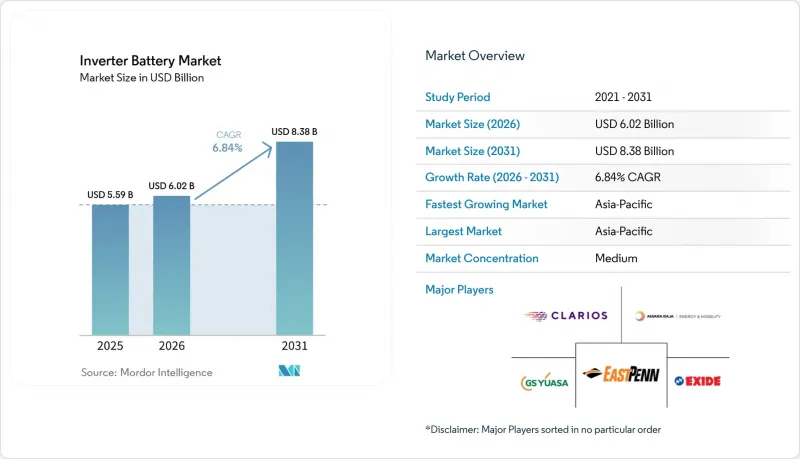
본 보고서는 배터리의 화학적 구성(리튬 이온, 납산, 나트륨 이온, 플로우, 기타), 인버터의 유형(독립형, 태양광 발전용, 하이브리드, UPS),용도(주거용, 상업용, 산업용, 통신용, 재생에너지 저장용, 기타), 지역(북미, 유럽, 아시아태평양, 남미, 중동 및 아프리카)별로 분류되어 있습니다. 시장 예측은 금액(달러) 기준으로 제시되어 있습니다.
세계의 인버터 배터리 시장 동향 및 인사이트
정전 증가와 전력망 신뢰성에 대한 수요
인구가 많고 급속한 도시화가 진행 중인 경제권에서 전력 품질의 격차로 인해 인버터 배터리는 가정에서 필수적인 구매 품목이 되었습니다. 본 조사에서 언급된 상황에 따르면, 남아시아 및 사하라 이남 아프리카에서는 가구당 연간 100시간 이상의 정전이 발생하고 있습니다. 따라서 조명, 가전제품, 통신 및 소규모 사업 활동을 위해 안정적인 전력 공급이 필요한 가구가 있는 지역에서는 인버터 배터리 시장이 혜택을 보고 있습니다. 농촌 지역의 전기화가 진행되더라도 전력망에 새로 연결된 가구조차 여전히 불안정한 전력 공급에 직면할 가능성이 있으므로, 이러한 수요가 반드시 감소하는 것은 아닙니다. 이러한 가정은 백업 장비를 구매하지 않는 고객이라기보다는 오히려 처음으로 백업 장비를 구매하는 고객이 될 가능성이 높습니다. 가계 예산이 빠듯한 상황에서 구매자가 제품을 비교할 때, 유통망, 서비스 제공 범위 및 명확한 백업 가동 시간에 대한 정보는 여전히 중요한 요소로 작용합니다.
재생에너지와 옥상 태양광 발전의 통합
지붕 태양광 발전은 수요를 단순한 정전 대책에서 태양광 발전에 의한 자가 소비 및 에너지 저장 활용으로 변화시키고 있습니다. 인도에서는 ‘PM Surya Ghar Muft Bijli Yojana’ 프로그램에 따라 2025년 상반기에 약 4.9 GW 규모의 주택용 지붕 태양광 발전 설비가 도입되었습니다. 이 프로그램에는 2026년 5월까지 690만 가구로부터 신청이 접수되었습니다. 태양광 패널에 중점을 둔 보조금은 가정이 하이브리드 인버터에 대응하는 시스템을 도입한 경우, 이후의 축전 시스템 구매를 여전히 촉진할 수 있습니다. 이를 통해 인버터 및 배터리 시장공급업체에게는 특히 고객이 계통 연계형 태양광 발전만으로는 백업 전원으로 부족하다는 사실을 깨달았을 때, 추가적인 비즈니스 기회가 창출됩니다. 또한, 태양광 발전, 배터리, 계통을 통합한 시스템은 제품 선정 과정을 시공업체나 시스템 통합사업자 주도로 전환시키고 있습니다.
높은 초기 시스템 비용과 설치 비용
셀 가격이 하락하고 있음에도 불구하고, 가격에 민감한 주택 시장에서는 시스템 비용이 여전히 장벽으로 작용하고 있습니다. 배터리 모듈, 인버터의 전자 부품, 설치 공사비, 시운전 비용 모두가 최종 가격에 영향을 미칩니다. 인도에서는 1단계에서 합리적인 가격에 대한 우려로 인해 에너지 저장 시스템이 제외되었기 때문에 2026년에 ‘PM Surya Ghar’ 프로그램의 다음 단계에 에너지 저장 시스템을 포함하는 방안을 검토했습니다. 자격을 갖춘 설치 업체의 수가 제한적이기 때문에 급성장하는 지역에서는 인건비가 높은 수준을 유지할 가능성이 있습니다. 또한, 배터리 교체 주기에 대응한 금융 상품은 장기 태양광 발전 대출에 비해 아직 충분히 정비되지 않았습니다. 이러한 과제로 인해, 신뢰성 높은 비상 전원의 가치가 명확한 경우에도 저소득 가구의 도입이 제한되고 있습니다.
부문별 분석
2025년, 리튬 이온 배터리는 인버터 배터리 시장 점유율의 76.5%를 차지했으며, LFP가 리튬 이온 배터리 중 주요 유형이 되었습니다. 2025년에는 전 세계 고정형 축전지 도입의 90% 이상을 LFP가 차지했습니다. 이 화학 조성은 저비용, 긴 사이클 수명, 그리고 확대되는 공급 기반이라는 장점을 모두 갖추고 있습니다. 납축전지는 초기 가격이 가장 중요시되는 주택 시장에서 여전히 중요한 위치를 차지하고 있습니다. 또한, 공급 관계나 박판 순납 제품에 대한 익숙함이 조달에 영향을 미치는 북미의 데이터센터에서도 그 역할을 유지하고 있습니다. 그러나 구매자들이 수명 주기 비용을 평가함에 따라 상업 및 산업용 설비에서 납축전지 제품의 점유율은 감소하는 추세에 있습니다.
나트륨 이온 배터리는 가장 빠르게 성장하는 배터리 기술로, 2031년까지 연평균 성장률(CAGR)이 8.1%를 나타낼 것으로 예측됩니다. CATL은 2026년 4월, 베이징 HyperStrong Technology사와 60 GWh 규모의 3년간 나트륨 이온 배터리 공급 계약을 체결하여, 이 기술을 시범 단계에서 계약에 기반한 고정형 에너지 저장 시스템 도입으로 전환했습니다. 흐름형 배터리 및 기타 화학계 배터리는 저장 시간이 4시간을 초과하는 상황에서는 비교적 제한적인 역할만 수행하고 있습니다. 나트륨 이온 기술은 리튬을 사용하지 않기 때문에 리튬 공급 위험에 대한 노출을 줄일 수 있습니다. EU의 배터리 규정(2023/1542)에 따르면, 2031년 이후 새로 제조되는 배터리에 대해 재활용 소재의 최소 함유율을 의무화해야 합니다. 이 규제로 인해 추적 가능한 밸류체인의 가치가 높아지겠지만, 나트륨 이온 배터리 생산은 LFP(인산철리튬) 배터리 생산에 비해 아직 성숙도가 낮은 상황입니다.
지역별 분석
아시아태평양은 2025년 인버터 배터리 시장 점유율의 48.4%를 차지했으며, 2031년까지 연평균 성장률(CAGR) 8.5%를 나타낼 것으로 예측됩니다. 인도에서는 가정 내 지속적인 전력 공급의 신뢰성에 대한 수요와 지붕형 태양광 발전의 보급 확대가 맞물려 수요가 증가하고 있습니다. ‘PM Surya Ghar’ 프로그램에는 2026년 5월까지 690만 가구로부터 신청이 접수되었습니다. 중국은 태양광 발전과 배터리의 통합 생태계를 통해 국내 수요를 뒷받침하는 동시에, 동남아시아, 아프리카 및 남미 일부 지역으로의 수출 거점 역할도 수행하고 있습니다. 베트남, 인도네시아, 태국에서는 도시 지역의 전기화 및 5G 네트워크 확장에 따라 상업 및 산업용 UPS 수요가 증가하고 있습니다. 또한, 인도가 계획 중인 그리드 규모 고정형 배터리 저장 장치용 10GWh 입찰은 Exide Energy Solutions 및 Amara Raja Advanced Cell Technologies와 같은 기업들의 현지 셀 제조에 대한 관심을 촉진하고 있습니다.
북미와 유럽은 데이터센터용 UPS에 대한 지출과 주택용 태양광 발전·전력 저장 시스템 도입을 중심으로 다음 큰 수요 클러스터를 형성하고 있습니다. 2025년, 북미의 고정형 납축전지 매출액은 13% 증가했으며, 데이터센터용 UPS 수요는 21% 성장했습니다. 유럽에서는 2025년에 27.1 GWh의 신규 배터리가 도입되어 총 도입 용량이 100 GWh를 넘어섰습니다. 독일, 영국, 이탈리아가 유럽의 신규 도입량의 47%를 차지했습니다. 정책 체계와 ‘넷 제로 산업법’이 향후 도입을 뒷받침하는 한편, 인허가 절차와 규격의 불일치가 여전히 제약 요인으로 작용하고 있습니다. 또한, EU의 배터리 규제에서는 원자재의 추적 가능성과 국내 생산이 확보된 밸류체인에 대해 조달상의 우대 조치가 마련되어 있습니다.
남미, 중동 및 아프리카는 인버터가 장착된 축전지 시장에서 규모는 작지만 독자적인 시장을 형성하고 있습니다. 칠레와 브라질에서는 유틸리티 규모의 재생에너지 및 에너지 저장 시스템 조달이 추진되고 있습니다. BYD는 2026년 5월, 칠레의 Grenergy사가 진행하는 ‘오아시스 데 아타카마’ 프로젝트를 위해 3.5GWh 규모의 에너지 저장 시스템을 공급하기로 합의했습니다. 사우디아라비아의 인프라 구축 계획과 남아프리카공화국의 전력 제한 조치로 인해, 에너지 저장 시스템은 핵심 전력 인프라로서 점점 더 중요한 위치를 차지하고 있습니다. 나이지리아의 Off-grid용 배터리 인버터 용량은 2025년에 1.2 GW에 달했으며, 조사 보고서에 따르면 해당 부문의 60%를 하이브리드 인버터가 차지했습니다. 사우디아라비아의 대규모 중앙집중형 프로젝트는 대형 포맷 공급업체에 유리하게 작용하는 반면, 아프리카의 분산형 수요는 계속해서 현지 판매 및 서비스 네트워크에 의존하고 있습니다.
기타 혜택 :
- 엑셀 형식 시장 예측(ME) 시트
- 3개월간의 애널리스트 지원
자주 묻는 질문
목차
제1장 서론
제2장 조사 방법
제3장 개요
제4장 시장 구도
제5장 시장 규모 및 성장 예측
제6장 경쟁 구도
제7장 시장 기회 및 향후 전망
KTH 26.09.02According to Mordor Intelligence, the inverter battery market size is expected to grow from USD 5.59 billion in 2025 to USD 6.02 billion in 2026 and is forecast to reach USD 8.38 billion by 2031 at 6.84% CAGR over 2026-2031.
This report is Segmented by Battery Chemistry (Lithium-Ion, Lead-Acid, Sodium-Ion, Flow, Other), Inverter Type (Standalone, Solar, Hybrid, UPS), Application (Residential, Commercial, Industrial, Telecom, Renewable Energy Storage, Other), and Geography (North America, Europe, Asia-Pacific, South America, Middle East and Africa). The Market Forecasts are Provided in Terms of Value (USD).
Global Inverter Battery Market Trends and Insights
Rising Power Outages and Grid Reliability Needs
Grid-quality gaps in populous and rapidly urbanizing economies are making inverter batteries an essential household purchase. South Asia and Sub-Saharan Africa experience more than 100 hours of annual power disruptions per household in the conditions described in the supplied research. The inverter battery market therefore benefits where households need a dependable supply for lighting, appliances, communications, and small business activity. Rural electrification does not necessarily reduce this need because newly connected homes can still face unstable service. These households can become first-time buyers of backup equipment rather than customers leaving the backup category. Distribution, service coverage, and clear backup-hour information remain important where buyers compare products under tight household budgets.
Renewable Energy and Rooftop Solar Integration
Rooftop solar is changing demand from simple outage protection to solar self-consumption and stored energy use. India deployed nearly 4.9 GW of residential rooftop solar capacity in the first half of 2025 under the PM Surya Ghar Muft Bijli Yojana. The program had received 6.9 million household applications by May 2026. Subsidies focused on solar panels can still support later storage purchases when homes use systems that are ready for hybrid inverters. This creates a follow-on opportunity for suppliers in the inverter battery market, especially when customers find that grid-connected solar alone does not provide backup power. Integrated solar, battery, and grid systems also shift product selection toward installers and system integrators.
High Upfront System and Installation Costs
System costs remain a barrier in price-sensitive residential settings despite lower cell prices. Battery modules, inverter electronics, installation labor, and commissioning all contribute to the final price. India considered including battery storage in the next stage of the PM Surya Ghar program during 2026 because storage had been excluded from the first phase over affordability concerns. A limited pool of qualified installers can keep labor costs high in fast-growing locations. Financing products are also less developed for battery replacement cycles than for long-term solar loans. These issues restrict participation by lower-income households even where reliable backup power has clear value.
Other drivers and restraints analyzed in the detailed report include:
- Data Center and Telecommunications Uptime Requirements
- Lithium-Ion Cost and Cycle-Life Improvements
- Raw Material Price Volatility and Supply-Chain Disruption
For complete list of drivers and restraints, kindly check the Table Of Contents.
Segment Analysis
Lithium-ion batteries held 76.5% of the inverter battery market share in 2025, and LFP was the leading lithium-ion variant. LFP represented more than 90% of stationary battery storage deployments globally in 2025. This chemistry offers a combination of lower cost, long cycle life, and a growing supply base. Lead-acid batteries remain important in residential markets where the initial price carries the greatest weight. They also retain a role in North American data centers where supply relationships and familiarity with thin-plate pure-lead products influence procurement. However, lead-acid products are losing ground in commercial and industrial installations as buyers assess lifetime costs.
Sodium-ion batteries are the fastest-growing chemistry, with an 8.1% forecast CAGR through 2031. CATL signed a 60 GWh, 3-year sodium-ion supply agreement with Beijing HyperStrong Technology in April 2026, moving the technology from pilot activity toward contracted stationary storage deployment. Flow batteries and other chemistries serve a smaller role where storage duration exceeds 4 hours. Sodium-ion technology does not use lithium, which can reduce exposure to lithium supply risks. The EU Batteries Regulation 2023/1542 will require minimum recycled-content quotas for newly manufactured batteries from 2031. That rule adds value to traceable supply chains, although sodium-ion production remains less mature than LFP production.
Complete Report Scope:
- By Battery Chemistry
- Lithium-ion Batteries
- Lead-acid Batteries
- Sodium-ion Batteries
- Flow Batteries
- Other Battery Chemistries
- By Inverter Type
- Standalone Inverters
- Solar Inverters
- Hybrid Inverters
- UPS Inverters
- By Application
- Residential Power Backup
- Commercial
- Industrial
- Telecommunications
- Renewable Energy Storage
- Other Applications
- By Geography
- North America
- United States
- Canada
- Mexico
- Europe
- Germany
- France
- Italy
- Spain
- United Kingdom
- Poland
- Russia
- Rest of Europe
- Asia-Pacific
- China
- India
- Japan
- South Korea
- Australia
- Indonesia
- Vietnam
- Thailand
- Rest of Asia-Pacific
- South America
- Brazil
- Argentina
- Chile
- Rest of South America
- Middle East and Africa
- Saudi Arabia
- United Arab Emirates
- Egypt
- South Africa
- Morocco
- Rest of Middle East and Africa
- North America
Geography Analysis
Asia-Pacific held 48.4% of inverter battery market share in 2025 and is forecast to grow at an 8.5% CAGR through 2031. India combines recurring household power reliability needs with expanding rooftop solar adoption. The PM Surya Ghar program had received 6.9 million household applications by May 2026. China supports domestic demand through its integrated solar and battery ecosystem and also acts as an export base for Southeast Asia, Africa, and parts of South America. Vietnam, Indonesia, and Thailand are adding commercial and industrial UPS demand through urban electrification and 5G network expansion. India's planned 10 GWh tender for grid-scale stationary storage also supports local cell manufacturing interest from firms including Exide Energy Solutions and Amara Raja Advanced Cell Technologies.
North America and Europe form the next large demand cluster, centered on data center UPS spending and residential solar-plus-storage installations. North American stationary lead battery sales rose 13% in 2025, while data center UPS demand grew 21%. Europe installed 27.1 GWh of new batteries in 2025, lifting total deployed capacity above 100 GWh. Germany, the United Kingdom, and Italy accounted for 47% of new European installations. Policy frameworks and the Net Zero Industry Act support future deployment, while permitting and nonuniform standards remain constraints. EU battery rules also give procurement value to supply chains with traceable materials and domestic production.
South America and the Middle East and Africa are smaller but distinct markets within the inverter battery market. Chile and Brazil are supporting utility-scale renewable energy and storage procurement. BYD agreed to supply 3.5 GWh of battery storage systems for Grenergy's Oasis de Atacama project in Chile during May 2026. Saudi Arabia's infrastructure program and South Africa's load-shedding conditions are moving batteries closer to core power infrastructure. Nigeria's off-grid battery-inverter capacity reached 1.2 GW in 2025, with hybrid inverters holding 60% of that segment in the supplied research. Large centralized projects in Saudi Arabia can favor large-format suppliers, while distributed African demand continues to depend on local sales and service networks.
- Amara Raja Energy & Mobility Limited
- BYD Company Limited
- C&D Technologies, Inc.
- Clarios LLC
- Contemporary Amperex Technology Co., Limited (CATL)
- East Penn Manufacturing Co.
- EnerSys
- Exide Industries Limited
- GS Yuasa Corporation
- HBL Engineering Limited
- Leoch International Technology Limited
- LG Energy Solution Ltd.
- Livguard Energy Technologies Pvt. Ltd.
- Luminous Power Technologies Pvt. Ltd.
- Microtex Energy Private Limited
- Okaya Power Private Limited
- Panasonic Energy Co., Ltd.
- Samsung SDI Co., Ltd.
- Trojan Battery Company
- Vision Group
Additional Benefits:
- The market estimate (ME) sheet in Excel format
- 3 months of analyst support
TABLE OF CONTENTS
1 INTRODUCTION
- 1.1 Study Assumptions and Market Definition
- 1.2 Scope of the Study
2 RESEARCH METHODOLOGY
3 EXECUTIVE SUMMARY
4 MARKET LANDSCAPE
- 4.1 Market Overview
- 4.2 Market Drivers
- 4.2.1 Rising Power Outages and Grid Reliability Needs
- 4.2.2 Renewable Energy and Rooftop Solar Integration
- 4.2.3 Data Center and Telecommunications Uptime Requirements
- 4.2.4 Lithium-Ion Cost and Cycle-Life Improvements
- 4.2.5 Certified Backup-Hour Transparency in Retail Channels
- 4.2.6 Repurposed EV Batteries for Stationary Backup
- 4.3 Market Restraints
- 4.3.1 High Upfront System and Installation Costs
- 4.3.2 Raw Material Price Volatility and Supply-Chain Disruption
- 4.3.3 Battery Safety, Degradation, and Maintenance Requirements
- 4.3.4 Fragmented Warranty, Recycling, and Second-Life Liability Rules
- 4.4 Supply-Chain Analysis
- 4.5 Porter's Five Forces Analysis
- 4.5.1 Bargaining Power of Suppliers
- 4.5.2 Bargaining Power of Buyers
- 4.5.3 Threat of New Entrants
- 4.5.4 Threat of Substitutes
- 4.5.5 Competitive Rivalry
- 4.6 Technology Outlook
- 4.7 Regulatory Landscape
- 4.8 Investment Analysis
5 MARKET SIZE AND GROWTH FORECASTS
- 5.1 By Battery Chemistry
- 5.1.1 Lithium-ion Batteries
- 5.1.2 Lead-acid Batteries
- 5.1.3 Sodium-ion Batteries
- 5.1.4 Flow Batteries
- 5.1.5 Other Battery Chemistries
- 5.2 By Inverter Type
- 5.2.1 Standalone Inverters
- 5.2.2 Solar Inverters
- 5.2.3 Hybrid Inverters
- 5.2.4 UPS Inverters
- 5.3 By Application
- 5.3.1 Residential Power Backup
- 5.3.2 Commercial
- 5.3.3 Industrial
- 5.3.4 Telecommunications
- 5.3.5 Renewable Energy Storage
- 5.3.6 Other Applications
- 5.4 By Geography
- 5.4.1 North America
- 5.4.1.1 United States
- 5.4.1.2 Canada
- 5.4.1.3 Mexico
- 5.4.2 Europe
- 5.4.2.1 Germany
- 5.4.2.2 France
- 5.4.2.3 Italy
- 5.4.2.4 Spain
- 5.4.2.5 United Kingdom
- 5.4.2.6 Poland
- 5.4.2.7 Russia
- 5.4.2.8 Rest of Europe
- 5.4.3 Asia-Pacific
- 5.4.3.1 China
- 5.4.3.2 India
- 5.4.3.3 Japan
- 5.4.3.4 South Korea
- 5.4.3.5 Australia
- 5.4.3.6 Indonesia
- 5.4.3.7 Vietnam
- 5.4.3.8 Thailand
- 5.4.3.9 Rest of Asia-Pacific
- 5.4.4 South America
- 5.4.4.1 Brazil
- 5.4.4.2 Argentina
- 5.4.4.3 Chile
- 5.4.4.4 Rest of South America
- 5.4.5 Middle East and Africa
- 5.4.5.1 Saudi Arabia
- 5.4.5.2 United Arab Emirates
- 5.4.5.3 Egypt
- 5.4.5.4 South Africa
- 5.4.5.5 Morocco
- 5.4.5.6 Rest of Middle East and Africa
- 5.4.1 North America
6 COMPETITIVE LANDSCAPE
- 6.1 Market Concentration
- 6.2 Strategic Moves
- 6.3 Market Share Analysis
- 6.4 Company Profiles (includes Global Level Overview, Market Level Overview, Core Segments, Financials as available, Strategic Information, Market Rank/Share, Products and Services, Recent Developments)
- 6.4.1 Amara Raja Energy & Mobility Limited
- 6.4.2 BYD Company Limited
- 6.4.3 C&D Technologies, Inc.
- 6.4.4 Clarios LLC
- 6.4.5 Contemporary Amperex Technology Co., Limited (CATL)
- 6.4.6 East Penn Manufacturing Co.
- 6.4.7 EnerSys
- 6.4.8 Exide Industries Limited
- 6.4.9 GS Yuasa Corporation
- 6.4.10 HBL Engineering Limited
- 6.4.11 Leoch International Technology Limited
- 6.4.12 LG Energy Solution Ltd.
- 6.4.13 Livguard Energy Technologies Pvt. Ltd.
- 6.4.14 Luminous Power Technologies Pvt. Ltd.
- 6.4.15 Microtex Energy Private Limited
- 6.4.16 Okaya Power Private Limited
- 6.4.17 Panasonic Energy Co., Ltd.
- 6.4.18 Samsung SDI Co., Ltd.
- 6.4.19 Trojan Battery Company
- 6.4.20 Vision Group
7 MARKET OPPORTUNITIES AND FUTURE OUTLOOK
- 7.1 White-Space and Unmet-Need Assessment