|
시장보고서
상품코드
2119384
화이트 윌로우 수피 추출물 : 시장 점유율 분석, 업계 동향 및 통계, 성장 예측(2026-2031년)White Willow Bark Extract - Market Share Analysis, Industry Trends & Statistics, Growth Forecasts (2026 - 2031) |
||||||
 Mordor Intelligence
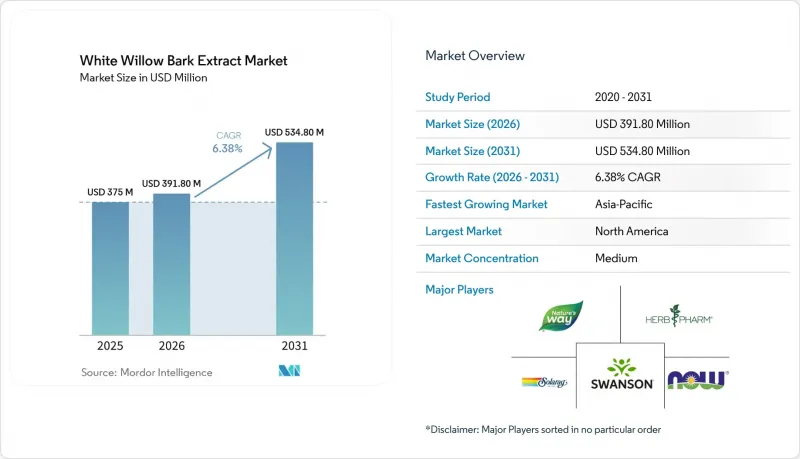
Mordor Intelligence에 의하면, 화이트 윌로우 수피 추출물 시장 규모는 2025년에 3억 7,500만 달러로 평가되었습니다. 2026년에 3억 9,180만 달러에 달하고, 2031년까지 5억 3,480만 달러에 이를 것으로 예측됩니다.
2026년부터 2031년까지 연평균 성장률(CAGR) 6.38%로 성장할 것으로 전망됩니다.
본 보고서는 제품 형태(캡슐, 정제, 분말, 액상 추출물), 표준화(살리신 15%, 25%, 50%, 고살리신, 기타),적응증(관절염, 요통, 생리통, 근육통, 일반 통증), 유통 채널(약국, 전문 판매점, 슈퍼마켓 등), 지역(북미, 유럽, 아시아태평양 등)별로 분류되어 있습니다. 예측치는 금액(달러)으로 표시되어 있습니다.
세계의 화이트 윌로우 수피 추출물 시장 동향 및 인사이트
천연 유래 진통 및 관절 건강 솔루션에 대한 수요 증가
NSAID의 장기 사용에 따른 위장 및 심혈관 영향에 대한 우려로 인해, 일부 소비자들은 식물 유래 제품을 고려하고 있습니다. 유럽의약품청(EMA)은 특정 버드나무 껍질 건조 추출물을 경미한 요통에 대한 확립된 허브 의약품으로 승인했습니다. 해당 모노그래프에서는 승인된 제제에 대해 1일 총 살리신 섭취량을 240mg으로 규정하고 있습니다. 이 승인은 유럽 내 의사의 지도 및 약국 주도의 권장 사항을 뒷받침하는 것입니다. 따라서 화이트 윌로우 수피 추출물 시장은 일반적인 허브 제품이 아닌, 표준화된 제품을 찾는 소비자의 요구에 부응할 수 있습니다. 또한 유럽의 승인 절차는 임상용 브랜드에 대해 대형 유통업체용 제품보다 더 명확한 제품 포지셔닝 근거를 제공합니다.
허브 보충제 분야의 전자상거래 확대
온라인 채널은 소비자가 허브 보충제를 찾고 재주문하는 방식을 변화시키고 있습니다. iHerb는 2025 회계연도에 29억 달러의 순매출을 기록했으며, 이는 전년 대비 19% 증가한 수치로, 전 세계에서 4,400만 건 이상의 주문을 처리했습니다. 이 회사는 또한 AutoShip 정기 구매 주문이 370% 증가했다고 보고했습니다. 이러한 추세는 살리신 함량, 1회 섭취량 및 사용 목적에 관한 명확한 정보를 제공하는 제품에 유리하게 작용합니다. 화이트 윌로우 수피 추출물 시장은 온라인 상품 검색 및 정기 구독을 통해 기존 약국 네트워크 밖에 있는 소비자들에게 접근성을 확대되고 있습니다. 명확한 표준화에 대한 메시지를 갖추지 못한 브랜드는 온라인 쇼핑의 중요성이 커짐에 따라 더욱 직접적인 가격 비교에 직면하게 될 것입니다. 살리신 함량, 1회 섭취량, 품질 관리에 대해 설명한 상품 페이지는 구매자가 표준화된 추출물과 정보가 부족한 대체품을 구별하는 데 도움이 됩니다. 이를 통해 품질에 대한 설명은 공급업체만이 파악하고 있는 기술적 세부 사항이 아니라 판매 과정의 일부가 됩니다.
살리실산염 과민증 및 약물 상호작용에 따른 안전상의 제약
버드나무 껍질 제품에는 일부 소비자의 사용을 제한하는 금기 사항이 있습니다. 유럽의약품청(EMA)은 살리실산 과민증, 특정 유형의 천식, 소화성 궤양, 응고 장애, 중증 간 기능 장애 또는 신장 기능 장애가 있는 분, 그리고 임신 후기인 분의 사용을 자제할 것을 권고하고 있습니다. 이러한 사용 제한은 여러 가지 약물을 복용하고 있을 가능성이 있는 고령 소비자에게 특히 중요합니다. 화이트 윌로우 수피 추출물 시장에서는 신중한 표시와 명확한 소비자 정보 제공이 요구됩니다. 관절염이나 관절 건강을 신경 쓰는 소비자를 대상으로 하는 브랜드는 약사의 참여나 모니터링 지원이 필요할 수 있습니다. 이러한 요건은 비용을 증가시키고, 폭넓은 소비자층에 접근하는 것을 더욱 어렵게 만듭니다. 또한, 소비자와 약사가 부적절한 추출물을 식별할 수 있도록 제품 정보는 충분히 명확해야 합니다. 이 때문에 살리실산염과 관련된 동등한 경고 프로파일을 갖지 않는 제품 카테고리에 비해, 책임 있는 사용에 관한 정보의 중요성이 더욱 커집니다.
부문 분석
2025년, 캡슐은 화이트 윌로우 수피 추출물 시장 점유율의 42.56%를 차지했습니다. 이러한 선두 위상은 약국 중심의 유통 경로와 반복되는 불편감을 관리하는 소비자층에서 정확하고 위변조가 방지된 용량이 선호되고 있음을 반영합니다. 캡슐은 1회 복용량당 명확한 함량을 표시할 수 있기 때문에 표준화된 살리신 추출물에 특히 적합합니다.
분말 형태는 2031년까지 연평균 성장률(CAGR) 7.87%를 나타낼 것으로 예측됩니다. 이 형태를 통해 스포츠 영양제 제조업체는 흰버들 껍질을 다른 회복 성분과 혼합하거나 다성분 제품을 개발할 수 있는 자유도가 높아집니다. 또한, 계약 제조나 구매자가 복용량의 유연성을 중시하는 소비자 직접 판매용 대량 보충제 제공에도 적합합니다. 캡슐이나 정제와 달리, 분말은 기존 약국이나 전문 건강 소매 채널 이외의 구매자에게도 대응할 수 있습니다.
2025년에는 살리신 함량 15%의 표준화 등급이 매출의 36.64%를 차지했습니다. 이 등급은 살리신이 다른 유효 성분과 결합된 대중용 보충제, 약사가 추천하는 제품, 관절 건강 유지용 포뮬러 등에서 여전히 널리 사용되고 있습니다. 한편, 25% 및 50% 등급은 더 높은 농도로 인해 1회 섭취량을 줄이거나 보다 특화된 제품 포지셔닝을 가능하게 하므로 그 중요성이 커지고 있습니다. 흰버들 껍질 추출물 업계는 맞춤형 사리신 및 총 살리실산염이 필요한 화장품 및 전문 영양보충제 구매자들도 지원하고 있습니다.
살리신 함량이 높은 표준화 추출물은 2031년까지 연평균 성장률(CAGR) 8.23%를 나타낼 것으로 예측됩니다. 이러한 성장은 명확한 유효 성분 프로파일을 갖춘 고농도 제품을 찾는 임상용 제제 개발자 및 증거 기반 소비자 브랜드 수요를 반영한 것입니다. 유럽의 의약품 모노그래프는 약국 및 전문 유통 채널을 위해 개발되었으며, 일관된 일일 살리신 함량이 요구되는 제품에 대한 추가적인 기준이 되고 있습니다.
지역별 분석
2025년, 북미는 화이트 윌로우 수피 추출물 시장 점유율의 37.89%를 차지했습니다. 이 지역은 확립된 건강기능식품 유통망, 약국 네트워크, 그리고 천연 유래 통증 관리 제품에 대한 소비자 수요의 혜택을 받고 있습니다. 미국의 허브계 영양보충제 소매 매출은 전년 대비 5.4% 증가하여 2024년에는 132억 달러에 달했습니다.
유럽은 흰버들 껍질 추출물 시장에서 규제가 가장 엄격하고 임상적으로 정의가 명확한 지역입니다. 유럽의약품청(EMA)은 1일 총 살리신 함량 240mg을 포함하는 엄격하게 정의된 건조 추출물을 경미한 요통에 대한 확립된 의약품으로 인정하고 있습니다.
아시아태평양은 2031년까지 연평균 성장률(CAGR) 8.12%로 확대될 것으로 예측됩니다. 중국은 표준화된 살리신 추출물의 주요 공급 거점인 동시에, 식물 유래 진통 제품에 대한 국내 소비 시장도 확대되고 있습니다. 또한 수요는 인도의 식물 유래 웰니스 용도, 일본의 인구 고령화, 그리고 한국의 기능성 건강기능식품 문화와도 관련이 있습니다.
기타 혜택 :
- 엑셀 형식 시장 예측(ME) 시트
- 3개월간의 애널리스트 지원
자주 묻는 질문
목차
제1장 서론
제2장 조사 방법
제3장 주요 요약
제4장 시장 구도
제5장 시장 규모 및 성장 예측
제6장 경쟁 구도
제7장 시장 기회 및 향후 전망
KTH 26.09.10According to Mordor Intelligence, the white willow bark extract market size is projected to be USD 375 million in 2025, USD 391.80 million in 2026, and reach USD 534.80 million by 2031, growing at a CAGR of 6.38% from 2026 to 2031.
This report is Segmented by Product Form (Capsules, Tablets, Powder, Liquid Extracts), Standardization (15%, 25%, 50% Salicin, High-Salicin, Others), Indication (Arthritis, Low Back Pain, Menstrual Cramps, Muscle Soreness, General Pain), Distribution (Pharmacies, Specialty, Supermarkets, and More), and Geography (North America, Europe, Asia-Pacific, and More). Forecasts are Provided in Value (USD).
Global White Willow Bark Extract Market Trends and Insights
Rising Demand for Natural Pain Relief and Joint-Health Solutions
Concern over the gastrointestinal and cardiovascular effects associated with long-term NSAID use is encouraging some consumers to consider botanical products. The European Medicines Agency recognizes a defined willow bark dry extract as a well-established herbal medicinal product for mild low back pain. The same monograph specifies a daily intake of 240 mg total salicin for the recognized preparation. This recognition supports physician-directed and pharmacy-led recommendations in Europe. The White willow bark extract market can therefore serve consumers looking for a standardized option rather than a general herbal product. The European pathway also gives clinical-use brands a clearer basis for product positioning than mass retail products have.
E-Commerce Expansion for Herbal Supplements
Online channels are changing how consumers find and reorder herbal supplements. iHerb reported USD 2.9 billion in net sales for fiscal 2025, a 19% increase from the prior year, and fulfilled more than 44 million orders globally. The company also reported 370% growth in AutoShip subscription orders. These features favor products with clear information on salicin content, serving size, and intended use. The white willow bark extract market gains access to consumers outside established pharmacy networks through online product discovery and recurring orders. Brands without a clear standardization message face more direct price comparison as online shopping becomes more important. Product pages that explain salicin content, serving size, and quality controls can help a buyer distinguish a standardized extract from a lower-information alternative. This makes the quality narrative part of the sales process rather than a technical detail held only by the supplier.
Salicylate-Sensitivity and Drug-Interaction Safety Constraints
Willow bark products have a contraindication profile that limits their use for some consumers. The European Medicines Agency advises against use by people with salicylate hypersensitivity, certain asthma conditions, peptic ulcers, coagulation disorders, severe liver or kidney impairment, and during the third trimester of pregnancy. These exclusions are especially relevant for older consumers who may take multiple medicines. The White willow bark extract market must support careful labeling and clear consumer information. Brands serving arthritis and joint-health consumers may need pharmacist engagement and monitoring support. These requirements add cost and make broad consumer targeting more difficult. They also mean that product information must be clear enough for consumers and pharmacists to identify when the extract is not appropriate. This places more importance on responsible use information than in categories where a product does not have a comparable salicylate-related warning profile.
Other drivers and restraints analyzed in the detailed report include:
- Standardized Salicin Extracts Enabling Formulation Consistency
- Traceable and Sustainable Willow Sourcing as a Premium Differentiator
- Regulatory Limits on Disease and Analgesic Claims
For complete list of drivers and restraints, kindly check the Table Of Contents.
Segment Analysis
Capsules held 42.56% of the White willow bark extract market share in 2025. This lead reflects the preference for precise, tamper-evident doses in pharmacy-led channels and among consumers managing recurring discomfort. Capsules are particularly suited to standardized salicin extracts because the format allows brands to state a defined amount in each serving.
Powder is forecast to record a CAGR of 7.87% through 2031. The format gives sports nutrition manufacturers more freedom to blend willow bark with other recovery ingredients and to create multi-ingredient products. It also supports contract manufacturing and direct-to-consumer bulk supplement offerings where buyers value flexibility in dosage. Unlike capsules and tablets, powder can serve buyers outside traditional pharmacy and specialty-health retail channels.
The 15% salicin standardized grade held 36.64% of revenue in 2025. It remains widely used in mass-market supplements, pharmacist-recommended products, and joint-health formulas where salicin is combined with other active ingredients. The 25% and 50% grades are becoming more relevant where a stronger concentration can support a smaller serving size or a more focused product position. The White willow bark extract industry also serves cosmetic and specialty nutraceutical buyers that require custom salicin or total-salicylate specifications.
High-salicin standardized extracts are forecast to grow at a CAGR of 8.23% through 2031. Their growth reflects demand from clinical-use formulators and evidence-led consumer brands that seek a more concentrated product with a defined active profile. The European medicinal-use monograph provides an additional reference point for products that are developed for pharmacy or professional channels and need a consistent daily salicin position.
Complete Report Scope:
- By Product Form
- Capsules
- Tablets
- Powder
- Liquid Extracts
- By Active Compound Standardization
- 15% Salicin Standardized
- 25% Salicin Standardized
- 50% Salicin Standardized
- High-Salicin Standardized Extracts
- Other Standardizations
- By Indication
- Arthritis and Joint Discomfort
- Low Back Pain
- Menstrual Cramps
- Muscle Soreness and Sports Recovery
- Other Indications
- By Distribution Channel
- Pharmacies and Drug Stores
- Specialty Health Stores
- Supermarkets and Hypermarkets
- Online E-Commerce Platforms
- Others
- By Geography
- North America
- United States
- Canada
- Mexico
- Europe
- Germany
- United Kingdom
- France
- Italy
- Spain
- Rest of Europe
- Asia-Pacific
- China
- India
- Japan
- Australia
- South Korea
- Rest of Asia-Pacific
- Middle East and Africa
- GCC
- South Africa
- Rest of Middle East and Africa
- South America
- Brazil
- Argentina
- Rest of South America
- North America
Geography Analysis
North America held 37.89% of the White willow bark extract market share in 2025. The region benefits from established supplement distribution, pharmacy networks, and consumer demand for natural pain-management products. U.S. herbal dietary supplement retail sales reached USD 13.2 billion in 2024, after increasing 5.4% from the prior year.
Europe is the most regulated and clinically defined geography for the White willow bark extract market. The European Medicines Agency recognizes a precisely defined dry extract with a daily 240 mg total salicin dose as a well-established medicinal product for mild low back pain.
Asia-Pacific is forecast to expand at a CAGR of 8.12% through 2031. China is a major supply base for standardized salicin extracts and a growing domestic consumer market for botanical pain products. Demand is also linked to India's botanical wellness use, Japan's aging population, and South Korea's functional supplement culture.
- Alchem International Pvt. Ltd.
- Bio-Botanica, Inc.
- Changsha Organic Herb Inc.
- Foodchem International
- Herb Pharm, LLC
- Herbo Nutra
- Hunan Nutramax Inc.
- Martin Bauer Group
- Naturalin Bio-Resources Co., Ltd.
- Nature's Answer
- Nature's Way Products, LLC
- NOW Health Group, Inc.
- Shaanxi Hongda Phytochemistry Co., Ltd.
- Shaanxi Undersun Biomedtech Co., Ltd.
- Solaray
- Swanson Health Products, Inc.
- Xi'an Lyphar Biotech Co., Ltd.
- Xi'an Sost Biological Science & Technology Co., Ltd.
Additional Benefits:
- The market estimate (ME) sheet in Excel format
- 3 months of analyst support
TABLE OF CONTENTS
1 Introduction
- 1.1 Study Assumptions & Market Definition
- 1.2 Scope of the Study
2 Research Methodology
3 Executive Summary
4 Market Landscape
- 4.1 Market Overview
- 4.2 Market Drivers
- 4.2.1 Rising Demand for Natural Pain Relief and Joint-Health Solutions
- 4.2.2 Expansion of Botanical Ingredients in Nutraceutical and Functional Products
- 4.2.3 Growth of Clean-Label and Plant-Based Skin-Care Formulations
- 4.2.4 E-Commerce Expansion for Herbal Supplements
- 4.2.5 Standardized Salicin Extracts Enabling Formulation Consistency
- 4.2.6 Traceable and Sustainable Willow Sourcing as a Premium Differentiator
- 4.3 Market Restraints
- 4.3.1 Salicylate-Sensitivity and Drug-Interaction Safety Constraints
- 4.3.2 Regulatory Limits on Disease and Analgesic Claims
- 4.3.3 Variability in Salicin Content and Botanical Authentication
- 4.3.4 Heavy-Metal and Environmental-Contaminant Risk in Willow Bark
- 4.4 Supply Chain Analysis
- 4.5 Regulatory Landscape
- 4.6 Technological Outlook
- 4.7 Porter's Five Forces
- 4.7.1 Threat of New Entrants
- 4.7.2 Bargaining Power of Suppliers
- 4.7.3 Bargaining Power of Buyers
- 4.7.4 Threat of Substitutes
- 4.7.5 Industry Rivalry
5 Market Size & Growth Forecasts (Value, USD)
- 5.1 By Product Form
- 5.1.1 Capsules
- 5.1.2 Tablets
- 5.1.3 Powder
- 5.1.4 Liquid Extracts
- 5.2 By Active Compound Standardization
- 5.2.1 15% Salicin Standardized
- 5.2.2 25% Salicin Standardized
- 5.2.3 50% Salicin Standardized
- 5.2.4 High-Salicin Standardized Extracts
- 5.2.5 Other Standardizations
- 5.3 By Indication
- 5.3.1 Arthritis and Joint Discomfort
- 5.3.2 Low Back Pain
- 5.3.3 Menstrual Cramps
- 5.3.4 Muscle Soreness and Sports Recovery
- 5.3.5 Other Indications
- 5.4 By Distribution Channel
- 5.4.1 Pharmacies and Drug Stores
- 5.4.2 Specialty Health Stores
- 5.4.3 Supermarkets and Hypermarkets
- 5.4.4 Online E-Commerce Platforms
- 5.4.5 Others
- 5.5 By Geography
- 5.5.1 North America
- 5.5.1.1 United States
- 5.5.1.2 Canada
- 5.5.1.3 Mexico
- 5.5.2 Europe
- 5.5.2.1 Germany
- 5.5.2.2 United Kingdom
- 5.5.2.3 France
- 5.5.2.4 Italy
- 5.5.2.5 Spain
- 5.5.2.6 Rest of Europe
- 5.5.3 Asia-Pacific
- 5.5.3.1 China
- 5.5.3.2 India
- 5.5.3.3 Japan
- 5.5.3.4 Australia
- 5.5.3.5 South Korea
- 5.5.3.6 Rest of Asia-Pacific
- 5.5.4 Middle East and Africa
- 5.5.4.1 GCC
- 5.5.4.2 South Africa
- 5.5.4.3 Rest of Middle East and Africa
- 5.5.5 South America
- 5.5.5.1 Brazil
- 5.5.5.2 Argentina
- 5.5.5.3 Rest of South America
- 5.5.1 North America
6 Competitive Landscape
- 6.1 Market Concentration
- 6.2 Market Share Analysis
- 6.3 Company Profiles {(includes Global level Overview, Market level overview, Core Segments, Financials as available, Strategic Information, Market Rank/Share for key companies, Products & Services, and Recent Developments)}
- 6.3.1 Alchem International Pvt. Ltd.
- 6.3.2 Bio-Botanica, Inc.
- 6.3.3 Changsha Organic Herb Inc.
- 6.3.4 Foodchem International Corporation
- 6.3.5 Herb Pharm, LLC
- 6.3.6 Herbo Nutra
- 6.3.7 Hunan Nutramax Inc.
- 6.3.8 Martin Bauer Group
- 6.3.9 Naturalin Bio-Resources Co., Ltd.
- 6.3.10 Nature's Answer
- 6.3.11 Nature's Way Products, LLC
- 6.3.12 NOW Health Group, Inc.
- 6.3.13 Shaanxi Hongda Phytochemistry Co., Ltd.
- 6.3.14 Shaanxi Undersun Biomedtech Co., Ltd.
- 6.3.15 Solaray
- 6.3.16 Swanson Health Products, Inc.
- 6.3.17 Xi'an Lyphar Biotech Co., Ltd.
- 6.3.18 Xi'an Sost Biological Science & Technology Co., Ltd.
7 Market Opportunities & Future Outlook
- 7.1 White-space & unmet-need assessment