

|
시장보고서
상품코드
2119552
팟캐스트 마케팅 서비스 : 시장 점유율 분석, 업계 동향 및 통계, 성장 예측(2026-2031년)Podcast Marketing Services - Market Share Analysis, Industry Trends & Statistics, Growth Forecasts (2026 - 2031) |
||||||
 Mordor Intelligence
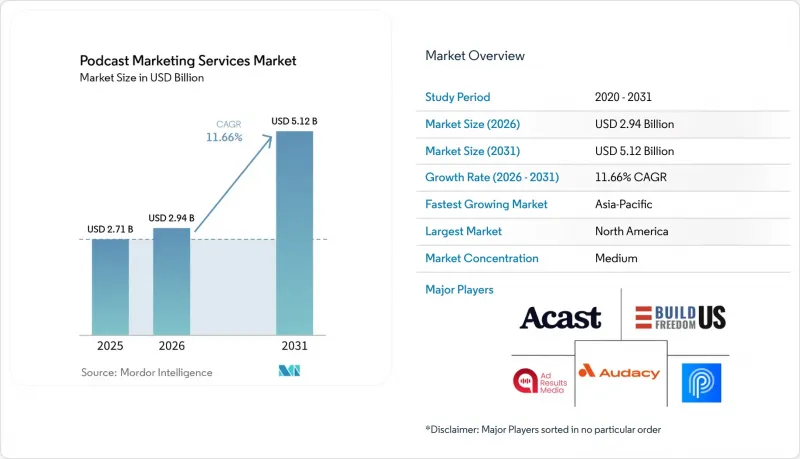
Mordor Intelligence에 의하면, 팟캐스트 마케팅 서비스 시장 규모는 2025년에 27억 1,000만 달러로 평가되었습니다. 2026년 29억 4,000만 달러에서 2031년까지 51억 2,000만 달러에 이를 것으로 예측되며, 2026년부터 2031년까지에서 CAGR은 11.66%를 나타낼 전망입니다.
본 보고서는 서비스 유형(전략 및 프로그램 개발, 제작 및 포스트 프로덕션, 배포 및 청취자 확보, 스폰서십 및 진행자 광고 판매, 분석 및 어트리뷰션, 기타), 수익 모델(스폰서십 관리, 기타), 최종 사용자 산업(소매 및 전자상거래, 은행, 금융서비스 및 보험(BFSI), 기타), 그리고 지역별로 분류되어 있습니다. 시장 예측은 금액(달러) 기준으로 제시되어 있습니다.
세계의 팟캐스트 마케팅 서비스 시장 동향 및 인사이트
진행자의 낭독 및 크리에이터 주도형 광고에 대한 수요 증가
진행자 낭독형 광고는 청취자들이 진행자의 추천을 일반적인 상업 광고 메시지와는 다르게 인식하는 경우가 많기 때문에 팟캐스트 마케팅 서비스 시장을 뒷받침하고 있습니다. 이에 따라 각 광고 슬롯을 호환 가능한 인벤토리나 표준 미디어 슬롯으로 취급하기보다는 브랜드, 진행자 및 타겟 청중 간의 관계가 캠페인 설계의 핵심이 됩니다. 대행사들은 클라이언트의 목적, 진행자의 말투, 청중의 관심사, 그리고 신중한 검토가 필요한 주장을 파악해야 합니다. 적절하게 구축된 통합 광고에는 명확한 상업적 목적, 프로그램에 걸맞은 표현, 그리고 녹음 전에 진행자가 제품을 이해할 수 있는 충분한 시간이 필요합니다. 따라서 서비스 제공업체는 진행자와의 적합성을 평가하고, 명확한 브리핑을 작성하며, 이용 조건을 협상하고, 추천 내용의 자연스러운 특성을 보호해야 합니다. 또한 이 모델에서는 특히 규제 대상 분야의 클라이언트의 경우, 상업적 관계가 존재할 때 투명한 공개가 요구됩니다. 브랜드가 진행자와의 제휴를 더 광범위하게 모색함에 따라, 캠페인 운영을 관리하면서도 청취자의 신뢰를 유지할 수 있는 대행사는 특히 여러 프로그램, 진행자, 방송일에 걸쳐 일관된 컨텐츠 제공이 필요한 캠페인에서 실질적인 우위를 점하게 됩니다.
비즈니스 및 엔터프라이즈 마케팅에서의 브랜드 팟캐스트 확대
브랜드 프로그램은 팟캐스트 마케팅 서비스 시장을 계절적인 광고 구매의 범위를 넘어, 보다 장기적인 컨텐츠 계획으로 확장시키고 있습니다. 2025년에 새로 진입한 팟캐스트 광고주는 시작 첫 달에 3만 9,231달러를, 그 후 6개월 동안은 월 평균 6만 4,616달러를 지출했습니다. 이에 비해 2024년에 새로 진입한 광고주는 시작 시 1만 8,200달러, 그 후 6개월 동안은월평균 3만 445달러를 지출했습니다. 이러한 지출 패턴은 신규 진출기업이 지속적인 커뮤니케이션 프로그램의 일환으로 팟캐스트를 이용하기 시작하면 더 큰 의지를 보인다는 점을 반영합니다. 또한, 프로그램 시작 후 첫 몇 달 동안은 제작 루틴을 확립하고, 포맷을 검증하며, 지속적인 투자가 필요한 청취자의 관심사를 파악하는 데 활용되는 경우가 많다는 점도 시사합니다. 브랜드 프로그램은 단기 캠페인 기간에만 의존하지 않고, 경영진의 인지도 제고, 고객 교육, 특정 주제에 초점을 맞춘 대화를 지원할 수 있습니다. 이러한 접근 방식에 따라 프로그램 전체 기간에 걸친 편집 계획, 일관된 배포, 게스트 조정 및 배포 지원의 중요성도 높아집니다. 이에 따라 주제와 게스트 선정은 상업적인 판단인 동시에 컨텐츠에 관한 판단이기도 합니다. 금융 서비스 및 헬스케어 업계의 고객은 정보 공개 및 광고 기준에 특히 주의를 기울여야 하며, 이는 관련 규정 준수 경험이 있고 고객이 에피소드를 공개하기 전에 적용할 수 있는 문서화된 심사 절차를 갖춘 제공업체에게 유리하게 작용할 가능성이 있습니다.
다운로드 수를 넘어선 측정 및 기여도 분석의 격차
측정상의 한계는 팟캐스트 마케팅 서비스 시장의 발전을 저해할 수 있습니다. 다운로드 수나 시청 횟수만으로는 캠페인의 상업적 영향력을 모두 파악할 수 없기 때문입니다. 이 과제는 RSS 피드, 동영상 플랫폼, 소셜 클립, 유료 미디어 채널 등 각각 다른 보고 방식을 채택하는 여러 매체에서 캠페인이 전개될 경우 더욱 두드러집니다. Spotify는 2026년 6월, 재생 시작 후 30초 이상 경과한 에피소드를 1회로 계산하는 새로운 ‘재생 수’ 기준을 도입하고, 크리에이터를 위한 분석 기능도 확충했습니다. 이번 업데이트로 인해 보다 일관성 있는 활동 지표를 확보할 수 있게 되었지만, 전환, 수익 또는 크로스 플랫폼 노출과 관련된 모든 의문이 해소된 것은 아닙니다. 서비스 제공업체는 보다 종합적인 전체 상황을 파악하기 위해 청중 데이터, 구매 후 설문조사, 프로모션 코드, 클라이언트의 매출 데이터를 결합해야 하는 경우가 종종 있습니다. 이로 인해 업무 부담이 증가할 뿐만 아니라, 클라이언트가 대규모 예산을 투입하기 전에 명확한 증거를 요구할 경우 의사 결정이 지연될 가능성이 있습니다. 또한 캠페인 보고서에서는 각 지표가 무엇을 나타낼 수 있는지, 그 한계는 어디에 있는지, 그리고 여러 지표가 어떻게 결합되어 클라이언트에게 실용적인 캠페인 성과에 대한 전체적인 그림을 구성하는지 설명해야 합니다.
부문 분석
2025년에는 제작 및 포스트 프로덕션이 시장의 29.06%를 차지했으며, 이는 음성과 영상이 연계된 컨텐츠에 대한 수요에 힘입은 결과였습니다. 브랜드는 기획부터 편집, 최종 배포에 이르기까지 프로그램을 일관되게 다루며, 크리에이티브 승인, 기술적 품질, 공개 시기에 대해 명확한 책임 분담이 가능한 스튜디오, 대행사, 전문가를 점점 더 필요로 하고 있습니다. 브랜드 인지도, 고객 교육, 사내 커뮤니케이션, 혹은 스폰서십 수익 중 어느 것을 목적으로 하든 제작 작업은 여전히 필수적입니다. 시청자는 여러 플랫폼에서 동일한 프로그램을 접하고, 컨텐츠의 모든 버전을 통해 클라이언트에 대한 평가를 형성하기 때문에 고품질의 녹음, 영상 표현, 편집, 배포가 중요합니다. ‘전략·프로그램 개발’, ‘배포·시청자 확보’, ‘스폰서십 및 진행자 내레이션 광고 판매’, ‘컨텐츠 재사용’이 기타 서비스 카테고리를 구성하고 있으며, 이는 팟캐스트 프로그램에 있어 고립된 제작 지원이 아닌, 연계된 운영 모델이 필요함을 보여줍니다.
‘분석 및 어트리뷰션’은 2031년까지 연평균 성장률(CAGR) 12.31%를 나타낼 것으로 예측되며, 전략 및 프로그램 개발 시장에서 가장 빠르게 성장하는 서비스 카테고리가 될 것입니다. 클라이언트는 마케팅, 재무 및 운영의 고위 경영진에게 성과를 설명해야 하므로, 이 활동의 중요성은 더욱 커지고 있습니다. 스포티파이(Spotify)의 2026년 6월 ‘재생 수(plays standard)’ 지표는 크리에이터에게 최소 30초간 재생된 에피소드에 대한 공통 활동 지표를 제공했습니다. 동영상 스트리밍으로 인해 조사 범위가 더욱 확대되는 한편, 이로 인해 다운로드 중심의 측정은 오디오 전용 캠페인에 비해 불완전해지고 있습니다. 플랫폼 보고서를 클라이언트 데이터, 설문조사, 프로모션 코드와 통합할 수 있는 제공업체는 보다 유용한 캠페인 분석을 제공할 수 있습니다. 컨텐츠 재사용은 이러한 노력을 뒷받침하며, 하나의 원본 자료로 소셜 미디어 게시물, 이메일 컨텐츠, 검색 최적화 자산을 생성할 수 있지만, 각 결과물에 대해서는 해당 활동을 더 광범위한 프로그램과 연결할 수 있는 적절한 보고 및 거버넌스가 여전히 필요합니다.
지역별 분석
북미는 2025년, 성숙한 광고 인프라, 높은 청취자 참여율, 그리고 확립된 프로그래매틱 바이잉 도구의 지원에 힘입어 팟캐스트 마케팅 서비스 시장 점유율의 48.23%를 차지했습니다. 이 지역에는 네트워크, 플랫폼, 제작사, 대행사, 측정 전문가 등이 폭넓게 존재하며, 기존 오디오 광고주와 비디오 팟캐스트 형식을 시범적으로 도입하고 있는 신흥 브랜드에 서비스를 제공합니다. 이러한 다양한 참여자들의 존재는 클라이언트에게 여러 시장 진입 경로를 제공하는 한편, 플랫폼의 이용 약관, 제작 모델, 캠페인 보고서를 비교할 때는 전문가의 조언이 유용합니다. 또한, 북미의 서비스 제공업체들은 오디오와 비디오를 결합한 캠페인 계획에 대한 요구에도 대응하고 있습니다.
아시아태평양은 2031년까지 연평균 성장률(CAGR) 12.44%를 나타낼 것으로 예측되며, 팟캐스트 마케팅 서비스 시장에서 가장 두드러진 성장을 보일 것으로 전망됩니다. 이 지역의 성장은 인도와 동남아시아의 ‘모바일 우선’ 청취 경향, 일본의 기업 팟캐스트 활용, 그리고 중국의 유료 컨텐츠 동향과 밀접한 관련이 있습니다. 이러한 상황으로 인해 현지 언어로 된 제작, 청중 개발, 배포 지원에 대한 수요가 높아지는 한편, 제공업체는 지역별로 다른 플랫폼 선호도, 상업 관행, 규제 요건에도 대응해야 합니다. 이러한 수요를 배경으로, 현지 시장에 대한 이해와 다국적 고객을 위한 지역 간 프로그램을 조정할 수 있는 능력을 겸비한 대행사가 우위를 점할 가능성이 있습니다.
유럽, 남미, 중동 및 아프리카는 팟캐스트 마케팅 서비스 시장에서 비교적 작은 지역 부문을 차지하고 있습니다. 유럽에서는 광고 규제가 잘 정비되어 있어, 공개, 권리, 데이터 보호 요건에 대한 경험이 있는 제공업체에 대한 수요가 발생할 가능성이 있습니다. 한편, 남미의 팟캐스트 청취자층은 브라질과 아르헨티나에 집중되어 있으며, 모바일 중심의 젊은 청취자들이 광고주의 관심을 끌고 있습니다. 국경을 초월한 권리 문제나 환율 변동으로 인해 지역별 직접 반응형 캠페인의 규모 확대가 어려워질 수 있습니다. 중동 및 아프리카는 여전히 발전 중인 시장이며, 다국적 기업의 브랜드 컨텐츠가 영어 및 아랍어 프로그램 공급을 확대하고 있지만, 국가에 따라 사업 환경은 크게 다릅니다.
기타 혜택 :
- 엑셀 형식 시장 예측(ME) 시트
- 3개월간의 애널리스트 지원
자주 묻는 질문
목차
제1장 서론
제2장 조사 방법
제3장 주요 요약
제4장 시장 구도
제5장 시장 규모 및 성장 예측
제6장 경쟁 구도
제7장 시장 기회 및 향후 전망
KTH 26.09.10According to Mordor Intelligence, the podcast marketing services market size was valued at USD 2.71 billion in 2025 and is estimated to grow from USD 2.94 billion in 2026 to reach USD 5.12 billion by 2031, at a CAGR of 11.66% during the forecast period 2026-2031.
This report is Segmented by Service Type (Strategy and Show Development, Production and Post-Production, Distribution and Audience Development, Sponsorship and Host-Read Ad Sales, Analytics and Attribution, and More), Revenue Model (Sponsorship Management, and More), End-User Industry (Retail and E-Commerce, BFSI, and More), and Geography. The Market Forecasts are Provided in Terms of Value (USD).
Global Podcast Marketing Services Market Trends and Insights
Rising Demand for Authentic Host-Read and Creator-Led Advertising
Host-read advertising supports the podcast marketing services market because listeners often view a host's recommendation differently from a standard commercial message. This makes the relationship between the brand, the host, and the intended audience central to campaign design, rather than treating each placement as interchangeable inventory or a standard media placement. The agency must understand the client's objectives, the host's voice, the audience's interests, and any claim that needs careful review. A well-developed integration needs a clear commercial purpose, language that suits the show, and enough time for the host to understand the product before recording. Service providers must therefore assess host fit, develop clear briefs, negotiate usage, and protect the natural character of an endorsement. The model also requires transparent disclosure where a commercial relationship exists, especially for clients in regulated categories. As brands seek host partnerships at greater scale, agencies that can preserve audience trust while managing campaign operations have a practical advantage, particularly when a campaign needs consistent delivery across multiple shows, hosts, and release dates.
Expansion of Branded Podcasts in Business and Enterprise Marketing
Branded programs are extending the podcast marketing services market beyond seasonal advertising purchases and into longer-term content planning. New podcast advertisers spent USD 39,231 in their first month in 2025 and USD 64,616 per month during the following 6 months, compared with USD 18,200 at launch and USD 30,445 per month during the following 6 months in 2024. The spending pattern reflects a larger commitment from new entrants once they begin using podcasts as part of an ongoing communication program. It also suggests that the first months of a program are often used to establish production routines, test formats, and identify the audience topics that merit continued investment. A branded show can support executive visibility, customer education, and subject-focused conversations without relying only on a short campaign window. This approach also raises the importance of editorial planning, consistent publishing, guest coordination, and distribution support across the full life of a program. It makes the choice of themes and guests both a commercial and a content decision. Financial services and healthcare clients require additional attention to disclosures and advertising standards, which can favor providers with relevant compliance experience and documented review processes that clients can apply before publishing an episode.
Measurement and Attribution Gaps Beyond Downloads
Measurement limitations can constrain the podcast marketing services market because a download or a view does not capture the full commercial impact of a campaign. The challenge is more pronounced when a campaign appears across RSS feeds, video platforms, social clips, and paid media channels, each using different reporting methods. Spotify introduced a new plays standard in June 2026 that counts an episode after at least 30 seconds of consumption, and it also expanded creator analytics. The update provides a more consistent activity signal, but it does not resolve every question about conversion, revenue, or cross-platform exposure. Service providers often need to combine audience data, post-purchase surveys, promo codes, and client sales data to form a fuller view. This creates additional operating work and can slow decisions when clients require clear evidence before committing larger budgets. It also means that campaign reports must explain what each measure can show, where its limits remain, and how several measures fit together in a practical account of campaign performance for the client.
Other drivers and restraints analyzed in the detailed report include:
- Growth of Video Podcast Consumption Across Platform Ecosystems
- Better Programmatic Buying and Audience Targeting for Audio Inventory
- High Ongoing Investment Needed to Build and Sustain Branded Podcast Audiences
For complete list of drivers and restraints, kindly check the Table Of Contents.
Segment Analysis
Production and Post-Production accounted for 29.06% of the market in 2025, supported by demand for coordinated audio and video output. Brands increasingly need studios, agencies, and specialists that can take a show from planning through editing and final distribution, with clear responsibilities for creative approval, technical quality, and publishing timing. Production work remains necessary whether the objective is brand awareness, customer education, internal communication, or sponsorship revenue. High-quality recording, visual presentation, editing, and publishing are important because audiences encounter the same show across multiple platforms and form opinions about the client from every version of the content. Strategy and Show Development, Distribution and Audience Development, Sponsorship and Host-Read Ad Sales, and Content Repurposing make up the other service categories, showing that a podcast program needs a connected operating model rather than isolated production support.
Analytics and Attribution is projected to grow at a 12.31% CAGR through 2031, making it the fastest-growing service category in the podcast marketing services market. This activity is gaining importance because clients need to explain results to senior marketing, finance, and operating teams. Spotify's June 2026 plays standard gives creators a common activity measure for episodes consumed for at least 30 seconds. Video distribution adds further reporting surfaces, and this makes download-centered measurement less complete than it was for audio-only campaigns. Providers that can join platform reporting with client data, surveys, and promotion codes can offer more useful campaign reviews. Content repurposing supports this work because 1 recording can inform social posts, email material, and search-focused assets, although each output still needs suitable reporting and governance that links activity to the wider program.
Complete Report Scope:
- By Service Type
- Strategy and Show Development
- Production and Post-Production
- Distribution and Audience Development
- Sponsorship and Host-Read Ad Sales
- Analytics and Attribution
- Content Repurposing
- By Revenue Model
- Sponsorship Management
- Subscription and Membership Strategy
- Affiliate Marketing
- By End-User Industry
- Retail and E-commerce
- BFSI
- Healthcare and Life Sciences
- IT and Telecommunications
- Media and Entertainment
- Other End-User Industries
- By Geography
- North America
- United States
- Canada
- Mexico
- South America
- Brazil
- Argentina
- Chile
- Rest of South America
- Europe
- Germany
- United Kingdom
- France
- Italy
- Spain
- Rest of Europe
- Asia-Pacific
- China
- Japan
- India
- South Korea
- Australia
- Rest of Asia-Pacific
- Middle East
- United Arab Emirates
- Saudi Arabia
- Qatar
- Rest of Middle East
- Africa
- South Africa
- Egypt
- Nigeria
- Rest of Africa
- North America
Geography Analysis
North America held 48.23% of the podcast marketing services market share in 2025, supported by a mature advertising infrastructure, high listener participation, and established programmatic buying tools. The region has a broad mix of networks, platforms, production companies, agencies, and measurement specialists, serving established audio buyers and newer brands testing video podcast formats. This range of participants offers clients several routes to market, but it also makes specialist advice useful when comparing platform terms, production models, and campaign reporting. North American service providers are also responding to the need for combined audio-and-video campaign planning.
Asia-Pacific is projected to grow at a 12.44% CAGR through 2031, making it the fastest-growing region in the podcast marketing services market. The region's expansion is linked to mobile-first listening in India and Southeast Asia, corporate adoption in Japan, and paid content activity in China. These conditions increase the need for local-language production, audience development, and distribution support, while providers must also account for differing platform preferences, commercial practices, and regulatory requirements across the region. Demand can favor agencies that combine local market understanding with the ability to coordinate regional programs for multinational clients.
Europe, South America, the Middle East, and Africa represent smaller regional segments of the podcast marketing services market. Europe has regulated advertising environments that can create demand for providers with experience in disclosure, rights, and data-protection requirements, while South America's larger podcast audiences are concentrated in Brazil and Argentina, where younger mobile-centered audiences can support advertiser interest. Cross-border rights issues and currency volatility can make regional direct-response campaigns harder to scale. The Middle East and Africa remain earlier-stage markets where branded content from multinational companies is building the supply of English- and Arabic-language programming, and operating conditions differ widely between countries.
- Acast AB
- Ad Results Media LLC
- Audacy, Inc.
- Build Freedom LLC
- Podcasting Ltd
- Fresh Air Production Ltd
- JAR Podcast Solutions Inc.
- Lower Street Media Ltd
- Pacific Content Inc.
- Pod People LLC
- Podbean Tech Inc.
- Podfly Productions, LLC
- Podigy LLC
- Quill Inc.
- Resonate Recordings, LLC
- iHeartMedia, Inc.
- Sirius XM Holdings Inc.
- Studiopod Media LLC
- Sweet Fish Media, LLC
- True Native Media, LLC
Additional Benefits:
- The market estimate (ME) sheet in Excel format
- 3 months of analyst support
TABLE OF CONTENTS
1 INTRODUCTION
- 1.1 Study Assumptions and Market Definition
- 1.2 Scope of the Study
2 RESEARCH METHODOLOGY
3 EXECUTIVE SUMMARY
4 MARKET LANDSCAPE
- 4.1 Market Overview
- 4.2 Market Drivers
- 4.2.1 Rising Demand for Authentic Host-Read and Creator-Led Advertising
- 4.2.2 Expansion of Branded Podcasts in Business and Enterprise Marketing
- 4.2.3 Growth of Video Podcast Consumption Across Youtube and Platform Ecosystems
- 4.2.4 Better Programmatic Buying and Audience Targeting for Audio Inventory
- 4.2.5 Repurposing Economics Turn One Recording Into Full-Funnel Content Packages
- 4.2.6 Corporate Internal and Private Podcasting Expands Agency Wallet Share
- 4.3 Market Restraints
- 4.3.1 Measurement and Attribution Gaps Beyond Downloads
- 4.3.2 High Ongoing Investment Needed to Build and Sustain Branded Podcast Audiences
- 4.3.3 Platform Dependency Shifts Discovery Power Toward Youtube and Walled Gardens
- 4.3.4 Rights, Music, and Cross-Border Compliance Complexity Slows Multi-Market Rollouts
- 4.4 Industry Value Chain Analysis
- 4.5 Regulatory Landscape
- 4.6 Technological Outlook
- 4.7 Impact of Macroeconomic Factors on the Market
- 4.8 Porter's Five Forces Analysis
- 4.8.1 Threat of New Entrants
- 4.8.2 Bargaining Power of Buyers
- 4.8.3 Bargaining Power of Suppliers
- 4.8.4 Threat of Substitutes
- 4.8.5 Industry Rivalry
5 MARKET SIZE AND GROWTH FORECASTS (VALUE)
- 5.1 By Service Type
- 5.1.1 Strategy and Show Development
- 5.1.2 Production and Post-Production
- 5.1.3 Distribution and Audience Development
- 5.1.4 Sponsorship and Host-Read Ad Sales
- 5.1.5 Analytics and Attribution
- 5.1.6 Content Repurposing
- 5.2 By Revenue Model
- 5.2.1 Sponsorship Management
- 5.2.2 Subscription and Membership Strategy
- 5.2.3 Affiliate Marketing
- 5.3 By End-User Industry
- 5.3.1 Retail and E-commerce
- 5.3.2 BFSI
- 5.3.3 Healthcare and Life Sciences
- 5.3.4 IT and Telecommunications
- 5.3.5 Media and Entertainment
- 5.3.6 Other End-User Industries
- 5.4 By Geography
- 5.4.1 North America
- 5.4.1.1 United States
- 5.4.1.2 Canada
- 5.4.1.3 Mexico
- 5.4.2 South America
- 5.4.2.1 Brazil
- 5.4.2.2 Argentina
- 5.4.2.3 Chile
- 5.4.2.4 Rest of South America
- 5.4.3 Europe
- 5.4.3.1 Germany
- 5.4.3.2 United Kingdom
- 5.4.3.3 France
- 5.4.3.4 Italy
- 5.4.3.5 Spain
- 5.4.3.6 Rest of Europe
- 5.4.4 Asia-Pacific
- 5.4.4.1 China
- 5.4.4.2 Japan
- 5.4.4.3 India
- 5.4.4.4 South Korea
- 5.4.4.5 Australia
- 5.4.4.6 Rest of Asia-Pacific
- 5.4.5 Middle East
- 5.4.5.1 United Arab Emirates
- 5.4.5.2 Saudi Arabia
- 5.4.5.3 Qatar
- 5.4.5.4 Rest of Middle East
- 5.4.6 Africa
- 5.4.6.1 South Africa
- 5.4.6.2 Egypt
- 5.4.6.3 Nigeria
- 5.4.6.4 Rest of Africa
- 5.4.1 North America
6 COMPETITIVE LANDSCAPE
- 6.1 Market Concentration
- 6.2 Strategic Moves
- 6.3 Market Share Analysis
- 6.4 Company Profiles (includes Global Level Overview, Market Level Overview, Core Segments, Financials as available, Strategic Information, Market Rank/Share, Products and Services, Recent Developments)
- 6.4.1 Acast AB
- 6.4.2 Ad Results Media LLC
- 6.4.3 Audacy, Inc.
- 6.4.4 Build Freedom LLC
- 6.4.5 Podcasting Ltd
- 6.4.6 Fresh Air Production Ltd
- 6.4.7 JAR Podcast Solutions Inc.
- 6.4.8 Lower Street Media Ltd
- 6.4.9 Pacific Content Inc.
- 6.4.10 Pod People LLC
- 6.4.11 Podbean Tech Inc.
- 6.4.12 Podfly Productions, LLC
- 6.4.13 Podigy LLC
- 6.4.14 Quill Inc.
- 6.4.15 Resonate Recordings, LLC
- 6.4.16 iHeartMedia, Inc.
- 6.4.17 Sirius XM Holdings Inc.
- 6.4.18 Studiopod Media LLC
- 6.4.19 Sweet Fish Media, LLC
- 6.4.20 True Native Media, LLC
7 MARKET OPPORTUNITIES AND FUTURE OUTLOOK
- 7.1 White-Space and Unmet-Need Assessment


