|
시장보고서
상품코드
2119554
국경 간 광케이블 경로 : 시장 점유율 분석, 업계 동향 및 통계, 성장 예측(2026-2031년)Cross-Border Fiber Route - Market Share Analysis, Industry Trends & Statistics, Growth Forecasts (2026 - 2031) |
||||||
 Mordor Intelligence
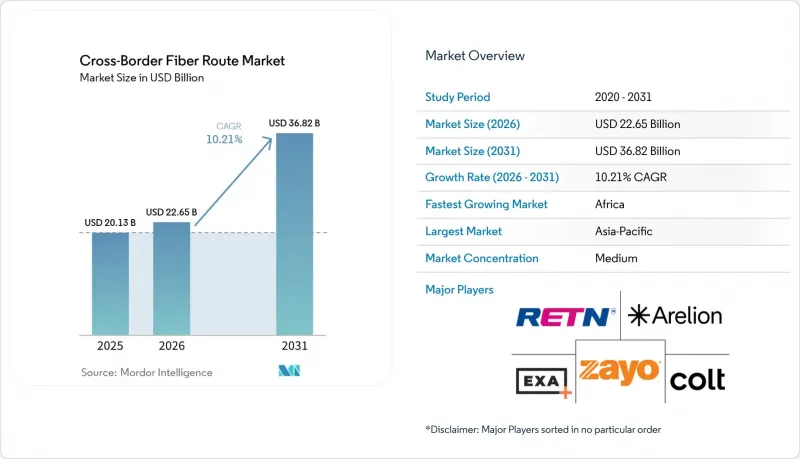
Mordor Intelligence에 의하면, 국경 간 광케이블 경로 시장 규모는 2025년에 201억 3,000만 달러로 평가되었습니다. 2026년 226억 5,000만 달러에서 2031년까지 368억 2,000만 달러에 이를 것으로 예상되며, 예측 기간(2026-2031년) CAGR은 10.21%를 나타낼 전망입니다.
본 보고서는 네트워크 유형별(육상 국경을 넘는 광섬유 백본, 해저 광섬유 백본, 육상·해저 하이브리드 백본), 소유 유형별(단독 소유, 컨소시엄 소유 등), 서비스 유형별(다크 파이버 및 파이버 페어 IRU 등),용도(통신 사업자의 트랜짓 등), 지역별로 분류되어 있습니다. 시장 예측은 금액(달러) 기준으로 제시되어 있습니다.
세계의 국경 간 광케이블 경로 시장 동향 및 인사이트력
하이퍼스케일러 및 AI 클러스터 간 상호 연결 수요
하이퍼스케일러는 2010년에는 극히 미미한 점유율에 불과했으나, 2025년에는 전체 국제 해저 대역폭의 75%를 차지하게 되었습니다. 또한, 2025년에 계획된 해저 케이블 부설의 3분의 2 이상에도 참여했습니다. AI 훈련 및 추론 워크로드에서는 서로 다른 관할 구역에 위치한 데이터센터 간에 매우 대규모의 데이터 세트가 전송됩니다. 이러한 요구 사항으로 인해 예측 가능한 지연 시간과 낮은 패킷 손실을 갖춘 전용 광섬유 쌍이나 경로가 선호됩니다. 국경 간 광케이블 경로 시장은 기존의 소비자용 인터넷 도시 간 연결뿐만 아니라, GPU가 밀집된 거점 간의 링크로 전환되고 있습니다. EXA Infrastructure는 2026년 보고서에서 금융 서비스 고객들이 AI 모델에 데이터를 통합함에 따라 1G 및 10G 주문에서 100G 및 400G 주문으로 전환했다고 보고했습니다.
컨텐츠 제공업체의 전용 케이블 직접 소유
컨텐츠 제공업체들은 용량 임대에서 해저 및 육상 광섬유 자산의 직접 소유로 전환하고 있습니다. 이러한 접근 방식을 통해 클라우드 및 AI 트래픽에 사용되는 경로의 용량, 보안, 업그레이드에 대한 결정권을 더욱 강화할 수 있습니다. 국경 간 광케이블 경로 시장에서 대규모 사설 시스템의 등장은 도매 통신사가 활용할 수 있는 수요의 균형도 변화시키고 있습니다. 공동으로 구축된 시스템 중에는 민간 사업자에게 광섬유 쌍이나 주파수 대역에 대한 접근을 제공하는 것도 있지만, 내부 수요 증가에 따라 그 용량이 계속해서 이용 가능할 것이라고 보장할 수는 없습니다. 국경 간 광케이블 경로 시장에서는 육상, 해저 및 상륙국 자산을 단일 서비스 설계로 통합할 수 있는 사업자가 점점 더 유리한 입지를 차지하고 있습니다. 우선순위가 높은 국제 회선에서 고객이 단일 공급자로부터 종단 간 용량을 요구하는 경우, 소규모 도매 공급자는 큰 불이익에 직면할 수 있습니다.
해저 케이블, 상륙국 및 국경을 넘는 백홀에 대한 막대한 자본 투자
해저 케이블 시스템, 상륙국 및 육상 백홀에는 막대한 선행 투자가 필요합니다. 소수의 케이블 시스템 공급업체의 생산 능력 제약으로 인해 케이블 설치 리드타임은 2026년까지 18개월에서 48개월로 연장되었습니다. 이러한 변화로 인해 투자자들은 수익이 확보될 때까지 더 오랜 기간 동안 자본을 계속 투입해야 합니다. 또한, 내부 자금 조달의 유연성을 갖춘 하이퍼스케일러와 프로젝트 파이낸싱에 의존하는 소규모 사업자 간의 격차도 확대되고 있습니다. 2025년 7월에 구축된 EXA Infrastructure의 런던-프랑크푸르트-암스테르담-브뤼셀 노선에는 이 회사의 21번째 및 22번째 해저 케이블 상륙국이 포함되어 있었습니다. 토목 공사, 전력 공급, 규제 당국에 대한 보증금, 해양 계획 수수료, 연안국의 접속료 등이 국경을 넘는 광섬유 노선 시장에서 신규 노선의 총 비용을 상승시키고 있습니다.
부문 분석
2025년, 육상 국경을 넘는 광섬유 백본은 국경을 넘는 광섬유 노선 시장의 46.58%를 차지했습니다. 이러한 위상은 확립된 통행권, 낮은 수리 난이도, 그리고 육상 회랑 전반에 걸친 성숙한 통신 사업자와의 관계를 반영합니다. 이러한 시스템은 대도시권 네트워크와 국제 게이트웨이를 연결하는 미주, 유럽, 중앙아시아에서 여전히 중요한 역할을 하고 있습니다. 해저 백본 시스템은 이러한 육상 네트워크를 연결하는 대륙 간 링크를 제공합니다. 대용량 해상 트래픽에서 이 시스템이 수행하는 필수적인 역할로 인해, 국경 간 광케이블 경로 시장은 단일 인프라 형태가 아닌 육상 및 해상 자산 모두에 의존하고 있다고 할 수 있습니다.
육상·해저 하이브리드 백본은 2031년까지 연평균 성장률(CAGR) 11.59%를 나타낼 것으로 예측됩니다. 이는 단일 인프라 유형만으로는 충분한 다양성, 지연 제어 또는 내결함성을 확보할 수 없는 경우, 해저 구간과 육상 구간을 결합한 것입니다. 2026년 기술 실증에서는 코히런트 플러그인형 광 모듈을 사용하여 5,682km의 해저 케이블에서 파장당 400G의 전송에 성공했습니다. 이 결과는 장거리 해저 구간에서도 개별 트랜스폰더를 통한 재생 없이 대용량 서비스를 지원할 수 있음을 보여줍니다. 또한 GEANT는 2025년에 재생 없이 3,403km의 육상 링크에서 400G 전송을 실증했습니다. 이러한 진전으로 인해 AI 지향적 연결 요구 사항에 대해 하이브리드 경로 설계의 중요성이 더욱 커지고 있습니다.
2025년에는 해당 부문의 43.93%가 컨소시엄 소유였습니다. 이 모델을 통해 여러 통신 사업자가 주요 해저 회랑에서 시스템의 자본 위험을 분담할 수 있게 됩니다. 이는 전략적 요구 사항이 일치하는 여러 사업자에게 경로가 서비스를 제공하는 경우 여전히 적절한 선택지입니다. PCCW Global, Sparkle, Telecom Egypt 및 Zain Omantel International은 2025년 6월 AAE-2 케이블 시스템에 관한 양해각서(MOU)를 체결했습니다. 이 프로젝트는 컨소시엄 구조가 복잡한 대륙간 시스템에서 여전히 가치가 있으며, 용량을 이용하는 각 사업자에게 위험을 분산시킬 수 있음을 보여줍니다.
도매용 중립 호스트의 소유 형태는 2026년부터 2031년까지 연평균 성장률(CAGR) 11.37%로 확대될 것으로 예측됩니다. 오픈 액세스 플랫폼은 최종 사용자 대상 사업에서 직접 경쟁하지 않으면서 다크 파이버, 파장 또는 관리형 용량을 판매할 수 있습니다. 이 구조는 완전한 IRU(전용 이용권) 취득을 보장할 수 없는 소규모 통신 사업자, 공공 기관 및 기업을 지원하는 동시에, 단독 당사자가 시스템 전체에 대한 자금 조달을 원하지 않는 경우의 개발을 촉진합니다. 사용자가 완전한 트래픽 제어 및 분리를 필요로 하는 사설 시스템에서는 단일 소유 모델이 여전히 중요합니다. 국경 간 광케이블 경로 시장에서는 구매자마다 자금 조달 능력, 보안 요구 사항, 인프라 공유에 대한 의지가 다르기 때문에 두 가지 소유 모델 모두를 지원할 수 있습니다.
지역별 분석
2025년, 아시아태평양은 국경 간 광케이블 경로 시장의 35.42%를 차지했습니다. 이 지역은 중국, 일본, 인도, 한국, 동남아시아에 걸쳐 있는 해저 케이블 상륙 인프라, 하이퍼스케일러의 데이터센터, 그리고 AI 컴퓨팅 역량을 모두 갖추고 있습니다. 중화전신은 2025년 7월, 아시아 지역 내 해저 케이블 ‘AUG East’에 24억 대만 달러(7,300만 달러) 이상을 투자했습니다. 이 시스템은 대만의 이란 및 타이둥 해안에 상륙할 예정이며, 2029년 완공을 목표로 하고 있습니다. SJC2 아시아 지역 내 케이블은 2025년에 운용을 시작하며, 설계 용량은 126 Tbps로 홍콩, 일본, 싱가포르를 연결합니다. 한편, 타타 커뮤니케이션즈는 2026년 MIST 케이블 시스템 및 새로운 첸나이-싱가포르 간 컨소시엄 케이블을 통해 인도와 싱가포르 간 용량을 확대하기 위해 1억 5,200만 달러를 투자했습니다.
북미와 유럽에서는 주요 국경을 가로지르는 광섬유 노선에 대한 투자가 계속해서 활발합니다. EXA 인프라스트럭처는 2025년 9월 ‘프로젝트 비셰그라드’를 시작하여, 새로운 국제 노선을 통해 바르샤바, 프라하, 브라티슬라바, 부다페스트를 연결할 계획입니다. 또한 EXA는 2025년 12월 아쿠아 콤즈(Aqua Coms) 인수를 완료하고, 북대서양의 9개 경로를 추가함으로써 케이블 상륙 기지 포트폴리오를 29곳으로 확대했습니다. 이 지역의 국경을 넘는 광섬유 노선 시장은 이미 확립된 수요 거점 외에도, 유럽 집행위원회가 2025년에 ‘안전한 백본 광섬유’, ‘5G’, ‘양자 통신’에 대한 자금 지원을 실시함에 따라 혜택을 받고 있습니다. 이 자금 지원으로 중부 및 동유럽 전역에서 추가적인 상호 연결이 촉진될 전망입니다.
아프리카는 2026년부터 2031년까지 연평균 성장률(CAGR) 12.65%를 나타낼 것으로 예측되며, 이는 국경을 넘는 광섬유 노선 시장에서 지역별 가장 높은 성장률입니다. 아프리카개발은행은 2026년 4월, 나이지리아의 ‘디지털 가치사슬 인프라 프로젝트’에 대해 2억 달러의 대출을 승인했습니다. 이 프로젝트는 국내 광섬유 백본을 3만km에서 12만km로 확장하여 베냉,카메룬, 니제르, 차드와의 연결을 실현하는 것을 목표로 하고 있습니다. 시콤(Seacom)사는 2026년 6월, 나이로비-캄팔라 간 육상 경로를 구축했습니다. 초기 용량은 1 Tbps이며, 최대 30 Tbps까지 확장 가능하여 내륙 지역에서 연안의 상륙국으로의 접근성이 개선되었습니다. 2026년 ITU 및 ICPC가 남인도양에는 상주하는 수리선이 없다고 보고함에 따라, 수리 능력은 여전히 지역적 제약 요인으로 남아 있습니다.
기타 혜택 :
- 엑셀 형식 시장 예측(ME) 시트
- 3개월간의 애널리스트 지원
자주 묻는 질문
목차
제1장 서론
제2장 조사 방법
제3장 주요 요약
제4장 시장 구도
제5장 시장 규모 및 성장 예측
제6장 경쟁 구도
제7장 시장 기회 및 향후 전망
KTH 26.09.10According to Mordor Intelligence, the cross-border fiber route market size was valued at USD 20.13 billion in 2025 and estimated to grow from USD 22.65 billion in 2026 to reach USD 36.82 billion by 2031, at a CAGR of 10.21% during the forecast period (2026-2031).
This report is Segmented by Network Type (Terrestrial Cross-Border Fiber Backbone, Submarine Fiber Backbone, and Hybrid Terrestrial-Submarine Backbone), Ownership Type (Single Ownership, Consortium Ownership, and More), Service Type (Dark Fiber and Fiber-Pair IRUs, and More), Application (Telecom Carrier Transit, and More), and Geography. The Market Forecasts are Provided in Terms of Value (USD).
Global Cross-Border Fiber Route Market Trends and Insights
Hyperscaler and AI-Cluster Interconnection Demand
Hyperscalers held 75% of total international subsea bandwidth in 2025, after having a negligible share in 2010. They also participated in more than two-thirds of planned submarine cable deployments in 2025. AI training and inference workloads move very large datasets between data centers in different jurisdictions. This requirement favors dedicated fiber pairs and routes with predictable latency and low packet loss. The Cross-border fiber route market is shifting toward links between GPU-dense locations rather than only traditional consumer internet city pairs. EXA Infrastructure reported in 2026 that financial services customers had moved from 1G and 10G orders to 100G and 400G orders as they brought data into AI models.
Direct Private-Cable Ownership by Content Providers
Content providers are moving from leased capacity toward direct ownership of submarine and terrestrial fiber assets. This approach gives them greater control over capacity, security, and upgrade decisions on routes used for cloud and AI traffic. Larger private systems in the Cross-border fiber route market also change the balance of demand available to wholesale carriers. Some jointly built systems provide commercial parties with access to fiber pairs or spectrum, yet that capacity is not assured to remain available as internal demand grows. The Cross-border fiber route market increasingly favors operators that can combine terrestrial, subsea, and landing-station assets into a single service design. Smaller wholesale providers can face a material disadvantage when customers require end-to-end capacity from a single supplier on high-priority international corridors.
High Marine, Landing-Station, and Cross-Border Backhaul Capex
Marine cable systems, landing stations, and terrestrial backhaul require major upfront funding. Cable-build lead times had increased from 18 months to 48 months by 2026 due to constrained manufacturing capacity among a small group of cable-system vendors. That change requires investors to commit capital for longer periods before revenue is certain. It also widens the gap between hyperscalers with internal funding flexibility and smaller operators that depend on project finance. EXA Infrastructure's London-Frankfurt-Amsterdam-Brussels route, deployed in July 2025, included the company's 21st and 22nd cable landing stations. Civil works, power supply, regulatory bonding, marine planning fees, and coastal-state access charges raise the total cost of a new route in the Cross-border fiber route market.
Other drivers and restraints analyzed in the detailed report include:
- Sovereign Connectivity and Data-Localization Mandates
- Route Diversification Away from Geopolitical Chokepoints
- Permitting and Environmental-Approval Delays
For complete list of drivers and restraints, kindly check the Table Of Contents.
Segment Analysis
Terrestrial cross-border fiber backbones accounted for 46.58% of the Cross-border fiber route market in 2025. Their position reflects established rights-of-way, lower repair complexity, and mature carrier relationships across land corridors. These systems remain important in the Americas, Europe, and Central Asia, where they connect metropolitan networks and international gateways. Submarine backbone systems provide the intercontinental links that connect these terrestrial networks. Their essential role in high-volume ocean traffic means the Cross-border fiber route market depends on both land and marine assets rather than a single infrastructure format.
Hybrid terrestrial-submarine backbones are projected to record an 11.59% CAGR through 2031. They combine marine and overland sections when a single infrastructure type cannot provide sufficient diversity, latency control, or resilience. A 2026 technical demonstration achieved 400G per wavelength over 5,682 km of subsea cable using coherent pluggable optics. The result indicates that long subsea sections can support higher-capacity services without discrete transponder regeneration, while GEANT demonstrated 400G transmission over a 3,403 km terrestrial link in 2025 without regeneration. These developments make hybrid route designs more relevant for AI-oriented connectivity requirements.
Consortium ownership accounted for 43.93% of the sector in 2025. This model allows several carriers to share the capital risk of systems on important oceanic corridors. It remains appropriate where a route serves several operators with aligned strategic needs. PCCW Global, Sparkle, Telecom Egypt, and Zain Omantel International signed a memorandum of understanding for the AAE-2 cable system in June 2025. The project shows that consortium structures retain value for complex intercontinental systems and can distribute risk across the entities that use the capacity.
Wholesale neutral-host ownership is expected to grow at a 11.37% CAGR from 2026 to 2031. Open-access platforms can sell dark fiber, wavelengths, or managed capacity without competing directly for end-user business. This arrangement can help smaller carriers, public entities, and enterprises that cannot commit to a full IRU position, while supporting development where no single party wants to finance a complete system. Single ownership remains relevant for private systems where users require full traffic control and isolation. The Cross-border fiber route market can support both ownership models because buyers differ in their funding capacity, security needs, and willingness to share infrastructure.
Complete Report Scope:
- By Network Type
- Terrestrial Cross-Border Fiber Backbone
- Submarine Fiber Backbone
- Hybrid Terrestrial-Submarine Backbone
- By Ownership Type
- Single Ownership
- Consortium Ownership
- Wholesale Neutral Host Ownership
- By Service Type
- Dark Fiber and Fiber-Pair IRUs
- Wavelength and Spectrum Capacity
- International Transport and Carrier Transit
- Managed Cross-Border Network Services
- By Application
- Hyperscaler and Cloud Interconnect
- Telecom Carrier Transit
- Data Center Interconnect
- Government and Defense Connectivity
- Financial Services and Low-Latency Trading Connectivity
- Content Delivery and Media Distribution
- By Geography
- North America
- United States
- Canada
- Mexico
- South America
- Brazil
- Chile
- Argentina
- Rest of South America
- Europe
- Germany
- United Kingdom
- France
- Russia
- Rest of Europe
- Asia-Pacific
- China
- Japan
- India
- South Korea
- Rest of Asia-Pacific
- Middle East
- Saudi Arabia
- United Arab Emirates
- Turkey
- Rest of Middle East
- Africa
- South Africa
- Nigeria
- Egypt
- Rest of Africa
- North America
Geography Analysis
Asia-Pacific held 35.42% of the Cross-border fiber route market share in 2025. The region combines subsea landing infrastructure, hyperscaler data centers, and AI computing capacity across China, Japan, India, South Korea, and Southeast Asia. Chunghwa Telecom invested more than NTD 2.4 billion (USD 73 million) in the AUG East intra-Asian subsea cable in July 2025. The system is expected to have landings on Taiwan's Yilan and Taitung coasts and target completion in 2029. The SJC2 intra-Asia cable became operational in 2025 with a design capacity of 126 Tbps, connecting Hong Kong, Japan, and Singapore, while Tata Communications committed USD 152 million in 2026 to expand India-Singapore capacity via the MIST Cable System and a new Chennai-Singapore consortium cable.
North America and Europe continue to attract major cross-border route investment. EXA Infrastructure launched Project Visegrad in September 2025, connecting Warsaw, Prague, Bratislava, and Budapest through new international routes. EXA completed its acquisition of Aqua Comms in December 2025, adding 9 North Atlantic routes and expanding its cable landing portfolio to 29 stations. The Cross-border fiber route market benefits in this region from established demand centers and the European Commission's 2025 funding for secure backbone fiber, 5G, and quantum communications. The funding favors additional interconnections across Central and Eastern Europe.
Africa is projected to grow at a 12.65% CAGR from 2026 to 2031, the highest regional rate in the Cross-border fiber route market. The African Development Bank approved a USD 200 million loan for Nigeria's Digital Value Chain Infrastructure Project in April 2026, targeting expansion of the national fiber backbone from 30,000 km to 120,000 km and links to Benin, Cameroon, Niger, and Chad. Seacom deployed a Nairobi-Kampala terrestrial route in June 2026 with 1 Tbps of initial capacity that can scale to 30 Tbps, improving inland access to coastal landing stations. Repair capacity remains a regional constraint because the ITU and ICPC reported in 2026 that the South Indian Ocean had no permanently stationed repair vessels.
- Arelion AB
- Colt Technology Services Group Limited
- Zayo Group Holdings, Inc.
- EXA Infrastructure Services UK Limited
- RETN Limited
- Tata Communications Limited
- NTT DOCOMO BUSINESS, Inc.
- Orange S.A.
- Telecom Italia Sparkle S.p.A.
- PCCW Global, Inc.
- Lumen Technologies, Inc.
- GTT Communications, Inc.
- GlobalConnect A/S
- Cogent Communications Holdings, Inc.
- Deutsche Telekom AG
- Telefonica Global Solutions, S.L.U.
- Singapore Telecommunications Limited
- SubCom, LLC
- NEC Corporation
- Alcatel Submarine Networks SAS
- HMN Technologies Co., Ltd.
- Ciena Corporation
- Nokia Corporation
- Telxius Telecom, S.A.
Additional Benefits:
- The market estimate (ME) sheet in Excel format
- 3 months of analyst support
TABLE OF CONTENTS
1 INTRODUCTION
- 1.1 Study Assumptions and Market Definition
- 1.2 Scope of the Study
2 RESEARCH METHODOLOGY
3 EXECUTIVE SUMMARY
4 MARKET LANDSCAPE
- 4.1 Market Overview
- 4.2 Impact of Macroeconomic Factors on the Market
- 4.3 Market Drivers
- 4.3.1 Hyperscaler and AI-Cluster Interconnection Demand
- 4.3.2 Direct Private-Cable Ownership by Content Providers
- 4.3.3 Sovereign Connectivity and Data-Localization Mandates
- 4.3.4 Route Diversification Away From Geopolitical Chokepoints
- 4.3.5 Digital Corridor Programs in Underserved Regions
- 4.3.6 Predictive Route Engineering for Distributed AI Workloads
- 4.4 Market Restraints
- 4.4.1 High Marine, Landing-Station, and Cross-Border Backhaul Capex
- 4.4.2 Permitting and Environmental-Approval Delays
- 4.4.3 Repair-Vessel and Specialized Component Bottlenecks
- 4.4.4 Corridor-Specific Security Exposure and Insurance Repricing
- 4.5 Industry Value Chain Analysis
- 4.6 Regulatory Landscape
- 4.7 Technological Outlook
- 4.8 Porter's Five Forces Analysis
- 4.8.1 Bargaining Power of Suppliers
- 4.8.2 Bargaining Power of Buyers
- 4.8.3 Threat of New Entrants
- 4.8.4 Threat of Substitutes
- 4.8.5 Competitive Rivalry
5 MARKET SIZE AND GROWTH FORECASTS (VALUE)
- 5.1 By Network Type
- 5.1.1 Terrestrial Cross-Border Fiber Backbone
- 5.1.2 Submarine Fiber Backbone
- 5.1.3 Hybrid Terrestrial-Submarine Backbone
- 5.2 By Ownership Type
- 5.2.1 Single Ownership
- 5.2.2 Consortium Ownership
- 5.2.3 Wholesale Neutral Host Ownership
- 5.3 By Service Type
- 5.3.1 Dark Fiber and Fiber-Pair IRUs
- 5.3.2 Wavelength and Spectrum Capacity
- 5.3.3 International Transport and Carrier Transit
- 5.3.4 Managed Cross-Border Network Services
- 5.4 By Application
- 5.4.1 Hyperscaler and Cloud Interconnect
- 5.4.2 Telecom Carrier Transit
- 5.4.3 Data Center Interconnect
- 5.4.4 Government and Defense Connectivity
- 5.4.5 Financial Services and Low-Latency Trading Connectivity
- 5.4.6 Content Delivery and Media Distribution
- 5.5 By Geography
- 5.5.1 North America
- 5.5.1.1 United States
- 5.5.1.2 Canada
- 5.5.1.3 Mexico
- 5.5.2 South America
- 5.5.2.1 Brazil
- 5.5.2.2 Chile
- 5.5.2.3 Argentina
- 5.5.2.4 Rest of South America
- 5.5.3 Europe
- 5.5.3.1 Germany
- 5.5.3.2 United Kingdom
- 5.5.3.3 France
- 5.5.3.4 Russia
- 5.5.3.5 Rest of Europe
- 5.5.4 Asia-Pacific
- 5.5.4.1 China
- 5.5.4.2 Japan
- 5.5.4.3 India
- 5.5.4.4 South Korea
- 5.5.4.5 Rest of Asia-Pacific
- 5.5.5 Middle East
- 5.5.5.1 Saudi Arabia
- 5.5.5.2 United Arab Emirates
- 5.5.5.3 Turkey
- 5.5.5.4 Rest of Middle East
- 5.5.6 Africa
- 5.5.6.1 South Africa
- 5.5.6.2 Nigeria
- 5.5.6.3 Egypt
- 5.5.6.4 Rest of Africa
- 5.5.1 North America
6 COMPETITIVE LANDSCAPE
- 6.1 Market Concentration
- 6.2 Strategic Moves
- 6.3 Market Share Analysis
- 6.4 Company Profiles (includes Global Level Overview, Market Level Overview, Core Segments, Financials as available, Strategic Information, Market Rank/Share, Products and Services, Recent Developments)
- 6.4.1 Arelion AB
- 6.4.2 Colt Technology Services Group Limited
- 6.4.3 Zayo Group Holdings, Inc.
- 6.4.4 EXA Infrastructure Services UK Limited
- 6.4.5 RETN Limited
- 6.4.6 Tata Communications Limited
- 6.4.7 NTT DOCOMO BUSINESS, Inc.
- 6.4.8 Orange S.A.
- 6.4.9 Telecom Italia Sparkle S.p.A.
- 6.4.10 PCCW Global, Inc.
- 6.4.11 Lumen Technologies, Inc.
- 6.4.12 GTT Communications, Inc.
- 6.4.13 GlobalConnect A/S
- 6.4.14 Cogent Communications Holdings, Inc.
- 6.4.15 Deutsche Telekom AG
- 6.4.16 Telefonica Global Solutions, S.L.U.
- 6.4.17 Singapore Telecommunications Limited
- 6.4.18 SubCom, LLC
- 6.4.19 NEC Corporation
- 6.4.20 Alcatel Submarine Networks SAS
- 6.4.21 HMN Technologies Co., Ltd.
- 6.4.22 Ciena Corporation
- 6.4.23 Nokia Corporation
- 6.4.24 Telxius Telecom, S.A.
7 MARKET OPPORTUNITIES AND FUTURE OUTLOOK
- 7.1 White-Space and Unmet-Need Assessment