

|
시장보고서
상품코드
2119567
인도의 자가 혈당 측정 기기 : 시장 점유율 분석, 업계 동향 및 통계, 성장 예측(2026-2031년)India Self-Monitoring Blood Glucose Devices - Market Share Analysis, Industry Trends & Statistics, Growth Forecasts (2026 - 2031) |
||||||
 Mordor Intelligence
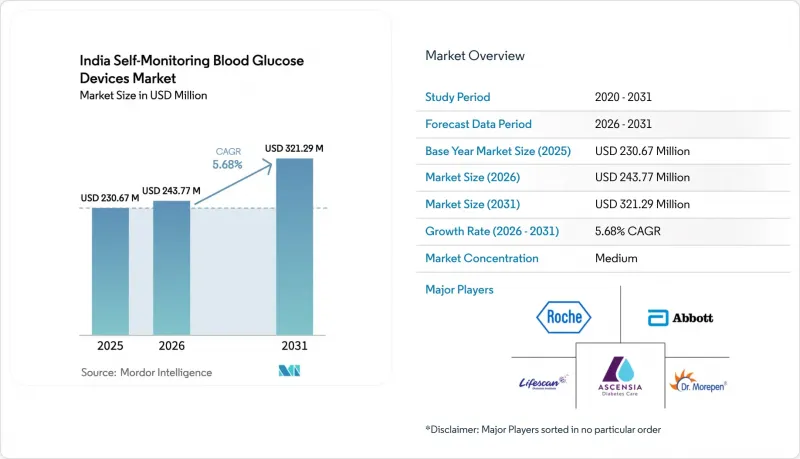
Mordor Intelligence에 의하면, 인도의 자가 혈당 측정 기기 시장 규모는 2025년에 2억 3,067만 달러로 평가되었습니다. 2026년 2억 4,377만 달러에서 2031년까지 3억 2,129만 달러에 이를 것으로 예상되며, 예측 기간(2026-2031년) CAGR은 5.68%를 나타낼 전망입니다.
본 보고서는 구성 요소(혈당 측정기, 테스트 스트립, 란셋 및 천자 장치), 기술(전기화학식 바이오센서, 광학식 등), 최종 사용자(재택 치료 환자, 병원 등), 유통 채널(오프라인 약국, 온라인 약국 및 소비자 직접 판매 등)별로 분류되어 있습니다. 시장 전망은 금액(달러) 기준으로 제시되어 있습니다.
인도의 자가 혈당 측정 기기 시장 동향 및 인사이트
당뇨병 유병률 증가 및 발병 연령의 저하
인도에는 7,700만 명의 성인 2형 당뇨병 환자와 2,500만 명의 당뇨병 전단계 환자가 존재하며, 이로 인해 자가 측정 기기에 대한 수요가 증가하고 있습니다. 25-40세 직장인의 발병 연령이 낮아짐에 따라 평생 모니터링 횟수가 증가하여, 디지털 라이프스타일에 적합한 커넥티드 혈당 측정기의 보급이 촉진되고 있습니다. 그 결과, 인도의 자가 혈당 측정 기기 시장에서는 테스트 스트립의 반복 구매가 증가하고, 프리미엄 기기로의 업그레이드도 증가하는 추세입니다.
정부의 선별 검사 및 보조금 프로그램
전국적인 선별 검사는 현재 700개 이상의 지역으로 확대되었으며, 공적 1차 진료에 혈당 검사가 포함되어 있습니다. 타밀나두 주에서만 2024년에 250만 명의 주민을 대상으로 선별 검사가 실시되어, 혈당 측정기 및 소모품의 소매 판매를 촉진했습니다. CGHS 및 ESIC의 일부 비용 지원은 혈당 측정기를 대상으로 하지만, 테스트 스트립은 대상에서 제외되어 공급업체에게는 지속적인 수익 가능성이 유지되는 반면, 저소득층의 도입은 제한되고 있습니다.
소모품의 고액 지속적인 비용
매월 소요되는 테스트 스트립 비용은 많은 경우 혈당 측정기의 일회성 구매 비용을 상회하며, 가격에 민감한 사용자들 사이에서는 검사 빈도가 감소하는 경향이 있습니다. 민간 보험의 보장 범위가 제한적이고, 공적 보험에 의한 환급도 최소한으로 그치고 있어 경제적 부담의 격차가 더욱 확대되고 있습니다.
부문 분석
2025년, 인도의 자가 혈당 측정 기기 시장에서 테스트 스트립은 50.02%의 점유율을 유지해, 소모품 중심의 수익 구조가 두드러지게 나타났습니다. 혈당 측정기 본체는 교체 주기와 디지털 기능 추가에 힘입어 연평균 성장률(CAGR) 10.74%로 성장하고 있습니다. 란셋과 천자 기구는 규모는 작지만 예측 가능한 판매량 추이를 보이고 있습니다. BeatO사의 ‘USB-C Curv’ 출시는 기술에 친숙한 젊은 층의 당뇨병 환자를 타겟으로 한 디자인 개선의 좋은 사례입니다. SRM Institute의 비침습형 프로토타입이 상용화된다면, 테스트 스트립 수요를 감소시키고 인도의 자가 혈당 측정 기기 시장을 재편할 가능성이 있습니다.
인도 PLI 제도 하에서의 생산 대부분은 전기화학적 테스트 스트립이 차지하고 있으며, 이로 인해 운송 비용이 10-15% 절감되어 현지 브랜드가 1급 도시를 넘어 유통망을 확대할 수 있게 되었습니다.
전기화학식 바이오센서는 성숙한 공급망과 입증된 정확도에 힘입어 2025년 매출의 76.10%를 차지했습니다. 광학식 플랫폼은 틈새 시장인 기관 수요를 충족시키고 있습니다. 스마트폰과 연동되는 동글은 연평균 성장률(CAGR) 15.28%로 성장하고 있으며, 인도의 7억 5,000만 대에 달하는 인터넷 연결이 가능한 휴대전화를 활용하는 형태입니다. 연속 측정형 스트립리스 카세트는 수명 주기 비용 절감을 원하는 사용자를 대상으로 하지만, 초기 투자 비용이 높습니다. CDSCO의 승인 절차는 안전성을 확보하는 한편, 신규 플랫폼 시장 출시 기간을 길게 만들어, 인도의 자가 혈당 측정 기기 시장이 차세대 형식을 어느 정도의 속도로 흡수할지를 좌우하고 있습니다.
기타 혜택 :
- 엑셀 형식 시장 예측(ME) 시트
- 3개월간의 애널리스트 지원
자주 묻는 질문
목차
제1장 서론
제2장 조사 방법
제3장 주요 요약
제4장 시장 구도
제5장 시장 규모 및 성장 예측
제6장 경쟁 구도
제7장 시장 기회 및 향후 전망
KTH 26.09.10According to Mordor Intelligence, the India self-Monitoring blood glucose devices market size was valued at USD 230.67 million in 2025 and estimated to grow from USD 243.77 million in 2026 to reach USD 321.29 million by 2031, at a CAGR of 5.68% during the forecast period (2026-2031).
This report is Segmented by Component (Glucometer Devices, Test Strips, and Lancets & Lancing Devices), Technology (Electrochemical Biosensors, Photometric, and More), End User (Home-Care Patients, Hospitals, and More), Distribution Channel (Offline Retail Pharmacies, E-Pharmacies & Direct-To-Consumer, and More). The Market Forecasts are Provided in Terms of Value (USD).
India Self-Monitoring Blood Glucose Devices Market Trends and Insights
Rising Diabetes Prevalence & Earlier Onset
India's 77 million adult Type 2 patient base, alongside 25 million prediabetic individuals, has intensified demand for self-testing devices. Earlier onset among professionals aged 25-40 pushes lifetime monitoring volumes higher and favors connected meters that fit digital lifestyles. The India Self-Monitoring Blood Glucose Devices market consequently records rising repeat purchases of strips and an uptick in premium device upgrades.
Government Screening & Subsidy Programmes
Nationwide screening now spans more than 700 districts, embedding glucose checks in public primary care. Tamil Nadu alone screened 2.5 million residents in 2024, stimulating downstream retail sales of meters and consumables. Partial reimbursements under CGHS and ESIC cover meters but exclude strips, sustaining recurring revenue potential for suppliers while constraining adoption among low-income groups.
High Recurring Cost of Consumables
Monthly strip expenses often exceed the one-time meter outlay, leading to reduced testing frequency among price-sensitive users. Limited private-insurance coverage and minimal public reimbursements exacerbate the affordability gap.
Other drivers and restraints analyzed in the detailed report include:
- Digital-Health Integration with Glucometers
- E-Pharmacy Subscription Penetration (Tier-2/3)
- Limited Insurance / Reimbursement Coverage
For complete list of drivers and restraints, kindly check the Table Of Contents.
Segment Analysis
Test strips retained 50.02% ownership of India Self-Monitoring Blood Glucose Devices market share in 2025, highlighting the consumable-centric revenue architecture. Glucometer devices, buoyed by replacement cycles and digital add-ons, are pacing at an 10.74% CAGR. Lancets and lancing devices, though smaller, follow a predictable volume trajectory. BeatO's USB-C Curv launch exemplifies design upgrades aimed at younger, tech-friendly diabetics. SRM Institute's non-invasive prototype, if commercialized, could compress strip demand and reshape the India Self-Monitoring Blood Glucose Devices market.
Electrochemical strips account for the bulk of manufacturing under India's PLI scheme, trimming landed costs by 10-15% and enabling local brands to widen distribution beyond tier-1 cities.
Electrochemical biosensors claimed 76.10% of 2025 revenues, supported by mature supply chains and validated accuracy. Photometric platforms occupy niche institutional demand. Smartphone-integrated dongles, rising at 15.28% CAGR, capitalize on India's 750 million internet-connected handsets. Continuous strip-free cassettes cater to users seeking lower lifetime spend but require higher upfront cash outlay. CDSCO approval processes promote safety yet elongate time-to-market for novel platforms, dictating the pace at which the India Self-Monitoring Blood Glucose Devices market absorbs next-gen formats.
Complete Report Scope:
- By Component
- Glucometer Devices
- Test Strips
- Lancets & Lancing Devices
- By Technology
- Electrochemical Biosensors
- Photometric (Optical)
- Continuous Strip-Free (e.g., cassette)
- Smartphone-integrated Dongles
- By End User
- Home-care Patients
- Hospitals
- Clinics & Diagnostic Labs
- Pharmacies & Wellness Stores
- By Distribution Channel
- Offline Retail Pharmacies
- Hospital-based Procurement
- e-Pharmacies & Direct-to-Consumer
List of Companies Covered in this Report:
- Abbott Laboratories
- AgaMatrix
- Arkray
- Ascensia
- BeatO (HealthArx)
- Bionime
- Morepen
- Dr. Trust (Nureca)
- ForaCare
- i-SENS Inc.
- Lifescan
- Menarini Diagnostics
- Nova Biomedical
- Roche
- Samajkalyan Pharma (Accurex)
- Sinocare
- Truworth Health
- Ypsomed
Additional Benefits:
- The market estimate (ME) sheet in Excel format
- 3 months of analyst support
TABLE OF CONTENTS
1 Introduction
- 1.1 Study Assumptions & Market Definition
- 1.2 Scope of the Study
2 Research Methodology
3 Executive Summary
4 Market Landscape
- 4.1 Market Overview
- 4.2 Market Drivers
- 4.2.1 Rising Diabetes Prevalence & Earlier Onset
- 4.2.2 Government Screening & Subsidy Programmes
- 4.2.3 Higher Disposable Income & Lifestyle Awareness
- 4.2.4 Digital-Health Integration with Glucometers
- 4.2.5 E-Pharmacy Subscription Penetration (Tier-2/3)
- 4.2.6 Localised Strip Manufacturing Under PLI Scheme
- 4.3 Market Restraints
- 4.3.1 High Recurring Cost of Consumables
- 4.3.2 Limited Insurance / Reimbursement Coverage
- 4.3.3 Counterfeit & Grey-Market Strips Undermine Trust
- 4.3.4 Data-Privacy Risks in App-Linked Devices
- 4.4 Supply-Chain Analysis
- 4.5 Regulatory Landscape
- 4.6 Technological Outlook
- 4.7 Porter's Five Forces Analysis
- 4.7.1 Bargaining Power of Suppliers
- 4.7.2 Bargaining Power of Consumers
- 4.7.3 Threat of New Entrants
- 4.7.4 Threat of Substitutes
- 4.7.5 Intensity of Competitive Rivalry
5 Market Size & Growth Forecasts (Value, USD)
- 5.1 By Component
- 5.1.1 Glucometer Devices
- 5.1.2 Test Strips
- 5.1.3 Lancets & Lancing Devices
- 5.2 By Technology
- 5.2.1 Electrochemical Biosensors
- 5.2.2 Photometric (Optical)
- 5.2.3 Continuous Strip-Free (e.g., cassette)
- 5.2.4 Smartphone-integrated Dongles
- 5.3 By End User
- 5.3.1 Home-care Patients
- 5.3.2 Hospitals
- 5.3.3 Clinics & Diagnostic Labs
- 5.3.4 Pharmacies & Wellness Stores
- 5.4 By Distribution Channel
- 5.4.1 Offline Retail Pharmacies
- 5.4.2 Hospital-based Procurement
- 5.4.3 e-Pharmacies & Direct-to-Consumer
6 Competitive Landscape
- 6.1 Market Concentration
- 6.2 Market Share Analysis
- 6.3 Company Profiles (includes Global level Overview, Market level overview, Core Business Segments, Financials, Headcount, Key Information, Market Rank, Market Share, Products and Services, and analysis of Recent Developments)
- 6.3.1 Abbott Diabetes Care
- 6.3.2 AgaMatrix
- 6.3.3 Arkray Inc.
- 6.3.4 Ascensia Diabetes Care
- 6.3.5 BeatO (HealthArx)
- 6.3.6 Bionime Corporation
- 6.3.7 Dr. Morepen
- 6.3.8 Dr. Trust (Nureca)
- 6.3.9 ForaCare
- 6.3.10 i-SENS Inc.
- 6.3.11 LifeScan
- 6.3.12 Menarini Diagnostics
- 6.3.13 Nova Biomedical
- 6.3.14 Roche Diabetes Care
- 6.3.15 Samajkalyan Pharma (Accurex)
- 6.3.16 Sinocare
- 6.3.17 Truworth Health
- 6.3.18 Ypsomed
7 Market Opportunities & Future Outlook
- 7.1 White-space & Unmet-Need Assessment


