

|
시장보고서
상품코드
2122922
자기 혈당 측정 : 시장 점유율 분석, 업계 동향 및 통계, 성장 예측(2026-2031년)Self-Monitoring Blood Glucose - Market Share Analysis, Industry Trends & Statistics, Growth Forecasts (2026 - 2031) |
||||||
 Mordor Intelligence
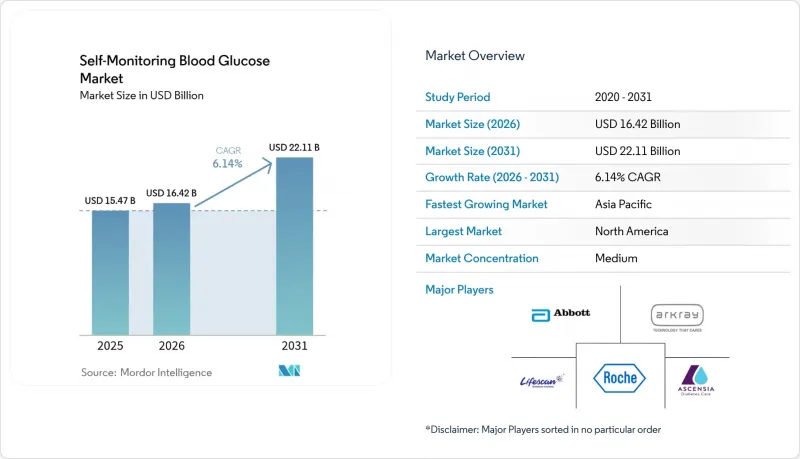
Mordor Intelligence에 의하면, 2026년 자기 혈당 측정 시장 규모는 164억 2,000만 달러로 추정되고 2025년 154억 7,000만 달러에서 확대해, 2031년에는 221억 1,000만 달러에 이를 것으로 예측됩니다.
2026-2031년 동안의 연평균 성장률(CAGR)은 6.14%를 나타낼 전망입니다.

본 보고서는 제품 유형(혈당 측정기, 기타), 기술(전기화학, 광학), 모달리티(휴대형 기존, 웨어러블·커넥티드), 용도(1형 당뇨병, 기타), 최종 사용자(병원 및 클리닉, 기타), 유통 채널(소매 약국, 기타),지역(북미, 유럽, 기타)별로 분류되어 있습니다. 시장 예측은 금액(달러) 기준으로 제시되어 있습니다.
세계의 자가 혈당 측정 시장 동향 및 인사이트
전 세계 당뇨병 유병률의 급증
국제 기구들은 당뇨병 환자 수가 2024년에 성인 8억 명을 넘어 2025년까지 13억 1,000만 명에 달할 가능성이 있다고 경고했으며, 빈번한 혈당 측정 필요성이 더욱 높아지고 있습니다. 진단 사례의 96%를 2형 당뇨병이 차지하고 있으며, 높은 체질량 지수(BMI)가 당뇨병 관련 장애 조정 생명 연수(DALY)의 절반 이상을 차지하고 있습니다. 당뇨병과 관련된 연간 직접 의료비는 4,130억 달러로 예측되며, 각 보험사는 신뢰할 수 있는 자가 혈당 측정 기기를 활용한 조기 개입을 중시하고 있습니다. 2025년에 발표된 합의 지침에서는 합병증을 예방하기 위한 기초로서 체계적인 검사의 중요성이 강조되고 있습니다. 이러한 부담의 규모를 고려할 때, 검사 보급률이 조금만 향상되어도 수요가 크게 증가할 것이 확실합니다.
가정 내 혈당 관리로의 전환
코로나19는 치료 경로의 광범위한 재설계를 촉진했으며, 응급 프로토콜 하에서 입원 환자와 외래 환자의 모니터링에 가정용 혈당 측정기 사용이 정착되었습니다. 그 후, 규제 당국에 의해 이 조치는 영구화되었습니다. 자가 측정이 HbA1c 수치를 0.3-0.5% 포인트 낮춘다는 증거에 따라, 의사들은 인슐린 사용자 여부와 관계없이 더 빈번한 재택 혈당 검사를 권장하게 되었습니다. 임상의에게 원격으로 전송되는 측정값은 내원 없이도 투약량을 미세 조정할 수 있게 하여, 지불 주체의 비용을 절감하는 동시에 편의성을 향상시키고 있습니다. 각 제조업체들은 환자의 참여도를 높이고 가격을 유지하기 위해, 테스트 스트립에 대한 보조금을 측정기와 앱이 통합된 번들 제품에 포함시키고 있습니다.
테스트 스트립에 대한 가격 압박 심화
성숙한 시장에서는 2023년 이후, 제네릭 테스트 스트립과 약국의 자체 브랜드 제품으로 인해 평균 판매 가격이 연평균 5-7% 하락하고 있습니다. 총 수익의 약 4분의 3을 테스트 스트립이 차지하고 있기 때문에 이익률 압박으로 인해 기존 제조업체들은 판매 수량 위주의 전략이나 프리미엄 커넥티드 생태계로의 전환을 강요받고 있습니다. 약국 혜택 관리 회사(PBM)가 매년 실시하는 입찰로 인해 경쟁이 심화되고 있으며, 제조업체들은 진열 공간을 확보하기 위해 코칭 앱이나 연장 보증을 세트로 판매할 수밖에 없는 상황에 처해 있습니다. 대기업들은 비용 우위를 되찾기 위해 효소 생산으로의 후방 통합을 모색하고 있습니다.
부문별 분석
2025년, 자가 혈당 측정 시장의 매출액 중 76.12%를 테스트 스트립이 차지했습니다. 이는 인슐린 사용자가 하루에 여러 번 측정해야 할 필요성에 힘입은 결과입니다. 이러한 소모품 모델은 공급업체를 하드웨어 교체 주기에서 분리시켜 주지만, 상품화(commoditization)로 인해 단가 이익률은 축소되고 있습니다. 현재 스트립의 기술 혁신은 0.4µL 이하의 모세혈관 혈액량과 5초 이내의 측정 시간을 목표로 하고 있으며, 이를 통해 치료 순응도 향상을 도모하고 있습니다. 혈당 측정기와 연동된 자가 혈당 측정 시장 규모는 급속히 확대되고 있으며, 2031년까지의 예측 연평균 성장률(CAGR)은 10.85%를 나타낼 것으로 전망됩니다. 이러한 제품들은 프리미엄 가격을 정당화할 수 있는 풍부한 데이터와 부가가치 서비스를 제공합니다. 제조업체들은 스마트폰 앱 개발자와 제휴하여 영양 기록, 만보계, 복약 알림 기능을 통합함으로써 차별화를 꾀하고 있습니다. 테스트 스트립의 환경적 부담을 최소화하기 위한 노력(바이오플라스틱 케이스, 골판지 포장 등)은 지속가능성에 대한 소비자의 높아지는 기대에 부응하는 것입니다.
2세대 측정 스트립에는 헤마토크리트 수치와 주변 온도를 교차 확인하는 다극 설계가 채택되어 사용자의 조작 실수를 줄이고 있습니다. 공급업체는 대량 구매 시 할인이 적용되는 로열티 프로그램을 도입하여 환자를 독자적인 생태계에 정착시키고 있습니다. 한편, 저소득 지역의 의료 시스템에서는 여전히 연결성보다 합리적인 가격을 우선시하고 있어, 단가가 하락하더라도 기본적인 측정 스트립에 대한 수요는 유지되고 있습니다.
판매되는 기기의 89.30%는 전기화학 센서를 기반으로 하고 있으며, 이는 수십 년에 걸친 신뢰성과 높은 비용 효율성을 보여줍니다. 효소를 통한 전류 출력은 혈당 농도와 선형적으로 상관관계가 있으므로 보정이 간소화됩니다. 탄소나노튜브 전극을 이용한 지속적인 소형화로 인해 더 얇고 짧은 테스트 스트립이 실현되었으며, 필요한 혈액량도 감소하고 있습니다. 광도법에 의한 측정법은 현재 시장 점유율이 미미하지만, 비효소적 검출 및 땀을 이용한 응용이 기대되는 광학 칩 덕분에 9.45%라는 가장 높은 성장 궤도를 보이고 있습니다. 광학 방식의 정확도와 단위당 경제성이 동등한 수준에 도달하기 전까지는 자가 혈당 측정 시장에서 전기화학 방식 플랫폼 시장 점유율 우위는 흔들리지 않을 것으로 보입니다.
연구자들은 조직간액 내의 포도당을 측정하기 위해 표면 증강 라만 분광법 실험을 진행하고 있지만, 피부 색조의 편차나 신호 대 잡음비 등의 과제에 직면해 있습니다. 전기화학식과 광학 측정식 모듈을 모두 탑재한 하이브리드형 측정기가 등장하여, 중복성을 제공할 뿐만 아니라 사용자의 전환 경로를 용이하게 하고 있습니다. 규제 당국은 평균 절대 상대 오차(MARD)의 기준치를 엄격하게 정하고 있습니다. 따라서 신기술이 임상적 타당성을 얻기 위해서는 전기화학 방식의 벤치마크를 상회해야 합니다.
지역별 분석
북미는 2025년 매출의 39.45%를 차지하며, 그 중심에는 미국이 있었습니다. 미국의 성인 당뇨병 유병률은 11.3%에 달하며, 1인당 의료비는 여전히 세계 최고 수준입니다. 메디케어와 민간 보험사는 혈당 측정기의 하드웨어와 소모품 모두를 보상하고 있으며, 이를 통해 자가 혈당 측정 시장의 큰 점유율이 유지되는 동시에 차세대 커넥티드 기기에 대한 자금 지원도 이루어지고 있습니다. 캐나다도 유사한 추세를 보이고 있지만, 각 주의 처방약 목록에서는 테스트 스트립의 가격 상한선이 중시되고 있어 저가 브랜드의 성장이 촉진되고 있습니다. 4G/5G의 광범위한 통신망은 혈당 측정기 데이터를 전자 차트에 직접 통합하는 원격 당뇨병 관리 플랫폼을 뒷받침하고 있습니다.
유럽은 2위를 차지하고 있으며, 2025년에는 독일 한 나라만으로도 지역 전체 매출의 4분의 1 이상을 차지했습니다. 법정 보험 제도에서는 인슐린 사용자에게 측정 스트립을 무제한으로 환급하고 있기 때문에 입찰에 따른 치열한 가격 하락에도 불구하고 판매량은 증가하고 있습니다. ‘유럽 그린 딜’과 같은 환경 지침에 따라 일회용 플라스틱 부품에 대한 모니터링이 강화되고 있으며, 공급업체들은 재활용 가능한 카트리지 도입 및 회수 시범 사업 시행에 나서고 있습니다. 스웨덴이나 프랑스 등 일부 국가에서는 조달 평가에 탄소 발자국 지표를 반영하기 시작하여, 친환경 브랜드에 선점 우위를 제공합니다.
아시아태평양은 2031년 연평균 성장률(CAGR)이 9.18%로 가장 빠르게 성장하고 있는 지역입니다. 중국의 성인 당뇨병 유병률은 10.9%로, 이는 1억 4,000만 명 이상의 잠재적 사용자에 해당합니다. 국내 제조업체들은 규모의 경제를 활용해 저가형 테스트 스트립을 공급하는 한편, 해외 브랜드들은 정확도와 연결성을 무기로 경쟁하고 있습니다. 인도에서는 확대되는 중산층과 ‘아유슈만 바라트’와 같은 정부 주도의 건강보험 제도로 인해 이용 기회가 넓어지고 있지만, 농촌 지역의 유통 격차는 여전히 남아 있습니다. 동남아시아 도시 지역에서는 스마트폰 보급률이 70%를 넘어섰기 때문에 앱 연동형 혈당 측정기의 보급이 가속화되고 있습니다. 현지 언어로 된 인터페이스와 국내에 호스팅된 클라우드 서버는 규제 요건과 문화적 선호도를 반영하여 보급을 촉진하고 있습니다.
기타 혜택
- 엑셀 형식 시장 예측(ME) 시트
- 3개월간의 애널리스트 지원
자주 묻는 질문
목차
제1장 서론
제2장 조사 방법
제3장 주요 요약
제4장 시장 구도
제5장 시장 규모 및 성장 예측
제6장 경쟁 구도
제7장 시장 기회 및 향후 전망
KTH 26.09.08According to Mordor Intelligence, self-Monitoring blood glucose market size in 2026 is estimated at USD 16.42 billion, growing from 2025 value of USD 15.47 billion with 2031 projections showing USD 22.11 billion, growing at 6.14% CAGR over 2026-2031.
This report is Segmented by Product Type (Glucose Meters, and More), Technology (Electrochemical and Photometric), Modality (Hand-Held Conventional and Wearable), Application (Type 1 Diabetes, and More), End-User (Hospitals, and More), Distribution Channel (Retail Pharmacies, and More), and Geography (North America, Europe, and More). The Market Forecasts are Provided in Terms of Value (USD).
Global Self-Monitoring Blood Glucose Market Trends and Insights
Escalating Global Diabetes Prevalence
International agencies warn that diabetes cases surpassed 800 million adults in 2024 and could hit 1.31 billion by 2025, amplifying the imperative for frequent glucose checks. Type 2 diabetes represents 96% of diagnoses, with high body-mass index driving more than half of related disability-adjusted life years. Annual direct medical spending linked to diabetes is projected at USD 413 billion, prompting insurers to emphasize early intervention using reliable self-monitoring devices. Consensus guidelines released in 2025 reinforce structured testing as foundational to avoid complications. The scale of the burden ensures that even incremental gains in testing penetration translate into substantial unit demand.
Shift Toward Home-Based Glucose Management
COVID-19 catalyzed a broad redesign of care pathways, normalizing home-use meters for both inpatient and outpatient monitoring under emergency protocols later made permanent by regulators. Evidence linking self-testing to 0.3-0.5 percentage-point reductions in HbA1c has convinced physicians to endorse more frequent home checks for insulin and non-insulin users alike. Remote meter readings transmitted to clinicians support medication titration without clinic visits, lowering costs for payers while improving convenience. Manufacturers are countersinking test-strip subsidies into integrated meter-and-app bundles to deepen patient engagement and defend pricing.
Intensifying Price Pressure on Test Strips
Generic strips and private-label pharmacy offerings have eroded average selling prices by 5-7% annually since 2023 in mature markets. With strips accounting for roughly three-quarters of total revenue, margin compression is steering incumbents toward volume-based tactics or migration to premium connected ecosystems. Pharmacy benefit managers conduct annual tenders that intensify competition, forcing manufacturers to bundle coaching apps and extended warranties to defend shelf space. Large players are exploring backward integration into enzyme production to recapture cost advantages.
Other drivers and restraints analyzed in the detailed report include:
- Expanded Reimbursement for SMBG Supplies
- Digital Integration with Tele-Diabetes Platforms
- Stringent Regulatory Compliance Hurdles
For complete list of drivers and restraints, kindly check the Table Of Contents.
Segment Analysis
Test strips generated 76.12% of Self-Monitoring Blood Glucose market revenue in 2025, propelled by the necessity for multiple daily measurements among insulin users. This consumable model insulates suppliers from hardware replacement cycles, though commoditization has narrowed unit margins. Strip innovations now target capillary volumes below 0.4 µL and 5-second read times to boost adherence. The Self-Monitoring Blood Glucose market size tied to glucose meters is expanding swiftly which deliver 10.85% forecast CAGR through 2031, offering richer data and value-added services that justify premiums. Manufacturers partner with smartphone-app developers to merge nutrition logs, step counts, and medication reminders, enhancing differentiation. Efforts to minimize strip environmental footprint-bioplastic housings and corrugated paper packaging-address rising consumer sustainability expectations.
Second-generation strips incorporate multi-electrode designs that cross-check hematocrit and ambient temperature, cutting user error. Suppliers bundle loyalty programs that discount bulk packs, locking patients into proprietary ecosystems. Conversely, healthcare systems in lower-income regions still prioritize affordability over connectivity, sustaining basic strip demand even as unit prices slip.
Electrochemical sensors underpin 89.30% of devices sold, testament to decades of reliability and cost efficiency. Their enzyme-mediated current output correlates linearly with glucose concentration, simplifying calibration. Continued miniaturization using carbon-nanotube electrodes enables thinner, shorter strips that require less blood. Photometric methods hold only a modest share today yet post the highest growth trajectory at 9.45% owing to optical chips that promise non-enzymatic detection and potential sweat-based applications. The Self-Monitoring Blood Glucose market share advantage of electrochemical platforms remains secure until optical accuracy and unit economics converge.
Researchers are experimenting with surface-enhanced Raman spectroscopy to resolve interstitial glucose yet face challenges such as skin-tone variability and signal-to-noise. Hybrid meters that incorporate both electrochemical and photometric modules are emerging, offering redundancy and facilitating transition paths for users. Regulatory agencies mandate tight mean absolute relative difference thresholds; thus, new technologies must surpass electrochemical benchmarks to gain clinical legitimacy.
Complete Report Scope:
- By Product Type
- Glucose Meters
- Test Strips
- Lancets
- By Technology
- Electrochemical
- Photometric
- By Modality
- Hand-held Conventional
- Wearable / Connected
- By Application
- Type 1 Diabetes
- Type 2 Diabetes
- Gestational Diabetes
- Prediabetes
- By End-user
- Hospitals & Clinics
- Home-care Settings
- Diagnostic Laboratories
- Ambulatory Surgical Centers
- By Distribution Channel
- Retail Pharmacies
- Hospital Pharmacies
- Online Pharmacies
- Others
- Geography
- North America
- United States
- Canada
- Mexico
- Europe
- Germany
- United Kingdom
- France
- Italy
- Spain
- Rest of Europe
- Asia-Pacific
- China
- Japan
- India
- Australia
- South Korea
- Rest of Asia-Pacific
- Middle East and Africa
- GCC
- South Africa
- Rest of Middle East and Africa
- South America
- Brazil
- Argentina
- Rest of South America
- North America
Geography Analysis
North America accounted for 39.45% of 2025 revenue, anchored by the United States where diabetes prevalence stood at 11.3% of adults and healthcare spend per capita remains the world's highest. Medicare and private insurers reimburse both meter hardware and supplies, sustaining sizeable Self-Monitoring Blood Glucose market share and funding next-generation connected devices. Canada mirrors these dynamics, although provincial formularies emphasize price caps on strips, spurring growth of lower-cost brands. Widespread 4G/5G coverage underpins tele-diabetes platforms that integrate meter feeds directly into electronic health records.
Europe ranks second, with Germany alone holding more than one quarter of regional revenue in 2025. Statutory insurance schemes reimburse unlimited strips for insulin users, driving volumes despite fierce tender-led price erosion. Environmental directives such as the European Green Deal elevate scrutiny of single-use plastic components, prompting suppliers to introduce recyclable cartridges and take-back pilots. Nations like Sweden and France have begun factoring carbon-footprint metrics into procurement scoring, offering early-mover advantages to eco-forward brands.
Asia-Pacific is the fastest-growing region at 9.18% CAGR through 2031. China's adult diabetes prevalence of 10.9% translates into more than 140 million potential users; domestic manufacturers leverage scale to supply low-priced strips, while foreign brands compete on accuracy and connectivity. India's expanding middle class and government health insurance schemes such as Ayushman Bharat widen access, yet rural distribution gaps persist. Smartphone penetration exceeding 70% across urban Southeast Asia accelerates adoption of app-linked meters. Local language interfaces and cloud servers hosted within national borders address regulatory and cultural preferences, facilitating uptake.
- Abbott Laboratories
- Roche
- Lifescan
- Ascensia
- Arkray
- Terumo Corp.
- i-SENS Inc.
- Nova Biomedical
- Bionime
- AgaMatrix
- Acon Laboratories
- Trividia Health
- Rossmax
- Ypsomed
- OK Biotech Co. Ltd.
- SD Biosensor Inc.
- Sinocare
- B. Braun
- A. Menarini Diagnostics (GlucoMen)
- Beurer
Additional Benefits:
- The market estimate (ME) sheet in Excel format
- 3 months of analyst support
TABLE OF CONTENTS
1 Introduction
- 1.1 Study Assumptions & Market Definition
- 1.2 Scope of the Study
2 Research Methodology
3 Executive Summary
4 Market Landscape
- 4.1 Market Overview
- 4.2 Market Drivers
- 4.2.1 Escalating Global Diabetes Prevalence And Earlier Diagnostic Rates
- 4.2.2 Shift Toward Home-Based, Patient-Empowered Glucose Management
- 4.2.3 Expanding Third-Party Reimbursement And Insurance Coverage For SMBG Supplies Across Major Economies
- 4.2.4 Rising Disposable Income And Diabetes Awareness In High-Growth Emerging Markets
- 4.2.5 Integration Of SMBG Data With Digital Health & Tele-Diabetes Platforms Driving Value-Added Services
- 4.3 Market Restraints
- 4.3.1 Intensifying Price Competition And Commoditization Of Test Strips Compressing Margins
- 4.3.2 Stringent Regulatory & Quality-Compliance Requirements Prolonging Product Approval Timelines
- 4.3.3 Environmental And Waste-Management Concerns Over Single-Use Strips And Lancets
- 4.4 Supply-Chain Analysis
- 4.5 Technological Outlook
- 4.6 Porter's Five Forces
- 4.6.1 Bargaining Power of Suppliers
- 4.6.2 Bargaining Power of Buyers
- 4.6.3 Threat of New Entrants
- 4.6.4 Threat of Substitutes
- 4.6.5 Competitive Rivalry
5 Market Size & Growth Forecasts (Value, USD)
- 5.1 By Product Type
- 5.1.1 Glucose Meters
- 5.1.2 Test Strips
- 5.1.3 Lancets
- 5.2 By Technology
- 5.2.1 Electrochemical
- 5.2.2 Photometric
- 5.3 By Modality
- 5.3.1 Hand-held Conventional
- 5.3.2 Wearable / Connected
- 5.4 By Application
- 5.4.1 Type 1 Diabetes
- 5.4.2 Type 2 Diabetes
- 5.4.3 Gestational Diabetes
- 5.4.4 Prediabetes
- 5.5 By End-user
- 5.5.1 Hospitals & Clinics
- 5.5.2 Home-care Settings
- 5.5.3 Diagnostic Laboratories
- 5.5.4 Ambulatory Surgical Centers
- 5.6 By Distribution Channel
- 5.6.1 Retail Pharmacies
- 5.6.2 Hospital Pharmacies
- 5.6.3 Online Pharmacies
- 5.6.4 Others
- 5.7 Geography
- 5.7.1 North America
- 5.7.1.1 United States
- 5.7.1.2 Canada
- 5.7.1.3 Mexico
- 5.7.2 Europe
- 5.7.2.1 Germany
- 5.7.2.2 United Kingdom
- 5.7.2.3 France
- 5.7.2.4 Italy
- 5.7.2.5 Spain
- 5.7.2.6 Rest of Europe
- 5.7.3 Asia-Pacific
- 5.7.3.1 China
- 5.7.3.2 Japan
- 5.7.3.3 India
- 5.7.3.4 Australia
- 5.7.3.5 South Korea
- 5.7.3.6 Rest of Asia-Pacific
- 5.7.4 Middle East and Africa
- 5.7.4.1 GCC
- 5.7.4.2 South Africa
- 5.7.4.3 Rest of Middle East and Africa
- 5.7.5 South America
- 5.7.5.1 Brazil
- 5.7.5.2 Argentina
- 5.7.5.3 Rest of South America
- 5.7.1 North America
6 Competitive Landscape
- 6.1 Market Concentration
- 6.2 Market Share Analysis
- 6.3 Company Profiles (includes Global level Overview, Market level overview, Core Business Segments, Financials, Headcount, Key Information, Market Rank, Market Share, Products and Services, and analysis of Recent Developments)
- 6.3.1 Abbott Laboratories
- 6.3.2 F. Hoffmann-La Roche AG
- 6.3.3 LifeScan Inc.
- 6.3.4 Ascensia Diabetes Care
- 6.3.5 ARKRAY Inc.
- 6.3.6 Terumo Corp.
- 6.3.7 i-SENS Inc.
- 6.3.8 Nova Biomedical
- 6.3.9 Bionime Corporation
- 6.3.10 AgaMatrix Inc.
- 6.3.11 ACON Laboratories
- 6.3.12 Trividia Health
- 6.3.13 Rossmax International
- 6.3.14 Ypsomed AG
- 6.3.15 OK Biotech Co. Ltd.
- 6.3.16 SD Biosensor Inc.
- 6.3.17 Sinocare Inc.
- 6.3.18 B. Braun Melsungen AG
- 6.3.19 A. Menarini Diagnostics (GlucoMen)
- 6.3.20 Beurer GmbH
7 Market Opportunities & Future Outlook
- 7.1 White-space & Unmet-need Assessment


