|
시장보고서
상품코드
2119592
첸나이의 데이터센터 : 시장 점유율 분석, 업계 동향 및 통계, 성장 예측(2026-2032년)Chennai Data Center - Market Share Analysis, Industry Trends & Statistics, Growth Forecasts (2026 - 2032) |
||||||
 Mordor Intelligence
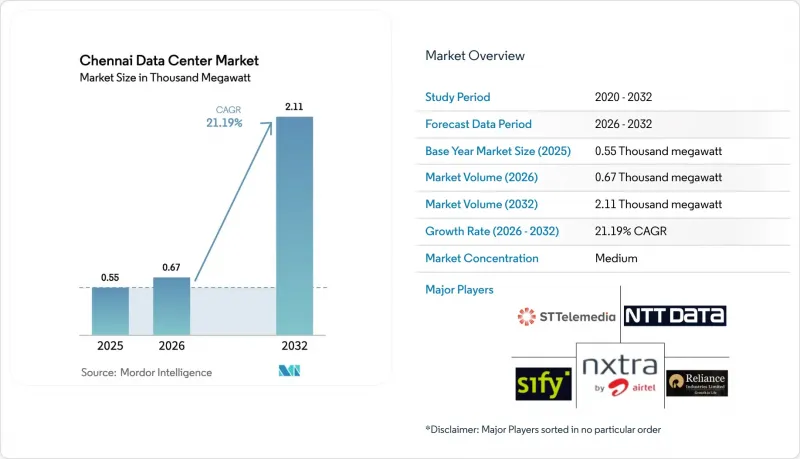
Mordor Intelligence에 의하면, 첸나이의 데이터센터 시장 규모는 2025년 550 MW로 평가되었습니다. 2026년에는 670 MW로 확대되어 2026-2032년 CAGR 21.19%로 성장을 지속하여, 2032년까지 2,110 MW에 이를 것으로 예측됩니다.
본 보고서는 데이터센터 규모(소규모, 중규모, 대규모, 메가, 초대규모), 티어(Tier 1·2, Tier 3, Tier 4), 이용 현황(코로케이션 유형 및 최종 사용자 산업별 이용 현황, 미이용)별로 분류되어 있습니다. 시장 전망은 MW 단위의 용량으로 표시되어 있습니다.
첸나이의 데이터센터 시장 동향 및 인사이트
해저 케이블 상륙으로 국제 대역폭 확대
SEA-ME-WE-6 및 MIST를 포함한 5개의 추가 시스템을 통해 첸나이는 총 420 TBPS의 용량에 직접 접근할 수 있게 되어, 싱가포르 및 마르세유로의 지연 시간을 줄이는 동시에 이 도시를 지역 재해 복구 허브로 자리매김하고 있습니다. 케이블 사업자들은 상륙 스테이션을 하이퍼스케일 캠퍼스와 코로케이션하여 OTT 및 핀테크 워크로드를 유치하는 연결성과 컴퓨팅을 수직 통합한 클러스터를 구축하고 있습니다. 풍부한 대역폭은 AI 훈련 분야에서 첸나이의 데이터센터 시장의 역할도 뒷받침하고 있으며, 대용량 데이터 수집에 있어 대용량 국제 경로가 활용되고 있습니다. 2016년 이후 인도의 케이블 용량이 9배 증가한 점과 맞물려, 첸나이의 해외 트래픽 점유율은 지속적으로 상승하고 있습니다.
타밀나두 주의 재생에너지 오픈 액세스 회랑
타밀나두주에는 풍력, 태양광, 수력발전을 합친 34.7 GW의 재생에너지 자산이 있어, 사업자들에게 100% 청정 에너지 목표 달성을 위한 비용 효율적인 경로를 제공합니다. 데이터센터의 전력 구매 계약은 유리한 송전 요금 및 전력 축적 관련 규정의 혜택을 받아 운영 비용을 최대 12% 절감하고 있습니다. STT GDC는 첸나이 캠퍼스에서 60% 이상의 친환경 전력을 조달하고 있으며, Equinix는 2030년까지 100% 달성을 목표로 하고 있습니다. 재생에너지 회랑은 향후 탄소 규제로 인한 위험을 완화하고, 하이퍼스케일 코로케이션 입찰에서 지속가능성을 경쟁적 차별화 요소로 삼고 있습니다.
그레이터 첸나이 내 25에이커 이상의 연속된 토지 부족
도시 확장에 따라 IT 회랑을 따라 위치한 양질의 토지가 고갈되고 있으며, 이로 인해 취득 비용이 15-20% 상승하여 사업자들은 고층 빌딩이나 교외 캠퍼스 건설을 선택할 수밖에 없는 상황입니다. Yotta사의 13에이커 규모 시설은 층별 모듈식 설계를 통해 2만 랙의 수용 능력을 실현한 반면, ESR사는 해안 지역의 지가 급등을 상쇄하기 위해 오라가담에 80에이커의 부지를 제공합니다. 위성 클러스터가 등장하지 않는 한, 토지 부족이 첸나이의 데이터센터 시장의 성장을 둔화시킬 가능성이 있습니다.
부문 분석
2025년, 대규모 시설은 균형 잡힌 설비 투자와 니어쇼어 연결의 이점에 힘입어 첸나이의 데이터센터 시장 점유율의 45.32%를 차지했습니다. 이 거대한 부문은 연평균 성장률(CAGR) 23.12%를 나타낼 것으로 예측되며, 2032년까지 첸나이의 데이터센터 시장 규모에 782.6 MW를 기여할 것으로 전망됩니다. 하이퍼스케일 기업들은 10 MW를 초과하는 연속된 홀을 확보하여 수냉식 AI 클러스터를 구축하는 한편, 일반 기업들은 규정 준수 워크로드를 위해 대규모 캠퍼스 내의 소규모 블록을 임대하고 있습니다.
첸나이의 광대한 캠퍼스에는 부지 내 변전소와 재생에너지의 직접 공급이 통합되어 있어 전력 지연과 탄소 발자국을 줄이고 있습니다. AdaniConneX의 플래그십 캠퍼스에서는 400 kV 개폐소와 18 MW 태양광 발전소를 결합하여 정격 출력을 낮추지 않고도 30 kW 랙 운영을 가능하게 하고 있습니다. NTT의 ‘첸나이 2’ 시설에서는 모듈형 전원 시스템을 우선적으로 채택하고 있어, AI 수요의 급증에 대응하여 단계적인 확장이 가능합니다.
기타 혜택 :
- 엑셀 형식 시장 예측(ME) 시트
- 3개월간의 애널리스트 지원
자주 묻는 질문
목차
제1장 서론
제2장 조사 방법
제3장 주요 요약
제4장 시장 구도
제5장 시장 규모 및 성장 예측(금액 및 MW)
제6장 경쟁 구도
제7장 시장 기회 및 향후 전망
KTH 26.09.10According to Mordor Intelligence, the chennai data center market size is expected to grow from 0.55 Thousand MW in 2025 to 0.67 Thousand MW in 2026 and is forecast to reach 2.11 Thousand MW by 2032 at 21.19% CAGR over 2026-2032.
This report is Segmented by Data Center Size (Small, Medium, Large, Mega, Massive), Tier Standard (Tier 1 and 2, Tier 3, Tier 4), Absorption (Utilized by Colocation Type and End-User Industry, Non-Utilized). The Market Forecasts are Provided in Terms of MW Capacity.
Chennai Data Center Market Trends and Insights
Sub-sea cable landings multiply international bandwidth
Five additional systems, including SEA-ME-WE-6 and MIST, give Chennai direct access to 420 TBPS aggregate capacity, lowering latency to Singapore and Marseille while positioning the city as a regional disaster-recovery hub. Cable operators co-locate landing stations with hyperscale campuses, creating vertically integrated connectivity-to-compute clusters that attract OTT and fintech workloads. Bandwidth abundance also underpins the Chennai data center market's role in AI training, where large data ingests benefit from high-capacity international routes. Combined with India's nine-fold increase in cable capacity since 2016, Chennai's share of outbound traffic continues to rise.
Renewable-energy open-access corridors in Tamil Nadu
Tamil Nadu hosts 34.7 GW of renewable assets across wind, solar, and hydro, giving operators a cost-effective path to 100% clean energy targets. Data-center power purchase agreements benefit from favorable wheeling charges and banking provisions, cutting operating costs by up to 12%. STT GDC sources more than 60% green power for its Chennai campus, while Equinix targets 100% by 2030. Renewable corridors also de-risk future carbon regulations, making sustainability a competitive differentiator in hyperscale colocation bids.
Scarcity of contiguous greater than 25-acre parcels in Greater Chennai
Urban expansion has exhausted prime land along the IT corridor, raising acquisition costs by 15-20% and forcing operators toward multi-story vertical builds or suburban campuses. Yotta's 13-acre facility achieves 20,000-rack capacity through floor-wise modular design, while ESR offers 80 acres in Oragadam to offset coastal land premiums. Land scarcity could slow the Chennai data center market unless satellite clusters emerge.
Other drivers and restraints analyzed in the detailed report include:
- Cloud-first adoption by BFSI, OTT and GCC operators
- State incentives under Tamil Nadu DC policy
- 230 kV grid-tie lead times exceed 24 months
For complete list of drivers and restraints, kindly check the Table Of Contents.
Segment Analysis
Large facilities captured 45.32% of Chennai data center market share in 2025, supported by balanced capex and near-shore connectivity advantages. The massive segment is forecast to grow at 23.12% CAGR, contributing 782.6 MW to Chennai data center market size by 2032. Hyperscale clients reserve contiguous halls exceeding 10 MW to deploy liquid-cooled AI clusters, while enterprises lease smaller blocks within large campuses for compliance-ready workloads.
Chennai's massive campuses integrate on-site substations and direct renewable feeds, reducing power latency and carbon footprints. AdaniConneX's flagship campus pairs a 400 kV switchyard with an 18 MW solar plant, enabling 30 kW racks without derating. NTT's Chennai 2 facility prioritizes modular power trains, allowing phased expansion in response to AI demand surges.
Complete Report Scope:
- By Data Center Size
- Small
- Medium
- Large
- Mega
- Massive
- By Tier Standard
- Tier I and II
- Tier III
- Tier IV
- By Absorption
- Utilized
- By Colocation Type
- Hyperscale
- Retail
- Wholesale
- By End-User Industry
- BFSI
- Cloud Service Providers
- E-Commerce
- Government
- Manufacturing
- Media and Entertainment
- Telecom
- Other End Users
- By Colocation Type
- Non-Utilized
- Utilized
List of Companies Covered in this Report:
- AdaniConneX
- Brookfield Infrastructure
- CapitaLand Data Centres (Ascendas)
- CtrlS Datacenters
- Equinix
- NTT Global Data Centers
- Nxtra by Airtel
- Reliance Data Centers
- Sify Technologies
- ST Telemedia GDC India
- Yotta Infrastructure
- Tata Communications
Additional Benefits:
- The market estimate (ME) sheet in Excel format
- 3 months of analyst support
TABLE OF CONTENTS
1 INTRODUCTION
- 1.1 Study Assumptions and Market Definition
- 1.2 Scope of the Study
2 RESEARCH METHODOLOGY
3 EXECUTIVE SUMMARY
4 MARKET LANDSCAPE
- 4.1 Market Overview
- 4.2 Market Drivers
- 4.2.1 Sub-sea cable landings multiply international bandwidth
- 4.2.2 Renewable-energy open-access corridors in Tamil Nadu
- 4.2.3 Cloud-first adoption by BFSI, OTT and GCC operators
- 4.2.4 State incentives under Tamil Nadu DC policy
- 4.2.5 >=30 kW AI/LLM rack densities force white-space retrofits
- 4.2.6 Cold-chain logistics pivot to data-powered automation hubs
- 4.3 Market Restraints
- 4.3.1 Scarcity of contiguous > 25-acre parcels in Greater Chennai
- 4.3.2 230 kV grid-tie lead times exceed 24 months
- 4.3.3 Monsoon-flood and CRZ clearance risk along ECR coastline
- 4.3.4 Shortfall of Uptime-Tier-certified commissioning talent
- 4.4 Value / Supply-Chain Analysis
- 4.5 Regulatory Landscape
- 4.6 Technological Outlook
- 4.7 Porter's Five Forces
- 4.7.1 Threat of New Entrants
- 4.7.2 Bargaining Power of Buyers
- 4.7.3 Bargaining Power of Suppliers
- 4.7.4 Threat of Substitutes
- 4.7.5 Competitive Rivalry
5 MARKET SIZE AND GROWTH FORECASTS (VALUE AND MW)
- 5.1 By Data Center Size
- 5.1.1 Small
- 5.1.2 Medium
- 5.1.3 Large
- 5.1.4 Mega
- 5.1.5 Massive
- 5.2 By Tier Standard
- 5.2.1 Tier I and II
- 5.2.2 Tier III
- 5.2.3 Tier IV
- 5.3 By Absorption
- 5.3.1 Utilized
- 5.3.1.1 By Colocation Type
- 5.3.1.1.1 Hyperscale
- 5.3.1.1.2 Retail
- 5.3.1.1.3 Wholesale
- 5.3.1.2 By End-User Industry
- 5.3.1.2.1 BFSI
- 5.3.1.2.2 Cloud Service Providers
- 5.3.1.2.3 E-Commerce
- 5.3.1.2.4 Government
- 5.3.1.2.5 Manufacturing
- 5.3.1.2.6 Media and Entertainment
- 5.3.1.2.7 Telecom
- 5.3.1.2.8 Other End Users
- 5.3.1.1 By Colocation Type
- 5.3.2 Non-Utilized
- 5.3.1 Utilized
6 COMPETITIVE LANDSCAPE
- 6.1 Market Share Analysis
- 6.2 Company Landscape
- 6.3 Company Profiles (includes Global-level Overview, Market-level Overview, Core Segments, Financials as available, Strategic Information, Market Rank/Share for key companies, Products and Services, and Recent Developments)
- 6.3.1 AdaniConneX
- 6.3.2 Brookfield Infrastructure
- 6.3.3 CapitaLand Data Centres (Ascendas)
- 6.3.4 CtrlS Datacenters
- 6.3.5 Equinix
- 6.3.6 NTT Global Data Centers
- 6.3.7 Nxtra by Airtel
- 6.3.8 Reliance Data Centers
- 6.3.9 Sify Technologies
- 6.3.10 ST Telemedia GDC India
- 6.3.11 Yotta Infrastructure
- 6.3.12 Tata Communications
- 6.4 List of Companies Studied
7 MARKET OPPORTUNITIES AND FUTURE OUTLOOK
- 7.1 White-Space and Unmet-Need Assessment