
|
시장보고서
상품코드
2119635
인도의 침전 실리카 시장 : 점유율 분석, 업계 동향과 통계, 성장 예측(2026-2031년)India Precipitated Silica - Market Share Analysis, Industry Trends & Statistics, Growth Forecasts (2026 - 2031) |
||||||
 Mordor Intelligence
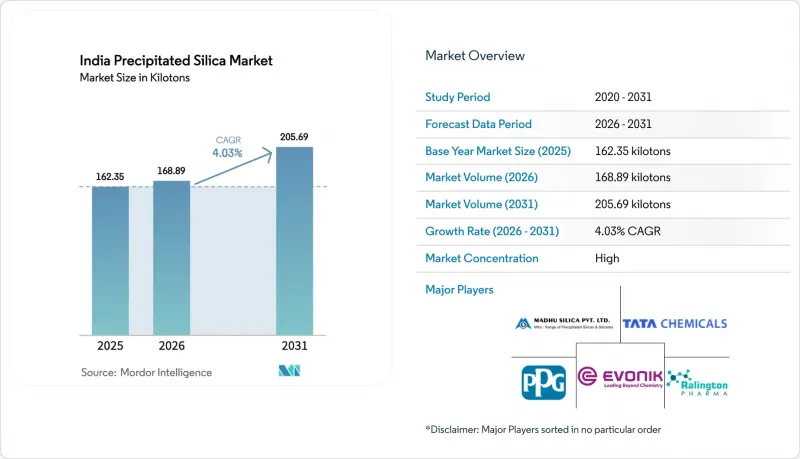
Mordor Intelligence에 의하면, 인도의 침전 실리카 시장 규모는 2025년에 162.35 킬로톤이라고 평가되어 2026년 168.89 킬로톤에서 2031년까지 205.69 킬로톤에 이를 것으로 예측되며, 예측 기간(2026-2031년) 중 CAGR은 4.03%로 예상됩니다.
본 보고서는 최종 사용자 산업별(농업, 구강 관리·화장품, 농약, 타이어, 전자제품 등), 제조 공정별(습식법, 건식법),제품 형태별(분말, 비드, 마이크로펄, 과립), 등급별(고무용, 식품용, 치과·구강 관리용, 사료용, 기타), 지역별(북인도, 서인도, 남인도, 동인도 및 북동인도)로 분류되어 있습니다.
인도 침전 실리카 시장 동향 및 인사이트
국내 OEM용 고무 산업에서의 타이어용 실리카 수요
국내 타이어 제조업체들은 현재 엄격한 연비 및 배기가스 규제를 충족하기 위해 더 높은 실리카 배합률을 채택하고 있으며, 침전 실리카는 단순한 범용 원료가 아닌 성능에 필수적인 첨가제로 자리매김하고 있습니다. CEAT사가 오프로드 타이어 부문에서 일일 생산량을 105톤에서 160톤으로 확대하고, 수출 매출의 25%라는 목표를 세운 것은 규모 확대와 세계 다각화가 수요의 회복력을 뒷받침하고 있음을 보여줍니다. 2020년에 일부 타이어 카테고리가 ‘자유’에서 ‘제한’으로 재분류된 수입 규제로 인해 해외 유입이 80% 이상 감소했고, 실리카 수요는 사실상 국내 공급망으로 유도되었습니다. SUV 판매 대수 증가와 레이디얼 타이어로의 전환 추세는 타이어 크기의 대형화와 실리카 사용량 증가로 이어져 소비를 더욱 뒷받침하고 있습니다. 인도의 침전 실리카 시장은 고성능 컴파운드가 원자재 가격 변동 속에서도 제조업체의 이익률을 유지할 수 있는 가격 책정 여지를 제공하기 때문에 직접적인 혜택을 받고 있습니다. 이러한 상호 연관된 자동차 업계 동향은 특수 고무 등급에 대한 수요를 점진적으로 끌어올리는 수년에 걸친 안정적인 수요 범위를 가져오고 있습니다.
주요 FMCG 기업들의 저VOC 치약으로의 급속한 전환
FMCG(일용소비재) 기업들은 휘발성 유기 용매를 제거하기 위해 구강 관리 제품의 배합을 재검토하고 있으며, 연마제 및 유변학 조절제로서 침전 실리카의 사용을 촉진하고 있습니다. 콜게이트 팔모리브 인디아는 이익률이 5-8퍼센트 포인트 높은 프리미엄 부문의 매출을 3배로 확대하는 것을 목표로 하고 있으며, 미백 효과와 사용감을 향상시키는 실리카 등급의 사용을 의무화하고 있습니다. 농촌 지역의 위생 습관 보급률은 여전히 낮은 수준이며, 도시 소비자 중 하루에 두 번 양치질을 하는 비율은 고작 20%에 불과하여, 인식이 높아짐에 따라 미개척 판매량의 성장 여지가 있음을 보여줍니다. BIS 규격 IS 6356:2001에서는 침전 실리카가 공인 연마제로 공식 등재되어 있어, 제형 설계자에게 규제상의 확실성이 보장됩니다. 프리미엄화와 규제 준수를 결합함으로써, 화장품 및 퍼스널케어 분야로의 파급 효과를 고려하기 전부터 이미 인도 침전 실리카 시장에 새로운 가치의 원천이 생겨나고 있습니다.
나트륨 규산염 폐수에 대한 배출 기준 강화
액체 배출에 대한 규제 당국의 감시가 강화되는 가운데, 국내 생산 능력의 70% 이상을 차지하는 습식 제조 설비에 대한 자본 요건이 엄격해지고 있습니다. CPCB(중앙오염관리위원회)의 지침 초안에서는 실리카 밸류체인 전반에 걸쳐 폐수 무방류 시스템,분진 억제, 그리고 물 재활용이 의무화되어 있어 규정 준수 비용이 급증하고 있습니다. 2024년 5월 액시얼켐(Axialchem)사의 구자라트주 공장에서 발생한 화재는 현대화 과정에서 직면하는 운영상의 취약점을 여실히 드러냈습니다. 재정력이 부족한 중소 제조업체들은 사업에서 철수하거나 설비 갱신을 연기할 가능성이 있으며, 그 결과 규제를 준수하는 대형 제조업체에 생산량이 집중될 것입니다. 따라서 인도의 침전 실리카 시장은 수요 증가분을 일부 상쇄하면서도 경쟁 장벽을 강화하는 단기적인 공급 부족 국면을 맞이하고 있습니다.
부문 분석
2025년, 타이어 부문은 인도 침전 실리카 시장 점유율의 36.30%를 차지하며, 충전재 수요에서 자동차 부문이 확고한 역할을 하고 있음을 반영합니다. 각 OEM 업체들이 구름 저항 목표치와 배기 가스 기준을 달성하기 위해 실리카 강화 컴파운드를 채택하고 있기 때문에 수요량의 가시성은 여전히 높은 수준을 유지하고 있습니다. 한편, 구강 관리 및 화장품 부문은 규모는 작지만 2031년까지 연평균 성장률(CAGR) 5.12%를 나타낼 것으로 예측되며, 이는 일용소비재 분야의 다각화와 프리미엄화가 진행되고 있음을 보여줍니다.
타이어 제조업체들은 생산의 지역화를 추진하고 있습니다. CEAT의 수출 지향적 생산 능력 확대와 아폴로의 오프로드용 신공장 건설 계획은 국내 브랜드의 세계적 위상을 부각시키고 있습니다. 한편, 농약 제제 제조업체들은 습윤성 분제 규제에 대응하기 위해 침전 실리카를 채택하고 있으며, 이는 자동차 시장의 변동 영향을 받지 않는 부수적인 수요를 창출하고 있습니다. 전자 분야에서의 이용 사례는 아직 초기 단계이지만, 국가의 반도체 및 배터리 관련 프로그램과 부합하며, 향후 고순도 등급에 대한 수요가 확대될 가능성을 시사하고 있습니다. 이러한 다양한 이용 사례의 조합으로 인해 인도의 침전 실리카 시장은 전문화된 제품 라인으로 전환되고 있으며, 단일 최종 용도에 대한 위험 집중을 완화하고 있습니다.
2025년에도 습식 공정 기술은 71.80%의 점유율을 유지했습니다. 이는 가동 중인 설비가 침몰 비용을 활용하고, 폭넓은 배합에서 수용성을 얻고 있기 때문입니다. 그러나 환경 규제 및 물 사용 제한으로 인해 건식 공정의 연평균 성장률(CAGR)은 4.19%로 가속화되고 있으며, 이는 폐수 배출량이 적은 제조 공정으로의 단계적인 전환이 진행되고 있음을 나타냅니다.
습식 공정 생산자들은 강화된 규제를 준수하기 위해 폐수 처리 시설 개조를 추진하고 있으며, 이로 인해 톤당 설비 투자(CAPEX)가 증가하여 비용 측면의 우위가 약화될 가능성이 있습니다. 건식 공정을 채택한 기업들은 에너지 절약 효과와 형상 제어 정밀도 향상을 내세워 구강 관리 및 마이크로 펄과 같은 틈새 시장에서 지지를 얻고 있습니다. 예측 기간 동안 인도의 침전 실리카 시장에서는 대량 생산으로 가격에 민감한 고무 용도에는 습식 공정이, 특수 용도나 수출 지향적인 부문에는 건식 공정이 각각 대응하는 공존 상태가 지속될 것으로 전망됩니다.
기타 혜택:
- 엑셀 형식 시장 예측(ME) 시트
- 3개월간의 애널리스트 지원
자주 묻는 질문
목차
제1장 서론
제2장 조사 방법
제3장 개요
제4장 시장 구도
제5장 시장 규모와 성장 예측
제6장 경쟁 구도
제7장 시장 기회와 향후 전망
JHS 26.09.03According to Mordor Intelligence, the India precipitated silica market size was valued at 162.35 kilotons in 2025 and estimated to grow from 168.89 kilotons in 2026 to reach 205.69 kilotons by 2031, at a CAGR of 4.03% during the forecast period (2026-2031).
This report is Segmented by End-User Industry (Agriculture, Oral Care and Cosmetics, Agrochemicals, Tire, Electronics, and More), Production Process (Wet-Process, Dry-Process), Product Form (Powder, Beads, Micro-Pearls, Granules), Grade (Rubber Grade, Food Grade, Dental/Oral-Care Grade, Feed Grade, Others), and Geography (North India, West India, South India, East and North-East India).
India Precipitated Silica Market Trends and Insights
Tyre-Grade Silica Demand from Domestic OEM-Focused Rubber Industry
Domestic tire manufacturers now integrate higher silica loadings to meet stringent fuel-efficiency and emission norms, positioning precipitated silica as a performance-critical additive rather than a commodity input. CEAT's ramp-up from 105 tons per day to 160 tons per day in its off-highway tire unit, along with its 25% export revenue target, illustrates how scale and global diversification underpin demand resilience. Import restrictions that reclassified several tire categories from "Free" to "Restricted" in 2020 cut foreign inflows by more than 80%, effectively channeling silica demand to domestic supply chains. Growing SUV sales and the radialization wave translate into larger tire dimensions and greater silica dosage, further anchoring consumption. The India precipitated silica market benefits directly as high-performance mixes offer pricing latitude that preserves manufacturer margins amid feedstock volatility. These interlinked automotive trends provide a multi-year volume corridor sustaining a progressive upswing in specialty rubber grades.
Rapid Shift Toward Low-VOC Toothpastes by FMCG Majors
FMCG players are reformulating oral-care lines to eliminate volatile organic solvents, incentivizing the use of precipitated silica as both an abrasive and rheology modifier. Colgate Palmolive India aims to triple premium-segment revenues, where margins are 5-8 percentage points higher, and mandates silica grades that deliver enhanced whitening and mouth-feel properties. Rural hygiene penetration remains low, with only 20% of urban consumers brushing their teeth twice daily, indicating untapped volume upside as awareness increases. BIS standard IS 6356:2001 formally lists precipitated silica among accepted polishing agents, providing regulatory certainty for formulators. Combining premiumization and compliance unlocks a new value pool for the India precipitated silica market, even before considering spillovers into cosmetics and personal-care categories.
Tightening Effluent Norms on Sodium Silicate Effluents
Regulatory scrutiny over liquid discharges is escalating capital requirements for wet-process units, which account for more than 70% of domestic capacity. Draft CPCB guidelines mandate zero-liquid-discharge systems, dust suppression, and water recycling across the silica value chain, inflating compliance costs. The May 2024 fire at Aksharchem's Gujarat plant illustrates operational vulnerabilities faced during modernization. Smaller players lacking financial muscle may exit or delay upgrades, consolidating volume among large, compliant manufacturers. The India precipitated silica market, therefore, navigates a near-term supply tightening that offsets part of the demand gains while reinforcing competitive barriers.
Other drivers and restraints analyzed in the detailed report include:
- Government Push for Solar PV Glass Fabs (Greenfield)
- Mandatory BIS Compliance for Agrochemical Wettable Powders
- Import Penetration of Low-Cost Chinese Grades
For complete list of drivers and restraints, kindly check the Table Of Contents.
Segment Analysis
The tire segment captured 36.30% of the India precipitated silica market share in 2025, reflecting the automotive sector's entrenched role in filler demand. Volume visibility remains high as OEMs integrate silica-reinforced compounds to hit rolling-resistance targets and emission standards. Concurrently, oral care and cosmetics, while having a smaller base, are forecast to post a 5.12% CAGR through 2031, evidencing diversification and premiumization in fast-moving consumer goods.
Tire-makers are regionalizing production; CEAT's export-oriented capacity expansion and Apollo's plans for greenfield off-the-road units highlight the global positioning of domestic brands. Meanwhile, agrochemical formulators adopt precipitated silica for wettable powder compliance, creating ancillary demand insulated from automotive swings. Electronics applications, though nascent, align with national semiconductor and battery programs, hinting at future pull for high-purity grades. This mosaic of use-cases nudges the India precipitated silica market toward specialized product lines, mitigating risk concentration in a single end-use.
Wet-process technology retained 71.80% dominance in 2025 as installed units leverage sunk costs and broad formulation acceptance. Yet environmental mandates and water-usage restrictions accelerate the dry-process CAGR to 4.19%, signaling gradual realignment toward lower-effluent routes.
Wet-process producers are retrofitting effluent-treatment plants to comply with tightened norms, which lifts capex per ton and may erode cost advantages. Dry-process adopters pitch energy savings and tighter morphology control, finding traction in oral-care and micro-pearl niches. Over the forecast horizon, the India precipitated silica market expects coexistence: wet processes serving large-volume, price-sensitive rubber applications, and dry processes capturing specialty and export-oriented segments.
Complete Report Scope:
- By End-user Industry
- Agriculture
- Oral Care and Cosmetics
- Agrochemicals
- Tire
- Electronics
- Other End-User Industries
- By Production Process
- Wet-Process
- Dry-Process
- By Product Form
- Powder
- Beads
- Micro-pearls
- Granules
- By Grade
- Rubber Grade
- Food Grade
- Dental/Oral-Care Grade
- Feed Grade
- Others (Battery-Separator Grade, Technical/Industrial Grade)
List of Companies Covered in this Report:
- AksharChem (India) Ltd.
- Evonik Industries AG
- Gujarat Multi Gas Base Chemicals
- Huber Engineered Materials
- JAY DINESH CHEMICALS
- Madhu Silica Pvt. Ltd.
- MLA Group of Industries
- PCIPL
- PPG Industries Inc.
- Ralington Pharma
- Regoj Chemical Industries
- Solvay SA
- Supersil Chemicals (I) Pvt. Ltd.
- Tata Chemicals Ltd.
- Tirupati Chemical Corporation
- Wacker Chemie AG
Additional Benefits:
- The market estimate (ME) sheet in Excel format
- 3 months of analyst support
TABLE OF CONTENTS
1 Introduction
- 1.1 Study Assumptions and Market Definition
- 1.2 Scope of the Study
2 Research Methodology
3 Executive Summary
4 Market Landscape
- 4.1 Market Overview
- 4.2 Market Drivers
- 4.2.1 Tyre-grade silica demand from domestic OEM-focused rubber industry
- 4.2.2 Rapid shift toward low-VOC toothpastes by FMCG majors
- 4.2.3 Government push for solar PV glass fabs (greenfield)
- 4.2.4 Mandatory BIS compliance for agrochemical wettable powders
- 4.2.5 Start-up led silica-based battery anode R&D
- 4.3 Market Restraints
- 4.3.1 Tightening effluent norms on sodium silicate effluents
- 4.3.2 Volatility in soda-ash prices
- 4.3.3 Import penetration of low-cost Chinese grades
- 4.4 Value Chain Analysis
- 4.5 Porter's Five Forces
- 4.5.1 Bargaining Power of Suppliers
- 4.5.2 Bargaining Power of Buyers
- 4.5.3 Threat of New Entrants
- 4.5.4 Threat of Substitutes
- 4.5.5 Degree of Competition
5 Market Size and Growth Forecasts (Volume)
- 5.1 By End-user Industry
- 5.1.1 Agriculture
- 5.1.2 Oral Care and Cosmetics
- 5.1.3 Agrochemicals
- 5.1.4 Tire
- 5.1.5 Electronics
- 5.1.6 Other End-User Industries
- 5.2 By Production Process
- 5.2.1 Wet-Process
- 5.2.2 Dry-Process
- 5.3 By Product Form
- 5.3.1 Powder
- 5.3.2 Beads
- 5.3.3 Micro-pearls
- 5.3.4 Granules
- 5.4 By Grade
- 5.4.1 Rubber Grade
- 5.4.2 Food Grade
- 5.4.3 Dental/Oral-Care Grade
- 5.4.4 Feed Grade
- 5.4.5 Others (Battery-Separator Grade, Technical/Industrial Grade)
6 Competitive Landscape
- 6.1 Market Concentration
- 6.2 Strategic Moves
- 6.3 Market Share**/Ranking Analysis
- 6.4 Company Profiles (includes Global level Overview, Market level overview, Core Segments, Financials as available, Strategic Information, Market Rank/Share for key companies, Products and Services, and Recent Developments)
- 6.4.1 AksharChem (India) Ltd.
- 6.4.2 Evonik Industries AG
- 6.4.3 Gujarat Multi Gas Base Chemicals
- 6.4.4 Huber Engineered Materials
- 6.4.5 JAY DINESH CHEMICALS
- 6.4.6 Madhu Silica Pvt. Ltd.
- 6.4.7 MLA Group of Industries
- 6.4.8 PCIPL
- 6.4.9 PPG Industries Inc.
- 6.4.10 Ralington Pharma
- 6.4.11 Regoj Chemical Industries
- 6.4.12 Solvay SA
- 6.4.13 Supersil Chemicals (I) Pvt. Ltd.
- 6.4.14 Tata Chemicals Ltd.
- 6.4.15 Tirupati Chemical Corporation
- 6.4.16 Wacker Chemie AG
7 Market Opportunities and Future Outlook
- 7.1 White-space and Unmet-need Assessment