
|
시장보고서
상품코드
2119683
가치 기반 헬스케어 서비스 : 시장 점유율 분석, 업계 동향과 통계, 성장 예측(2026-2031년)Value-based Healthcare Services - Market Share Analysis, Industry Trends & Statistics, Growth Forecasts (2026 - 2031) |
||||||
 Mordor Intelligence
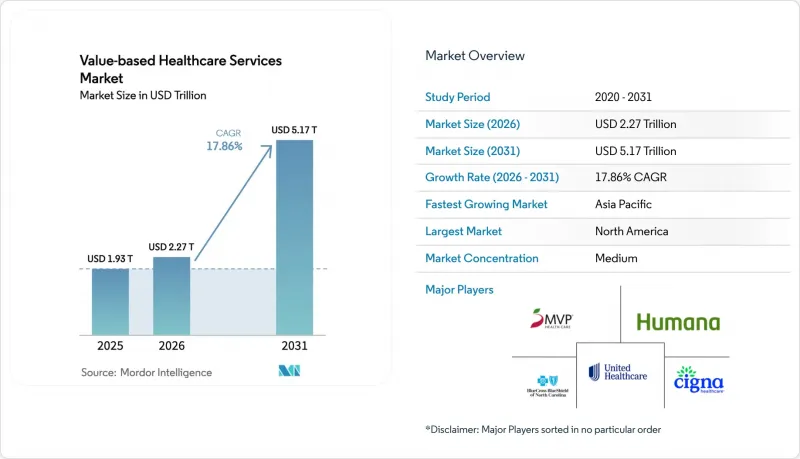
Mordor Intelligence에 따르면 2026년 가치 기반 헬스케어 서비스 시장 규모는 2조 2,700억 달러로 추정되며, 2025년 1조 9,300억 달러에서 확대될 전망입니다.
또한, 2031년의 예측치는 5조 1,700억 달러로, 2026년부터 2031년까지 연평균 성장률(CAGR) 17.86%로 성장할 것으로 전망됩니다.
본 보고서는 지불 모델(포괄 지불, 공유 절감(ACO), 성과 연동형 보상 등), 제공 기관 유형(병원·통합 의료 네트워크(IDN), 의사 그룹 진료소, 재택의료·급성기 후 관리, 외래 수술 센터 등), 및 지역(북미, 유럽, 아시아태평양, 중동 및 아프리카, 남미)별로 분류되어 있습니다. 시장 전망은 금액(달러) 기준으로 제시되어 있습니다.
세계 가치 기반 헬스케어 서비스 시장의 동향 및 인사이트
만성 질환 부담 증가와 고령화
2030년까지 미국의 65세 이상 성인 인구는 7,300만 명에 달할 것이며, 이 중 85%는 적어도 하나의 만성 질환을 앓고 있고, 60%는 여러 질환을 관리하게 될 것입니다. 이 계층은 이미 입원 환자 수의 절반 이상을 차지하고 있으며, 의료비 상승을 초래하고 있습니다. 가치 기반 헬스케어 서비스 시장에서는 예방적 개입을 촉진하고 피할 수 있는 입원을 줄이는 ‘공유 절감(shared savings)’ 제도를 통해 협력적인 관리가 장려되고 있습니다. 의료 제공자들은 종단적 데이터, 재택 모니터링 및 다직종 협력 케어 팀을 활용하여 복잡한 요구 사항에 대응하고, 측정 가능한 품질 향상과 비용 절감을 실현하고 있습니다.
정부 주도의 대체 지불 모델로의 전환
정책은 결정적인 촉매제가 됩니다. 정책은 결정적인 촉진요인이 되고 있습니다. CMS 혁신 센터는 비용 절감으로 이어지지 않은 프로그램을 종료하는 한편, 2026년 1월부터 741개 병원이 참여하는 ‘Transforming Episode Accountability Model’ 등 의무적인 에피소드 단위 포괄 지급 제도를 도입하고 있습니다. 국제적으로는 네덜란드 등 여러 국가가 총지출을 늘리지 않으면서 치료 프로토콜 준수를 개선하는 포괄지불제를 채택하고 있습니다. 이러한 의무화로 인해 의료 제공자들은 종량제(FFS)에서 위험 부담형 계약으로의 전환을 가속화하고 있습니다.
이중 수익 주기의 복잡성(FFS 대 VBC)
종량제(FFS)와 가치 기반 계약(VBC)이라는 두 가지 청구 시스템을 병행하여 운영하는 것은, 특히 기업 수준의 IT 자원이 부족한 소규모 조직에서 재무 부서에 부담을 줍니다. 직원들은 서로 다른 코딩, 문서화, 보고 규정을 조율해야 하며, 이에 시간을 할애함으로써 관리상의 오버헤드가 증가합니다. 가치 기반 모델로의 수익 전환이 전환점에 도달할 때까지는 백오피스 업무의 중복이 업무 효율의 걸림돌로 남아 있을 것입니다.
부문 분석
2025년 기준으로 가치 기반 헬스케어 서비스 시장의 30.74%를 차지한 것은 공유 절감 프로그램(Shared Savings Program)으로, 당초에는 참가자를 손실 위험으로부터 보호하기 위해 진입 장벽을 낮추는 역할을 하고 있습니다. 이 프로그램들은 메디케어에서만 1,100만 명의 수혜자에게 서비스를 제공하고 있으며, 2023년에는 21억 달러의 절감 효과를 가져왔습니다. 캡이테이션/세계 버짓에 의한 가치 기반 헬스케어 서비스 시장의 규모는 2031년까지 연평균 성장률(CAGR) 19.02%로 확대될 것으로 예측됩니다. 이는 지불자가 예측 가능한 비용 한도를 선호하는 한편, 의료 제공자가 보험 수리 및 케어 관리 능력을 강화하고 있기 때문입니다. 포괄적 지불 방식은 외과적 에피소드를 포괄하는 의무적 TEAM 모델을 통해 보급이 확대되고 있는 반면, 성과 연계형 보상(Pay-for-Performance) 계약에서는 공정성 요소를 포함하도록 품질 지표가 정교해지고 있습니다. 환자 중심 의료 홈(PCMH) 프레임워크는 보다 광범위한 ACO(Accountable Care Organization) 구조 내에 점차 통합되고 있으며, 에피소드 기반 조건은 현재 만성 질환의 경과까지 포괄하고 있습니다. 이는 결과(outcome)의 정의가 점점 더 정교해지고 있음을 반영합니다. 전문 분야별 포괄 지급이나 고용주와의 직접 계약과 같은 틈새 모델이 추가적인 선택지를 제공하며, 가치 기반 헬스케어 서비스 시장에서 지불 설계가 지속적으로 진화하고 있음을 보여줍니다.
캡이테이션에 대한 신뢰가 높아짐에 따라, 케어 조정 플랫폼, 원격 모니터링, 지역 밀착형 파트너십에 대한 투자가 가속화되고 있습니다. 집단 건강 분석을 숙달한 조직은 높은 소비자 만족도를 유지하면서 의료 제공자의 인센티브를 조정하고, 담당 환자 집단의 위험을 관리하며, 공유 절감분을 확보할 수 있습니다. 규모가 부족한 조직은 보험 수리적 위험을 분산시키는 공동 계약 네트워크로 기울고 있습니다.
지역별 분석
북미는 2025년에 45.90%의 점유율을 유지했습니다. 이는 메디케어, 메디케이드 및 고용주에 의한 도입이 성과 지향적 조항에 관한 성숙한 선례를 확립했기 때문입니다. 책임의료(Accountable Care)를 향한 연방 정부의 노력에 힘입어, 2030년까지 모든 기존 메디케어 수급자가 위험 분담 관계에 편입될 전망입니다. 캐나다에서는 주 단위의 성과 연계형 인센티브 시범 도입이 진행 중이며, 멕시코에서는 공공 부문 지불이 품질 지표와 연계되어 있습니다.
아시아태평양은 대규모 공공 개혁과 급속한 디지털화 확산에 힘입어 2031년까지 연평균 성장률(CAGR) 25.20%라는 가장 가파른 성장 궤도를 보이고 있습니다. 중국은 1선 도시에서 암 치료에 대한 포괄적 지불 제도를 시범 도입하고 있으며, 일본은 고령자의 예방 의료를 장려하도록 진료 보수 체계를 조정하고, 인도의 ‘아유슈만 바라트 디지털 미션’은 청구 절차가 필요 없는 전자 환급의 기반을 제공하고 있습니다. 호주의 주 전체를 대상으로 한 프로그램에서는 표준화된 진료 경로를 통해 입원 일수 단축이 입증되었으며, 지역 차원의 개념 증명이 이루어졌습니다.
유럽에서는 꾸준한 도입이 이어지고 있으며, 네덜란드의 당뇨병 포괄 지급 모델이 선도하고 있습니다. 이 모델에서는 1차 진료와 전문 의료 팀이 공동 예산 하에 협력하고 있습니다. 독일에서는 병원 자금 지원에 품질 기준이 반영되어 있습니다. 영국에서는 통합 의료 시스템(Integrated Care Systems) 내에서 인구 기반 지불 제도를 시범적으로 도입하고 있습니다. 남유럽 국가들에서는 선정된 지역에서 성과 연계형 계약의 시범 사업을 실시하고 있습니다. 중동 및 아프리카에서는 초기 단계의 노력이 나타나고 있으며, 걸프협력회의(GCC) 회원국들은 디지털 등록 시스템에 투자하고 있고, 남아프리카공화국의 국민건강보험 법안에는 성과 조항이 포함되어 있습니다. 남미에서는 브라질의 민간 보험사가 암 치료용 정액 지급 상품을 도입했고, 아르헨티나에서는 공립 병원에서 에피소드 기반 지불 방식을 시범적으로 시행하고 있습니다.
기타 혜택:
- 엑셀 형식의 시장 예측(ME) 시트
- 3개월간의 애널리스트 지원
자주 묻는 질문
목차
제1장 소개
제2장 조사 방법
제3장 주요 요약
제4장 시장 구도
제5장 시장 규모와 성장 예측
제6장 경쟁 구도
제7장 시장 기회와 향후 전망
KSM 26.09.03According to Mordor Intelligence, value-based healthcare services market size in 2026 is estimated at USD 2.27 trillion, growing from 2025 value of USD 1.93 trillion with 2031 projections showing USD 5.17 trillion, growing at 17.86% CAGR over 2026-2031.
This report is Segmented by Payment Model (Bundled Payments, Shared Savings, Pay-For-Performance, and More), Provider Setting (Hospitals & IDNs, Physician Group Practices, Home Health & Post-Acute Care, Ambulatory Surgical Centres, and More), and Geography (North America, Europe, Asia-Pacific, Middle East & Africa, South America). The Market Forecasts are Provided in Terms of Value (USD).
Global Value-based Healthcare Services Market Trends and Insights
Rising Burden of Chronic Diseases & Aging Population
Adults aged 65 and older will number 73 million in the United States by 2030, with 85% living with at least one chronic ailment and 60% managing multiple conditions. This cohort already drives over half of hospital admissions and pushes healthcare costs upward. The value-based healthcare services market incentivizes coordinated management through shared savings arrangements that encourage preventive interventions and reduce avoidable hospitalizations. Providers leverage longitudinal data, home-based monitoring, and multidisciplinary care teams to address complex needs, generating measurable quality gains and cost offsets.
Government-Led Shift Toward Alternative Payment Models
Policy is a decisive catalyst. The CMS Innovation Center has retired programs that failed to save money while rolling out mandatory episode bundles such as the Transforming Episode Accountability Model, which will involve 741 hospitals from January 2026. Internationally, nations like the Netherlands have adopted bundled payments that improve care protocol adherence without raising total spend. Such mandates hasten provider migration away from fee-for-service toward risk-bearing arrangements.
Dual Revenue-Cycle Complexity (FFS vs VBC)
Running parallel billing systems for fee-for-service and value contracts strains finance departments, particularly in smaller organizations lacking enterprise IT resources. Staff must reconcile divergent coding, documentation, and reporting rules, diverting time and increasing administrative overhead. Until a tipping point of revenue shifts under value models, back-office duplication will remain a drag on operational efficiency.
Other drivers and restraints analyzed in the detailed report include:
- Payer-Provider Push for Integrated, Longitudinal Care
- Expansion of Medicare Advantage & Risk-Based ACO Programs
- Limited Readiness for Downside-Risk Exposure
For complete list of drivers and restraints, kindly check the Table Of Contents.
Segment Analysis
Shared savings programs controlled 30.74% of the value-based healthcare services market in 2025, acting as an accessible on-ramp because they initially shield participants from downside exposure. They serve 11 million beneficiaries within Medicare alone and delivered USD 2.1 billion in savings during 2023. The value-based healthcare services market size for capitation/global budgets is forecast to expand at a 19.02% CAGR through 2031 as payers prefer predictable cost envelopes and providers bolster actuarial and care-management capabilities. Bundled Payments gain traction via the mandatory TEAM model covering surgical episodes, while Pay-for-Performance contracts refine quality metrics to include equity components. Patient-Centered Medical Home frameworks increasingly integrate inside broader ACO structures, and episode-based terms now encompass chronic disease cycles, reflecting rising sophistication in defining outcomes. Niche models such as specialty bundles and employer direct contracting add further optionality, illustrating the continuous evolution of payment design in the value-based healthcare services market.
Growing confidence in capitation accelerates investment in care coordination platforms, remote monitoring, and community-based partnerships. Organizations that master population-health analytics can align provider incentives, adjust panel risk, and capture shared savings while maintaining high consumer satisfaction. Those lacking scale gravitate toward collaborative contracting networks that pool actuarial exposure.
Complete Report Scope:
- By Payment Model
- Bundled Payments
- Shared Savings (ACO)
- Pay-for-Performance
- Patient-Centred Medical Home (PCMH)
- Capitation/Global Budgets
- Episode-based Payments
- Other Emerging Models
- By Provider Setting
- Hospitals & IDNs
- Physician Group Practices
- Home Health & Post-Acute Care
- Ambulatory Surgical Centres
- Virtual/Tele-health Providers
- Other Provider Settings
- By Geography
- North America
- United States
- Canada
- Mexico
- Europe
- Germany
- United Kingdom
- France
- Italy
- Spain
- Rest of Europe
- Asia-Pacific
- China
- Japan
- India
- Australia
- South Korea
- Rest of Asia-Pacific
- Middle East & Africa
- GCC
- South Africa
- Rest of Middle East & Africa
- South America
- Brazil
- Argentina
- Rest of South America
- North America
Geography Analysis
North America retained 45.90% share in 2025 because Medicare, Medicaid, and employer adoption set mature precedents for outcome-oriented clauses. Federal alignment towards accountable care is slated to place every traditional Medicare beneficiary within a risk-sharing relationship by 2030. Canada pilots province-based outcome incentives and Mexico links public-sector payment to quality metrics.
Asia Pacific exhibits the steepest trajectory at 25.20% CAGR through 2031, underpinned by large-scale public reform and rapid digital uptake. China experiments with bundled oncology payments across tier-one cities, Japan adjusts its fee schedule to reward prevention among seniors, and India's Ayushman Bharat Digital Mission provides a backbone for claimless electronic reimbursement. Australia's statewide program demonstrates reductions in hospital length of stay via standardized pathways, signaling regional proof of concept.
Europe maintains steady uptake, led by the Netherlands' diabetes bundles that unite primary and specialty teams on shared budgets. Germany integrates quality thresholds into hospital financing. The United Kingdom tests population-based payments within Integrated Care Systems. Southern European states pilot outcome contracts in selected regions. Middle East and Africa display nascent initiatives, with Gulf Cooperation Council members investing in digital registries and South Africa's National Health Insurance Bill incorporating performance clauses. In South America, Brazil's private insurers adopt capitated oncology products and Argentina trials episode payments in public hospitals.
- UnitedHealth Group (Optum)
- Humana Inc.
- CVS Health (Aetna)
- Elevance Health (Anthem)
- Cigna Healthcare
- Kaiser Permanente
- Blue Cross Blue Shield
- MVP Health Care
- Agilon Health
- Aledade
- Signify Health
- Evolent Health
- Lumeris
- Conifer Health Solutions
- Privia Health
- Oak Street Health
- VillageMD
- ChenMed
- CareMore Health
- Centene Corp.
- Clover Health
- Health Catalyst
- GuideWell (Florida Blue)
Additional Benefits:
- The market estimate (ME) sheet in Excel format
- 3 months of analyst support
TABLE OF CONTENTS
1 Introduction
- 1.1 Study Assumptions & Market Definition
- 1.2 Scope of the Study
2 Research Methodology
3 Executive Summary
4 Market Landscape
- 4.1 Market Overview
- 4.2 Market Drivers
- 4.2.1 Rising Burden of Chronic Diseases & Aging Population
- 4.2.2 Government-Led Shift Toward Alternative Payment Models
- 4.2.3 Payer-Provider Push for Integrated, Longitudinal Care
- 4.2.4 Expansion of Medicare Advantage & Risk-Based ACO Programs
- 4.2.5 AI-Enabled Risk Stratification & Predictive Analytics
- 4.2.6 Employer-Funded Value-Based Contracts for Cost Containment
- 4.3 Market Restraints
- 4.3.1 Dual Revenue-Cycle Complexity (FFS vs VBC)
- 4.3.2 Limited Readiness for Downside-Risk Exposure
- 4.3.3 Interoperability Gaps Across Community-Based Providers
- 4.3.4 Physician Burnout from Quality-Reporting Demands
- 4.4 Porter's Five Forces Analysis
- 4.4.1 Threat of New Entrants
- 4.4.2 Bargaining Power of Buyers
- 4.4.3 Bargaining Power of Suppliers
- 4.4.4 Threat of Substitutes
- 4.4.5 Competitive Rivalry
5 Market Size & Growth Forecasts (Value in USD)
- 5.1 By Payment Model
- 5.1.1 Bundled Payments
- 5.1.2 Shared Savings (ACO)
- 5.1.3 Pay-for-Performance
- 5.1.4 Patient-Centred Medical Home (PCMH)
- 5.1.5 Capitation/Global Budgets
- 5.1.6 Episode-based Payments
- 5.1.7 Other Emerging Models
- 5.2 By Provider Setting
- 5.2.1 Hospitals & IDNs
- 5.2.2 Physician Group Practices
- 5.2.3 Home Health & Post-Acute Care
- 5.2.4 Ambulatory Surgical Centres
- 5.2.5 Virtual/Tele-health Providers
- 5.2.6 Other Provider Settings
- 5.3 By Geography
- 5.3.1 North America
- 5.3.1.1 United States
- 5.3.1.2 Canada
- 5.3.1.3 Mexico
- 5.3.2 Europe
- 5.3.2.1 Germany
- 5.3.2.2 United Kingdom
- 5.3.2.3 France
- 5.3.2.4 Italy
- 5.3.2.5 Spain
- 5.3.2.6 Rest of Europe
- 5.3.3 Asia-Pacific
- 5.3.3.1 China
- 5.3.3.2 Japan
- 5.3.3.3 India
- 5.3.3.4 Australia
- 5.3.3.5 South Korea
- 5.3.3.6 Rest of Asia-Pacific
- 5.3.4 Middle East & Africa
- 5.3.4.1 GCC
- 5.3.4.2 South Africa
- 5.3.4.3 Rest of Middle East & Africa
- 5.3.5 South America
- 5.3.5.1 Brazil
- 5.3.5.2 Argentina
- 5.3.5.3 Rest of South America
- 5.3.1 North America
6 Competitive Landscape
- 6.1 Market Concentration
- 6.2 Market Share Analysis
- 6.3 Company Profiles (includes Global level Overview, Market level overview, Core Segments, Financials as available, Strategic Information, Market Rank/Share for key companies, Products & Services, and Recent Developments)
- 6.3.1 UnitedHealth Group (Optum)
- 6.3.2 Humana Inc.
- 6.3.3 CVS Health (Aetna)
- 6.3.4 Elevance Health (Anthem)
- 6.3.5 Cigna Healthcare
- 6.3.6 Kaiser Permanente
- 6.3.7 Blue Cross Blue Shield
- 6.3.8 MVP Health Care
- 6.3.9 Agilon Health
- 6.3.10 Aledade
- 6.3.11 Signify Health
- 6.3.12 Evolent Health
- 6.3.13 Lumeris
- 6.3.14 Conifer Health Solutions
- 6.3.15 Privia Health
- 6.3.16 Oak Street Health
- 6.3.17 VillageMD
- 6.3.18 ChenMed
- 6.3.19 CareMore Health
- 6.3.20 Centene Corp.
- 6.3.21 Clover Health
- 6.3.22 Health Catalyst
- 6.3.23 GuideWell (Florida Blue)
7 Market Opportunities & Future Outlook
- 7.1 White-space & Unmet-Need Assessment