

|
시장보고서
상품코드
2119741
산업용 AI 소프트웨어 시장 : 점유율 분석, 업계 동향과 통계, 성장 예측(2026-2031년)Industrial AI Software - Market Share Analysis, Industry Trends & Statistics, Growth Forecasts (2026 - 2031) |
||||||
 Mordor Intelligence
Mordor Intelligence에 의하면, 2026년 산업용 AI 소프트웨어 시장 규모는 235억 2,000만 달러로 추정되고 있어 2025년 200억 달러에서 확대하는 전망입니다.
또한, 2031년 시장 규모는 529억 7,000만 달러에 달할 것으로 예측되며, 2026년부터 2031년까지 연평균 성장률(CAGR) 17.62%로 성장할 것으로 전망됩니다.
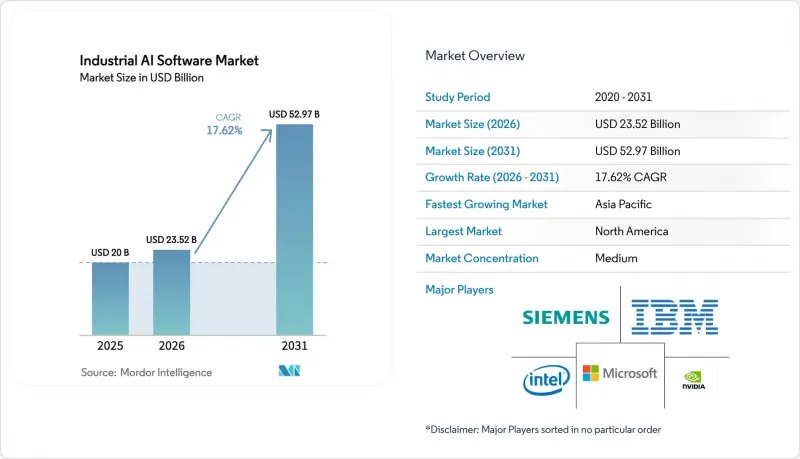
본 보고서는 도입 형태(클라우드 기반 및 On-Premise형), 최종 사용자 산업(자동차 및 운송, 소매 및 소비재, 의료 및 생명과학, 항공우주 및 방위 등), 용도(예지 보전, 품질 검사·이미지 처리, 공정 최적화 등), 그리고 지역별로 분류되어 있습니다.
전 세계 산업용 AI 소프트웨어 시장 동향 및 인사이트
예지 보전 도입으로 예상치 못한 가동 중단 시간이 줄어듭니다.
현재 공장에서는 일정 기반 유지보수에서 AI 주도형 루틴으로 전환한 결과, 유지보수 예산을 25-30% 절감하고 고장을 70-75% 줄였습니다. 테네시 밸리 오소리티(TVA)는 AI 기반 송전망 제어를 도입함으로써 2개월 동안 4만 건의 고객 정전을 방지하여, 자본 집약적인 유틸리티 분야에서도 비용 절감 효과를 충분히 확대할 수 있음을 입증했습니다. 보쉬의 안스바흐 공장에서는 결함 감지를 엣지 기반 비전 AI로 전환하여 지연을 최소화하는 동시에, 검사원이 더 높은 부가가치를 창출하는 업무에 집중할 수 있도록 했습니다. 선견지명이 있는 사업자들은 예상치 못한 가동 중단이 1시간 발생할 때마다 5만 달러 이상의 비용이 발생할 수 있기 때문에 이러한 이점을 매우 중요하게 여기고 있습니다.
끊임없이 증가하는 산업용 빅데이터 스트림
현재 단일 공장에서도 하루에 테라바이트 규모의 센서 데이터가 생성되고 있으며, 이는 머신러닝 모델을 위한 최적의 토양이 되고 있습니다. 한 기업의 경우, 122개 공장에서 하루에 1억 건의 데이터 포인트가 생성되고 있으며, 이것이 바로 데이터 인프라가 AI 파이프라인에 데이터를 공급하는 클라우드 네이티브 데이터 레이크로 전환되고 있는 이유입니다. 그러나 일관성 없는 명명 규칙과 사일로화된 히스토리안은 여전히 병목 현상을 일으키고 있으며, CIO들은 모델의 정확도를 높이고 훈련 주기를 단축하기 위해 시맨틱 레이어에 대한 투자를 서두르고 있습니다.
데이터 주권 및 지적 재산권 보호에 대한 우려
EU의 AI 법에 따르면, 많은 공장 현장의 알고리즘이 고위험으로 분류되어 현지 데이터 보관 및 감사 추적이 의무화되어 있습니다. 이에 따라 다국적 제조 기업들은 거주 요건을 충족하면서도 하이퍼스케일 AI 서비스(aws.amazon.com)를 계속 활용하기 위해 소버린 클라우드를 구축하고 있습니다. AWS는 이러한 유럽 전용 존에 78억 유로를 배정했습니다. 별도의 구축은 비용을 증가시키지만, 기업들은 규정 위반에 따른 벌금과 비용을 저울질하며 판단하고 있습니다.
부문 분석
2025년 기준으로, 산업용 AI 소프트웨어 시장 점유율의 60.58%를 클라우드 기반 솔루션이 차지하고 있으며, 기업들이 확장성이 뛰어나고‘사용량 기반 과금’ 방식의 플랫폼으로 워크로드를 통합함에 따라, 2031년까지 연평균 성장률(CAGR) 19.65%라는 가장 강력한 성장 궤적을 기록했습니다. 클라우드 도입에 따른 산업용 AI 소프트웨어 시장 규모는 멀티테넌트형 보안 모델에 대한 신뢰도 상승을 반영하여 2031년까지 355억 4,000만 달러에 달할 것으로 예측됩니다. 하이브리드 아키텍처는 기밀성이 높은 데이터 세트를 지역별 노드에 격리하면서, 익명화된 특징량을 중앙 모델 훈련 허브에 공급함으로써 데이터 주권에 대한 우려를 더욱 완화합니다.
확정적인 지연 시간과 엄격한 자산 관리가 요구되는 규제 강도가 높은 산업에서는 On-Premise 도입이 여전히 필수적입니다. 포춘 2000에 선정된 제조업체들은 클라우드 사용의 급증에 따른 예측 불가능한 아웃바운드 통신 요금을 피하기 위해 온사이트 클러스터를 유지하는 경우가 많지만, 클라우드에서 사용되는 것과 동일한 컨테이너화된 스택을 통해 이러한 클러스터를 관리하는 사례가 늘고 있습니다. 그 결과, 두 가지 도입 형태는 서로 경쟁하기보다는 상호 보완적으로 작용하게 되어, 산업용 AI 소프트웨어 시장 전체의 지속적인 지출을 촉진하고 있습니다.
지역별 분석
북미는 견고한 벤더 및 고객 생태계와 클라우드의 높은 보급률 덕분에 2025년 산업용 AI 소프트웨어 시장 규모의 36.45%를 차지했습니다. 제조업체들이 기존의 IT 갱신 주기보다 인지 기능 업그레이드를 우선시한 결과, IBM만 해도 2025년에 생성형 AI 관련 수주액이 60억 달러에 달했습니다. 마이크로소프트는 AI 코파일럿을 소프트웨어 스택에 통합하고, 사전 학습된 모델로 산업용 개발자를 지원함으로써 매출 2,450억 달러를 돌파했습니다.
아시아태평양은 성장 속도 면에서 선두를 달리고 있으며, 2031년까지 연평균 성장률(CAGR) 20.55%로 확대되고 있습니다. 일본의 공장에서는 가동 중지 시간을 거의 제로로 줄이는 AI 강화형 로봇의 시범 운영이 진행되고 있는 반면, 중국의 국가 프로그램에서는 스마트 제조 클러스터에 대한 보조금 지원이 추진되고 있습니다. 이 지역의 AI 투자액은 2025년에 34억 달러에 달할 전망이며, 이는 2024년 지출액의 거의 3배에 해당합니다. 중국 단독으로 160% 증가한 것은 정책 주도의 시급성을 여실히 보여줍니다.
유럽은 데이터 주권에 대한 엄격한 입장에 힘입어 그 뒤를 따르고 있습니다. 이 지역의 산업용 AI 소프트웨어 시장은 GAIA-X와 같은 보안 데이터 공간을 중심으로 하고 있으며, 이를 통해 공급업체는 플랫폼 운영자에게 통제권을 양도파관 않고도 텔레메트리 데이터를 공유할 수 있게 됩니다. 중동 및 아프리카, 남미의 동향은 제각각이지만 도입은 증가 추세를 보이고 있습니다. 석유 자원이 풍부한 걸프 국가들은 정유시설의 처리 능력을 최적화하기 위해 AI를 도입하고 있는 반면, 라틴아메리카의 생산 기업들은 성숙한 경제권에서 직면하는 기술적 부채를 회피하고, 기존의 MES(제조 실행 시스템) 계층을 건너뛰어 클라우드 네이티브 AI 제품군을 직접 도입하고 있습니다.
기타 혜택:
- 엑셀 형식 시장 예측(ME) 시트
- 3개월간 애널리스트 지원
자주 묻는 질문
목차
제1장 서론
제2장 조사 방법
제3장 개요
제4장 시장 구도
제5장 시장 규모와 성장 예측
제6장 경쟁 구도
제7장 시장 기회와 향후 전망
JHS 26.09.03According to Mordor Intelligence, industrial AI software market size in 2026 is estimated at USD 23.52 billion, growing from 2025 value of USD 20 billion with 2031 projections showing USD 52.97 billion, growing at 17.62% CAGR over 2026-2031.
This report is Segmented by Deployment Type (Cloud-Based and On-Premise), End-User Industry (Automotive and Transportation, Retail and CPG, Healthcare and Life Sciences, Aerospace and Defense, and More), Application (Predictive Maintenance, Quality Inspection and Vision, Process Optimization, and More), and Geography.
Global Industrial AI Software Market Trends and Insights
Predictive-maintenance adoption cuts unplanned downtime
Plants now slash maintenance budgets by 25-30% and breakdowns by 70-75% after switching from calendar-based to AI-led routines. Tennessee Valley Authority spared 40,000 customer outages in two months by using AI-driven grid controls, proving that cost avoidance scales well in capital-intensive utilities. Bosch's Ansbach site moved defect detection to edge-based vision AI, keeping latency low and inspectors focused on higher-value tasks. Forward-looking operators view these gains as vital because every hour of unplanned stoppage can cost USD 50,000 or more.
Growing volumes of industrial big-data streams
Single factories now generate terabytes of sensor output per day, creating fertile ground for machine-learning models. Ndustrial processes 100 million data points daily across 122 plants, illustrating why data infrastructure is edging toward cloud-native lakes that feed AI pipelines. Yet inconsistent naming conventions and siloed historians remain bottlenecks, urging CIOs to invest in semantic layers that boost model accuracy and shorten training cycles.
Data-sovereignty and IP-protection concerns
The EU AI Act categorizes many factory-floor algorithms as high-risk, mandating local data retention and audit trails. Multinational manufacturers, therefore, spin up sovereign clouds, AWS earmarked EUR 7.8 billion for such European zones, to meet residency rules while still tapping hyperscale AI services aws.amazon.com. Separate deployments inflate costs, but firms weigh them against the penalties of non-compliance.
Other drivers and restraints analyzed in the detailed report include:
- National Industry 4.0 incentive programs
- Generative-AI copilots ease engineering labor shortages
- Scarcity of OT-AI integration talent
For complete list of drivers and restraints, kindly check the Table Of Contents.
Segment Analysis
Cloud-based solutions accounted for 60.58% of the Industrial AI Software market share in 2025 and posted the strongest trajectory at 19.65% CAGR through 2031 as firms consolidate workloads on scalable, pay-as-you-grow platforms. The Industrial AI Software market size for cloud deployments is forecast to reach USD 35.54 billion by 2031, reflecting rising confidence in multi-tenant security models. Hybrid architectures further alleviate sovereignty fears by isolating sensitive datasets on regional nodes while feeding anonymized features to central model training hubs.
On-premise installations remain critical in regulated verticals that demand deterministic latency and strict asset control. Fortune 2000 manufacturers often retain on-site clusters to dodge unpredictable egress fees from cloud activity spikes, yet they increasingly orchestrate these clusters through the same containerized stacks used in the cloud. Consequently, both deployment archetypes now complement rather than cannibalize each other, stimulating continual spending across the Industrial AI Software market.
Complete Report Scope:
- By Deployment Type
- Cloud-based
- On-premise
- By End-user Industry
- Automotive and Transportation
- Retail and CPG
- Healthcare and Life Sciences
- Aerospace and Defense
- Energy and Utilities
- Other Industries
- By Application
- Predictive Maintenance
- Quality Inspection and Vision
- Process Optimization
- Supply-chain and Asset Tracking
- Safety and Compliance Analytics
- By Geography
- North America
- South America
- Europe
- Asia-Pacific
- Middle East and Africa
Geography Analysis
North America contributed 36.45% of the Industrial AI Software market size in 2025, thanks to strong vendor-customer ecosystems and deep cloud penetration. IBM alone booked USD 6 billion in generative-AI orders in 2025 as manufacturers prioritized cognitive upgrades over traditional IT refresh cycles. Microsoft surpassed USD 245 billion in revenue by integrating AI copilots into its software stack, supporting industrial developers with pre-trained models.
Asia-Pacific is the speed leader, expanding at 20.55% CAGR to 2031. Japan's factories pilot AI-augmented robotics that showcase near-zero downtime, while Chinese state programs funnel subsidies into smart manufacturing clusters. Regional AI investments are set to reach USD 3.4 billion in 2025, nearly triple 2024 outlays, and a 160% bump in China alone illustrates policy-driven urgency.
Europe follows close behind, shaped by rigor around data sovereignty. The Industrial AI Software market here pivots on secure data-spaces such as GAIA-X that let suppliers share telemetry without ceding control to platform operators. Middle East, Africa, and South America charts show mixed but rising adoption. Oil-rich Gulf nations adopt AI to optimize refinery throughput, whereas Latin American producers leapfrog legacy MES layers by directly adopting cloud-native AI suites, sidestepping the technical debt faced in mature economies.
- IBM Corporation
- Intel Corporation
- NVIDIA Corporation
- Microsoft Corporation
- Siemens AG
- Oracle Corporation
- Cisco Systems Inc.
- Veritone Inc.
- Advanced Micro Devices
- Google LLC
- GE Vernova
- Honeywell International
- ABB Ltd.
- Schneider Electric SE
- Rockwell Automation
- Bosch Rexroth AG
- Amazon Web Services
- Hitachi Ltd.
- PTC Inc.
- AspenTech
Additional Benefits:
- The market estimate (ME) sheet in Excel format
- 3 months of analyst support
TABLE OF CONTENTS
1 INTRODUCTION
- 1.1 Study Assumptions and Market Definition
- 1.2 Scope of the Study
2 RESEARCH METHODOLOGY
3 EXECUTIVE SUMMARY
4 MARKET LANDSCAPE
- 4.1 Market Overview
- 4.2 Market Drivers
- 4.2.1 Predictive-maintenance adoption cuts unplanned downtime
- 4.2.2 Growing volumes of industrial big-data streams
- 4.2.3 National Industry 4.0 incentive programs
- 4.2.4 Generative-AI copilots ease engineering labor shortages
- 4.2.5 Carbon-accounting mandates for Scope-3 emissions
- 4.3 Market Restraints
- 4.3.1 Data-sovereignty and IP-protection concerns
- 4.3.2 Scarcity of OT-AI integration talent
- 4.3.3 Legacy automation infrastructure lock-in
- 4.3.4 GPU-hardware supply volatility
- 4.4 Value Chain Analysis
- 4.5 Regulatory Landscape
- 4.6 Technological Outlook
- 4.7 Porter's Five Forces Analysis
- 4.7.1 Bargaining Power of Buyers
- 4.7.2 Bargaining Power of Suppliers
- 4.7.3 Threat of New Entrants
- 4.7.4 Threat of Substitutes
- 4.7.5 Intensity of Competitive Rivalry
5 MARKET SIZE AND GROWTH FORECASTS (VALUE)
- 5.1 By Deployment Type
- 5.1.1 Cloud-based
- 5.1.2 On-premise
- 5.2 By End-user Industry
- 5.2.1 Automotive and Transportation
- 5.2.2 Retail and CPG
- 5.2.3 Healthcare and Life Sciences
- 5.2.4 Aerospace and Defense
- 5.2.5 Energy and Utilities
- 5.2.6 Other Industries
- 5.3 By Application
- 5.3.1 Predictive Maintenance
- 5.3.2 Quality Inspection and Vision
- 5.3.3 Process Optimization
- 5.3.4 Supply-chain and Asset Tracking
- 5.3.5 Safety and Compliance Analytics
- 5.4 By Geography
- 5.4.1 North America
- 5.4.2 South America
- 5.4.3 Europe
- 5.4.4 Asia-Pacific
- 5.4.5 Middle East and Africa
6 COMPETITIVE LANDSCAPE
- 6.1 Market Concentration
- 6.2 Strategic Moves
- 6.3 Market Share Analysis
- 6.4 Company Profiles (includes Global level Overview, Market level overview, Core Segments, Financials as available, Strategic Information, Market Rank/Share for key companies, Products and Services, and Recent Developments)
- 6.4.1 IBM Corporation
- 6.4.2 Intel Corporation
- 6.4.3 NVIDIA Corporation
- 6.4.4 Microsoft Corporation
- 6.4.5 Siemens AG
- 6.4.6 Oracle Corporation
- 6.4.7 Cisco Systems Inc.
- 6.4.8 Veritone Inc.
- 6.4.9 Advanced Micro Devices
- 6.4.10 Google LLC
- 6.4.11 GE Vernova
- 6.4.12 Honeywell International
- 6.4.13 ABB Ltd.
- 6.4.14 Schneider Electric SE
- 6.4.15 Rockwell Automation
- 6.4.16 Bosch Rexroth AG
- 6.4.17 Amazon Web Services
- 6.4.18 Hitachi Ltd.
- 6.4.19 PTC Inc.
- 6.4.20 AspenTech
7 MARKET OPPORTUNITIES AND FUTURE OUTLOOK
- 7.1 White-space and Unmet-need Assessment


