

|
시장보고서
상품코드
2119758
Wi-Fi 7 시장 : 점유율 분석, 업계 동향과 통계, 성장 예측(2026-2031년)Wi-fi 7 - Market Share Analysis, Industry Trends & Statistics, Growth Forecasts (2026 - 2031) |
||||||
 Mordor Intelligence
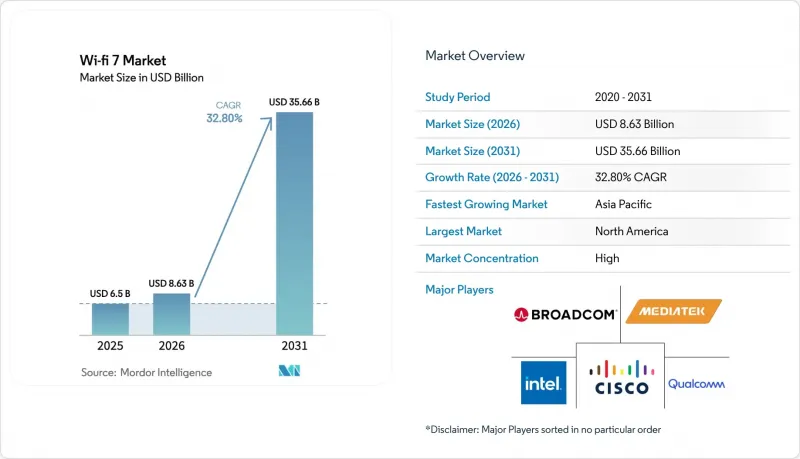
Mordor Intelligence에 의하면, Wi-Fi 7 시장 규모는 2025년에 65억 달러로 평가되었고 2026년 86억 3,000만 달러에서 2031년까지 356억 6,000만 달러에 이를 것으로 예측되며, 예측 기간(2026-2031년)에서 CAGR은 32.8%를 나타낼 전망입니다.
본 보고서는 유형별(하드웨어 및 서비스), 용도별(실내 및 실외), 최종 사용자별(주거, 기업, 산업 및 제조, 기타),주파수 대역 구성별(듀얼 밴드(2.4/5GHz) 및 트라이 밴드(2.4/5/6GHz)), 그리고 지역별로 분류되어 있습니다. 시장 예측은 금액(달러)으로 제시되어 있습니다.
전 세계 Wi-Fi 7 시장 동향 및 인사이트
Tier 1 ISP의 트라이밴드 CPE 번들 제공이 가정용 업그레이드 주기를 가속화
Tier 1 ISP의 트라이밴드 CPE 번들 제공이 일반 가정의 업그레이드 주기를 가속화하고 있습니다. 차터 커뮤니케이션즈(Charter Communications)와 같은 서비스 제공업체들은 2024년 후반에 Advanced Wi-Fi 7 라우터의 출하를 시작했습니다. 이를 통해 기존 4년 주기의 소비자용 기기 교체 주기를 단축하고, 고가의 광섬유 회선이 가정 내에서 최대 속도를 발휘할 수 있도록 보장하고 있습니다. 루멘 테크놀로지스도 이에 발맞추어 자체 설계한 Wi-Fi 7 게이트웨이를 출시하며, 통신 사업자의 보조금을 통해 가입자의 초기 하드웨어 비용을 상쇄할 수 있음을 입증했습니다. 이 전략을 통해 고객은 프리미엄 광대역 요금제에 지속적으로 가입하게 되고, 사용자 1인당 평균 수익이 확대되는 동시에 Wi-Fi 7 시장 전체를 견인할 수백만 대의 트라이밴드 단말기가 보급될 것입니다.
Wi-Fi Alliance의 ‘Wi-Fi CERTIFIED 7’ 인증 라벨이 기업의 상호 운용성 위험을 줄여줍니다.
Wi-Fi Alliance의 ‘Wi-Fi CERTIFIED 7’ 인증 라벨은 기업의 상호 운용성 위험을 줄여줍니다. 2024년 1월에 시작된 이 인증 프로그램은 벤더 중립적인 프로세스를 통해 320 MHz 채널, 멀티링크 작동 및 4K QAM 기능을 검증함으로써 구매자의 망설임을 해소했습니다. 2024년 12월에 출시된 시스코의 지능형 액세스 포인트는 이 프로그램을 기반으로 설계되었으며, AI를 활용한 자동 설정 기능을 탑재하여 도입 시간을 대폭 단축합니다. 현재 대규모 조직에서는 Wi-Fi 7 장비를 표준 준수 제품으로 인정하게 되어, 표준 승인을 기다리며 보류되었던 여러 거점에서의 도입이 가능해졌습니다.
엔트리 레벨 스마트폰에서 Wi-Fi 6E와 비교했을 때 높은 추가 부품 원가
엔트리 레벨 스마트폰의 경우, Wi-Fi 6E와 비교했을 때 부품 원가(BoM) 증가 폭이 큽니다. 320 MHz 채널 및 4,096-QAM을 지원하려면 고도의 RF 프론트엔드 설계가 필요합니다. Qorvo와 같은 벤더가 공급하는 멀티 안테나 모듈은 단말기 비용을 15-25% 상승시키기 때문에 저가형 스마트폰 제조업체들은 그 비용을 감당할 수 없습니다. 이러한 비용 차이로 인해 부품 가격이 하락할 때까지는 Wi-Fi 7의 조기 도입이 플래그십 모델로 한정될 것이며, 대중 시장에서의 양산화는 지연될 것입니다.
부문 분석
2025년, 하드웨어 부문은 총 수익의 81.35%를 차지하며, 사후 업그레이드가 불가능한 새로운 RF 아키텍처에 따른 자본 집약성을 여실히 드러내고 있습니다. 이 지출의 대부분은 액세스 포인트, 게이트웨이, 칩셋이 차지하고 있지만, 소프트웨어 분석 및 관리형 서비스는 기존 도입 기반을 바탕으로 연평균 성장률(CAGR) 40.2%로 성장하고 있습니다. Wi-Fi 7 하드웨어 시장 규모는 2025년 52억 9,000만 달러에서 2031년에는 290억 2,000만 달러로 확대될 것으로 예측되며, 이는 공급업체들이 실리콘,안테나, 프런트엔드 모듈에 주력하고 있는 점을 정당화해 줍니다. ISP가 클라우드 포털, 디바이스-어즈-어-서비스(DaaS) 플랜, 자동 최적화 도구를 번들로 제공하고 있기 때문에 서비스 분야는 여전히 Wi-Fi 7 업계에서 가장 빠르게 성장하는 분야로 자리 잡고 있습니다.
액세스 포인트는 기업의 장비 교체 주기와 트라이 라디오 설계가 필요한 고밀도 시설 덕분에 여전히 가장 큰 하드웨어 하위 부문으로 자리 잡고 있습니다. 게이트웨이는 트라이밴드 CPE에 대한 보조금 지원에 힘입어 그 뒤를 이어 급성장하고 있습니다. 칩셋이 혁신의 속도를 주도하고 있으며, 브로드컴의 BCM 6765와 미디어텍의 Filogic 플랫폼은 특정 도입 환경에 맞추어 최적화된 전용 실리콘의 대표적인 예입니다.
사무실, 대학, 고층 아파트 등이 배선 공사 없이 멀티 기가비트 통신 범위를 필요로 함에 따라, 실내 이용 사례는 2025년 매출의 66.20%를 차지했습니다. 이 부문이 주도적인 위치를 차지하고 있는 이유는 멀티링크 운영(Multi-Link Operation) 등 Wi-Fi 7의 기능이 기기가 밀집된 환경에서 간섭을 줄이는 데 탁월하기 때문입니다. 경기장, 지자체 Wi-Fi, 스마트 시티의 회랑 등을 포함한 실외 용도는 절대값으로는 뒤처지고 있지만, 2031년까지 연평균 성장률(CAGR) 39.4%를 나타낼 것으로 예측됩니다.
익스트림 네트웍스는 ‘Zwarte Cross 2024’ 페스티벌에서 Wi-Fi 7을 지원하는 3밴드 AP를 선보이며, 수만 명의 동시 사용자에게 안정적인 대역폭을 제공했습니다. 이러한 실증 사례는 실외 성능을 입증하는 것이며, 서비스 제공업체의 트래픽 오프로딩 및 도시 전체의 백홀 업그레이드를 위한 길을 열어주고 있습니다. 규제상의 AFC 장벽이 해소됨에 따라, 실외 구축이 Wi-Fi 7 시장의 새로운 수익원을 뒷받침하게 될 것입니다.
지역별 분석
중국의 주요 통신 사업자들이 ‘Fiber-to-the-Room(FTTR)’을 사실상 표준으로 채택함에 따라, 2025년 매출의 40.60%를 아시아태평양이 차지했습니다. 차이나텔레콤만 해도 광대역 회선 수는 1억 9,300만 회선으로 확대되었으며, 기가비트 회선 보급률은 27.3%에 달하고,, 이로 인해 유럽 및 미국의 기준보다 훨씬 짧은 주기로 전국적인 게이트웨이 업그레이드가 시급해지고 있습니다. 공급망이 인접해 있다는 점이 신속한 제품 개선을 뒷받침하고 있으며, 벤더들은 수개월 이내에 잇달아 Wi-Fi 7 레퍼런스 설계를 수탁 제조업체에 제공할 수 있게 되었습니다.
북미는 여전히 프리미엄 얼리 어답터 지역입니다. FCC가 5,945 MHz를 초과하는 표준 출력으로의 운용을 승인함에 따라 실외 배치가 가능해졌지만, AFC 데이터베이스에 따른 제약은 여전히 남아 있습니다. 차터(Charter)나 루멘(Lumen)과 같은 서비스 제공업체들은 경쟁이 치열한 기가비트 대역에서 트라이밴드 게이트웨이를 차별화 요소로 삼고 있습니다. 시스코(Cisco), HPE 알루바(Aluba), 콤스코프(Comscope)가 인증된 장비를 출하함에 따라 기업의 장비 교체 주기 또한 가속화되고 있습니다.
유럽에서는 규제 통합을 통해 도입이 진행되고 있습니다. 유럽연합 집행위원회는 2024년에 6GHz 대역의 하위 주파수 대역에 대한 규제를 통합하여, ISP와 기업이 재인증 없이 국경을 넘어 6GHz 채널을 구축할 수 있도록 했습니다. 보더폰 UK는 2024년에 Wi-Fi 7 라우터 테스트를 완료하고, 2025년 상용화 시작을 발표했습니다.
중동에서는 2031년까지 현저한 성장이 예상됩니다. 각국 정부는 AI 기반 영상 감시, 커넥티드 교통, 몰입형 관광 체험 등을 특징으로 하는 스마트 시티 입찰에 Wi-Fi 7을 포함시키고 있습니다. 두바이에서 진행된 공개 실증 실험에서는 시제품 단계에서 3.7 Gbps의 다운링크 속도를 기록하며, 개방적인 도시 환경에서도 양호한 전파 전파가 가능함을 입증했습니다. 남미는 브라질의 적극적인 주파수 대역 개방의 혜택을 받고 있지만, 아프리카 시장에서는 지역 규제 당국이 ITU의 지침을 따를 때까지 기다리는 상황입니다.
기타 혜택:
- 엑셀 형식 시장 예측(ME) 시트
- 3개월간의 애널리스트 지원
자주 묻는 질문
목차
제1장 서론
제2장 조사 방법
제3장 개요
제4장 시장 구도
제5장 시장 규모와 성장 예측
제6장 경쟁 구도
제7장 시장 기회와 향후 전망
JHS 26.09.03According to Mordor Intelligence, the Wi-Fi 7 market size was valued at USD 6.5 billion in 2025 and estimated to grow from USD 8.63 billion in 2026 to reach USD 35.66 billion by 2031, at a CAGR of 32.8% during the forecast period (2026-2031).
This report is Segmented by Type (Hardware and Services), Application (Indoor and Outdoor), End User (Residential, Enterprise, Industrial and Manufacturing, and More), Frequency Band Configuration (Dual-Band (2. 4/5 GHz) and Tri-Band (2. 4/5/6 GHz)), and Geography. The Market Forecasts are Provided in Terms of Value (USD).
Global Wi-fi 7 Market Trends and Insights
Tri-band CPE Bundling by Tier-1 ISPs Accelerates Household Upgrade Cycles
Tri-band CPE bundling by tier-1 ISPs accelerates household upgrade cycles. Service providers such as Charter Communications began shipping Advanced Wi-Fi 7 routers in late 2024, bypassing the usual four-year consumer replacement cadence and ensuring that expensive fiber lines deliver full in-home speeds. Lumen Technologies followed with an internally designed Wi-Fi 7 gateway, proving how operator subsidies can erase upfront hardware costs for subscribers. The strategy locks customers into premium broadband tiers, widens average revenue per user, and seeds millions of tri-band endpoints that lift the entire Wi-Fi 7 market.
Wi-Fi Alliance "Wi-Fi CERTIFIED 7" Labeling Lowers Enterprise Interoperability Risk
Wi-Fi Alliance "Wi-Fi CERTIFIED 7" labeling reduces enterprise interoperability risk. The January 2024 certification launch ended buyer hesitation by validating 320 MHz channels, Multi-Link Operation, and 4K QAM features in a vendor-neutral process. Cisco's intelligent access points released in December 2024 are built around the program, adding AI-driven self-configuration that slashes deployment times. Large organizations now treat Wi-Fi 7 gear as standards-compliant, enabling multi-site purchases that were on hold for ratification.
High Incremental BoM Versus Wi-Fi 6E in Entry-Level Smartphones
High incremental BoM cost versus Wi-Fi 6E in entry-level smartphones. Support for 320 MHz channels and 4,096-QAM requires advanced RF front-end designs; vendors such as Qorvo supply multi-antenna modules that raise handset costs by 15-25%, which budget-phone makers cannot absorb. The gap confines early Wi-Fi 7 adoption to flagship models until component prices fall, delaying volume scale in the mass market.
Other drivers and restraints analyzed in the detailed report include:
- 6 GHz Spectrum Release Mandates In The EU and Brazil Open 1.2 GHz of New Airwaves
- OEMs Race to Ship AI-PCs and XR Headsets That Exceed 5 GBPS Throughput
- AFC-related Certification Delay for Outdoor APs in the US and EMEA
For complete list of drivers and restraints, kindly check the Table Of Contents.
Segment Analysis
The hardware segment generated 81.35% of overall revenue in 2025, underscoring the capital intensity linked to new RF architectures that cannot be retrofitted. Access points, gateways, and chipsets account for the bulk of this spending, while software analytics and managed services sit on top of the installed base and are growing at a 40.2% CAGR. The Wi-Fi 7 market size for hardware is projected to stretch from USD 5.29 billion in 2025 to USD 29.02 billion in 2031, validating supplier focus on silicon, antennas, and front-end modules. Services still represent the fastest-climbing slice of the Wi-Fi 7 industry as ISPs bundle cloud portals, device-as-a-service plans, and automated optimization tools.
Access points remain the largest hardware sub-segment thanks to enterprise refresh cycles and high-density venues that demand tri-radio designs. Gateways follow closely, propelled by tri-band CPE subsidies. Chipsets set the pace for innovation: Broadcom's BCM 6765 and MediaTek's Filogic platforms exemplify purpose-built silicon tuned to specific deployment environments.
Indoor use cases captured 66.20% of 2025 revenue as offices, universities, and high-rise apartments needed multi-gigabit coverage without recabling. This segment leads because Wi-Fi 7 features, such as Multi-Link Operation, excel at mitigating interference in dense device clusters. Outdoor applications, including stadiums, municipal Wi-Fi, and smart-city corridors, trail in absolute value but are forecast to grow at 39.4% CAGR through 2031.
Extreme Networks showcased Wi-Fi 7 tri-radio APs at the Zwarte Cross 2024 festival, delivering consistent bandwidth to tens of thousands of concurrent users. Such proof points validate outdoor performance, setting the stage for service-provider offload and city-wide backhaul upgrades. As regulatory AFC hurdles clear, outdoor roll-outs will underpin incremental revenue streams for the Wi-Fi 7 market.
Complete Report Scope:
- By Type
- Hardware
- Access Points
- Gateways
- Routers and Extenders
- Chipsets / Modules
- Services
- Hardware
- By Application
- Indoor
- Outdoor
- By End User
- Residential
- Enterprise
- Industrial and Manufacturing
- Service Providers / Smart-City
- By Frequency Band Configuration
- Dual-band (2.4/5 GHz)
- Tri-band (2.4/5/6 GHz)
- By Geography
- North America
- South America
- Europe
- Asia-Pacific
- Middle East and Africa
Geography Analysis
Asia-Pacific commanded 40.60% of 2025 revenue as Chinese operators turned fiber-to-the-room into a de-facto baseline. China Telecom alone grew to 193 million broadband lines with 27.3% gigabit penetration, which forces a nation-wide gateway upgrade cadence far shorter than Western norms. Supply-chain proximity aids quick iterations, allowing vendors to push successive Wi-Fi 7 reference designs into contract manufacturers within months.
North America remains a premium early adopter region. The FCC's approval of standard-power operation above 5,945 MHz unlocks outdoor deployments, even though the AFC database still imposes friction on. Service providers such as Charter and Lumen position tri-band gateways as a differentiator in crowded gigabit tiers. Enterprise refresh cycles pick up as Cisco, HPE Aruba, and CommScope ship certified gear.
Europe approaches adoption through regulatory cohesion. The European Commission harmonized the lower 6 GHz band in 2024, allowing ISPs and enterprises to roll out 6 GHz channels across national borders without re-certification. Vodafone UK completed Wi-Fi 7 router testing in 2024, flagging a 2025 commercial debut.
The Middle East shows a signficjant growth through 2031. Governments bundle Wi-Fi 7 into smart-city tenders that feature AI video surveillance, connected transit, and immersive tourist experiences. A public demonstration in Dubai logged 3.7 Gbps downlink on pre-production equipment, underscoring favorable propagation in open urban layouts. South America benefits from Brazil's proactive spectrum release, while African markets wait for regional regulators to echo ITU guidelines.
- Broadcom Inc.
- Qualcomm Technologies, Inc.
- Intel Corporation
- MediaTek Inc.
- Cisco Systems, Inc.
- TP-Link Technologies Co., Ltd.
- Huawei Technologies Co., Ltd.
- Netgear, Inc.
- Cambium Networks
- Synaptics
- CommScope
- AsusTek Computer Inc.
- Extreme Networks
- Sercomm Corporation
Additional Benefits:
- The market estimate (ME) sheet in Excel format
- 3 months of analyst support
TABLE OF CONTENTS
1 INTRODUCTION
- 1.1 Study Assumptions and Market Definition
- 1.2 Scope of the Study
2 RESEARCH METHODOLOGY
3 EXECUTIVE SUMMARY
4 MARKET LANDSCAPE
- 4.1 Market Overview
- 4.2 Market Drivers
- 4.2.1 Tri-band CPE bundling by Tier-1 ISPs accelerates household upgrade cycles
- 4.2.2 Wi-Fi Alliance "Wi-Fi CERTIFIED 7" labeling reduces enterprise-grade interoperability risk
- 4.2.3 6 GHz spectrum release mandates in EU and Brazil open 1.2 GHz of new air-waves
- 4.2.4 OEM race to ship AI-PCs and XR headsets that exceed 5 Gbps throughput ceiling
- 4.2.5 Fiber-to-the-room (FTTR) roll-outs in China driving gateway refresh every below 18 months
- 4.2.6 Automotive zonal-architecture adoption of 802.11be for in-cabin streaming
- 4.3 Market Restraints
- 4.3.1 High incremental BoM cost vs. Wi-Fi 6E in entry-level smartphones
- 4.3.2 AFC?related certification delay for outdoor APs in US and EMEA
- 4.3.3 Power-consumption penalty ( above 30 %) in battery-constrained IoT sensors
- 4.3.4 Channel-occupancy compliance risk in unlicensed 6 GHz in India and Russia
- 4.4 Industry Value Chain Analysis
- 4.5 Regulatory Landscape
- 4.6 Technological Outlook
- 4.7 Porter's Five Forces Analysis
- 4.7.1 Bargaining Power of Buyers
- 4.7.2 Bargaining Power of Suppliers
- 4.7.3 Threat of New Entrants
- 4.7.4 Threat of Substitutes
- 4.7.5 Intensity of Competitive Rivalry
5 MARKET SIZE AND GROWTH FORECASTS (VALUE)
- 5.1 By Type
- 5.1.1 Hardware
- 5.1.1.1 Access Points
- 5.1.1.2 Gateways
- 5.1.1.3 Routers and Extenders
- 5.1.1.4 Chipsets / Modules
- 5.1.2 Services
- 5.1.1 Hardware
- 5.2 By Application
- 5.2.1 Indoor
- 5.2.2 Outdoor
- 5.3 By End User
- 5.3.1 Residential
- 5.3.2 Enterprise
- 5.3.3 Industrial and Manufacturing
- 5.3.4 Service Providers / Smart-City
- 5.4 By Frequency Band Configuration
- 5.4.1 Dual-band (2.4/5 GHz)
- 5.4.2 Tri-band (2.4/5/6 GHz)
- 5.5 By Geography
- 5.5.1 North America
- 5.5.2 South America
- 5.5.3 Europe
- 5.5.4 Asia-Pacific
- 5.5.5 Middle East and Africa
6 COMPETITIVE LANDSCAPE
- 6.1 Market Concentration
- 6.2 Strategic Moves
- 6.3 Market Share Analysis
- 6.4 Company Profiles (includes Global-level Overview, Market-level overview, Core Segments, Financials as available, Strategic Information, Market Rank/Share for key companies, Products and Services, and Recent Developments)
- 6.4.1 Broadcom Inc.
- 6.4.2 Qualcomm Technologies, Inc.
- 6.4.3 Intel Corporation
- 6.4.4 MediaTek Inc.
- 6.4.5 Cisco Systems, Inc.
- 6.4.6 TP-Link Technologies Co., Ltd.
- 6.4.7 Huawei Technologies Co., Ltd.
- 6.4.8 Netgear, Inc.
- 6.4.9 Cambium Networks
- 6.4.10 Synaptics
- 6.4.11 CommScope
- 6.4.12 AsusTek Computer Inc.
- 6.4.13 Extreme Networks
- 6.4.14 Sercomm Corporation
7 MARKET OPPORTUNITIES AND FUTURE OUTLOOK
- 7.1 White-space and Unmet-need Assessment


