

|
시장보고서
상품코드
2119781
미국의 마이크로컨트롤러(MCU) : 시장 점유율 분석, 업계 동향 및 통계, 성장 예측(2026-2031년)Americas Microcontroller (MCU) - Market Share Analysis, Industry Trends & Statistics, Growth Forecasts (2026 - 2031) |
||||||
 Mordor Intelligence
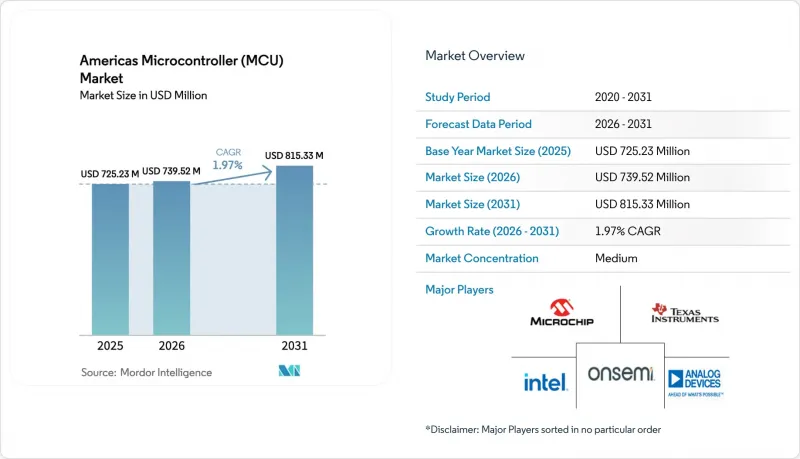
Mordor Intelligence에 의하면, 아메리카 마이크로컨트롤러 시장 규모는 2025년 7억 2,523만 달러로 평가되었습니다. 2026년에는 7억 3,952만 달러로 확대되어 2026년부터 2031년에 걸쳐 CAGR 1.97%로 성장을 지속하여, 2031년에는 8억 1,533만 달러에 이를 것으로 예측됩니다.
본 보고서는 비트 아키텍처(8비트, 16비트, 32비트, 64비트 이상), 최종 사용자 산업(자동차, 소비자 가전 등), 코어 아키텍처(ARM 기반, RISC-V 기반 등), 연결성(무선 지원 MCU, 비무선 MCU), 지역별로 분류되어 있습니다. 시장 예측은 금액(미 달러) 기준으로 제시되어 있습니다.
남미 및 북미의 마이크로컨트롤러(MCU) 시장 동향 및 인사이트
자동차의 전동화 추진
전기자동차에는 내연기관 차량에 비해 3배에서 5배 더 많은 반도체가 탑재되어 있으며, 트랙션 인버터, 배터리 관리 보드, 차체 도메인 컨트롤러 각각에 적어도 하나의 고성능 MCU가 사용되고 있습니다. NXP는 2025년 3월, 임베디드 MRAM과 800MHz Arm Cortex 코어를 탑재한 16nm S32K5 제품군을 발표하며, 레거시 ECU의 통합과 실시간 AI 추론 구현을 도모했습니다. 르네사스의 RH850/C1M-Ax MCU는 하이브리드 차량에서 듀얼 트랙션 인버터를 제어하여 기판 수와 배선 중량을 줄입니다. 캐나다의 새로운 온실가스 배출 규제와 미국 환경보호청(EPA)의 규제 강화로 인해 전동 파워트레인의 도입이 가속화되고 있으며, 북미 및 남미의 마이크로컨트롤러 시장은 자동차 설계 주기와 밀접하게 연결되어 있습니다. 인피니언이 2025년 3월에 출시한 AURIX 브랜드 최초의 자동차용 RISC-V 마이크로컨트롤러는 ASIL-D 안전 목표를 충족하면서 비용 면에서 우위를 갖춘 대체 솔루션으로 등장했음을 알리는 것입니다.
IoT 에지 노드의 보급
산업용 및 소비자용 디바이스는 지연 시간을 단축하고 클라우드 이용 비용을 절감하는 로컬 인텔리전스를 갖추고 있습니다. IEEE의 데이터에 따르면, 지능형 산업용 에지 시장은 2019년 116억 달러에서 2025년에는 308억 달러로 비약적으로 확대되었으며, 현재 지출의 41%를 소프트웨어가 차지하고 있습니다. 르네사스는 초저전력 코어가 엣지에서 보안이 보장된 신경망을 실행하게 될 것이라고 전망하며, 2030년까지 무선 연결용 MCU 시장 규모가 100억 달러에 달할 것으로 예측했습니다. Silicon Labs사의 MGM240S를 기반으로 한 Arduino의 ‘Nano Matter’ 보드는 제스처 인식을 로컬에서 실행하고 상호 운용 가능한 Matter 프로토콜을 지원하므로 스마트 홈 도입을 용이하게 합니다. NXP의 2025년 무선 시장 전망에서도, 추론 워크로드를 데이터센터에서 이전시키는 온칩 머신 러닝 가속기가 마찬가지로 주목받고 있습니다.
가격의 상품화와 이익률 압박
웨어러블이나 엔트리 레벨 스마트 홈 센서와 같은 대량 판매 부문에서는 평균 판매 가격(ASP)이 원자재비 인플레이션율보다 더 빠르게 하락하고 있습니다. 마이크로칩의 2025년도 순매출은 견조한 판매량에도 불구하고 42.3% 감소하여, 이익률이 줄타기하는 듯한 상황을 여실히 드러냈습니다. IP 로열티가 없는 RISC-V 진출기업들의 가격 경쟁이 격화되면서, 기존 공급업체들은 툴체인, 레퍼런스 디자인, 장기적인 공급 보장을 통해 차별화를 꾀할 수밖에 없는 상황입니다.
부문별 분석
2025년, 32비트 클래스는 매출의 53.85%를 차지하며 북미 및 남미의 마이크로컨트롤러 시장을 지탱했습니다. 수요의 중심은 자동차 차체, 섀시 및 파워 모듈이며, 이러한 분야에서는 메모리 보호, FOTA(Firmware Over-the-Air) 지원 및 결정론적 실시간 성능이 순수한 연산 능력보다 더 중요하게 여겨집니다. 구형 16비트 소켓의 업그레이드에 따라, 북미 및 남미 지역의 32비트 마이크로컨트롤러 시장 규모는 2031년까지 연평균 성장률(CAGR) 2.05%로 확대될 것으로 예측됩니다.
64비트 이상 부문은 현재 점유율이 10% 미만이지만, 5.54%라는 가장 높은 연평균 성장률(CAGR)을 기록하고 있습니다. AI를 많이 사용하는 운전자 모니터링 카메라, 소프트웨어 정의 차량 도메인 컨트롤러, 산업용 비전 시스템은 모두 확장된 주소 공간과 고급 벡터 엔진이 필요합니다. 마이크로칩(Microchip)의 ‘PIC64 High-Performance Spaceflight Computing’ 제품 라인은 방사선 내성 환경에서 머신러닝 추론을 실행하는 RISC-V 벡터 유닛을 탑재하고 있어, 방위 분야의 주요 제조업체에 맞춤형 ASIC을 대체할 수 있는 국내산 대안을 제공합니다.
자동차 분야는 2025년 매출의 29.25%를 차지하며, 여전히 모든 최종 사용자 분야 중 최대 점유율을 유지했습니다. 레벨 2 이상의 운전 지원, 배터리 상태 분석, 존형 아키텍처에 대한 OEM의 로드맵에 힘입어 MCU 탑재 수는 높은 수준을 유지하고 있습니다. 전동화 플랫폼의 갱신 주기가 단축됨에 따라, 이 부문은 연평균 성장률(CAGR) 2.96%로 확대될 것으로 예측됩니다.
헬스케어 및 의료기기 분야는 5.78%라는 가장 높은 연평균 성장률(CAGR)을 기록하고 있습니다. 지속 혈당 모니터, 휴대용 초음파 진단 장치, AI 지원 진단용 영상 장치는 센서 융합을 처리하고 FDA 승인 알고리즘을 실행하는 저전력 보안 MCU에 의존하고 있습니다. 현재 북미 및 남미 지역의 헬스케어 분야 마이크로컨트롤러 시장 점유율은 아직 작지만, 하드웨어가 FDA가 정한 사이버 보안 규정 및 상세한 감사 로그 기록 체계를 준수해야 하기 때문에 빠르게 확대되고 있습니다.
기타 혜택 :
- 엑셀 형식 시장 예측(ME) 시트
- 3개월간의 애널리스트 지원
자주 묻는 질문
목차
제1장 서론
제2장 조사 방법
제3장 주요 요약
제4장 시장 구도
제5장 시장 규모 및 성장 예측
제6장 경쟁 구도
제7장 시장 기회 및 향후 전망
KTH 26.09.04According to Mordor Intelligence, the americas microcontroller market size is expected to grow from USD 725.23 million in 2025 to USD 739.52 million in 2026 and is forecast to reach USD 815.33 million by 2031 at 1.97% CAGR over 2026-2031.
This report is Segmented by Bit Architecture (8-Bit, 16-Bit, 32-Bit, 64-Bit & Above), End-User Industry (Automotive, Consumer Electronics, and More), Core Architecture (ARM-Based, RISC-V-Based, and More), Connectivity (Wireless-Enabled MCUs, Non-Wireless MCUs), and Geography. The Market Forecasts are Provided in Terms of Value (USD).
Americas Microcontroller (MCU) Market Trends and Insights
Automotive Electrification Push
Electric vehicles embed three to five times more semiconductors than internal-combustion cars, and every traction inverter, battery-management board, or body-domain controller consumes at least one performance MCU. NXP unveiled its 16 nm S32K5 family in March 2025 with embedded MRAM and an 800 MHz Arm Cortex core to consolidate legacy ECUs and host real-time AI inference. Renesas' RH850/C1M-Ax MCU coordinates dual traction inverters in hybrids, cutting board count and wiring weight. New greenhouse-gas limits in Canada and stricter US EPA rules accelerate electrified powertrain adoption, keeping the Americas microcontroller market closely tied to automotive design cycles. Infineon's first automotive RISC-V MCU under the AURIX brand, launched in March 2025, signals a cost-driven alternative that still meets ASIL-D safety targets.
Proliferation of IoT Edge Nodes
Industrial and consumer devices are gaining local intelligence that shrinks latency and lowers cloud fees. IEEE data show the intelligent industrial edge segment leaped from USD 11.6 billion in 2019 to USD 30.8 billion by 2025, with software now 41% of spend. Renesas forecasts USD 10 billion for wireless connectivity MCUs by 2030 as ultra-low-power cores run secure neural networks at the edge. Arduino's Nano Matter board, built on Silicon Labs' MGM240S, executes gesture recognition locally and speaks the interoperable Matter protocol, easing smart-home rollouts. NXP's 2025 wireless outlook likewise highlights on-chip machine-learning accelerators that shift inference workloads away from data centers.
Pricing Commoditisation and Margin Squeeze
Volume segments such as wearables and entry-level smart-home sensors see ASP decline faster than input inflation. Microchip's FY2025 net sales fell 42.3% despite healthy unit volumes, underscoring the knife-edge margin equation. RISC-V entrants with zero IP royalties intensify price competition, forcing established suppliers to differentiate through toolchains, reference designs, and long-term supply assurances.
Other drivers and restraints analyzed in the detailed report include:
- Migration to 32-bit and ARM-based MCUs
- Government Near-shoring Incentives
- Persistent Wafer-fab Capacity Bottlenecks Below 28 nm
For complete list of drivers and restraints, kindly check the Table Of Contents.
Segment Analysis
In 2025 the 32-bit class accounted for 53.85% of revenue and anchored the Americas microcontroller market. Demand centers on automotive body, chassis, and power modules where memory protection, FOTA support, and deterministic real-time performance outweigh raw compute. The Americas microcontroller market size for 32-bit devices is projected to climb at 2.05% CAGR through 2031 as legacy 16-bit sockets upgrade.
The 64-bit and above band, while below 10% share today, owns the fastest 5.54% CAGR. AI-heavy driver-monitoring cameras, software-defined vehicle domain controllers, and industrial vision systems each require expanded address space and advanced vector engines. Microchip's PIC64 High-Performance Spaceflight Computing line brings RISC-V vector units that run machine-learning inference in radiation-hardened environments, giving defense primes a domestic alternative to custom ASICs.
Automotive remained the largest of all end-user buckets with 29.25% revenue in 2025. OEM roadmaps for level 2+ driver assistance, battery state-of-health analytics, and zonal architectures keep MCU attach counts high. The segment is predicted to advance at 2.96% CAGR as electrified platforms shorten refresh cycles.
Healthcare and medical devices post the fastest 5.78% CAGR. Continuous-glucose monitors, portable ultrasound, and AI-supported diagnostic imagers rely on low-power secure MCUs that handle sensor fusion and run FDA-cleared algorithms. The Americas microcontroller market share for healthcare is small today but expands quickly because hardware must comply with cybersecurity controls and detailed audit logging regimes set by the FDA.
Complete Report Scope:
- By Bit Architecture
- 8-bit
- 16-bit
- 32-bit
- 64-bit and Above
- By End-user Industry
- Automotive
- Consumer Electronics
- Industrial Automation
- Communications and Networking
- Healthcare and Medical Devices
- Others
- By Core Architecture
- ARM-based
- RISC-V-based
- x86-based
- Proprietary Cores
- By Connectivity
- Wireless-enabled MCUs
- Non-wireless MCUs
- By Geography
- North America
- United States
- Canada
- Mexico
- South America
- Brazil
- Argentina
- Rest of South America
- North America
List of Companies Covered in this Report:
- Renesas Electronics Corporation
- NXP Semiconductors N.V.
- Microchip Technology Inc.
- Texas Instruments Incorporated
- Infineon Technologies AG
- STMicroelectronics N.V.
- ON Semiconductor Corporation
- Silicon Laboratories Inc.
- Nordic Semiconductor ASA
- Cypress Semiconductor Corporation
- Espressif Systems (Shanghai) Co., Ltd.
- GigaDevice Semiconductor Inc.
- Maxim Integrated Products, Inc.
- Analog Devices, Inc.
- Qualcomm Incorporated
- Intel Corporation
- Ambiq Micro, Inc.
- FUJITSU Semiconductor Memory Solution Ltd.
- Holtek Semiconductor Inc.
- Microsemi Corporation
Additional Benefits:
- The market estimate (ME) sheet in Excel format
- 3 months of analyst support
TABLE OF CONTENTS
1 INTRODUCTION
- 1.1 Study Assumptions and Market Definition
- 1.2 Scope of the Study
2 RESEARCH METHODOLOGY
3 EXECUTIVE SUMMARY
4 MARKET LANDSCAPE
- 4.1 Market Overview
- 4.2 Market Drivers
- 4.2.1 Automotive electrification push
- 4.2.2 Proliferation of IoT edge nodes
- 4.2.3 Migration to 32-bit and ARM-based MCUs
- 4.2.4 Government near-shoring incentives (CHIPS Act, Brazil PADIS)
- 4.2.5 Mandatory embedded-device cyber-security standards (U.S. NIST IR 8425)
- 4.2.6 RISC-V cost disruption in entry-level SKUs
- 4.3 Market Restraints
- 4.3.1 Pricing commoditisation and margin squeeze
- 4.3.2 Persistent wafer-fab capacity bottlenecks below 28 nm
- 4.3.3 Software-complexity outpacing 8-/16-bit capabilities
- 4.3.4 IP-licensing and export-control compliance risks
- 4.4 Value / Supply-Chain Analysis
- 4.5 Regulatory Landscape
- 4.6 Technological Outlook
- 4.7 Porter's Five Forces
- 4.7.1 Bargaining Power of Suppliers
- 4.7.2 Bargaining Power of Buyers
- 4.7.3 Threat of New Entrants
- 4.7.4 Threat of Substitutes
- 4.7.5 Intensity of Competitive Rivalry
5 MARKET SIZE and GROWTH FORECASTS
- 5.1 By Bit Architecture
- 5.1.1 8-bit
- 5.1.2 16-bit
- 5.1.3 32-bit
- 5.1.4 64-bit and Above
- 5.2 By End-user Industry
- 5.2.1 Automotive
- 5.2.2 Consumer Electronics
- 5.2.3 Industrial Automation
- 5.2.4 Communications and Networking
- 5.2.5 Healthcare and Medical Devices
- 5.2.6 Others
- 5.3 By Core Architecture
- 5.3.1 ARM-based
- 5.3.2 RISC-V-based
- 5.3.3 x86-based
- 5.3.4 Proprietary Cores
- 5.4 By Connectivity
- 5.4.1 Wireless-enabled MCUs
- 5.4.2 Non-wireless MCUs
- 5.5 By Geography
- 5.5.1 North America
- 5.5.1.1 United States
- 5.5.1.2 Canada
- 5.5.1.3 Mexico
- 5.5.2 South America
- 5.5.2.1 Brazil
- 5.5.2.2 Argentina
- 5.5.2.3 Rest of South America
- 5.5.1 North America
6 COMPETITIVE LANDSCAPE
- 6.1 Market Concentration
- 6.2 Strategic Moves
- 6.3 Market Share Analysis
- 6.4 Company Profiles (includes Global level Overview, Market level overview, Core Segments, Financials as available, Strategic Information, Market Rank/Share for key companies, Products and Services, and Recent Developments)
- 6.4.1 Renesas Electronics Corporation
- 6.4.2 NXP Semiconductors N.V.
- 6.4.3 Microchip Technology Inc.
- 6.4.4 Texas Instruments Incorporated
- 6.4.5 Infineon Technologies AG
- 6.4.6 STMicroelectronics N.V.
- 6.4.7 ON Semiconductor Corporation
- 6.4.8 Silicon Laboratories Inc.
- 6.4.9 Nordic Semiconductor ASA
- 6.4.10 Cypress Semiconductor Corporation
- 6.4.11 Espressif Systems (Shanghai) Co., Ltd.
- 6.4.12 GigaDevice Semiconductor Inc.
- 6.4.13 Maxim Integrated Products, Inc.
- 6.4.14 Analog Devices, Inc.
- 6.4.15 Qualcomm Incorporated
- 6.4.16 Intel Corporation
- 6.4.17 Ambiq Micro, Inc.
- 6.4.18 FUJITSU Semiconductor Memory Solution Ltd.
- 6.4.19 Holtek Semiconductor Inc.
- 6.4.20 Microsemi Corporation
7 MARKET OPPORTUNITIES and FUTURE OUTLOOK
- 7.1 White-space and Unmet-Need Assessment


