

|
시장보고서
상품코드
2119824
아시아태평양의 자동차용 플라스틱 : 시장 점유율 분석, 업계 동향 및 통계, 성장 예측(2026-2031년)Asia-Pacific Automotive Plastics - Market Share Analysis, Industry Trends & Statistics, Growth Forecasts (2026 - 2031) |
||||||
 Mordor Intelligence
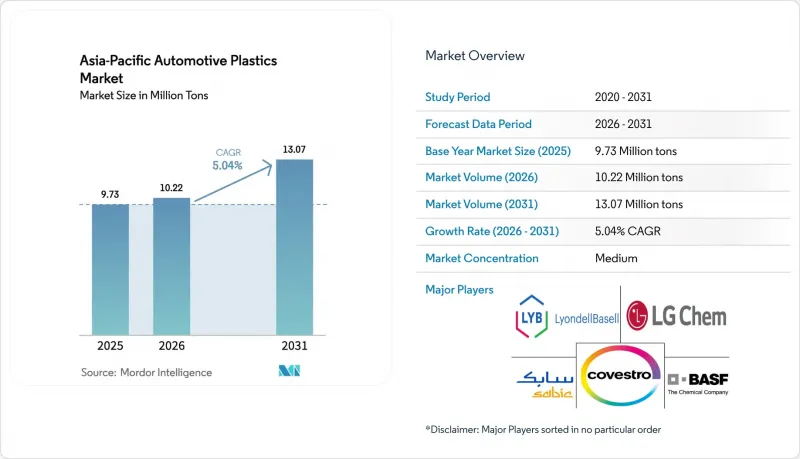
Mordor Intelligence에 의하면, 2026년 아시아태평양의 자동차용 플라스틱 시장 규모는 1,022만 톤으로 추정되고 2025년 973만 톤으로부터 확대해, 2031년에는 1,307만 톤에 이를 것으로 예측됩니다.
2026-2031년 동안의 연평균 성장률(CAGR)은 5.04%를 나타낼 전망입니다.
본 보고서는 소재별(폴리프로필렌, 폴리우레탄, 폴리염화비닐, 기타), 차량 유형별(기존·기존식 차량, 전기자동차), 용도별(외장, 내장, 엔진룸 내부, 기타 용도), 지역별(중국, 인도,일본, 한국, 아세안, 기타 아시아태평양 국가)로 분류되어 있습니다. 시장 예측은 수량(톤) 단위로 제시되어 있습니다.
아시아태평양의 자동차용 플라스틱 시장 동향 및 인사이트
경량화 규제에 대한 대응
아시아태평양의 규제 당국은 차량군의 평균 배출량을 경량화 목표와 연계하고 있습니다. 이에 대응하여 자동차 제조업체들은 저비용으로 복잡한 형상을 구현할 수 있는 첨단 폴리프로필렌 혼합재를 통해 금속을 대체하고 있습니다. 보레알리스(Borealis)사의 ‘Fibremod’ 장유리섬유 강화 폴리프로필렌은 폭스바겐(Volkswagen)의 ‘Multivan’의 무게를 200kg 줄이는 동시에 강성 목표도 달성했습니다. 테슬라(Tesla)에 의해 처음 보급된 ‘기가캐스팅(Gigacasting)’의 도입은 화이트 바디 전략을 혁신하고 있으며, 플라스틱 공급업체들에게 구조적 역할을 정당화하도록 압력을 가하고 있습니다. 이러한 흐름에 대응하기 위해 각 컴파운더 업체들은 아비엔트(Aventis)사의 ‘하이드로세롤(Hydrocell)’과 같은 화학 발포제를 도입하고 있습니다. 이를 통해 도어 패널의 무게를 20% 줄이면서 이산화탄소 배출량도 저감할 수 있습니다. 2036년까지 배터리식 전기차가 소형차 총 판매 대수의 52.9%를 차지할 것으로 예상되는 중국에서는 열 관리 기능까지 겸비한 경량 플라스틱 모듈이 필수 요소로 자리 잡고 있습니다.
내장재 및 외장재 분야에서 폴리프로필렌의 보급 확대
폴리프로필렌의 방음성과 가공상의 장점이 고성능 부품으로의 채택을 뒷받침하고 있습니다. Rochling Automotive의 흡기 매니폴드는 폴리아미드 재질의 대체품에 비해 차내 소음을 10-15dB 저감하고, 재료 비용을 15% 절감했습니다. 일본의 한 연구팀은 셀룰로오스 나노섬유를 폴리프로필렌에 배합함으로써 완전한 재활용성을 유지하면서 충격 강도를 향상시켰습니다. 이는 확대 생산자 책임(EPR) 법 하에서 매력적인 특징입니다. Sirmax의 소비 후 수지를 30% 함유한 컴파운드는 현재 도어 패널에 적용되어 있으며, 수명 주기 동안 탄소 발자국을 21% 줄이고 냄새 기준도 충족하고 있습니다. 외장 클래딩에는 LyondellBasell의 ‘Circulen Recover’와 같은 자외선 안정화 등급이 활용되어, 20%의 재활용 소재를 함유하면서도 치수 안정성을 유지하고 있습니다. 공정 최적화 연구를 통해 성형 압력을 높이면 수축이 억제된다는 사실이 확인되어, 눈에 띄는 A급 표면에서 폴리프로필렌의 장점이 더욱 강화되었습니다.
재활용 인프라의 격차와 규제 압력
확대된 생산자 책임(EPR) 규제가 확대되고 있지만, 일부 시장에서는 회수 및 선별 능력이 자동차 폐차율을 따라가지 못하고 있습니다. 인도의 ‘2025년 폐차 규정’에서는 종합적인 온라인 추적 시스템이 도입되었으나, 플라스틱에 대한 세부 할당량이 생략되어 있어 순환 경제로의 즉각적인 전환 효과가 제한되고 있습니다. 베트남은 경질 PET 포장재의 재활용률을 22%로 의무화하고 있는데, 이는 자동차용 플라스틱 모듈에 대한 향후 의무화를 시사하며, 규정 준수 비용의 상승으로 이어질 것입니다. 일본의 성숙한 스튜어드십 프로그램은 여전히 포장재에 중점을 두고 있어, 자동차 부품은 현재 회수 체계의 대상에서 제외되어 있습니다. 기술적 연구에 따르면, 범퍼의 재분쇄 재료는 프라이머 제거가 불완전할 경우 내충격성을 상실하는 것으로 나타났으며, 이는 기계적 처리를 보완하는 화학적 재활용의 필요성을 부각시키고 있습니다. Yanfeng과 Trinseo와 같은 공급망 간 협력은 2030년 목표를 달성하기 위한 용해 기술 및 고도 선별 기술을 확대함으로써 이러한 격차를 해소하는 것을 목표로 하고 있습니다.
부문 분석
폴리프로필렌은 자동차용 플라스틱 시장에서 수량 점유율 41.10%를 차지하며 가장 큰 점유율을 자랑하고 있습니다. ExxonMobil의 ‘Achieve Advanced’ 등급은 기존 코폴리머를 능가하는 충격 강도를 실현하여, 구조의 박형화가 가능해져 경량화를 도모하는 동시에 톤당 55달러의 마진 축소를 뒷받침하고 있습니다. 폴리카보네이트는 가공업체들이 유리 부품 및 조명 하우징용으로 코베스트로의 기계적 재활용 소재를 채택하고 있어 7.12%라는 가장 높은 CAGR을 기록하고 있습니다. BASF의 잔장(Zhanjiang) 메가라인이 본격 가동되면, 800V 아키텍처에서 유연한 케이블 피복이 필요한 전동화 수요에 대응하기 위해 열가소성 폴리우레탄공급이 부족해질 전망입니다.
엔지니어링 수지 분야의 자동차용 플라스틱 시장 규모는 확대되고 있으며, 아크릴로니트릴-부타디엔-스티렌(ABS)은 바이오매스 유래 스티렌 단량체로의 전환이 진행되고 있고, 폴리아미드 66의 경우 상하이에서 4만 톤의 생산 능력 증강이 예상됩니다. 폴리에틸렌은 여전히 포장재와 경량 외장 트림을 지탱하고 있지만, 한편 PVC는 순환형 경제 추진 과정에서 이미지 측면에서 압박을 받고 있습니다. ASA, PBT, PMMA 등의 특수 수지군은 내후성 그릴이나 스쿠터용 배터리 팩과 같은 틈새 용도로 공급되고 있습니다. 아시아태평양의 정유시설가 원유를 화학제품으로 전환하는 가운데, 업스트림 부문과의 통합은 비용 측면에서의 완충 역할을 하여 급증하는 엔지니어링 수지군에 맞서 폴리프로필렌의 입지를 지켜주고 있습니다.
기타 혜택
- 엑셀 형식 시장 예측(ME) 시트
- 3개월간의 애널리스트 지원
자주 묻는 질문
목차
제1장 서론
제2장 조사 방법
제3장 주요 요약
제4장 시장 구도
제5장 시장 규모 및 성장 예측
제6장 경쟁 구도
제7장 시장 기회 및 향후 전망
KTH 26.09.10According to Mordor Intelligence, Asia-Pacific automotive plastics market size in 2026 is estimated at 10.22 Million tons, growing from 2025 value of 9.73 Million tons with 2031 projections showing 13.07 Million tons, growing at 5.04% CAGR over 2026-2031.
This report is Segmented by Material (Polypropylene, Polyurethane, Polyvinyl Chloride, and More), Vehicle Type (Conventional/Traditional Vehicles and Electric Vehicles), Application (Exterior, Interior, Under-Bonnet, and Other Applications), and Geography (China, India, Japan, South Korea, ASEAN, and Rest of Asia-Pacific). The Market Forecasts are Provided in Terms of Volume (Tons).
Asia-Pacific Automotive Plastics Market Trends and Insights
Lightweighting Mandate Compliance
Regulatory authorities across Asia-Pacific tie fleet-average emissions to weight reduction goals. Automakers respond by substituting metals with advanced polypropylene blends that deliver complex geometries at lower cost. Borealis Fibremod long-glass-fiber polypropylene helped reduce the weight of Volkswagen's Multivan by 200 kg and met stiffness targets. Gigacasting adoption, first popularised by Tesla, is reshaping body-in-white strategies and puts pressure on plastics suppliers to justify structural roles. To keep pace, compounders introduce chemical foaming agents such as Avient Hydrocerol that cut door-panel weight by 20% while lowering carbon dioxide emissions. In China, where battery-electric vehicles are forecast to command 52.9% of total light-vehicle sales by 2036, lightweight plastic modules that also manage heat are becoming indispensable.
Growing Polypropylene Penetration in Interiors and Exteriors
Polypropylene's noise-dampening and processing advantages are driving adoption in high-performance components. Rochling Automotive intake manifolds trimmed cabin noise by 10-15 dB compared with polyamide alternatives and saved 15% on material cost. Research teams in Japan blend cellulose nanofibres into polypropylene, boosting impact strength while preserving full recyclability, a feature attractive under extended-producer-responsibility laws. Compounds with 30% post-consumer resin from Sirmax now appear in door panels, cutting lifecycle carbon footprints by 21% and meeting odor thresholds. Exterior cladding benefits from ultraviolet-stable grades such as LyondellBasell CirculenRecover that retain dimensional integrity while offering 20% recycled content. Process optimisation studies confirm that higher packing pressure mitigates shrinkage, reinforcing polypropylene's appeal for visible Class-A surfaces.
Recycling Infrastructure Gaps and Regulatory Pressure
Extended-producer-responsibility rules proliferate, yet collection and sorting capacity lag vehicle scrappage rates in several markets. India's End-of-Life Vehicles Rules 2025 introduce comprehensive online tracking but omit detailed plastic quotas, limiting immediate circularity gains. Vietnam mandates a 22% recycling rate for rigid PET packaging, signaling future obligations for automotive plastic modules that raise compliance costs. Japan's mature stewardship programmes still focus on packaging, so automotive parts fall outside current take-back streams. Technical studies show that bumper regrind loses impact resistance if primer removal is incomplete, underscoring the need for chemical recycling to complement mechanical routes. Supply-chain collaborations such as Yanfeng-Trinseo aim to bridge the gap by scaling dissolution and advanced-sorting technologies that meet 2030 targets.
Other drivers and restraints analyzed in the detailed report include:
- Surge in Electric-Vehicle Production Volumes
- Cost Reduction via High-throughput Injection Moulding
- Volatility in Raw-material (Naphtha / Propylene) Pricing
For complete list of drivers and restraints, kindly check the Table Of Contents.
Segment Analysis
Polypropylene commands the largest slice of the automotive plastics market at 41.10% volume share. ExxonMobil Achieve Advanced grades lift impact strength above legacy copolymers, allowing thinner structures that lower mass and support a USD 55 per-ton margin squeeze. Polycarbonate delivers the fastest 7.12% CAGR as processors embrace Covestro mechanically recycled content for glazing and lighting housings. Thermoplastic polyurethane supply is set to tighten once BASF's Zhanjiang mega-line ramps up, responding to electrification needs that require flexible cable jacketing in 800 V architectures.
The automotive plastics market size for engineering resins is climbing with acrylonitrile-butadiene-styrene shifting toward biomass styrene monomer and polyamide 66 seeing 40 000-ton capacity increments in Shanghai. Polyethylene still supports packaging and lightweight exterior trims, whereas PVC faces image pressure under circularity pledges. Specialty families like ASA, PBT, and PMMA supply niche roles such as weather-resistant grilles and scooter battery packs. As Asia-Pacific refineries convert crude to chemicals, upstream integration provides cost buffers that safeguard polypropylene's foothold against the surging engineering-resin cohort.
Complete Report Scope:
- By Material
- Polypropylene (PP)
- Polyurethane (PU)
- Polyvinyl Chloride (PVC)
- Polyethylene (PE)
- Acrylonitrile-Butadiene-Styrene (ABS)
- Polyamides (PA)
- Polycarbonate (PC)
- Other Materials (ASA, PET, PBT, PMMA, etc.)
- By Vehicle Type
- Conventional/Traditional Vehicles
- Electric Vehicles
- By Application
- Exterior
- Interior
- Under-bonnet
- Other Applications (Instrument Panel, Door Systems, etc.)
- By Geography
- China
- India
- Japan
- South Korea
- ASEAN
- Rest of Asia-Pacific
List of Companies Covered in this Report:
- Arkema
- Asahi Kasei Advance Corporation
- BASF SE
- Borealis AG
- Celanese Corporation
- Covestro AG
- dsm-firmenich
- Evonik Industries AG
- Exxon Mobil Corporation
- Kingfa Science and Technology (India) Limited
- LG Chem
- LyondellBasell Industries Holdings B.V.
- Polyplastics Co., Ltd
- SABIC
- Toray Industries Inc
- Trinseo
- Victrex plc
Additional Benefits:
- The market estimate (ME) sheet in Excel format
- 3 months of analyst support
TABLE OF CONTENTS
1 Introduction
- 1.1 Study Assumptions and Market Definition
- 1.2 Scope of the Study
2 Research Methodology
3 Executive Summary
4 Market Landscape
- 4.1 Market Overview
- 4.2 Market Drivers
- 4.2.1 Lightweighting Mandate Compliance
- 4.2.2 Growing Polypropylene Penetration in Interiors and Exteriors
- 4.2.3 Surge in Electric-Vehicle Production Volumes
- 4.2.4 Cost Reduction via High-throughput Injection Moulding
- 4.2.5 OEM Score-card Targets for Bio-based/Recycled Plastics
- 4.3 Market Restraints
- 4.3.1 Recycling Infrastructure Gaps and Regulatory Pressure
- 4.3.2 Volatility in Raw-material (Naphtha/Propylene) Pricing
- 4.3.3 Emerging Alloy-Aluminium Substitution in Structural Parts
- 4.4 Value Chain Analysis
- 4.5 Porter's Five Forces
- 4.5.1 Bargaining Power of Suppliers
- 4.5.2 Bargaining Power of Buyers
- 4.5.3 Threat of New Entrants
- 4.5.4 Threat of Substitutes
- 4.5.5 Degree of Competition
5 Market Size and Growth Forecasts (Volume)
- 5.1 By Material
- 5.1.1 Polypropylene (PP)
- 5.1.2 Polyurethane (PU)
- 5.1.3 Polyvinyl Chloride (PVC)
- 5.1.4 Polyethylene (PE)
- 5.1.5 Acrylonitrile-Butadiene-Styrene (ABS)
- 5.1.6 Polyamides (PA)
- 5.1.7 Polycarbonate (PC)
- 5.1.8 Other Materials (ASA, PET, PBT, PMMA, etc.)
- 5.2 By Vehicle Type
- 5.2.1 Conventional/Traditional Vehicles
- 5.2.2 Electric Vehicles
- 5.3 By Application
- 5.3.1 Exterior
- 5.3.2 Interior
- 5.3.3 Under-bonnet
- 5.3.4 Other Applications (Instrument Panel, Door Systems, etc.)
- 5.4 By Geography
- 5.4.1 China
- 5.4.2 India
- 5.4.3 Japan
- 5.4.4 South Korea
- 5.4.5 ASEAN
- 5.4.6 Rest of Asia-Pacific
6 Competitive Landscape
- 6.1 Market Concentration
- 6.2 Strategic Moves
- 6.3 Market Share(%)/ Ranking Analysis
- 6.4 Company Profiles (includes Global level Overview, Market-level Overview, Core Segments, Financials as available, Strategic Information, Market Rank/Share, Products and Services, Recent Developments)
- 6.4.1 Arkema
- 6.4.2 Asahi Kasei Advance Corporation
- 6.4.3 BASF SE
- 6.4.4 Borealis AG
- 6.4.5 Celanese Corporation
- 6.4.6 Covestro AG
- 6.4.7 dsm-firmenich
- 6.4.8 Evonik Industries AG
- 6.4.9 Exxon Mobil Corporation
- 6.4.10 Kingfa Science and Technology (India) Limited
- 6.4.11 LG Chem
- 6.4.12 LyondellBasell Industries Holdings B.V.
- 6.4.13 Polyplastics Co., Ltd
- 6.4.14 SABIC
- 6.4.15 Toray Industries Inc
- 6.4.16 Trinseo
- 6.4.17 Victrex plc
7 Market Opportunities and Future Outlook
- 7.1 White-space and Unmet-need Assessment


