

|
시장보고서
상품코드
2120524
자동차용 플라스틱 : 시장 점유율 분석, 업계 동향 및 통계, 성장 예측(2026-2031년)Automotive Plastics - Market Share Analysis, Industry Trends & Statistics, Growth Forecasts (2026 - 2031) |
||||||
 Mordor Intelligence
Mordor Intelligence에 의하면, 자동차용 플라스틱 시장 규모는 2026년에 336억 7,000만 달러로 추정되고 예측 기간(2026-2031년) CAGR 8.21%로 성장을 지속하여, 2031년에는 499억 6,000만 달러에 이를 전망입니다.
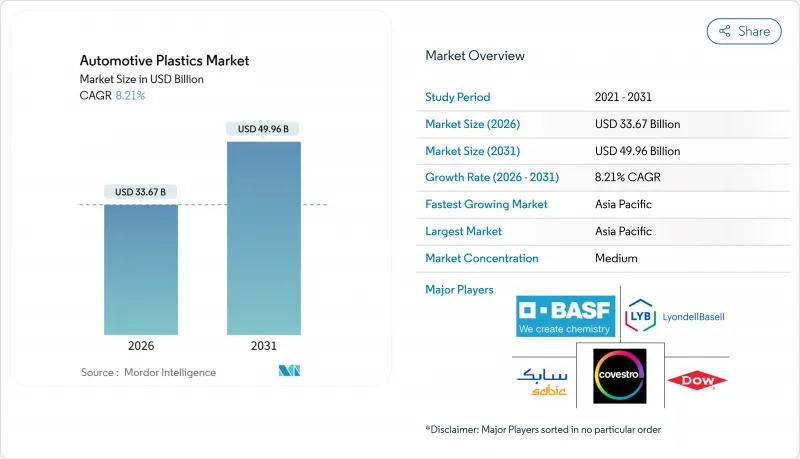
본 보고서는 소재별(폴리프로필렌, 폴리우레탄 등), 용도별(외장, 내장, 보닛 하부, 기타 용도),차종별(기존 차량 및 전기차), 원료별(버진 플라스틱, 재활용 플라스틱, 바이오 플라스틱), 지역별(아시아태평양, 북미 등)로 분류되어 있습니다. 시장 예측은 금액(미 달러) 기준으로 제시되어 있습니다.
세계의 자동차용 플라스틱 시장 동향 및 인사이트
CO₂ 배출 규제 목표가 경량화를 촉진
EU에서는 더욱 엄격해진 차량군 평균 CO2 배출량 상한선과 더불어, 북미의 연비 기준 조정으로 인해 자동차 제조업체들은 차종의 경량화를 추진해야 하는 상황에 놓여 있습니다. 유리섬유 강화 폴리프로필렌은 약간의 비용 증가만으로 강철에 비해 대폭적인 경량화를 실현할 수 있어, 가장 비용 대비 효과가 높은 규제 대응 솔루션으로 부상하고 있습니다. 중국의 듀얼 크레딧 제도는 수요를 더욱 부양하여 경량 차량의 도입을 촉진하는 동시에, 도어 패널 및 테일게이트에서 폴리머로의 전환을 가속화하고 있습니다. 현재 대중차용 플랫폼에서는 기존에 금속이 사용되던 구조부에도 플라스틱이 채택되기 시작하면서, 표준 소재와 첨단 소재 간의 성능 격차가 점차 좁혀지고 있습니다. ISO 마킹 기준에 따라 제품 수명 주기 종료 시의 추적성이 확보되어, 경량화 노력과 순환형 경제 노력이 조화를 이루고 있습니다.
EV 아키텍처가 가져오는 구조적·열적 역할
배터리식 전기차(BEV) 플랫폼에서는 내연기관 차량에 비해 차량 1대당 플라스틱 사용량이 증가하고 있습니다. 이는 주로 배터리 커버, 열 관리용 하우징, 플랫 플로어 팬 등의 부품에서 기인하며, 이러한 부품에서는 전기 절연 특성과 설계 유연성을 활용하여 폴리머가 채택되고 있습니다. 테슬라의 ‘모델 Y’는 일체 성형된 폴리카보네이트·ABS 재질의 실드를 채택하여 부품 수와 조립 시간을 줄이고 있습니다. 아크 트래킹 내성이 점점 더 중요시되는 가운데, 난연성 폴리카보네이트와 고CTI 폴리아미드는 배터리 모듈 커버 및 800V 커넥터의 표준 소재로 자리 잡고 있습니다. EV 프로그램의 초기 모델에서는 플라스틱 사용량이 가장 많지만, 이후 재설계 단계에서는 비용 절감을 위해 금속이 채택되는 경우가 많습니다. 재활용 함량을 중시하는 EU의 새로운 배터리 규제가 도입됨에 따라, 사용 후 폴리카보네이트와 나일론에 대한 수요가 급증하고 있습니다.
원유 가격 변동이 이익률을 압박
폴리프로필렌과 폴리에틸렌은 석유화학 원료의 가격 동향에 뒤이어 연동되기 때문에 분기마다 가격 변동이 나타납니다. 이러한 변동은 계약 재협상으로 이어지는 경우가 많아, 이미 어려운 공급업체의 이익률에 추가적인 압박을 가하고 있습니다. 2025년 1분기에는 브렌트 원유 가격의 급등으로 인해 유럽의 폴리프로필렌 가격이 상승했습니다. 이 급등으로 인해 불가항력 조항이 발동되어, 두 곳의 주요 OEM 제조업체의 제품 출시일이 연기되었습니다. 업스트림 부문의 생산 능력이 집중되어 있어, 폴리아미드 시장은 특히 영향을 받기 쉬운 상황입니다. 예를 들어, 카프로락탐 생산 중단으로 인해 PA6 가격이 대폭 급등했습니다. 게다가 지수 연동형 가격 책정은 리스크를 자동차 제조업체로 전가하기 때문에 자동차 제조업체의 다년간 비용 예측을 복잡하게 만들고 있습니다. 한편, 재무 기반이 취약한 중소규모의 컴파운더들은 업계 재편을 추진하거나 업계에서 철수하고 있습니다.
부문 분석
폴리아미드의 연평균 성장률(CAGR)은 8.92%로, 터보차저 장착 엔진이나 하이브리드 엔진에서 폴리프로필렌의 한계를 뛰어넘는 높은 연속 사용 온도가 요구되고 있음을 반영하고 있습니다. 자동차용 플라스틱 시장에서 폴리아미드 시장 규모는 대폭 확대될 전망입니다. 또한, 전기차용 배터리 커버가 고CTI 나일론 등급으로 전환된다면, 자동차용 플라스틱 시장에서 폴리아미드의 점유율은 더욱 확대될 가능성이 있습니다. 폴리우레탄은 경량화로 이어지는 얇은 폼의 이점을 바탕으로 시트 및 NVH(소음·진동·하모닉) 용도에서 꾸준히 틈새 시장을 개척하고 있는 반면, PVC는 유럽 자동차 내장재 시장에서 프탈레이트를 사용하지 않는 열가소성 폴리올레핀에 시장 점유율을 빼앗기고 있습니다.
고급 폴리카보네이트는 파노라마 루프나 LED 조명용 렌즈로의 응용 분야에서 꾸준히 진전을 보이고 있습니다. ABS는 밀도 면에서 불리한 점이 있지만, 광택이 있는 인테리어 트림에는 여전히 대표적인 선택지로 자리 잡고 있습니다. 폴리에틸렌의 동향은 전체 생산 추세를 반영하고 있습니다. 그러나 EVOH 배리어층으로 강화된 다층 HDPE 연료 탱크는 더욱 엄격해진 증발 규제를 준수함으로써 현재 업계 표준으로 자리 잡고 있습니다. PBT 및 PPA와 같은 특수 수지는 센서 하우징 및 800볼트 버스바에서 중요한 역할을 담당하고 있으며, 치수 안정성 덕분에 고가 제품군에서 수요를 확보하고 있습니다. 또한, 업계가 세계 조달 및 재활용으로 전환됨에 따라 표준화된 ISO 약어의 중요성이 점점 더 커지고 있습니다.
내장 부품은 2025년 매출의 32.98%를 차지했으나, 그 연평균 성장률(CAGR)은 8.96%의 성장률을 보이는 고온 환경의 보닛 하부 부품에 뒤처지고 있습니다. 터보차저가 장착된 다운사이징 엔진과 하이브리드 차량의 냉각 루프로 인해 작동 온도가 상승함에 따라, 보닛 하부 부품용 자동차용 플라스틱 시장은 확대될 것으로 예측됩니다. 흡기 매니폴드의 경우, 경량화와 기류 최적화를 위해 현재 유리섬유 강화 PA66이 채택되고 있는 반면, 라디에이터의 엔드 탱크는 PPA로의 전환이 진행되고 있습니다.
외장 패널은 각 OEM 업체들이 경량화의 이점과 수리 비용을 저울질하는 가운데 꾸준히 성장하고 있습니다. 또한, 48볼트 및 800볼트 아키텍처가 보급됨에 따라, 액체 리저버, 고전압 커넥터, 섀시 실드 등 기타 용도에서도 고부가가치 엔지니어링 수지로의 소재 구성이 전환되고 있습니다. 보닛 내부 부품은 수량적으로는 작은 비중을 차지하지만, 고급 수지의 가격 책정 덕분에 재료 가치 측면에서는 큰 비중을 차지하고 있습니다.
지역별 분석
아시아태평양은 2025년에 49.11%의 점유율을 차지하며 연평균 성장률(CAGR) 9.94%로 확대되었으며, 이는 각 지역 중 가장 높은 성장률입니다. 중국의 야심찬 전기차 생산 목표가 폴리프로필렌 수요의 급격한 증가를 뒷받침하고 있습니다. 한편, 인도의 생산 연계형 인센티브는 BASF, LG화학, 롯데 등 업계 대기업들의 새로운 컴파운딩 공장 설립을 촉진하고 있습니다. 일본의 탄소중립 차량 도입 노력은 피마자유 유래 폴리아미드의 채택을 현저히 증가시키고 있습니다. 동남아시아는 제2의 거점으로 부상하고 있으며, 중국과 한국공급업체들은 지정학적 리스크를 완화하기 위해 태국과 인도네시아에서 전략적으로 생산 능력을 강화하고 있습니다.
북미는 꾸준한 성장세를 보이고 있습니다. 미국의 ‘인플레이션 억제법’에 따른 국내 조달 요건으로 인해 컴파운딩 사업이 텍사스주와 루이지애나주로 다시 돌아오고 있습니다. 한편, 멕시코는 해당 지역의 주요 수지 공급국임에도 불구하고 USMCA(미국·멕시코·캐나다 협정)의 엄격한 부가가치 기준을 충족하는 데 어려움을 겪고 있습니다. 캐나다는 엔지니어링 플라스틱에 크게 의존하는 고급 전기차 생산을 촉진하는 인센티브에 힘입어 성장률 측면에서 미국을 앞지르고 있습니다.
유럽은 자동차 생산이 정체된 상황에서도 꾸준한 성장 궤도를 타고 있습니다. 재활용 소재 사용에 대한 적극적인 규제와 PVC가 포함되지 않은 내장재 도입 노력 덕분에 수요는 계속해서 지지를 받고 있습니다. 독일은 가동률 향상을 위해 생산 능력 합리화를 추진하고 있으며, 프랑스와 이탈리아는 전기차 구매 보조금에 기대를 걸고 있습니다. 남미에서는 성장세가 나타나고 있습니다. 브라스크엠(Braskem)사의 바이오 폴리프로필렌 관련 시범 프로젝트를 통해 브라질은 향후 수출 거점이 될 가능성이 있으나, 상업적 규모로 확대되기까지는 아직 2년이 소요될 전망입니다. 중동 및 아프리카는 사우디아라비아의 현지화 노력과 남아프리카공화국의 조립 거점에 힘입어 눈부신 속도로 성장하고 있습니다.
기타 혜택 :
- 엑셀 형식 시장 예측(ME) 시트
- 3개월간의 애널리스트 지원
자주 묻는 질문
목차
제1장 서론
제2장 조사 방법
제3장 주요 요약
제4장 시장 구도
제5장 시장 규모 및 성장 예측
제6장 경쟁 구도
제7장 시장 기회 및 향후 전망
KTH 26.09.10According to Mordor Intelligence, the automotive plastics market size is estimated at USD 33.67 billion in 2026, and is expected to reach USD 49.96 billion by 2031, at a CAGR of 8.21% during the forecast period (2026-2031).
This report is Segmented by Material (Polypropylene, Polyurethane, and More), Application (Exterior, Interior, Under Bonnet, and Other Applications), Vehicle Type (Conventional/Traditional Vehicles and Electric Vehicles), Source (Virgin Plastic, Recycled Plastic, and Bio-Based Plastic), and Geography (Asia-Pacific, North America, and More). The Market Forecasts are Provided in Terms of Value (USD).
Global Automotive Plastics Market Trends and Insights
Regulatory CO2 Targets Driving Lightweighting
In the EU, stricter fleet-average CO2 caps, alongside North America's fuel-economy adjustments, are pushing automakers to shed weight from their models. Glass-fiber-reinforced polypropylene, offering significant weight reduction over steel at a modest cost premium, emerges as the most cost-effective compliance solution. China's dual-credit scheme boosts demand further, incentivizing lightweight vehicles and accelerating the shift to polymers in door panels and tailgates. Mass-market platforms are now integrating plastics into structural areas traditionally reserved for metals, narrowing the performance divide between standard and advanced materials. ISO marking standards ensure traceability at the end of a product's life, harmonizing weight reduction efforts with circular-economy initiatives.
EV Architecture Unlocking Structural and Thermal Roles
Battery-electric platforms utilize more plastics per vehicle compared to their ICE counterparts. This is largely due to components like battery covers, thermal-management housings, and flat-floor pans, which leverage polymers for their electrical insulation properties and design flexibility. Tesla's Model Y features one-piece polycarbonate-ABS shields, reducing part count and assembly time. Given the heightened emphasis on arc-tracking resistance, flame-retardant polycarbonate and high-CTI polyamides have become the go-to materials for battery-module covers and 800-volt connectors. The initial model years of an EV program see the highest plastic usage, with subsequent redesigns often opting for metals to cut costs. With the introduction of new EU battery regulations emphasizing recycled content, there's a surge in demand for post-consumer polycarbonate and nylon.
Crude-Oil Volatility Compressing Margins
Polypropylene and polyethylene, tracking petrochemical feedstocks with a lag, experience quarterly price swings. These fluctuations often lead to contract renegotiations and strain already thin supplier margins. In Q1 2025, a rally in Brent crude pushed European polypropylene prices higher. This surge triggered force-majeure clauses and delayed launch dates for two major OEMs. The concentrated upstream capacity makes polyamide markets particularly vulnerable; for instance, a caprolactam outage led to a significant spike in PA6 prices. Additionally, index-linked pricing transfers risk to automakers, complicating their multi-year cost forecasts. Meanwhile, smaller compounders, lacking robust balance sheets, are either consolidating or exiting the sector.
Other drivers and restraints analyzed in the detailed report include:
- Mandatory Recycled-Content Quotas Reshaping Supply Chains
- Skateboard EV Platforms Consolidating Part Counts
- Microplastic Regulations Limiting Polymer Choices
For complete list of drivers and restraints, kindly check the Table Of Contents.
Segment Analysis
Polypropylene held the largest share at 34.22% in 2025 due to its dominance in interior panels and bumper skins. Polyamide's 8.92% CAGR reflects higher continuous-use temperatures in turbocharged and hybrid engines that exceed polypropylene limits. The market size for polyamide in automotive plastics is set to grow significantly. Furthermore, if EV battery covers transition to high-CTI nylon grades, polyamide's market share in automotive plastics could increase further. While polyurethane steadily carves out its niche in seating and NVH roles, benefiting from thinner foams that reduce weight, PVC is ceding ground to phthalate-free thermoplastic polyolefins in European car interiors.
Premium polycarbonate is making strides with its applications in panoramic roofs and LED lighting lenses. ABS, despite facing density penalties, continues to be the go-to choice for glossy interior trims. Polyethylene's performance mirrors overall production trends. However, multilayer HDPE fuel tanks, fortified with EVOH barriers, are now setting the standard by adhering to stricter evaporative regulations. Specialty resins like PBT and PPA are carving out significant roles in sensor housings and 800-volt busbars, commanding price premiums due to their dimensional stability. And as the industry moves towards global sourcing and recycling, standardized ISO abbreviations are proving invaluable.
Interior components captured 32.98% of 2025 revenue, yet their CAGR lags high-heat under-bonnet parts that grow at 8.96%. The automotive plastics market for under-bonnet parts is expected to expand as turbocharged downsized engines and hybrid cooling loops raise operating temperatures. Air-intake manifolds now rely on glass-fiber-reinforced PA66 for weight savings and optimized airflow, while radiator end tanks transition to PPA.
Exterior panels are growing steadily as OEMs weigh lightweighting benefits against repairability costs. Other applications, including fluid reservoirs, high-voltage connectors, and chassis shields, see a mix shift toward high-value engineering resins as 48-volt and 800-volt architectures proliferate. Under-bonnet parts, though a smaller portion of volume, account for a significant share of material value because of premium resin pricing.
Complete Report Scope:
- By Material
- Polypropylene (PP)
- Polyurethane (PU)
- Polyvinyl Chloride (PVC)
- Polyethylene (PE)
- Acrylonitrile Butadiene Styrene (ABS)
- Polyamides (PA)
- Polycarbonate (PC)
- Other Materials
- By Application
- Exterior
- Interior
- Under Bonnet
- Other Applications
- By Vehicle Type
- Conventional / Traditional Vehicles
- Electric Vehicles
- By Source
- Virgin Plastic
- Recycled Plastic
- Bio-based Plastic
- By Geography
- Asia-Pacific
- China
- Japan
- India
- South Korea
- Rest of Asia-Pacific
- North America
- United States
- Canada
- Mexico
- Europe
- Germany
- United Kingdom
- France
- Italy
- Rest of Europe
- South America
- Brazil
- Argentina
- Rest of South America
- Middle-East and Africa
- Saudi Arabia
- South Africa
- Rest of Middle-East Africa
- Asia-Pacific
Geography Analysis
Asia-Pacific held a 49.11% share in 2025 and is advancing at a 9.94% CAGR, the strongest among regions. China's ambitious EV production target fuels a significant surge in polypropylene demand. Meanwhile, India's production-linked incentives are catalyzing the establishment of new compounding plants by industry giants like BASF, LG Chem, and Lotte. Japan's commitment to carbon-neutral fleets is driving a notable uptick in the adoption of castor-oil-based polyamides. Southeast Asia is emerging as a secondary hub, with Chinese and Korean suppliers strategically bolstering capacities in Thailand and Indonesia to mitigate geopolitical risks.
North America is charting a steady course. The US Inflation Reduction Act's domestic-content rules are steering compounding operations back to Texas and Louisiana. Meanwhile, Mexico, despite being a significant resin supplier in the region, grapples with stringent USMCA value-content thresholds. Canada is outpacing the U.S. in growth, driven by incentives promoting premium EV production, which leans heavily on engineering plastics.
Europe is navigating a steady growth trajectory, even amidst stagnant vehicle builds. Demand remains buoyed by aggressive mandates for recycled content and commitments to PVC-free interiors. Germany is streamlining its capacity for better utilization, while France and Italy are banking on EV purchase subsidies. South America is witnessing growth. Braskem's pilot project on bio-based polypropylene could position Brazil as a future export hub, albeit with commercial scalability still two years away. The Middle East and Africa are growing at a commendable pace, bolstered by Saudi localization efforts and assembly hubs in South Africa.
- Arkema
- Asahi Kasei Advance Corporation
- BASF SE
- Borealis AG
- Braskem
- Celanese Corporation
- Covestro AG
- Daicel Corporation
- Dow
- dsm-firmenich
- DuPont
- Evonik Industries AG
- Exxon Mobil Corporation
- INEOS
- LANXESS
- LG Chem
- LyondellBasell Industries Holdings B.V.
- Mitsui Chemicals Inc.
- SABIC
- TEIJIN LIMITED
Additional Benefits:
- The market estimate (ME) sheet in Excel format
- 3 months of analyst support
TABLE OF CONTENTS
1 Introduction
- 1.1 Study Assumptions and Market Definition
- 1.2 Scope of the Study
2 Research Methodology
3 Executive Summary
4 Market Landscape
- 4.1 Market Overview
- 4.2 Market Drivers
- 4.2.1 Regulatory CO2 targets driving lightweighting
- 4.2.2 EV production surge elevating plastics/vehicle
- 4.2.3 Cost and design flexibility versus metals
- 4.2.4 Mandatory recycled-content quotas in EU vehicles
- 4.2.5 Rise of skateboard EV platforms allowing 15-20 kg more plastic integration
- 4.3 Market Restraints
- 4.3.1 Volatile crude-linked resin prices
- 4.3.2 OEM qualification delays for bio-based engineering plastics
- 4.3.3 Micro-plastic tyre and brake-dust directives limiting certain polymer blends
- 4.4 Value Chain Analysis
- 4.5 Porter's Five Forces
- 4.5.1 Bargaining Power of Suppliers
- 4.5.2 Bargaining Power of Buyers
- 4.5.3 Threat of New Entrants
- 4.5.4 Threat of Substitutes
- 4.5.5 Degree of Competition
5 Market Size and Growth Forecasts (Value)
- 5.1 By Material
- 5.1.1 Polypropylene (PP)
- 5.1.2 Polyurethane (PU)
- 5.1.3 Polyvinyl Chloride (PVC)
- 5.1.4 Polyethylene (PE)
- 5.1.5 Acrylonitrile Butadiene Styrene (ABS)
- 5.1.6 Polyamides (PA)
- 5.1.7 Polycarbonate (PC)
- 5.1.8 Other Materials
- 5.2 By Application
- 5.2.1 Exterior
- 5.2.2 Interior
- 5.2.3 Under Bonnet
- 5.2.4 Other Applications
- 5.3 By Vehicle Type
- 5.3.1 Conventional / Traditional Vehicles
- 5.3.2 Electric Vehicles
- 5.4 By Source
- 5.4.1 Virgin Plastic
- 5.4.2 Recycled Plastic
- 5.4.3 Bio-based Plastic
- 5.5 By Geography
- 5.5.1 Asia-Pacific
- 5.5.1.1 China
- 5.5.1.2 Japan
- 5.5.1.3 India
- 5.5.1.4 South Korea
- 5.5.1.5 Rest of Asia-Pacific
- 5.5.2 North America
- 5.5.2.1 United States
- 5.5.2.2 Canada
- 5.5.2.3 Mexico
- 5.5.3 Europe
- 5.5.3.1 Germany
- 5.5.3.2 United Kingdom
- 5.5.3.3 France
- 5.5.3.4 Italy
- 5.5.3.5 Rest of Europe
- 5.5.4 South America
- 5.5.4.1 Brazil
- 5.5.4.2 Argentina
- 5.5.4.3 Rest of South America
- 5.5.5 Middle-East and Africa
- 5.5.5.1 Saudi Arabia
- 5.5.5.2 South Africa
- 5.5.5.3 Rest of Middle-East Africa
- 5.5.1 Asia-Pacific
6 Competitive Landscape
- 6.1 Market Concentration
- 6.2 Strategic Moves
- 6.3 Market Share / Ranking Analysis
- 6.4 Company Profiles (includes Global-level Overview, Market-level Overview, Core Segments, Financials, Strategic Information, Products and Services, Recent Developments)
- 6.4.1 Arkema
- 6.4.2 Asahi Kasei Advance Corporation
- 6.4.3 BASF SE
- 6.4.4 Borealis AG
- 6.4.5 Braskem
- 6.4.6 Celanese Corporation
- 6.4.7 Covestro AG
- 6.4.8 Daicel Corporation
- 6.4.9 Dow
- 6.4.10 dsm-firmenich
- 6.4.11 DuPont
- 6.4.12 Evonik Industries AG
- 6.4.13 Exxon Mobil Corporation
- 6.4.14 INEOS
- 6.4.15 LANXESS
- 6.4.16 LG Chem
- 6.4.17 LyondellBasell Industries Holdings B.V.
- 6.4.18 Mitsui Chemicals Inc.
- 6.4.19 SABIC
- 6.4.20 TEIJIN LIMITED
7 Market Opportunities and Future Outlook
- 7.1 White-Space and Unmet-Need Assessment
- 7.2 Technological Developments in Electric Vehicles


