

|
시장보고서
상품코드
2119825
유럽의 이산화티타늄 시장 : 점유율 분석, 업계 동향과 통계, 성장 예측(2026-2031년)Europe Titanium Dioxide - Market Share Analysis, Industry Trends & Statistics, Growth Forecasts (2026 - 2031) |
||||||
 Mordor Intelligence
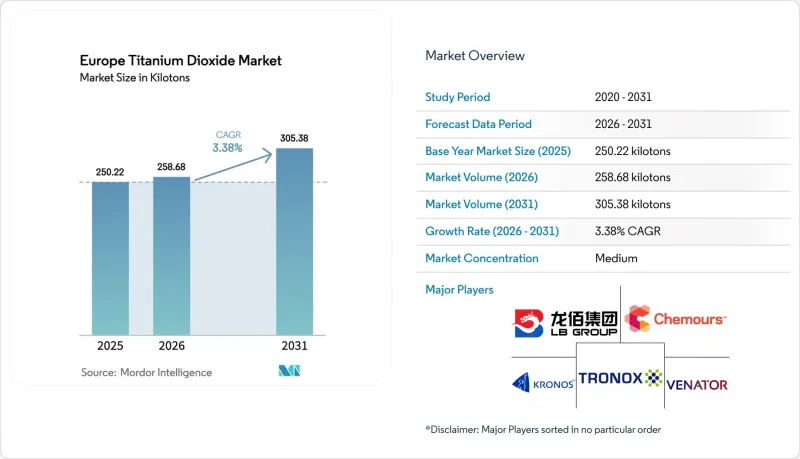
Mordor Intelligence에 의하면, 유럽의 이산화티타늄 시장 규모는 2025년에 250.22 킬로톤으로 평가되어 2026년 258.68 킬로톤에서 2031년까지 305.38 킬로톤에 이를 것으로 추정되고 있어 예측 기간(2026-2031년)에서 CAGR은 3.38%를 나타낼 전망입니다.
본 보고서는 등급(루틸형 및 아나타제형), 제조 공정(황산염법 및 염화물법), 용도(페인트 및 코팅, 플라스틱, 종이 및 펄프, 화장품 및 퍼스널케어, 기타 용도(의약품 등)), 지역(독일, 영국, 프랑스, 이탈리아,스페인, 북유럽 국가, 러시아 및 기타 유럽)별로 분류되어 있습니다. 시장 예측은 수량(톤) 기준으로 제시되어 있습니다.
유럽 이산화티타늄 시장 동향 및 인사이트
건설 수요에 힘입은 고성능 페인트 및 코팅 수요
건축용 코팅은 유럽 도료 부문에서 약 56%의 점유율을 차지하고 있으며, 불투명도와 내후성을 확보하는 데 있어 이산화티타늄(TiO2)은 필수적인 요소로 자리 잡고 있습니다. 2030년까지 건축물의 배출량을 40% 감축하는 것을 목표로 하는 ‘EU 리노베이션 웨이브’에서는 수명 주기 전반에 걸쳐 도료 사용량을 줄여주는 높은 은폐력을 가진 파사드용 코팅에 대해 보조금이 지원되고 있습니다. 프랑스의 전력 비용은 2024년에 전년 대비 40% 감소한 58유로/MWh를 기록했으나, 여전히 2019년 수준을 80% 상회하고 있어, 이에 따라 배합 설계자들은 저렴한 충전제보다 내구성이 뛰어난 TiO2를 풍부하게 함유한 배합을 선호하는 추세입니다. 독일의 그린빌딩 장려 정책에서는 NOx를 분해하는 광촉매 코팅이 우선시되고 있으며, ISO 50001을 준수하기 위해서는 3%를 초과하는 TiO2 함량이 필요한 틈새 시장이 되었습니다. 핀란드의 제조업체인 테크노스(Teknos)는 반덤핑 관세 도입을 18개월에 걸쳐 단계적으로 실시할 것을 요청하고 있으며, 중국산 TiO2의 가격이 급등할 경우 수성 도료를 사용한 재도장 프로젝트가 지연될 것이라고 경고하고 있습니다.
경량이며 내구성이 뛰어난 플라스틱이 TiO2 함유량을 끌어올리고 있다.
자동차 업계에서 유리섬유 강화 폴리올레핀으로의 전환과 얇으면서도 불투명도가 높은 포장용 필름의 보급으로 인해 마스터배치 내 이산화티타늄 농도가 상승하고 있습니다. 폭스바겐과 스텔란티스는 독일 및 프랑스에서 생산되는 전기차의 색상 견뢰도 목표를 달성하기 위해 실내 트림에 2%-4%의 이산화티타늄 사용을 지정하고 있습니다. 2024년 생산량의 89킬로톤을 차지하는 재생 폴리머 제품 라인 역시, 사용 후 원료를 균일한 흰색 베이스로 혼합하기 위해 이산화티타늄에 의존하고 있습니다. EU의 일회용 플라스틱 규제로 인해 더 얇은 필름의 사용이 촉진되고 있으며, 진열 시의 매력을 유지하기 위해서는 더 높은 안료 함량이 필요합니다. 1톤당 최대 329kg의 폐기물만 발생하는 염화물 공법으로 제조된 안료는 REACH를 준수하는 자동차 공급망에서 황산염계 안료를 대체하는 추세가 강해지고 있습니다.
독성에 대한 인식과 REACH/CLP 분류의 엄격화
ECHA가 2021년에 TiO2에 부여한 흡입 위험성 라벨로 인해, 현재 함유율이 1%를 초과하는 모든 분말 제품에는 발암성 경고 표시가 의무화되어 벽면용 도료 및 화장품에 대한 소비자의 신뢰를 훼손하고 있습니다. 독일이 2022년에 식품용 E171의 사용을 금지함에 따라 일반 시민들의 우려는 더욱 커졌으며, AURO 등의 브랜드는 불투명도가 떨어지더라도 TiO2를 포함하지 않는 도료를 출시하기 시작했습니다. Lavera를 비롯한 화장품 제조업체들도 이에 발맞추어 2024년에 TiO2가 함유되지 않은 파운데이션을 출시했습니다. 같은 해 SCCS가 피부 안전성을 확인했음에도 불구하고 말입니다. 프랑스와 독일의 산업안전 규제로 인해 현재 분말 제조 공정에서는 호흡용 보호구 착용이 의무화되어 있으며, 이로 인해 규정 준수 비용이 증가함에 따라 도료 제조업체들은 액체 분산액으로의 전환을 강요받고 있습니다. 그린빌딩 인증에서는 TiO₂를 탄산칼슘으로 부분적으로 대체하는 것이 더욱 높이 평가되어, 시각적인 밝기를 희생하는 대신 매립 탄소를 15%-20% 줄일 수 있게 되었습니다.
부문 분석
2025년, 루틸 계열은 외장용 도료 및 플라스틱에 요구되는 뛰어난 불투명도와 내후성 덕분에 유럽 이산화티타늄 시장의 62.12%를 차지했습니다. 나노 및 초미세 안료는 자가 세정 코팅 및 제약 분야 수요에 힘입어 연평균 성장률(CAGR) 4.96%를 나타낼 것으로 예측됩니다. 이로 인해 생산량은 적지만 프리미엄 가격이 유지되어 수익을 뒷받침하고 있습니다. 염화물 공정을 통한 루틸계 이산화티타늄의 가격은 입자 분포가 더 좁고 불순물 함량이 적기 때문에 황산염계 경쟁 제품보다 10%-15% 비쌉니다. 이러한 특성은 고광택 마감을 실현하기 위해 자동차 OEM 업체들로부터 높이 평가받고 있습니다. 대체재의 압박으로 인해 범용 인테리어 등급 제품이 탄산칼슘의 증량제로 전락하고 있는 상황에서도, 루틸계 용도 분야의 유럽 이산화티타늄 시장 규모는 꾸준히 확대될 것으로 전망됩니다.
아나타제는 표면 에너지가 NOx의 산화를 촉진하기 때문에 광촉매 파사드 분야에서 여전히 중요한 위치를 차지하고 있습니다. 이 기능은 빈 공과대학교(TU Wien)가 2024년에 실시한 시험에서 40%-60%의 오염 물질 제거율이 확인됨으로써 입증되었습니다. 그러나 베네이터(Venator)사가 뒤스부르크 및 스칼리노의 생산 설비를 가동 중단함에 따라, 경제적 역풍으로 인해 황산법을 이용한 아나타제 생산에 대한 신규 투자가 억제되고 있습니다. VTT의 셀룰로오스계 ‘CELLIGHT’ 콘셉트는 모든 등급에 걸쳐 장기적인 위협이 되고 있지만, 불투명성, 자외선 차단성, 그리고 TiO₂만이 제공하는 화학적 비활성 측면에서 기능적 격차를 겪고 있습니다. 따라서 루틸 계열은 핵심 시장 점유율을 유지하는 한편, 나노 부문은 더욱 엄격해진 EU 친환경 라벨 하에서 특수 용도 수요를 흡수함으로써 이익률 하락을 막을 것으로 보입니다.
기타 혜택:
- 엑셀 형식 시장 예측(ME) 시트
- 3개월간의 애널리스트 지원
자주 묻는 질문
목차
제1장 서론
제2장 조사 방법
제3장 개요
제4장 시장 구도
제5장 시장 규모와 성장 예측
제6장 경쟁 구도
제7장 시장 기회와 향후 전망
JHS 26.09.03According to Mordor Intelligence, the Europe titanium dioxide market size was valued at 250.22 kilotons in 2025 and estimated to grow from 258.68 kilotons in 2026 to reach 305.38 kilotons by 2031, at a CAGR of 3.38% during the forecast period (2026-2031).
This report is Segmented by Grade (Rutile and Anatase), Production Process (Sulfate and Chloride), Application (Paints and Coatings, Plastics, Paper and Pulp, Cosmetics and Personal Care, and Other Applications (Pharmaceuticals, and More)), and Geography (Germany, United Kingdom, France, Italy, Spain, Nordics, Russia, and Rest of Europe). Market Forecasts are Provided in Terms of Volume (Tons).
Europe Titanium Dioxide Market Trends and Insights
Construction-Driven Demand for High-Performance Paints and Coatings
Architectural coatings retain a roughly 56% share of Europe's paints segment, making TiO2 indispensable for opacity and weather resistance. The EU Renovation Wave, aimed at a 40% cut in building emissions by 2030, channels subsidies toward high-hiding-power facade coatings that lower life-cycle paint use. France's electricity costs, while down 40% year-over-year to EUR 58/MWh in 2024, are still 80% above 2019 levels, nudging formulators to favor durable TiO2-rich recipes rather than cheaper extenders. German green-building incentives prioritize photocatalytic coatings that decompose NOx, a niche requiring TiO2 loads of more than 3% to comply with ISO 50001. Finnish producer Teknos has requested an 18-month phase-in of anti-dumping duties, warning that sudden cost spikes on Chinese TiO2 would slow waterborne repaint projects.
Lightweight Durable Plastics Boosting TiO2 Loadings
The automotive shift to glass-fiber-reinforced polyolefins and the proliferation of thin, high-opacity packaging films are increasing TiO2 concentrations in masterbatches. Volkswagen and Stellantis specify 2%-4% TiO2 in interior trims to meet color-fastness targets in electric vehicles manufactured in Germany and France. Recycled polymer lines, accounting for 89 kilo tonnes of 2024 output, also rely on TiO2 to blend post-consumer feedstocks into a uniform white base. EU single-use plastic rules are driving the use of thinner films, which require higher pigment loadings to maintain shelf appeal. Chloride-route pigment, which generates at most 329 kg of waste per tonne, increasingly displaces sulfate grades in REACH-compliant automotive supply chains.
Toxicity Perception and Tightening REACH/CLP Classification
ECHA's 2021 inhalation-hazard label on TiO2 now forces any powder product exceeding 1% content to carry a cancer warning, denting consumer confidence in wall paints and cosmetics. Germany's 2022 ban on food-grade E171 amplified public concern, encouraging brands like AURO to unveil TiO2-free paints despite lower opacity. Lavera and other cosmetics players followed by launching TiO2-free foundations in 2024, even though SCCS confirmed skin safety the same year. Occupational safety mandates in France and Germany now require respirators in powder units, which increases compliance costs and nudges coatings producers toward liquid dispersions. Green-building labels further reward partial TiO2 substitution with calcium carbonate, cutting embodied carbon 15%-20% at the expense of visual brightness.
Other drivers and restraints analyzed in the detailed report include:
- Shift to Chloride-Process Premium Grades for Sustainability Compliance
- EU Renovation Wave Spurring Photocatalytic Self-Cleaning Facades
- Volatile Prices for Ilmenite, Rutile and Energy
For complete list of drivers and restraints, kindly check the Table Of Contents.
Segment Analysis
Rutile controlled 62.12% of the Europe titanium dioxide market in 2025 thanks to superior opacity and weather fastness required in exterior paints and plastics. Nano and ultrafine pigments are projected to grow at a 4.96% CAGR, driven by self-cleaning coatings and pharmaceutical demand, which supports premium prices that cushion revenue despite their smaller tonnage base. Chloride-route rutile is priced 10%-15% higher than sulfate rivals due to its tighter particle distribution and lower impurity levels, attributes that are highly valued by automotive OEMs for achieving high-gloss finishes. The Europe titanium dioxide market size for rutile applications is forecast to expand steadily even as substitution pressure nudges commodity interior grades toward calcium carbonate extenders.
Anatase retains relevance in photocatalytic facades because its surface energy accelerates NOx oxidation, a function validated by TU Wien's 2024 tests, which showed 40%-60% pollution removal. Yet economic headwinds stifle new sulfate-anatase investment after Venator mothballed its Duisburg and Scarlino units. VTT's cellulose-based CELLIGHT concept illustrates a long-term threat across all grades but faces functional gaps in opacity, UV shielding, and chemical inertness that TiO2 uniquely provides. Thus, rutile should hold core share while nano segments erode margin dilution by capturing specialty demand under stricter EU ecolabels.
Complete Report Scope:
- By Grade
- Rutile
- Anatase
- By Production Process
- Sulfate
- Chloride
- By Application
- Paints and Coatings
- Plastics
- Paper and Pulp
- Cosmetics and Personal Care
- Other Applications (Pharmaceuticals, Textiles, Food Colorants, etc.)
- By Geography
- Germany
- United Kingdom
- France
- Italy
- Spain
- Nordics Countries
- Russia
- Rest of Europe
List of Companies Covered in this Report:
- Argex Titanium Inc.
- Cinkarna Celje d.d.
- CNNC HUA YUAN TITANIUM DIOXIDE CO., LTD is
- Tronox Holdings plc
- Evonik Industries AG
- Russkiy Titan
- Grupa Azoty
- ILUKA RESOURCES LIMITED
- INEOS
- ISHIHARA SANGYO KAISHA, LTD.
- Kerala Minerals and Metals Ltd. (KMML)
- Kronos Worldwide Inc.
- LB Group
- Precheza a.s.
- Shandong Dongjia Group
- Tayca Corporation
- Tayca Europe
- The Chemours Company
- Tronox Holdings plc
- Venator Materials PLC
Additional Benefits:
- The market estimate (ME) sheet in Excel format
- 3 months of analyst support
TABLE OF CONTENTS
1 Introduction
- 1.1 Study Assumptions & Market Definition
- 1.2 Scope of the Study
2 Research Methodology
3 Executive Summary
4 Market Landscape
- 4.1 Market Overview
- 4.2 Market Drivers
- 4.2.1 Construction-driven demand for high-performance paints and coatings
- 4.2.2 Lightweight durable plastics boosting TiO2 loadings
- 4.2.3 Shift to chloride-process premium grades for sustainability compliance
- 4.2.4 EU Renovation Wave spurring photocatalytic self-cleaning facades
- 4.2.5 Ultrafine rutile use in medical-device and drug-delivery coatings
- 4.3 Market Restraints
- 4.3.1 Toxicity perception and tightening REACH/CLP classification
- 4.3.2 Volatile prices for ilmenite, rutile and energy
- 4.3.3 Accelerating shift away from chlorine threatens chloride-route security
- 4.4 Value Chain Analysis
- 4.5 Porter's Five Forces
- 4.5.1 Threat of New Entrants
- 4.5.2 Bargaining Power of Buyers
- 4.5.3 Bargaining Power of Suppliers
- 4.5.4 Threat of Substitute Products
- 4.5.5 Degree of Competition
5 Market Size & Growth Forecasts (Volume)
- 5.1 By Grade
- 5.1.1 Rutile
- 5.1.2 Anatase
- 5.2 By Production Process
- 5.2.1 Sulfate
- 5.2.2 Chloride
- 5.3 By Application
- 5.3.1 Paints and Coatings
- 5.3.2 Plastics
- 5.3.3 Paper and Pulp
- 5.3.4 Cosmetics and Personal Care
- 5.3.5 Other Applications (Pharmaceuticals, Textiles, Food Colorants, etc.)
- 5.4 By Geography
- 5.4.1 Germany
- 5.4.2 United Kingdom
- 5.4.3 France
- 5.4.4 Italy
- 5.4.5 Spain
- 5.4.6 Nordics Countries
- 5.4.7 Russia
- 5.4.8 Rest of Europe
6 Competitive Landscape
- 6.1 Market Concentration
- 6.2 Strategic Moves
- 6.3 Market Share(%)/Ranking Analysis
- 6.4 Company Profiles (includes Global level Overview, Market level overview, Core Segments, Financials as available, Strategic Information, Market Rank/Share for key companies, Products & Services, and Recent Developments)
- 6.4.1 Argex Titanium Inc.
- 6.4.2 Cinkarna Celje d.d.
- 6.4.3 CNNC HUA YUAN TITANIUM DIOXIDE CO., LTD is
- 6.4.4 Tronox Holdings plc
- 6.4.5 Evonik Industries AG
- 6.4.6 Russkiy Titan
- 6.4.7 Grupa Azoty
- 6.4.8 ILUKA RESOURCES LIMITED
- 6.4.9 INEOS
- 6.4.10 ISHIHARA SANGYO KAISHA, LTD.
- 6.4.11 Kerala Minerals and Metals Ltd. (KMML)
- 6.4.12 Kronos Worldwide Inc.
- 6.4.13 LB Group
- 6.4.14 Precheza a.s.
- 6.4.15 Shandong Dongjia Group
- 6.4.16 Tayca Corporation
- 6.4.17 Tayca Europe
- 6.4.18 The Chemours Company
- 6.4.19 Tronox Holdings plc
- 6.4.20 Venator Materials PLC
7 Market Opportunities and Future Outlook
- 7.1 White-space and Unmet-need Assessment


