|
시장보고서
상품코드
2119827
세포 및 유전자 치료 CDMO : 시장 점유율 분석, 업계 동향 및 통계, 성장 예측(2026-2031년)Cell And Gene Therapy Contract Development And Manufacturing Organization - Market Share Analysis, Industry Trends & Statistics, Growth Forecasts (2026 - 2031) |
||||||
 Mordor Intelligence
2025년, 세포 및 유전자 치료 CDMO 시장에서 세포 치료는 69.98%의 점유율을 차지했습니다.
이는 6개의 시판 중인 CAR-T 제품과 지속적으로 확대되고 있는 동종 이식용 파이프라인에 힘입은 결과입니다. 세포 치료법 중 가장 큰 점유율을 차지하는 것은 줄기세포 플랫폼으로, 확립된 증식, 동결보존, 품질 관리(QC) 워크플로가 높이 평가받고 있습니다. 유전자 편집 도구의 개선으로 개발 주기가 단축됨에 따라, CAR-NK 세포나 YδT 세포 등 유전자 변형 세포를 활용한 접근 방식이 탄력을 받고 있습니다. 유전자 치료는 시장 규모가 작지만, 2031년까지 연평균 성장률(CAGR) 16.85%를 기록하며 그 격차를 빠르게 좁혀갈 것으로 예측됩니다.
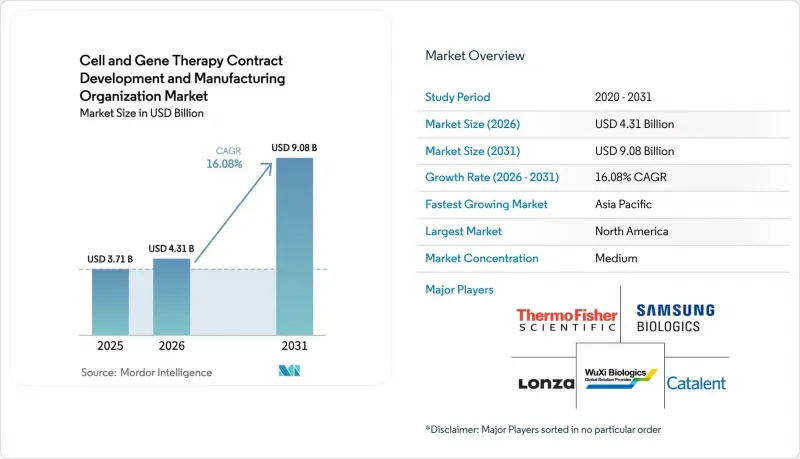
Mordor Intelligence에 따르면, 세포 및 유전자 치료 CDMO 시장 규모는 2025년에 37억 1,000만 달러에 달할 것으로 전망됩니다. 본 보고서는 제품별(세포 치료(줄기세포 기반 등), 유전자 치료(바이러스 벡터, 비바이러스 벡터)), 단계별(전임상 단계, 임상 단계, 상용화 단계), 서비스 유형별(공정 개발, GMP 제조, 기타), 지역별(북미, 유럽, 아시아태평양, 기타)로 분류되어 있습니다. 시장 전망은 금액(미 달러) 기준으로 제시되어 있습니다.
세계의 세포 및 유전자 치료 CDMO 시장 동향 및 인사이트
CGT 임상 파이프라인의 확대
현재 2,000건 이상의 프로그램이 개발 중이며, 이 수치는 2024년 이전에 확보된 생산 능력을 훨씬 상회합니다. 미국 식품의약국(FDA)은 심사 효율화를 도모하기 위해 ‘치료용 제품국(Office of Therapeutic Products)’을 설립했으며, 2025년까지 매년 두 자릿수의 승인 건수를 예측했습니다. 각 후보 제품에는 개별적으로 최적화된 바이러스 벡터 또는 세포 증식 워크플로가 필요하지만, 이러한 전문 지식을 사내에 보유하고 있는 스폰서는 거의 없습니다. Casgevy, Lyfgenia, prademagene zamikeracel 등의 시판 승인은 수요를 뒷받침할 뿐만 아니라, 여러 배치에 걸친 임상용 공급 수주를 촉진하고 있습니다. 임상시험의 80%가 북미와 유럽에서 수행되고 있어 현지 시설에 부담이 가중됨에 따라 프리미엄 가격 책정이 가능해졌습니다. 따라서 이러한 요인이 세포 및 유전자 치료 위탁 개발·제조 기관(CDMO) 시장의 지속적인 두 자릿수 성장을 뒷받침하고 있습니다.
유전성 질환 및 암 유병률 증가
약 4억 명의 환자가 유전성 질환을 앓고 있으며, 전 세계 암 발병률은 연간 2-3%의 속도로 증가하고 있습니다. 정밀 의학의 발전으로 벡터를 활용한 접근 방식을 통해, 지금까지 치료가 불가능했던 표적에 대한 치료가 가능해졌습니다. CAR-T 요법은 현재 40만-50만 달러의 정가가 책정되어 있으며, 지불 주체가 일회성 치료에 대해 보험 급여를 지급할 의사가 있음을 보여주고 있습니다. 고소득 지역의 인구 고령화에 따라 적격 환자 수는 증가하고 있으며, 당뇨병 및 심혈관 질환에 대한 유전자 치료의 잠정 승인은 이러한 치료법이 주류로 자리 잡고 있음을 시사합니다. 적응증의 범위가 확대됨에 따라, 더 대규모 배치공급 체계를 갖춘 CDMO가 가장 큰 혜택을 볼 것으로 예측됩니다.
대규모 AAV 생산에서 고성능 분석의 한계
현재 AAV 로트의 최종 출시에는 최대 4주가 소요되며, 그 주된 원인은 캡시드 비율 측정 및 유전체 무결성 검사에 있습니다. 분석에 소요되는 시간이 길다는 점은 생산 캠페인의 처리량을 제한하고 재고 비용을 상승시키고 있습니다. 장비 공급업체들은 자동화 모듈을 출시하고 있지만, 규제 당국의 검증 절차로 인해 도입이 지연되고 있습니다. 이러한 병목 현상은 여전히 규정 준수 요건이 가장 엄격한 미국 및 유럽의 제조 시설에서 두드러지게 나타납니다. 인라인 분석 및 머신러닝을 활용한 출시 체계에 투자하는 CDMO는 경쟁사와의 차별화를 꾀할 수 있을 것으로 보입니다.
부문 분석
바이러스 벡터, 특히 AAV는 그 안전성과 조직 친화성의 이점으로 인해 가격 결정력을 유지하고 있습니다. 2024년 Iovance의 AMTAGVI에 대해 유럽에서 제조된 배치가 처음으로 FDA 승인을 받은 것은 상업적 실현 가능성을 입증했을 뿐만 아니라, 국경을 넘는 공급 경로의 개발로 이어졌습니다. 비바이러스성 모달리티, 특히 지질 나노입자 및 미니서클 DNA는 바이러스 계열에 고유한 면역원성 및 스케일업 문제를 회피할 수 있어 자본을 유치하고 있습니다.
동종 세포 치료제의 배치 크기는 5배 증가할 것으로 예상되며, 이에 따라 2,000L 밀폐형 바이오리액터 및 자동 무균 용접 시스템에 대한 수요가 견인될 전망입니다. 한때 200L 배치로 제한되었던 유전자 치료제 제조는 빠르게 1,000L-2,000L 규모의 일회용 발효조로 전환되고 있으며, 이를 통해 1회 투여당 비용을 절감하고 있습니다. 시너지 효과도 존재합니다. 이중 기능을 갖춘 시설을 보유한 CDMO는 업스트림 공정을 상호 활용할 수 있어 자산 가동률을 높이는 동시에 특정 치료법에 대한 경기 변동의 영향을 완화할 수 있습니다.
지역별 분석
북미는 2025년에 전 세계 매출의 43.75%를 차지했는데, 이는 FDA의 ‘클리어 패스웨이(Clear Pathway)’, 스타트업이 밀집된 클러스터, 초기 임상시험에 대한 자금 지원에 적극적인 투자자층에 힘입은 결과입니다. 미국에서만 진행 중인 임상시험의 60% 이상을 차지하고 있어, 이에 따라 서모피셔(Thermo Fisher)와 같은 CDMO는 프린스턴 거점 확장에 4억 7,500만 달러를 투자하고, 삼성바이오로직스는 전략적 파트너십을 통해 생산 능력을 배정할 수밖에 없는 상황입니다. 그러나 해당 지역의 비용 구조와 인력 부족으로 인해 납기 기간이 길어지고 있습니다. 이에 대응해 각 CDMO 기업은 공정 개발 비용을 인상하는 한편, 커뮤니티 칼리지와의 인재 양성 파트너십을 제안하며 인력 확보의 안정화를 도모하고 있습니다.
아시아태평양은 2031년까지 연평균 성장률(CAGR) 16.12%로 가장 높은 성장이 예상되어, 기존 지배적 지위에 도전할 것으로 보입니다. 중국 국가발전개혁위원회는 여러 산업단지에 자금을 지원하고 있으며, 우시 바이오로직스는 싱가포르와 미국에서 생산 능력을 확충하는 동시에 우시 캠퍼스도 확장하고 있습니다. 일본의 의약품 및 의료기기종합기구(PMDA)는 미국의 ‘브레이크스루 테라피(Breakthrough Therapy)’ 지정에 유사한 ‘패스트 트랙(Fast Track)’ 제도를 신설하여 심사 기간의 중앙값을 4개월 단축했습니다. 한국의 롯데바이오로직스는 인천에 40만 리터 규모의 공장을 건설하기 위해 33억 달러를 투입하고 있으며, 이 지역을 수요 거점으로 삼겠다는 의향을 밝혔습니다. 저비용 노동력과 현대적인 인프라 덕분에 이 지역은 가격 책정에서 우위를 점하고 있으며, 유럽과 미국의 혁신 기업들을 합작 투자로 유치하고 있습니다.
유럽은 성숙한 시장을 유지하고 있지만, 성장 속도는 둔화되고 있습니다. 유럽의약품청(EMA)의 중앙 승인 제도는 예측 가능성을 제공하지만, 국가마다 다른 GMP 검사 및 높은 에너지 비용이 사업 전개에 대한 기동성을 제약하고 있습니다. 론자의 비스프 캠퍼스와 AGC 바이오로직스의 하이델베르크 시설은 가격보다 실적을 중시하는 프로젝트를 계속해서 유치하고 있습니다. 국경을 넘는 공급망이 유럽의 배치 릴리스와 중동의 임상시험 거점을 연결하고 있어, 이 지역이 규제상의 요충지 역할을 하고 있음을 보여줍니다. 한편, 아일랜드와 포르투갈에서는 보조금 및 숙련된 인력 확보를 배경으로 그린필드 투자가 국지적으로 나타나고 있습니다.
기타 혜택
- 엑셀 형식 시장 예측(ME) 시트
- 3개월간의 애널리스트 지원
자주 묻는 질문
목차
제1장 서론
제2장 조사 방법
제3장 주요 요약
제4장 시장 구도
제5장 시장 규모 및 성장 예측
제6장 경쟁 구도
제7장 시장 기회 및 향후 전망
KTHCell therapy commanded 69.98% of the cell and gene therapy contract development and manufacturing organization market in 2025, buoyed by six commercial CAR-T products and an expanding allogeneic pipeline. Stem-cell platforms account for the largest share in cell therapy, favoured for established expansion, cryopreservation, and QC workflows. Engineered cell approaches such as CAR-NK and Yδ T cells are gaining speed as improved gene-editing tools shorten development cycles. Despite its smaller base, gene therapy is projected to register a 16.85% CAGR through 2031, closing the gap swiftly.
According to Mordor Intelligence, the cell and gene therapy contract development and manufacturing organization market size is valued at USD 3.71 billion in 2025. This report is Segmented by Product (Cell Therapy {Stem-Cell-Based, and More} Gene Therapy {Viral Vectors, Non-Viral Vectors}), Stage (Pre-Clinical, Clinical, Commercial), Service Type (Process Development, GMP Manufacturing, and More), and Geography (North America, Europe, Asia Pacific, More). The Market Forecasts are Provided in Terms of Value (USD).
Global Cell And Gene Therapy Contract Development And Manufacturing Organization Market Trends and Insights
Rise in CGT Clinical Pipeline
Over 2,000 active programs are in development, a figure that dwarfs the capacity commissioned before 2024. The US FDA created the Office of Therapeutic Products to streamline reviews and anticipates double-digit approvals each year through 2025. Each candidate demands bespoke viral-vector or cell-expansion workflows, expertise that most sponsors lack internally. Commercial approvals such as Casgevy, Lyfgenia, and prademagene zamikeracel validate demand and trigger multi-batch clinical supply orders. North America and Europe host 80% of trials, straining local facilities and allowing premium pricing. The driver, therefore, underpins sustained double-digit growth for the cell and gene therapy contract development and manufacturing organization market.
Rising Prevalence of Genetic Diseases & Cancer
Roughly 400 million patients live with a genetic disorder, and global cancer incidence is increasing 2-3% a year.Precision-medicine advances have unlocked previously untreatable targets using vector-based approaches. CAR-T therapies now command list prices of USD 400,000-500,000 and demonstrate the willingness of payers to reimburse one-time interventions. Ageing demographics in high-income regions swell the eligible population, while contingency approvals for diabetes and cardiovascular gene therapies hint at mainstream uptake. CDMOs well-positioned to supply larger batch sizes will benefit most as the indication size widens.
Limited High-Throughput Analytics for Large-Scale AAV Production
Complete AAV lot release now demands up to four weeks, largely due to capsid-ratio assays and genome integrity tests. Slow analytical turnaround restricts campaign throughput and inflates inventory costs. Equipment vendors are launching automation modules, but regulatory validation prolongs adoption. The bottleneck is pronounced in US and European plants, where compliance expectations remain highest. CDMOs investing in inline analytics and machine-learning-driven release will achieve competitive differentiation.
Other drivers and restraints analyzed in the detailed report include:
- VC & Big-Pharma Funding Surge
- Outsourcing Preference of Small CGT Developers
- Complex, Manual-Intensive Manufacturing & Regulatory Hurdles
For complete list of drivers and restraints, kindly check the Table Of Contents.
Segment Analysis
Viral vectors-particularly AAV-retain pricing power given their safety and tissue-tropism advantages. The first FDA-cleared European-manufactured batch of Iovance's AMTAGVI in 2024 underscored commercial viability and opened cross-border supply lines. Non-viral modalities, notably lipid nanoparticles and minicircle DNA, are drawing capital because they can circumvent immunogenicity and scaling issues inherent to viral systems.
Batch sizes for allogeneic cell therapies are forecast to rise fivefold, driving demand for 2,000 L closed bioreactors and automated sterile welding systems. Gene therapy manufacturing, once restricted to 200 L batches, is rapidly migrating to 1,000 L-2,000 L single-use fermenters, compressing the cost per dose. Synergies exist: CDMOs with dual-capability suites can cross-utilize upstream operations, raising asset utilization rates and cushioning the impact of any one modality cycle.
Complete Report Scope:
- By Product
- Cell Therapy
- Stem-cell-based
- Non-stem-cell-based
- Other cell therapies
- Gene Therapy
- Viral Vectors
- Non-viral Vectors
- Cell Therapy
- By Stage
- Pre-clinical
- Clinical
- Commercial
- By Service Type
- Process Development
- GMP Manufacturing
- Analytical Testing / QC
- Fill-Finish & Packaging
- Geography
- North America
- United States
- Canada
- Mexico
- Europe
- Germany
- United Kingdom
- France
- Italy
- Spain
- Rest of Europe
- Asia Pacific
- China
- Japan
- India
- South Korea
- Australia
- Rest of Asia Pacific
- Middle East & Africa
- GCC
- South Africa
- Rest of Middle East & Africa
- South America
- Brazil
- Argentina
- Rest of South America
- North America
Geography Analysis
North America generated 43.75% of global revenue in 2025, supported by the FDA's clear pathways, a dense cluster of start-ups, and an investor base willing to underwrite early clinical studies. The United States alone hosted more than 60% of active trials, compelling CDMOs such as Thermo Fisher to commit USD 475 million for a Princeton expansion and Samsung Biologics to allocate capacity through strategic partnerships. However, the region's cost base and a tightening labour pool inflate delivery times. CDMOs respond by raising process-development fees and offering workforce-training partnerships with community colleges to stabilize recruitment.
Asia Pacific is projected to deliver the fastest 16.12% CAGR through 2031, challenging historic dominance. China's National Development and Reform Commission funded multiple industrial parks, with WuXi Biologics adding capacities in Singapore and the United States while simultaneously expanding its Wuxi campus. Japan's Pharmaceuticals and Medical Devices Agency created a Fast Track similar to the US Breakthrough Therapy tag, cutting median review times by four months. South Korea's Lotte Biologics has earmarked USD 3.3 billion for a 400,000 L plant in Incheon, signalling intent to anchor regional demand. Cost-competitive labour and modern infrastructure give the region pricing leverage that lures Western innovators into joint ventures.
Europe maintains a mature but slower-growth profile. EMA's centralised authorisation system offers predictability, yet divergent national GMP inspections and higher energy costs temper agility. Lonza's Visp campus and AGC Biologics' Heidelberg facility continue to draw projects that value track record over price. Cross-border supply chains connect European batch release to Middle Eastern clinical sites, illustrating the region's role as a regulatory fulcrum. Meanwhile, pockets of greenfield investment appear in Ireland and Portugal, driven by grants and skilled talent availability.
- Lonza Group
- Catalent
- Thermo Fisher Scientific (Patheon)
- WuXi Advanced Therapies
- Samsung Group
- AGC Biologics
- Charles River Labs (Cognate)
- Recipharm
- FUJIFILM
- Minaris Regenerative Medicine
- PCI Pharma Services
- Almac Group
- Pfizer CentreOne
- KBI Biopharma
- BioCentriq
- ElevateBio
- Yposkesi
- Genezen
- 3P Biopharmaceuticals
- Oxford Biomedica
Additional Benefits:
- The market estimate (ME) sheet in Excel format
- 3 months of analyst support
TABLE OF CONTENTS
1 Introduction
- 1.1 Study Assumptions & Market Definition
- 1.2 Scope of the Study
2 Research Methodology
3 Executive Summary
4 Market Landscape
- 4.1 Market Overview
- 4.2 Market Drivers
- 4.2.1 Rise In CGT Clinical Pipeline
- 4.2.2 Rising Prevalence Of Genetic Diseases & Cancer
- 4.2.3 VC & Big-Pharma Funding Surge
- 4.2.4 Outsourcing Preference Of Small CGT Developers
- 4.2.5 Allogeneic 'Off-The-Shelf' Platforms Needing Large-Batch CDMO Capacity
- 4.2.6 Global CMC Dossier Harmonisation (FDA-EMA-PMDA) Shortening Multi-Region Launches
- 4.3 Market Restraints
- 4.3.1 Limited High-Throughput Analytics For Large-Scale AAV Production
- 4.3.2 Complex, Manual-Intensive Manufacturing & Regulatory Hurdles
- 4.3.3 Shortage Of GMP-Grade Plasmid & Viral Raw Materials
- 4.3.4 Post-COVID CDMO Over-Capacity Driving Margin Squeeze
- 4.4 Supply Chain Analysis
- 4.5 Regulatory Landscape
- 4.6 Technological Outlook
- 4.7 Porter's Five Forces Analysis
- 4.7.1 Bargaining Power of Suppliers
- 4.7.2 Bargaining Power of Buyers
- 4.7.3 Threat of New Entrants
- 4.7.4 Threat of Substitutes
- 4.7.5 Industry Rivalry
5 Market Size & Growth Forecasts (Value)
- 5.1 By Product
- 5.1.1 Cell Therapy
- 5.1.1.1 Stem-cell-based
- 5.1.1.2 Non-stem-cell-based
- 5.1.1.3 Other cell therapies
- 5.1.2 Gene Therapy
- 5.1.2.1 Viral Vectors
- 5.1.2.2 Non-viral Vectors
- 5.1.1 Cell Therapy
- 5.2 By Stage
- 5.2.1 Pre-clinical
- 5.2.2 Clinical
- 5.2.3 Commercial
- 5.3 By Service Type
- 5.3.1 Process Development
- 5.3.2 GMP Manufacturing
- 5.3.3 Analytical Testing / QC
- 5.3.4 Fill-Finish & Packaging
- 5.4 Geography
- 5.4.1 North America
- 5.4.1.1 United States
- 5.4.1.2 Canada
- 5.4.1.3 Mexico
- 5.4.2 Europe
- 5.4.2.1 Germany
- 5.4.2.2 United Kingdom
- 5.4.2.3 France
- 5.4.2.4 Italy
- 5.4.2.5 Spain
- 5.4.2.6 Rest of Europe
- 5.4.3 Asia Pacific
- 5.4.3.1 China
- 5.4.3.2 Japan
- 5.4.3.3 India
- 5.4.3.4 South Korea
- 5.4.3.5 Australia
- 5.4.3.6 Rest of Asia Pacific
- 5.4.4 Middle East & Africa
- 5.4.4.1 GCC
- 5.4.4.2 South Africa
- 5.4.4.3 Rest of Middle East & Africa
- 5.4.5 South America
- 5.4.5.1 Brazil
- 5.4.5.2 Argentina
- 5.4.5.3 Rest of South America
- 5.4.1 North America
6 Competitive Landscape
- 6.1 Market Concentration
- 6.2 Market Share Analysis
- 6.3 Company Profiles (includes Global level Overview, Market level overview, Core Segments, Financials, Strategic Information, Market Rank/Share, Products & Services, Recent Developments)
- 6.3.1 Lonza Group
- 6.3.2 Catalent Inc
- 6.3.3 Thermo Fisher Scientific (Patheon)
- 6.3.4 WuXi Advanced Therapies
- 6.3.5 Samsung Biologics
- 6.3.6 AGC Biologics
- 6.3.7 Charles River Labs (Cognate)
- 6.3.8 Recipharm AB
- 6.3.9 FUJIFILM Diosynth Biotechnologies
- 6.3.10 Minaris Regenerative Medicine
- 6.3.11 PCI Pharma Services
- 6.3.12 Almac Group
- 6.3.13 Pfizer CentreOne
- 6.3.14 KBI Biopharma
- 6.3.15 BioCentriq
- 6.3.16 ElevateBio
- 6.3.17 Yposkesi
- 6.3.18 Genezen
- 6.3.19 3P Biopharmaceuticals
- 6.3.20 Oxford Biomedica
7 Market Opportunities & Future Outlook
- 7.1 White-space & Unmet-need Assessment