|
시장보고서
상품코드
2119850
유럽의 금속 정밀 선삭 제품 제조 : 시장 점유율 분석, 업계 동향 및 통계, 성장 예측(2026-2031년)Europe Metal Precision Turned Product Manufacturing - Market Share Analysis, Industry Trends & Statistics, Growth Forecasts (2026 - 2031) |
||||||
 Mordor Intelligence
Mordor Intelligence에 의하면, 유럽의 금속 정밀 선삭 제품 제조 시장 규모는 2025년에 189억 7,000만 달러로 평가되었습니다. 2026년 199억 4,000만 달러에서 2031년까지 255억 2,000만 달러에 이를 것으로 예측되며, 2026-2031년에 걸쳐 CAGR은 5.11%를 나타낼 전망입니다.
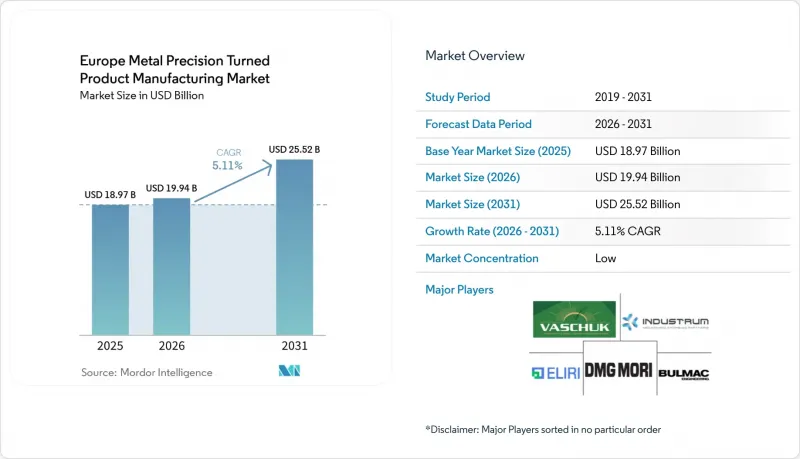
본 보고서는 가공 방식(수동 가공, CNC 가공), 기계 유형(자동 나사 가공기, 로터리식 트랜스퍼기, CNC 선반, 기타), 제품 유형, 소재, 최종 사용자, 기술, 생산 규모, 지역(독일, 프랑스, 기타)별로 분류되어 있습니다. 시장 전망은 금액(달러) 기준으로 제시되어 있습니다.
유럽의 금속 정밀 선삭 제품 제조 시장 동향 및 인사이트
자동차의 전동화와 경량 부품 수요
배터리식 전기차(BEV)의 생산은 유럽의 금속 정밀 선삭 제품 제조 시장에서 부품 요구 사항을 변화시키고 있습니다. 일부 용도의 경우, 기존 철계 파워트레인 부품의 생산량은 감소 추세를 보이고 있지만, 모터 샤프트, 배터리 모듈의 엔드캡, e-액슬 하우징, 전력 전자용 기판 등이 새로운 요구 사항을 창출하고 있습니다. VDA 보고서에 따르면, 2025년 독일에서 생산된 자동차의 40%가 전기차였습니다. 구리 합금 버스는 엄격한 표면 품질이 요구되는 반면, 알루미늄 모터 하우징은 열 사이클을 거친 후에도 정확한 압입 공차를 유지해야 합니다. 기존에는 수동 변속기 부품에 주력해 온 공급업체들은 이 수주 경쟁에서 승리하기 위해 더욱 강력한 가공 및 측정 능력을 필요로 하고 있습니다. 이러한 변화로 인해 공급업체 간에 획일적인 대체 패턴이 발생하는 것은 아닙니다. 생산량이 증가하기 전에, 새로운 차량 설계를 안정적이고 재현성 있는 가공 공정에 반영할 수 있는 기업이 경쟁 우위를 차지하게 될 것입니다.
의료·치과 임플란트 제조의 확대
임플란트는 일관된 형태와 추적 가능성이 보장된 제조가 요구되므로, 의료·치과 부문 수요가 유럽의 금속 정밀 선삭 제품 제조 시장을 지탱하고 있습니다. 생산은 스위스의 쥐라 아크나 독일 남부 등, 정밀 선삭 산업이 확립된 지역에 집중되어 있습니다. 유로스타트(Eurostat) 보고서에 따르면, 2025년에는 65세 이상 인구가 유럽 총인구의 22% 이상을 차지했습니다. 이러한 인구 동향은 정형외과적 재수술, 치과 보철물 및 관련 임플란트 수술에 대한 수요를 뒷받침하고 있습니다. ISO 13485 품질 요건은 소규모 공급업체에게는 진입 장벽이 되며, 검증된 공정을 갖춘 확고한 전문 업체에게 유리하게 작용합니다. 수탁 제조업체의 경우, 임플란트 프로그램의 전체 수명 주기에 걸쳐 검증된 공정을 유지하는 데 상업적 가치가 있습니다. 따라서 신뢰할 수 있는 검사, 배치 기록, 자재 관리는 절삭 능력과 마찬가지로 중요합니다.
숙련된 CNC 프로그래밍 및 계측 인력 부족
경험이 풍부한 CNC 프로그래머와 계측 전문가의 부족은 유럽의 금속 정밀 선삭 제품 제조 시장 전체의 생산 능력을 제한하고 있습니다. 각 공장에서는 다축 기계 프로그래밍, 치수 측정 결과 해석, 부품의 품질을 저해하지 않으면서 공정 변경을 관리할 수 있는 직원을 필요로 합니다. 이러한 요건은 기존 선반 조작이나 단일 생산 업무 처리보다 더 높은 수준의 기술을 요구합니다. 또한, 정밀 공학 클러스터 내 고령 근로자의 존재는 후계자 확보의 필요성을 야기하고 있으나, 견습 제도만으로는 그 수요에 신속하게 대응하기 어려울 수 있습니다. 자동화를 통해 수작업은 줄일 수 있지만, 그 반면 메카트로닉스나 공정 제어 기술에 대한 수요는 높아집니다. 고도의 작업은 프로그래밍 시의 판단력이나 측정 결과에 대한 신중한 해석에 의존하기 때문에 이러한 제약은 품질과 생산량 모두에 영향을 미칩니다. 따라서 규제 대상 산업이나 항공우주 산업의 고객에게 서비스를 제공하는 사업에서는 인재 확보에 대한 압박이 가장 심각합니다.
부문 분석
2025년 기준, CNC 가공은 유럽의 금속 정밀 선삭 제품 제조 시장 점유율의 82.37%를 차지했으며, 2031년까지 연평균 성장률(CAGR) 6.28%를 나타낼 것으로 예측됩니다. 이러한 점유율은 재현 가능한 공차가 요구되는 자동차, 의료, 항공우주, 산업 부문의 수주에서 CNC 가공이 중심적인 역할을 하고 있음을 반영합니다. 수동 가공은 수리, 레거시 업무, 생산량이 제한된 맞춤형 제품 분야에서 여전히 중요한 역할을 하고 있습니다. 프로그래밍이 가능한 설비를 중심으로 새로운 생산 능력이 구축됨에 따라, 수동 가공의 역할은 제한적일 것으로 보입니다. 디지털 프로그램을 통해 재주문의 셋업 시간이 단축되고, 최초 제품 검사의 일관성이 향상됩니다. 이로 인해 정기적인 고객 프로그램을 처리하는 소규모 공급업체라도 CNC 생산이 더욱 실용적이 됩니다. 고객 입장에서도 주문이 재주문될 때 프로그램을 저장·확인·재활용할 수 있다는 이점이 있습니다. 특히 공차가 중요한 경우, 수동 조정만으로는 이러한 연속성을 확보하기 어렵습니다.
또한, CNC 시스템은 생산 기록의 추적성을 지원하며, 이는 규제 대상 용도나 고부가가치 용도에서 점점 더 중요해지고 있습니다. 유럽의 금속 정밀 선삭 제품 제조 업계에서는 각 공장이 공구 데이터, 검사 결과, 생산 이력을 특정 주문과 연계할 수 있어 혜택을 보고 있습니다. 수습공은 주로 최신 CNC 시스템으로 훈련을 받는 경우가 많기 때문에 다양한 장비가 혼재된 공장에서는 인력 배치가 어려워질 수 있습니다. 폴란드, 체코, 루마니아의 신설 공장에서는 생산 능력을 확대함에 따라 첨단 장비가 도입되고 있습니다.
2025년, 유럽의 금속 정밀 선삭 제품 제조 시장에서 CNC 선반과 선반 센터가 48.26%의 점유율을 차지했습니다. 수평형 및 수직형 선반 센터는 자동차용 샤프트, 하우징, 일반 산업용 부품의 대부분을 계속해서 담당하고 있습니다. 스위스형 선반은 절삭 공구 근처에서 세밀한 지원이 중요한 소형 및 복잡한 부품을 처리합니다. CNC 다축 선반은 2031년까지 연평균 성장률(CAGR) 8.47%를 나타낼 것으로 예측됩니다. 항공우주 부문의 하청업체들은 엄격하게 관리된 순서에 따라 여러 가공 공정을 완료해야 하는 부품 제조에 이를 활용하고 있습니다. 자동 나사 가공기나 로터리식 트랜스퍼 머신은 대량 생산되는 표준 부품에 여전히 유용합니다. 따라서 공작기계 선정은 공장 내 기존 설비의 유무보다는 부품의 특성에 점점 더 좌우되고 있습니다. 이로 인해 견적 단계의 초기부터 공정의 능력을 제품의 복잡성에 맞출 수 있는 공급업체가 유리해집니다.
고객으로부터 공정 간 이관 횟수를 줄인 복잡한 부품에 대한 요구가 높아짐에 따라, 기계의 구성도 변화하고 있습니다. 다축 가공기는 선삭, 밀링, 드릴링, 마무리 가공을 단일 제어 사이클 내에서 결합할 수 있습니다. 이를 통해 재가공이 줄어들고, 상호 관련된 형상의 일관성이 향상됩니다. 다축 설비에 대한 투자는 생산이 부진한 시기에도 지속할 수 있습니다. 이는 향후 까다로운 수주 요구에 대비하기 위함입니다. 셰플러 에어로스페이스(Schaeffler Aerospace)에서는 WFL MILLTURN 머시닝 센터를 사용하여 인코넬 718, M50NiL, 크로니듀어 30으로 제작된 부품을 가공하고 있으며, 여기에는 미세한 선삭 및 밀링 공차가 요구되는 작업도 포함됩니다. 표준 선반은 여전히 많은 용도에서 필수적이지만, 항공우주 및 의료 분야의 모든 사양을 충족시킬 수는 없습니다.
2025년, 유럽의 금속 정밀 선삭 제품 제조 시장에서 부싱과 슬리브는 24.18%의 점유율을 차지했습니다. 이러한 위상은 유압 장비, 자동차, 산업기계 분야의 지속적인 수요를 반영하고 있습니다. 나사와 볼트는 여전히 중요한 대량 생산 제품이지만, 일반적인 강종에서는 가격 경쟁이 치열해지고 있습니다. 샤프트, 핀, 축방향 부품은 장기간에 걸친 제조 공정에서 치수 일관성을 유지해야 하는 상황에서 사용됩니다. 나사산 인서트는 정밀하게 성형된 금속 접합면이 필요한 항공우주용 복합재료 구조물을 지지합니다. 유압·공압 부품, 선반·밀링 가공 부품 및 기타 제품은 에너지, 철도, 기계 산업의 고객에게 공급됩니다. 이러한 제품군의 차이는 구매 과정에서 명확하게 드러납니다. 표준 제품의 경우 신뢰성 높은 생산과 비용 관리가 중시되는 반면, 의료 제품의 경우 검증된 성능과 장기적인 품질 보증이 중시됩니다.
의료 및 치과용 부품 시장은 2031년까지 연평균 성장률(CAGR) 8.84%로 확대될 것으로 예측됩니다. 치근 임플란트, 잇몸 성형기, 치과용 어버트먼트, 정형외과용 나사에는 엄격한 동심도 요건이 요구되는 티타늄 부품이 사용됩니다. 이러한 사양에서는 단가 자체보다 검증된 제조 공정이 더 중시됩니다. EU 의료기기 규정에서는 이식형 의료기기 제조업체에게 문서화된 검증 및 타당성 확인 의무를 이행할 것을 요구하고 있습니다. 이러한 요건으로 인해 인증 기간이 장기화되어, 확립된 품질 시스템을 갖춘 기업에 생산이 집중될 가능성이 있습니다. 이러한 제품 구성은 전문 공급업체에게 고부가가치의 지속적인 업무를 확보할 수 있는 길을 열어줍니다. 이러한 추세는 전체 생산 프로그램에 걸쳐 치밀한 공정 계획, 문서화된 품질 점검, 공급업체와의 소통의 중요성을 더욱 강조하고 있습니다.
기타 혜택
- 엑셀 형식 시장 예측(ME) 시트
- 3개월간의 애널리스트 지원
자주 묻는 질문
목차
제1장 서론
제2장 조사 방법
제3장 주요 요약
제4장 시장 구도
제5장 시장 규모 및 성장 예측
제6장 경쟁 구도
제7장 시장 기회 및 향후 전망
KTH 26.09.10According to Mordor Intelligence, the Europe metal precision turned product manufacturing market size was valued at USD 18.97 billion in 2025, and is projected to grow from USD 19.94 billion in 2026 to reach USD 25.52 billion by 2031, at a 5.11% CAGR over 2026-2031.
This report is Segmented by Operation (Manual, CNC), Machine Type (Automatic Screw, Rotary Transfer, CNC Lathes, Other), Product Type, Material, End User, Technology, Production Scale, and Geography (Germany, France, and More). The Market Forecasts are Provided in Terms of Value (USD).
Europe Metal Precision Turned Product Manufacturing Market Trends and Insights
Automotive Electrification and Lightweight Component Demand
Battery-electric vehicle production is changing the requirements for parts in the European metal precision-turned parts market. Traditional ferrous powertrain volumes are declining in some applications, but motor shafts, battery-module end caps, e-axle housings, and power-electronics substrates create new requirements. The VDA reported that 40% of cars manufactured in Germany in 2025 were electric . Copper-alloy bus bars require controlled surface quality, while aluminum motor housings must maintain accurate interference fits through thermal cycling. Suppliers that formerly focused on manual-transmission parts need stronger machining and measurement capability to compete for this work. The change does not produce a uniform replacement pattern across suppliers. It rewards companies that can translate new vehicle designs into stable, repeatable machining routes before production volumes rise.
Expansion of Medical, Dental, and Implant Manufacturing
Medical and dental demand supports the European metal precision-turned parts market, as implants require consistent geometry and traceable manufacturing. Production is concentrated in established precision turning areas, including Switzerland's Jura Arc and southern Germany. Eurostat reported that people aged 65 or older accounted for more than 22% of Europe's population in 2025 . This demographic profile supports demand for orthopedic revisions, dental replacements, and related implant procedures. ISO 13485 quality requirements raise the barrier for smaller suppliers and favor established specialists with validated processes. For contract manufacturers, the commercial value lies in maintaining a validated process over the full life of an implant program. This makes reliable inspection, batch records, and material control as important as cutting capacity.
Scarcity of Skilled CNC Programming and Metrology Talent
The shortage of experienced CNC programmers and metrology specialists limits capacity across the European metal precision turned product manufacturing market. Shops need employees who can program multi-axis machines, interpret dimensional results, and manage process changes without compromising the quality of parts. This requirement is more demanding than operating a conventional lathe or handling a single production task. Older workers in precision engineering clusters also create replacement needs that apprenticeship programs may not meet quickly enough. Automation can reduce manual handling, but it increases the demand for mechatronics and process control skills. The constraint affects both quality and output because advanced work depends on programming judgment and careful interpretation of measurement results. Staffing pressures are therefore most severe in operations serving regulated or aerospace customers.
Other drivers and restraints analyzed in the detailed report include:
- Rising Adoption of Multi-Axis and Swiss-Type CNC Turning
- Nearshoring of Critical Components Within European Supply Chains
- High Energy, Compliance, and Equipment-Conversion Costs
For complete list of drivers and restraints, kindly check the Table Of Contents.
Segment Analysis
CNC operations accounted for 82.37% of the European metal precision-turned product manufacturing market share in 2025 and are forecast to grow at a 6.28% CAGR through 2031. The share reflects its central role in automotive, medical, aerospace, and industrial orders that require repeatable tolerances. Manual operation remains relevant for repair, legacy work, and bespoke jobs with limited volumes. Its role is likely to remain narrow as new capacity is built around programmable equipment. Digital programs reduce setup time for repeat orders and enable more consistent first-article inspection. This makes CNC production more practical, even for smaller suppliers serving recurring customer programs. Customers also benefit from programs that can be stored, reviewed, and reused when an order is returned. That continuity is difficult to achieve through manual adjustments alone, especially where tolerances are critical.
CNC systems also support traceable production records, which are increasingly important for regulated and high-value applications. The European metal precision-turned parts industry benefits when shops can link tool data, inspection results, and production history to a specific order. Mixed fleets can be harder to staff because apprentices often train primarily on modern CNC systems. New facilities in Poland, Czechia, and Romania are adopting advanced equipment as they expand capacity.
CNC lathes and turning centers accounted for 48.26% of the European metal precision turned product manufacturing market share in 2025. Horizontal and vertical centers continue to handle a large share of automotive shafts, housings, and general industrial work. Swiss-type machines serve small, complex components for which close support near the cutting tool is important. CNC multi-axis turning machines are forecast to grow at an 8.47% CAGR through 2031. Aerospace subcontractors use them for parts that require several features to be completed within a tightly controlled sequence. Automatic screw machines and rotary transfer machines remain useful for high-volume standard components. Machine selection is therefore increasingly tied to the part's features rather than to the legacy equipment available in a shop. This favors suppliers that can match process capability to product complexity early in the quotation stage.
The machine mix is changing because customers increasingly request complex parts with fewer handoffs between operations. A multi-axis machine can combine turning, milling, drilling, and finishing operations in a single controlled cycle. This reduces refactoring and improves the consistency of features that relate to one another. Investment in multi-axis equipment can continue during periods of weaker production because it prepares suppliers for more demanding future orders. Schaeffler Aerospace uses WFL MILLTURN machining centers to machine components from Inconel 718, M50NiL, and Cronidur 30, including work requiring fine-turning and milling tolerances. Standard lathes remain essential for many applications, but they cannot meet every specification in aerospace and medical work.
Bushings and sleeves accounted for 24.18% of the European metal precision-turned product manufacturing market share in 2025. Their position reflects recurring demand from hydraulic equipment, vehicles, and industrial machinery. Screws and bolts remain important high-volume products, although price competition is strong in common steel grades. Shafts, pins, and axial components are used where dimensional consistency must be maintained over extended production runs. Threaded inserts support composite aerospace structures that need accurately formed metallic interfaces. Hydraulic and pneumatic components, turned-milled parts, and other products serve energy, rail, and machinery customers. The contrast between these groups is clear in the purchasing process. Standard products emphasize reliable output and cost control, while medical products emphasize validated capability and long-term quality assurance.
Medical and dental components are forecast to grow at an 8.84% CAGR through 2031. Root implants, gingiva formers, dental abutments, and orthopedic screws use titanium components with strict concentricity requirements. Their specifications place greater emphasis on validated processes than on unit price alone. The EU Medical Devices Regulation requires manufacturers of implantable devices to meet documented verification and validation obligations. These requirements make qualification periods lengthy and can concentrate production among companies with established quality systems. This product mix gives specialist suppliers a route to higher-value, recurring work. This pattern reinforces the importance of careful process planning, documented quality checks, and supplier communication throughout a production program.
Complete Report Scope:
- By Operation
- Manual Operation
- CNC Operation
- By Machine Type
- Automatic Screw Machines
- Rotary Transfer Machines
- CNC Lathes and Turning Centers
- Horizontal Turning Centers
- Vertical Turning Centers
- CNC Swiss-Type or Sliding-Headstock Lathes
- CNC Multi-Axis Turning Machines
- CNC Multi-Spindle Turning Machines
- Other Machine Types
- By Product Type
- Screws and Bolts
- Bushings and Sleeves
- Shafts, Pins, and Axial Components
- Threaded Inserts and Fastening Components
- Hydraulic and Pneumatic Components
- Turned-Milled Complex Components
- Medical and Dental Components
- Other Metal Precision Turned Products
- By Material
- Steel and Stainless Steel
- Aluminum and Aluminum Alloys
- Brass and Copper Alloys
- Titanium and Titanium Alloys
- Nickel-Based and High-Temperature Alloys
- Engineering Plastics and Other Materials
- By End User
- Automotive
- Industrial Machinery and Automation
- Electronics and Electrical Engineering
- Medical and Dental
- Aerospace and Defense
- Hydraulics and Pneumatics
- Energy and Power Equipment
- Rail, Maritime, and Transportation Equipment
- Appliances and Consumer Products
- Other End Users
- By Technology
- CNC Turning
- Swiss Machining
- Multi-Axis Turn-Mill Machining
- Multi-Spindle Machining
- Manual Turning
- Hybrid Additive-Subtractive Machining
- By Production Scale
- Prototype and One-Off Production
- Small-Batch Production
- Medium-Series Production
- High-Volume Production
- By Country
- Germany
- France
- United Kingdom
- Italy
- Spain
- Switzerland
- Netherlands
- Belgium
- Austria
- Poland
- Czechia
- Romania
- Hungary
- Russia
- Rest of Europe
List of Companies Covered in this Report:
- DMG MORI CO., LTD.
- Xometry Europe GmbH
- Protolabs, Inc.
- Grieshaber GmbH & Co. KG
- PREFAG Carl Rivoir GmbH & Co. KG
- Zannini S.p.A.
- Schuler Prazisionstechnik AG
- Decovi SA
- Neida Bartschi AG
- Benoit Jolivet SAS
- SABNER Sp. z o.o.
- Hardy's Precision Engineering Ltd
- Bulmac Engineering Ltd
- INDUSTRUM GROUPE
- VASCHUK LTD.
- ELIRI SA
- DANI 151 LTD
- UAB Kiruna
- Sargasas UAB
- GMO Precision Turned Parts GmbH
- J. E. Gerhardt GmbH
Additional Benefits:
- The market estimate (ME) sheet in Excel format
- 3 months of analyst support
TABLE OF CONTENTS
1 Introduction
- 1.1 Study Assumptions and Market Definition
- 1.2 Scope of the Study
2 Research Methodology
3 Executive Summary
4 Market Landscape
- 4.1 Market Overview
- 4.2 Market Drivers
- 4.2.1 Automotive Electrification and Lightweight Component Demand
- 4.2.2 Expansion of Medical, Dental, and Implant Manufacturing
- 4.2.3 Rising Adoption of Multi-Axis and Swiss-Type CNC Turning
- 4.2.4 Aerospace Production and Tight-Tolerance Component Requirements
- 4.2.5 Digital Product Passports and Traceable Material Provenance
- 4.2.6 Nearshoring of Critical Components Within European Supply Chains
- 4.3 Market Restraints
- 4.3.1 Scarcity of Skilled CNC Programming and Metrology Talent
- 4.3.2 High Energy, Compliance, and Equipment-Conversion Costs
- 4.3.3 Volatility in Aluminum, Steel, Brass, and Titanium Input Costs
- 4.3.4 Long Validation Cycles for Regulated Medical Components
- 4.4 Value and Supply-Chain Analysis
- 4.5 Regulatory Landscape
- 4.6 Technological Outlook
- 4.7 Porter's Five Forces Analysis
- 4.7.1 Bargaining Power of Suppliers
- 4.7.2 Bargaining Power of Buyers
- 4.7.3 Threat of New Entrants
- 4.7.4 Threat of Substitutes
- 4.7.5 Intensity of Competitive Rivalry
5 Market Size and Growth Forecasts (Value (USD))
- 5.1 By Operation
- 5.1.1 Manual Operation
- 5.1.2 CNC Operation
- 5.2 By Machine Type
- 5.2.1 Automatic Screw Machines
- 5.2.2 Rotary Transfer Machines
- 5.2.3 CNC Lathes and Turning Centers
- 5.2.3.1 Horizontal Turning Centers
- 5.2.3.2 Vertical Turning Centers
- 5.2.3.3 CNC Swiss-Type or Sliding-Headstock Lathes
- 5.2.3.4 CNC Multi-Axis Turning Machines
- 5.2.3.5 CNC Multi-Spindle Turning Machines
- 5.2.4 Other Machine Types
- 5.3 By Product Type
- 5.3.1 Screws and Bolts
- 5.3.2 Bushings and Sleeves
- 5.3.3 Shafts, Pins, and Axial Components
- 5.3.4 Threaded Inserts and Fastening Components
- 5.3.5 Hydraulic and Pneumatic Components
- 5.3.6 Turned-Milled Complex Components
- 5.3.7 Medical and Dental Components
- 5.3.8 Other Metal Precision Turned Products
- 5.4 By Material
- 5.4.1 Steel and Stainless Steel
- 5.4.2 Aluminum and Aluminum Alloys
- 5.4.3 Brass and Copper Alloys
- 5.4.4 Titanium and Titanium Alloys
- 5.4.5 Nickel-Based and High-Temperature Alloys
- 5.4.6 Engineering Plastics and Other Materials
- 5.5 By End User
- 5.5.1 Automotive
- 5.5.2 Industrial Machinery and Automation
- 5.5.3 Electronics and Electrical Engineering
- 5.5.4 Medical and Dental
- 5.5.5 Aerospace and Defense
- 5.5.6 Hydraulics and Pneumatics
- 5.5.7 Energy and Power Equipment
- 5.5.8 Rail, Maritime, and Transportation Equipment
- 5.5.9 Appliances and Consumer Products
- 5.5.10 Other End Users
- 5.6 By Technology
- 5.6.1 CNC Turning
- 5.6.2 Swiss Machining
- 5.6.3 Multi-Axis Turn-Mill Machining
- 5.6.4 Multi-Spindle Machining
- 5.6.5 Manual Turning
- 5.6.6 Hybrid Additive-Subtractive Machining
- 5.7 By Production Scale
- 5.7.1 Prototype and One-Off Production
- 5.7.2 Small-Batch Production
- 5.7.3 Medium-Series Production
- 5.7.4 High-Volume Production
- 5.8 By Country
- 5.8.1 Germany
- 5.8.2 France
- 5.8.3 United Kingdom
- 5.8.4 Italy
- 5.8.5 Spain
- 5.8.6 Switzerland
- 5.8.7 Netherlands
- 5.8.8 Belgium
- 5.8.9 Austria
- 5.8.10 Poland
- 5.8.11 Czechia
- 5.8.12 Romania
- 5.8.13 Hungary
- 5.8.14 Russia
- 5.8.15 Rest of Europe
6 Competitive Landscape
- 6.1 Market Concentration Analysis
- 6.2 Strategic Moves
- 6.3 Market Share Analysis
- 6.4 Company Profiles (Includes Global Level Overview, Market Level Overview, Core Segments, Financials as available, Strategic Information, Market Rank/Share, Products and Services, Recent Developments)
- 6.4.1 DMG MORI CO., LTD.
- 6.4.2 Xometry Europe GmbH
- 6.4.3 Protolabs, Inc.
- 6.4.4 Grieshaber GmbH & Co. KG
- 6.4.5 PREFAG Carl Rivoir GmbH & Co. KG
- 6.4.6 Zannini S.p.A.
- 6.4.7 Schuler Prazisionstechnik AG
- 6.4.8 Decovi SA
- 6.4.9 Neida Bartschi AG
- 6.4.10 Benoit Jolivet SAS
- 6.4.11 SABNER Sp. z o.o.
- 6.4.12 Hardy's Precision Engineering Ltd
- 6.4.13 Bulmac Engineering Ltd
- 6.4.14 INDUSTRUM GROUPE
- 6.4.15 VASCHUK LTD.
- 6.4.16 ELIRI SA
- 6.4.17 DANI 151 LTD
- 6.4.18 UAB Kiruna
- 6.4.19 Sargasas UAB
- 6.4.20 GMO Precision Turned Parts GmbH
- 6.4.21 J. E. Gerhardt GmbH
7 Market Opportunities and Future Outlook
- 7.1 White-Space and Unmet-Need Assessment